




Abstract
Objectives:
To consider, at a conceptual level, the factors that inform perceptions of peer deviance and subsequently, at an empirical level, the extent to which survey information from high school students confirms whether these elements shape perceptions of friends’ drinking. This study also offers an alternative way to document projection bias.
Methods:
249 public high school students completed a survey about what factors inform their perceptions of friends’ drinking behavior. Subjects also responded to several vignettes in order to assess their general tendency to engage in projection.
Results:
Subjects rely on both observed behavior and various forms of communication when forming perceptions of friends’ drinking, though there is notable variation across these elements. When using hypothetical vignettes, results suggest projection bias is significantly diminished as subjects are provided with more information about a hypothetical peer.
Conclusions:
Adolescents appear to rely on a wide range of information when forming perceptions about friends’ drinking behavior. Although we did document a tendency to engage in projection when subjects had minimal information about a peer, the fragility of this tendency questions whether perceptual measures are inherently contaminated.
Introduction
Criminology has not fully embraced a measurement subdiscipline akin to psychometrics, but it nonetheless has engaged in critical discussion and evaluation regarding the validity of several measures essential to criminological inquiry (e.g., Harrison et al. 2007; Sampson and Raudenbusch 1999; Short and Nye 1957; Thornberry and Krohn 2000; see also Sullivan and McGloin 2014). Recently, scholars have turned attention to one of the most robust correlates of delinquency: peer deviance (Warr 2002). Numerous studies have established that there is an empirical discrepancy between respondent perceptions of peer deviance and peer self-reports of such behavior and that this discrepancy oftentimes is related to the subjects’ own delinquency (Boman, Stogner, et al. 2012; Boman, Ward, et al. 2012; Young et al. 2014). Some scholars view this as evidence of projection bias (e.g., Boman, Stogner, et al. 2012; Boman, Ward, et al. 2012), whereas others suggest that projection may exist, but it is not the only factor informing perceptions of friends’ delinquency (e.g., Rebellon and Modecki 2014). What actually shapes beliefs regarding peer deviance remains somewhat of a mystery, however, and scholars are becoming increasingly more vocal about the need to understand the stimuli that inform them (Boman et al. 2016; Rebellon and Modecki 2014; Young et al. 2014).
Given that using peer deviance measures derived from peer self-reports avoids potential projection biases, some researchers may question why there is a need to understand what informs perceptions. In spite of the supposed advantages of using peer self-reports, there are compelling theoretical and empirical reasons to turn attention to perceptual measures. First, theorists in the normative influence tradition have argued that perceptions are key constructs that underlie the etiology of delinquency, such that inaccurate beliefs can still produce very real behavioral consequences (W. I. Thomas and Thomas 1928). In other words, an individual’s perception about their friends’ behavior is not a proxy for peer behavior but rather functions as an intended measure (e.g., Akers 1998). Second, decades’ worth of research has highlighted perceived peer deviance as one of the most robust correlates of delinquency (Warr 2002), displaying comparable effect sizes to other important correlates such as self-control (Pratt et al. 2010) and retaining an effect even when accounting for peer self-reports of deviance (e.g., Prinstein and Wang 2005; Young and Weerman 2013). Third, there is a well-established literature outside criminology that underscores the importance of perceptions when attempting to change risky behavior. Numerous interventions adopting the “social norms” approach demonstrate that attempts to change (only) inaccurate perceptions have notable impacts on later substance use (Perkins 2002, 2003).
Accordingly, it seems time to heed the calls to shift perceived peer deviance to the status of dependent variable (Boman et al. 2016; Rebellon and Modecki 2014; Young et al. 2014). As a first step in this shift, the current article considers two key issues. First, it discusses the primary factors that likely inform perceptions of peer deviance, subsequently offering preliminary evidence from a survey of high school students on the viability of these potential sources. Second, this article highlights the reasons why many of the prior studies seeking to identify and study projection have been limited methodologically. Then, it considers one additional, alternative way to measure the tendency toward projection bias, providing a different form of insight into the proclivity of adolescents to assign their own deviant behavior to others.
Perceived Peer Deviance
The bulk of literature supposedly demonstrating normative peer influence has relied on perceptual measures—that is, asking subjects to report whether or not their friends are delinquent (and/or how much delinquency their friends engage in). In recent decades, scholars have raised concerns about the potential biases associated with using perceptual measures of social influence, whether they pertain to friends, schoolmates, or parents (Davies and Kandel 1981; Gottfredson and Hirschi 1990; Kandel 1996). Although criminologists use perceptual measures to capture a variety of constructs stemming from a range of theoretical perspectives (e.g., social disorganization, social control theories), many of which would also be subject to potential projection bias (e.g., Davies and Kandel 1981), the majority of the critical discussion of perceptual measures in criminology has focused on peer influence (Warr 1993, 2002).
This focus is likely due, at least in part, to Gottfredson and Hirschi’s (1990; see also Gottfredson and Hirschi 1987) strong skepticism about the oft-cited relationship between perceived peer deviance and a respondent’s own deviance. They argued that perceived peer deviance could reflect (1) shared delinquent activities with the respondent, (2) the tendency to select friends like oneself, (3) the tendency to project one’s own behavior onto others, (4) the friend telling the respondent about delinquency that the respondent did not witness, and (5) the respondent hearing about the friend’s delinquency from third parties who witnessed or heard about the delinquency, all of which they believed undercut the validity of this measure (Gottfredson and Hirschi 1990:157). Although all of these points are possible, they are not equal in their consequences for the current measurement debate about perceived versus self-reported measures of peer deviance.
Measurement cannot solve the first two issues, as the reality is that adolescents often commit crime together (Reiss 1988) and only procedural or analytical specifications can account for selection bias (e.g., Paternoster et al. 2013). But, scholars have claimed that using self-reports from peers provides the opportunity to sidestep Gottfredson and Hirschi’s last three concerns (Young et al. 2011). Importantly, however, these last three points do not all speak to the same issue. Recognizing where they diverge is crucial in understanding why the debate about how one should measure peer deviance is not clear-cut. Gottfredson and Hirschi’s third point speaks to the bias that is most problematic for perceptual peer measures—projecting one’s behavior onto friends. If it is true that perceptions about friends are (only) the product of individuals assuming behavioral similarities between themselves and their friends, then decades’ worth of research supporting the socialization perspective should be reevaluated because it has been systematically biased toward finding a “social influence” effect. But, the latter two points capture nonobserved sources of information that may reasonably influence perceptions and are not inherently biased. To be clear, these last two points speak to the extent to which perceived peer deviance is an accurate proxy of the peer’s actual behavior, but they are problematic for the study of peer influence only if one believes that the objective behavior of peers is the only construct of interest.
The idea that perceptions are not an essential construct in and of themselves is directly at odds with normative influence perspectives, all of which embrace the sociological and psychological axiom that “what one believes that others think and do has a profound impact on what one does” (Neighbors et al. 2006:282 emphasis added; also see Asch 1951; Cooley 1902; Mead 1934; Sherif 1936; Sutherland 1947; W. I. Thomas and Thomas 1928; Volkart 1951). Akers (1998) has been the most vocal advocate in this domain, arguing that social learning hinges on individuals’ perceptions and expectations. Further, whereas Gottfredson and Hirschi (1990) view the potential reliance on communication with friends to be problematic, Sutherland (1947) and Akers (1998) have both identified verbal communication as one of the most important elements in the formation of perceptions (see also the discussion of deviancy training by Dishion and Owen 2002; Dishion et al. 1996). Moreover, the entire premise of symbolic interactionism hinges on the importance of perceptions and beliefs (Matsueda 1992; Mead 1934; see also Matza 1969). For scholars interested in testing normative influence perspectives then, perceptions of peer behavior are an essential theoretical construct of interest and any potential inconsistencies between perceptions of peer behavior and peer self-reports, should they exist, are not inherently problematic. After all, these perspectives assume that there can be multiple sources of information and social referents that inform adolescents’ views of behavioral norms (see also Sherif and Sherif 1964).
Still, it cannot be ignored that the empirical gap between perceived peer deviance and peer self-reports is systematically related to the respondents’ own deviance (Meldrum and Boman 2013; Rebellon 2012; Rebellon and Modecki 2014; Young et al. 2011; Young et al. 2014). Given that such findings offer some preliminary credence to Gottfredson and Hirschi’s concerns about perceived peer deviance merely being an alternative measure of respondent deviance, determining whether the discrepancy between perceived and self-reported peer deviance measures reflects projection or instead may result from other factors (e.g., verbal and nonverbal communication from friends or third parties) is obviously crucial for understanding how to interpret prior work, make appropriate methodological choices moving forward, and better understand a supposed key construct of criminological interest.
Unfortunately, extant literature does not offer a straightforward commentary on this point for at least four reasons. First, although research suggests that the empirical discrepancy between perceived and self-reported peer deviance measures is tied to respondents making their friends more like them, there is also evidence that this discrepancy results from some subjects believing their friends are less like themselves than they actually are (e.g., Boman and Ward 2014). Observing misperceptions in this direction suggests that the gap between these two measures cannot simply be reduced to individuals projecting their own behavior onto others.
Second, the methodological approaches that have been most commonly used to assess projection bias allow researchers to determine the degree to which there is a discrepancy between objective and perceptual measures, but they do not explicitly model the sources of this discrepancy. 1 With few exceptions, studies typically conclude that they have documented evidence of projection bias if the discrepancy between perceptual and self-reported peer measures is in the direction of the subject’s own delinquency and/or perceptual measures have a stronger correlation with respondent delinquency than do peer self-reports (e.g., Boman and Ward 2014; Boman, Stogner, et al. 2012; Boman, Ward, et al. 2012). 2 Some scholars have also suggested that if the error terms for perceived peer deviance items are correlated with those for subject self-reports of deviance, this indicates projection bias may exist (Boman et al. 2014; Matsueda and Anderson 1998; Rebellon and Modecki 2014). These findings do not inherently reflect projection, however, unless one is willing to believe that (1) perceptions of peer deviance are comprised only of objective peer behavior and projection or (2) other factors, such as communication, that may influence perceptions do not also impact respondents’ behavior (e.g., Boman, Stogner, et al. 2012; Meldrum, Young, and Weerman 2009). Neither of these assumptions is supported by theory or research (Akers 1998; Akers et al. 1979; Matsueda 1982; Sutherland 1947; Warr and Stafford 1991). Therefore, assuming that these empirical patterns reflect projection bias likely undercuts the complex nature of how perceptions are formed, maintained, and updated. Indeed, both Matsueda and Anderson (1998) and Rebellon and Modecki (2014) are very clear that in the case of correlated error terms this relationship could reflect multiple factors, of which projection is only one possibility.
Third, several studies considering the discrepancy between perceived and self-reported peer measures have potentially meaningful disjoints between the key measures of interest. For example, with some data sets, respondents are not told to focus specifically on the identified in-school friends who provide data for the peer self-reports when responding to questions about their friends’ deviance (Young et al. 2011; Young et al. 2014; Young and Weerman 2013; though see Boman, Stogner, et al. 2012; Boman, Ward, et al. 2012). This raises the possibility that empirical discrepancies between these two measures reflect different points of reference (i.e., which friends the subject is thinking of) rather than, or perhaps in addition to, other elements that inform the two measures. Additionally, several studies measure perceived peer deviance as the proportion of friends that are delinquent, whereas the peer self-report measures report the amount of delinquency within the peer group (e.g., Meldrum et al. 2009; Young et al. 2014, 2015). Given Haynie’s (2002) finding that peer deviance measures based on ratios of involvement are stronger predictors of delinquency than are measures based on the average levels of delinquency, the relative strength of the perceptual measure may reflect the fact that it was measured as a proportion, not projection bias.
Fourth, the reason why projection is so problematic is because it essentially reduces perceived peer deviance to another measure of respondent deviance. However, research investigating the dimensionality of perceived peer deviance and respondents’ self-reported deviance has demonstrated that they do not reflect the same underlying construct (Agnew 1991; Boman et al. 2014; Rebellon and Modecki 2014; Thornberry et al. 1994; Young et al. 2015; Zhang and Messner 2000). As a result, the current thinking among many scholars is that perceived peer deviance is a separate construct from both respondent peer deviance and peer self-reported deviance, though it is unclear what informs that construct (Boman and Ward 2014; Rebellon and Modecki 2014; Young et al. 2014, 2015).
Despite such acknowledgments and the explicit call to focus attention on what factors inform perceptions of peer deviance (see Boman et al. 2016; Rebellon and Modecki 2014; Young et al. 2014), scant attention has been paid to discussing the factors that may structure perceptions of peer deviance, other than projection. Of course, it is difficult to know the complete array of factors that inform a cognitive construct (Young et al. 2014:78), but it is clearly time for an earnest consideration of the elements that adolescents likely draw upon when forming perceptions of their friends’ deviant behavior. In discussing how people form “some representation of the thoughts, feelings, attributes and behaviors of other people in their environment,” Miller and Prentice (1996:803) have observed that individuals call upon three sources of information: observable behavior, communication, and knowledge of self. The full range of items that affect perceptions likely extends past these broad categories, but they offer a starting point for the conversation regarding the origins of this measure.
Observed Behavior
Given the ample time adolescents spend with friends (Brown 1990) and that much delinquency occurs in groups (Warr 2002), it is reasonable to suspect that observed behavior informs adolescents’ perceptions about peer deviance. For there to be a one-to-one relationship between objective peer behavior and an adolescent’s perception of this behavior, however, not only must other factors not impinge on perceptions, but adolescents must witness any and all instances of their friends’ deviant behavior. There are certain features of adolescent friendship groups that bring into question how likely it is that witnessed behavior accurately informs perceptions.
First, socializing with friends does not always occur in situations that are conducive for delinquent action. Thus, if an individual’s friends engage in delinquent acts but not in his or her presence, then that individual may truly—but incorrectly—believe that his or her friends are not delinquent. Further, an individual may witness his or her friends’ delinquency but only some of the time. In this latter case, the respondent may correctly know that his or her friends are delinquent but substantially underestimate the frequency of their delinquent tendencies. Of course, psychological research suggests that overestimating delinquent behavior is also quite possible; in instances of attribution bias (Heider 1958), an individual may assume that observed behavior reflects some underlying general characteristic rather than action that emerged in a particular context. For example, an adolescent who witnesses his friend get drunk at a party may subsequently believe that this is regular behavior, even if it is not, or that it extends to other behaviors, such as smoking marijuana. These potential inaccuracies, even when stemming from attribution bias, certainly suggest that perceived peer deviance may not be a good proxy of objective peer behavior, but they do not inherently damage the premise of perceived peer deviance measures as a cognitive construct that shapes delinquency.
Communication
Communication processes relevant for delinquency can occur directly with friends or with a third party who claims to have knowledge of the friends’ (non)delinquent tendencies (e.g., friends of the friend, classmates, etc.). With regard to communication among friends, there are at least three kinds of information that may be conveyed. First, adolescents may draw on their friends’ explicit communication regarding the extent to which they engage in particular deviant behaviors. Second, adolescents may draw on their friends’ expressed attitudes/beliefs about the behavior under consideration. Third, adolescents may draw upon nonverbal communication. When peers nod, give high-fives, or laugh in response to witnessing or hearing about another person’s deviance, this can send powerful implicit messages about their value system (Dishion et al. 1996). Through such “deviancy training” processes, youth may come to believe that their friends are engaged in deviant activities, even if they do not observe it or hear about it firsthand. Likewise, if peers roll their eyes or exhibit disgust when observing or hearing about another’s deviant exploits, this sends a message that they most likely do not engage in the behavior themselves, even in the absence of explicit statements to this effect.
Of course, all three of these communication mechanisms may not convey information that aligns with “true” behavior. Given the critical role peers play in the negotiation of an individual identity separate from one’s parents during adolescence, youth may present a version of themselves to friends that is not fully consistent with the behavior they self-report in surveys. This is consistent with Goffman’s (1959) argument that people deliberately craft an identity, which they present and manage (see also Bullingham and Vesconcelos 2013; Kitts 2003). Thus, some youth may exaggerate their deviance to friends because they believe this will gain them status and respect (Moffitt 1993). Alternately, other adolescents may downplay their deviance because they believe it could have detrimental social consequences (e.g., peer disapproval, suspension from a sports team or club). Finally, it is also possible that some youth simply do not talk about certain kinds of behavior at all, which may be seen as implicit communication that one does not engage in the behavior under consideration.
Adolescents may also receive information about friends’ behavior indirectly through third-party communication (which some scholars have termed hearsay and rumors; see Gottfredson and Hirschi 1990; Meldrum and Boman 2013; Rebellon and Modecki 2014). It is easy to imagine that if one hears from one or several schoolmates that a friend got drunk at a party, this would influence his beliefs regarding his friend’s drinking behavior. Indeed, when studying reflected appraisals of peers regarding physical attractiveness, Felson (1985) found that they were not always accurate portrayals of friends’ self-reported appraisals because children often learned what friends thought of them through third parties (see also Sherif and Sherif 1964). Of course, there is an extensive body of research on the misinformation prevalent in adolescent rumors and gossip (Kuttler, Parker, and La Greca 2002; Wang, Iannotti, and Luk 2012; Wang, Iannotti, and Nansel 2009; Wert and Salovey 2004), raising the likely chance that information from third parties may not always be accurate. Even so, such information can have a very real impact on one’s perceptions of his or her friends’ behavior.
Knowledge of Self
According to Miller and Prentice (1996), perceptions also call upon knowledge of the self: projection bias. The challenge for researchers is that the tendency to project is easy to infer but difficult to measure. At least in part, this is because studies typically do not have the requisite control over information provided to respondents, which clouds whether any empirical discrepancies between perceptual peer deviance and peer self-reported deviance actually reflect projection. To clarify, though researchers have the peer’s self-reported deviance, they do not typically have access to additional information that the respondent has, such as the extent to which the peer engages in such behavior in front of friends, whether the peer truthfully discusses such behavior with friends, what the peer’s expressed attitudes are regarding behavior, or what others say about his behavior. 3
One alternative empirical tactic may be focusing on adolescents’ (general) tendency to project their deviant behavior onto others. Ideally, this approach should ensure that the respondent has no information about the peer above and beyond what the researcher has. With this in mind, leveraging hypothetical vignettes may provide some insight, as they offer the ability to reduce the likelihood that the subject is calling upon information other than what is provided in the vignette and his or her own delinquent behavior. Put simply, if perceptions regarding the delinquency of a hypothetical peer systematically vary across subjects according to their own reported delinquency, this could be interpreted as demonstrating a tendency for projection (as opposed to the respondent having information about the peer that the researcher does not). Further, this method could allow one to determine the extent to which any observed tendency to project changes based on the provision of information about the peer (e.g., the peer’s behavior, communication from the peer about his attitudes). Of course, this cannot be a stand-alone approach to understanding projection bias, as it is removed from “real” peer interactions, but this line of inquiry may nonetheless provide a useful commentary that complements existing research.
An Empirical “First Step”
We believe that there must be a concerted effort to make perceived peer deviance a dependent variable in its own right and craft a series of inquiries around this agenda. As Boman et al. (2016) recently noted, the first logical step in this consideration may be to simply ask respondents what informs their beliefs about friends’ deviance. Therefore, the current study uses descriptive data collected from nearly 250 public high school students to provide some initial commentary on the extent to which adolescents draw on observable behavior and various forms of communication in forming perceptions about friends’ drinking behavior. Then, it offers an example of how a vignette methodology might assess the tendency for projection of one’s deviant behavior onto others.
Sample and Method
A diverse public high school located near a major East Coast city granted permission to anonymously survey students in a set of classes for which taking a class period would not affect lesson plans. Students enrolled in 16 different classes were given the opportunity to complete the survey, which translated into 445 eligible subjects (of approximately 2,750 enrolled in the school). Two hundred forty-nine students provided both parental consent and personal assent to take the survey; this 56 percent response rate is consistent with prior work using active parental consent (see Esbensen et al. 1996). The respondents ranged in age from 13 to 19, with an average of 15.8 years old, and were 63 percent female. The sample had impressive racial diversity, with 54.3 percent of respondents identifying as African American, 14.6 percent as White, 11.3 percent as Asian, 10.5 percent as Hispanic, and 9.3 percent as “other,” which included bi/multi-racial.
The survey asked students to think of their closest friends in school and then queried them about their friendship(s) and perceptions of their friends’ drinking behavior. Respondents also reported their own behavior and attitudes with regard to drinking as well as the extent to which they shared them with friends. Because the survey completion time was limited to one class period, and because the survey was focused on gathering an array of information about perceptions of friends’ behavior, the decision was made to focus on one deviant behavior rather than several. We selected drinking (alcohol) because it is a relatively common delinquent act among teenagers, allowing us to investigate both patterns of use and nonuse, and also tends to be gender neutral (Athenstaedt, Mikula, and Bredt 2009; Moffitt et al. 2001). In the current sample, 45 percent of both the male and female respondents reported that they drank alcohol in the prior year (more than “just a sip or taste of someone else’s drink”), a prevalence rate that is consistent with recent data from the Monitoring the Future Study (Johnston et al. 2013).
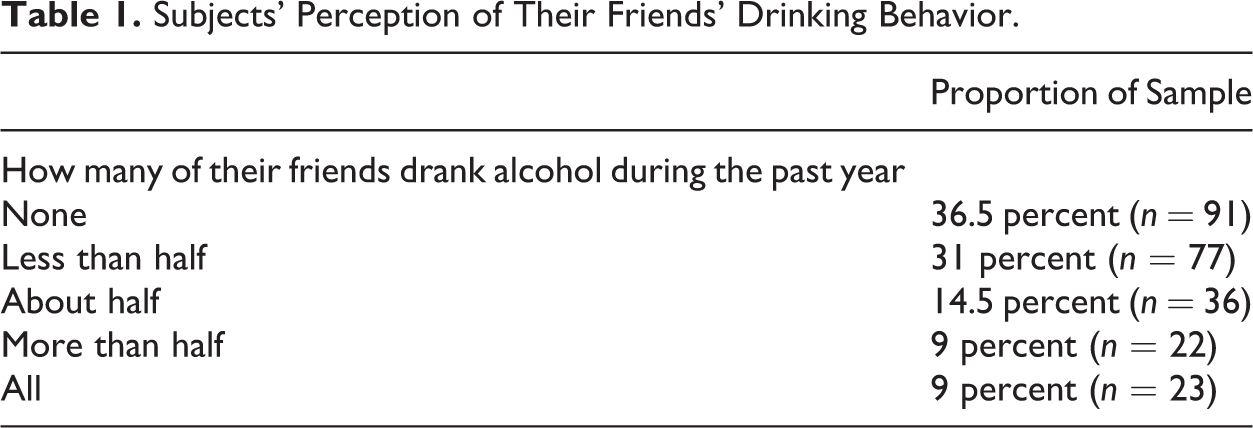
At the start of the survey, respondents were asked to think of their closest friends in school and to keep this group of people in mind when answering questions regarding their friends’ drinking behavior. 4 Table 1 provides the distribution of the subjects’ answers regarding how many of their friends drank alcohol during the past year. Interestingly, though 45 percent of the sample reported that they drank in the past year, nearly 64 percent indicated they believed that at least some of their friends drank. Next, respondents were asked to consider what factors informed their beliefs and were provided with several options that covered witnessed behavior and various forms of communication. Subjects were able to endorse as many elements as they wanted (i.e., they were not mutually exclusive)—it is these responses that provide insight on the key question of interest.
Subjects’ Perception of Their Friends’ Drinking Behavior.
Considering the Sources of Perceptions
Observed behavior
For respondents who reported that they believed at least some of their friends drank, they were asked to indicate whether they based this belief on (1) having drank with their friends during the past year and/or (2) seeing their friends drink during the past year. Among the respondents who reported that their friends drank (n = 158), 33 percent indicated that this belief, at least in part, stemmed from drinking with their friends, and 56 percent indicated they had this belief at least in part because they had personally witnessed their friends drinking (see Table 2). Because these two options are not mutually exclusive, it is worth noting that 60 percent of the respondents who reported that their friends drank endorsed at least one of these options (28 percent endorsed both).
The Percentage of Respondents Who Endorse Behavioral and Communication Elements as Sources of Perceptions about Friends’ Drinking.

aThese columns refer to the same 158 respondents who reported that their friends drank.
Among these same respondents (n = 158), we also asked about how often, on average, their friends drank alcohol. Responses included one time (36 percent), once a month (52 percent), once a week (9 percent), and more than once a week (3 percent). When asked whether observed behavior informed these perceptions about the frequency of their friends’ drinking, 28 percent of respondents indicated this belief was at least partly based on how often they drank with friends and 44 percent indicated it was at least partly based on how often they personally saw their friends drink (note that 50 percent endorsed at least one option).
The proportion of respondents who report they rely upon witnessed behavior when forming perceptions is notably higher among those subjects who reported that their friends did not drink. Among these respondents (n = 91), 76 percent indicated this belief was in part based on the fact that they had not drank alcohol with these friends during the past year and 89 percent said it was in part based on the fact that they had not witnessed their friends drink during the prior year (note that 90 percent selected at least one of these options; when compared to the 60 percent respondents who endorsed one of the analogs if their friends drank, t = 5.18, p < .001). 5
As one means of addressing the likelihood that adolescents observe the full extent of each other’s deviance, the survey asked respondents who self-reported drinking alcohol in the past year about the degree to which their friends witnessed this behavior. Among the respondents who self-reported drinking (n = 112), 37 percent indicated that their friends were never present when they drank, 24 percent indicated that sometimes when they drank their friends were present, 15 percent indicated most of the time they drank their friends were present, and 24 percent reported that every time they drank alcohol their friends were present. Thus, more than 75 percent of the respondents who reported drinking said that their friends did not witness the full extent of their drinking behavior.
Communication
Respondents were also queried about the extent to which they relied on a range of communication to inform their beliefs about their friends’ drinking behavior (see Table 2). Eighty-five percent of the subjects who reported that their friends drank indicated that they believed this in part because their friends explicitly told them that they drink; notably, this is substantially higher than the proportion of these same respondents who endorsed having relied on direct observation of behavior (t = 5.32, p < .001). Regarding injunctive norms, 57 percent of these respondents indicated that they believed their friends drank at least in part because their friends told them that drinking was fine and/or fun. Again, we also questioned these same respondents about their perceptions of their friends’ frequency of drinking. When asked about the factors that informed beliefs about drinking frequency, 74 percent reported that they were shaped, at least in part, by what their friends directly told them about their own drinking behavior and 55 percent reported it was partly influenced by their friends’ expressed attitudes and values.
With regard to the adolescents who reported that their friends did not drink, 46 percent indicated that they held this belief at least in part because their friends explicitly told them that they did not drink, which is notably lower than the proportion of these same respondents who endorsed having relied on observation of behavior (t = −7.86, p < .001). Similarly, approximately 32 percent indicated that their beliefs were informed by the fact that their friends told them they believed drinking alcohol was wrong, which is likewise significantly lower than the proportion of these same respondents who endorsed having relied on observation of behavior (t = −10.04, p < .001). On the whole, then, it appears that adolescents who believe their friends drink are more reliant on direct communication to inform these beliefs; in contrast, adolescents who believe their friends do not drink appear to be more reliant on directly observed behavior (or, more accurately, the absence of observed drinking).
Turning to indirect communication, among those who believed that their friends drank, nearly 48 percent said this belief was at least partly informed by their friends’ reaction to other people’s drinking and 36 percent of them said this same element influenced their beliefs about how often their friends drink. In comparison, 54 percent of the respondents who indicated that their friends did not drink endorsed this option. Indirect communication may also come from third parties who report their own observations regarding an adolescent’s friends. Among those subjects who reported that their friends drank, 39 percent indicated that they believed this at least in part because other people had told them that their friends drank; among these same respondents, 29 percent reported that this element also informed their beliefs about how often their friends drank. For those respondents who reported that their friends did not drink, only 12 percent endorsed the response option that they based their belief at least in part on other people telling them their friends did not drink.
We queried respondents about whether they explicitly talked to their friends about their own drinking behavior (this included if they did not drink alcohol). Nineteen percent of respondents said they talk to all of their friends about their drinking behavior, 39 percent said they talk to only some of their friends, and 42 percent said they do not talk to any of their friends about their drinking. 6 When asked about their attitudes toward drinking (i.e., whether it was wrong or fun/not a big deal), 57 percent of respondents said they believed drinking was wrong, but only one-quarter of this 57 percent indicated that they shared this belief with their friends. Among the 43 percent of respondents who reported they believed drinking was fun/not a big deal, only 21 percent of them indicated that they shared this attitude to their friends. In other words, even though it seems that adolescents rely on communication when forming perceptions about their friends’ drinking, researchers should not assume that such communication is always an accurate portrayal of friends’ true behavior or attitudes.
Projection
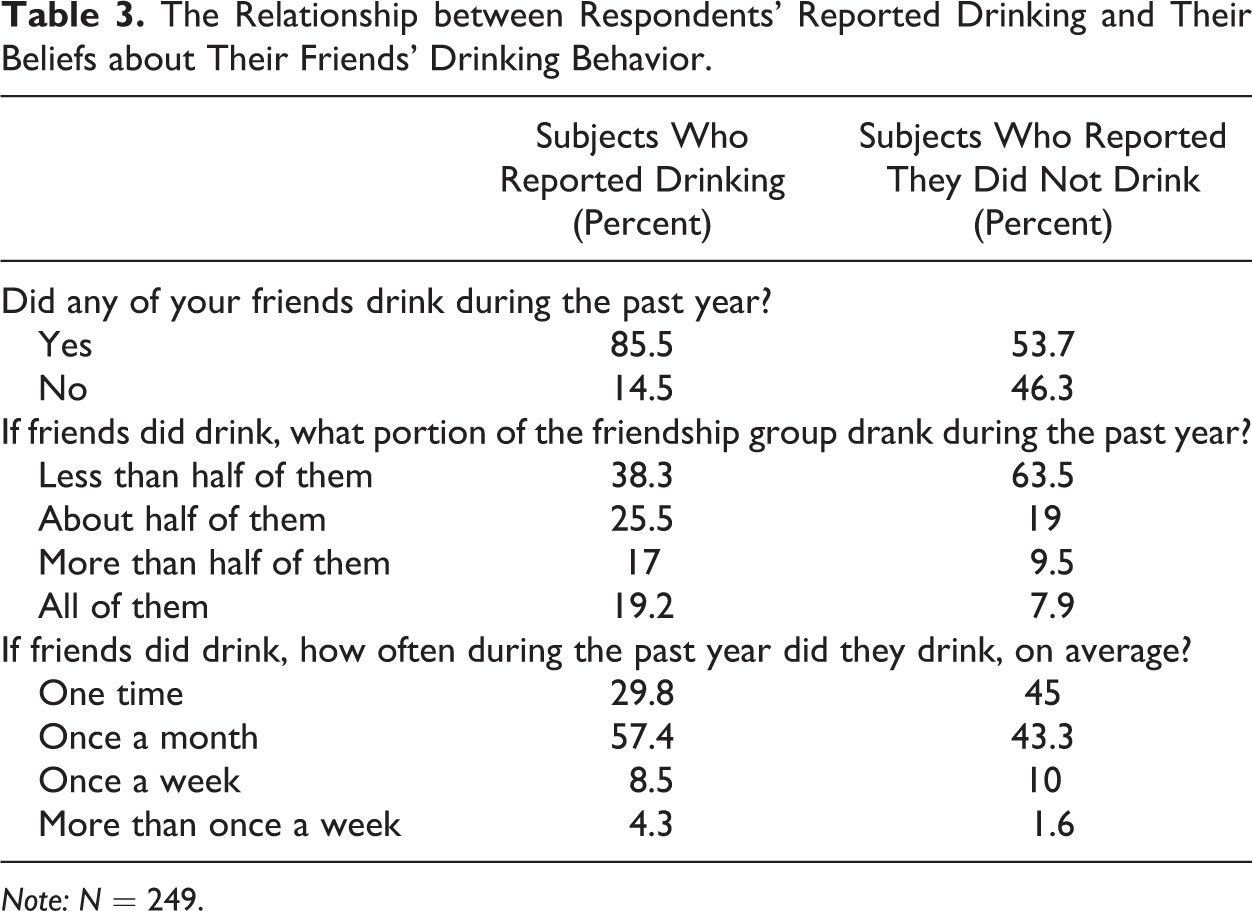
As Table 3 demonstrates, students who report drinking are more likely to believe (1) that their friends drink, (2) that a greater proportion of their friendship group drinks, and (3) that their friends drink more frequently. Further, there is a clear relationship between subjects’ own self-reported frequency of drinking and the perceived frequency that they believe their friends drink (polychoric correlation = .71). Such patterns may suggest that the adolescents in this study are demonstrating a tendency to project their own behavior onto friends, but it may also reflect a true social influence effect (as well as a selection effect). Clearly, discerning the extent to which adolescent draw on “knowledge of self” when forming perceptions of peer behavior requires more than such descriptive information.
The Relationship between Respondents’ Reported Drinking and Their Beliefs about Their Friends’ Drinking Behavior.
Note: N = 249.
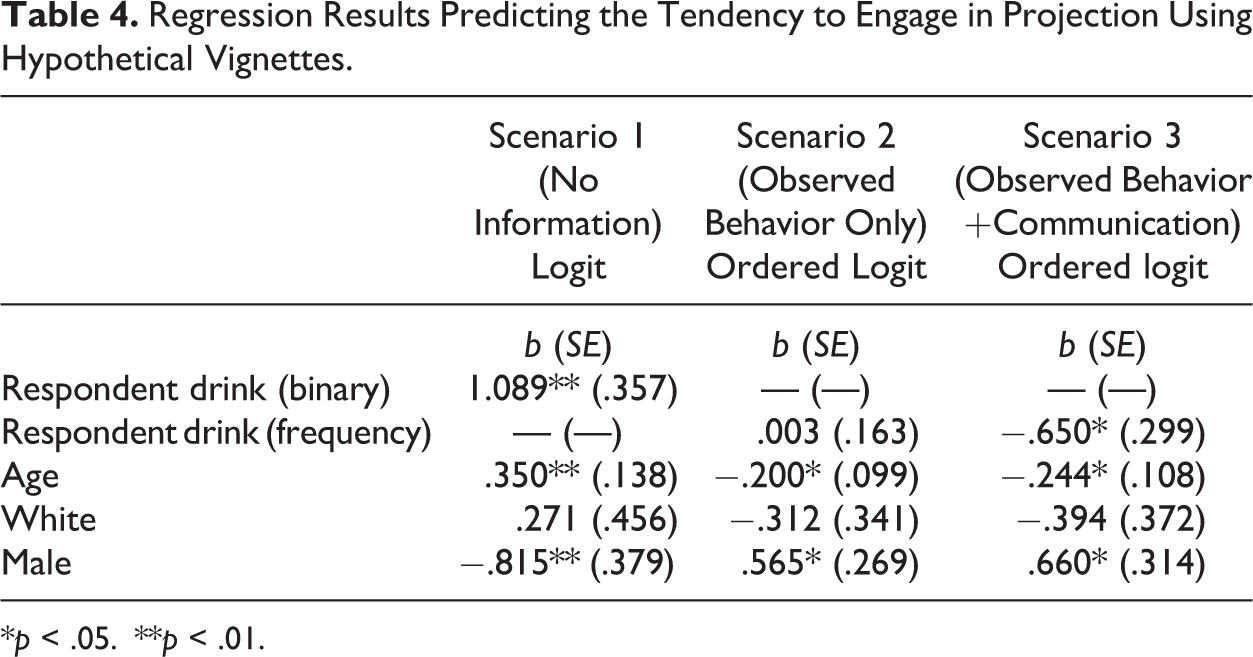
Earlier, we recommended that one alternative way to assess the tendency of adolescents to engage in projection of deviant behavior would be to leverage hypothetical vignettes. Accordingly, all respondents were provided with three scenarios as part of the survey. The first was very short, offering essentially no information about the hypothetical friend: “A new student in your grade recently transferred into your school. You have talked with him a few times and think he’s someone you could be friends with.” After reading this statement, respondents were asked: “If someone asked you whether you thought this student drank alcohol (more than just a sip or a taste of someone else’s drink) during the last year, what would you say?” Arguably, this offers ample opportunity to rely on knowledge of self to inform perceptions, as barely any information is offered to the respondent. Overall, 21.5 percent of the respondents reported that this hypothetical friend drank alcohol. Importantly, however, this distribution was different when considering the respondents’ own drinking behavior. Among those subjects who reported drinking during the past year, 32 percent indicated they believed the person in the vignette drank, compared to only 12 percent of the nondrinking subjects. Although the majority of respondents who drink do not assume that a hypothetical “new friend” does the same, the results of a logistic regression (see Table 4) confirm that they are considerably more likely to believe this peer drinks than are respondents who do not drink (b = 1.089, p < .01), net of the respondents’ age, race, and gender. Because this vignette method ensures that the subject is not calling upon the extent to which she or he has witnessed this friend’s behavior or any form of communication from or about this friend, we believe it is reasonable to assume this finding reflects a tendency toward projection.
Regression Results Predicting the Tendency to Engage in Projection Using Hypothetical Vignettes.
*p < .05.
**p < .01.
Again, however, this vignette offers almost no information about the hypothetical peer. Therefore, we offered subjects another opportunity to engage in projection, though under different scenario conditions. Specifically, the next scenario stated, “You go to a party that is hosted by someone in your school over the weekend and while there, you see this new student drinking a beer.” Because this scenario outright states that the peer drank alcohol at least one time, asking respondents whether or not they believed the peer drank during the past year was no longer a reasonable query. Instead, respondents were asked, “If someone asked you how often you think this same student drank alcohol (more than just a sip or a taste of someone else’s drink) during the last year, what would you say?” Response options included one time (= 1), once a month (= 2), once a week (= 3), and more than once a week (= 4).
The logic of projection bias states that if individuals have a tendency to “assign” their own behavior onto their friends, then respondents who drink more often should assume that the hypothetical friend also drinks more often. Of course, scholars have suggested that perceptions are not fully comprised of projection, but instead reflect some composite of projection and observed peer behavior (Boman, Stogner, et al. 2012; Meldrum et al. 2009). With this in mind, one might expect to see less stark evidence of a tendency to project under this condition, though it should still emerge. 7 We considered this possibility with an ordered logit regression model (see model 2 in Table 4), for which the independent variable was how often the respondent self-reported drinking during the prior year (see Table 5 for the distribution of responses to this question). The results indicate that respondents’ self-reported drinking did not have a statistically significant relationship with perceptions of the hypothetical peer’s drinking (b = .003, p = .984), net of the respondents’ age, race, and gender. Thus, there is no evidence of a tendency to engage in projection under this specification.
Responses to the Second and Third Vignettes Describing the Hypothetical Peer.
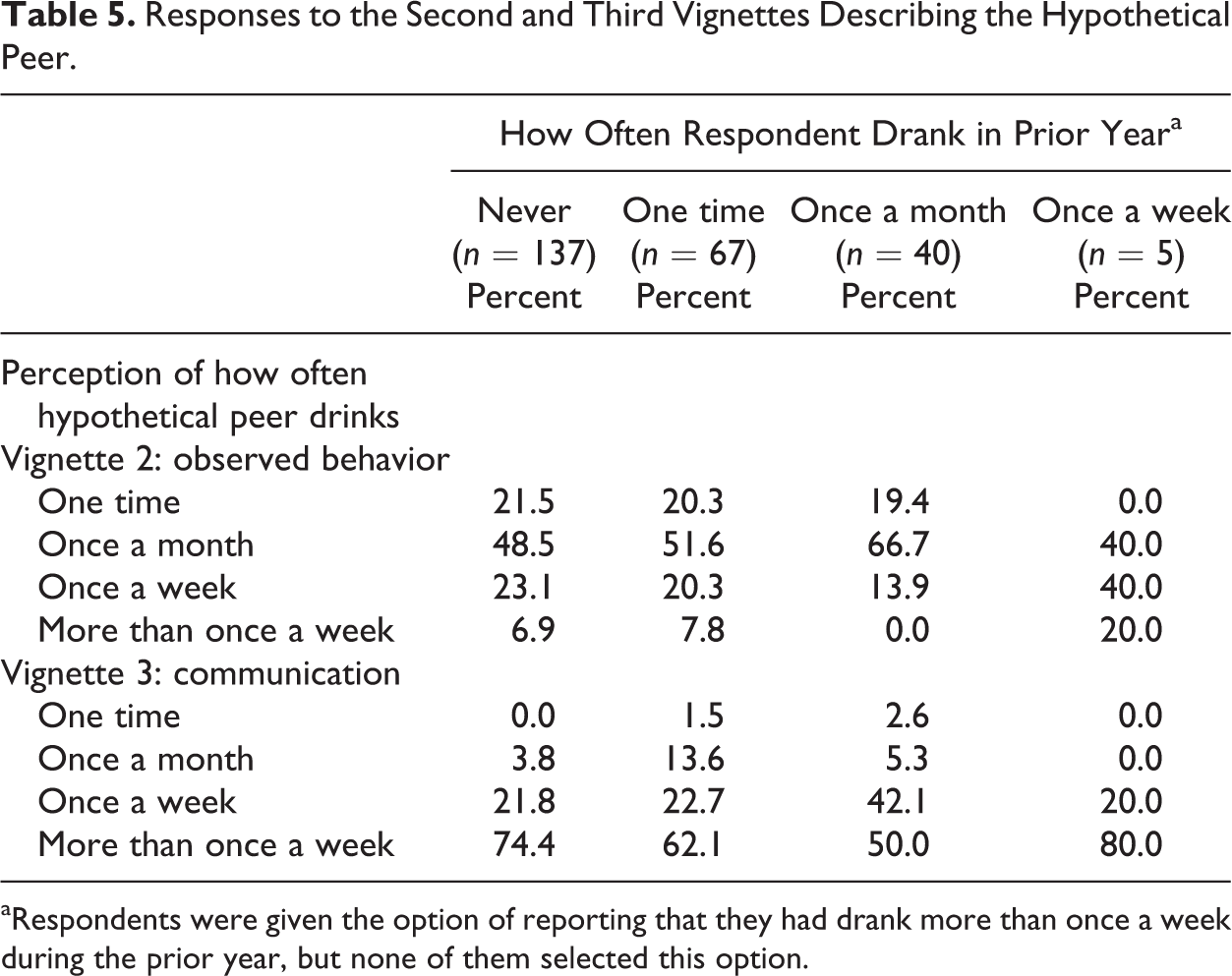
aRespondents were given the option of reporting that they had drank more than once a week during the prior year, but none of them selected this option.
Next, respondents were given information about communication. Specifically, the survey stated, While at the party, you hang out with the new student for a while and talk. When you ask him where he got the beer, he says he brought it in case there wasn’t enough alcohol at the party. He says it was easy for him to get his older brother to buy him beer. He also says that the 21-year-old drinking age is ridiculous and that he has a high tolerance—besides, it is fun.
Discussion
The argument that perceived peer deviance is a crucial part of the etiology of delinquency is not new, but it has accumulated notable skepticism due to concerns that perceptual measures are contaminated by projection bias. After several years of research, the current literature makes a compelling case that perceived peer deviance is not the same construct as peer self-reported deviance, but also that it is not the same construct as respondent delinquency (e.g., Rebellon and Modecki 2014). In light of such findings, scholars have been calling for a careful consideration of what elements may actually inform perceptions. Therefore, this study took a first step by investigating the factors that nearly 250 adolescents enrolled in a public high school reported they used to form their perceptual beliefs about their friends’ drinking behavior.
Consistent with prior work (e.g., Young et al. 2011), we found that there does not appear to be one-to-one overlap between respondent behavior and his or her perceptions of friends’ behavior—indeed, for nearly one-third of our sample, there was a disjoint between whether respondents drank and whether they believed their friends drank. This in and of itself challenges the notion that the effect of perceptual peer behavior merely reflects projection (though, of course, it could also challenge the idea of social influence). This study also offered preliminary evidence that the tendency for adolescents to project their own drinking behavior onto others is less likely as they obtain additional information about that person. Specifically, using a hypothetical vignette method, we only observed evidence of the tendency to project in a scenario that provided no information about behavior or communication, which raises questions about the widely held belief that perceptions are inherently marred by projection bias. Indeed, this study suggests that adolescents draw upon substantively relevant information when forming their perceptual beliefs.
Our results indicate that this substantively relevant information includes behavior and an array of communication mechanisms. Respondents reported that their perceptions were based on the observed behavior of friends, communication with friends about their behavior and attitudes, nonverbal communication by friends, and information about their friends from third-party sources. Thus, the formation of perceptions appears to be more complex than the combination of observed behavior and adolescents simply assuming their friends are similar to themselves. As such, scholars should not be surprised that there is an empirical discrepancy between perceived peer deviance and peer self-reports of deviance.
In thinking about the disjoint between these two measures, there is a parallel to be drawn with the deterrence literature. After decades of empirical work failed to offer strong support for the deterrence perspective, this research was criticized for using objective measures of risk based on the notion that it is what one perceives to be true that matters for decision-making (Geerken and Gove 1975; Williams and Hawkins 1986). After all, deterrence, like normative influence theories, is a perceptual theory of crime (Geerken and Gove 1975; Williams and Hawkins 1986). It would have been easy for researchers to continue to assume that individuals form perceptions of risk based simply on the objective risk of arrest, but scholars realized that this assumption was not realistic and that the formation of risk perceptions is much more complex (Stafford and Warr 1993). Having embraced perceived risk as a key construct of interest, researchers have made impressive progress in understanding how personal and vicarious experience shape risk perceptions, how these perceptions change under particular conditions, and how individuals update these beliefs (e.g., Anwar and Loughran 2011; Pogarsky 2007). Further, this literature recognizes that inaccuracies in perceptions (i.e., when the perceived risk is discrepant from objective sanction risk) do not undermine their power to influence behavior. Indeed, the broader decision-making literature documents how errors in estimation or expected outcomes, often informed by heuristics and biases, nonetheless shape and produce action (Tversky and Kahneman 1974). In short, recognizing that perceived risk plays such a seminal role in offending decision-making—and that it often differs from true objective risk—prompted deterrence researchers to treat perceptions as a dependent variable in order to better understand it as a theoretical construct.
To be fair, however, scholars studying normative influence have not been as careful or judicious in their language and arguments as have deterrence scholars. Perceptual measures are labeled as measures of “peer deviance” rather than perceived peer deviance (in contrast to research on “perceptual deterrence”). If theories propose that what one believes and anticipates are the proximate factors that motivate delinquency, then it is important that researchers recognize this and take strides to maintain second-order agreement. Advocates of normative influence have rarely done this, nor have they made these perceptions the dependent variable in empirical inquiry (Rebellon and Modecki 2014). Using deterrence research as a guidepost on how to more fully understand this supposedly essential construct would prove useful and may help further expand and specify theory.
Although we do not agree with scholars who have called for the wholesale dismissal of perceived peer deviance measures, we do not recommend ignoring “objective” peer measures either. It is our view that just as with objective and subjective sanction risk, both measures have merit for empirical inquiry (see also Young et al. 2014), but we do believe that researchers should be aware of the strengths, shortcomings, and implications of the different operationalizations. We encourage scholars to think critically about which measure (or data) is best suited to answer their question of interest, as they have philosophically different conceptions of peer influence. If scholars are interested in the actual behavior of individuals’ friends as a risk factor for delinquency, then objective measures are more precise and should be used. For instance, research interested in understanding the effects of juvenile placement procedures (Leve and Chamberlain 2005) or roommate assignment in college (Duncan et al. 2005) offer instances in which scholars may be more interested in the objective behavior of peers. When it comes to explicitly testing the dominant theoretical explanations of normative peer influence, however, perceptual measures arguably are more appropriate. The risk is simply too high that peer self-reports ignore factors that shape adolescent beliefs of friends’ behaviors and attitudes; if one seeks to understand how an individual’s understanding of his social world affects his offending behavior, then perceived peer deviance should be the key measure.
Nearly 50 years ago, Matza (1969) warned against an approach to the study of crime that treated individuals simply as objects that are acted upon by outside forces. He argued that criminologists should instead view and treat individuals as subjects who play an active part in constructing an understanding of the world and their own place in it (see also Becker 1953). In this way, subjective measures of peer delinquency move us closer to Matza’s call to “appreciate the philosophical inner-life of the subject; to see the world the way the subject sees it … and to interpret the world the way the subject would interpret it” (Lemelle 2009:191). By embracing perceived peer deviance as an important construct and taking strides to understand its content and contours, the discipline has an opportunity to better understand the mechanism(s) of social influence under the assumption that individuals are cognitively engaged participants in their own offending pathways (K. J. Thomas and McGloin 2013).
Because this study is a first step into investigating the factors that influence peer perceptions, it has several limitations that can guide future work. First, although we believe that extant work has not offered sufficient evidence of projection bias, we also do not believe that the methods used here can be the only way researchers explore the factors that influence perceptions. After all, using descriptive information and hypothetical scenarios are problematic in their own right. It would be beneficial for researchers to consider more creative and sophisticated ways to explore how perceptions are formed and what factors are influential in this process. For example, in a departure from what has become the traditional approach to assessing projection, Young et al. (2014) recently specified a structural equation model with longitudinal data, in which they estimated a projection path (see also Jussim and Osgood 1989). Although there may be some questions about the appropriateness of using lagged terms as instruments and the extent to which this path only captures projection, no one method is a panacea. Such attempts to address this question from a different angle are important; it is the triangulation of these approaches that ultimately will provide insight on this question.
Second, the sample used here comes from a single high school on the East Coast. The student body was notably diverse, but one should still be cautious in making any claims about generalizability. Ideally, a larger-scale study with multiple high schools from several regions could be conducted to provide a more representative assessment of the factors that influence perceptions of peer behavior. Third, the delinquent behavior in this study was limited only to drinking alcohol. The decision to focus on drinking behavior was due to the combination of the limited time allocated for the completion of the survey and to ensure there was sufficient variation in respondent and peer behavior. Still, this raises questions about whether the results would have been replicated when using different crime types. Research suggests that there are similar discrepancies between perceptual and objective measures of peer behavior for substance use and other types of crime (e.g., Boman, Stogner, et al. 2012; Boman, Ward, et al. 2012), but it is still possible that projection is a larger issue for other forms of delinquency or that the factors influencing perceptions differ across crime types.
Fourth, it would be insightful to offer respondents a wider array of scenario conditions to assess the tendency to engage in projection. For instance, it would be informative to determine if and how the inclusion of specific kinds of communication independently impact perceptions. Does direct communication from the friend affect perceptions more so than information heard from third parties? Do expressed descriptive norms have a greater impact than injunctive norms? Furthermore, the information we provided regarding behavior and communication focused on engagement in the deviant behavior (i.e., drinking). Clearly, if scholars agree that this method offers some insight into general projection tendencies and how they may alter under particular circumstances, then determining whether the provision of information that suggests the friend does not partake in the deviant act impacts the tendency to engage in projection is essential. Further, altering the characteristics of the “friend” in the vignette to make him more or less similar to the subject would also provide important knowledge on the tendency to project one’s own behavior onto others, as perceived demographic similarity, for instance, may increase this tendency.
In addition to these avenues for future work, we believe it would be instructive for research to investigate how gender may shape perceived peer deviance, especially with regard to the role of communication. Research suggests that females tend to engage in greater self-disclosure in social relationships (Dindia and Allen 1992), including adolescent communication with friends (Rapini et al. 1990). Moreover, scholars note that females tend to be more adept at both sending and interpreting nonverbal cues (Hall, Carter, and Horgan 2000). For female adolescents, then, communication processes may take on an added premium compared to males when constructing and maintaining their beliefs about friends’ deviance. If so, this would underscore the potential loss of crucial information if researchers focus only on the self-reported behavior of friends. Pursuing this line of inquiry, as well as those tied to addressing the limitations of the current study, has the potential to shed additional insight about the appropriateness and meaning of different measures of peer influence as well as the complex nature of the “peer effect.”
Footnotes
Acknowledgments
The authors wish to thank Denise Gottfredson and Christopher Sullivan for their helpful comments on earlier versions of this article. They are also very thankful to Holly Nguyen for her help with the data collection.
Declaration of Conflicting Interests
The author(s) declared no potential conflicts of interest with respect to the research, authorship, and/or publication of this article.
Funding
The author(s) received no financial support for the research, authorship, and/or publication of this article.