



Abstract
Objective:
Despite a recent surge of interest in the important role that identity change plays in the desistance process, much of the empirical work has been qualitative and conducted with small samples, usually of serious adult offenders. Drawing on a nationally representative sample of adolescents in South Korea, this study explores how the development of their prosocial identity is related to their own social bond and network and collectively how this process relates to a downward trend in violent behavior.
Method:
Negative binomial random effects models were estimated to assess the within-individual effects of the proposed predictor and mediators on the outcome variable. Then, longitudinal path analyses were conducted to explore the overall and specific mediation processes.
Conclusion:
First, there is an inverse relationship between prosocial identity and violent behavior across time. Second, our own identity of self might not be entirely a social construction based on others’ appraisals but is intimately connected to the actions that we intentionally take. Third, positive effects of a prosocial identity on subsequent violence are mediated primarily by the avoidance of association with delinquent peers. Theoretical implications and limitations are discussed.
Keywords
Over the past 20 years, criminologists have witnessed a surge in theoretical attempts and empirical work explicating the process of desistance from crime among serious adult offenders. Some of these theories lean toward the importance of structural factors, emphasizing the significance of assuming conventional social roles like full-time employee and/or spouse (Laub and Sampson 2003). In theories of this type, desistance comes about almost without the conscious effort and intention of offenders when the routine activities consequent to new social roles subject their occupants to greater informal social control than what existed in the past. Other theories lean in somewhat the opposite direction, suggesting that desistance is heavily dependent upon human agency and the intentional efforts of offenders to commit themselves to a new identity and a new direction for their life (Maruna 2001; Paternoster and Bushway 2009; Vaughan 2007). Still other theories are a somewhat ambiguous mixture of structural and agentic theories, positing that desistance involves a combination of objective (structural roles) and subjective (identity and agency) factors, without a clear delineation as to the causal ordering or relative importance of the two (Farrall 2005; Giordano, Cernkovich, and Rudolph 2002; Giordano, Schroeder, and Cernkovich 2007; Soyer 2014).
It is our opinion that the rising tide of desistance theorizing is beginning to favor the primacy of identity changes coupled with intentional agentic moves toward a prosocial life. There has been a spate of recent theorizing, conceptualizing, and empirical work on the important role that identity change plays in the criminal desistance process. Much of the empirical work on identity change and desistance, however, has been qualitative 1 and conducted with small samples, usually of serious adult offenders (Aresti, Eatough, and Brooks-Gordon 2010; Bachman et al. 2016; Healy 2013; 2014; Kerrison, Bachman, and Paternoster 2016; LeBel et al. 2008; Na, Paternoster, and Bachman 2015; Opsal 2012; Paternoster et al. 2016; Radcliffe and Hunter 2016; Soyer 2014; Stevens 2012; Stone 2016). The research base in support of identity theory, therefore, is fairly thin and of limited scope. Our purpose is to add to the literature on identity change and movement in a prosocial direction, drawing on longitudinal data from a nationally representative sample of adolescents in South Korea (the Korean Youth Panel Survey [KYPS]).
Despite the inherent ambiguity in its conceptualization and operationalization, criminologists have thought of desistance as solely taking place among serious adult offenders who “reach some reasonable threshold of frequent and serious criminal offending” (Laub and Sampson 2001:10). Accordingly, many researchers generally assume that a population of individuals who have offended at least once in the past (usually identified by official measures) is eligible for the study of desistance (Brame, Bushway, and Paternoster 2003). More recently, however, other researchers (e.g., Massoglia and Uggen 2007, 2010) have asserted that desistance research needs to be extended beyond officially labeled adult offenders to include a broader and more representative community sample (including adolescents) to provide a general model of desistance or cessation of offending behavior. This is because self-report surveys suggest that almost all adolescents engage in some form of offending behaviors, and most of them successfully escape formal arrest and sanctions. In this vein, an empirical exploration of “behavioral” desistance in addition to “official” desistance is crucial in the current sample of Korean adolescents because their violent behaviors—although explicitly illegal—are unlikely to be sufficiently serious enough to attract the attention of officials. In addition, these types of behaviors are committed mostly against other adolescents, and victims tend not to file a formal complaint to the police. Even when adolescent offenders are detected by the police, the common practice and shared norms of the Korean society have been to resolve the issues within family or schools under the influence of strong collectivist and patriarchal cultures.
Our effort here is directed at expanding the scope of desistance literature to account for not just the recidivism of officially labeled offenders but also the behavioral pattern of moving away from violent behaviors among the general youth population. The fact that the age–crime curve dips downward in late adolescence—when most adolescent-limited offenders do not experience “turning points” (Sampson and Laub 1993) or “hooks for change” (Giordano et al. 2002)—suggests that this period in one’s life is important for examining desistance processes (Massoglia and Uggen 2007), especially if we understand desistance as a gradual process of decreasing offending behavior to termination, as well as maintaining the continued state of nonoffending (Bushway et al. 2001: Laub and Sampson 2003). Although it has been well recognized and accepted in criminological literature that only a few are committed to their offending careers, whereas the vast majority of delinquents “drift” back to convention after experimenting with some delinquency through a process of “aging” or “maturational reform” (e.g., Gottfredson and Hirschi 1990; Matza 1964; Moffit 1993), we still do not know much about this “aging out of crime” process during the adolescence and transition to adulthood (Carlsson 2018). In addition, recent theoretical and empirical developments in the desistance literature emphasize that conventional turning points are more likely to be experienced and embraced successfully by those who already had motivation and willingness to change and commit themselves to prosocial institutions and conventional line of actions (Paternoster and Bushway 2009), and desistance might have occurred ahead of successful transitions to prosocial adult roles such as legitimate work (Skardhama and Savolainen 2014).
No matter it is conceptualized as “desistance” or “drift” from crime back to convention, the actual process of moving away from antisocial behaviors with increasing age might be associated with a variety of changes in biological, psychological, social factors, and some combination of all of these factors (Laub and Sampson 2003:26-33; Rocque 2015). Despite a rich tradition in criminology that attempted to soften the deterministic views of positivism (e.g., Matza 1964, 1969) by emphasizing the subjective nature of the process toward becoming deviant or conventional (i.e., active individuals make conscious choices about their lives), most initial theories of desistance were built on the primacy of external or structural factors. It was only recently that theories of desistance began to emphasize the self-motivated and self-directed changes by focusing on human agency and internal/subjective factors such as self-identity as a driving force to modify one’s preference and behavior (Giordano et al. 2002; Maruna 2001; Paternoster and Bushway 2009; Silver and Ulmer 2012).
In this study, we explore the association between prosocial identity and youth violence as one of many possible causal links, which has traditionally gained little attention; nevertheless, this possible causal link might be integral for a more complete understanding of the declining pattern of delinquency observed across the age–crime curve. After demonstrating that there is a substantial amount of heterogeneity in the development of both prosocial identity and violent behavior, we attempt to generalize the validity of the extant work on the identity theories of desistance to a general youth population. Two specific questions will be examined: (1) What is the relationship over time between a youth’s prosocial identity and a youth’s own violent behavior? and (2) what is the relationship among a prosocial identity, the development of prosocial bonds and networks, and subsequent violence? Our empirical analyses are based upon the presumption that a shift in one’s own prosocial identity, which does not necessarily or even solely result from the identity attributions by others (Matsueda 1992; Matsueda and Heimer 1997), is an important source of change in one’s own offending behavior. Further, a prosocial identity may have implications for one’s social bonds and social networks, which in turn affect participation in violent behaviors. In particular, exploring the possible causal mechanisms underlying the link between the cognitive/subjective factors and delinquency through the integration of other important social factors will be beneficial for “a much more realistic understanding of why and how individuals desist from crime” (Rocque 2015:341).
After a brief review of the identity-based theories of offending that provide theoretical rationales for our models, we will discuss in more detail about why and how prosocial identity and violent behavior are associated with each other. It will be followed by a discussion of the existing literature and how our study fits into that framework. Next, we will provide a description of the data and methods with a discussion of how the current study extends well beyond a relatively narrow focus to a more general model of desistance. This will be followed by our empirical results and a discussion of the implications of our findings.
Identity and Desistance
An Overview of Identity-based Theories of Crime and Desistance
The perception of self-identity has been conceptualized in a variety of ways. Its effects on important life outcomes, such as antisocial behaviors, have been tested under many alternative theoretical models by researchers inside and outside the field of criminology (e.g., Burke and Stets 2011; Kinch 1963; Lemert 1951; Matsueda 1992; Paternoster and Bushway 2009; Silver and Ulmer 2012). The symbolic interactionist perspective refers to the idea that the self is created out of a mutual interaction between the actor and others; the actor behaves in a particular way consistent with who she or he is, others respond to that behavior, and the actor perceives those responses by others (“reflected appraisals”) and behaves in accordance with those perceptions (Matsueda 1992). Similarly, Kinch’s (1963:481) formalized theory of the self-concept asserted that “[t]he individual’s conception of himself emerges from social interaction and, in turn, guides or influences the behavior of that individual.” Falk and Miller (1998:151) stated the dynamic relationships among identity, behavior, and the responses of others in much the same language “…a person’s self-image influences the way she behaves…her behavior [then] becomes a stimulus for the reactions of others, and the self-image process begins anew” and can be illustrated as → identity → behavior → appraisals/responses of others → identity → behavior → appraisals (and the cycle continues).
In the criminal desistance literature, Giordano et al. (2002) also placed the cognitive transformation as an integral element of change in the overall behavioral pattern. While both draw heavily on the notion of symbolic interactionism, the approach taken by Giordano and colleagues is more agentic than Matsueda’s (1992) view through its emphasis on internality as a driving force of change as well as the actor’s own role in this transformation process. However, they posit that hooks for changes precede “fundamental shifts in identity and changes in the meaning and desirability of deviant/criminal behavior” (p. 992). …The latter types of shifts are not, however, simply the result of individualistic mental processes. Instead, the hook for change can play an important role in fostering these very transformations…. (p. 1001) …Hooks for change can provide an important opening in the direction of a new identity and concrete reinforcement during all phases of the transformation process…. (p. 1002)
While internally generated motivations to change self-image play a significant role in how individuals view themselves as prosocial beings and thereby conduct themselves in ways that are consistent with the new perception of self (Paternoster and Bushway 2009; Silver and Ulmer 2012), we believe these positions are not completely at odds with symbolic interactionist theories which also acknowledge the possibility of other sources of self-change than merely social interaction and role-taking. For example, Matsueda (1992:1582) suggests that the perception of self as a delinquent may not be entirely a function of reflected appraisals. It is consistent with Mead’s (1934) position that the cognitive process of internal dialogue between “me” and “I” is triggered if the current situations are viewed as problematic when individuals begin to anticipate the responses of others and incorporate the future into a present problem in light of the past. In a similar vein, Heimer and Matsueda (1994:367) posit that “delinquency is in large part a function of stable meanings of the self relevant to deviant behavior, which arise partly through processes of role-taking and labeling.” Matsueda and Heimer (1997) in their theoretical elaboration also recognize that there is an “endogenous process” in which actors take constituent features of the life course into consideration in carrying out meaningful and self-conscious behavior, in addition to an “exogeneous process” (e.g., taking the role of significant others in problematic situations) which may or may not involve the consciousness of actors.
Identity and Offending Behaviors
There has been an abundant literature suggesting the possible links between identity and behavioral outcomes in psychology and social psychology. In particular, self-identity has been perceived as a salient motivational and self-regulatory factor because the tendency to refrain from previous deviant lifestyles and the inclination toward prosocial behaviors emanate from the way one views himself (Akerlof and Kranton 2010; Foote 1951; Markus and Nurius 1986; Oyserman, Elmore, and Smith 2012). Foote (1951:17) argued that the basis of one’s motivation is what he termed identification—“appropriation of and commitment to a particular identity or series of identities” (see also Rosenberg 1979). Foote’s point is that the simple occupancy of a role does not provide a sufficient explanation for why someone performs or behaves in accordance with role expectations, since “[r]oles as such do not provide their own motives” (p. 14). Rather, it is one’s identity that provides such motivation; one behaves like a spouse and is committed to the actions of a spouse because they identify as a husband or wife. Without the identity, role performance is not forthcoming: “[o]nly full commitment to one’s identity permits a full picture of motivation. Faith in one’s conception of one’s self is the key which unlocks the physiological resources of the human organism, releases the energy…to perform the indicated act” (pp. 18-19). From an economic rather than a sociological perspective, Akerlof and Kranton (2000, 2010:4) similarly argued that the content of one’s identity (who we think we are) has a profound influence on our preferences and our behavior: “[i]n every social context, people have a notion of who they are, which is associated with beliefs about how they and others are supposed to behave.” As an illustration of the motivational power of identity, as well as Foote’s notion of identification, Akerlof and Kranton (2010) explore two identities available in an English school first described by Willis (1977): the “lads” and the “ear’oles.” Identification as a lad (a Lad identity) motivates boys to wear certain clothing, adopt a hostile attitude toward the teacher and education in general, and adopt antisocial behaviors like disrupting the classroom, drinking, smoking, and engaging in sexual activity. In contrast, identification with the ear’oles (an ear’ole identity) motivates these boys to dress conventionally, be attentive in class, do their schoolwork, and act courteously and deferentially to teachers. With respect to desistance, one’s identity as prosocial provides the motivation to involve one’s self in conventional institutions, as well as to persevere in the face of eventual and inevitable setbacks. In their identity-based motivation theory, Oyserman with her colleagues (Oyserman 2007, 2009, 2015; Oyserman and Destin 2010; Oyserman, Elmore, and Smith 2012; Oyserman et al. 2017) posit that people are motivated to regulate their behavior and act in ways that fit who they are now and want to become.
Mediating Mechanisms Linking Identity to Offending Behaviors
With respect to the causal link between one’s identity and a decline in offending, both Silver and Ulmer (2012) and Paternoster and Bushway (2009) clearly discuss the specific intervening mechanisms linking the within-individual variation in self appraisals to the change in subsequent offending over time, regardless of whether that decline is only temporary or a true desistance. Silver and Ulmer (2012) argue that a conventional identity fosters the development of a “commitment portfolio,” 3 which includes both conventional institutions like jobs and intimate relationships, but also conventional moral positions. What a prosocial identity ensures, then, is the motivation to form specific conventional commitments in order to develop prosocial bonds or attain social, human, and cultural capital. A prosocial identity provides the motivation to seek out and make good the opportunities provided by certain turning points or hooks for change: “…the development of a conventional or desisting future self can motivate a person to seek out and seize hooks for change” (Silver and Ulmer 2012:709). In detailed descriptions of the identity theory of desistance within a number of publications (Na et al. 2015; Paternoster et al. 2015, 2016; Paternoster and Bushway 2009), it has been hypothesized that in order to be convincing as well as to elicit the support of others in the maintenance process, those working on identity change need to take concrete steps toward a more conventional life. In the words of Lofland (1969), offenders would need to move toward “normal” places, hardware, and others, and away from their deviant counterparts. In the language of social control theory (Laub and Sampson 2003; Sampson and Laub 1993), an identity change needs to be followed by efforts at strengthening one’s social bond. What a conventional identity does by way of motivating behavior, then, is to commit a person to prosocial institutions, involvements, and attitudes (see also Giordano et al. 2002). Symbolic interactionist theories also posit that the prevailing identity of an individual is translated into behavior through a social process of role-taking and interactions with others (Matsueda 1992; Matsueda and Heimer 1997; Mead 1934).
The Present Study
What the extant literature collectively suggests is that the development of a prosocial identity is an important part of the desistance process and that desistance results when an offender develops a more conventional personal identity and subsequently makes a concrete commitment to change by strengthening elements of the social bond and departing from delinquent social networks (i.e., by securing jobs, attaching to conventional others, getting assistance for substance abuse problems, dissociating from delinquent peers). The evidence base, however, is skewed toward serious adult offenders and narrative “storylines” (Agnew 2006:121). There is a much smaller body of evidence from quantitative work, particularly involving younger samples. Drawing on these theoretical and empirical grounds, we can articulate two specific hypotheses about the relationship between a prosocial identity and offending over time:
Unfortunately, the current data do not allow us to investigate explicitly how distinct changes in the self are triggered internally, as we discussed in the previous section. Although a more systematic and complete empirical verification of the causal links proposed by identity-based theories of desistance would be difficult, especially when it involves a cognitive/mental process of internal changes in self-identity, small and incremental steps can be taken (however incomplete) and it should be relatively easy to disprove. The current study serves that purpose. Before we discuss how we tested these hypotheses, we offer a brief synopsis of the existing literature with respect to the relationship between identity and offending.
Data and Method
Sample
The data for this study were drawn from the KYPS of the Korean National Youth Policy Institute (KNYPI). It is a prospective longitudinal panel study of the attitudinal and behavioral changes adolescents experience while transitioning into early adulthood. As the only national youth research institute in South Korea, KNYPI has conducted diverse theoretical and empirical research of youths in order to contribute to the establishment of scientifically based national youth policy. Through a stratified multistage cluster sampling procedure using geographical units (provinces) as strata and schools and classes as clusters, a sample of 3,449 youths was obtained during the first wave of data collection. This sample was representative of the general youth population in South Korea attending schools as eighth graders at the time of the survey (mean age: 13.80). Subjects were first interviewed in 2003 and were reinterviewed annually thereafter until 2008. Interview information included basic demographics, youths’ perception of themselves and reflected appraisals of themselves from the standpoint of significant others, self-reports of delinquency, and many other theoretically relevant covariates such as social bonds to conventional others and association with delinquent peers. While similar patterns were observed from the full sample (available upon request), we report the results only from a subset of the sample who engaged in at least one violent behavior during the study period—which makes the subjects eligible to desist (N = 1,357).
As one of the world’s fastest growing developed countries over the past decades, South Korea is a strategic international setting for testing the hypotheses we proposed in this study. The Korean age–crime curve peaks a bit earlier (around the age of 14), which is unlike the traditional age–crime curve observed in the United States and other Western countries (Jeong 2012; Park 2001). This may be due to the fact that middle school students in Korea tend to manifest mindless and aimless thoughts and behaviors while engaging in unstructured activities outside their home and school compared to high school students. 4 When youth enter high school, however, they spend most of their time and energy on preparing for college entry and future jobs, as they come to perceive their desired/possible future selves very seriously. This is considered one of the primary determinants of prosocial identity development (Paternoster and Bushway 2009).
Measures
Dependent variable: Violent behaviors
In the prior literature, delinquency scales have been created in various ways by combining individual items measuring subjects’ involvement in different types of delinquent behaviors (Sweeten 2012; Thornberry and Krohn 2000). In this study, a six-item scale of self-reported violence 5 was employed to measure the adolescents’ involvement in various types of violent behaviors that are serious in nature: hitting someone very seriously, group (gang) fight, taking other people’s money or other belongings by force, teasing or mocking others very seriously, threatening others, and bullying other friends. We decided to exclude less serious types of status offenses (smoking cigarettes, drinking alcohol, truancy, running away from home, and having sexual intercourse) because engagement in these behaviors (especially smoking, drinking alcohol, and having sexual intercourse) becomes rapidly prevalent in South Korea as adolescents transition into young adulthood. The results of exploratory and confirmatory factor analyses did not support one-factor solution either. Substantively, these less serious types of status offenses might not be relevant to the study of desistance because many adolescents very sporadically engage in minor rule-breaking behaviors with no discernible and consistent patterns (Laub and Sampson 2003:22). 6 More importantly, we decided to focus exclusively on serious types of violent behaviors that could have resulted in an arrest to make the findings more generalizable and comparable to those from official measures of crime. Considering that a handful of high-rate delinquents, or a high frequency of less serious types of violence, might skew the shape of the data distribution (Sweeten 2012), a violence variety score was used by summing the number of items for which a subject reported at least one involvement in a violent offense during each recall period (Thornberry and Krohn 2000).
Independent variable: Prosocial identity
While self-identity is a broad construct and its change involves complex processes, we only consider the items measuring the extent to which subjects regard themselves as deviant or prosocial. In their identity theory of desistance, Paternoster and Bushway (2009) clearly posit that personal identities whereby offenders think of themselves as one who commits crimes are important sources of preferences for certain lines of action including offending behavior; and changes in deviant/prosocial identities are the major factors in initiating and sustaining desistance. While other studies relied on some indirect measures of either prosocial or deviant identity (e.g., Na et al. 2015), we were able to construct a more direct measure of each subject’s prosocial identity drawing on the following two items reflecting the extent to which subjects think of themselves as deviants: (1) I think of myself as a troublemaker and (2) I think of myself as a delinquent. Response categories ranged from 1 (strongly disagree) to 5 (strongly agree). These items were reverse coded so that high scores reflect a prosocial view of self. Exploratory factor analysis (EFA) suggested that one component is extracted that has the eigenvalue of greater than 1 with all the factor loadings greater than 0.9. The scale was created by averaging the responses of the individual items. Cronbach’s αs during the entire study period ranged from .779 to .853.
Mediating variables: Parent attachment, teacher attachment, and delinquent peer association
Parent attachment was measured by asking the subjects how much they agree with the following 10 statements: (1) I try to spend time with my parents, (2) my parents always show love and affection to me, (3) my parents and I understand each other very well, (4) my parents and I often have confidential talks, (5) I often tell my parents about my thoughts and things happening to me outside, (6) my parents and I often have casual conversations, (7) my parents know where I am when I am outside, (8) my parents know whom I am with when I am outside, (9) my parents know what I am doing when I am outside, and (10) my parents know when I will be back when I am outside. Response categories varied from 1 (strongly disagree) to 5 (strongly agree) and higher scores indicate higher levels of attachment to parent(s). EFA suggested that all the items load in one factor with their factor loadings greater than .6, and the scale was created by averaging the individual item scores. Cronbach’s αs ranged from .878 to .911.
Teacher attachment was measured by asking the subjects how much they agree with the following three statements: (1) I can easily talk to teachers about my concerns, (2) teachers show that they love and care about me, and (3) I wish I could become someone like my teachers. Response categories varied from 1 (strongly disagree) to 5 (strongly agree) and higher scores represent higher levels of attachment to school teachers. EFA suggested that only one component is extracted with eigenvalue of greater than 1, and the scale was created by averaging the individual item scores. Cronbach’s αs ranged from .720 to .798.
Association with delinquent peers was measured by eight items asking the subjects about the number of close friends who engaged in the following behaviors in the past 12 months: (1) disciplined, suspended, or expelled from school; (2) arrested by police; (3) drank alcohol; (4) smoked cigarettes; (5) played truant; (6) hit someone very seriously; (7) took something by force; (8) and stole something. Similar to the violence measure we adopted, a variety scale was created by summing the number of items for which a subject reported at least one delinquent peer. EFA suggested that only one component is extracted that has the eigenvalue of greater than 1, and the scale was created by averaging the individual item scores. Higher scores indicate more association with delinquent peers. Cronbach’s αs ranged from .773 to .900.
Control variables
Reflected appraisal
Symbolic interactionist theories predict that reflected appraisals by others are a primary determinant of subject’s self-identity (Falk and Miller 1998; Kinch 1963; Matsueda 1992; Mead 1934). Matsueda (1992), in his revised model of reflected appraisals and behavior, found that reflected appraisals also had a direct impact on delinquency, which makes this an important control variable in this study. The current survey asked two additional questions that were very similar to the ones used to measure the level of a subject’s deviant identity: (1) other people think of me as a troublemaker and (2) other people think of me as a delinquent. We created a measure of reflected appraisal based on these two items reflecting subjects’ perceptions about how significant others (such as parents, teachers, and friends) view them. Response categories ranged from 1 (strongly disagree) to 5 (strongly agree). EFA extracted one component with its eigenvalue greater than 1, and all the factor loadings were greater than 0.95. The scale was created by averaging the individual item scores. All items were reverse coded so that high scores indicate a prosocial perception of appraisals of self by others. The magnitude of Cronbach’s αs ranged from .885 to .949.
Life satisfaction
A feeling of dissatisfaction and frustration resulting from various sources of stress is one of the widely recognized motivational factors that push individuals into crime (Agnew 1992). Among adolescents, these feelings can originate from limited access to the legitimate means of satisfying peer- and media-engendered needs (Greenberg 1979; Steffensmeier et al. 1989). In particular, many Korean adolescents who are not competent in the university entrance process think they are problematic and resort to violence. Life satisfaction was measured using a single item asking subjects how satisfied they are in their lives overall. Response categories ranged from 1 (not at all) to 5 (very satisfied).
Career plan and aspiration for education
In their discussion of “undesired/feared selves” and “desired/possible selves,” Silver and Ulmer (2012) and Paternoster and Bushway (2009) posit that projection and consideration of future selves and agentic moves toward prosocial goals are crucial for the changes in both self-perception and corresponding behavior. Although there were no direct measures for these constructs, two proxy items were available to measure the subject’s level of future orientation. The existence of a concrete career plan was measured by asking the subjects if they already have specific jobs they desire to have in the future. Aspiration for education was measured by asking the subjects how far they wish to pursue their education. Higher scores indicate higher levels of future job orientation and aspiration for education.
Demographic characteristics
As time-invariant covariates, key demographic characteristics such as gender, age, presence of both parents in the household, and household income (measured by US$1,000 per month) were measured at the baseline and included in the subsequent analyses as control variables.
Analytic Strategy
The current study employs two distinct analytic approaches: negative binomial random effects models and longitudinal path models to explore the (1) within-individual effects of the predictors and mediators on the outcome and the (2) longitudinal mediation effects of the proposed mediators. When modeling the association between the changes in predictors (xitj ) and the corresponding changes in outcome over time (yit ), researchers have relied on a variety of alternative modeling strategies to the conventional regression approaches because selection biases originating from unobserved sources of heterogeneity across units of analysis (α i ) may obscure the true relationship between xitj and yit .

Longitudinal panel data are advantageous in separating out the sources of variation in variables into within-unit and between-unit levels. By doing so, the systematic variation in α i can be explicitly controlled in estimating the within-unit effects of xitj , which makes one of the implicit but unverifiable assumptions in the estimation of regression model unnecessary: covariance (xitj , α i = 0). Specifically, criminologists have employed two standard modeling strategies to increase the internal validity of panel findings: fixed effects and random effects models (Allison 2005, 2009; Hsiao 2003; Wooldridge 2002). 7 The adoption of one approach over the other is often justified based on the accuracy or efficiency in estimating parameters because the choice involves a bias–variance trade-off. 8 Considering that α i tends to vary systematically across units and often affects xitj , fixed effects approaches were employed in this study to explicitly control for the sources of potential confounding originating from α i . The Hausman (1978) test also suggested that the key assumption of random effects models (exogeneity of xitj ) was violated in the current data.
In particular, we adopted a negative binomial model because the values of the violence variety scale are nonnegative and discrete, and over dispersion might be a serious concern in estimating the parameters (Long 1997). Considering that conventional fixed effects models may not perform as intended with discrete dependent variables such as binary or count events (i.e., fixed effects negative binomial regression models with overdispersed count dependent variables fail to control all the time-invariant covariates and thus are not true fixed effects models; see Allison 2005, 2009, 2012; Allison and Waterman 2002, for more detail), a slightly modified version of the conventional random effects model was used with both within-individual (xitj
−
After assessing both direct and indirect effects of prosocial identity on violence based on the within-individual effects models, longitudinal path analyses were conducted using Mplus version 7.11 (Muthén and Muthén 2013) to better understand the sequence of the causal link among prosocial identity, proposed mediators, and violence. Mplus is useful in estimating and testing total and specific indirect effects because of its flexibility in creating different types of bootstrap confidence intervals (CIs) such as percentile, bias-corrected, or bias-corrected and accelerated CIs for any parameters of interest (Hayes 2013; Preacher and Hayes 2008:885). 9
In both the quasi-random effects and longitudinal path analyses, the issue of missing data was not of significant concern considering that the panel attrition rates were relatively low until the end of the study period (less than 10 percent during waves 1–4 and 15 percent at wave 5). The dropouts at each point did not manifest any significant departure from the retained sample in terms of key demographic characteristics as well as the variables used in our analytic models. Accordingly, full-information maximum likelihood estimation was used under the assumption of ignorable patterns of missing data, such as missing completely at random or at least missing at random.
Results
Table 1 summarizes the descriptive statistics of all the variables included in the subsequent analyses. The sample is comprised of both males (58 percent) and females (42 percent) whose average ages range from 13.80 (wave 1) to 17.80 (wave 5). South Korea is a racially homogeneous country and information on race/ethnicity was not collected in the survey. All the survey participants were students at the baseline and over 98 percent of them continued to attend school until wave 5. The average household income was about US$3,000 per month and over 90 percent of the participants had both parents in their household. Despite the relatively low level of violence reported in this general youth population, almost 40 percent of the original sample (1,357 of 3,449) engaged in at least one type of violent behavior during the study period and were analyzed in the subsequent analytic models. Not surprisingly, the frequency and prevalence of violence at each wave among this restricted subsample were much higher than those of the original sample. Overall, meaningful variations were observed in these characteristics between individuals and within individuals over time. In particular, the intraclass correlations estimated by fully unconditional models of two separate growth curve models with prosocial identity and violent behavior as outcomes (.35 and .15, respectively) suggested that 65 percent and 85 percent of the variances in these variables exist at within-individual level. Figure 1 demonstrates graphically the amount of variation and reshuffling that exist in these trajectories drawing on a subsample of 20 individuals randomly selected from the original sample. 10
Descriptive Statistics.

Note. SD = standard deviation.
a These variables are binary and the means represent the proportions.
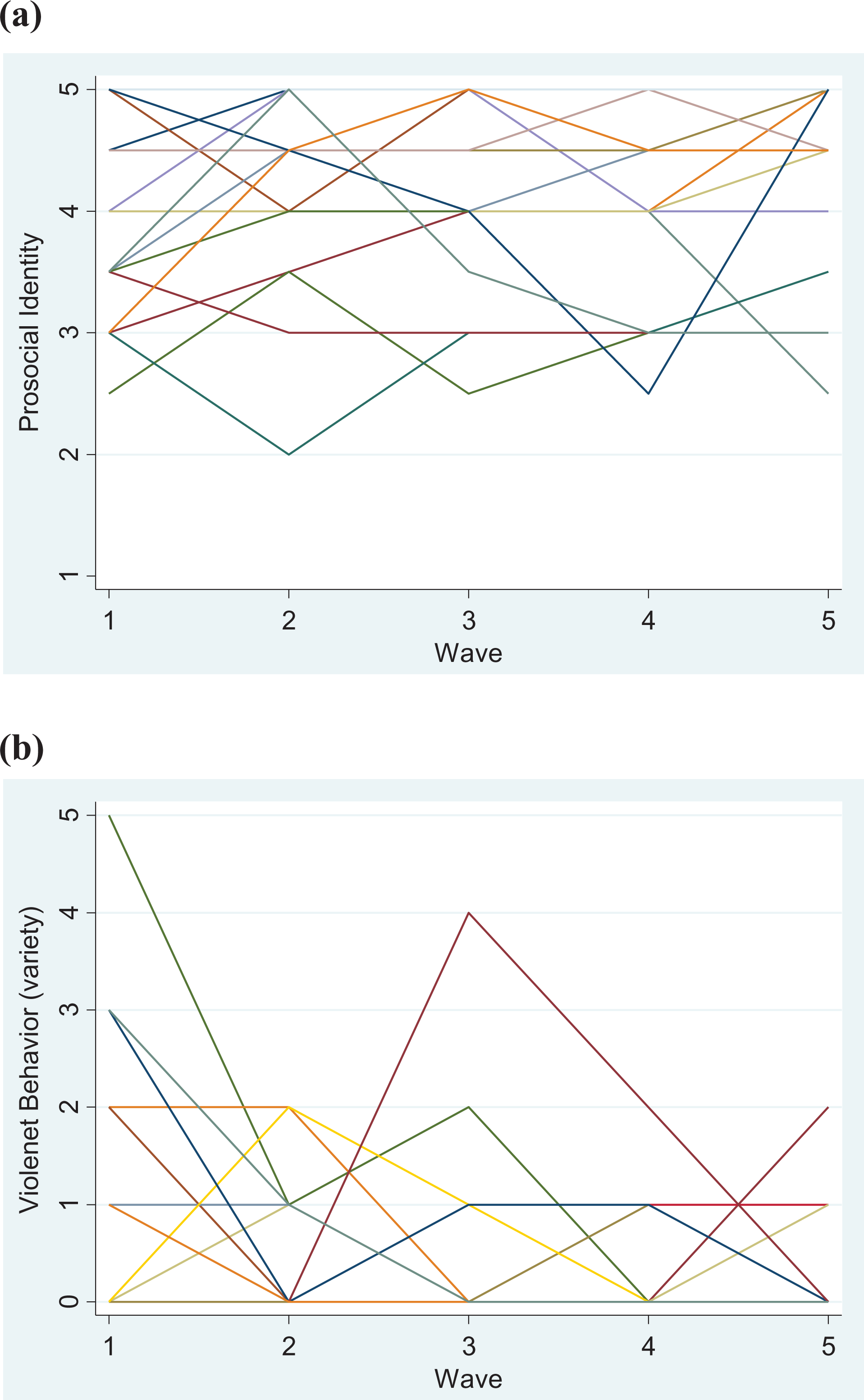
Within-individual trajectories of prosocial identity and violent behavior. (a) Prosocial identity (n = 20). (b) Violent behavior (variety index; n = 20).
Table 2 reports the results of the time-demeaned negative binomial random effects models predicting self-reported violent behavior with different model specifications. 11 Contrary to the pattern of typical “age–crime curves,” which tend to manifest increasing delinquency involvement until the age of 16–17 (Hirschi and Gottfredson 1983), 12 the time-trend only model in which only the subject’s age and its quadratic term are used as time-varying covariates (model 1) suggests that the overall longitudinal pattern of involvement in violent behavior continues to decrease from the baseline (β = −3.71, incidence rate ratios [IRR] = 0.02, p < .001) following a nonlinear functional form with upward curvature (β = 0.10, IRR = 1.11, p < .001). 13 It is consistent with the pattern observed from the official crime statistics and other survey data in South Korea (e.g., Jeong 2012, 2014; Park 2001), which might be explained by the distinct sociocultural contexts into which adolescents are socialized as discussed in the previous sections. Indeed, this pattern of declining violence with age would result from many known and even unknown characteristics of individuals and their environments that are both time-varying and time-invariant in nature (Laub and Sampson 2003; Rocque 2015). Thus, time-trend variables capturing the age effects were explicitly controlled in the subsequent models to better estimate the unique contributions of the key predictor and proposed mediators to the within-individual changes in violence over time. It was observed that, contrary to the pure age-based theories of crime that assume a normative/similar pattern of development across individuals over time (Gottfredson and Hirschi 1990; Wilson and Herrnstein 1985), there is a significant variability in the estimated growth parameter, which cannot be fully accounted for by age itself.
Within- and Between-individual Effects of Prosocial Identity on Violent Behavior.
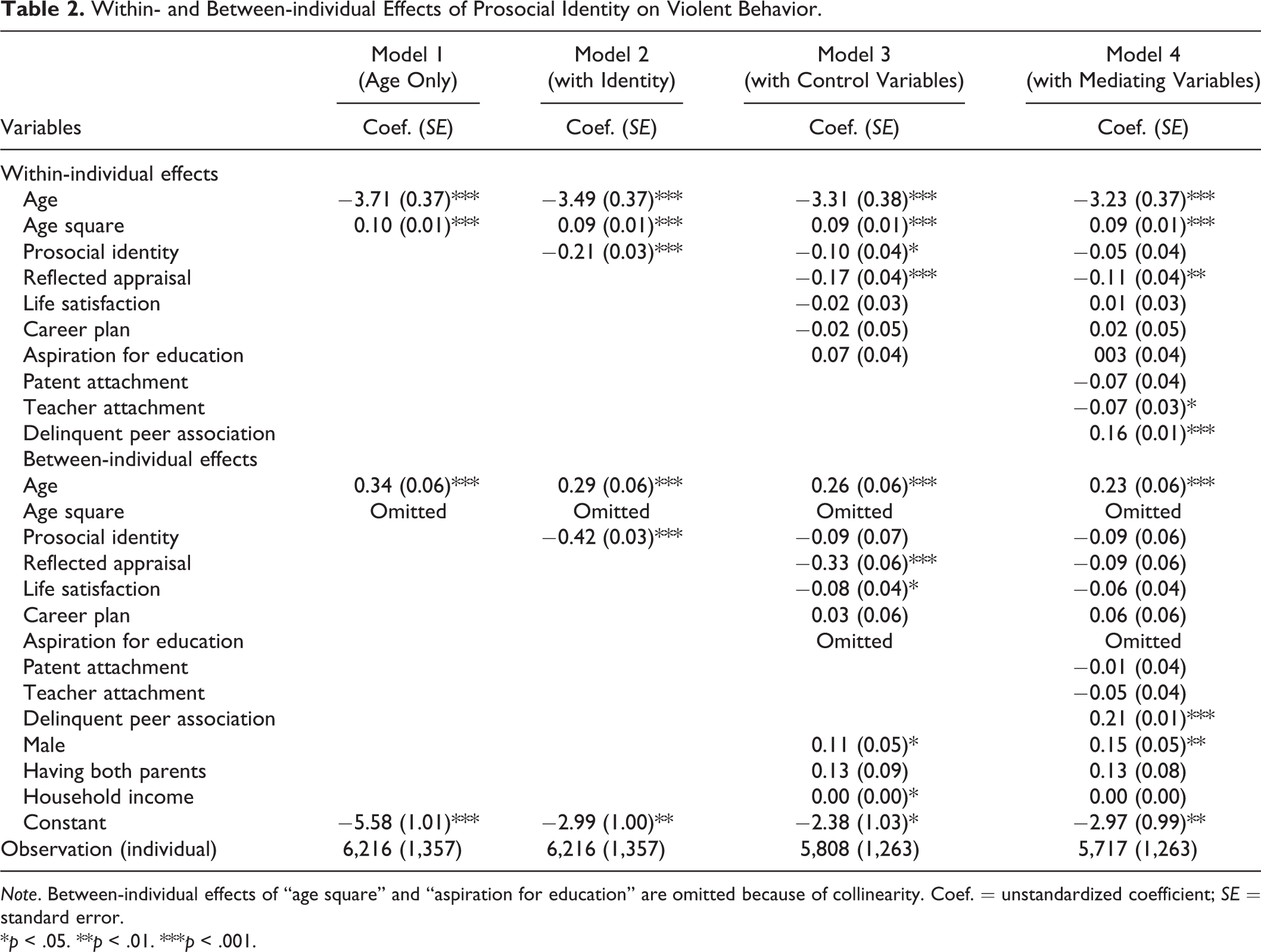
Note. Between-individual effects of “age square” and “aspiration for education” are omitted because of collinearity. Coef. = unstandardized coefficient; SE = standard error.
*p < .05. **p < .01. ***p < .001.
Our first hypothesis involves whether wave-to-wave changes in violent behavior are associated with within-individual changes in prosocial identity even after controlling for all the time-stable heterogeneity, time trend, and some of the most important time-varying sources of potential confounders. Model 2 in Table 2 indicates that within-individual variations in self-reported violence are significantly and negatively associated with within-individual changes in a subject’s perception of self as prosocial, net of all the sources of unobserved heterogeneity across individuals, and the observed growth pattern of violence over time. Specifically, a one-unit increase in the prosocial identity scale is associated with a 19 percent decrease in the violence variety scale (β = −0.21, IRR = 0.81, p < .001). This finding mirrors the self-identity literature which posits that those who view themselves as prosocial are less likely to engage in antisocial behaviors than those who view themselves as deviant (Akerlof and Kranton 2010; Brownfield and Thompson 2005; Burke 1980; Burke and Stets 2011; Foote 1951). Nonetheless, this study adds to the desistance literature by expanding the scope of self-identity theories to account for the process of within-individual changes in misbehavior not just among adult offenders (e.g., Na et al. 2015; Rocque, Posick, and Paternoster 2016) but also among the general youth population who did engage in violent behavior and are at risk of desistance. In model 3, we added some important time-varying covariates and time-stable characteristics to further minimize the selection bias that might yield an overestimated coefficient for the true relationship between prosocial identity and violence. As expected, the magnitude of the coefficient for prosocial identity is reduced substantially when these covariates are controlled, although it remains a significant predictor of violence (β = −0.10, IRR = 0.90, p < .05). While Matsueda (1992:1585-87) treated the reflected appraisal by others as a direct cause of delinquency after deleting the self-appraisal from the causal chain proposed by Kinch (1963), our finding suggests that one’s identity may have a unique impact on violence and delinquency above and beyond the influence of reflected appraisal.
We test another major hypothesis of interest in this study by examining whether the observed relationship between prosocial identity and violence is mediated by social bond and social network variables. We ask readers to recall that proposed mediators have significant mediating effects when a direct effect of a predictor on an outcome that was originally salient decreases substantially and becomes nonsignificant when potential mediators are considered simultaneously in the model estimation (Baron and Kenny 1986; Hayes 2013). Consistent with our a priori prediction, model 4 shows that the total effect of prosocial identity on violence observed in model 3 (β = −0.10, IRR = 0.90, p < .05) is reduced considerably and becomes nonsignificant (β = −0.05, IRR = 0.95, p > .05) when the proposed mediators are estimated simultaneously. Specifically, the total effect (β = −0.10) is decomposed into both direct (β = −0.05, which accounts for 50 percent of the total effect) and indirect effects (β = −0.05, which also accounts for 50 percent of the total effect). We view that this mediation is meaningful enough to further assess the longitudinal link among these variables and, more importantly, to explore the specific indirect paths between prosocial identity and violence.
The between-individual effects of the predictors show similar patterns as those observed from within-individual models. Model 2 shows that adolescents overall with higher levels of prosocial identity during the entire study period are significantly less likely to engage in violent behavior (β = −0.42, IRR = 0.66, p < .001). Models 3 and 4 indicate that the between-individual effect of prosocial identity observed in model 2 is reduced considerably and becomes even nonsignificant with controls (β = −0.09, IRR = 0.91, p > .05).
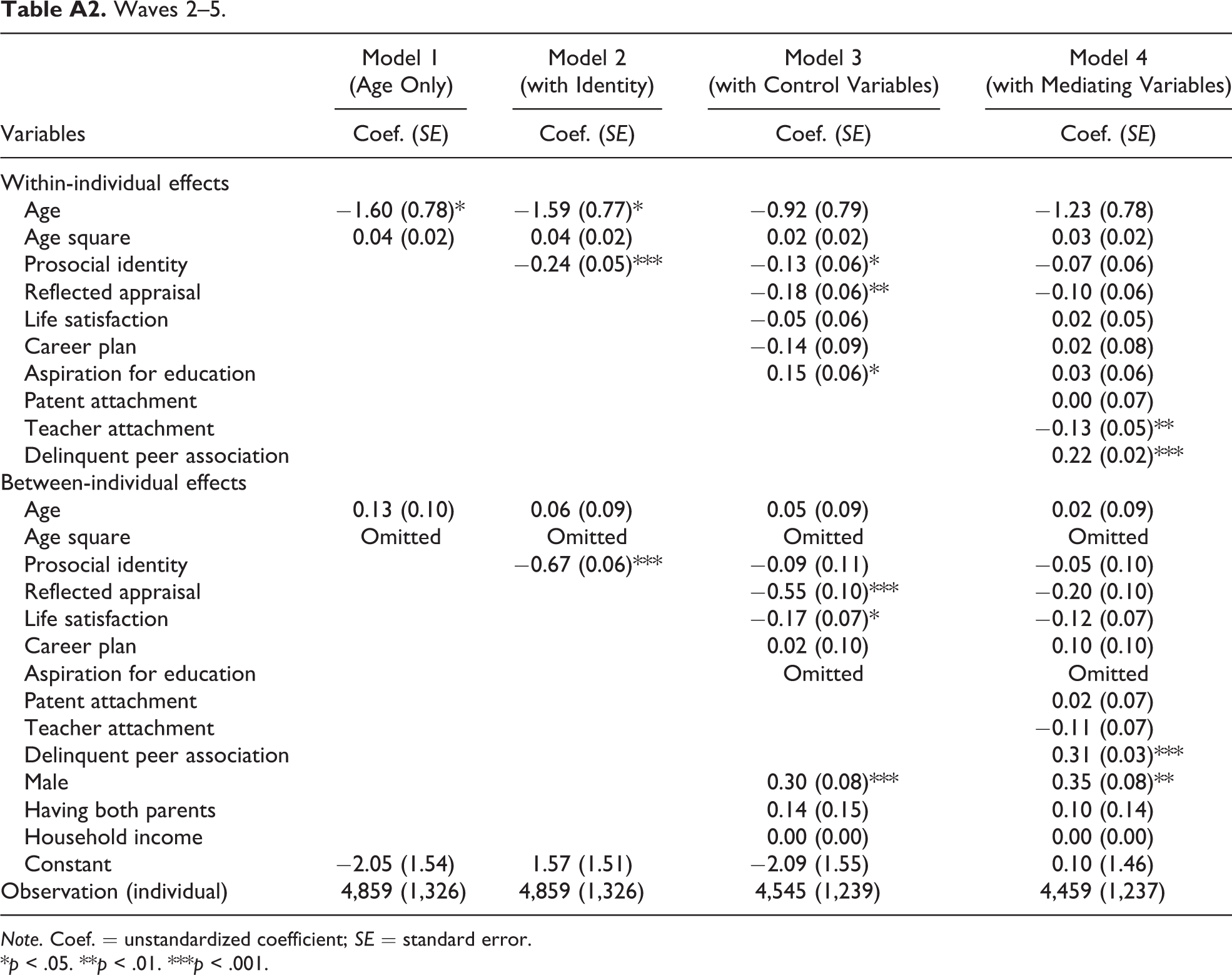
To further assess the degree to which these findings hold across different model specifications, the parameters were reestimated with the following subsamples: (1) only the most serious offenders (n = 766) after excluding the individuals who engaged in only “teasing or mocking” and/or “bullying other friends” and (2) only waves 2–5 due to a relatively large change in both identity and violence across the first two waves. Similar patterns were observed in these sensitivity checks (see Appendix Tables A1 and A2).
To explicitly assess the specific mediation processes we proposed, the same longitudinal path analysis was repeated using a set of variables measured at different time periods (wave 1, 2, and 3 as a baseline, respectively). All the analyses were conducted via Mplus version 7.11 (Muthén and Muthén 2013) using the options for the negative binomial model for an overdispersed count outcome. Just as we did for the previous random effects models, we controlled for the same time-varying and time-invariant covariates measured at the same wave as prosocial identity was measured (except for the demographic characteristics which were measured at the baseline). In addition, prior levels of violence (at waves t and t + 1) and mediators (at wave t) were also controlled to strengthen the validity of the findings (Cole and Maxwell, 2003). These models are overidentified and a set of goodness-of-fit indices indicates that our proposed models fit the data reasonably well (Table 3).
Goodness of Fit Indices for Longitudinal Path Models.
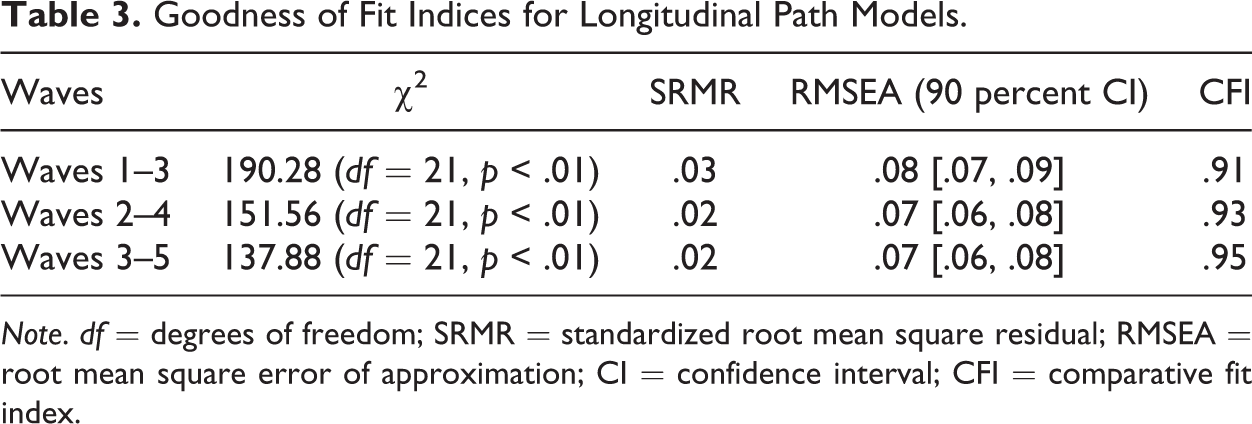
Note. df = degrees of freedom; SRMR = standardized root mean square residual; RMSEA = root mean square error of approximation; CI = confidence interval; CFI = comparative fit index.
Figure 2 shows that one’s prosocial identity is significantly related to subsequent social relationships and commitment by increasing one’s attachment to parents and teachers and decreasing the association with delinquent peers. The estimates of the path coefficients suggest a similar pattern of relationships across different time periods. As expected from the results of model 4 in Table 2, delinquent peer association is significantly associated with subsequent violent behavior in the expected direction (β = 0.03, p < .05; β = 0.05, p < .001; and β = 0.04, p < .001 for waves 1, 2, and 3 as a baseline, respectively). However, none of the path coefficients from parent and teacher attachments to violence is significantly different from 0. Consistent with the pattern observed in model 4 of Table 2, prosocial identity does not have a significant direct impact on subsequent violence when all the control and mediating variables are held constant.

Longitudinal path models. These coefficients are unstandardized estimates. *p < .05. **p < .01. ***p < .001.
Table 4 summarizes the estimated total, direct, and indirect effects of prosocial identity on subsequent violent behavior. The estimated total indirect effects of the proposed mediators are the same (−.01), although this is significant only for the “waves 3–5” model. In particular, the indirect effect of one’s effort to stay away from delinquent peers is most salient, which accounts for the entire indirect effect estimated. It is consistent with Matsueda and Heimer’s (1997:188) position that the influence of peer group is intensified during adolescence, which becomes the locus of social interaction in the socialization process.
Total, Direct, and Indirect Effects of Prosocial Identity on Violent Behavior.
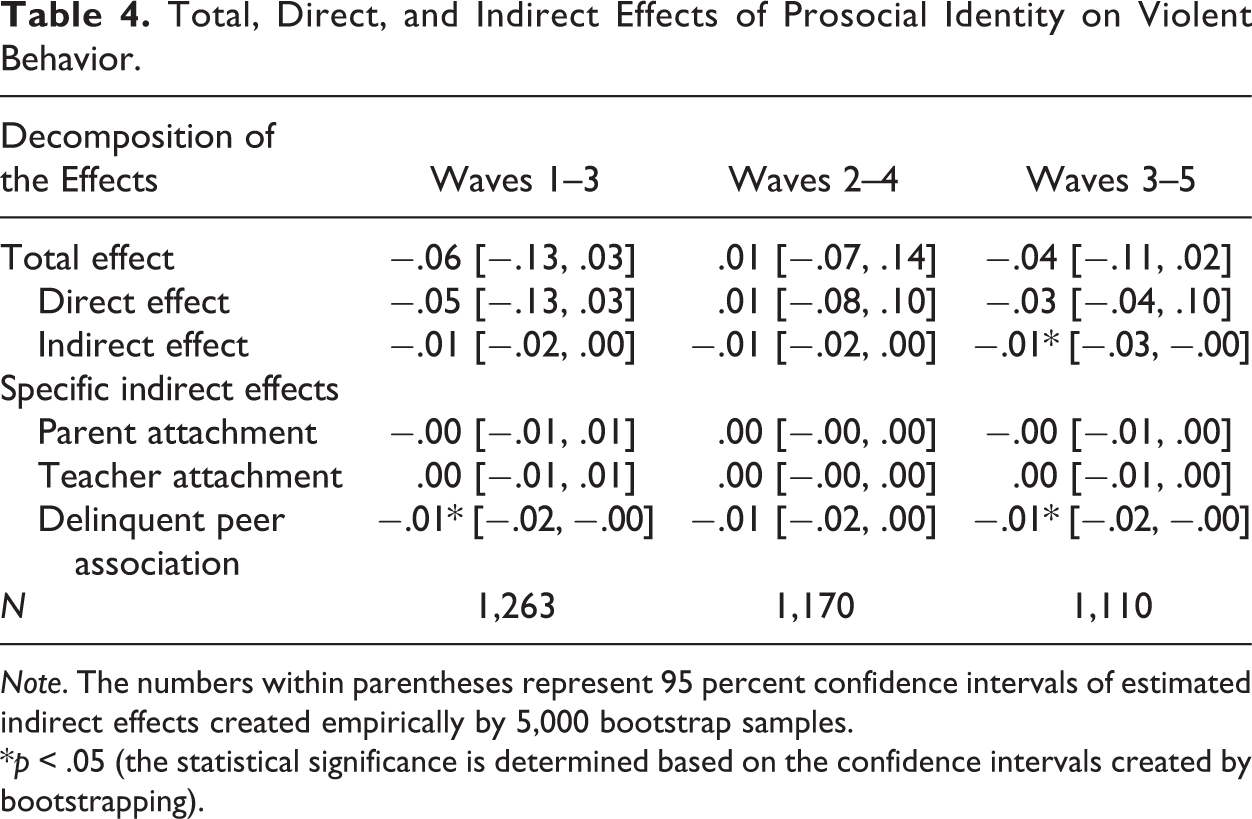
Note. The numbers within parentheses represent 95 percent confidence intervals of estimated indirect effects created empirically by 5,000 bootstrap samples.
*p < .05 (the statistical significance is determined based on the confidence intervals created by bootstrapping).
Discussion and Conclusion
Recent years have seen a surge in interest in criminological theories of desistance that place great focus on offenders’ identities and the role of human agency. While there has been a good deal of empirical support for the importance of identity in explaining desistance, the vast majority of this research has been conducted on adult samples based on qualitative/narrative research designs. Drawing on a nationally representative sample of the youth population in South Korea, we tested two specific hypotheses about the association between prosocial self-identity and youth violence and found at least partial support for the hypotheses we proposed. Our findings suggest that our own identity of self as conformist might only partially be a social construction shaped by others’ appraisals, but nevertheless remains intimately connected to the actions we intentionally take. The significantly independent effect of prosocial identity on adolescent violent behavior allows for the possibility that agentic cognitive processes leading to a self-change can have a unique contribution to the decrease in delinquency, even in the absence of externally driven stimuli from significant others (Matsueda 1992) or salient life events such as “turning points” (Laub and Sampson 2003) or “hooks for change” (Giordano et al. 2002). In addition, consistent with Silver and Ulmer’s (2012) and Paternoster and Bushway’s (2009) speculations, having a prosocial identity is instrumental in developing a commitment to actions consistent with that identity. In other words, having a prosocial identity strengthens the conventional social bonds through a closer attachment to one’s parents and teachers as well as detachment from delinquent peers. These results harmonize well with identity theories that place great weight on human agency and the role that deliberate/intentional efforts at self-improvement play in the desistance process among adult offenders.
The primary goal of this study was to expand the theoretical and empirical scope of identity-based theories of crime and desistance in order to account for the movement away from antisocial behaviors during adolescence. According to Laub and Sampson (2003), “good theories of crime should account for the onset, continuation, and desistance from criminal behavior across the life span” (pp. 22-23). Although Laub and Sampson (2003:23) assert that there is not much to learn about the termination or desistance of low-rate offending among adolescents other than what is already known, we view that adolescence is a critical period of life for studying the gradual process of cessation of offending, considering that most adolescent-limited delinquents make initial and continued attempts to move away from deviant pathways (Moffitt 1993) and indeed successfully shift their life trajectories toward a prosocial direction even before experiencing some widely recognized turning points in life (see Skardhama and Savolainen 2014). During this period, adolescents begin to see themselves in a different light as they undergo biological, cognitive, and psychological development as well as accumulate social experiences that were not available earlier in life. They also come to view crime and deviance differently by considering longer term and more diverse contexts within which they will be situated after considering the views of a broad spectrum of others. Indeed, adolescence is a critical period when children begin to consider the norms, rules, and expectations of more “abstract and generalized others” who may not be present in the immediate situation, in addition to “concrete and specific” significant others nearer to them (Matsueda 1992; Matsueda and Heimer 1997:187). As their cognitive ability to consider perspectives of others improves, and their tendency to incorporate the future into a present context increases, the boundary of reference groups crucial for viewing oneself as an object expands and multiple reference groups emerge (Cauffman and Steinberg 2000; Scott, Reppucci, and Wooldard 1995; Steinberg and Cauffman 1996). Such a malleable nature of self and its mutable elements should be more pronounced during adolescence when the duration of cumulative continuity is relatively short and the mutual process of self-selection and social causation is less systematic (Matsueda and Heimer 1997:180-83). Accordingly, adolescents have more leeway than their younger and older counterparts in considering new possibilities in the future, discarding old lifestyles and habits, and beginning the process of building new perspectives and ways of life (Arnett 2000; Erikson 1968). This is why key propositions of identity-based theories of crime and desistance need to be extended and elaborated further to account for the desistance from delinquency among adolescents. While Matsueda’s (1992) and Heimer and Matsueda’s (1994) views also emphasize reflection, thought, or self-consciousness as critical components for the origin of self-change, ours are more internal, cognitive, agentic, and intentional than previous theorizing based on the perspective of the “self as subject” (Blasi and Glodis 1995). The current data show that the pattern of decline in violent behavior maps fairly well with the within-individual variation of prosocial identity even after controlling for the influence of some important and widely recognized sources of identity formation such as reflected appraisals and other theoretical factors; this opens up the possibility that desistance from delinquency among adolescents can be at least partially accounted for by the intentional decision to change self-identity and discontinue deviant lifestyles after conscious reappraisal of the costs and benefits of continued offending behavior (Cornish and Clarke 1986; Paternoster and Bushway 2009). Despite the possibility of substantial overlap with moral development which is also presumed to exert motivational power for moral commitments and actions (Blasi and Glodis 1995; Hardy and Carlo 2011; Hardy et al. 2014; Krettenauer and Victor 2017; Walker 2014) and tend to improve from adolescence to adulthood (Krettenauer, Murua, and Jia 2016), our indicators of prosocial identity are not direct measures of moral identity, defined as “the degree to which being a moral person is important to an individual’s identity” (Hardy and Carlo 2011: 212). More importantly, we view that our conceptualization of prosocial identity involves more cognitive and agentic processes than that of moral identity because one’s motivation to change self-identity and move away from deviant lifestyles is generated internally and intentionally by considering the costs of continued deviant lifestyles and failures associated with feared self-images. Nonetheless, we encourage researchers to explore the roles played by moral identity, as a related but distinct construct, in the desistance process.
The pattern observed from the multiple mediation analyses (i.e., the inverse effect of a prosocial identity on violent behavior is mediated almost exclusively by efforts to dissociate with deviant peers) suggests that most immediate and visible change after the decision to stop deviant acts during adolescence would necessarily involve agentic moves to stay away from deviant peer networks that increase not just direct criminal motivation and opportunity, but also differential reinforcement encouraging continued involvement in violent behavior (Akers 1990). Violence among adolescents is mostly a group behavior in South Korea, and only the paths from delinquent peer association to violence were significant in Figure 2. This is consistent with the assertion that declines in crime during adolescence are associated primarily with declines in peer association (Warr 1993).
Considering that prosocial identity is a prominent factor facilitating the natural process of desistance from delinquency, we should not implement policies or practices that might inhibit or delay the agentic moves toward prosocial identities and lifestyles. For example, criminalizing minor types of misbehavior (Kupchik 2010; Na and Gottfredson 2013) could potentially disrupt a natural recovery process from sporadic and less systematic delinquent behaviors. More seriously, such stigmatizing experiences might lead to further and more serious deviance through “collateral damages” to educational/vocational opportunities (Kirk and Sampson 2013) and amplify processes of negative social reactions/reinforcements consequent to a formal labeling of delinquents (i.e., “secondary deviance” and “secondary sanctioning”: Liberman, Kirk, and Kim 2014). Rather, efforts should be made to increase the accessibility to positive opportunities—rather than blocked opportunities—to help youths strive for future success and (re)gain a perception of themselves as conformists, establishing offending as both unacceptable and undesirable. When delinquent behavior is made public through formal criminal justice system processing, it might result in a “delayed passage to adult status, both objectively and subjectively” (Massoglia and Uggen 2010:544).
Despite our efforts directed to extend the spectrum of identity theories of crime and desistance to account for the pattern of substantial decreases in delinquency during the second decade of life, there are some limitations of this study. First, since the current data do not include direct measures of internally generated sources of identity change (e.g., undesired/feared selves and desired/possible selves in the future), we could not examine more complete processes linking the wellspring of identity to the causal diagram we have proposed in this study. Second, our attempt to explore the mediating mechanisms of the identity–delinquency link is limited because the measures of other important dimensions of social bond (e.g., moral belief, commitment) are not available. In a similar vein, other possible intervening processes (e.g., psychological, psychosocial, and social changes) that accompany the changes in self-identity and delinquency need to be assessed in future research. Lastly, while it is plausible to assume that the change of self-identity is structurally circumscribed (Matsueda and Heimer 1997:176-77; Silver and Ulmer 2012:705-6), it was beyond the scope of this study to assess whether other structural/cultural factors affect the identity change and/or condition the impact of identity on the proposed mediators and the outcome. Future research should explore these unverified causal mechanisms and contingencies.
In sum, we view that identity theory of crime and desistance can serve as an integrative theoretical framework in order to provide a more complete and realistic understanding of within-individual changes in deviant behavior in general and desistance from delinquency and crime throughout life-course specifically (including the critical period of adolescence). It incorporates both internal and external influences on desistance to present a systematic and dynamic process explicating how these factors produce and sustain changes in behavior.
Footnotes
Appendix
Waves 2–5.
| Variables | Model 1 (Age Only) | Model 2 (with Identity) | Model 3 (with Control Variables) | Model 4 (with Mediating Variables) |
|---|---|---|---|---|
| Coef. (SE) | Coef. (SE) | Coef. (SE) | Coef. (SE) | |
| Within-individual effects | ||||
| Age | −1.60 (0.78)* | −1.59 (0.77)* | −0.92 (0.79) | −1.23 (0.78) |
| Age square | 0.04 (0.02) | 0.04 (0.02) | 0.02 (0.02) | 0.03 (0.02) |
| Prosocial identity | −0.24 (0.05)*** | −0.13 (0.06)* | −0.07 (0.06) | |
| Reflected appraisal | −0.18 (0.06)** | −0.10 (0.06) | ||
| Life satisfaction | −0.05 (0.06) | 0.02 (0.05) | ||
| Career plan | −0.14 (0.09) | 0.02 (0.08) | ||
| Aspiration for education | 0.15 (0.06)* | 0.03 (0.06) | ||
| Patent attachment | 0.00 (0.07) | |||
| Teacher attachment | −0.13 (0.05)** | |||
| Delinquent peer association | 0.22 (0.02)*** | |||
| Between-individual effects | ||||
| Age | 0.13 (0.10) | 0.06 (0.09) | 0.05 (0.09) | 0.02 (0.09) |
| Age square | Omitted | Omitted | Omitted | Omitted |
| Prosocial identity | −0.67 (0.06)*** | −0.09 (0.11) | −0.05 (0.10) | |
| Reflected appraisal | −0.55 (0.10)*** | −0.20 (0.10) | ||
| Life satisfaction | −0.17 (0.07)* | −0.12 (0.07) | ||
| Career plan |
|
0.02 (0.10) | 0.10 (0.10) | |
| Aspiration for education | Omitted | Omitted | ||
| Patent attachment | 0.02 (0.07) | |||
| Teacher attachment | −0.11 (0.07) | |||
| Delinquent peer association | 0.31 (0.03)*** | |||
| Male | 0.30 (0.08)*** | 0.35 (0.08)** | ||
| Having both parents | 0.14 (0.15) | 0.10 (0.14) | ||
| Household income | 0.00 (0.00) | 0.00 (0.00) | ||
| Constant | −2.05 (1.54) | 1.57 (1.51) | −2.09 (1.55) | 0.10 (1.46) |
| Observation (individual) | 4,859 (1,326) | 4,859 (1,326) | 4,545 (1,239) | 4,459 (1,237) |
Note. Coef. = unstandardized coefficient; SE = standard error.
*p < .05. **p < .01. ***p < .001.
Authors’ Note
The data for this study were provided by the Korean National Youth Policy Institute (KNYPI).
Acknowledgments
The authors would like to thank Katherine E. Limoncelli, Christopher Sullivan, and three anonymous reviewers for their unusually helpful comments and suggestions on the previous drafts of this article.
Declaration of Conflicting Interests
The author(s) declared no potential conflicts of interest with respect to the research, authorship, and/or publication of this article.
Funding
The author(s) received no financial support for the research, authorship, and/or publication of this article.