



Abstract
Objectives:
This study examines the influence of online peers who are not regularly seen in person by considering if online, pro-delinquent support is associated with self-reported delinquency independently of delinquent peers.
Methods:
Data come from a longitudinal, panel survey of two cohorts of middle and high school students located within six school districts (N = 1,177). Analyses first examine the overlap between online peer support for delinquency and perceived peer delinquency. Next, models consider how measures of online peer support for delinquency are associated with the prevalence (logit), variety (negative binomial), and changes (first difference) in self-reported delinquency.
Results:
Online peers generally do not enable exposure to new messages supportive of delinquency; rather, they supplement influences derived from delinquent peers. Little evidence was found that online peer support was associated with general delinquency and violence, although changes in online peer support were associated with changes in these outcomes. Partial evidence was found that online peers are associated with the prevalence, variety, and changes in self-reported theft and substance use.
Conclusions:
The influence from unique online peers is largely secondary to offline peers, although this depends upon the crime type under investigation.
Introduction
Advancements in technology over the past several decades have significantly expanded opportunities for youth to meet new people and connect with their existing friends. In fact, while many terms are used to describe the current generation of youth (e.g., postmillennial, generation Z), the phrase “digital native” (Prensky 2001) 1 captures one of the defining characteristics of youth today—adolescents have near ubiquitous access to mobile, electronic devices that allow them to wirelessly access the Internet and social media (Palfrey and Gasser 2008; Subrahmanyam and Smahel 2010). This access has important implications for understanding delinquent and deviant behavior given the well-established link between socialization and crime (Pratt et al. 2010; Warr 2002). In the past, researchers typically assume that propinquity, or physical proximity, almost exclusively determined the types of associations one experiences and thus the type and degree of contact with behavioral patterns supportive of crime. It is for this reason that schools and neighborhoods have served as the primary social contexts within which delinquent and deviant behavior are learned and reinforced. While these contexts remain vital to understanding delinquency, technology has changed the social world of adolescents in ways that may impact the types of behavior patterns to which youth are exposed, which may affect overall involvement in delinquency.
Concern for the potential harm of online peers is often expressed by the general public (George and Odgers 2015). According to two national studies, around 63 percent of parents report being extremely concerned about their children meeting someone online (boyd and Hargittai 2013), and one third have concerns or questions over the use of social media in general (Duggan et al. 2015). But is this concern warranted as it relates to negative influences? At the turn of the century, Warr (2002:87-88) called attention to an emerging yet unstudied population, the “virtual peer group,” which “contains an ample supply of dubious role models.” In his 2009 book on social learning theory, Akers expanded on Warr’s point by stating that learning theories clearly recognize the role of virtual groups along with other secondary groups. In the recent edition of their criminology textbook, Akers, Sellers, and Jennings (2017: 87-88) directly emphasize how those who use social media represent different “variations on virtual differential association,” whereby earlier, longer, more frequent, and more intimate associations have more influence on behavior.
The notion that virtual, or online, peers are secondary groups runs counter to the emerging body of literature which suggests these peers can have strong effects on offline personal behavior. Although the operationalization of online peers varies across studies, recent work found associations between communicating online and self-reported offending and substance use (e.g., Huang et al. 2014; McCuddy and Vogel 2015a; Miller and Morris 2014). However, most studies examining online delinquent peer influence are unable to control for offline peer behavior. This presents an interesting dilemma for researchers studying delinquent peer effects. On the one hand, it is possible that the association between online peers and crime is driven by characteristics of offline friends. If so, criminologists may not need to worry with online peer effects since this could simply be an extension of social processes we have been studying for decades. On the other hand, the ability of online communication to enhance socialization could mean that online peers play a salient role in influencing delinquent tendencies among digital natives. If youth form unique online friendships with individuals who are not known in person, this could extend the pool of peers who can transmit definitions and reinforcement favorable toward crime. Using a longitudinal sample of 1,177 middle and high school students, the current study attempts to shed light on this issue by exploring the overlap between perceived peer delinquency and online support for delinquency, in addition to examining how both measures of peer influence are associated with self-reported delinquency.
Literature Review
Peer Influence and Delinquency
Criminologists have long noted a strong correlation between delinquent peers and self-reported delinquency, and scholars have spent decades trying to understand how peers facilitate the onset and continuation of criminal behavior. The consistent and robust peer effect has led researchers to speculate why peers matter by specifying mechanisms of influence, such as attitudinal transference, behavioral reinforcement, and group pressure (e.g., Akers 2009; Matsueda 1988; McGloin and Thomas 2019; Warr 2002). One of the unifying themes throughout the peer literature is the concept of differential association, which refers to the proposition that criminal behavior is learned through communication and interaction with intimate associates (Sutherland 1947). This suggests it is how we interact with others, and the content of those interactions, that is of primary importance in the etiology of delinquency. Specifically, those who are exposed to an excess of delinquent definitions are more likely to adopt such behavior themselves, and communication plays a significant role in this process. Factors that facilitate or hinder communication, such as mobility and propinquity, directly influence the degree of contact with others and thus the criminal definitions made available to an individual. As available associations become more abundant, this in turn affects exposure to norms and values supporting or disapproving of crime. Extensions of differential association posit additional mechanisms in the learning process; for example, Akers’ (2009) social learning theory suggests actual and anticipated rewards and punishment reinforce behavior. These theories of normative influence suggest crime is the result of being socialized to accept criminal definitions and behavior.
Somewhat counter to this perspective are those who advocate that the criminogenic potential of peers operates through unstructured socializing, which according to Osgood et al. (1996), provides situational inducement and opportunity to offend. Under this view, peers do not have to be delinquent to affect one’s behavioral tendencies; rather, time spent socializing in unstructured settings is intrinsically criminogenic. This means greater emphasis may need to be placed on offline contexts if opportunity is a more proximate cause of offending. In fact, Warr and Stafford (1991) described the relationship between peers and delinquency as “tenuous” and argued adolescents may not invoke personal attitudes approving delinquency when engaging in crime or deviant acts. In support of their position, they found that peer attitudes do indeed affect personal behavior, but this relationship is mediated almost entirely through personal attitudes (c.f., Jensen 1972). To this end, scholars have highlighted the need to focus on short-term peer processes contingent on specific situations. For example, fear of losing status and maintaining loyalty to close ties can result in behavioral compliance with a group even if it goes against one’s own moral inhibitions (Costello and Hope 2016; Warr 2002).
Perhaps the strongest criticism of the peer-delinquency association is rooted in the concept of selection. Control theorists often assume those with a propensity toward crime select delinquent friends, in turn explaining the robust association between peers and crime (Glueck and Glueck 1950; Gottfredson and Hirschi 1990). However, other work attributes the selective process to factors beyond delinquency, such as weak attachments to conventional society (Thornberry 1987), low self-control (McGloin and Shemer 2009), and experiencing peer rejection (Dishion, Piehler, and Myers 2008; Patterson, DeBaryshe, and Ramsey 1989). A recent meta-analysis by Gallupe and colleagues (2018) finds support for both peer influence and selection, underscoring the need to control for both processes when examining the link between peers and offending. Despite decades of research exploring this issue, the peer selection debate continues within the field of criminology.
Furthermore, there is evidence to suggest that peer influence may be an offense specific process. Under a classic learning approach, one must be exposed to specific definitions to violate specific laws and norms (Boman, Mowen, and Higgins 2019; Matsueda 1982, 1988; Thomas 2015; Tittle, Burke, and Jackson 1986). This notion was supported by the work of Tittle and colleagues (1986), who suggest that substance use differs from other crimes due to its moral distinctiveness. Using drugs is often perceived as victimless, whereas there is direct harm to others through crimes such as assault and theft. In other words, definitions favorable toward crimes that involve exploitation may be part of a different domain requiring exposure to specific behavioral patterns that support harming others (see also Jackson, Tittle, and Burke 1986). Prior work by Thomas and McCuddy (2020) found there was within-individual variation in the susceptibility of influence, where youth who anticipate high levels of guilt for a crime are less likely to be influenced by their peers. This also aligns with the opportunity framework, where situational factors could influence how one’s status is affected by participating in group activity (e.g., drug use). Whether the mechanism is attitudinal or situational, it is important to consider multiple types of delinquency when examining delinquent peer influence.
Changing Landscape of Social Behavior
Incorporating online peers into the study of crime is no simple task as there are a number of ways digital communication has affected both the structure of peer groups (i.e., online peers as a context) and the ways in which influence is transmitted (i.e., learning norms, behavioral reinforcement, situational inducement). In order for peers to exert influence generally, one must communicate with others or observe behavior first-hand. For digital natives, online communication provides ample opportunity to socialize by enhancing the ways youth connect with one another. A nationally representative sample revealed that as of 2018, 90 percent of teenagers in the United States go online multiple times per day, and just under half are online “almost constantly” (Anderson and Jiang 2018). In fact, the use of the term “digital native” to describe youth reflects a generational shift in which social media and the use of online communication is normative and not merely a temporary, subcultural artifact (boyd 2014; Palfrey and Gasser 2008).
There are three ways that online communications affect the differential association process among digital natives. First, and most pertinent to the current study, youth can be exposed to associations online who are not part of traditional contexts, thereby increasing the possibility of exposure to behavior patterns favorable toward (or against) crime. According to the Pew Research Center (Lenhart et al. 2015), more than half of teenagers (57%) have established new friendships online, with two-thirds (64%) of these originating through social media (around one-third from online gaming). There are a variety of reasons why youth may seek new friendships online, including self-exploration (seeing how others react), social compensation (make up for being shy or socially anxious), and social facilitation (to form new friendships) (Subrahmanyam and Greenfield 2008). These first two relate to ways that cyberspace can ameliorate the effects of negative in-person encounters by creating a perceived “safe space” or circumventing barriers to communication. Through social facilitation, youth can expand their peer networks by befriending those with similar traits. For example, the most popular online groups for teenagers in 2018 involved hobbies (including gaming), humor, and pop culture; however, 69 percent of youth report that social media allows them to interact with people from different backgrounds and experiences (Anderson and Jiang 2018). In the same study, two-thirds of youth reported social media enables them to find different points of view. Regardless of the reasons why and how friendships are developed online, it is clear youth form associations outside of the traditional, face-to-face peer group. Although we have moved beyond asking “if” peers matter in field of criminology, this question remains unanswered as it relates to peers in the cyber context.
The second way online communication affects differential association is by altering the way individuals communicate with their friends. In particular, cyberspace affects the modalities of association (Sutherland 1947) through expanded opportunities to socialize. Unlike communication that takes place in schools or neighborhoods, online communication is considered “spatiotemporally disorganized,” meaning geographic space and time no longer completely determine how and when individuals communicate with one another (Jaishankar 2008). Although prior work has demonstrated that social media mostly increases the overall amount of time spent communicating with peers rather than displacing time spent interacting in offline settings (George and Odgers 2015; Kraut et al. 2002; Lee 2009), recent work using nationally representative data suggests adolescents may be spending less time hanging out with friends in person (Twenge, Spitzberg, and Keith Campbell 2019). Using data from the Monitoring the Future survey, Twenge and colleagues demonstrated that at the cohort level, overall time spent communicating with friends in person has declined while time spent communicating online has increased. 2 Whether the cyber context has increased or displaced time communicating with friends, its ability to facilitate frequent communication over longer periods of time means it could provide additional pro-criminal definitions and reinforcement.
The modalities of duration and frequency relate to communicating with all online peers, meaning those who were met both online and offline. Moreover, online communication may also alter the intensity of associations by facilitating the transition of weak ties into more intimate ties. While there is a large overlap between offline and online friends, studies show there is little overlap in the peers who are communicated with the most in online versus offline contexts (Subrahmanyam and Smahel 2010). Close online friends may differ from close offline friends, which may increase the total pool of influential peers. Therefore, online-only peers may represent a pool of intimate peers who have the capacity to transmit norms and reinforce behavior that is independent of the influence from offline friends.
Finally, those who communicate via cyberspace sometimes act differently when online compared to how they act in offline settings (Aiken 2016; Joinson 2001). In discussing certain basic psychological features of the Internet, Suler (2016) explains how the lack of physical contact lessens inhibitions since the perceived emotional distance when online reduces the fear of repercussions as individuals no longer feel responsible for what they say or do (see also Aiken 2016). Numerous studies have found evidence that online communication facilitates self-disclosure of personal information (Amichai-Hamburger, Kingsbury, and Schneider 2013; Joinson 2001; Suler 2016) which can increase the intimacy of existing offline friendships (Buhrmester and Prager 1995; Valkenburg and Peter 2009). According to one national study, around 85 percent of teenagers report that social media allows them to show different sides of themselves that they would not show offline (Lenhart et al. 2015). Other work has found that about one-third of adolescents prefer communicating with their friends online rather than in person (Schouten, Valkenburg, and Peter 2007). Taken together, forming new associations in an online context, enhancing opportunities to communicate online, and increasing the self-disclosure of personal information online may ultimately alter the degree in which youth are exposed to definitions and reinforcement favorable toward crime.
Offline Consequences of Online Socialization
Mirroring the trend of early criminological inquiry, initial work discussing the potential online peer effect was more philosophical than empirical. Contemporary scholars clarify that primary peer groups are those that are “face-to-face” (Warr 2002) or those that occur “in person” (Akers 2009). When Warr published his book Companions in Crime in 2002, his language alluded to the idea that online peers are secondary to in-person peers. Akers and colleagues (2017) were more direct in stating that virtual peers are indeed part of secondary groups, although they use the term “virtual differential association” without defining or elaborating on how these peers differ or how the process of differential association is affected by the cyber context. Rather, they draw from Sutherland’s modalities of association and how definitions are weighted by factors that can strengthen or weaken the influence of behavior patterns. This addresses how opportunities to socialize have been expanded through cyberspace, but it is unclear how influence from online peers differs from that of face-to-face peers.
Initial studies exploring the effects of associating with online peers were limited in that they used small focus groups and laboratory experiments which focused on the intention or willingness to engage in risky behavior offline as the dependent variable as opposed to measuring actual behavior (see Branley and Covey 2017; Young and Jordan 2013). As research designs expanded, self-reported deviant and delinquent behavior made its way into the purview of scholars. For example, Huang et al. (2014) found that exposure to offline friends who posted pictures of partying where alcohol was present was associated with later alcohol use (see also Moreno et al. 2009; Stoddard et al. 2012).
Miller and Morris (2014) further expanded the study of online socialization by applying Akers’ social learning theory to both offline and “fully” (i.e., never met in person) online peer groups. Definitions, imitation, and differential reinforcement were found to operate similarly in the cyber context as they did in traditional contexts. However, the focus of their study was on what they call virtual offenses (e.g., hacking and piracy). Other studies have focused on the effects of being exposed to criminal behavior from any online peer, meaning those offline friends who use online communication as well as online-only friends. For example, McCuddy and Vogel (2015a) found an association between viewing both violent and non-violent peer behavior online and self-reported offending among college students, and Branley and Covey (2017) found the same association for exposure to depictions of, and support for, violence and substance use on social media among an international sample of young adults. Subsequent work by McCuddy and Vogel (2015b) focused on a fundamental difference between online and offline social networks by considering the role of network size in the peer influence process. They found that individuals embedded in larger online networks experience an exposure saturation point where messages promoting criminal behavior became redundant and have diminishing returns on self-reported crime. This suggests that peer influence is stronger in smaller, more intimate online peer groups, which aligns with prior work on peers in traditional contexts (Akers 2009).
While these studies have laid the groundwork for examining online peer influence, we have yet to address the contextual issue related to online peers. That is, the question remains whether individuals are exposed to the same pro-criminal definitions from online peers as they are from offline peers. Additionally, most prior work has been unable to test for the unique effect of one’s collective online group, meaning restricting focus to peers who have never been met in person omits part of the cyber context (e.g., offline weak ties who become intimate online friends) and examining online peers as a whole ignores the fact that many adolescents befriend people online who are the same friends offline. In one of the few studies isolating unique online effects, Negriff (2019) initially found a strong association between online-only friends who smoke marijuana and self-reported substance use; however, this association disappeared after controlling for offline friends. Finally, controlling for temporal ordering can help ensure the validity of the findings. With the exception of the work from Huang and colleagues (2014), the above-mentioned studies were all cross-sectional.
Current Study
The social world of adolescents is clearly more complex than in the past, and the intricacies of the cyber context create challenges for researchers interested in studying peer relationships. The current study takes a step toward addressing these issues by first exploring the overlap between perceived peer delinquency and support for delinquent acts provided by online friends who are not regularly seen in person. Next, models explore three ways that online peers may be associated with delinquency: prevalence (to see if online peers are associated with involvement in delinquency), variety (to assess the degree to which online peers are associated with committing different acts of delinquency), and changes over time (to see if changes in having online peers who provide support for delinquency between time 1 and 2 is associated with changes in delinquency between time periods). All models are estimated using general and offense-specific measures of peer influence and delinquency.
Methods
Data
Data for this study are drawn from the first two waves of the University of Missouri—St. Louis Comprehensive School Safety Initiative. This project was designed to investigate the causes and consequences of school violence as well as students’ experiences with school rules and safety, the police, victimization, and offending. During the first wave, parental consent was obtained from 3,663 seventh and eighth grade students in 12 middle schools from six districts throughout St. Louis County, representing 77% of those students eligible to participate. A total of 3,640 were surveyed during the winter and spring of 2017. Schools were purposely selected to represent a broad range of characteristics based on factors such as percent eligible for free and reduced lunch and Title 1 status. A total of 3,165 students completed the survey during the second year (winter/spring of 2018), representing over 86% of those eligible to participate. The oldest respondent was born in 2000 (
Sample Selection
Of the 3,165 respondents who completed the second wave of the survey, 921 indicated they did not have any online friends who they do not regularly see in person. In order to examine the cyber context as a distinct source of peer influence, it is important to restrict the sample to those who have distinct online friends in order to determine if their support for delinquency is independent of the effect of perceived peer delinquency. Of the 2,244 remaining respondents, 131 were missing information on self-reported delinquency, 231 were missing on peer delinquency, and 230 were missing on the demographic or risk factor control variables. An additional 475 respondents were missing information on these covariates at wave 2 and were also removed. These restrictions resulted in a sample of 1,177 respondents being included in the analytic sample. To preserve temporal ordering, all covariates are measured at wave one with all dependent variables measured one year later during wave two. 3
Measures
Self-Reported Delinquency
Self-reported delinquency was first measured at wave two by using a general variety scale. Respondents were asked how many times in the past six months they had engaged in 13 different delinquent acts (See Appendix for full list of scale items). Given the positive skew of the distribution for the individual items, a variety scale (Sweeten 2012) was created by first dichotomizing each delinquency item then taking the sum of all items (
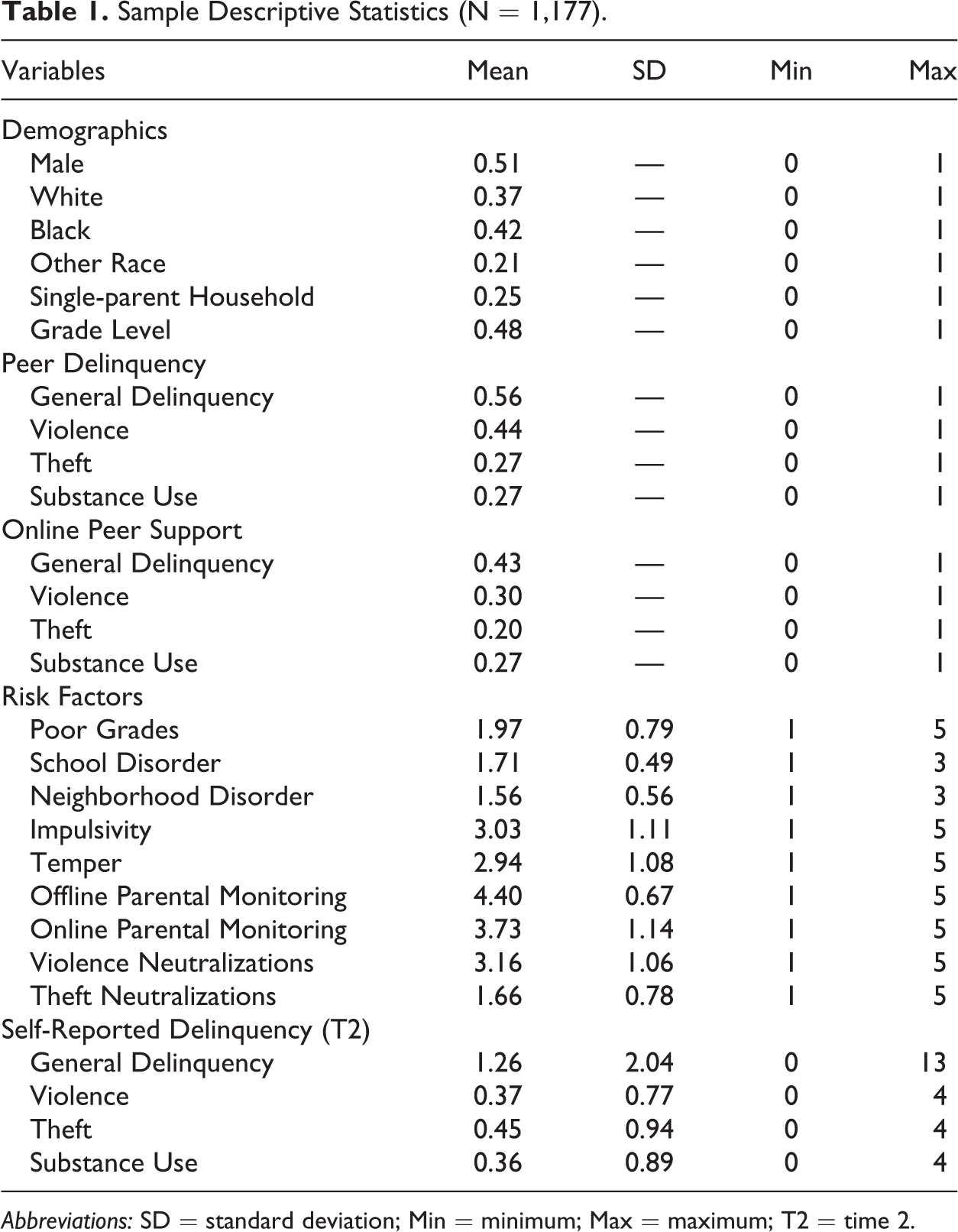
In addition to a general delinquency scale, three variety scales focus on specific types of delinquency that correspond to the peer delinquency variables: violence, theft, and substance use. Violence consists of five items: hitting, attacking someone with a weapon, carrying a hidden weapon, using a weapon or force to get money or things from people, and being involved in a gang fight. Theft consists of four items: avoided paying for things such as movies or bus/metro rides, stole something under $50, stole something over $50, and gone into or tried to go into a building to steal something. Substance use refers to prescription drugs that were not prescribed, tobacco products, alcohol, marijuana, heroin, and other illegal drugs. All three specific variety scores were dichotomized in models predicting the prevalence of each type of delinquency (25% committed an act of violence, 26% stole something, and 20% used an illegal substance). All descriptive statistics are presented in Table 1.
Sample Descriptive Statistics (N = 1,177).
Abbreviations: SD = standard deviation; Min = minimum; Max = maximum; T2 = time 2.
Perceived Peer Delinquency
Numerous studies have used a perceptual measure of the proportion of delinquent friends to capture peer delinquency since this represents the “source of learning delinquent and anti-delinquent behavior patterns” (Matsueda 1982:491). In fact, some have argued that perceptual measures are the most theoretically valid way of capturing normative influence from friends since adolescents construct their own understanding of their social world regardless of the actual behavior of their friends (Akers 2009; McGloin and Thomas 2016). However, others argue that adolescents misperceive the delinquency of their friends by projecting their own delinquency when answering survey items related to peer behavior (Haynie and Osgood 2005; Young et al. 2011). 4 This could lead to an overestimation of the peer effect since perceptions may be correlated with other causes of delinquency. McGloin and Thomas (2016) argue that while there is not complete overlap between direct measures from peers compared to individual’s perceptions (i.e., respondents do in fact often misperceive their peers’ behavior), the perception of peer behavior is what most strongly influences one’s own behavior, because perceptions do not have to be accurate to be influential. This study takes a similar position, and perceptual measures are used for all peer delinquency items.
Specifically, peer delinquency was measured at wave 1 by asking “During the last year, how many of your current friends have done the following?” The individual behaviors include five specific items: hitting, attacking someone with a weapon, stealing something less than $50, using tobacco or alcohol products, and using marijuana or other illegal drugs. Peer general delinquency is a dichotomous indicator, where a value of 1 refers to respondents who had any friends who committed any of the five delinquent acts. 5 Sensitivity analyses utilize a variety scale, representing the sum of each dichotomous measure. For the analysis focusing on individual types of crime, violence refers to hitting and attacking with a weapon, theft refers to the single-item measure, and peer substance use refers to alcohol/tobacco or marijuana/other drugs.
Online peer support for delinquency captures the same five behaviors but refers to “online friends that you do not regularly see in person.” Thus, this measure captures distinct online peers whose friendships are either developed or maintained predominately through online communication. The prompt also asked respondents to report the proportion of online friends who “expressed support for” each of the five behaviors within the past year. It is important to note how this measure differs from perceived peer delinquency since these items are not directly comparable. The traditional measure captures behavior, meaning a respondent believes his or her friend committed a delinquent act. The online measure captures peer attitudes or behaviors interpreted by the respondents as being supportive of delinquency. For example, an online peer could disclose their own behavior, or they can post and share material about other peer behaviors they either endorse or condemn (e.g., a video of a fight may disclose personal involvement or the involvement of other peers). To match the peer delinquency typology, measures were created for online peer support for general delinquency, violence, theft, and substance use. Once again, a value of 1 indicates respondents who have any online peers who provide support for each item, and the variety scores used in sensitivity analyses refer to the number of different crimes that online peers support.
Control Variables
Several variables are included to control for factors consistently associated with delinquency. The first set of items captures perceptions of disorder experienced in the traditional contexts of neighborhood and school (Gottfredson et al. 2005). Neighborhood disorder is comprised of six items related to perceived problems in the neighborhood (α = 0.84). School disorder consists of five items related to perceived problems within schools (α = 0.80). To capture academic achievement, poor grades is a single self-reported item ranging from 1 to 5, with higher values corresponding to lower grades.
The data include items that capture two domains of self-control as identified by the Grasmick et al. (1993) scale. Impulsivity was measured using a single item asking if respondents agree with the statement they act without thinking. A second dimension of self-control is also included that loads on a second factor related to temperament. Temper is comprised of three items referring to losing one’s temper, hurting others when angry, and if others should stay away when one is angry (α = 0.77).
Two control variables are included that capture elements of parental monitoring (Hirschi 1969; Janssen et al. 2016). Offline parental monitoring consists of a three-item scale asking respondents how much they agree that their parents know where they are, who they are with, and how to contact them. A single-item measure related to online parental monitoring is also included that asked respondents how much they agree that their parents know what they are doing when using electronic devices.
To capture delinquent attitudes, two measures of neutralizations were included that focus on theft and violence (Jensen 1972; Sykes and Matza 1957). Theft neutralizations refers to a four-item scale asking respondents how much they agree with statements related to when it is okay to steal from someone. Violence neutralizations is also a 4-item scale but focuses on when it is okay to beat someone up. Although these measures are moderately correlated (0.48), they load on separate factors and represent distinct constructs.
The final set of control variables pertain to basic demographic characteristics. Male is a dichotomous variable with males coded as 1 and females as 0. For race/ethnicity, dichotomous variables were created for White, Black, and Other Race. This latter group refers to those who are Asian, Native American, Hispanic, multiracial, or if the respondent selected “other” as a response to the race question. Grade level is a dichotomous indicator differentiating between the seventh and eighth grades, with a value of 1 corresponding to the eighth grade at wave 1. Single-parent household is a dichotomous measure indicating if a respondent lived with only one parent.
Analytic Strategy
The empirical analyses begin by first examining the overlap between peer delinquency and online peer support for delinquency. This demonstrates the extent to which the cyber context provides distinct influence that is separate from traditional contexts, while also examining how the cyber context supplements the traditional view of peer delinquency. After exploring this overlap, a series of regressions are estimated to examine the associations between peers (at time 1) and different elements of offending (at time 2). First, prevalence is examined by estimating logistic regressions predicting whether respondents engaged in any delinquent act. Next, the variety of crime is examined through a negative binomial regression predicting the number of different delinquent acts committed by respondents. Finally, a first-differencing approach is taken where within-individual changes in delinquency are regressed on within-individual changes in peer delinquency. Peer processes are dynamic and change over time, and this approach accounts for developing or losing pro-delinquent peers in addition to opportunities for socialization that may be contingent on age. This method also reduces omitted variable bias related to time-invariant heterogeneity by treating each respondent as their own control (e.g., early parental socialization, socioeconomic status, etc.). OLS regression is used to estimate these models since the outcome is normally distributed (Allison 1990).
After exploring general delinquency, additional analyses test for offense-specific processes where measures of peer violence, theft, and substance use are used to predict the same self-reported behaviors. This is followed by a summary of three sensitivity analyses focusing on alternative modeling strategies. Additionally, the research design meant that students were clustered within schools. Since there may be underlying similarities between students within the same school, this means the assumption of independent observations has been violated. Thus, all empirical models are estimated using robust standard errors through clustering by school.
Results
Overlap of Exposure to Peer Delinquency
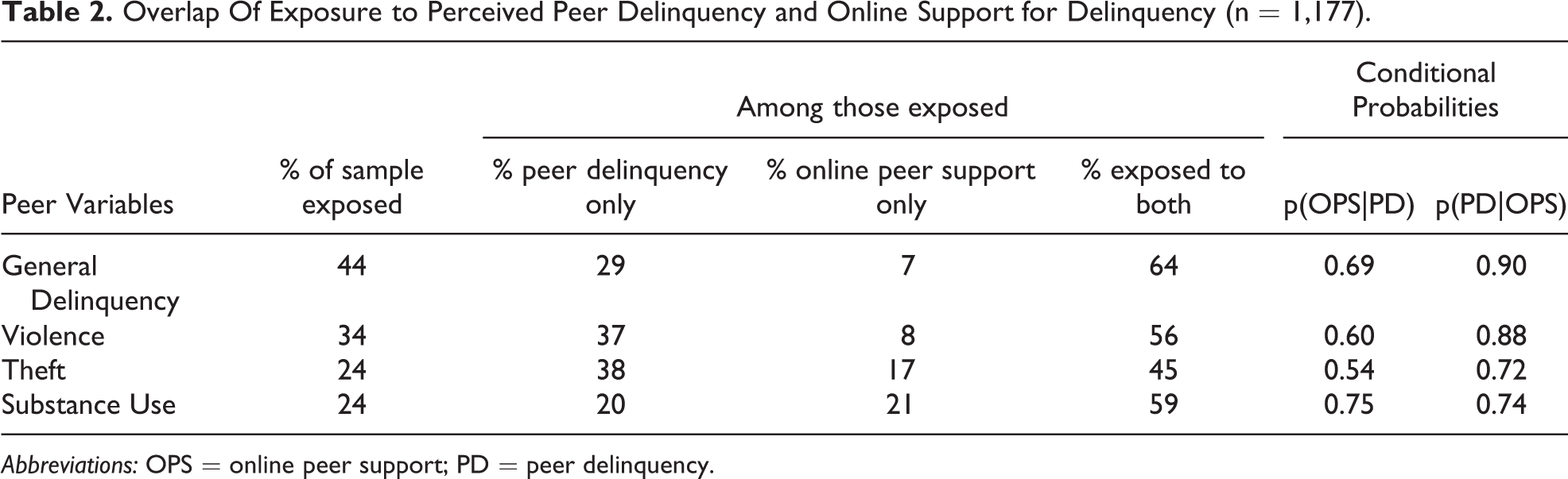
Table 2 focuses on the overlap between perceived peer delinquency and online support for delinquency by first observing the percent of the sample exposed to either item, followed by the breakdown between contexts among those exposed. Among the 44 percent of the sample exposed to general delinquency, 64 percent of respondents were exposed to peer influence in both contexts. As for unique online influence, seven percent of those exposed only received online peer support from those not regularly seen in person, which corresponds to just over 4 percent of the total sample. Using conditional probabilities, the probability someone was exposed to online peer support given they had delinquent peers is 0.69. 6 In other words, we can assume that about two out of three respondents who had delinquent peers also received online peer support for delinquency. Looking at this from the other context, the probability someone had delinquent peers given they were exposed to online peer support it 0.90. This means those who were exposed to unique peer support within the cyber context were more likely to be exposed to peer influence in both contexts compared to those who have delinquent peers. As a whole, context overlap was much more common than exposure to peer influence within a specific context.
Overlap Of Exposure to Perceived Peer Delinquency and Online Support for Delinquency (n = 1,177).
Abbreviations: OPS = online peer support; PD = peer delinquency.
The findings for peer influence related to violence are very similar to general delinquency, except there is slightly less overlap since there is more unique exposure to perceived peer violence. Here, the probability someone was exposed to online peer support for violence given they had violent peers is 0.60. As for influence related to theft, unique online exposure to peer support was more prevalent (17%) relative to violence (9%). This corresponds to about six percent of the sample who received online support in the absence of having peers who had stolen something. The overlap between contexts is the lowest among crime types: the probability someone was exposed to online peer theft given they had peers who had stolen something is only 0.54. While the cyber context introduces more unique online peers who support theft relative to violence, it appears that fewer respondents have their peer theft supplemented with online peer support.
The findings for substance use are the most distinct. While the overlap is similar to other crime types, over one in five respondents who are exposed to influence related to substance use only receive online support, which corresponds to about seven percent of the total sample. Moreover, the probability that someone was exposed to online support given they had substance using peers is 0.75, meaning the cyber context supplements offline influence more for substance use relative to other crime types. Taken together, those exposed to influence related to substance use experience the lowest prevalence of unique offline influence and the highest prevalence of unique online influence.
Effects of Exposure to Peer Influence
The results of analyses examining the effects of exposure to peer delinquency and online peer support for delinquency are presented in Table 3. The first model uses logistic regression to predict the prevalence of general delinquency. Here, we see that exposure to online peer support at time 1 is not associated with self-reported delinquency at time 2 when controlling for peer delinquency and other covariates. Under this test, the predicted probability of committing an act of delinquency is .70 (e0.82/1 + e0.82) among those exposed to peer delinquency. The next model uses a negative binomial regression to estimate the count of different delinquent acts. Once again, online peer support is not associated with delinquency. The peer delinquency measure remains statistically significant and is associated with a 79% increase ((e0.58 −1) × 100) in the expected count of delinquent acts. Moreover, in both models, the coefficients for peer delinquency are twice the size of those for online peer support. Between these models, the findings are consistent among risk factors: race, impulsivity, temper, and hitting neutralizations are positively associated with delinquency, while grade level, and online parental monitoring are negatively associated with delinquency. 7
Association between Online Peer Support and Self-Reported General Delinquency (n = 1,177).a

Abbreviations: SE = standard error.
aEstimated using robust standard errors. Prevalence models use logistic regression, variety models use negative binomial regression, and changes models use OLS regression. *p < 0.05; **p < 0.01; ***p < 0.001.
The final model uses OLS regression to examine how changes in online peer support and peer delinquency are associated with changes in the variety of self-reported delinquency. Counter to the initial approaches, this model demonstrates that changes in being exposed to online peer support for delinquency is positively associated with changes in self-reported delinquency (b = .44, p < .01). Given the binary nature of the peer variables, this interpretation is rather straightforward: those who acquired online peer support between times 1 and time 2 committed a greater variety of delinquent acts over the same time period. Interestingly, changes in the peer delinquency measure are not significant, although those who experienced increases in temper, hitting, and theft neutralizations saw increases in delinquency, whereas those who changed grades and experienced more offline monitoring committed fewer acts of delinquency.
The results of analyses examining the effects of exposure to influence related to violence, theft, and substance use are presented in Table 4. The first three models focus on violence, and findings are substantively identical to the general delinquency models. The effect of peer violence is among the largest of all variables in the model, and similar to before, online peer support for violence is not associated with the prevalence or variety of violent acts, but changes in online peer support are associated with changes in violence (b = 0.31, p < .001). Unlike the initial models, changes in peer delinquency are also associated with changes in violence (b = 0.10, p < .05). A different story emerges for theft, where online peer support is associated with the prevalence, variety, and changes in theft over time. Specifically, the predicted probability of theft is .64 among those exposed to online support, and this exposure is associated with a 51% increase in the expected count of different types of theft. The effect of changes in online peer support (b = .22, p < .05) is similar to that of peer delinquency (b = .20, p < .05).
Association between Online Peer Support and Self-Reported Delinquency by Crime Type (n = 1,177) a

Abbreviations: SE = standard error, Par. = parental.
aEstimated using robust standard errors. Prevalence models use logistic regression, variety models use negative binomial regression, and changes models use OLS regression.
bOffense-specific measures used for online peer support and peer delinquency. *p < 0.05; **p < 0.01; ***p < 0.001.
The final three models focus on substance use and findings are quite like those from the theft models, where online peer support is significant across all three analyses. The predicted probability of substance use is .69 among those exposed to online peer support, and this increases the variety of substances used by 77%. Changes in being exposed to online peer support for substance use were also associated with changes in the number of different types of substances used. The influence of online peer support is comparable to peer substance use, where the strength of associations is very similar across models.
Sensitivity Analyses
In order to provide an alternative way to address temporal ordering, models were re-estimated by including a lagged dependent variable, which accounts for other unmeasured factors related to delinquency that are not captured by the other covariates. This approach may also underestimate the effect of peer influence since the lagged measure removes any variance that is shared with self-reported delinquency at time two, meaning this represents a lower bound of peer influence but controls for the possibility that the peer effects are driven by selecting delinquent peers (Gallupe, McLevey, and Brown 2018; Haynie and Osgood 2005). 8 Under this rather conservative test, there was once again no effect of online exposure to violence. Exposure to online support for theft was only related to the prevalence of theft and not the variety measure. Exposure to substance use was also only related to self-reported prevalence. While evidence has been mixed, the strongest support for the online peer effect appears to be related to substance use. 9
While binary peer measures were used for practical purposes, this removes all variation within these items, which may prove important in understanding how peers are associated with crime. To address this issue, the models were re-estimated using variety scales for each peer variable. The substantive findings are identical to those presented here. The only noteworthy difference is found in the theft models. Peer theft was not associated with the self-reported prevalence or variety of theft, although online peer support for theft remained significant. All other reported associations remained statistically significant.
Finally, while the current study is unable to explicitly examine mechanisms of influence, models control techniques neutralizing violence and theft, which are both moderately correlated with the offline and online peer items (ranges from 0.30 to 0.34). To better understand this mechanism of differential association, all models were re-estimated where a baseline model excludes these attitudes. When considering the prevalence of general delinquency, the size of the coefficients decreased by about eight percent for both peer variables when adding in the attitudinal measures; yet the substantive findings remained identical. Other findings likewise matched the main analyses with one exception. For the variety of general delinquency, we see that online peer support is significant when the attitudes are omitted, although the coefficient for peer delinquency is twice the size of online peer support (0.64 compared to 0.32). In order to see if peers are differentially associated with each attitude, subsequent models treat the neutralizations as outcomes and we see that online peer support does not predict violence neutralizations, but peer delinquency is significant. For theft, the opposite occurs: online peer support is significant, but peer delinquency is not.
In sum, these sensitivity analyses support the conclusions of the main models. The first two find even less evidence for the influence of online peers, while the last analysis focused on a theoretical issue related to attitudinal transference. On the one hand, findings suggest processes may unfold differently for different types of crime, further justifying the need to examine offense-specific models. On the other hand, offline peer delinquency is still the driving force behind the association between peers and crime.
Discussion
The peer group of digital natives is unlike those of past generations. Youth share their lives online and form friendships with peers who are not regularly seen in person. This provides an additional source of influence that may be independent of what would be found within offline contexts; that is, the influence of exposure to online friends who provide support for delinquency. However, despite the ubiquity of social media and integration of digital technology, the current study found that online influence is largely secondary to the influence of traditional peer delinquency.
The high degree of overlap between peer delinquency and online peer support demonstrates that few respondents are only exposed to peer influence the way it is traditionally operationalized. This was especially prominent for substance use where three out of four of those who had substance using friends also had online friends who provided support. To a much lesser degree, the cyber context contains crime-supporting online friends who provide support favorable toward delinquency in the absence of offline friends who committed the same crimes. This ranged from a low of four percent of the total sample for theft to seven percent of the total sample for substance use. Taken together, the cyber context mostly supplements the influence of offline peer delinquency rather than provide unique exposure to criminal definitions.
Moreover, the findings tend to support Warr’s (2002) and Akers et al.’s (2017) position that online peers are secondary groups whose influence is less important than offline peers. In models that incorporate temporal ordering, online peer support predicts the prevalence and variety of theft and substance use, but not general delinquency or violence. While changes in the online peer items were significant across all analysis, these models are still limited by the fact we cannot disentangle if changes in delinquency are associated with changes in the peer variables. Still, these changes are important to consider from a learning perspective given that the ratio of pro-criminal to pro-conforming peers changes over time, as do opportunities to connect with peers in the absence of authority figures.
Where does this leave us in the quest to understand if online peers matter? The descriptive findings suggest that if they matter, it is minimal: among those who have online peers who provide support for crime, there is a 90 percent chance they have offline peers who do the same. Within crime types, with the exception of substance use, respondents were more likely to be exposed to negative influences from peers offline compared to online.
The multivariate results, while not conclusive, demonstrate that traditional peer delinquency is a more important risk factor for delinquency compared to online influence. Thus, we can conclude that online peers may matter for certain types of crime, but their influence is secondary to in-person friends. However, these findings may be due to the specific mechanism captured by online peers. Since it merely measures “support” for delinquency, we are only capturing attitudes from these peers, whereas the offline measure captures the perception of peer behavior. The sensitivity analyses found some evidence that online peers may influence attitudes related to theft, but the observed associations were very similar to traditional peer delinquency. Overall, the robust findings for traditional peers could be due to the fact that the offline measure accounts for situational opportunities that do not exist within the online context. Unfortunately, the data lack measures of offline peer support which could be used to test one mechanism (attitudes) across both contexts. Without similar measures of attitudes or behaviors across contexts, we cannot identify the exact mechanism of peer influence. Regardless, this study demonstrates that the risk provided by unique online peers is minimal, as traditional measures of peer delinquency are more strongly associated with self-reported delinquency.
Despite the utility of these data, there are a few key caveats to this study. First, the peer items used in this study limit our ability to fully understand the complex socialization processes occurring online. In particular, these data lack information about online support provided by close, offline friends. Since most of one’s online friends are the same friends from one’s school and neighborhood, there is an important element of peer influence missing. Additionally, since online communication is linked with the self-disclosure of personal information, future work should see if youth are willing to discuss information about delinquent behaviors online but not in person. Drawing more from a situational perspective, the intersection between offline and online time spent with peers may also be an important area for further exploration. Although unstructured time online is inherently different from face-to-face contact, prior work has found that time spent communicating online is associated with offline delinquency (see Meldrum and Clark 2015).
Second, the online peer measures capture the proportion of online friends who expressed support for each type of crime. It is unclear what this proportion really means, and alternative strategies should be incorporated in subsequent work. For example, do respondents include all online friends, or are they referring to their closest online friends with whom they communicate most often? For more serious crimes such as attacking someone with a weapon, it is possible individuals may overestimate the proportion of online friends who endorse such acts. For other crimes such as substance use, respondents could be engaged in the offense while communicating online. These issues weighed into the decision to dichotomize the peer variables, and future work may be better able to parse out variation in online influence.
Moreover, the timing of these measures leaves room for improvement, as models used peer behavior over the past year at time 1 to predict self-reported delinquency over the past six months at time 2. While this issue is present in most survey data, it is complicated by the changing nature of online peer groups. The findings from the first difference models suggest changes in exposure to online support may be important to consider. The fact the peer delinquency measure was not significant could mean that offline groups are more stable compared to online groups. Identifying mechanisms of online influence will likely require unique methodology, perhaps beyond the capabilities of traditional, survey-based research.
Finally, since this study focused on how the cyber context is a unique source of influence, it only considered respondents who reported they had online friends who are not regularly seen in person. This results in the removal of around 29 percent of the sample at each wave, which potentially overestimates the effect of this unique type of online peer support. Those removed are more likely to be female, white, and live in two-parent households. They also have lower levels of self-reported and peer delinquency across all items and report lower levels across all risk factors. Part of the missing data is likely explained by the age of the sample. Although most youth use online communication to some degree, social media platforms must abide by the Children Online Privacy Protection Act, which restricts websites from collecting information from those under the age of 13 (Federal Trade Commission 2017). Importantly, findings here comport with research using a nationally representative sample that finds only two-thirds of youth have online friends they have never met in person (Lenhart et al. 2015). Moving forward, studies examining how all adolescents use online communication should not be plagued by this limitation. The rise in the use of technology has coincided with a reduction in the “digital divide” between socioeconomic status and computer use (Anderson and Jiang 2018; Madden et al. 2013), resulting in over 95 percent of U.S. adolescents having access to mobile technology (Anderson and Jiang 2018).
Conclusion
This study supports the proposition that online peer groups are secondary to offline groups. The vast majority of adolescents exposed to negative peer influence online were also exposed to delinquent peers offline, meaning there is relatively little additional risk introduced through the cyber context. Future work may want to start asking “for whom” do online peers matter. As one reviewer pointed out, societies characterized by higher levels of social control may limit the opportunities for youth to hang out, which could affect offline peer processes. For these youth, the online context may be more important. Additionally, those with extreme ideologies or antisocial attitudes may find like-minded others online, and the ability of the cyber context to facilitate self-disclosure means the boundaries of what is considered socially acceptable behavior may widen. While these processes are plausible, it appears that offline friends still serve as the primary agents of peer socialization.
Footnotes
APPENDIX A: SCALE DESCRIPTIONS
Acknowledgments
The author would like to thank Matt Vogel, Finn Esbensen, Kyle Thomas, Janet Lauritsen, Jean McGloin, and Elaine Doherty for their invaluable feedback on his dissertation and previous versions of this manuscript.
Declaration of Conflicting Interests
The author(s) declared no potential conflicts of interest with respect to the research, authorship, and/or publication of this article.
Funding
The author(s) disclosed receipt of the following financial support for the research, authorship, and/or publication of this article: This research was supported in part by Award No. 2015-CK-BX-0021 awarded by the National Institute of Justice, Office of Justice Programs, U.S. Department of Justice in addition to the Charles G. Huber, Jr. Endowed Dissertation Fellowship. The opinions, findings, and conclusions or recommendations expressed in this publication are those of the author and do not necessarily reflect the views of the Department of Justice.
