



Abstract
Objectives
To investigate how peer dynamics, specifically interpersonal conversations between a potential offender and a peer, contemporaneous with a crime opportunity, influence perceptions of sanction certainty and social costs.
Methods
Data are analyzed from randomized experiments and hypothetical vignettes embedded within a nationwide, online survey (n = 1,275). Vignettes were presented for three distinct crime opportunities, drunk driving, fighting, and insurance fraud.
Results
The findings suggest that respondents adjust two core decision-making perceptions—the perceived certainty of being legally sanctioned and perceived social costs such as stigma or embarrassment—in accord with the content of verbal communications from peers. There is evidence for this both between and within subjects.
Conclusions
The study underscores the importance of accounting for both physical and social features of the situational context for crime in models of offender decision making. Implications are drawn regarding the social milieu for offender decision making, and the broader criminological relevance of choice principles.
Considerable advancements on offender decision making have materialized since Nagin’s (2007) influential call to move choice center stage. Knowledge has grown on emotional influences (van Gelder, De Vries, and van Der Pligt 2009; Barnum and Solomon 2019; Pickett, Roche, and Pogarsky 2018), behavioral economic heuristics and biases (Loughran, Paternoster, and Weiss 2012; Pickett 2018; Pogarsky et al. 2017, 2018), the coherence of sanction risk perceptions (Barnum, Nagin and Pogarsky 2020; Thomas, Hamilton, and Loughran 2018), and enhancing the realism of decision making research with videos and virtual reality (van Gelder et al. 2019). These subtopics reflect an increasingly granular focus on the contexts and situations in which opportunities for crime arise.
The immediate context for crime consists partly of environmental factors, such as lighting, disorder, land usage, and neighborhood configuration (e.g., Clarke and Cornish 1985; Nagin, Solow, and Lum 2015; Chalfin, Kaplan, and LaForest 2021). But people also contribute to this context, as instigators, co-offenders, peers, bystanders, and law enforcement (Haynie 2001; Warr 2002; McGloin and Nguyen 2012). We are interested in the interpersonal dynamics that ensue during opportunities for crime. Research on peer influence ascribes the behavioral concordance among associated individuals partly to attitude and value transmission over time. Yet less is explicitly known about how peers affect judgments about the consequences from crime while people face an opportunity to offend. Research has shown that structural attributes of a social configuration, such as density or size, indirectly influence contemporaneous judgments about the consequences from offending (Haynie and Osgood 2005; McGloin and Rowan 2015; McGloin and Thomas 2016). However, more active forms of influence also take place when group members exchange information with one another during an opportunity for crime (McCarthy et al. 1998; Granic and Dishion 2003; Weerman 2003; Sirakaya 2006).
This study investigates how verbal communications—situation-relevant statements between two or more people—among peers, affect contemporaneous judgments about the potential legal and extralegal consequences associated with an opportunity to offend. Several theoretical expectations were developed by integrating concepts from the peers and decision-making literatures. Data were analyzed from randomized experiments embedded in a survey containing hypothetical vignettes for three distinct crime opportunities: drunk driving, fighting, and insurance fraud. Findings suggest that although an actor may enter a criminogenic situation with a general sense of the risks and costs entailed in offending, the social setting presents additional dynamics that help shape these judgments for contemporaneous decision making.
Social Context for Offending Decisions
A persistent debate in criminology concerns whether associated individuals behave similarly to one another because of selection or influence. Under the selection perspective, the behavioral concordance among affiliated persons results because likeminded people associate with one another (e.g., Gottfredson and Hirschi 1990). However, associated individuals also behave similarly because they influence one another (McGloin 2009; Pyrooz et al. 2021). Normative influences emphasize value systems and/or subcultures inculcated through processes of social learning (Burgess and Akers 1966; McGloin and Thomas 2019). They are grounded in core human instincts to seek acceptance and avoid rejection. These processes do not require a confluence of persons and circumstances since they unfold over time. Moreover, the longstanding behavioral correspondence between associated individuals exists irrespective of the time they spend physically together (Warr 2002).
A distinct form of peer influence occurs during the more immediate situations in which opportunities for crime unfold. According to Osgood et al. (1996), associated persons form a social configuration, wherein the primary impetus for crime and delinquency can reside. Consistent with this, geographic areas where people convene, in bars and restaurants or for other commercial activity, tend to have more crime than residential areas do (e.g., Roncek 1981; Weisburd, Bushway, Lum, and Yang 2004). Some of this situational peer influence is passive, as when the mere presence of others during a crime opportunity, apart from any interpersonal interactions, influences the decision maker (Hochstetler 2001; Gardner and Steinburg 2005; Matsueda 2013). For example, McGloin and Thomas (2016) extended Granovetter’s (1978) threshold model for collective deviance (see also McGloin and Rowan 2015). The authors grounded a perceptual deterrence survey in two social contexts, a college football game, and a concert in a park. The vignettes randomly varied the number of co-offenders participating in disorderly conduct and vandalism. They found that with more hypothesized co-offenders, perceptions of formal and informal costs to the actor from joining decreased, whereas the anticipated rewards, such as fun and social inclusion, increased. In a recent refinement, McGloin et al. (2021) identified an “opt-out threshold” or reverse bandwagon effect, where potential co-offenders can become so numerous as to increase perceptions of risks and costs and discourage (co)offending.
These structural dynamics aside, active situational peer influences potentially occur, for example, when people either instigate or discourage crime (Hoeben and Thomas 2019; see also McCarthy et al. 1998; Jacobs and Wright 1999; Warr 2002; Weerman 2003; McGloin and Nguyen 2012). Here, peers serve as a catalyst or hinderance, by potentially influencing judgments regarding the risks, costs, and/or inducements entailed in a crime opportunity thereby motivating or deterring a specific course of action (e.g., Warr 2002; McGloin and Nguyen 2012). These active influences may be especially pronounced for individuals who are uncertain or naïve about the offending decision. Below, we discuss how peers can actively influence one another's contemporaneous judgments, and through this, the likelihood of offending.
Active Peer Influence in Crime Decisions
Criminologists have also debated whether peers influence one another primarily by what they do or what they think (e.g., Warr and Stafford 1991; Wilson, Paternoster, and Loughran 2017; see also Thornberry et al. 1994; Young et al. 2014). Research has shown that peer influences are not predominantly attributable to behavioral modeling or mimicry. Peers also influence the cognitions, thoughts, and perceptions of their associates (see Matza 1969). Specifically, we consider the possibility of active peer influence on an offender's perceptions by verbal communications regarding the anticipated consequences from crime.
Consequences have been a pervasive theme throughout scholarship on individual transgression (Becker 1968; Coleman 1986; Nagin 1998, 2013; Matseuda 2013). Legal consequences involve the curtailment of freedom by incarceration and/or supervised release, and economic adversities resulting from penalties and costs. Research on legal sanctions focuses mainly on perceptions of sanction certainty as findings show the deterrent potential of perceived certainty (i.e., perceived likelihood of arrest) far surpasses that of the perceived severity and celerity of punishment (Nagin 1998, 2013; Apel and Nagin 2011). 1
This said, criminal offenders also risk social consequences. These extralegal sanctions generally entail embarrassment or stigma resulting from disapproval by people who are consequential to the decision-maker, which include romantic partners, family, friends, and coworkers (Grasmick and Bursik 1990; Warr 2002, 2016). The anticipated social costs from offending also deter crime, sometimes more so than the anticipation of legal sanctions do (e.g., Tittle 1980; Burkett and Ward 1993; Paternoster and Simpson 1996). 2 Next, we address how interpersonal communications may influence these two situational judgments.
Contemporaneous Communications and Judgments
Information Transmission
Peers can influence contemporaneous judgments by their counterparts in various ways. People arouse one another's emotions or affect the salience of distinct dimensions of the crime decision (e.g., immediate benefits vs. delayed costs). In addition, peers serve as a temporally proximate source of information for judgments about the legal and extralegal consequences from crime. Geerken and Gove (1975) provide useful logic regarding how communications from peers can affect contemporaneous judgments. The authors (1975:498) liken deterrence and decision making to information transmission: “only analysis of all the sources of information about risk and severity of punishment and how they are related to the social environment, crime rate, and the actual risk and severity of punishment will enable us to understand how punishment relates to crime in a real society.”
Information has been central throughout deterrence scholarship. Stafford and Warr (1993) argued that models of sanction risk perception should include avoidance of punishment experiences, as well as both sanctioning and avoidance experiences of other persons known to the decision maker, because such experiences inform judgments. Bayesian Updating principles also emphasize information in perceptions of sanction risk. In that perspective, actors maintain a prior estimate of the certainty of punishment that they periodically update based on signals containing relevant information (e.g., Anwar and Loughran 2011; Wilson, Paternoster, and Loughran 2017). Generally, in such studies, the informational contributions of peers come passively from their personal clearance rate, which is defined as the ratio of arrests to crimes committed during an updating period (between interview waves)—that is, peers with fewer arrests compared to crimes committed may signal to the decision maker that legal risks are low.
But peers likely exchange more information than this, particularly when opportunities for crime arise. One way peers can actively encourage (or discourage) one another to commit crime is through verbal communications as an opportunity for crime unfolds. Such information seems well-positioned to influence contemporaneous judgments. First, it has the advantage of being a final input into such judgments. Researchers of the psychology of memory report a serial position effect by which most recently viewed words are most readily recalled, a recency effect, and, as between words in the middle versus words at the beginning, the latter are more readily remembered, a primacy effect (e.g., Greene 1986). As implied by the recency effect, temporal proximity of conversational input to the decision can heighten the import of information in ensuing judgments and decisions. Second, and relatedly, are the behavioral economic principles of availability and salience. Beyond memory, research also shows that items of information that “stand-out” influence a decision maker more than items that do not (Taylor and Fiske 1978). Thus, information presented in a communication delivered methodically and/or emphatically by a peer, especially a close or trusted friend, is likely to stand-out compared to other situational and structural inputs in the moments leading up to a decision.
Therefore, we expect contemporaneous communications by peers to influence judgments consistent with the general directionality of the communication as it relates to risk and cost assessment. Consider two alternative communications: “I wouldn’t do that if I were you, people get arrested for that all the time,” or “Go for it, people do that all the time.” If anything, the former statement suggests higher sanction certainty, whereas the latter statement suggests it is lower. We anticipate comparable informational impacts on non-probabilistic estimates of social costs. Sirakaya (2006) found evidence for a “social multiplier effect,” wherein endogenous social interactions affect recidivism rates. The author demonstrated that beyond treated offenders, a drug program also influenced persons the treated offenders interacted with, because of the treated offenders improved prosocial outlook and connection to the community. Moreover, Dishion and colleagues (1999; Granic and Dishion 2003) have shown that talk about risks, costs, and rewards of law-breaking behavior among friend groups leads to “deviance training” and predicts increases in delinquency, substance use, and violence. Thus, we envision a comparable process here, akin to an informational nudge (Sunstein 2014). This leads us to expect,
Hypothesis 1a: Contemporaneous peer communications regarding the certainty of sanctioning for a crime are positively associated with the perceived certainty of punishment for that crime. Hypothesis 1b: Contemporaneous peer communications regarding the social costs for a crime are positively associated with the perceived social costs for that crime.
Multiple Judgments and Nonmatching Perceptions
Thus far we have addressed how contemporaneous verbal communications between peers can influence judgments that correspond with the communicated information. Earlier we raised an example where one friend tells another not to offend because s/he knows of people being arrested for that offense. However, the possibility also exists for the same information to influence multiple judgments, including those that less precisely match the information provided. For example, Anwar and Loughran (2011) estimated that while being arrested for aggressive offending produced a 5% increase in the perceived certainty of legal sanction for committing an aggressive crime, it also produced a 4% increase in the perceived certainty of sanction for committing an income generating crime. Extending these notions further, we consider whether communications about sanction certainty produce comparable “externalities” on perceptions of social costs, and for that matter whether communications about social costs influence perceived sanction certainty.
In Crime, Punishment, and Deterrence, Gibbs (1975) outlined a range of preventative consequences from punishment beyond deterrence. Moreover, the discussion elaborated various interrelationships between legal and extralegal consequences. Beyond formal deterrence, punishment also promotes normative validation, wherein “individuals refrain from illegal acts not because they fear punishment but because they evaluate those acts negatively, and legal punishments maintain or intensify those negative evaluations” (Gibbs 1975: 80). He continued that punishment also serves to socialize and enculturate, thus bolstering the punished person's appreciation that the sanctioned conduct was wrong and should be avoided (see also Tittle 1977).
Nagin and Pogarsky (2001:870–871) outlined two ways that extralegal sanctions can originate. First, extralegal sanctions often accrue from the imposition of a legal sanction. Arrest and prosecution serve to publicize the transgression, which can then prompt a range of nonlegal consequences, from shame and stigma, to compromised employment and residential opportunities. Second however, extralegal sanctions do not require the imposition of a formal legal sanction. Others may still learn of an individual's criminal transgression(s) even if the police do not, and extralegal sanctions can still ensue. Thus, the discussion above prompts us to extend the previous hypotheses to the case of nonmatching perceptions. Notice below, however, that Hypotheses 2a and 2b are asymmetric. That is, although there is ample basis to suspect that information regarding legal risk will also influence perceived social costs, there is commensurately little basis to expect information about social costs to reciprocally generate legal costs. Therefore, we expect,
Hypothesis 2a: Contemporaneous peer communications regarding the certainty of sanctioning for a crime are positively associated with the perceived social costs for that crime. Hypothesis 2b: Contemporaneous peer communications regarding the social costs for a crime are unrelated to the perceived certainty of punishment for that crime.
Situational Adjustment
Thus far we have addressed perceptual differences between groups based on the randomized content of peer communications. The preceding hypotheses imply that peer communications can “informationally nudge” formal and extralegal cost perceptions by lending additional context to the offending opportunity. 3 In this regard, the literature recognizes a potentially informative set of counterpart judgments for each offending opportunity. The first is a general, acontextual estimate of the likelihood of punishment, or social costs, for committing a specific type of crime. A general sanction certainty estimate answers the question, “If you committed (specified crime), what are the chances you will be arrested and punished by the police?” This type of risk or cost perception has produced a range of insights from panel studies of decision making, incentives, and criminal behavior and its consequences over time (Matsueda, Kreager, and Huizinga 2006; Lochner 2007; Loughran, Paternoster, Chalfin, and Wilson 2016). A second, counterpart judgment corresponds to the same crime but is grounded in the operative circumstances of a specific offending opportunity (see Nagin et al. 2015; Barnum et al. 2021). Thus in contrast, a situational measure of sanction certainty is elicited by first providing respondents with a hypothetical offending opportunity and thereafter asking “under the circumstances in the scenario, if you committed (specified crime), what are the chances you will be arrested and punished by the police?” Comparable sets of general and situational anticipated social costs also exist for each offending opportunity.
The difference between an individual's general perception of the consequences associated with a crime and a situational assessment of those consequences under specific circumstances is potentially informative about contemporaneous peer dynamics. Recall the earlier comparison of two hypothetical communications (p. 7), “I wouldn’t do that if I were you, people get arrested for that all the time,” versus “Go for it, people do that all the time.” The impact of an informational nudge should be reflected in a larger situational adjustment for the latter communication which suggests lower sanction certainty than for the former communication which does not. Generally, in cases where the directionality of the peer communication is to encourage offending, by either minimizing sanction risk or social cost, this difference should be larger than when the peer communication does not. Thus, systematic differences between general and situational risk assessments provide information about situational adjustments in perceptions based on temporally proximate utterances by friends. In sum,
Hypothesis 3a: Contemporaneous peer communications regarding the certainty of sanction for a crime relate positively to the difference between a situational and general estimate of the certainty of punishment for that crime. Hypothesis 3b: Contemporaneous peer communications regarding the social costs for a crime relate positively to the difference between a situational and general estimate of the social costs for that crime.
Methods
Data and Sample
Data were collected with an online survey during the summer of 2019 to a nationwide sample of United States residents who were at least 18 years old. Participants were workers for Amazon's Mechanical Turk, “MTurk,” who volunteered for paid human intelligence tasks (HITS), such as editing books, writing product descriptions, or rating websites. Criminologists have increasingly turned to online samples to study offender decision-making with experimental surveys (Pickett et al. 2018; Barnum and Solomon 2019; Herman and Pogarsky 2020), as have academic researchers more generally (e.g., Ratner, Dotsch, Wigboldus, van Knippenberg, and Amodio 2014; Dowling and Wichowsky 2015). Relative to probability samples of the American public, MTurk respondents produce comparable inferences about the direction and magnitude of relationships between variables in experimental designs (Weinberg, Freese, and McElhatten 2014; Mullinix, Leeper, Druckman, and Freese 2015). To improve the quality of data, we followed all standard practices for using MTurk samples—i.e., limiting participation to workers who reside in the United States, had approval ratings greater than 95%, and had completed 100 or more HITS (Peer, Vosgerau and Acquisti 2014). We also limited participation to workers who had not participated in any HITs previously published by the authors.
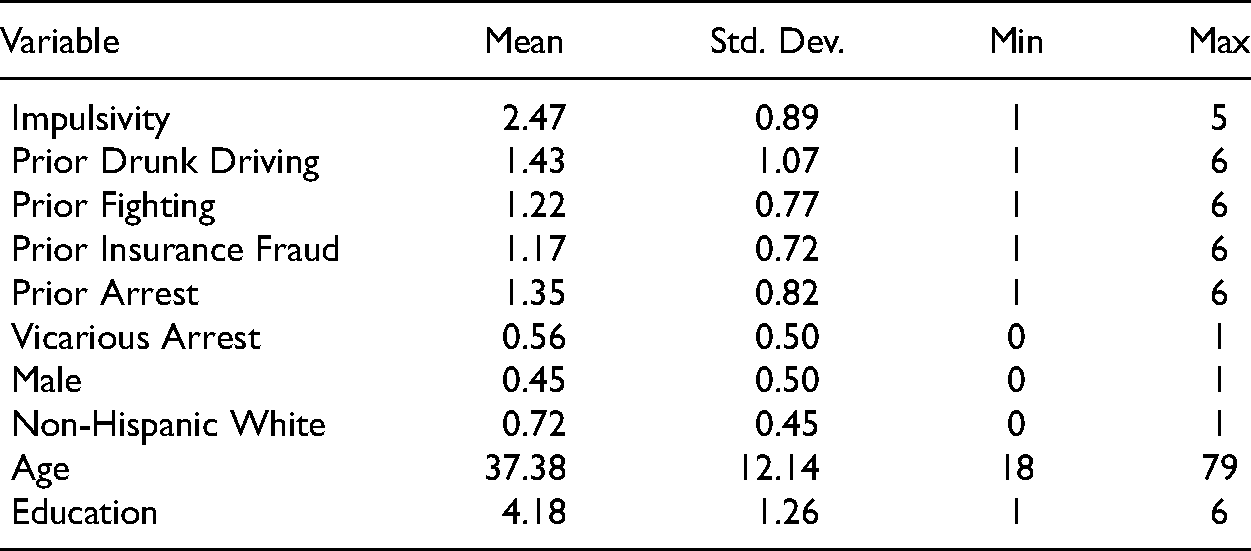
Our survey embedded an experimental vignette for each of three different crime opportunities. Of the 1,399 respondents who began the survey 1,316 (94%) completed it. Of these, a final analytic sample of n = 1,275 remained after 41 additional cases (3%) were removed for item nonresponse on at least one key variable. Table 1 provides summary statistics on impulsivity, prior criminal involvement, prior arrest history, and demographics. The current sample resembles past MTurk samples on key demographics (e.g., Levay, Freese, and Druckman 2016; Pickett et al. 2018).
Sample Characteristics (N = 1,275).
Measuring Active Peer Influence
The current study explored whether conversational content, anchored in a specific criminal opportunity, informs the decision to engage in three qualitatively distinct criminal behaviors: drunk driving, fighting, and insurance fraud. We developed three perceptual deterrence vignettes designed to present realistic social contexts where conversations between people typically occur. Specifically, the settings were a bar, a sporting event, and an auto repair shop, and each portray a situation in which the respondent speaks with a hypothetical friend about the prospect of committing a crime. Importantly, our vignettes build on prior perceptual deterrence studies using the vignette methodology (e.g., Nagin and Paternoster 1993; Pogarsky 2004; Pickett et al. 2018; Barnum and Solomon 2019). These studies demonstrate the importance of situational and contextual information (e.g., presence of guardian, level of provocation) for the formation of risk perceptions. We therefore restrict experimental manipulation to the content of communication by friends while holding constant other contextual details that undoubtedly shape the decision to offend. Table 2 contains the basic scenario stems.
Scenario Stems.
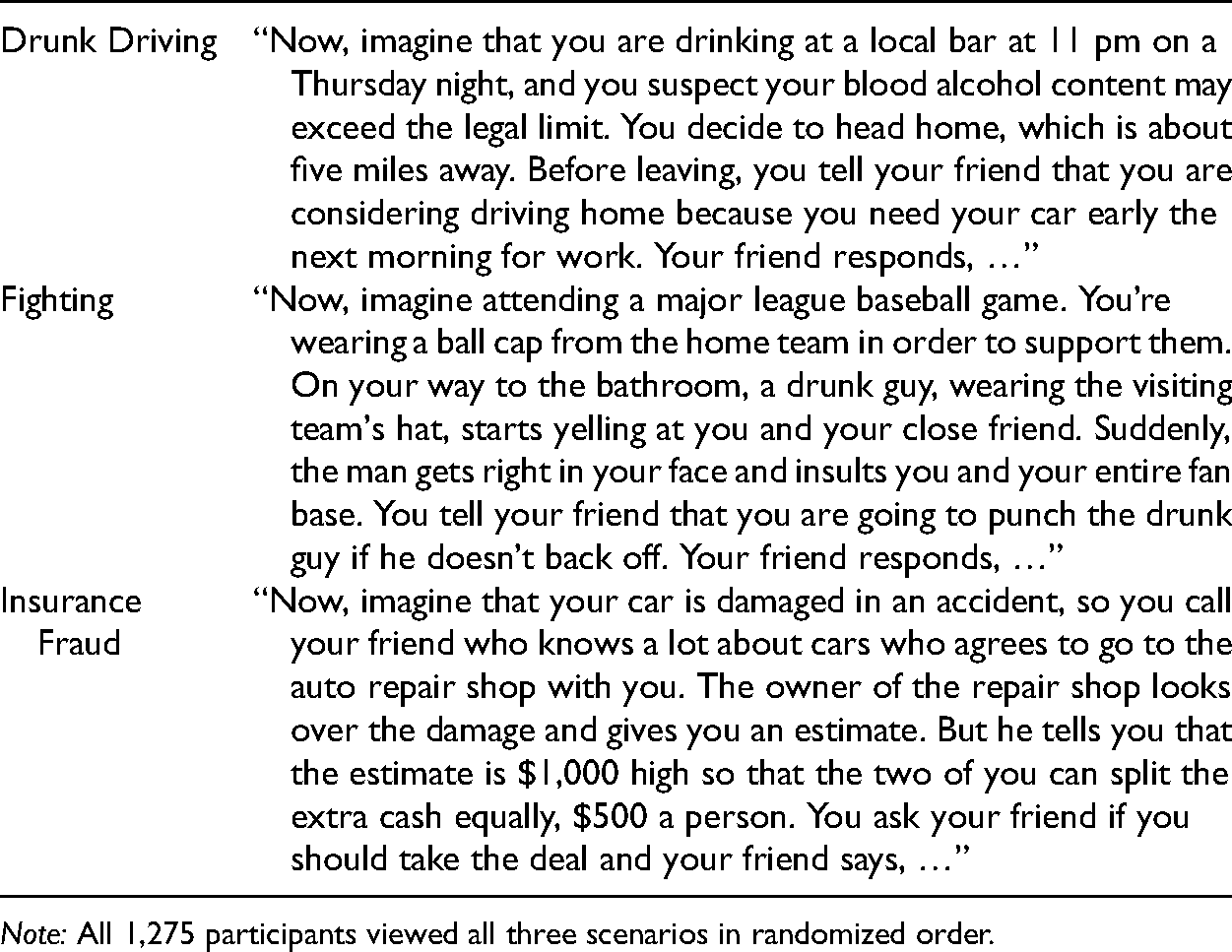
Note: All 1,275 participants viewed all three scenarios in randomized order.
Our primary objective is to investigate the possibility that verbal communication serves as situational-relevant information that informs assessments about the risks and costs of a crime opportunity. Thus, respondents were randomly assigned to one of four conditions per vignette. 4 In each case, a hypothetical friend says something to the actor during the offending opportunity that relates to either sanction certainty or social cost perceptions. Specifically, each vignette included one of four conversational inputs corresponding to either: 1) higher sanction certainty, 2) lower sanction certainty, 3) higher social costs, or 4) lower social costs. These manipulations appear in Table 3 with corresponding sample sizes for each condition.
Contemporaneous Communication Manipulations.
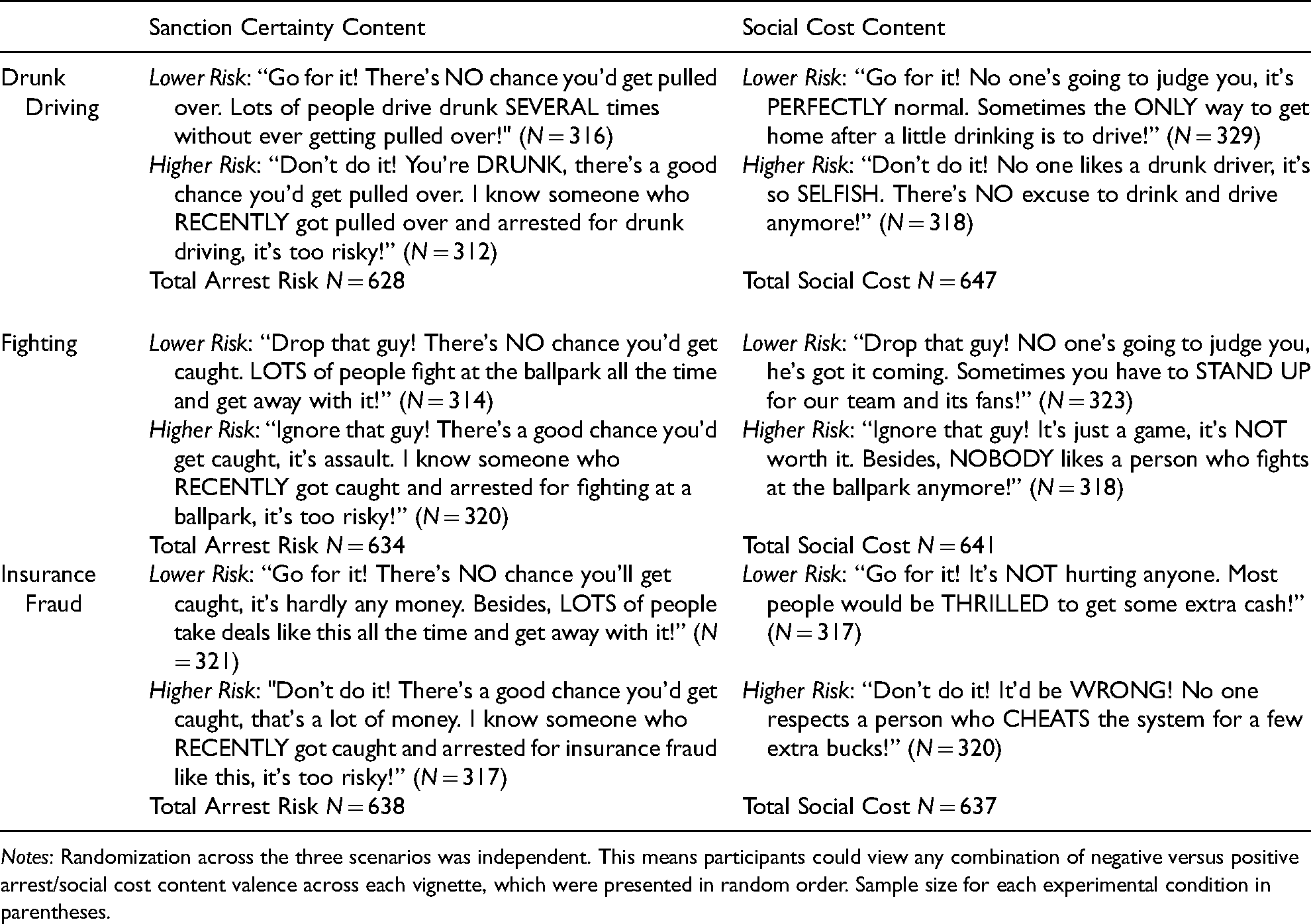
Notes: Randomization across the three scenarios was independent. This means participants could view any combination of negative versus positive arrest/social cost content valence across each vignette, which were presented in random order. Sample size for each experimental condition in parentheses.
As “proof of concept” we opted for stark, binary manipulations: either a conversational message to increase the corresponding perception (e.g., “Don’t do it”) or an instigative message to decrease it (e.g., “Go for it”). Because of the rich diversity in real life conversation, we constrained our experiment to a single, brief exchange (Goodwin and Heritage 1990; Gunia et al. 2012). This was to isolate the normative content of the conversation and its influence on perceptions of sanction risk and social costs. In doing so, we avoided any conversational inputs that direct the respondent's attention to objective features of the opportunity that could change the true probability of apprehension as such manipulations may be confounded with other inanimate situational manipulations. Instead, we presented broad conversational manipulations that merely alluded to the riskiness (or lack thereof) of each behavior either in terms of apprehension certainty or social costs. Since the hypothetical friend is actively influencing the respondent regarding criminal behavior, we strove for vivid and realistic vignettes, hence the capitalized words to represent points of emphasis (Hoeben and Thomas 2019; see also Blondé and Girandola 2016).
Perceived Sanction Certainty and Social Costs
To address our expectation that general, decontextualized estimates of the likelihood of punishment or social costs are distinct from judgments grounded in the operative circumstances of the offending decision, we measured both general and situational decision-making perceptions. General perceptions are assessments by respondents before reading the vignettes. Captured this way, general perceptions are behavior specific as opposed to context specific and therefore represent abstract expectations about the risks and costs of committing a particular crime. Situational perceptions, on the other hand, correspond to the circumstances of the scenarios; thus, each situational perception is elicited after its corresponding vignette.
Before respondents evaluated the hypothetical vignettes, they rated general expectations of sanction certainty and social cost for drunk driving, fighting, and insurance fraud. The order of these questions was randomized. For sanction certainty, respondents were asked to “Please rate how LIKELY or UNLIKELY it is that you would get CAUGHT by the police if you committed each of the following crimes.” Response categories ranged from 1 (extremely likely) to 7 (extremely unlikely). For social costs, we asked respondents to imagine they committed the three behaviors and then rate “how much do you AGREE or DISAGREE that the people you know would LOSE RESPECT for you if you committed each of the following crimes.” Again, response categories ranged from 1 (strongly agree) to 7 (strongly disagree). Respondents rated each behavior in random order. All six variables were coded so that higher scores represent greater perceptions of sanction certainty or social costs.
After each vignette, respondents rated the likelihood they would get arrested and lose the respect of the people they know if they committed each behavior under the specified conditions. Specifically, to capture situational sanction certainty, respondents were told to think “about the situation described above, imagine you actually [behavior] in this scenario, how LIKELY or UNLIKELY is it that you would be caught by the police?” For anticipated situational social costs, we asked respondents to “please rate how much you AGREE or DISAGREE that if you actually [behavior] in this scenario, the people you know would lose respect for you.” The response categories for each measure were the same as for the general measures above. The two perceptual measures were presented in random order, with higher ordinal response categories reflecting perceptions of higher risk.
Background Characteristics
Several background characteristics were measured. We capture impulsivity by averaging four items from the Grasmick et al. (1993) scale: 1) act on the spur of the moment; 2) don’t devote much thought and effort to preparing for the future; 3) do whatever brings pleasure here and now; 4) more concerned with what happens in the short run than long run (α = .78). Items were reverse coded so that higher scores reflect greater impulsivity. Prior offending captured the number of time respondents had driven drunk, been in a physical fight, and committed insurance fraud in the past three years. Response categories ranged from 1 to 6 (none; 1 time; 2–3 times; 4–5 times; 6–7 times; 8 + times)—approximately 20% of the sample reported driving drunk, 10% reported being in a physical fight, and 7% committed insurance fraud at least once in the past three years. Prior arrest is the number of times respondents reported being arrested in their lifetime—ranging from 1 (none) to 6 (8 + times). We also included a dichotomous measure for vicarious arrest by asking, “Have any of your family members or close friends ever been arrested?” (yes = 1). Lastly, we measured respondent gender (male = 1), race (non-Hispanic White = 1; non-White = 0), age in years (18–79), and educational attainment (1 = less than high school degree, 6 = graduate degree).
Results
The primary goal of our analyses was to test whether, net of other relevant situational information, contemporaneous communications from a peer about an offending opportunity influence judgments about sanction certainty and social costs. To begin, Figure 1 presents the sample-wide distributions of both general and situational perceived sanction certainty and social costs.
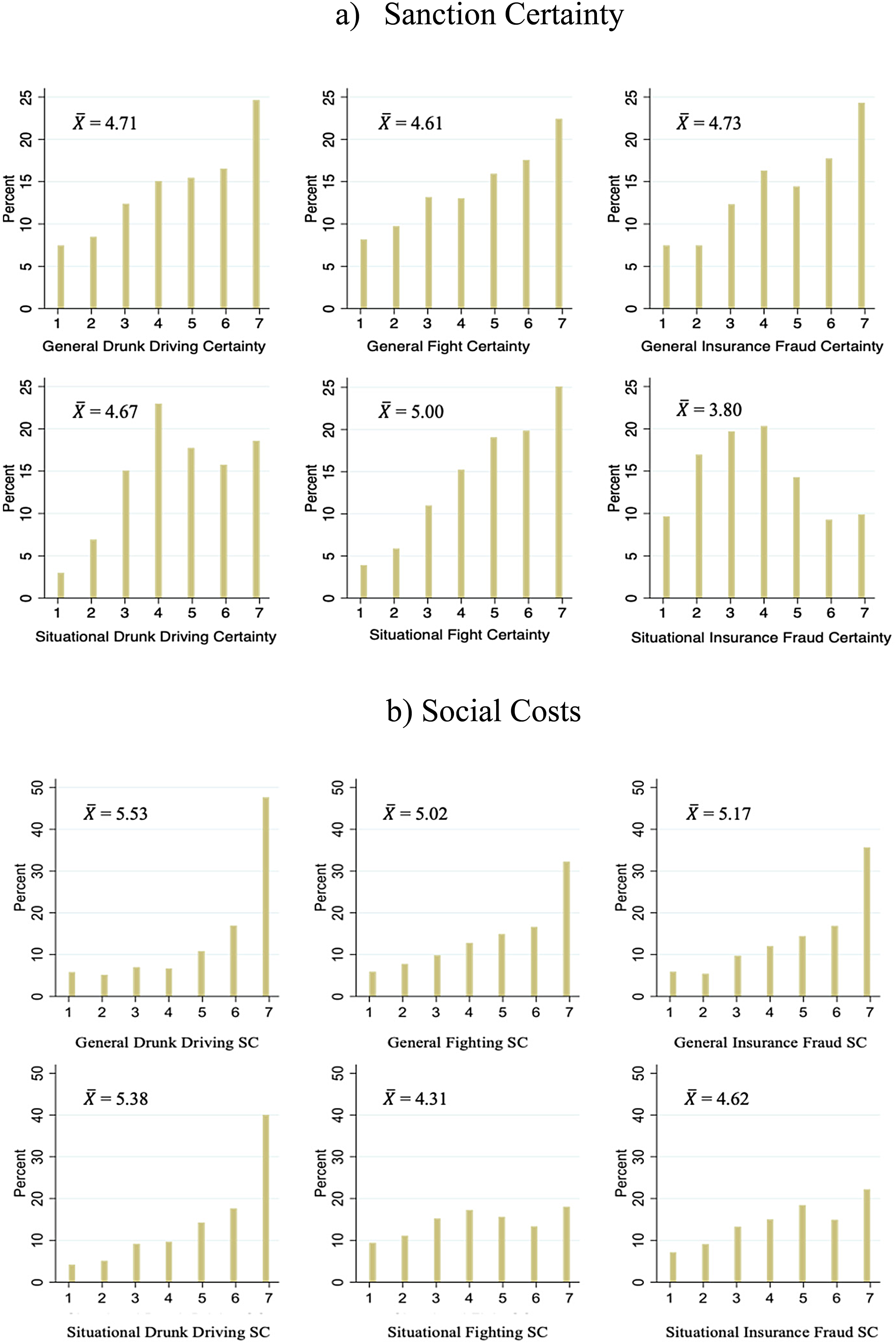
General and situational sanction certainty and social cost perceptions. Notes: Likert scale ranges from 1 = very unlikely to 7 = very likely. SC = social costs.
Across each offense, the situational measures vary more than the general measures do. For example, mean generalized sanction certainty estimates were 4.71, 4.61, and 4.73, for drunk driving, fighting, and insurance fraud, respectively. In contrast, average situational sanction certainty estimates were 4.67 for drunk driving, 5.00 for fighting and 3.80 for insurance fraud. Similarly, the general social cost measures varied between a mean of 5.53 for drunk driving, 5.02 for fighting, and 5.17 for insurance fraud whereas the situational social cost measures vary between 5.38 for drunk driving, 4.31 for fighting, and 4.62 for insurance fraud, again reflecting considerably more variation in the situational measures across offense types. This overall pattern comports with recent suggestions that contextual information regarding an offending opportunity enables more precisely calibrated judgments from which finer distinctions can emerge. Next, we explore whether this heterogeneity in situational judgments corresponds with the systematic manipulation of communications between the respondent and a peer at the time of the offending decision. 5
The Influence of Peer Communications on Judgments
Information Transmission for Matching Judgments
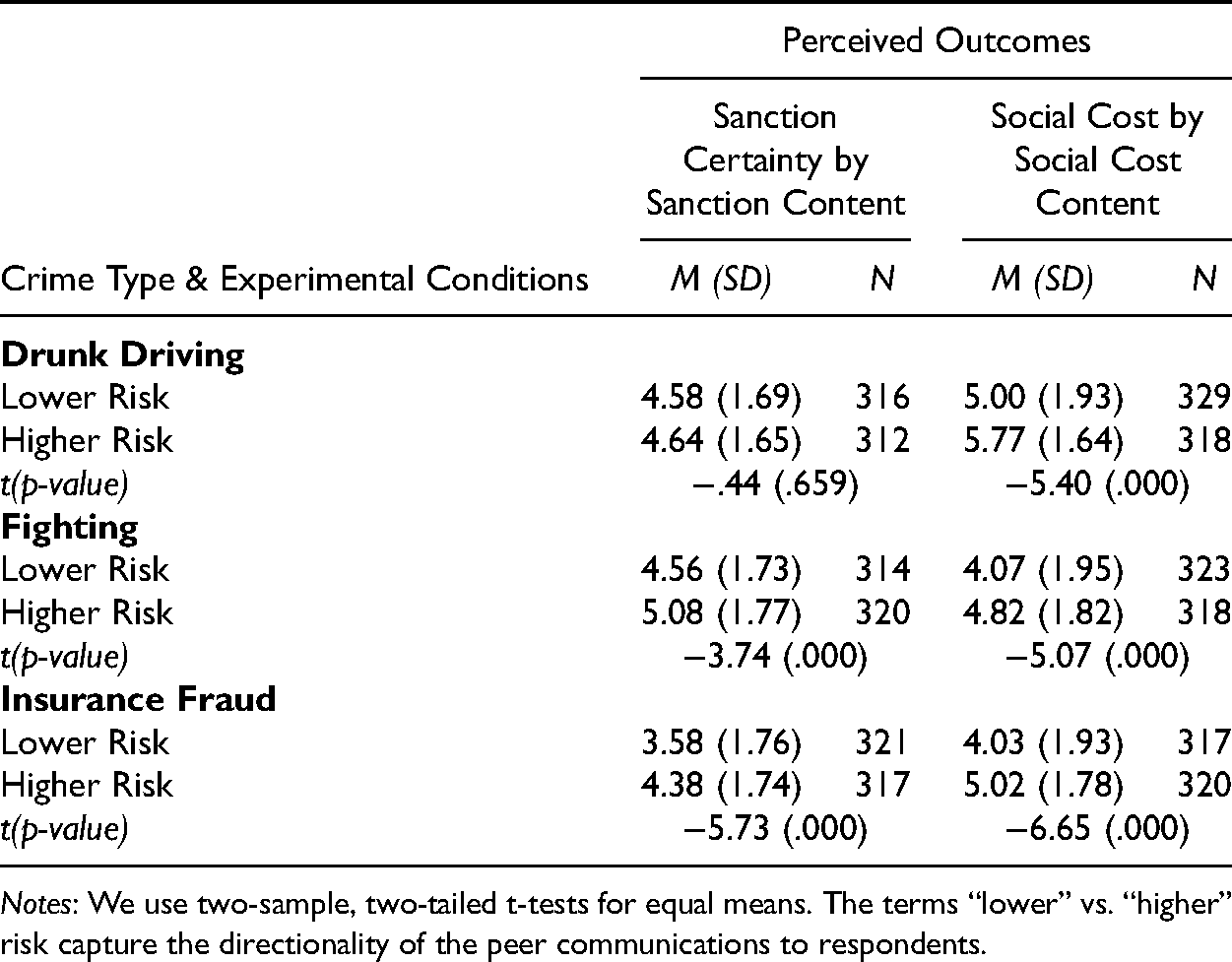
Table 4 presents mean levels of perceived sanction certainty and social cost, by experimental condition, for each offense. Recall that there were four experimental conditions, each involving a communication between the respondent and a friend at the time of the offending opportunity that either suggested 1) higher sanction certainty, 2) lower sanction certainty, 3) higher social costs, or 4) lower social costs. First, we examine the impact of contemporaneous peer communications regarding the certainty of punishment or social costs on matching judgments, Hypotheses 1a and 1b.
Experimental Results: Information Transmission for Matching Outcomes.
Notes: We use two-sample, two-tailed t-tests for equal means. The terms “lower” vs. “higher” risk capture the directionality of the peer communications to respondents.
The results in Table 4, which appear graphically in Figure 2, show that the experimental manipulations produced the theorized effects. In all cases, situational risk estimates were nominally higher when communications related to higher sanction certainty for offending compared to communications suggesting lower sanction certainty. This pattern held for both perceived sanction certainty and perceived social costs. Moreover, these differences were statistically discernible at p < .001 for 5 of 6 mean comparisons. The results were particularly stark for sanction certainty regarding insurance fraud—whereas
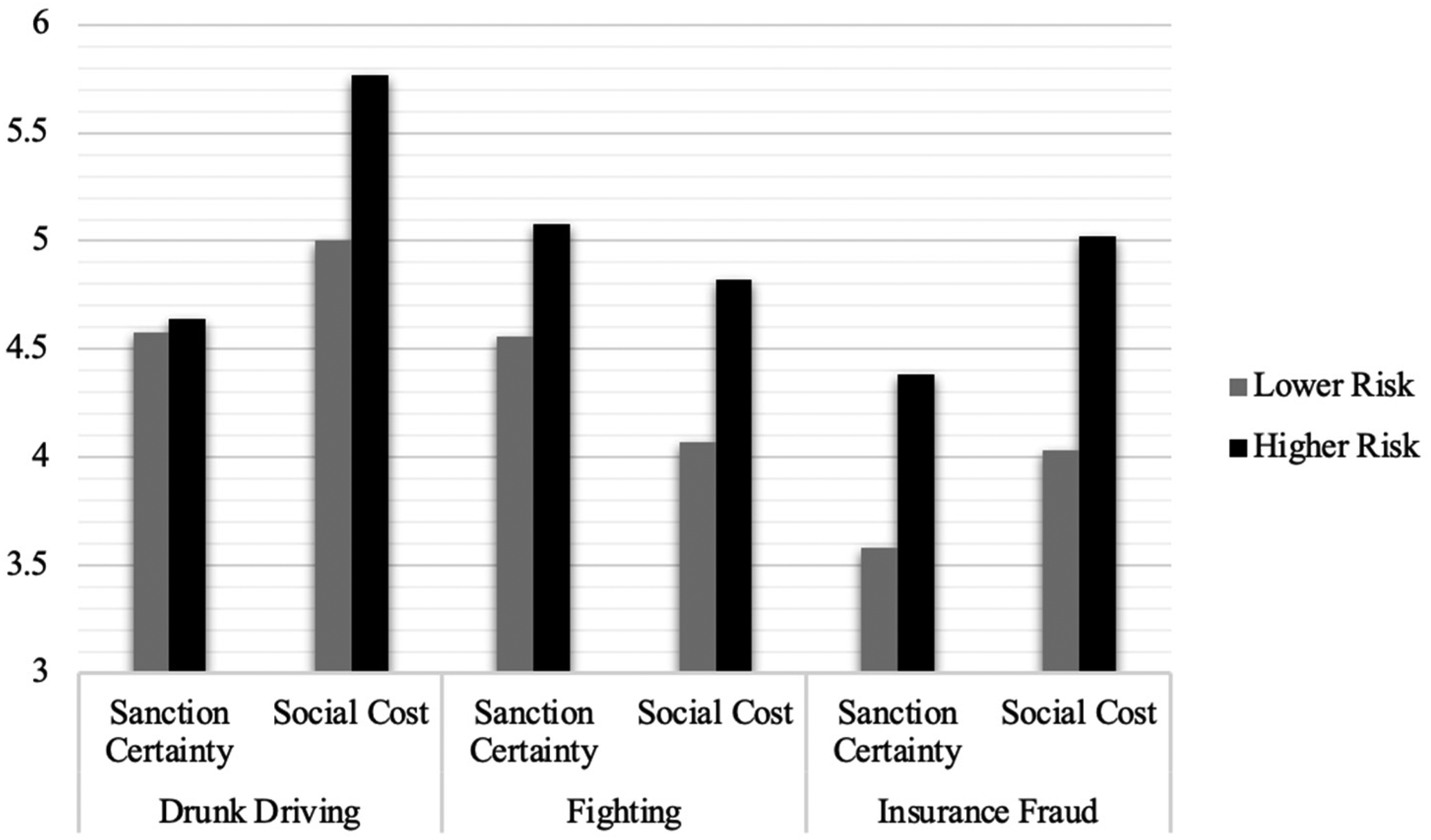
Perceived sanction certainty and social costs by communication content. Notes: Graphs correspond with results in Table 4. The terms “lower” vs. “higher” risk capture the directionality of the peer communications to respondents.
Some past research suggests peer influence is more pronounced for adolescents and younger adults than it is for older individuals, and we investigated this possibility here (e.g., Warr 2002; Gardner and Steinberg 2005). Subsidiary analyses assigned respondents to one of four age groups corresponding to each quartile of the sample-wide distribution of age: 18–25, 26–34, 35–47, and 48 and older. The analyses from Table 4 were then re-estimated for each subgroup. For sanction certainty perceptions, the findings within each age category followed the same pattern for the overall sample. Comparable findings emerged for anticipated social costs, except that the effects of peer communications on anticipated social costs were larger for younger respondents than they were for older respondents.
Information Transmission for Nonmatching Judgments
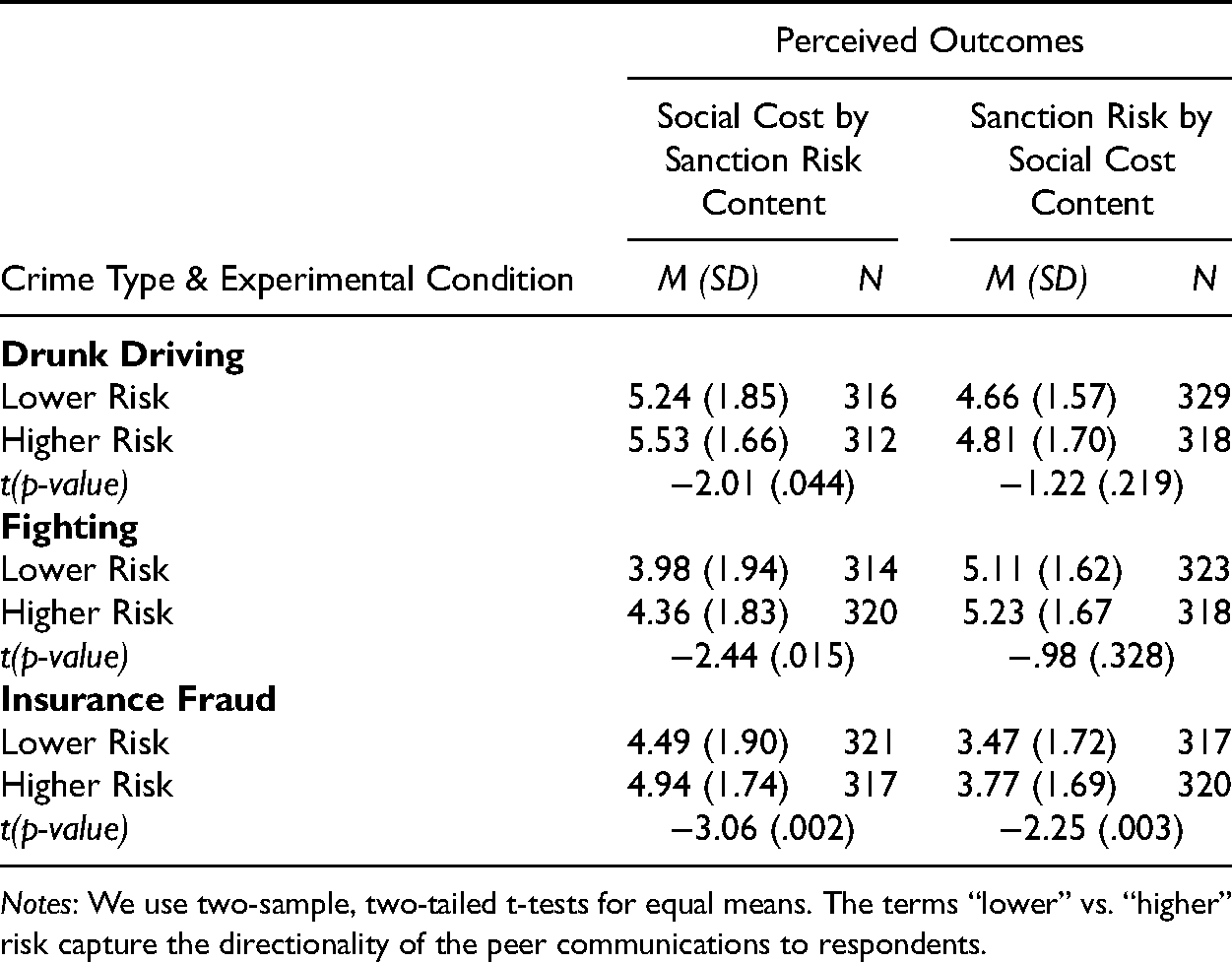
Beyond the impact of contemporaneous peer communications on matching perceptual outcomes, we also investigated the impacts of nonmatching information, that might arise, when formal punishment promotes normative validation influencing how society and individuals view certain behaviors (Hypotheses 2a and 2b). Table 5 presents mean sanction certainty and social cost estimates by nonmatching communicated content. As expected, conversational content pertaining to a higher likelihood of getting arrested was significantly associated with higher social cost perceptions for all three offenses. For drunk driving, there was a mean difference in perceived social costs of 5.53–5.24 = 0.29 (p < .05) between lower and higher risk communications about sanction certainty. The mean difference in perceived social costs for fighting was 4.36–3.98 = 0.38 (p < .05), and 4.94–4.49 = 0.49 (p < .01) for insurance fraud, which was the largest of the three effects.
Experimental Results: Information Transmission for Nonmatching Outcomes.
Notes: We use two-sample, two-tailed t-tests for equal means. The terms “lower” vs. “higher” risk capture the directionality of the peer communications to respondents.
Importantly, a comparable pattern is not obtained for the impact of the social cost manipulation on legal sanction certainty perceptions. In this case, only the communication pertaining to social costs for insurance fraud produced significant differences at the p < .05 level in estimates of sanction certainty between the lower and higher social cost content conditions (
One additional detail is notable from Figure 3, which graphically depicts the risk estimates from Table 5. For fighting and insurance fraud, even though the sanction certainty content manipulation affects both sanction certainty estimates, and social costs estimates in the theorized directions, the impact remains greatest for the matching perceptual outcome, sanction certainty. That is, for fighting, a communication suggesting the offense is legally risky increases sanction certainty perceptions by (5.08–4.56)/4.56 × 100 = 11.41%, but social cost estimates by only 9%. For insurance fraud, a communication suggesting the offense is legally risky increases sanction certainty perceptions by 22%, but social cost estimates by only 10%. This suggests that notwithstanding any spillover impacts on nonmatching perceptions, more directly relevant content affects judgments more than less relevant content does.
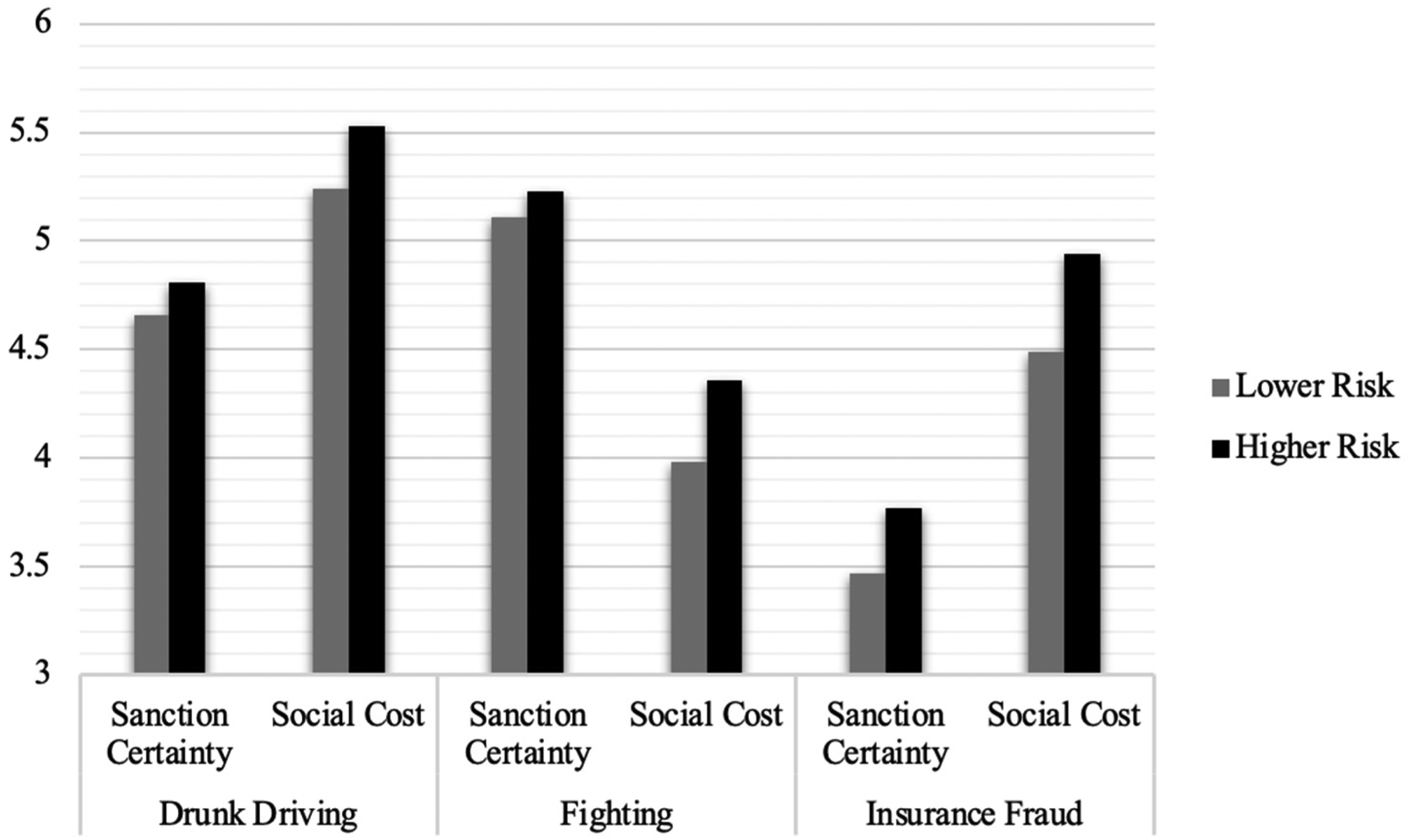
Perceived sanction certainty and social costs by nonmatching communication content. Note: Graphs correspond with results presented in Table 5. Sanction certainty perceptions predicted by social cost content manipulations and social cost perceptions predicted by sanction certainty content manipulations. The terms “lower” vs. “higher” risk capture the directionality of the peer communications to respondents.
Situational Adjustments
Finally, we investigate hypotheses 3a and 3b by comparing individuals’ situationally grounded perceptions with their general, decontextualized counterparts for each crime. Recall that before reading each vignette, respondents first gave general sanction risk and social cost estimates for each offense. Thereafter, they provided companion estimates under the circumstances outlined in the vignette. For further insight on contemporaneous information transmission among peers, we created difference scores by subtracting each general judgment from its corresponding situational version.
These differences are instructive about several aspects of our experiment. First, the sign of the difference indicates whether perceived certainty or social costs are greater or less given the added circumstances in a scenario. A difference less than 0 means that the general estimate exceeds the situational estimate, whereas differences above 0 reflects the opposite. Second, the calculation also reflects the raw magnitude of any differences. Finally, differences within estimates of either sanction certainty or social cost perceptions can be compared across the different experimental manipulations.
Figure 4 shows the mean situational adjustments for each of the 6 decision making perceptions, by whether the communicated content corresponded to higher or lower risk. These results provide further evidence for the processes of information transmission described earlier. Formal difference in means tests revealed that all 6 comparisons produce nominal differences in the theoretically expected direction, with 5 differences statistically discernible at p < .05. That is, differences between situational and general measures significantly varied between content corresponding to higher or lower risk for drunk driving social cost, as well as both sanction certainty and social cost measures for fighting and insurance fraud. 7 Note that the pattern is obtained regardless of whether the situational adjustments are positive or negative. In the case of sanction certainty for fighting, for example, the situational estimate exceeds the general estimate by a much greater amount when the content of the communication corresponded to higher risk than when the content suggested lower risk. But although both situational adjustments for perceptions of informal costs for fighting are negative, they are far more negative when respondents receive communications reflecting lower risk than when the content suggests higher risks.
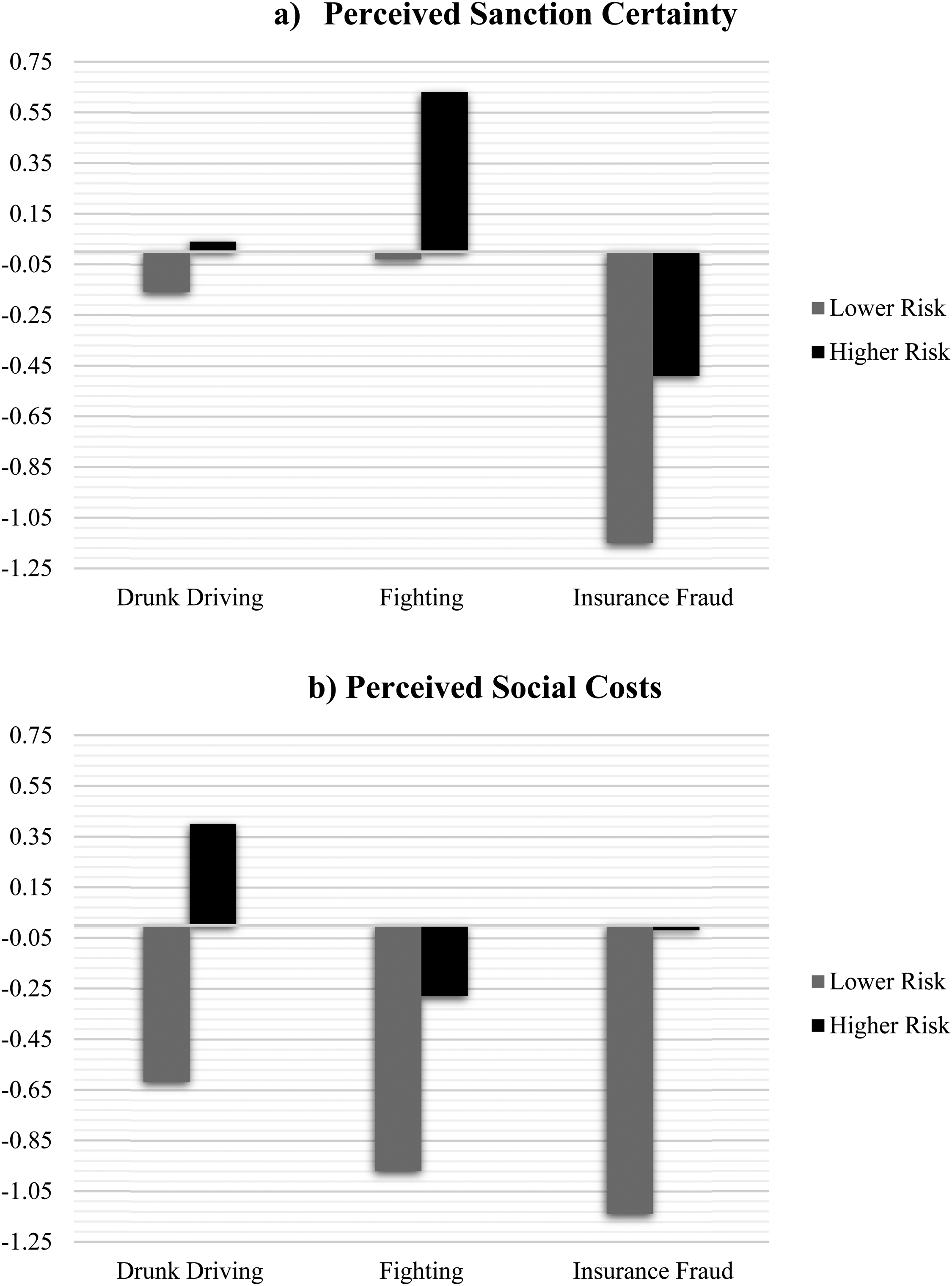
Situational adjustments of perceived sanction certainty and social costs by communication content. Notes: Each bar in the graph represents the difference obtained by subtracting a general perception from its corresponding, situational version. The terms “lower” vs. “higher” risk capture the directionality of the peer communications to respondents.
Subsidiary analyses further explored the robustness of these findings. Although the results largely supported our theoretical expectations, we wanted to ensure that they were not driven by boundary effects (Casey and Scholz 1991). This is because estimates of sanction certainty and social costs are clearly bounded. Thus, respondents who indicated that the general likelihood of getting arrested for a particular crime was either very unlikely ( = 1) or very likely ( = 7) could only report a “situationally adjusted” estimate in one direction. This is particularly relevant here because as is evident from Figure 1, there was a high percentage of respondents who reported 7's on the global measures of sanction risk and social costs for each crime. Therefore, we recalculated the results in Figure 4 after removing participants who reported a 1 or a 7 on the general measures. 8 Results from these sensitivity checks yielded comparable findings to those presented above.
Supplemental Survey and Data on Situational Adjustments
Finally, we collected supplemental data to further explore the meaningfulness of the difference scores for processes of information transmission among peers. In our original survey, the baseline general perceptual questions were entirely context-free, which could prompt readers to wonder whether the pattern of difference scores is driven by the experimental content manipulations, or some other explicit or implicit aspect of the vignettes. Consider, for example, judgments about driving drunk. Without information about the circumstances of the offending opportunity, participants may impute their own information when estimating the level of sanction certainty for drunk driving (e.g., driving distance, time of day, etc.), whereas the vignettes provide this information, thus holding it constant across respondents. Variation in imputed information across participants may therefore confound within-person comparisons between general and specific perceptual measures.
To address this possibility, additional data were collected with a supplemental survey to 561 MTurk workers. The function and layout of the survey was comparable to that for our main analyses—participants first provided general perceptual estimates for the three crimes followed by the same three scenarios (and manipulations) in randomized order. However, instead of tasking participants to rate purely decontextualized crimes at the outset, we now provided the same key points of contextual information about the offending opportunity that also appeared in the scenario stems presented in Table 2. The specific wording for these questions appears in Table A1 in the appendix. We then conducted comparable within-person comparisons to test Hypotheses 3a and 3b.
These supplemental sensitivity analyses yielded a similar pattern of findings as before (see Figure A1 in appendix for graphical depiction of results). That is, all 6 comparisons produce nominal differences in the theoretically expected direction. Four of these differences were statistically discernible at p < .05, and only the estimates for insurance fraud were no longer statistically significant for either judgment. Interestingly, the difference between situational and general sanction certainty perceptions for drunk driving are now significant, such that participants positively adjust general sanction certainty expectations when exposed to situational content suggesting higher certainty and decrease them when the content suggests lower risk. Although the situational, scenario-based estimates tended to be lower on average than the general measures, estimates were lowest when conversational content suggested lower risk. These findings underscore how contemporaneous peer communications represent credible sources of information relating to sanction certainty and social cost perceptions during offending opportunities.
Discussion
To date, research on the situational and environmental aspects of crime has largely focused on area level indicators of criminal opportunities in time and space, consistent with the routine activities and social disorganization perspectives (Cohen and Felson 1979; Ratcliffe 2006). In this view, police deployments and related policies are logical interventions for increasing sanction risk perceptions in areas marked by physical indicators of suitable targets (e.g., Nagin 2013; Chalfin et al. 2021). We extended this notion of an “environmental backcloth” for crime decisions to include peer influences from social contexts, which “create potent forces producing or constraining behavior” (Ross and Nisbett 2011:9; see also Thaler and Sunstein 2009; Jepperson and Meyer 2011).
Hoeben and Thomas (2019) recently outlined various interdependencies in peer decision making. Peers influence one another passively through normative processes such as role modeling and mimicry, where the “influencer” may be unaware of their impact on others’ judgements and behaviors (e.g., McGloin and Rowan 2015; McGloin and Thomas 2016). Peers also actively influence one another's contemporaneous judgments about the (dis)incentives for crime by providing or emphasizing information and instigating or dissuading a specific course of action. We reported an empirical demonstration of the latter, in which situation-specific conversation between friends affected two core decision making variables—perceptions of sanction certainty and social costs. At least three material findings emerged.
First, as hypothesized, participants receiving communications suggesting higher risks for offending estimated higher levels of risk. This was true for both perceptions of sanction certainty and perceived social costs. This pattern held across three qualitatively distinct transgressions. Second, in line with arguments by Gibbs (1975) and Nagin and Pogarsky (2001), conversational content about the probability of sanction certainty also influenced estimates of social costs according to the direction of the communication. This reinforces that sanction threats operate not only through people's fear of getting caught (e.g., Pickett et al. 2018), but also through “normative validation” whereby punishment socializes and enculturates a punished person, further signaling that the sanctioned conduct was wrong and should be avoided (see also Braithwaite 1989). It is important to note, however, that this association was not as strong as when the communication and perception both involved sanction certainty. In contrast, we found little relationship between information regarding social costs and perceptions of sanction certainty.
Third, there was additional evidence for these processes within respondents as well. That is, people appear capable of recalibrating general expectations of sanction certainty and social costs to be more in line with the information provided by the physical and social context of a criminal opportunity. Social cues provided by peers were especially impactful when the communications downplay risk, a finding consistent with situational peer research on instigation and co-offending (e.g., Osgood et al. 1996; Haynie and Osgood 2005; McGloin and Nguyen 2012).
Our findings contribute to a growing literature on the formation and malleability of judgments related to crime opportunities (e.g., Anwar and Loughran 2011; Pogarsky et al. 2017; Thomas et al. 2018). Regarding interpersonal peer dynamics, Sirakaya (2006) distinguished exogenous social effects, that are attributable to some group characteristic, such as socioeconomic or demographic composition, from endogenous social effects or social interactions. Loughran (2019:749) amplified this point: “An alternative way to think of peer decision-making is in a game theoretic context, in which two (or more) individuals are involved in a strategic interaction and attempting to respond best based not only on their preferences but also on each other's potential actions.” Neglecting these higher order causal dynamics can bias estimates of “peer effects” and/or impede a more thorough understanding of how peers influence contemporaneous judgments (see also Barnum and Armstrong 2019). Consider Sirakaya's (2006) example of a drug treatment program, which is not only palliative for treated offenders, but also for persons the treated offenders interact with, since treated offenders bring an improved prosocial outlook to the community and a recalibrated sense of the legal and extralegal consequences of substance use.
Moreover, broader societal-level interventions targeting the way people communicate and exchange information about crime can impact contemporaneous judgments similarly to traditional law enforcement strategies, such as hot spot policing (Pickett 2018; Pogarsky and Herman 2019). Our conversational manipulations, for example, significantly influenced respondents’ risk perceptions even without directing their attention to objective features of the opportunity that are more reliably related to the true probability of apprehension (as would be the case with a statement like, “Don’t do it, there are cops everywhere.”). Thaler and Sunstein (2009:53–73) further highlight the potential for social multiplier-type interventions to shape decision making, emphasizing the apparent predisposition to belong to a group, as well as to avoid social disapproval (see also Warr 2002). For example, Texas implemented numerous anti-littering initiatives, using various deterrence-based strategies, such as increased fines, to reduce littering on Texas highways. After several failed attempts, Texas adopted an alternative approach by employing a “Don’t mess with Texas” slogan to prompt the spirit of Texas pride—i.e., do not behave in a way that hurts other Texans. The slogan was displayed in television ads, billboards, and other venues, and litter was subsequently reduced dramatically.
Comparable interventions have also reduced substance use among young adults. To illustrate, young adults tend to overestimate substance use by their peers, which leads to increased personal use. Campaigns that have been successful in reducing substance use recognize this phenomenon and attempt to “realign” perceptual correspondence by emphasizing how few people actually use substances (e.g., “only 5% of students reported using illicit drugs in the past year”), rather than simply highlighting negative consequences (see, e.g., Wechsler et al. 2000; Linkenbach and Perkins 2003). In line with the conversational inputs in our experiments, campaigns such as these aim to reduce certain criminal and/or risky behavior by “reinforming” actors about how others act in specific social situations, signaling decision makers to adjust their perceptions accordingly.
Although beyond the scope of our study, future research should continue to explore how peers influence judgments about the anticipated benefits from crime. Research suggests this occurs through mechanisms of social status and acceptance (Thomas and Nguyen 2020; see also Warr 2002), but it is also possible communications between peers can increase the salience of benefits more broadly. This may be especially pertinent for instrumental crimes such as insurance fraud in the current study when conversational inputs highlight the potential monetary value at stake in a particular situation. Given the standard temporal dynamics of crime where the benefits, whether instrumental or hedonic, tend to be immediate with the costs often delayed, the various inducements to crime remain critical components of the crime decision (see Loughran et al. 2016).
To better understand the situations and contexts for offender decision making, new empirical paradigms have developed to complement existing ones. Virtual reality techniques are well suited for studying these momentary perceptual processes (e.g., Nee et al. 2019; van Gelder et al. 2019). Although our manipulations of conversational content appear to have been well communicated to and understood by respondents, written versions of the vignettes might nevertheless undersell the momentary significance of conversation for decision making. That is, with written scenarios it may be difficult to ensure participants are interpreting the points of emphasis we intended to be most salient. Virtual reality, on the other hand, can lend immediate, additional detail through both visual and audio stimulation while simultaneously controlling for factors inherent to a criminogenic setting—which is important for the study of peer influence on decision making as highlighted by our supplemental within-subject analyses.
Beyond realism and situational control, emerging methodologies can also help extend experimental manipulations. For example, researchers might consider whether the identity of the “correspondent” influences the salience of the message by manipulating who provides the communication—e.g., a stranger, a peer, or an actual close friend. This could be done by mapping images of friends on virtual avatars, and by manipulating key characteristics of this person such as gender, age, and ethnicity. Researchers could further consider whether the style of communication (e.g., emphatic versus mundane) or its framing (e.g., as a loss or a gain) help shape perceptions. Finally, it is important to compare peer influence on judgments from nonverbal cues such as actual deviant behavior with the perceptual impacts from the verbal cues in the current study (see, e.g., Gallupe et al. 2019).
Although we focused on information transmission as a mechanism linking peers with decision outcomes, peers likely shape contemporaneous judgements about offending opportunities in other ways as well. For example, consider the initial inducement statements used in our risk manipulations: “Go for it!” and “Drop that guy!” Statements such as these may evoke certain feelings and emotions that shape perceptions beyond any risk-specific remarks (e.g., “people get away with this all the time”). Encouraging, and enthusiastic statements from peers may evoke or reaffirm feelings of confidence leading decision makers to underestimate or even ignore potential risks indirectly motivating offending even if other objective information (e.g., presence of police) signals otherwise (e.g., Barnum and Solomon 2019; van Gelder et al. 2019). Moreover, peer communications may help a decision-maker refine their general attitudes towards certain behaviors (e.g., fighting is wrong) in an offending opportunity by highlighting relevant neutralizations inherent to that situation (e.g., “people fight at ball games all the time”) (Thomas 2018). Given the social nature of many crimes, it is important for researchers to continue unpacking the ways peers influence each other during criminal decisions.
We close with Coleman's (1986) influential point, embodied in Coleman's Boat, that intentional action is best understood in context (see also Matseuda 2017; Nagin and Sampson 2019). Often, research on offender decision making has assumed a solitary central actor, the very “methodological individualism” Coleman cautioned against (see also Sullivan, McGloin, and Kennedy 2011). Thus, Apel (2013) suggested expanding the range of variables theorized to influence decision making processes to, for example, indicia of neighborhood disorder or decay, logic which also applies to perceptions of social costs from crime, such as stigma and embarrassment. As Matseuda (2013:388) put it: “Rational choice principles offer a parsimonious micro-foundation for macro-sociological concepts and causal mechanisms. The task then, is to identify how macro-level social contexts condition micro-level processes (individual decisions), and how micro-processes, in turn, produce macrolevel outcomes (social organization).” In this spirit, our intent was to integrate thinking about offender decision making and social context to help produce a more informed understanding of criminal behavior.
Footnotes
Declaration of Conflicting Interests
The author(s) declared no potential conflicts of interest with respect to the research, authorship, and/or publication of this article.
Funding
The author(s) received no financial support for the research, authorship and/or publication of this article.

Notes
Appendix
Question Wording and Measurement for Supplemental Situational Adjustment Analysis
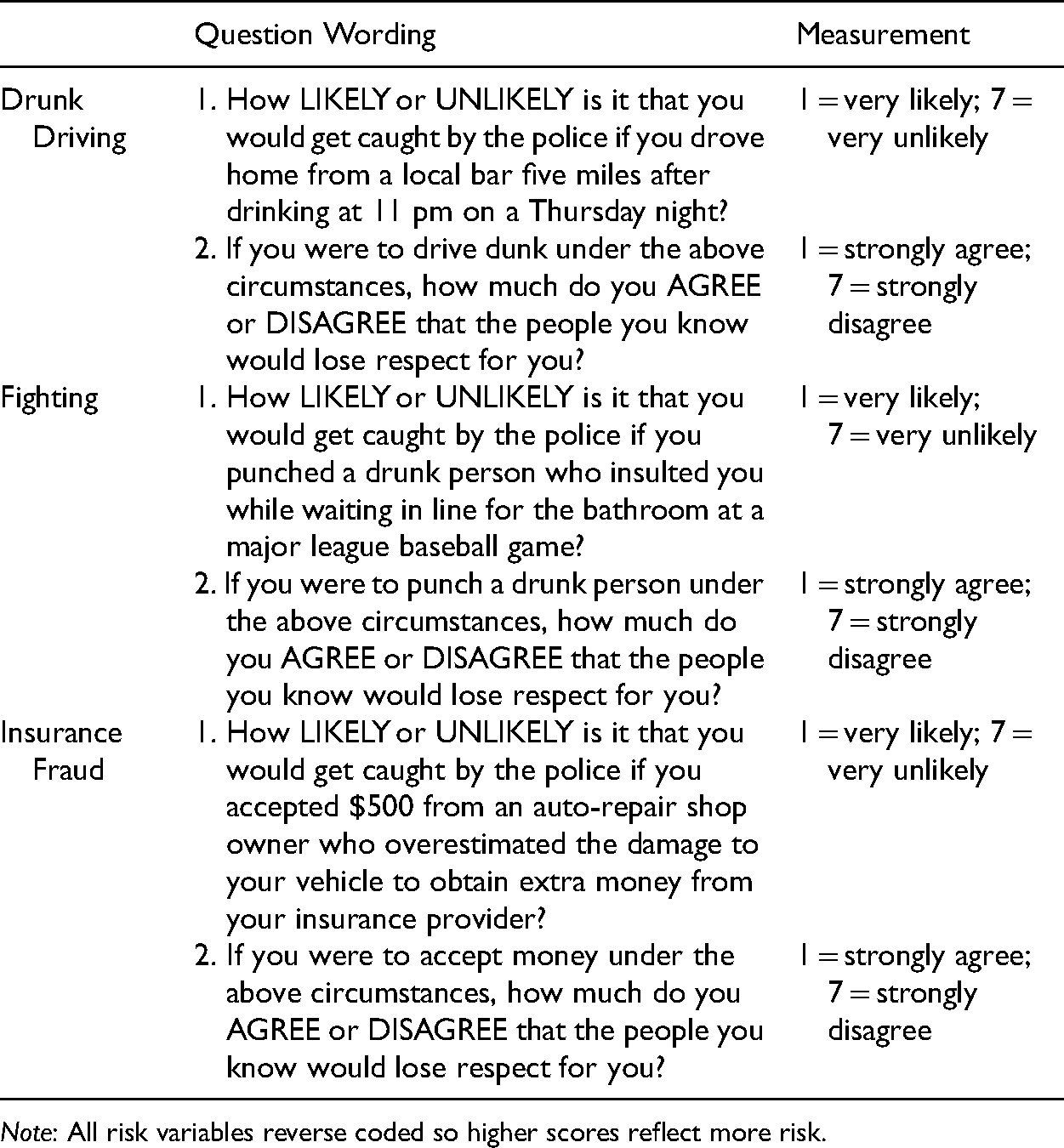
| Question Wording | Measurement | |
|---|---|---|
| Drunk Driving | 1. How LIKELY or UNLIKELY is it that you would get caught by the police if you drove home from a local bar five miles after drinking at 11 pm on a Thursday night? | 1 = very likely; 7 = very unlikely |
| 2. If you were to drive dunk under the above circumstances, how much do you AGREE or DISAGREE that the people you know would lose respect for you? | 1 = strongly agree; 7 = strongly disagree | |
| Fighting | 1. How LIKELY or UNLIKELY is it that you would get caught by the police if you punched a drunk person who insulted you while waiting in line for the bathroom at a major league baseball game? | 1 = very likely; 7 = very unlikely |
| 2. If you were to punch a drunk person under the above circumstances, how much do you AGREE or DISAGREE that the people you know would lose respect for you? | 1 = strongly agree; 7 = strongly disagree | |
| Insurance Fraud | 1. How LIKELY or UNLIKELY is it that you would get caught by the police if you accepted $500 from an auto-repair shop owner who overestimated the damage to your vehicle to obtain extra money from your insurance provider? | 1 = very likely; 7 = very unlikely |
| 2. If you were to accept money under the above circumstances, how much do you AGREE or DISAGREE that the people you know would lose respect for you? | 1 = strongly agree; 7 = strongly disagree |
Note: All risk variables reverse coded so higher scores reflect more risk.