




Abstract
Objectives: Prior contextual-level studies suggest that individuals who reside in areas with higher concentrations of foreign-born residents engage in less crime and delinquency. Yet, this work has relied on either cross-sectional models or longitudinal data with only baseline measurements of immigration, which tells us little about whether temporal changes in immigrant concentration affect changes in individual-level offending. We addressed this shortcoming by conducting a contextual-level study that uses a within-individual research design. Methods: Using public and restricted data from the National Longitudinal Survey of Youth 1997 and U.S. Census data, we employed Bayesian random-effects models to examine the within-individual associations between the percentage of the population that is foreign-born in respondents’ county of residence and two indicators of criminal offending during adolescence and early adulthood. Results: Findings indicated that percent foreign-born was associated with subsequent reductions in criminal arrest but not self-reported offending. Moreover, we found that these effects were similar regardless of whether respondents moved or remained in place over time. Finally, for self-reported offending, the effects of percent foreign-born were stronger for first-generation immigrants, but for arrest, they were similar across generation. Conclusions: Immigrant concentration is a time-varying phenomenon that has the potential to reduce individual-level offending.
Public opinion has historically linked immigration with increases in crime and social disorder, particularly during times of rapid growth (Martinez and Lee 2000; Rumbaut and Ewing 2007). Yet, what is different today than in previous eras is the amassed scientific evidence to refute this claim. In the past two decades, research on immigration and crime has transitioned from an area of study with scant empirical knowledge into one of the most prolific bodies of scholarship in criminology (Ousey and Kubrin 2018). The findings emerging from this research—both at the individual and macrolevel—are that immigrants are less criminally involved than their native-born peers and that the influx of foreign-born residents into the community generally exerts an inverse or null effect on aggregate crime (Bersani and DiPietro 2016a; Ousey and Kubrin 2018). In light of this evidence, most criminologists (if not all) now associate immigration with a host of positive features for the local community, the most notable of which is reductions in crime and violence (Lee and Martinez 2009).
Scholars are also beginning to consider whether immigrant populations affect the offending and victimization patterns of area residents with contextual-level studies. The evidence from this research suggests that individuals are less likely to engage in criminal behavior or be victimized if they reside in places with greater numbers of foreign-born residents (Sampson et al. 2005; Desmond and Kubrin 2009; Xie and Baumer 2018). Studies also reveal that the crime-reducing benefits associated with immigrant concentration principally affect immigrants and certain racial/ethnic groups (Morenoff and Astor 2006; Desmond and Kubrin 2009; Wright and Rodriguez 2014), while others point to the possibility that immigration reduces offending for all members of the community (Wolff et al. 2015).
Although contextual-level studies have produced important insights regarding the relationship between immigration and crime, there are issues that have yet to be addressed in the literature. For example, thus far, contextual-level research has employed either cross-sectional models or longitudinal data with only baseline measurements of immigration. While such research allows us to understand whether living in places with a greater number of foreign-born people at a single point in time correlates with criminal behavior—what Ousey and Kubrin (2009) referred to as “stock effects”—it tells us nothing about whether temporal changes in immigrant concentration affect changes in individual-level offending over time.
We argue that the lack of attention to temporal design in contextual studies is an important omission for at least two reasons. First, as others have pointed out, immigration is a dynamic feature of communities that unfolds over time (Ousey and Kubrin 2009; Stowell et al. 2009). The implication of this process is that individuals who remain in place over time may experience changes in immigrant concentration as their community undergoes compositional change around them (Kirk and Laub 2010; Sampson 2012; Sharkey 2012), something that would not be captured in prior contextual studies on immigration and crime. In addition, there is another source of change that contextual studies need to consider—people can move to different communities that have very different immigrant contexts. Thus, the current contextual-level literature tells us little about how a fundamental part of immigration—change—affects criminal offending.
Second, the lack of attention to temporal design in contextual-level studies also means that prior research has been unable to employ more sophisticated modeling strategies that control for unobserved time-invariant confounders, thus limiting our ability to make causal inferences regarding the impacts of immigrant concentration on crime—a criticism that has been noted in the macro-level immigration literature (e.g., Wadsworth 2010) and the neighborhood effects literature more broadly (e.g., Sharkey and Faber 2014). However, longitudinal studies with repeated measures on the focal variables—in our case, immigrant concentration and individual offending—can make within-individual comparisons. Such comparisons, by design, control for unobserved covariates that do not change over time, which allow for a more causal interpretation than prior methods (Raudenbush and Bryk 2002; Osgood 2010).
The current study addresses this gap in the literature by examining the within-individual effects of immigrant concentration on self-reported offending (SRO) and arrest across multiple waves using data from the National Longitudinal Survey of Youth 1997 (NLSY97). Specifically, we examine the within-individual associations between the percentage of the population that is foreign-born in the respondents’ county of residence and two indicators of criminal offending during adolescence and early adulthood. We also assess whether the protective function of immigrant concentration applies for movers and nonmovers and across immigrant generation.
To understand how immigration influences individual-level crime and delinquency, we draw on the immigration revitalization perspective to argue that shifts in household structure and the labor market brought on by living in (or moving to) areas with higher immigrant concentration would be a viable deterrent for offending during adolescence and early adulthood—two high-risk periods for criminal behavior. For example, immigration is known to bolster the number of two-parent households and marriage rates—characteristics that are key for deterring juvenile delinquency and adult crime (Sampson and Laub 1993; Desmond and Kubrin 2009). In addition, the available job opportunities highlighted in the immigrant/ethnic enclave literature play an important role in promoting labor market attachment and a greater stake in conformity, which are key for promoting informal social control and discouraging crime (Martinez, Lee, and Nielsen 2004). Taken together, there are theoretical reasons why immigration—and the processes associated with this social change—would deter criminal offending across these key points in the life course.
Background
Longitudinal Research on Immigration and Crime
The link between immigration and crime has a long history in the social science literature (Martinez and Lee 2000). From the time of Shaw and McKay (1942) and earlier (e.g., Thomas and Znaniecki 1918), scholars emphasized that high rates of crime in immigrant communities were attributed to the poor structural conditions of the places in which they lived, not the individual characteristics of foreign-born residents themselves. In line with this view, Shaw and McKay (1942) introduced their social disorganization model to explain that immigration destabilizes communities by reducing cooperation and communication among residents and creates conditions (e.g., racial/ethnic heterogeneity) that are unfavorable for informal social control, thereby increasing crime. More recently, however, researchers have begun to associate immigration with a host of positive features for the local community (Lee and Martinez 2009; Velez 2009; Martinez et al. 2010). Known as the immigration revitalization thesis, this perspective argues that immigration strengthens the social and economic conditions of local areas in ways that promote social control and reduce criminal offending (Martinez 2006; Xie and Baumer 2018). This revitalizing effect is primarily centered around two factors: an abundance of two-parent families and the emergence of ethnic economies in immigrant enclaves. The logic behind the immigration revitalization perspective is simple. When you have a large concentration of individuals who prioritize familial values and upward mobility through hard work and legitimate employment, residents are more likely to share strong bonds with one another and a commitment for promoting the well-being of the community, which includes deterring crime. Without a doubt, the evidence amassed from the past two decades is consistent with the basic tenets of the immigration revitalization thesis, and this perspective is now regarded as the dominant paradigm for explaining the immigration-crime connection (Lee and Martinez 2009).
While social disorganization theory and the immigration revitalization thesis are often regarded as competing perspectives, what they share is that both propose that the impacts of immigration take place over time (Martinez et al. 2010). Unfortunately, tests of the macro-level association between immigration and crime are almost always cross-sectional. For example, in a recent meta-analysis, Ousey and Kubrin (2018) found that only 20 percent of aggregate-level studies on immigration and crime employed a longitudinal framework, yet longitudinal studies produced the largest negative association between immigration and crime in comparison to other research design characteristics (e.g., unit of analysis, operational definition of crime, destination). Research also shows that cross-sectional and longitudinal models can yield contradictory results, even within the same study. Wadsworth's (2010) analysis of 458 metropolitan statistical areas (MSAs) found that percent foreign-born was positively associated with homicide and robbery rates in 1990 and robbery rates in 2000. However, when examining this relationship over time, Wadsworth found that changes in immigration between 1990 and 2000 were inversely associated with changes in homicide and robbery rates. Wadsworth attributed the differences in findings to spuriousness given that longitudinal studies can control for time-stable factors—both observable and unobservable—that may be biasing the cross-sectional models (also see Ousey and Kubrin 2009).
Contextual-Level Research on Immigration and Crime
Another notable benefit of immigration is the possibility that higher levels of the foreign-born population serve as a protective factor for individual residents. The evidence from these contextual-level studies reveal that immigrant communities insulate residents from adolescent violence and offending (Sampson et al. 2005; Morenoff and Astor 2006; Desmond and Kubrin 2009; Kubrin and Desmond 2015), victimization (Xie and Baumer 2018), and both juvenile and adult reoffending (Piatkowska and Camacho 2022; Wolff et al. 2015). To illustrate, Sampson and colleagues (2005) found that individuals living in communities with at least 40 percent immigrants displayed odds of violence that were four-fifths lower than those living in other neighborhoods in Chicago. Using Florida data, Wolff and colleagues (2015) found that for each percentage increase in immigrant concentration, the odds of juvenile recidivism decreased by about 5 percent.
Yet, as noted earlier, these contextual-level studies are limited because they treat immigration as static, which precludes us from understanding whether changes in immigrant concentration affect changes in individual criminal offending over time. Such an omission is important for this body of research because people often experience different neighborhood and residential conditions over time. One way this can happen is when individuals move between communities. Although not all moves will result in changes in neighborhood conditions (e.g., some people will invariably move between places with similar contexts), many moves—especially long-distance moves—result in dramatic changes in socioeconomic and demographic conditions (Sharkey 2012). Another way individuals can experience change, which does not require moving, is when their neighborhood undergoes compositional change. Such change can occur due to out-migration processes (e.g., middle-class flight, foreclosures, and housing demolition) or in-migration processes (e.g., immigration and gentrification) over time (Kirk and Laub 2010). Compositional change influences not only the number and types of people living in neighborhoods but also the structural features and social processes of neighborhoods (Sampson 2012). Thus, we know little about whether changes in immigrant concentration are associated with changes in offending in contextual-level studies, and if an association does exist, whether it is due to people moving to areas with higher levels of immigrants and/or staying in place in areas experiencing an influx of immigrants.
Immigration Revitalization Theory
In the discussion below, we build on the immigration revitalization perspective by arguing that shifts in household structure and revitalized labor markets brought on by immigration would be a viable deterrent for individual offending during adolescence and early adulthood. Prior research often relies on these mechanisms to explain why immigration contributes to lower rates of crime and violence in the community (Ousey and Kubrin 2009; Barranco, Harris, and Feldmeyer 2017). Yet, changes in household structures and revitalized urban economies can also strengthen communities in ways (e.g., higher levels of informal social control, reductions in poverty) that have important implications for individual crime.
Household structure
The link between household structure and crime has received much attention in criminology (Rankin and Kern 1994; Rebellon 2002). At the individual level, research shows that youth living in single-parent homes have an estimated 10 to 15 percent higher likelihood of engaging in delinquency than youth in two-parent households (Wells and Rankin 1991). The explanations for this effect center around factors relating to parental supervision and monitoring, maintaining familial bonds between the child and parent, and effective punishment for anti-social behavior (Rankin and Kern 1994; Wright and Cullen 2001). Related, studies also show that marriage (and other romantic partnerships) have the power to dissuade adult offending (Sampson and Laub 1993). At the macrolevel, the percentage of single-parent households in the community has consistently been linked to social disorder and weakened networks of informal social control, which contribute to higher rates of criminal offending, including in rural areas (Sampson 1987; Osgood and Chambers 2000). Shaw and McKay (1942), for example, argued that communities with an abundance of single-parent homes lack the capability to effectively monitor peer groups, thereby increasing crime.
As noted above, one reason why immigration curtails crime is by increasing the share of two-parent households in the community (Feldmeyer 2009; Kubrin 2013). Immigrants are firmly dedicated to familial norms, including marriage and are significantly less likely to divorce in comparison to natives (Oropesa and Landale 2004; Bersani and DiPietro 2016a). Thus, by living in (or moving to) an immigrant community with an abundant number of two-parent families, adolescents in these areas are more likely to be sanctioned for deviant behavior—either in the community or at home—and more likely to have a strong parental attachment and adhere to pro-social norms. Moreover, residing in an immigrant community where marriage is a strong norm may mean that young adults in those areas are more likely to find themselves in relationships that thwart criminal offending or otherwise be surrounded by other married adults who themselves are law-abiding and pursue conventional aspirations (Bersani and DiPietro 2016a).
Labor market
The connection between the labor market and crime has also received much attention in the literature (Pratt and Cullen 2005; Uggen and Wakefield 2008). At the individual level, studies show that having parents who are employed and economically stable (or working oneself, especially in adulthood) is associated with a lower likelihood of criminal and delinquent behavior (Sampson and Laub 1993; Hay et al. 2007). The mechanisms for these effects are many, including reductions in economic need, stronger stakes in conformity, shifts in routine activities, among other things (Uggen and Wakefield 2008). At the macrolevel, stronger labor markets are consistently associated with lower crime and disorder through increases in informal social control (Sampson 1987).
Focusing on local labor markets, the connection between immigration and ethnic economies has been well examined in the literature, including in criminology (Stansfield 2014; Kim, Hipp, and Kubrin 2019). As some have pointed out, immigrants helped reshape the economies of many American cities beginning in the 1990s, often by reducing population loss, housing vacancies, and “breathing new life” into the local labor market (Sampson 2015; Vigdor 2017). For example, immigrants increase the share of consumers in the economy and boost the tax and revenue base of local communities. Immigrants are also very entrepreneurial and tend to open their own businesses (e.g., restaurants, ethnic markets and bakeries), which create new jobs for local residents—both immigrant and nonimmigrant (Sampson 2008; 2015). 1 Thus, by residing in (or moving to) an immigrant community, young people are more likely to live in a stronger economy that translates to lower poverty, less social disorder, and higher levels of informal social control, all of which deter criminal offending.
Does Generational Status Matter?
An important finding at the individual level is that first-generation immigrants engage in less crime than their second- and third-plus generation peers (Sampson et al. 2005; Bersani 2014). This empirical conclusion is not new. During the early twentieth century, scholars emphasized that it was “not the foreign-born but their children” that constituted much of the crime problem (Tonry 1997:20). The finding that the probability of offending increases across generations is consistent with Portes and Zhou's (1993) segmented assimilation theory. Portes and Zhou argue that assimilation is not a straight-line process, but instead, can take three distinct pathways that have important implications for how newcomers and their children adjust to life in the United States. The first path follows the classic assimilation model, whereby immigrants harness their human capital skills to improve their socioeconomic position and that of their descendants. A second path associates upward mobility with those who hold onto their immigrant culture and traditions and maintain strong ties with other co-ethnics. A third pathway suggests that some immigrants will conform to deviant subcultures and experience a downward assimilation process where crime, poverty, drug use, and other detrimental outcomes occur, especially when they reside in areas with weak co-ethnic ties (Portes and Zhou 1993). Thus, Portes and Zhou (1993) contend that the specific path that immigrants and their descendants take is dependent on the human capital they bring with them, the “contexts of reception” they receive from the host society, and the strength and quality of the ethnic community in which they live.
The above discussion has important implications for the current study because segmented assimilation theory suggests that immigrant concentration may yield stronger protective benefits for first- and second-generation immigrants as opposed to the third-plus generation (Morenoff and Astor 2006; Desmond and Kubrin 2009). Ethnic communities are not simply clusters of spaces where newcomers tend to settle; they are “mini-homelands” that provide immigrants and their children with the opportunity to build social support, acquire critical resources like employment, and retain their cultural identity and traditions—all of which are critical for buffering residents from criminal activity (Martinez et al. 2004; Portes and Rumbaut 2014). Given this, one might expect first- and second-generation immigrants—who tend to live in communities marked by a higher percentage of foreign-born residents than the third-plus generation—to be especially likely to experience the protective benefits that immigrant communities provide. There is some, albeit limited, evidence to support this position. For example, using Add Health, Desmond and Kubrin (2009) found a significant negative association between immigrant concentration and adolescent violence for foreign-born youth but not native-born youth—although, the difference in coefficients between groups was not significant. In a study of Chicago, Morenoff and Astor (2006:52-53) found that immigrant concentration was significantly associated with reductions in violence for second-generation youth but not first- or third-generation immigrants; although not entirely consistent with segmented assimilation theory, the authors interpreted their findings as supportive given that the effects of immigrant concentration on violence were weakest for the “most assimilated” (third generation) and stronger for the “less assimilated” (second generation).
At the same time, there is also a reason to believe that immigrant concentration could be equally beneficial for all community members. Sampson (2008) argued that increases in immigration during the 1990s contributed to the great American crime drop for both immigrant and nonimmigrant groups by suggesting that the same revitalization process that leads to resiliency in immigrant communities (e.g., two-parent households and strong labor market) benefits nonimmigrant populations as well, thereby reducing their involvement in crime. Indirect evidence of this possibility comes from studies showing that immigration is associated with lower crime rates among groups (e.g., Whites and Blacks) who do not currently have high immigration levels (Light and Ulmer 2016). For instance, Ramos (2023) found that Black and White ex-prisoners experienced the largest reduction in recidivism risk when they returned to live in communities with high levels of immigration. Taken together, there is an equally compelling reason to believe that the protective effects of immigration may be generalizable to all community residents rather than just the first and second generation.
The Current Study
The current study builds on the contextual-level literature by examining the within-individual association between immigrant concentration and individual offending during adolescence and early adulthood. We argue that immigration produces shifts in household structure and revitalizes local labor markets and that these processes are critical for preventing offending during these critical stages of the life course. We also consider whether the association between immigrant concentration depends on whether respondents move to a new community or remain in place over time. At this time, it is unclear whether immigrant concentration reduces within-individual offending due to one or both of these possibilities. Finally, we consider whether this relationship differs across generational status. As noted above, there are plausible reasons why first- or second-generation immigrants would derive greater crime-reducing benefits from living in an immigrant community, as well as reasons for why immigration would affect all generational groups equally. In light of these arguments, we examine the following research questions related to the longitudinal effects of immigrant concentration, moving, generational status, and criminal offending.
Research Question 1: Are changes in immigrant concentration associated with within-individual changes in criminal offending?
Research Question 2: Does the within-individual association between immigrant concentration and criminal offending depend on whether respondents moved to a new county?
Research Question 3: Does the within-individual association between immigrant concentration and criminal offending depend on generational status?
Method
Data and Sample
Data for this study came from four main sources: the NLSY97 public use file, the NLSY97 restricted geocode file, the 1990 and 2000 U.S. decennial census, and the 2008-2012 American Community Survey (ACS). The NLSY97 public use file provided information on the survey respondents. The NLSY97 restricted geocode file provided information on the state and county of residence of survey respondents at each wave and information on the birth location of respondents, and respondents’ parents and grandparents. The decennial census and ACS provided data on the immigrant concentration of the counties the NLSY97 respondents resided in during each wave of the survey.
The NLSY97 is a study conducted by the Bureau of Labor Statistics (BLS) and has been used by prior researchers to study the link between immigration and crime (e.g., Bersani 2014; Bersani and DiPietro 2016b). The study is a nationally representative sample of 8,984 youth who were living in the United States in 1997 and who were born between the years 1980 and 1984. The data contain two probability-based household samples: a nationally representative cross-sectional sample of 6,748 respondents and an additional oversample of 2,236 Black and Hispanic youths. Data were collected on an annual basis from 1997 to 2011 and biennially since 2013 (data collection efforts are ongoing). Retention rates have been high, with about 80 percent of NLSY97 respondents being re-interviewed at each wave (Center for Human Resource Research 2003).
The current study used annual data from waves 1 to 7. 2 In addition, we made the following restrictions to our sample. First, from the full sample, we deleted observations on respondents who had missing data on residential location or who lived in a county that experienced a major boundary change during the 1990s and 2000s (1,365 observations on 111 respondents deleted). 3 Second, we deleted respondents who had less than three survey waves of complete data after listwise deletion in order to assess within-individual change (5,331 observations on 976 respondents deleted). Third, our analyses lagged the independent variables by one wave to preserve temporal order, which resulted in an additional loss of 7,897 observations. The final sample consists of 42,597 observations on 7,897 respondents.
Measures
Dependent variables
We included two time-varying measures of criminal offending taken at waves 2 to 7. First, SRO was a measure of the number of types of criminal acts committed at each wave. This measure was derived from questions that asked respondents whether they had (1) purposely damaged or destroyed someone else's property, (2) committed theft from a store, person, or house worth more than $50, including a car, (3) committed other property offenses such as fencing, receiving stolen property, or fraud, (4) sold or helped sell marijuana or other hard drugs such as heroin, cocaine, or LSD, (5) attacked someone with the intention of seriously hurting them, and (6) carried a handgun since the previous wave. Response options were “yes” and “no.” Items were summed to create a measure where higher scores equate to a higher variety of offending (α = .62). Second, arrest was a count measure of the number of times respondents reported being arrested at each wave. This measure was derived from questions that asked respondents whether they had been arrested by the police or taken into custody for an illegal or delinquent offense (excluding minor traffic offenses) since the previous wave. Respondents who reported being arrested were then asked how many times they had been arrested. These measures are consistent with other studies of SRO and arrest using the NLSY97 (e.g., Bersani and DiPietro 2016b; Widdowson and Siennick 2021).
Focal independent variable
Our focal independent variable was a time-varying measure of county-level immigrant concentration taken at wave 1 (1997) to wave 6 (2002). We followed prior research by measuring immigrant concentration as the percentage of the population that is foreign-born (e.g., Martinez et al. 2010; Xie and Baumer 2018). As noted, we determined respondents’ state and county of residence with the NLSY97 restricted geocode file, and with this geographical information, we linked respondents to U.S. Census data. 4 Specifically, we derived our measure of percent foreign-born from the 1990 and 2000 U.S. decennial census and the 2008-2012 ACS. We then used linear interpolation to estimate the percentage of the population that is foreign-born in noncensus years (i.e., between 1990 and 2000, and 2000 and 2008-2012).
Moderating variables
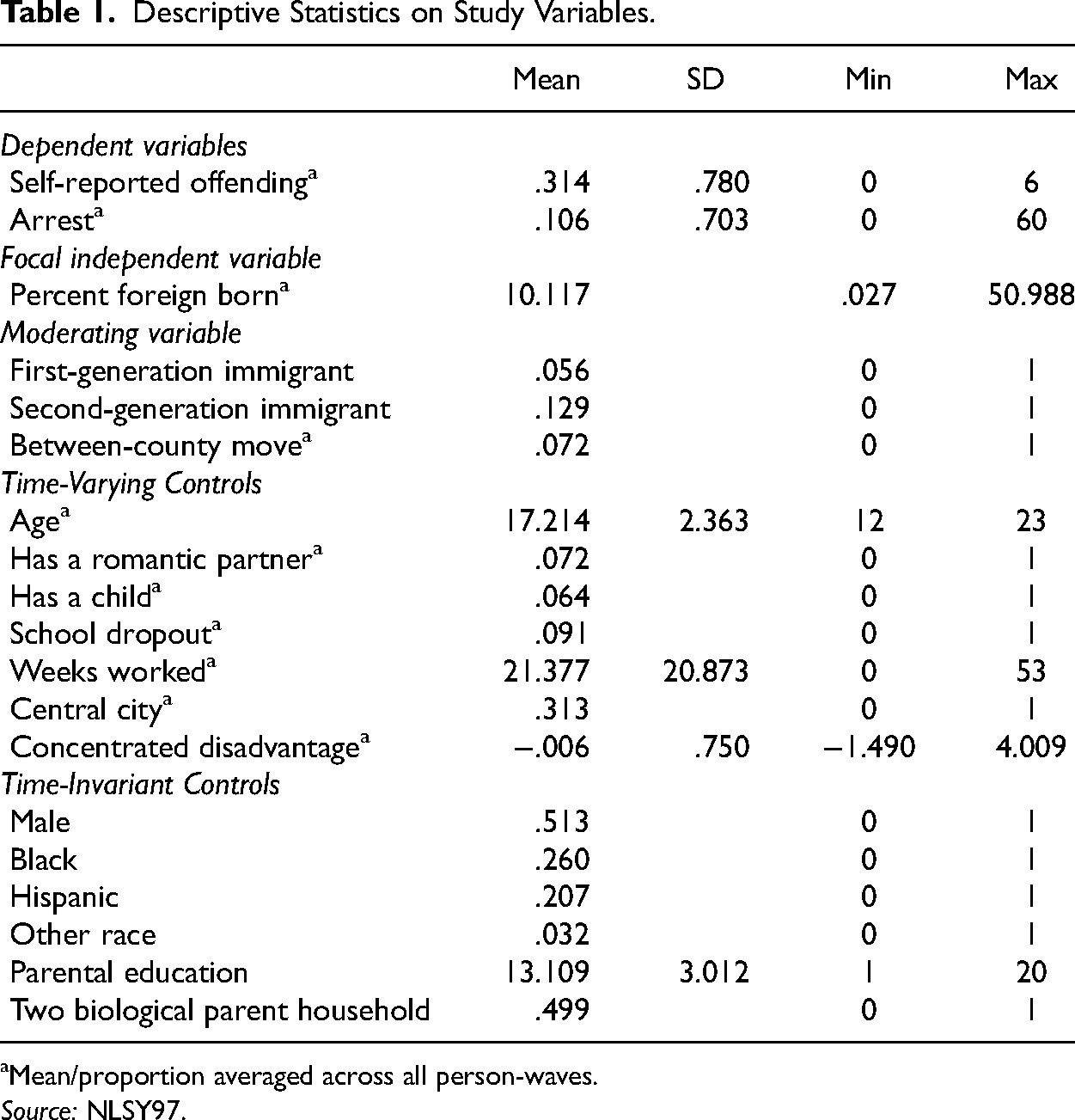
Our first moderating variable, immigrant generation, was represented as a set of time-invariant dichotomous indicators for first-generation immigrant, second-generation immigrant, and third-plus-generation youth; third-plus-generation youth was the omitted reference category. Following prior research (Bersani 2014; Bersani and DiPietro 2016a), we determined generational status based on information about respondents’ birth location, biological parents’ birth location, and in some cases, biological grandparents’ birth location. 5 First-generation immigrants were respondents who were born outside the United States and had one or more biological parents born outside the United States. Second-generation immigrants were respondents who were born inside the United States but had one or more biological parents born outside the United States. Finally, third-plus-generation were respondents who were born in the United States and both parents were born in the United States. 6 As shown in Table 1, about 5.6 percent of our sample were first-generation immigrants, about 12.9 percent were second-generation immigrants, and about 81.5 percent were third-plus-generation.
Descriptive Statistics on Study Variables.
Mean/proportion averaged across all person-waves.
Source: NLSY97.
Our second moderating variable, between-county move, was a dichotomous indicator of whether respondents resided in a new county in comparison to the county they were residing in during the previous wave (0 = no, 1 = yes). For example, respondents’ person-waves were scored 0 until they moved to a new county at which point their person-wave was scored 1 for that wave. If a respondent remained in that new county for subsequent waves, their person-wave returned to a score of 0, until they moved again, in which case the sequence was repeated. As shown in Table 1, about 7.2 percent of person-waves in the sample consisted of a between-county move; additional descriptive analyses revealed that 25.9 percent of the sample experienced at least one between-county move over the course of the study (not tabled).
Control variables
We included several time-varying and time-invariant controls to account for alternative explanations for the association between immigrant concentration and individual-level criminal offending. We direct readers to Appendix A for a full description of the control variables and to Table 1 for their descriptive statistics.
Analytical Strategy
Our analytical approach comes from the multilevel modeling tradition, which is concerned with analyzing nested data structures (Raudenbush and Byrk 2002). In a traditional multilevel model, the data are assumed to exhibit a purely hierarchical structure, whereby lower-level units are nested within a single higher-level unit. However, there are many situations where data exhibit nonhierarchical structures (e.g., where lower-level units belong to more than one higher-level unit). In the case of the present study, our data structure consisted of repeated observations (person-waves) nested within individuals and repeated observations nested within U.S. counties, but some individuals were not fully nested within a single county over time. Instead, some individuals were cross-classified with U.S. counties. For illustrative purposes, Figure 1 displays a network graph of this cross-classification. Here three individuals are observed over two time periods. Two of the individuals remained in the same county over time (fully nested), but one individual moved between county 1 and 2 (cross-classified). Because our data consisted of individuals some of whom were both fully nested and some of whom were cross-classified, our data are considered partially cross-classified.
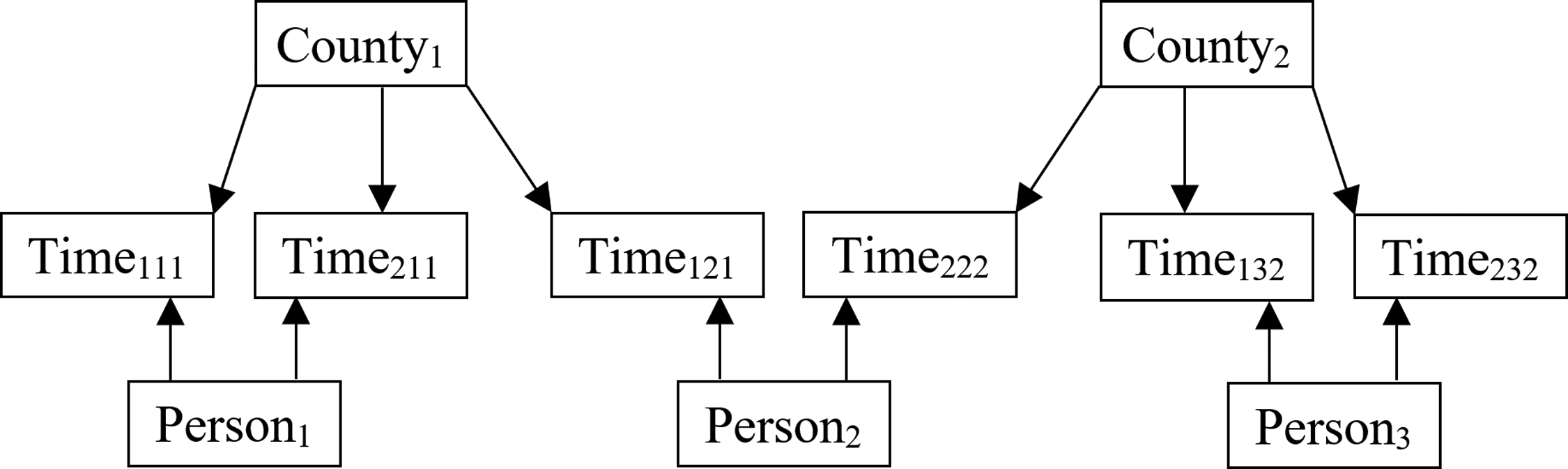
Cross-classified data structure in the NLSY97.
The statistical theory underlying cross-classified models is well established (Grady and Beretvas 2010; Raudenbush and Byrk 2002).
7
In our study, the specific models estimated consist of three levels (or classifications) and took the following form (where i indicates person-wave, j indicates individual, and k indicates county):
Our cross-classified models were estimated in MLwiN 3.05 (Rasbash et al. 2020) via R software using the R2MlwiN package (Zhang et al. 2016). The MLwiN software employs Bayesian modeling using Markov Chain Monte Carlo (MCMC) methods. For each model, four chains were fitted using default priors. After an initial burn-in period of 10,000 iterations, we estimated 300,000 iterations removing (or thinning) every third iteration to reduce autocorrelation, which resulted in a final MCMC sample size of 100,000 per chain. We used several criteria to determine proper Markov chain mixing and convergence, including the Max Gelman-Rubin rule (Gelman and Rubin 1992) and a visual inspection of the trace plots. In all models, the Max Gelman-Rubin statistic was less than 1.02, indicating good fit. In addition, a visual inspection of the plots suggested proper and efficient mixing.
Results
Descriptive Information on Immigrant Concentration
We begin by providing descriptive information on our focal independent variable—immigrant concentration—and how it varies over time. Table 1 shows that the average person-wave consisted of a respondent living in a county where 10.12 percent of the population was foreign-born—although there was marked variation, with some living in a county with as low as .03 percent foreign-born and as high as 50.99 percent foreign-born.
To illustrate the amount of change in immigration concentration that respondents experienced over time, Figure 2 presents the average foreign-born population each year from wave 1 (1997) to wave 6 (2002) for the full sample, as well as for each generation, separately. The results suggest that the average respondent experienced a 1.05 percentage point increase in the foreign-born population over time, increasing from 9.58 percent (wave 1) to 10.63 percent (wave 6); a t-score of this difference was significant (t = 23.6, p < .001). 8 , 9 Although the absolute increase in the foreign-born population is small, the increase is more meaningful when calculated as the percent change in the growth of immigrant concentration over time, which was an 11 percent increase [i.e., (10.63-9.58)/9.58 = .11]. Figure 3 further unpacks this change by presenting a frequency distribution on a change score that was calculated by subtracting the foreign-born population level from respondents’ first county of residence from their last county of residence; here, positive scores indicate an increase in immigrant concentration over time and negative scores indicate a decrease. 10 This figure shows that 89.5 percent of respondents experienced an increase in the foreign-born population over time, with a sizeable share (20.8 percent) experiencing over a 2-point percentage increase. Together, these findings indicate that the vast majority of respondents experienced an increase in the foreign-born population in their county of residence over time. 11
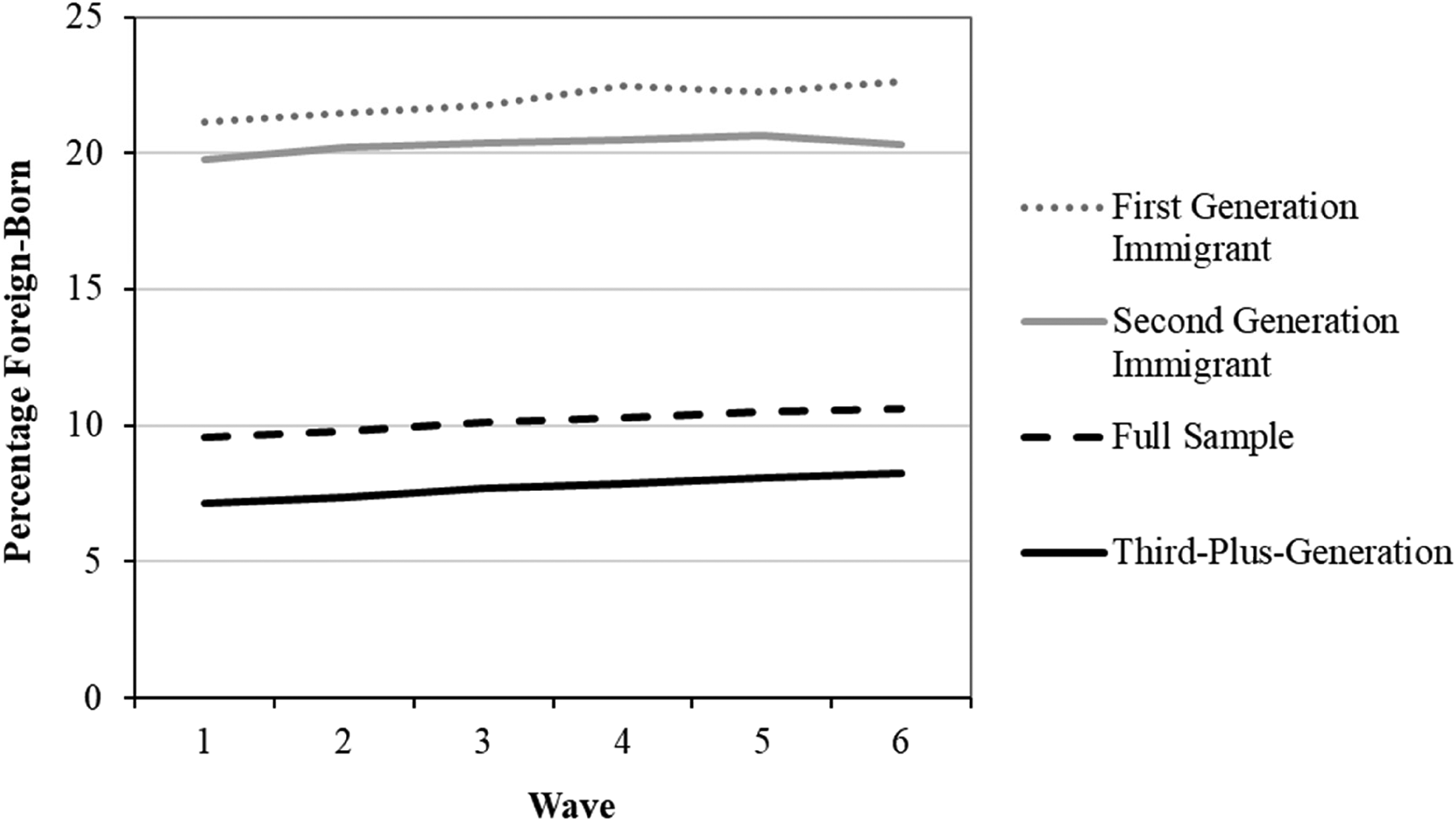
The percentage of foreign people in respondents’ county of residence each wave by immigrant generational status.

Frequency distribution for the change in the foreign-born population between respondents’ first and last county of residence.
Research Question #1
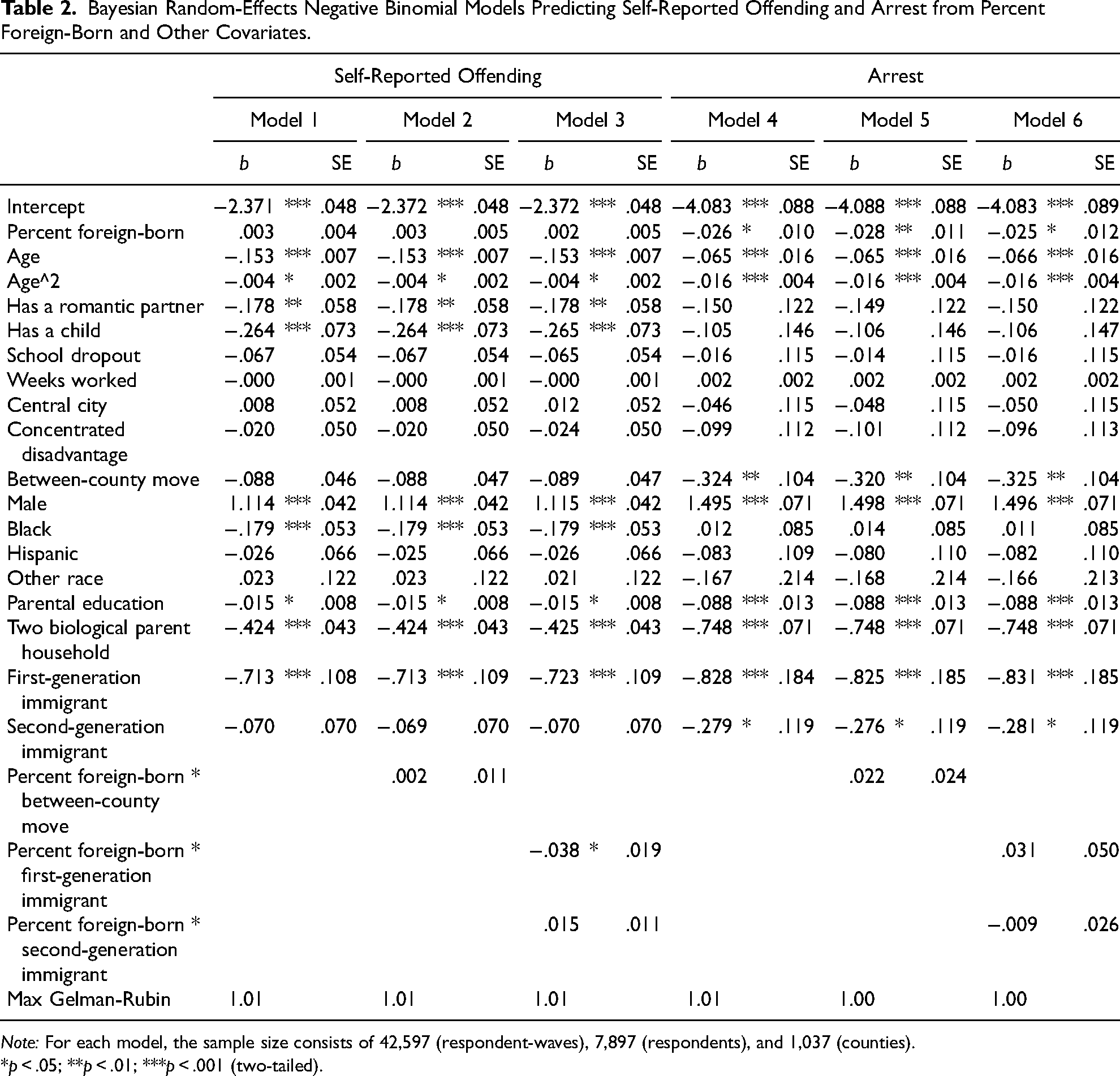
Our first research question asks whether changes in immigrant concentration were associated with within-individual changes in criminal offending. To test this, we estimated two Bayesian random-effects negative binomial models that predicted SRO and arrest from percent foreign-born and the other covariates. The results, which are displayed in models 1 and 4 of Table 2, indicate that during periods when respondents resided in a county with a higher foreign-born population, they tended to have significantly lower counts of arrest (but not SRO) in the next wave. To put this effect in context, recall that the average respondent experienced a 1.05 percentage point increase in the foreign-born population between waves 1 and 6, which suggests that the average person's count of arrest decreased by 2.69 percent over time [i.e., (exp(−.026*1.05) − 1)*100]. Others may have experienced larger decreases, however. For example, Figure 3 shows that nearly 6 percent of the sample experienced at least a 4-percentage point increase in the foreign-born population between their first and last wave, which means those respondents experienced a 9.88 percent decrease (or more) in the count of arrest over time [i.e., (exp(-.026*4)-1)*100]. In sum, these results lend support to the idea that increases in immigrant concentration reduce within-individual changes in offending over time—although the effect is limited to arrest.
Bayesian Random-Effects Negative Binomial Models Predicting Self-Reported Offending and Arrest from Percent Foreign-Born and Other Covariates.
Note: For each model, the sample size consists of 42,597 (respondent-waves), 7,897 (respondents), and 1,037 (counties).
*p < .05; **p < .01; ***p < .001 (two-tailed).
Models 1 and 4 of Table 2 also indicate that immigrant generation and several control variables were associated with SRO and arrest. Consistent with prior research, first-generation immigrants had a significantly lower count of SRO (b = −.713, p < .001) and arrest (b = −.828, p < .001) compared to the third-plus-generation. Second-generation immigrants also had a lower count of arrest (b = −.279, p < .05) compared to the third-plus-generation, but there was not a significant difference between second-generation immigrants and the third-plus-generation with respect to SRO (b = −.070, p > .10). Across both models, age, having parents with higher education, and growing up in a two-parent household were associated with lower levels of offending, while being male was associated with higher offending. 12
Research Question #2
Our second research question asks whether the within-individual effects of immigrant concentration on criminal offending depend on moving. To test this, we estimated two Bayesian random-effects negative binomial models that predicted SRO and arrest from percent foreign-born, between-county move, and multiplicative interactions between percent foreign-born and between-county move, net of covariates. The results, which are displayed in models 2 and 5 of Table 2, indicate that the effect of percent foreign-born on arrest and SRO does not depend on whether individuals moved. In both models, the interaction term failed to reach statistical significance. Thus, our results suggest that the within-individual associations between immigrant concentration and offending are statistically similar whether respondents moved or stayed in place.
Research Question #3
Our third research question asks whether the within-individual effects of immigrant concentration on criminal offending depend on immigrant generation. To test this, we estimated two Bayesian random-effects negative binomial models that predicted arrest and SRO from percent foreign-born, immigrant generation, and multiplicative interactions between percent foreign-born and immigrant generation, net of other covariates. The results, which are displayed in models 3 and 6 of Table 2, indicate that the effect of percent foreign-born on arrest does not depend on immigrant generation (evident by the nonsignificant interaction terms); however, the effect of percent foreign-born on SRO does. Specifically, model 3 of Table 2 shows that the within-individual association between percent foreign-born and SRO is significantly more negative for first-generation immigrants compared to third-generation youth (b = −.038, p < .05). Thus, we found mixed evidence that certain generations benefited more or less from immigrant concentration over time—for arrest, immigrant concentration appears to have reduced offending for all generations; whereas, for SRO, immigrant concentration reduced offending more for first-generation immigrants but only when compared to the third-plus generation.
Discussion
Prior contextual-level research suggests that individuals who reside in areas with higher concentrations of foreign-born residents engage in less crime and delinquency. Yet, virtually all of this work has relied on either cross-sectional models or longitudinal data with only baseline measurements of immigration, which tells us nothing about whether temporal changes in immigrant concentration affect changes in individual-level offending. We addressed this gap in the literature by examining the within-individual association between immigrant concentration and two forms of criminal offending during adolescence and early adulthood using data from the NLSY97. We also considered whether the effects of immigrant concentration depend on whether respondents moved to a new county and their generational status.
Four main findings emerged from this study. First, we demonstrated that immigrant concentration is a characteristic that varies over time for respondents. Descriptively, most respondents (89.5 percent) experienced an increase in the foreign-born population over the course of the study. While the absolute increase was small (a little over 1 percentage point), the percent change over time represented a 11 percent growth in county-level immigrant concentration. Moreover, many respondents experienced larger increases in the foreign-born population. For example, nearly 21 percent experienced over a 2-percentage point increase over time. Further, these increases in immigrant concentration were evident for both movers and nonmovers.
Second, we found that during periods when individuals lived in U.S. counties with a higher percentage of foreign-born people, they experienced subsequent within-individual reductions in arrest but not reductions in SRO. The finding for arrest is consistent with past contextual-level studies that indicate that higher immigrant levels are associated with a lower likelihood of offending for community residents (Sampson et al. 2005; Morenoff and Astor 2006; Desmond and Kubrin 2009; Wolff et al. 2015). It is also consistent with longitudinal macrolevel studies that have highlighted the value of modeling the effects of immigration on crime over time in an effort to reflect the dynamic nature of immigration and to better account for unobserved time-invariant confounders, which improves causal inference (Ousey and Kubrin 2009; Stowell et al. 2009; Wadsworth 2010).
Our finding that immigrant concentration was not associated with reductions in SRO could indicate a couple of different things. First, it could simply reflect a null finding, which is not unheard of in the contextual literature [see Lauritsen (2001) for mixed findings and Tillyer and Vose (2011) for a null finding]. If so, at the very least that would mean our finding indicates that immigrant concentration has no discernable within-individual effect—either positive or negative—on SRO among the full sample, which is still in line with the broader immigration literature (Ousey and Kubrin 2018). Second, it could reflect a spurious finding either due to our ability to control for unobserved heterogeneity or some other observed confounder. We believe this possibility is less likely, however, given that a bivariate growth curve revealed a nonsignificant association between percent foreign-born and SRO (not shown). Finally, it may be that arrest and SRO reflect different types of underlying offending (e.g., seriousness or crime type mix). If so, this could mean that immigrant concentration is better at deterring certain forms of offending than others. To our knowledge, most studies that have examined the contextual-level effect of immigration on crime using self-reports focus on violent behaviors that respondents have committed (Sampson et al. 2005; Morenoff and Astor 2006; Desmond and Kubrin 2009) or reported being the victim of (Wright and Benson 2010; Xie and Baumer 2018). Our SRO measure, meanwhile, includes property-related crimes, drug dealing, and acts of violence.
Third, in considering whether the association between immigrant concentration and criminal offending depends on moving, we found that the effects were similar regardless of whether respondents moved to a new county or remained in place over time. We examined this issue given that prior research and theory were unclear on whether the protective benefits of immigrant concentration would be due to individuals remaining in place in a community undergoing compositional change because of an influx of immigrants or whether the benefits are due to individuals moving to a community with higher levels of immigrants (Kirk and Laub 2010; Sampson 2012; Sharkey 2012). The finding that they were similar suggests that immigrant concentration has protective effects for a range of different living situations—whether people are “stuck in place” (Sharkey 2012) or “moving to opportunity” (Sampson 2012).
Fourth, in considering whether the associations between immigrant concentration and criminal offending depend on immigrant generation, we found the results differed based on the outcome in question. For SRO, our results suggest that immigrant concentration is more strongly related to within-individual reductions in offending for first-generation immigrants compared to the third-plus-generation. As noted earlier, it is possible that immigration may yield stronger protective effects for the first generation because this group is more likely to reside in ethnic enclaves—a finding consistent with at least two studies (Morenoff and Astor 2006; Desmond and Kubrin 2009) and the results presented in Figure 2. For arrest, we found no evidence that the contextual-level impact of immigrant concentration affected the generational status groups any differently. In other words, first- and second-generation immigrants, as well as the third-plus-generation, all experienced a similar arrest-reducing benefit during periods when they lived in communities with a larger percentage of foreign-born residents. This finding is consistent with theory that suggests immigrants can revitalize communities in ways that benefit all members of society (Sampson 2008; 2015), as well as with research that shows crime-reducing benefits of immigration for native populations (Wolff et al. 2015; Ramos 2023). More importantly, the finding that immigration benefits more than just immigrant groups is important considering that the foreign-born population continues to grow at a historic pace and that immigration is now a social fixture for many communities across the United States
The immigration effects we observe in our study could be attributed to various mechanisms that would be anticipated by the immigrant revitalization perspective. Although we were not able to test this, we posited that immigration could deter crime during adolescence and early adulthood because of shifts related to household structure and the local labor market—conventional institutions that have important implications for offending during these critical stages of the life course. For example, living in (or moving to) an immigrant community is associated with increases in two-parenthood households and marriage rates, both of which are associated with lower crime and delinquency (Sampson and Laub 1993; Desmond and Kubrin 2009). In addition, the stronger labor market found in immigrant communities may serve as a deterrent to crime by reducing poverty, increasing the share of residents who are committed to employment and other conventional pursuits, ultimately boosting informal social control (Martinez et al. 2004; Sampson 2015). Future research should consider examining to what degree these potential mechanisms (as well as others) account for the within-individual association between immigrant concentration and individual offending.
Although our study contributes to the literature on immigration and crime, it is not without limitations. One limitation relates to the spatial unit used to capture “immigrant concentration”—counties. Although counties may not approximate communities as well as smaller units of analysis (e.g., census tracts), they have been used in prior research to assess the effects of immigration on crime (Barranco et al. 2017; Xie and Baumer 2018). It is also possible that the county-level relationship between immigration and crime is no longer significant once other spatial scales are included in the analysis, a process that Wenger (2021) refers to as omitted level bias. Given this possibility, future research should replicate our study using other units of analysis to assess the robustness of our findings.
Another limitation is that our measure for immigrant concentration categorizes “all foreign-born” as a monolithic group (DiPietro and Bursik 2012). The drawback to this conceptual approach is that different immigrant groups may yield varying effects on crime. For example, a recent study by Kubrin, Hipp, and Kim (2018) found that the association between immigration and crime produced varying effects when categorizing immigrant groups by race/ethnicity, regions of the world that immigrants emigrate from, and where immigrants co-locate once they arrive in the United States. This suggests that immigrant communities are not all the same and that nationality and other characteristics (e.g., human capital) likely serve as proxies for the strength and quality of ethnic enclaves, and therefore, its ability to deter crime. As a result, future research should examine whether the contextual-level effects of immigration on crime vary when separating the foreign-born into more fine-grained categories such as by nationality.
A final limitation is that although our study captured a key age range for examining criminal and delinquent behavior (i.e., adolescence and early adulthood), we were unable to follow respondents beyond early adulthood. Unfortunately, the NLSY97 stopped fielding SRO questions for most respondents after wave 7. Yet, it is important to see if the contextual-level effects of immigrant concentration on individual offending persist beyond this period given that many individuals will still be engaged in criminal behavior for at least another decade (Doherty and Bersani 2018). We consider this another important area for future research.
In conclusion, our study contributes to the literature on immigration and crime by demonstrating that immigrant concentration is a time-varying phenomenon, which has the potential to reduce individual-level offending over time. We found that the effects of immigrant concentration (for both SRO and arrest) were similar whether people moved or remained in a community undergoing compositional change. For arrest specifically, we found that the insulating impact of immigration applies equally to individuals from all three generational statuses. Overall, our findings show that immigration serves as a pro-social force for the community that promotes within-individual reductions in criminal offending and that these effects influence a wide range of living situations and people. Moving forward, we recommend that future contextual studies examine the effects of immigrant concentration over time using different units of analyses, larger age ranges, different measures of immigration, and test possible intervening mechanisms that explain the connection between immigration and crime.
Footnotes
Declaration of Conflicting Interests
The author(s) declared no potential conflicts of interest with respect to the research, authorship, and/or publication of this article.
Funding
The author(s) received no financial support for the research, authorship, and/or publication of this article.

Notes
Author Biographies
Appendix A. Description of control variables.
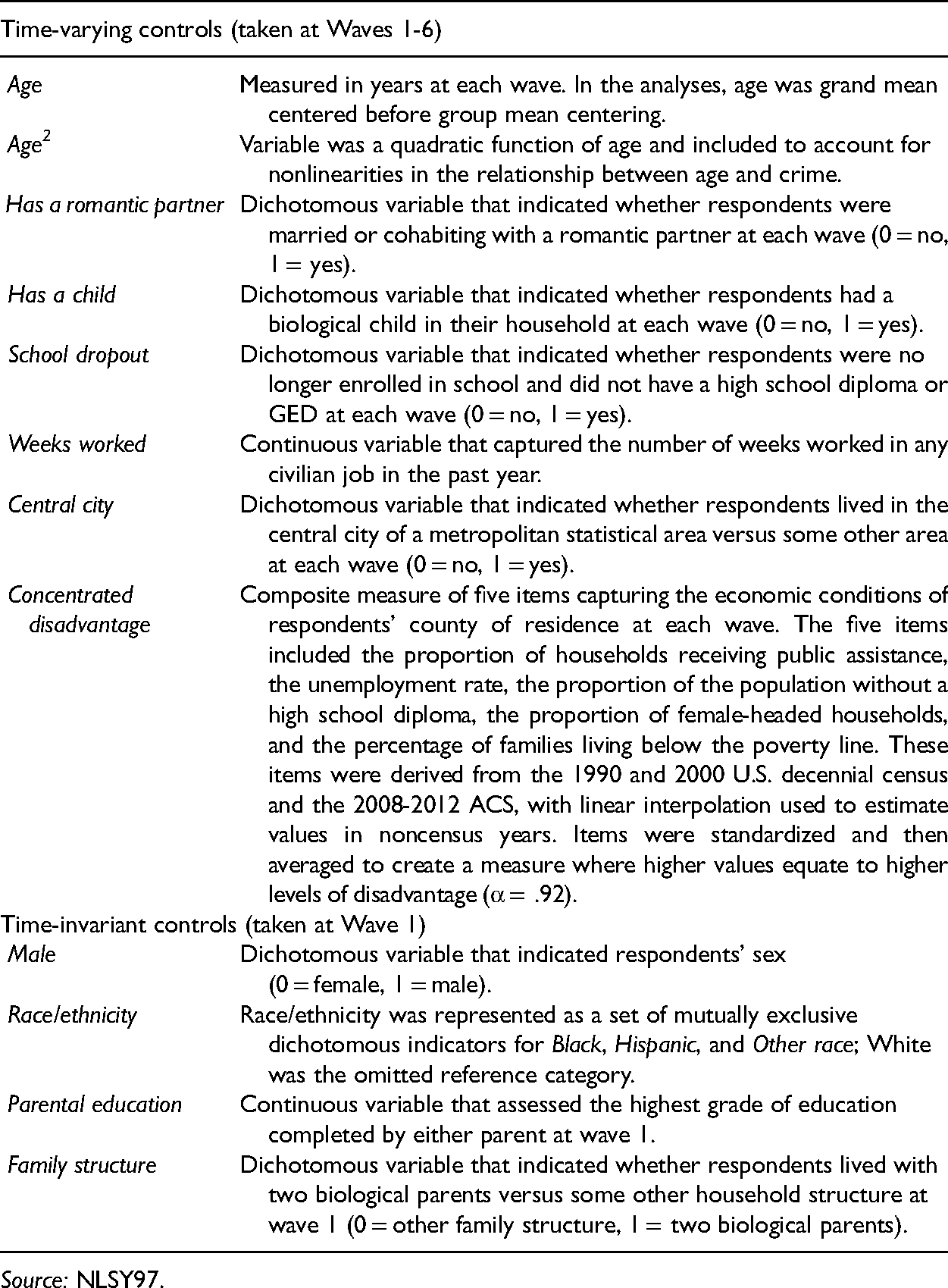
| Time-varying controls (taken at Waves 1-6) | |
| Age | Measured in years at each wave. In the analyses, age was grand mean centered before group mean centering. |
| Age2 | Variable was a quadratic function of age and included to account for nonlinearities in the relationship between age and crime. |
| Has a romantic partner | Dichotomous variable that indicated whether respondents were married or cohabiting with a romantic partner at each wave (0 = no, 1 = yes). |
| Has a child | Dichotomous variable that indicated whether respondents had a biological child in their household at each wave (0 = no, 1 = yes). |
| School dropout | Dichotomous variable that indicated whether respondents were no longer enrolled in school and did not have a high school diploma or GED at each wave (0 = no, 1 = yes). |
| Weeks worked | Continuous variable that captured the number of weeks worked in any civilian job in the past year. |
| Central city | Dichotomous variable that indicated whether respondents lived in the central city of a metropolitan statistical area versus some other area at each wave (0 = no, 1 = yes). |
| Concentrated disadvantage | Composite measure of five items capturing the economic conditions of respondents’ county of residence at each wave. The five items included the proportion of households receiving public assistance, the unemployment rate, the proportion of the population without a high school diploma, the proportion of female-headed households, and the percentage of families living below the poverty line. These items were derived from the 1990 and 2000 U.S. decennial census and the 2008-2012 ACS, with linear interpolation used to estimate values in noncensus years. Items were standardized and then averaged to create a measure where higher values equate to higher levels of disadvantage (α = .92). |
| Time-invariant controls (taken at Wave 1) | |
| Male | Dichotomous variable that indicated respondents’ sex (0 = female, 1 = male). |
| Race/ethnicity | Race/ethnicity was represented as a set of mutually exclusive dichotomous indicators for Black, Hispanic, and Other race; White was the omitted reference category. |
| Parental education | Continuous variable that assessed the highest grade of education completed by either parent at wave 1. |
| Family structure | Dichotomous variable that indicated whether respondents lived with two biological parents versus some other household structure at wave 1 (0 = other family structure, 1 = two biological parents). |
Source: NLSY97.