




Abstract
This study was designed to examine two aspects of sight-singing instruction: (1) solfège syllables versus the syllable loo for singing patterns and (2) the use of related songs (songs that began with tonal patterns being studied) as compared with unrelated songs. Second-grade students (N = 193) enrolled in general music classes participated in 25 minutes of sight-singing instruction for 16 sessions. In each session a new four-note pattern and song were introduced, and previously learned patterns were reviewed. Four levels of instructional treatment were examined as the independent variable: (1) related songs/solfège, (2) related songs/loo, (3) unrelated songs/solfège, and (4) unrelated songs/loo. Pitch and contour accuracy of familiar and unfamiliar patterns were examined as dependent variables on sight-singing pre-, post-, and retention tests. Results indicated significant pre- to posttest improvement in sight-singing skills. Most post- to retention test differences were nonsignificant, indicating skill retention. Sight-singing skills transferred to unfamiliar patterns. Treatment effectiveness differed by pattern familiarity. Solfège with familiar patterns and a neutral syllable (loo) with unfamiliar patterns resulted in significantly greater contour accuracy. Relating patterns to songs had no significant effect on achievement.
Goals of music education programs in the United States expressed in the National Standards for Arts Education state that students should be able to sing alone and with others and should be able to read and notate music so they can explore music independently and with others (MENC–The National Association for Music Education, 1994). More specifically, an achievement standard for kindergarten through grade 4 states that students should be able to use a system (e.g., solfège syllables) to read simple pitch notation in treble clef. Beliefs about the degree of emphasis that should be placed on skill development in music reading have varied historically and continue to be debated, but without question, developing students’ notation reading ability is an explicitly stated national goal that music education programs are commissioned to pursue.
Data collected from national samples of students who participated in the National Assessment of Educational Progress (NAEP), an instrument used to track and report progress toward education goals, affirmed the goals of teaching singing and notation reading but indicated limited student success. On the first NAEP in music in 1971–1972, fewer than 12% of participants ages 9, 13, 17, and 26 to 35 could sight-sing a two-phrase exercise encompassing only two or three different pitches (NAEP, 1974). Selecting the drawn line matching an aurally presented up-down contour was performed correctly by 56% of 9-year-olds on the first NAEP administration and 51% on the second, in 1978–1979 (NAEP, 1981). On the third music NAEP, in 1997, which was limited to eighth graders, only 35% of the students sang “America” with pitch and intonation assessed as adequate or better, similar to results on the same task with 9-year-olds on the first NAEP (Persky, Sandene, & Askew, 1998).
Calling for the music education profession to address the issue of music reading instruction, Elliott (1982) raised important questions, such as (1) Do we know how to teach music reading skills to groups in the general school population? and (2) Do we understand the process by which one learns to sight-read? More recently, Yarbrough (2004) noted that “Sight-reading methods are numerous while studies of their effectiveness are almost nonexistent” (p. 4). Even more specifically, few studies have examined the effectiveness of sight-singing instruction methods within elementary general music classes, the place where such skills could be taught to the entire population just as the reading of language is taught to all children.
Sight-singing, a multifaceted task engaging both cognitive processes and physical skills, is the ability to sing from notation without assistance from a musical instrument or without hearing the sounds first. Notation is just a reminder, representing sounds already known to the singer who also must already know the physical actions required to produce the sounds (Walker, 1992). Dodson’s (1983) theoretical model of the music-reading process includes a referential coding step in which visual and auditory stimuli can be associated with referents such as syllables, numbers, or letter names to aid in recall and to provide an intermediary medium in which visual and auditory images can interact. While referents such as solfège are assumed to be effective in improving sight-singing performance, few research studies have investigated the nature of this phenomenon.
Tonal patterns frequently are used by teachers for teaching and evaluating sight-singing skills with students at beginning stages. Landmark research by Petzold (1960) found that initial reading and singing practice that used patterns extracted from a song significantly improved accuracy for all but the most gifted fourth graders when they read and sang the song. Even for more experienced young adult choral singers, pattern recognition ability, assessed by speed and accuracy in singing written intervals, has been found to correlate significantly with error rate when singing songs (rs = −.445; Fine, Berry, & Rosner, 2006). With first-grade children, instruction using an intermediary step of hand/body movements and invented notation did not significantly improve ability to read and sing melodic patterns, although overall pretest to posttest gains demonstrated that first-grade children could attain a degree of proficiency in sight-singing tonal patterns (Klemish, 1970). Martin (1991) compared the effects of three instruction conditions on first graders’ sight-singing achievement with tonal patterns: the use of (1) solfège, (2) solfège plus hand signs, or (3) solfège plus hand signs plus flashcards showing solfège letters. Contrary to Klemish’s findings, the students did not experience significant improvement in pitch accuracy or in solfège accuracy when reading notation. The use of 378 patterns in this study may have created too much variability for success in the initial stages of reading instruction. Harvey, Garwood, and Palencia (1987) found singing to be significantly more accurate following consistent practice on a less variable task and suggested that greater variability in practice may negatively affect later performance by impairing perceptual or cognitive processes. Based on this research, it would seem that sight-singing instruction and assessment using fewer patterns that encompass a limited number of different pitches should be examined with students in the initial stages of learning to read notation.
When teaching sight-singing skills, teachers can present tonal patterns in isolation or relate them directly to songs. Studies examining the relationship of text and melody in memory, recall, and performance may have some implications for how the pairing of these two components might facilitate pitch recall when learning to read notation. On listening recognition tasks, pairing of text and tune was found to improve adults’ memory for both components (Serafine, Crowder, & Repp, 1984), even when texts were nonsense syllables (Serafine, Davidson, Crowder, & Repp, 1986). Morrongiello and Ross (1990), however, found that memory of words did not facilitate memory of tunes for preschoolers. In contrast, words have helped preschoolers develop a memory of melodies, when songs were heard over an extended time (Feierabend, Saunders, Holahan, & Getnick, 1998). Text seems to have contributed more to the recognition of a tune than vice versa (Hébert & Peretz, 2001), but even more so for children (Morrongiello & Ross, 1990). Crowder, Serafine, and Repp (1990) concluded that the phonetic properties of text produce acoustical differences in melodies that at least partially are responsible for memory of melodies. In addition to facilitating recognition, text fragments have been found to facilitate melody recall (Peretz, Radeau, & Arguin, 2004), indicating that words and tunes of songs may be connected in a way that allows automatic recall access from text to melody and vice versa. Peretz et al. (2004, Experiment 1) found the first few words or notes of a song to be the most reliable triggers for recall. Likewise, Smith, Kemler Nelson, Grohskopf, and Appleton (1994) noted that initial pitch material is the most salient because information may be cognitively stored and retrieved in the sequence in which it occurs in real time. This may indicate that if patterns are related to songs, they may be easier to recall if they are extracted from the beginnings of songs.
On performance tasks, Racette and Peretz (2007) found that text recall was dependent on serial order more so when people were singing than when speaking, suggesting that melodic lines are remembered in connected strings with front anchoring. The addition of lyrics did not decrease singing accuracy with adult musicians or nonmusicians. Ginsborg and Sloboda (2007) found that the inability to recall one element usually did not affect adults’ ability to recall the other, especially among those with less singing experience. With children, Goetze (1985) found that singing with text versus with loo did not significantly affect third graders’ contour or pitch accuracy when echoing a short phrase. Second graders were not included in the study, but similar results were found with first graders, except that pitch accuracy, although not contour accuracy, was significantly more accurate when singing with loo versus text, but only when they sang individually versus along with others. Using two short songs, Gault (2002) found that children in grades K and 1 had significantly more accurate recall when singing with text versus a neutral syllable with one song, but not the other, whereas Marshall (2002) found no significant differences in third graders’ song recall accuracy when singing with text versus a neutral syllable. These studies indicate that the use of text does not adversely affect singing accuracy as children develop and text may even have potential to aid in recall and performance of accurate pitches. If lyrics can activate corresponding melodic representations as suggested by Peretz et al. (2004), words from the beginnings of songs may be useful in facilitating the production of internal auditory representations of pitch to guide vocal reproduction on a reading task. Consequently, lyrics might potentially be used as an aid for beginning sight-singers.
The present study examined sight-singing performance with a limited number of tonal patterns to ascertain if using a syllable system (i.e., solfège), or relating tonal patterns to familiar rote songs, would have an effect on achievement at children’s initial stages of learning sight-singing skills. Based on previous research findings with intervals, patterns, and songs, I hypothesized that the use of both solfège and related songs might facilitate singing accuracy. With children, known songs that can be related to tonal patterns could provide familiar and appealing models to guide aural imagery when decoding the patterns. Based on published music textbook series, second grade is often the level at which students start seeing notation and can begin learning sight-singing skills; therefore, it was from this level that participants were selected for this study. The experimental design permitted comparison of performance with familiar patterns (those practiced in class) and unfamiliar patterns (those read and sung only during sight-singing tests) as well as an examination of retention of skills following a period of no practice. The study addressed the following research questions: (1) What effect does using solfège versus a neutral syllable (loo) to sing tonal patterns during instruction have on sight-singing accuracy with patterns practiced in class? (2) What effect does using solfège versus loo to sing tonal patterns during instruction have on the ability to transfer sight-singing skills to unfamiliar patterns? (3) What effect does relating tonal patterns to songs during instruction have on sight-singing accuracy with patterns practiced in class? and (4) What effect does relating tonal patterns to songs during instruction have on the ability to transfer sight-singing skills to unfamiliar patterns?
Method
Participants
Second-grade students (N = 193, 93 boys and 100 girls) from 12 intact classrooms participated in a program of sight-singing activities during regular general music classes. Ages ranged from 6.25 to 8.75 years (M = 7.5 years, SD = .35). Classrooms were chosen from three public schools in a large urban school district in the Northeastern United States. Each school housed four second-grade classrooms so each of the instructional treatment conditions could be taught within the same school and by the same music teacher. The teachers implementing the instruction had extensive music teaching experience, 18 or more years, and strong educational backgrounds, bachelor’s plus 24 or more graduate credits in music education. All of the teachers stated that they had not used solfège in their first-grade classes during the previous year. Consistency among the teachers in following the instruction procedures was accomplished through preservice and in-service training, through ongoing monitoring of classes by the researcher, and by their following the detailed lesson plans provided. To further assure consistency, each teacher was video-recorded early in the program. The teachers then met as a group to view and discuss all recordings to ensure consistency in teacher implementation of pattern-reading procedures.
Procedures
During weekly, 45-minute music classes, 16 sessions were used to present 25 minutes of sight-singing instruction, involving the children (1) reading and singing tonal patterns and (2) singing specified songs with activities such as singing games. Each classroom of students learned sight-singing skills in one of four randomly assigned instructional treatment conditions. The patterns used and the prescribed sequence of their introduction were consistent across all conditions, with all previously learned patterns reviewed and one new pattern introduced each week. Also, a new song was taught each week by rote using the song text, with two of the groups singing a related song (description follows) and two groups singing an unrelated song. An example of the patterns and the songs used in the study can be seen in Figure 1, and a complete list of the patterns may be found in Reifinger (2009). The students in the related-song groups were guided in recalling the related song when reviewing the patterns. Within each song condition, one group used solfège and the other used loo when singing the tonal patterns. Hence, the treatment conditions were (1) related songs/solfège (n = 50), (2) related songs/loo (n = 40), (3) unrelated songs/solfège (n = 46), and (4) unrelated songs/loo (n = 57).
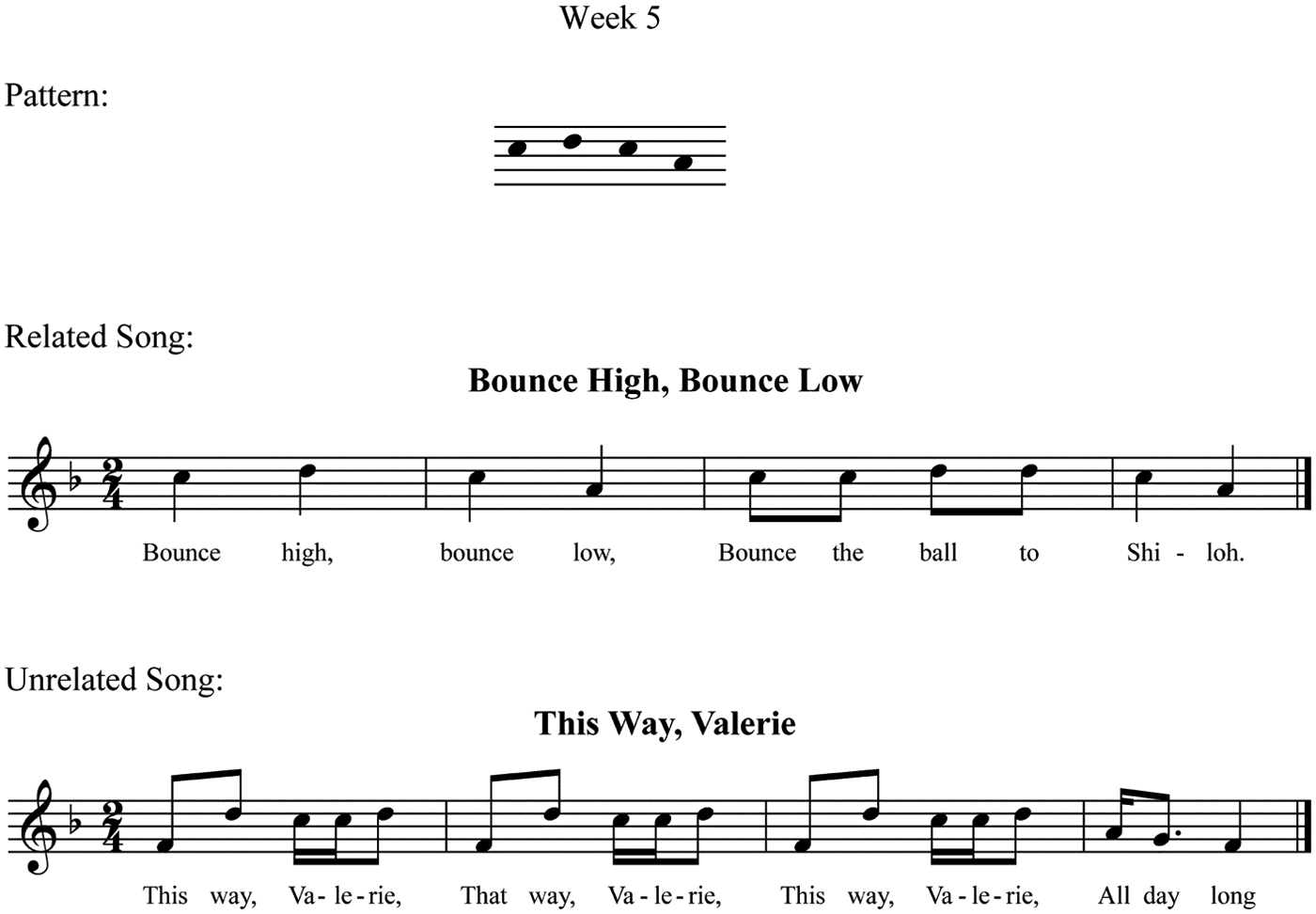
Example of a pattern, related song, and unrelated song used during a lesson
This sight-singing segment of the lesson was standardized across sessions and groups. First, the students reviewed all patterns learned in prior sessions by reading and singing each three times consecutively. They sang silently then aloud on trial one, then echoed the teacher on the next two trials. The guided silent trial encouraged each student to formulate an internal auditory representation of the pitches, which is requisite to both singing the correct pitch and self-monitoring accuracy. The student’s singing that followed was a response to visually presented stimuli rather than an imitation of aurally presented stimuli. Although a student could possibly echo the vocal model without reading on subsequent trials, hearing an accurate aural representation to associate with the visual was essential. The patterns were modeled and echoed at the absolute pitch indicated on the visual. In the related-song conditions, the related song was identified after trial two and that song’s words were used when singing the pattern on trial three. Next, the new pattern was presented, but because it was new, it was modeled and echoed for all three trials. A singing game followed, using the new prescribed related or unrelated song. Near the end of the sight-singing segment, all patterns were practiced for three trials as before, except this time the new pattern was practiced in the same manner as the review patterns.
The patterns, notated on large flash cards, consisted only of five staff lines one inch apart with four pitches indicated by filled-in noteheads. Only do, re, mi, so, or la (moveable-do system) ranging from F4 to D5 were used. No clef, note stems, or words were included. Starting notes of do, mi, or so were used 40%, 20%, and 40% of the time, respectively, similar to frequencies found in song literature for this grade level. The key of F facilitated the reading task, as all notes lay within the staff lines and no accidental or key signature was needed (fa was not used). According to Phillips (1996), tonal patterns should be pitched high enough so that children develop their head voice register, and the range of pitches used with the patterns in this study lay within the appropriate singing range for second-grade children. Each pattern’s corresponding related song included (a) the tonal pattern as the first four notes, (b) the same rhythmic unit for the first four notes, (c) duple meter, and (d) a downbeat beginning. The unrelated song was of similar interest and difficulty level but did not contain the pattern. To sequence the introduction of new patterns, only patterns using so and mi were taught first, starting with the patterns beginning on so. Next, the patterns including la were taught, then do, and, finally, re.
Prior to the first sight-singing session, students individually sight-sang the 25 tonal patterns used in this study, as a pretest. Next, during 15 weeks of sight-singing instruction, patterns were presented at a rate of one new pattern per session, with a 16th session used to practice the previously presented patterns. After session 16, students again individually sight-sang the 25 tonal patterns, presented in a different random order for each student. On this sight-singing posttest, however, the 15 patterns that had been practiced in class were familiar and 10 other patterns were unfamiliar. During the 8 weeks following session 16, none of the patterns or songs was practiced. A sight-singing retention test was administered after this period of no instruction.
Testing Procedures and Scoring
During individually administered sight-singing tests, the researcher and the student sat on opposite sides of a desk in a quiet room. Resonator bells representing do, mi, and so were on the desk in a low-to-high/left-to-right position from the student’s perspective. First, to practice matching the bell when singing the starting pitch, the student listened to a recording in which an F bell was played and echoed by an adult female singing with loo. The researcher then played the F bell and cued the student to echo. These steps were repeated for A and C. Although children find it easier to match a vocal model (Tatem, 1990), resonator bells were used during testing and instruction because they ensured consistent intonation, were easy to use in a classroom, and provided an identical pitch source for the children across teachers and the researcher during instruction and testing conditions. Next, the student sang three different practice patterns that were similar to those tested. To do this the student viewed the pattern flash card while listening to and then echoing a recorded model. The researcher pointed to each note during the model presentation and the student’s echo. The student was then told to “try some on your own.” When each of the patterns was shown, the starting pitch was played, and the notes were pointed to as the student sang. No feedback on accuracy was given, but students were reminded to listen carefully and match the bell to sing the correct starting pitch. For students in the solfège groups, the recorded model heard for the post- and retention tests used solfège. The students had the option of singing solfège or loo when tested. Tests were recorded for later scoring.
An experienced elementary music teacher listened to the sight-singing tests in a random order, making pitch determinations without regard to the solfège syllable if used. The teacher did not know the actual notes of the patterns or the treatment group or testing condition represented. Due to limitations in vocal control with children at that age (Cooper, 1992), precise intonation was not required as long as the judge was able to make a determination of which step of the scale the student was attempting to sing. A second teacher also transcribed 50% of the tests. By dividing the number of agreements by the number of agreements plus disagreements, interrater reliability was calculated to be .89. By comparing the judge’s pitch determinations with the actual pitches of the patterns, note accuracy (1 point per correct pitch/4 per pattern) and contour accuracy (1 point per correct note-to-note contour/3 per pattern) were tallied, with discrete totals for familiar and unfamiliar patterns, resulting in four sight-singing variables. Pitch accuracy was determined in an absolute sense, with no adjustments being made if the starting or previously sung pitch was inaccurate.
Results
A preliminary analysis was used to assess whether familiar and unfamiliar patterns should be examined as separate variables. Six paired t tests compared familiar versus unfamiliar pattern mean differences for note accuracy and contour accuracy on the pre-, post-, and retention tests, using a Bonferroni adjusted alpha level of .008. Because the number of familiar (n = 15) and unfamiliar patterns (n = 10) was unequal and paired t tests require equal sample sizes, data from 10 randomly selected familiar patterns were used in this comparison only. All subsequent analyses included the data from all the patterns. Note accuracy did not differ significantly by pattern type on the pretest (t = 1.40, p > .008) but differed significantly on the posttest (t = 4.98, p < .001) and retention test (t = 3.84, p < .001). Contour accuracy differed significantly by pattern type on the pretest (t = 13.10, p < .001) and retention test (t = 2.99, p < .003) but not on the posttest (t = .49, p > .008). Consequently, data for note accuracy and contour accuracy remained segregated based on pattern type for subsequent analyses.
Preliminary analyses also were used to examine the equivalence among the treatment groups in sight-singing pretest performance and in exposure to treatment as determined by mean participant frequency of music class attendance. A multivariate analysis of variance (MANOVA) indicated that sight-singing note and contour accuracy on the pretest did not differ significantly among the treatment groups for either pattern type (familiar or unfamiliar, although all patterns were unfamiliar on the pretest), Pillai’s Trace = .081, F(12, 564) = 1.30, p > .05. Also, attendance at the 16 experimental sessions did not differ significantly among the treatment groups, Kruskal-Wallis H = 2.85, df = 3, p > .05.
Analysis of the effects of instruction involved comparing the four sight-singing performance scores that resulted from combining the two levels of accuracy (note and contour) with the two levels of pattern familiarity (familiar and unfamiliar), across the three test administrations. A repeated measures MANOVA examined whether the set of dependent variables, considered as a linear composite, changed across test administrations and by the interaction of test administration and treatment. Where significant differences were identified, univariate analyses were then used to examine the means of each of the four sight-singing variables separately. Effect sizes of mean differences are presented using eta squared (η2), reflecting the proportion of variance of the dependent variable explained by the independent variable. Indications of practical significance are presented using Cohen’s d, with values in the range of .20, .50, and .80 representing small, medium, and large differences, respectively.
Results indicated a significant difference in sight-singing performance by test administration, Pillai’s Trace = .565, F(8, 170) = 27.61, p < .001, η2 = .57 and a significant test administration by treatment condition interaction, Pillai’s Trace = .348, F(24, 516) = 2.82, p < .001, η2 = .12. The univariate analysis for test administration (all treatment groups combined) showed that significant differences between test administrations occurred on all four sight-singing performance scores (all ps < .001) (see Total Sample means in Table 1). Within-subjects contrasts examining univariate differences between each test administration revealed that stronger pretest to posttest effects occurred for familiar patterns (contour accuracy p < .001, η2 = .54; note accuracy p < .001, η2 = .26) than for the unfamiliar patterns (contour accuracy p < .001, η2 = .16; note accuracy p < .001, η2 = .12). The effect size of the overall pre- to posttest mean gain was d = 1.70 for contour accuracy and d = 1.04 for note accuracy with the familiar patterns, and d = .48 for contour accuracy and d = .47 for note accuracy with the unfamiliar patterns. Only one significant difference from posttest to retention test occurred, a small decline in contour accuracy with familiar patterns (p < .01, η2 = .04), with an effect size of d = .10. The retention test mean for contour accuracy with familiar patterns, however, was still significantly higher than the pretest mean (p < .001).
Accuracy Percentages and Standard Deviations for Contour Accuracy and Note Accuracy With Familiar and Unfamiliar Patterns on the Pretest, Posttest, and Retention Test (Reten.) by Treatment Group and by Total Sample
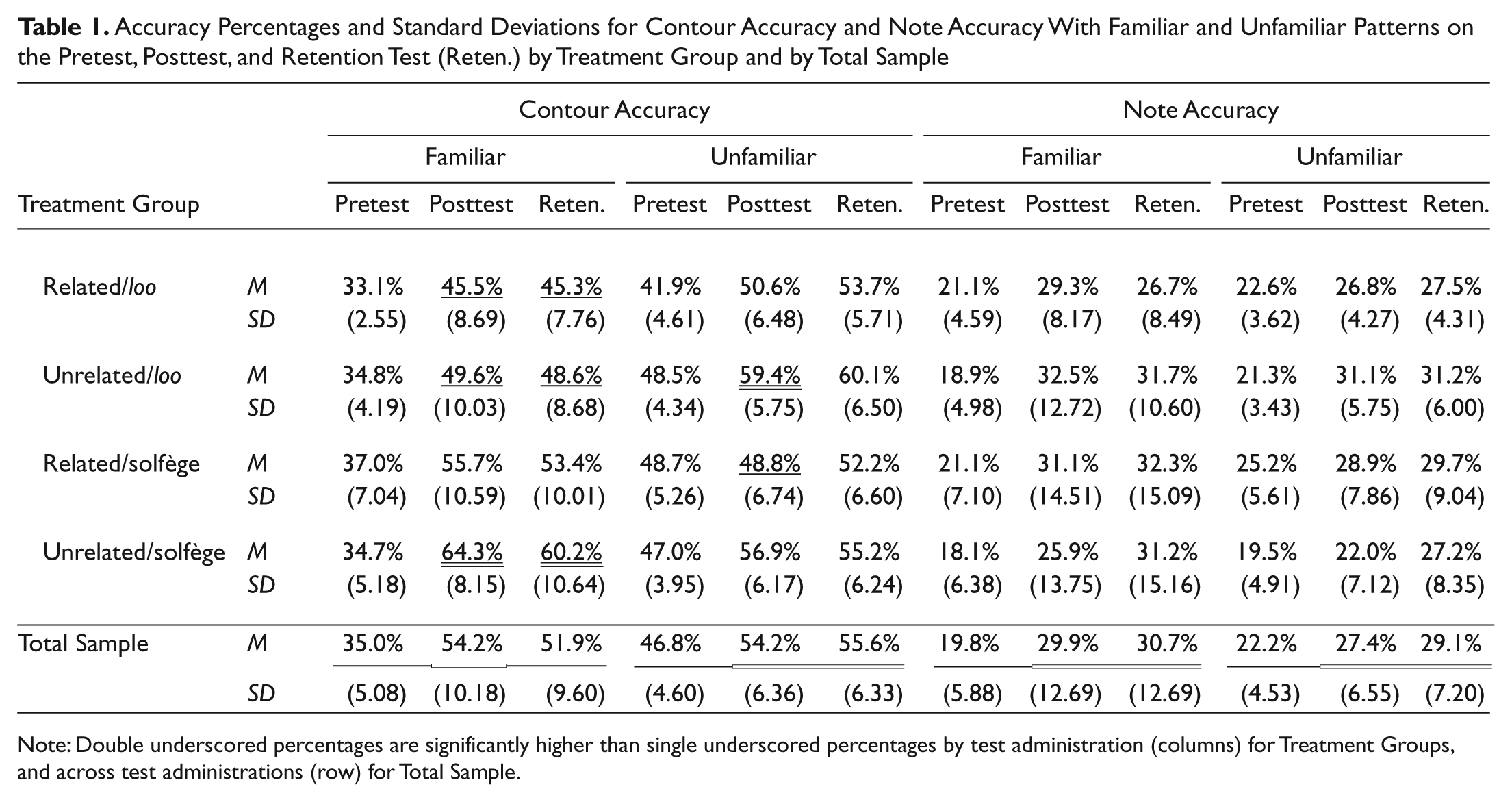
Note: Double underscored percentages are significantly higher than single underscored percentages by test administration (columns) for Treatment Groups, and across test administrations (row) for Total Sample.
Univariate analysis related to the interaction of test administration by treatment condition indicated a significant difference among treatment groups across test administrations in contour accuracy/familiar (p < .001) and contour accuracy/unfamiliar (p < .045). Within-subjects contrasts examining pretest to posttest mean changes indicated significant improvement for both familiar patterns (p < .001, η2 = .09) and unfamiliar patterns (p < .02, η2 = .04). No significant changes occurred from posttest to retention test, indicating that the students maintained their respective achievement levels. A Tukey test used to compare the posttest means indicated that with familiar patterns, unrelated/solfège treatment resulted in significantly greater mean contour accuracy than related/loo (p < .001) and unrelated/loo treatment (p < .001) (see Table 1 and Figure 2). The effect size of the pretest to posttest gain with unrelated/solfège treatment was d = 2.57. These differences were sustained in the retention test on which unrelated/solfège treatment again resulted in significantly greater mean accuracy than related/loo (p < .002) and unrelated/loo treatment (p < .013). With unfamiliar patterns, the direction of the posttest mean differences in contour accuracy by treatment group was reversed (see Table 1 and Figure 2). Unrelated/loo treatment resulted in significantly greater posttest mean contour accuracy than related/solfège treatment (p < .035). The effect size of the pretest to posttest gain with unrelated/loo treatment was d = .75.
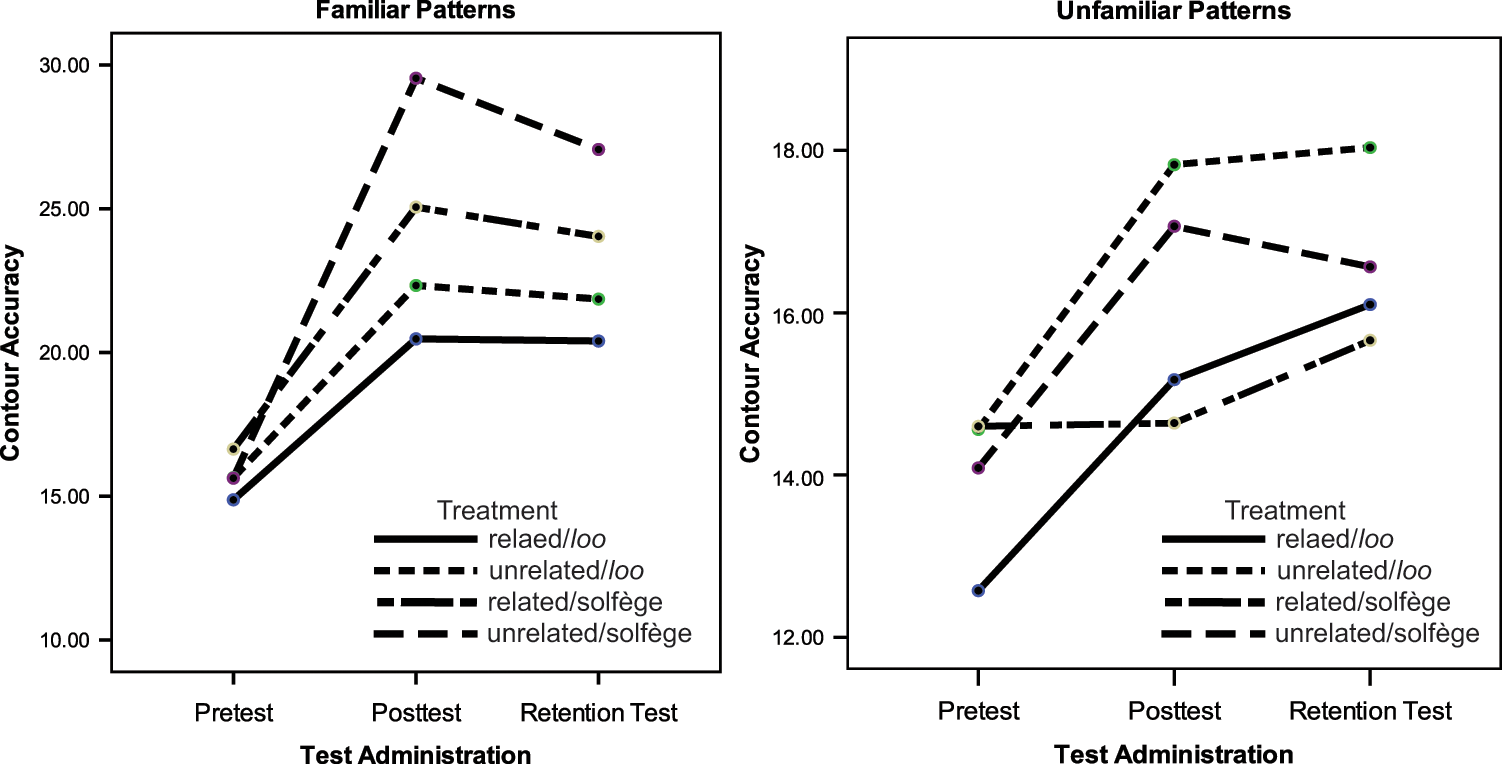
Sight-singing contour accuracy mean scores by the interaction of test administration and treatment condition for familiar (maximum = 45) and unfamiliar (maximum = 30) patterns
With respect to note accuracy, although significant improvement occurred across test administrations, no significant interaction of test administration and treatment condition occurred for either familiar or unfamiliar patterns. To consider the treatment factors of syllable and relatedness separately, the means of the sight-singing scores were examined with a repeated measures MANOVA for two independent factors (syllable and relatedness). There was a significant syllable by test administration interaction, Pillai’s Trace = .211, F(8, 182) = 6.08, p < .001, but no significant relatedness by test administration interaction, Pillai’s Trace = .072, F(8, 182) = 1.77, p > .05.
Discussion
The change in the grand means of the second graders’ sight-singing performance across test administrations indicated that improvement in the students’ accuracy was significant for all four sight-singing variables (note accuracy/familiar patterns, note accuracy/unfamiliar patterns, contour accuracy/familiar patterns, and contour accuracy/unfamiliar patterns). It appears that the instruction in general music classes was effective in improving second graders’ sight-singing skills, with a moderate overall effect size. While stronger effects occurred with the patterns practiced in class, the finding of significant improvement with the unfamiliar patterns suggests that the students were able to transfer sight-singing skills learned in class to new patterns. The students retained their sight-singing skills after an 8-week period of no instruction with one exception, a small but significant decline in contour accuracy with the familiar patterns. It should be noted, however, that the pre- to posttest gain was strongest for this measure, indicating very large practical significance, while the posttest to retention test difference indicated very small practical significance. With both familiar and unfamiliar patterns, improvement was more evident with contour accuracy, although contour concepts were not addressed specifically during instruction. These findings are consistent with other studies suggesting that children’s accuracy in reproducing contours precedes their accuracy in reproducing precise pitches and intervals (e.g., Davidson, McKernon, & Gardner, 1981; Flowers & Dunne-Sousa, 1990).
Of chief interest was whether sight-singing achievement differed based on the type of instruction the students received. This was the case as indicated with the treatment condition by familiarity by test administration interaction for contour accuracy scores (see Figure 2). With the patterns practiced in class, mean posttest contour accuracy was significantly higher for the group that used solfège and did not relate patterns to songs as compared to both of the groups that used loo. With the patterns not practiced in class, mean posttest contour accuracy was significantly higher for the group that used loo and did not relate the patterns to songs as compared to the students who used solfège and related the patterns to songs. A separate analysis indicated that improvement differed significantly based on whether solfège or loo was used but not based on whether related or unrelated songs were used. After a period of no instruction, no significant change in contour accuracy occurred with any of the instructional treatment groups, indicating that the acquired skills were retained.
The superior performance of the solfège group with familiar patterns concurs with Dodson’s (1983) theoretical model of the music reading process, which states that an additional step of coding with a referent such as solfège serves as an aid in translating visual information to an auditory image. In addition to being viewed as a referent used for translation, the solfège syllable also could be viewed as a priming element used for pitch retrieval during testing. Results of priming studies in music that examined how the presentation of one element (prime) prompted a memory of another element (target) have indicated that the presentation of either text or melody of a song seemed to facilitate the recall of the other (Peretz et al., 2004). While the solfège may be viewed as a referent or a prime, an alternate interpretation could be that solfège aided with pitch recall because it functioned like text and became integrated with the tonal pattern in memory to some extent, as suggested in previous studies examining the integration of text and melody (e.g., Crowder et al., 1990; Serafine et al., 1984, 1986). A consistent loo syllable cannot function as a varied referent, prime, or text to aid in the recall of tonal material. The association of solfège syllable with pitch in this study may have developed only after a period of practice on the familiar patterns, as no advantage for using solfège was evident on the patterns that were not heard repeatedly. In a previous study, text and tune were found to contribute to preschoolers’ ability to recognize melodies only after a prolonged listening period (Feierabend et al., 1998).
The original hypothesis that recalling a related song might help when reading and singing pitches was not supported by the results; the students in the related-song groups did not perform with greater accuracy than did those in the unrelated-song groups. The four isochronous pitches of the tonal patterns may have had very limited capacity to help the students conjure up the melody of a song because only the single characteristic of pitch was present, while other common melodic elements such as rhythmic variance, metrical patterns, and phrase structure were absent. Also, the related-song strategy may not have been an effective aid because it resulted in greater variability versus solfège, as the reading of each pattern required the recall of a different song. In contrast, the solfège provided a very limited array of text that could be applied in a uniform manner across the entire set of patterns. Wallace (1994) examined the opposite task of using melody to aid in text recall. Better recall of text occurred among young adults when the same melody was repeated across all verses of text rather than using a new melody for each verse. If an additional retrieval cue is to be effective in aiding recall, it must be simple enough to avoid placing additional demands on attention and memory capacity. In terms of cost/benefit in this study, the related songs’ varied texts may have competed for recall effort, resulting in a greater cost than benefit provided in facilitating pitch recall. This also may explain why the mean accuracy on the unfamiliar patterns was significantly higher for the students using loo than for those using solfège. When reading and singing the unfamiliar patterns, even solfège may have added too much to the cognitive load to be of benefit for these young students for whom music reading and solfège use were relatively new.
The nature of how text can result in facilitation or interference in cognition and how this affects students’ ability to sing pitches accurately was examined by Mishra and Fine (2010) with undergraduate music majors performing a sight-singing task. When students sight-sang notation with printed text that consisted of standard retrieval cues, pitch letters in this case, significantly fewer pitch and text errors were made when the provided letter and notated pitch matched than when the text was a mismatched letter or the neutral syllable la. Using the neutral syllable of la, however, resulted in significantly fewer errors than when reading and singing random letters, which would require additional cognitive processing. Similar results were found in the present study, although printed text was not provided. It seems that when the lyric and the pitch represent the same information in two different modes, facilitation results and singing performance may be enhanced. When the lyric and the pitch represent qualitatively different information, however, the two elements compete for cognitive resources during processing, producing cognitive interference that may cause performance decrements.
Performance on the unfamiliar patterns addressed the issue of transfer of sight-singing skills acquired during instruction. Salomon and Perkins’s (1989) description of two different routes through which transfer can occur may help in interpreting the findings of this study. High-road transfer involves the use of a cognitive strategy in which certain elements of the task are attended to mindfully and abstracted in order to apply rules, principles, or labels. This abstraction provides a bridge from a familiar to an unfamiliar context. Low-road transfer, on the other hand, involves using extensive drill and practice through which the behavior becomes fast and effortless. The amount of practice and the variability of contexts in which the behavior occurs affect the extent to which skills become flexible and transfer to a variety of situations. The instructional procedures of this study would have facilitated predominantly low-road transfer because extensive drill and practice with a limited variety of patterns encouraged automaticity of response. Transfer was most evident with the group that sang with loo and did not relate patterns to songs. Among all groups, this group should experience the greatest degree of low-road transfer because application of a cognitive strategy (i.e., determining what solfège syllable or what related song) was not required when performing the task, making this condition the most effortless and automatic. Schellenberg (2003) also pointed out that transfer is most likely to occur where there are more similarities between the old and the new problem, as was the case most extensively in the unrelated/loo condition.
The group using solfège and relating patterns to songs had the greatest opportunity to experience high-road transfer because both of these strategies could be abstracted as a way to bridge to the task of sight-singing new patterns. Relating to songs was not helpful, however, because the new patterns were not based on familiar songs. Using solfège did not seem to help based on the finding of significantly greater contour accuracy with the unfamiliar patterns for the unrelated/loo group. Instructional procedures in this study explicitly guided students in applying the familiar song strategy, but not in the process of attending to aspects of the notation to determine the correct solfège syllable. Had the students been instructed in how to apply the solfège strategy, greater high-road transfer may have occurred. Additional studies should investigate the effects of instruction specifically related to the identification of notation features to determine solfège syllables on the transfer of sight-singing skills. The sequence and rate in which specific pitches of the scale were introduced also may have affected rate of transfer. Initially, it may be beneficial to visually present a more limited number of different pitches at one time and to allow students opportunities to practice transferring skills with just those pitches before adding new ones. Harvey et al. (1987) pointed out that practice involving greater variability of musical stimuli seemed to cause confusion and resulted in reduced pitch accuracy. Students also may benefit from initially spending more time using solfège without reading notation or from reading only aurally familiar melodic patterns before transferring reading skills to unfamiliar patterns. Further research might examine if other ways of implementing a solfège strategy or using related songs helps to facilitate accuracy in reading and singing pitch symbols.
The second graders in this study demonstrated significant improvement in sight-singing skills as a result of activities incorporated into regular general music classes. Results support the use of solfège in beginning instruction as an effective strategy to facilitate sight-singing. Because the teachers carrying out the instruction had not used solfège with these students in the past, it appears that just 16 sessions of solfège use helped the second graders read and sing contours more accurately on practiced patterns. Note accuracy did improve significantly for all groups combined in the present study, although significant improvement was not associated with any individual treatment group, perhaps because of the limited duration of instructional treatment. Further research might examine if a longer intervention period or instruction with students at other grade levels would result in significant differences in note accuracy achievement based on the type of instructional treatment.
Footnotes
Acknowledgements
The author gratefully acknowledges the assistance of the following music teachers in providing the instruction and the judging for this project: Nancy Fennell, Patricia Manni, Stephanie Milisits, Mary Nelson, and Mary Schatkowski.
The author declared no potential conflicts of interest with respect to the research, authorship, and/or publication of this article.
The author received no financial support for the research, authorship, and/or publication of this article.