




Abstract
Entrance examinations and auditions are common admission procedures for college music programs, yet few researchers have attempted to look at the long-term predictive validity of such selection processes. In this study, archival data from 93 student records of a German music academy were used to predict development of musicianship skills over the course of a 4-year program. Audition grades for the principal instrument, aural skills, and basic knowledge of music theory were correlated with similar data available for the final exams. Final high school grades also were available. Results indicated moderate correlations between entrance and final grades for aural skills (r = .69) and music theory (.45). Piano majors did better at aural skills and music theory than other candidates. A positive influence of keyboard proficiency also was found for the nonpiano majors. The correlation between initial and final grade on the principal instrument was dependent on the instrument category: piano (.64), followed by voice (.55), winds (.24), and strings (.05). Stronger academic performance prior to college was associated with superior performance in academic subjects in college, whereas no influence was found for academic strength on students’ principal instrument performance.
Auditions are a ubiquitous tool for music academies in selecting promising candidates for different instrumental classes and programs. The same is true in other areas of study, especially in physical education, visual arts, and drama. Throughout the course of studies, students make progress on the principal instrument and acquire additional knowledge and skills. But what is the relation between proficiency at the start and success in the final exams some years later? In this study, I was interested in predictors of student musicianship, namely, aural skills, basic music theory, and performance on the principal instrument, that are used to regulate admission into some institutions of tertiary music education.
The report by a workgroup of the European Association of Conservatoires (AEC), a large cultural and educational network comprising 280 institutions for professional music training in 55 countries, states, Training in higher music education depends fundamentally upon students having obtained a significant level of musical skills prior to entry. Primary and secondary schools do not always offer opportunities for obtaining such skills. Consequently, conservatoires need to assess their applicants through specially designed entrance examinations, which may consist of live auditions with juries of teachers. (AEC, 2010, p. 13)
Schools of music, conservatories, and music academies, therefore, have adopted a great variety of procedures to select their prospective students (Jørgensen, 2009), and an informal perusing of websites underscores this impression. Unfortunately, according to a study from the 1980s, only a few (12%) of those entrance procedures are validated empirically (cf. Jørgensen, 2009, p. 72). My literature search did not unearth any more recent studies on the topic. Although auditions and entrance examinations are “primarily concerned with the prediction of study achievement with a silent conviction (or maybe only a hope?) that those who are selected will also turn out to be the best suited for future careers in music“ (Jørgensen, 2009, p. 74), not much is known about their longer-term predictive validity. 1
A number of researchers have tried to predict student success (e.g., grades) in college from school records, SAT scores, and IQ measures. Harris (1940) assembled more than 300 references regarding research on the factors affecting college grades. His results were mirrored by those of later researchers. Burton and Ramist (2001) reviewed studies since the 1980s predicting success in college (e.g., academic performance, nonacademic accomplishments, leadership in college, and postcollege income). They found that “the combination of high school records and SAT scores is consistently the best predictor” (Burton & Ramist, 2001, p. 1). However, they acknowledged that “in performance areas such as art, music, and physical education . . . the usual academic admission measures predict relatively poorly” (p. 49). Thus, for more specialized nonacademic skills, the predictive power of high school grades or SATs decreased. In their meta-analysis, Trapmann, Hell, Weigand, and Schuler (2007) reported, for example, that preclinical courses in medical school were more predictive of later grades than clinical courses. This was in line with general results by Trapmann and coworkers that increasing the specificity of the predictor, for instance, by considering high school math grades for a science program rather than grades in the native language, led to higher predictive validity. While it appears sensible to select prospective students for academic studies based on academic predictors, schools of music are faced with the problem of having to select applicants based partly on nonacademic ones. Depending on the particular application procedure, these nonacademic predictors include performance on a principal instrument, music theory, and aural skills.
Predictors of student instrumental music achievement and sustained participation in music instruction prior to college have received considerable interest from music educators (e.g., Kuhlman, 2005; see review by Gaunt & Hallam, 2009). At least in Western countries, socioeconomic status (SES) seemed to be an important factor in the early stages of learning to play an instrument (Albert, 2006), because a low SES indirectly led to lack of opportunities and knowledge, which in turn impacted attitudes and self-concepts as well as performance. Furthermore, female middle school students were more likely to persist in instrumental music, as were students from two-parent homes (Kinney, 2009). In addition, highly involved parents and competent teachers were found to promote successful musical careers (e.g., see review by Creech, 2009; Gruber, Lehtinen, Palonen, & Degner, 2008). Optimized practice in terms of quantity and quality is central to any music study as well as to forecasted levels of performance (see review by Jørgensen & Hallam, 2009). One would assume that some of the above-mentioned environmental factors operate mainly throughout childhood and adolescence, that is, prior to entrance into an institution of tertiary music education, whereas on the threshold to higher music education, candidates are probably self-selected on a number of criteria, and many of the prerequisite conditions will have been met or compensated for successfully.
One music factor that has been discussed since the earliest studies is the impact of music aptitude, whichever way it may be assessed. Research with mainly precollege students has shown that music aptitude measurements were predictive of instrumental success (e.g., Larson, 1930; cf. Harrison, Asmus, & Serpe, 1994), although reliability of such tests has been questioned on occasion, and even early studies tended to suggest that aptitude scores were influenced by music training (e.g., Martin, 1964, for Drake’s Music Aptitude Test). By the time all students have received training, it is questionable if differences in music aptitude can be assessed and used reliably for prognosis of college success. At the very least, the range of variability on the aptitude scores could be restricted and thereby attenuate correlations with grades in college.
One of the first authors to address this topic, Stanton (1929) ventured to establish a prognosis of students’ music achievement at the Eastman School of Music by using an aptitude test, the Seashore Measures of Musical Talent (SMMT), and an academic testing instrument, the Iowa Comprehension Test (ICT; “to measure mental response in terms of reading and comprehension”; p. 19), thus pairing two promising indicators from the literature. Those tests were administered prior to the students’ entering school. Teachers’ ratings of the students’ talent at the end of the first semester along with class marks of theory, history of music, and rhetoric then were used to establish a five-fold classification (5FC) of the freshmen (categories for continuation were safe, probable, possible, doubtful, and discouraged).
My reanalysis of Stanton’s (1929) data in Table 3 (p. 23) with N = 351 revealed correlations between the SMMT and the 5FC of .63, between ICT and SMMT of .19, and between 5FC and ICT of .60 (all correlations significant at p < .01). My multiple regression analysis using the published data revealed that both factors, aptitude and academic skills, accounted for an adjusted 63% of the variance in the 5FC. The better students went on to receive more awards and scholarships, and they also performed more often in a local recital series at Kilbourn Hall, all of which can be considered a criterion-related validity of the above predictions. Unfortunately, I could not untangle the relative weight of principal instrument, music theory, and history in Stanton’s 5FC, but the prediction of success was rather impressive. The present study measured some of these parameters separately in a longitudinal design over 4 years.
Explaining individual differences in music theory and aural skills in college freshmen music theory course work was the focus of a series of studies by Harrison (e.g., Harrison, 1987a, 1987b; Harrison et al., 1994). Gordon’s Musical Aptitude Profile (MAP) was administered before students began their music studies and was used to predict grades in music theory after three and five semesters, and applied music after five semesters (Harrison, 1987a, 1987b). More specifically, a music theory composite grade upon students’ completion of the third/fifth semester of music theory with associated component grades (written work, sight-singing, ear training) was used along with a recital grade from the fifth semester, “a culminating performance requirement for all music majors” (Harrison, 1987a, p. 1108), as the criterion measures against which the MAP subscale and composite scores were validated. Results included low negative, nonsignificant correlations between MAP and recital grade, and low to moderate associations between the composite theory grade and the MAP Rhythm Imagery (.39, p < .01) as well as the MAP Composite (.30, p < .05). Intercorrelations between music theory subcomponents were moderate (.47 to .59). In a later study, Harrison and coworkers (1994) used structural equation modeling and found that piano experience (coded as present or absent) was a significant predictor of theory grades in the first semester and that being a piano or voice major rather than an instrumentalist explained variance in the second-semester music theory grades (p. 132). While academic predictors (SAT) accounted for some variance in music theory grades, the results of a college music aptitude test did not. Harrison et al. (1994, p. 35) consider their findings in line with previous studies. Thus, although some predictive studies do exist, the empirical evidence is not yet clear, and no researcher to my knowledge has investigated the prognostic validity of entrance examinations on later principal instrument achievement.
Although the present study used only data from a German school, the consensus in the AEC appears to be that European schools possess more commonalities than differences; this is why student as well as staff mobility among schools is encouraged through extensive exchange programs. It is beyond the scope of this study to establish how applicable the results are for other countries, but the international employment market for musicians speaks to the fact that schools in Germany as well as the United States ought to produce graduates with similar qualifications.
The purpose of the present study was to estimate the predictive validity of components from a school of music entrance examination (audition) for the grades achieved by students at the end of a 4-year degree program. I surmised that music theory and aural skills would show a close association at all times and that high correlations should exist between audition and final diploma grades. High school grades should be predictive of academic but not of instrumental success. Using archival data from student records, I investigated whether instrumental music skills and basic music theory assessments along with high school grades were prognostic of success in tertiary music education.
Method
Data Retrieval and Types of Data Used
Data were extracted from student records kept by the office of the registrar at a German school of music. This school is Germany’s oldest school of music and one of three in Bavaria. 2 Permission to analyze the records was granted by the administration beforehand. The records originally were kept on paper, and all pertinent data were copied onto a spreadsheet and prepared for analysis. Most information could be copied straight from a data sheet that contained scores from the entrance examinations regarding aural skills, basic music theory, keyboard proficiency, and principal instrument auditions. In sum, the data pertained to (a) the entrance examination, (b) final examinations for the diploma certificate, and (c) information on past school achievement in secondary school (type of school, final grade).
Participants
Student records stemmed from graduates (N = 93) who had been enrolled between 1991 and 2004 in a 4-year diploma program either in instrumental music education (19%) or in performance (81%). Records were selected based on completeness from the entrance examination to the final examination. Of the sample, 57% were female. Principal instruments were strings (n = 33; 35%), winds (n = 26; 28%), piano (n = 18; 19%), and voice (n = 16; 17%). Although some of the students were enrolled simultaneously in both programs, they were counted only once for this study. Prior to all analyses, distributions of all variables were inspected to ascertain normality.
Entrance and Final Exam Measures
The measures used in this study are straightforward, albeit their reliability and validity cannot be assessed completely because they have emerged from everyday practices at a school of music. They will be described in the following section to allow the reader an informed notion of compatibility with similar measures elsewhere. Entrance and final exams in music theory and aural skills typically are administered and scored by the regular music theory faculty. Questions in written aural skills include dictation of two and three successive intervals, simultaneous intervals, three-voice chords (tonal and free tonality), four-voice chords (tonal), and a tonal melody. In music theory, students have to complete a four-part figured bass; identify scales; explain terminology, such as Andante or Allegro; and notate complex rhythms. Given the 4-year duration of the degree program, the final exams are correspondingly more complex. All students take the same tests, regardless of principal instrument played. The instrumental auditions are adjudicated by the respective school of music faculty and staff; that is, a panel of pianists listens to all piano admissions and scores them on a 1-to-5 continuous rating scale. All students play self-selected repertoire pieces from varying epochs. Grades are then either averaged across the panel or a consensual rating is achieved after discussion. Given the number of panels and habitual practices (culture) of the individual instrumental groups, procedures are not completely standardized. Piano proficiency of nonpiano majors is assessed using a similar procedure, however with only two experienced teachers present.
The school continually has admitted students according to the same standards for many years without substantial change in rates of admission, and the turnover in faculty is slow so that most exams in this sample even might have been scored by the same people at entrance and for the final exam. All measures resulted in numerical grades that ranged continuously from 1 (very good) to 5 (deficient), mirroring the German school grading system, which corresponds roughly to the American A-to-D letter grades. 3 Note that in contrast to the American university system, where grades are accumulated across several years, the German system under investigation here was based on a single final jury/exam. How strongly teachers incorporate the students’ development and study behavior in their assessments is unclear (see also Discussion section).
Results
Relation Between Entrance and Final Exams
The first and most interesting question concerned the relation between entrance and final exams in music theory, aural skills, and principal instrument (see Table 1). Correlations between aural skills and music theory were moderately high, whereas the associations with the principal instrument grades were rather low. The only reliable correlation existed between aural skills (final) and principal instrument (entrance; .22, p < .05). Furthermore, the relation between entrance and final exam on the principal instrument was surprisingly moderate across the sample (r = .31, p < .01).
Correlations Between Entrance and Final Grades in Aural Skills, Music Theory, and Principal Instrument (N = 93).
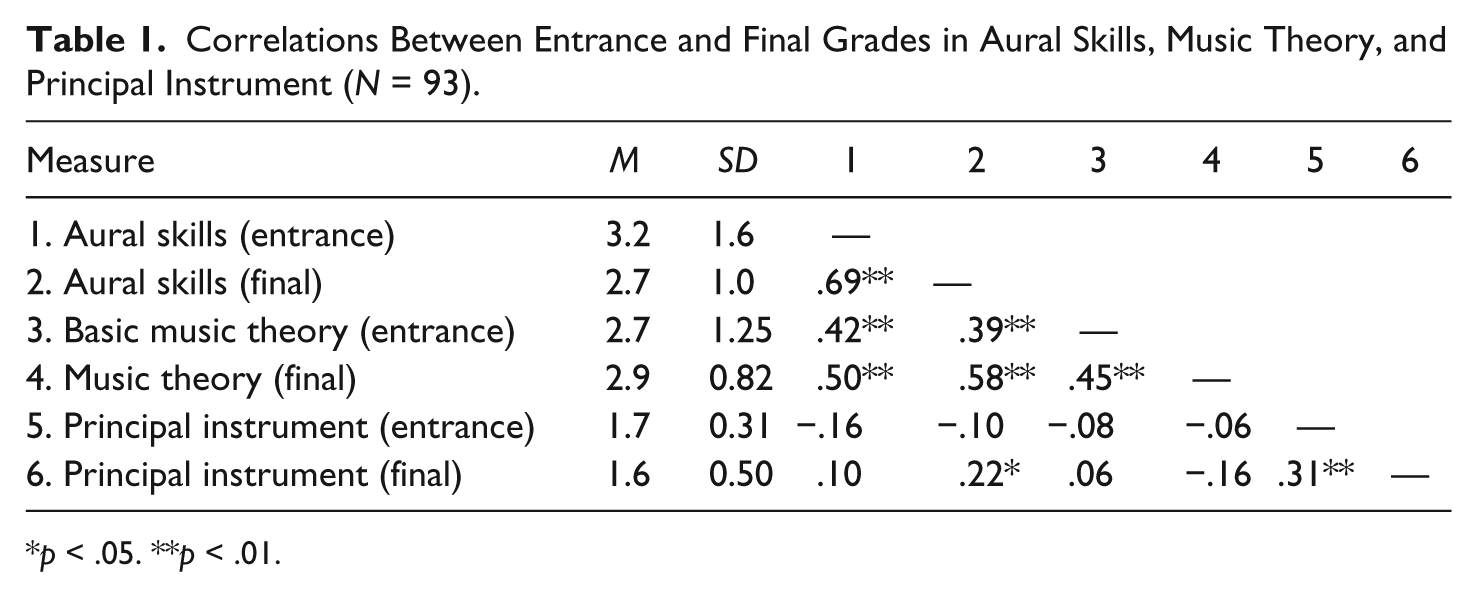
p < .05. **p < .01.
The close association of music theory components was in accordance with previous research. The small correlations between music theory components and principal instrument point to a theory-practice schism, which also did not come as a surprise. Other academic variables not reported here in detail, namely, grades in music history, organology/acoustics, and musical analysis, also correlated moderately with each other and with music theory (final), r = .29 to .50, all p < .01.
Differences Between Instrument Categories
To assess the influence of principal instrument category, whether at the audition or in the final exams, I conducted a multivariate analysis of variance with all six exam grades as dependent variables and instrument category as a four-level between-subjects factor (see Table 2). The multivariate test of instrument category was reliable, Hotelling-Spur F(18, 227) = 5.065, ηp2 = .29. The observed effect was large.
Results of Univariate Analyses of Variance of Exam Grade Measures (Dependent Variable) With Instrument Categories (Independent Variable) and Corresponding Estimated Means and CIs.

Note. Lower means indicate better performance according to German school grading system (1 = very good; 3 = satisfactory; 5 = deficient). CI = confidence interval.
Kruskal-Wallis test, χ2(3, N = 90) = 32.54, because of inhomogeneous variances.
Because the assumption of homogeneity of the variances was violated for aural skills (entrance), Lévené-Test p = .004, a one-factor Kruskal-Wallis test was conducted on median differences for this variable, χ2(3, N = 90) = 32.54, p < .01, η2 = .37, resulting in a large effect. Follow-up Mann-Whitney tests revealed that pianists’ mean ranks differed reliably from the other instrument categories (all p < .01). The 95% confidence intervals (CIs) confirmed that the pianists outperformed their peers in aural skills and music theory. Varying means for the principal instrument (at entrance) were presumably due to differing adjudication standards by the respective instrumental faculty or due to reasons to be discussed later.
While the overall prediction of final grades on the principal instrument with entrance grades was .31 (see Table 1), the prediction from the entrance grades for the four instrument categories varied somewhat despite normal distributions of raw scores: piano, .64 (p < .01, n = 17); strings, .05 (ns); voice, .55 (p < .05); winds, .24 (ns); for all nonpianists, .25 (p < .05; n = 75). A test on the difference between the correlations for pianists and nonpianists turned out to be significant, p < .05. This difference between pianists and nonpianists was followed up by using the intercorrelations between skills (see Tables A and B, available online at http://jrme.sagepub.com/supplemental) and performing a t test with pianist/nonpianist as the grouping variable for all correlations of principal instrument with all other variables (in rows 5 and 6 of the tables). A Fisher transformation of those correlations and ensuing independent-sample t test revealed a significant difference, t(16) = 4.56, p < .01, mean difference .52, 95% CI [.28, .76], d = 2.16. Skills were thus more highly intercorrelated among pianists (M = .49, SD = .27) than among nonpianists (M = –.034, SD = .21). The test also was significant when omitting the predictive correlation for principal instrument (entrance with final), now d = 2.26.
If this advantage in aural skills and basic music theory applied for pianists, did it also apply to nonpianists with better initial keyboard skills? For this analysis, I used the grade assigned for a piano proficiency test that all nonpiano majors had to take as part of their auditions. The correlations between piano proficiency grades of nonpiano majors and principal instrument (entrance), basic music theory (entrance), and aural skills (entrance) were –.035 (ns), .18 (ns), and .40 (p < .01), respectively. Thus, achievements on aural skills of nonpiano majors at the start of the degree program were associated with superior initial piano proficiency.
Academic Ability as a Moderating Variable of Success in College
Unlike in the American educational system, German students do not obtain SAT scores. Also, no test of intelligence could be administered in the present study. The closest measure to assess academic ability prior to college was the final aggregated high school exam grade (somewhat similar to a grade point average). This measure comprised teacher grades from a range of school subjects. In my sample, the students’ mean was 2.1 (SD = .66; range 1.0 to 3.6), and this variable was distributed normally. A grouping variable was created by performing a median split on the high school exam grades (median = 2.0). Next, a variable capturing academic grades in college—called “academics (final)”—was computed by averaging the grades in musical acoustics, musical analysis, organology, repertoire studies, and music history. Then, four independent-samples t tests were conducted using the high school grades as the grouping variable. Students who had been academically strong prior to college did better in college music theory (final), t(81) = 2.91, p < .01, 95% CI [–.86, –.16], d = .64; aural skills (final), t(81) = 3.64, p < .01, 95% CI [–1.17, –0.34], d = .80; and academics (final), t(81) = −4.11, p < .01, 95% CI [–.68, –.24], d = .89. However, no reliable difference regarding high school grades was found for the principal instrument (final), t(81) = .305, ns, 95% CI [–.18, .25], d = .08. Thus, academic strength prior to college predicted academic performance in college but not artistic performance on the major instrument or voice.
Discussion
Special selection processes and criteria for admission to tertiary education are imposed for students of music and other areas (physical education, arts, drama). Given the ubiquity of such procedures in schools of music, there is surprisingly little research on their influence on the students’ final success. In the present study, I used archival student records at a German school of music to investigate the relationship between grades of several subcomponents from the audition (admission) process and corresponding final diploma grades. The idea was to investigate whether audition components were good predictors of success at the end of college and whether or not final grades were related to the instrument played (including voice) or on prior academic performance.
The overall correlations between music theory and aural skills components were moderate to high, as was expected (see Table 1). Conversely, the nonsignificant correlations between music theory or aural skills with the principal instrument (at beginning and end of college) are worthy of discussion. One could have hypothesized—and many music theorists and ear-training teachers might assert—that better performance in aural skills and music theory promotes artistic performance via some wished-for transfer effect. At first glance, in my study, this did not seem to be the case. Artistic performance and academic performance (if I include aural skills here) were two unrelated, and in some cases even slightly negatively related, aspects of musicianship. However, for pianists, all components were more highly intercorrelated than for nonpianists (see Tables A and B, available online at http://jrme.sagepub.com/supplemental). This effect may evoke the skewed impression among teachers that better performers also excel in music theory or aural skills.
Pianists appeared to have a clear advantage over nonpiano majors (see Table 2). Even among nonpiano majors, superior piano proficiency was predictive of better grades in the entrance aural skills test. Harrison et al. (1994) already found piano majors to be at an advantage regarding music theory in the first year. Also, they reported that piano experience (coded only as present or absent) predicted theory grades in the first semester and suggested that students with little piano experience would benefit from (class) piano lessons in the first semester to promote their music theory course work (cf. Harrison et al., 1994, p. 135). I completely agree with this conclusion and would encourage schools to teach piano proficiency in a way that is compatible with music theory and aural skills, rather than doing repertoire work. 4 This even could be enhanced by teaching piano skills to future music educators in a manner that would be applicable to their future classrooms/studios. The present analyses used only four instrument categories, and the results suggest a divide between pianists and nonpianists. With more participants, it would have been possible to investigate whether other instruments—guitar, accordion, and harp—that share the piano’s polyphonic/harmonic possibilities would offer similar benefits with regard to aural skills.
Why did pianists show such superior performance? Perhaps learning to play the piano may implicitly impart theory-based harmonic and structural knowledge in a manner that is close to the testing conditions in the admission procedure. Some nonpianists also may spend a lot of time focusing on technical aspects of their instruments during practice and have no time or interest left for acquiring explicit aural skills (e.g., melodic dictation). This would be especially likely with a relatively late initiation to instrumental tuition (e.g., among brass players as opposed to violinists). An alternative explanation would be that it is not the polyphonic nature of the piano per se that is beneficial but existing differences in teaching traditions: Formal music theory activities may be more likely integrated into piano instruction than into the teaching of single line instruments.
Academic performance in high school has been shown to be a good predictor of academic performance in college (cf. Burton & Ramist, 2001; Trapmann et al., 2007). The verdict that “usual academic admission measures predict relatively poorly” in aesthetic areas of study (Burton & Ramist, 2001, p. 49) proved only partly correct in the present study. Stanton (1929) already had found a high correlation between a measure of scholastic aptitude and his indicator of success in a music program. Whereas Stanton’s data did not separate artistic and academic performance, the results of the present study indicated such differential effects. Academic performance in music-related subjects in college was related to high school academic performance. However, principal instrument performance was unrelated to these academic measures. Therefore, it may happen that excellent players with low academic abilities suffer in academic courses and need extra help. Conversely, academically strong students might be bored with a curriculum lacking in academic challenges that accommodates academically weak performers.
The most puzzling aspects of this study were the different associations between entrance audition and final performance grades on the principal instrument (correlations for piano, .64; strings, .05; voice, .55; winds, .34; for all nonpianists, .25). One explanation could be that adjudicators want to encourage students to continue in their respective programs and provide overly enthusiastic grades, which in turn mars rankings in students’ observable competences. Or jurors might remember the students from the entrance audition, or from recitals since then, and unwillingly rate development or personal impressions rather than actual performance. The close personal contact of student and master-teacher, further, may create social obligations on behalf of the teacher to grade leniently in the end. Grade inflation is present in the German as well as the American university system (Rojstaczer & Healy, 2012; WR, 2012), probably because no effective mechanisms exist to prevent it.
An alternative and simple, yet unsubstantiated, explanation for the lower predictability for strings and winds would be that teachers cannot truly assess the students’ initial potential—although they might believe that this is what they are doing—and that the artistic development follows serendipitous paths with resulting low correlations. The obvious question emerging from this would be, Why does this phenomenon affect different instrumental groups differentially? Could it be that artistic development might be more predictable in pianists (and vocalists?), who have maximized their practice regimen (duration and effectiveness) prior to college and thus retain their relative rank in the class? Some wind or string students may receive their first high-quality instruction in college and progress on varying trajectories, leading to changes in ranking within the groups. Alas, I cannot rule out that some students do not flourish under their new teachers and stagnate. All of these reasons may lead to a change in relative rank in the class (and corresponding grades) with ensuing lower predictive correlations.
I should mention some limitations of the study, which arise from the fact that preexisting real-life data were analyzed that had accumulated over years with no possibility of tight control over their genesis. I cannot rule out a restriction in range on some variables, but given that dropouts due to deficient grades at this school are relatively rare (under 10 per year), it is unlikely that there is a noticeable effect of selectivity. In addition, the data were gathered on degree programs that have since been restructured to implement the bachelor/master system used in many countries (including the United States). Due to a lack of other studies, I do not know if the results generalize well to this system. 5 However, because performance standards and persons involved have not changed over time, I would expect reproducibility of the main findings. Only one school in Germany was surveyed in this study, and given the absence of comparable data, one will have to wait for future research in order to judge the generalizability of these findings to other educational settings. Finally, I have limited the long-term development to its manifestation in grades (entrance vs. final), leaving out qualitative changes in musicianship and real-life measures, such as employment status, income, and job satisfaction.
In closing, this study was a first attempt to address the problem of predictive validity in an area that is generally neglected (Jørgensen, 2009), and to my knowledge, this is the first study to span an entire 4-year degree program in music. It is surprising that not more schools of music have used their archival data to validate admission and auditioning procedures. If they have done so, their results did not—at least to my knowledge—reach the interested academic community. Therefore, administrators should encourage research on the structural relations of grades in order to increase their understanding of the mutual benefits of certain content areas. For example, enhancing piano proficiency in a way that interconnects with music theory or aural skills might benefit nonpianists with regard to those areas as well as reduce frustrations and possibly dropouts. An obvious question for future research would be, Is it possible (or desirable) to design more prognostic instruments for entrance examinations? Traditional procedures have led tertiary music education to its present high levels, but with the music world around us changing, it might be interesting to revisit the gatekeeping mechanisms and unquestioned tenets that govern degree programs at music academies (and similar institutions, whatever their names and wherever their location).
Footnotes
Declaration of Conflicting Interests
The author(s) declared no potential conflicts of interest with respect to the research, authorship, and/or publication of this article.
Funding
The author(s) received no financial support for the research, authorship, and/or publication of this article.

Notes
Author Biography
References
Supplementary Material
Please find the following supplemental material available below.
For Open Access articles published under a Creative Commons License, all supplemental material carries the same license as the article it is associated with.
For non-Open Access articles published, all supplemental material carries a non-exclusive license, and permission requests for re-use of supplemental material or any part of supplemental material shall be sent directly to the copyright owner as specified in the copyright notice associated with the article.
