




Abstract
The purposes of the present study were to identify the teacher behaviors that preceded learners’ active participation in solving musical and technical problems and describe learners’ roles in the problem-solving process. I applied an original model of problem solving to describe the behaviors of teachers and students in 161 rehearsal frames extracted from 43 lessons with five artist-teachers. Results indicate that the number and type of learner problem-solving components varied according to the preceding teacher behavior. The teacher behaviors that most often preceded learner problem solving were varying the specificity of feedback and directives, asking questions, demonstrating contrasting options, stating principles, and refraining from answering learners’ questions.
Most meaningful musical goals are attainable only if learners can make progress outside the presence of their teachers. To the extent that students depend on their teachers, they are limited in their ability to develop the skills and thinking required for successful music-making. Students learn more, learn better, and learn more happily if they receive opportunities and develop the capacity for independent learning (Deci & Ryan, 2000; Hmelo-Silver, 2004; McPherson & McCormick, 1999).
Intellectual and musical independence encompasses multiple aspects of thinking, behavior, and attitude, including autonomy (Deci & Ryan, 2000), self-regulated learning (McPherson & McCormick, 1999), self-directed learning (Loyens, Magda, & Rikers, 2008), and problem-based learning (Hmelo-Silver, 2004). The problem-based learning (PBL) approach places learners in a position to encounter problems directly, often in collaborative settings. Students are to work toward the solution to problems without teacher direction; the teacher is instead a guide, a facilitator (Hmelo-Silver, 2004). Learning that involves these elements of student self-direction, in contrast to purely teacher-directed learning, is beneficial for several reasons. Learners are more likely to explore, extend themselves, risk, and think creatively when teachers and parents provide opportunities for choice (Grolnick, Deci, & Ryan, 1997), and learners who develop the ability to solve problems have demonstrated increased expressivity (Broomhead, 2009) and a greater capacity for creativity (Lin & Cho, 2011). Researchers have demonstrated a link between motivation and autonomy (Deci & Ryan, 2000; Isen & Reeve, 2005; Koestner, Ryan, Bernieri, & Holt, 1984) and between motivation and self-regulated learning (e.g., McPherson & McCormick, 1999). Problem solving during independent practice is a hallmark of expert musicianship, one that separates successful from unsuccessful music learners (Chaffin & Imreh, 2001; Rohwer & Polk, 2006).
All of these findings provide a rationale for ensuring that students develop the capacity to learn independently. This is particularly consequential in music given that learners are commonly expected to spend the majority of their music learning time outside the presence of teachers. Yet, previous research has shown that music students’ ability to progress independently is often lacking (Bergee, 1997; Hewitt, 2011; McPherson, 2005). Both Bergee (1997) and Hewitt (2011), for example, found that music learners have difficulty accurately evaluating their own performance. Most middle school instrumentalists that Miksza, Prichard, and Sorbo (2012) observed practiced passages of more than eight measures in length, and repetition was their most commonly used practice strategy. Rohwer and Polk (2006) reported that eighth-grade students could identify few strategies that they used during independent practice, and elementary-aged students interviewed by McPherson practiced largely without purpose; much of their independent practice time was spent playing through pieces, not seeking to accomplish identifiable goals (McPherson, 2005).
Problem Solving
It is important to define with some precision what is meant when one speaks of problem solving and what is involved in the process. There is no clear consensus as to the meaning of several terms found in problem-solving literature (see Wenke & Frensch, 2003); even defining the word problem has been, well, problematic. A problem could be termed broadly as any goal that has not been attained (Hambrick & Engle, 2003) or more narrowly confined to any goal for which the solution is not easily forthcoming (Duncker, 1945). Problem solving, therefore, may encompass any goal-directed behavior on one end of the spectrum or may exist only “when a living creature has a goal but does not know how this goal is to be reached” (Duncker, 1945, p. 1).
Problems come about because of a defining mental “gap,” causing a “barrier between the current state and the goal state” (Lüer & Spada, 1998, p. 256). “Unsatisfactory gaps” may exist as a result of the nature of the problem and the characteristics of the problem solver (Wenke & Frensch, 2003). A problem may be straightforward, involving few steps to resolution, or complex, requiring a series of tasks, and a problem goal may be clearly identifiable or ill defined. Although the nature of a particular problem is relatively static in and of itself, the characteristics of the problem solver may change, rendering the problem less difficult. Through practice, for example, a needed skill may become automatic, freeing up more attentional capacity for the execution of other parts of the task (McCarty, Clifton, & Collard, 1999; Zheng, Swanson, & Marcoulides, 2011), or the problem solver may attain knowledge enabling the solution to a problem (see K. Lee, Ng, & Ng, 2009). The amount of “gap” that brings about any type of problem therefore lies on a continuum; problems are of varying difficulties and complexities, depending on the nature of the problem and the characteristics of the problem solver (Wenke & Frensch, 2003).
Problem solving as a skill may be more challenging than teachers often realize. Even what appear to be easy tasks may actually require the nearly simultaneous execution of a number of cognitive and perceptual skills. Roesler (2016) provides a description of the problem-solving process that revealed components synonymous with those labeled within analyses of problem solving in other disciplines (Hill-Briggs et al., 2011; Isaksen & Dorval, 1993; C. B. Lee, Koh, Cai, & Quek, 2012; McCarty et al., 1999):
establish goal(s)
evaluate performance
conceive and consider options
generalize and apply principles
decide and act.
Each of these behaviors may be challenging individually; considering them together provides insight into the potential complexity of problems that students may struggle to solve on their own. When students are tasked with solving apparently simple problems (e.g., adjusting an out-of-tune note), they may struggle due to difficulties with necessary perceptive skills, such as evaluation (Hewitt, 2011), or they may lack sufficient domain knowledge (e.g., how to manipulate pitch on their instruments) to guide them to decide on a proper course of action (Hambrick & Engle, 2003; Tsai, Hou, Lai, Liu, & Yang, 2012). If learners are not well practiced in procedural or cognitive skills, problems may exceed their working memory capacity, especially as problems grow in complexity (Hambrick & Engle, 2003; Song, He, & Kong, 2011).
The Teacher as Problem-Solving Trainer
Vygotsky’s zone of proximal development (ZPD) provides that tasks that students are otherwise incapable of executing may be brought into the realm of their capacity through the assistance of a more knowledgeable other—a teacher (Vygotsky, 1978). Often applied in the learning of skills and knowledge such as mathematics and reading, it is conceivable that the skills of problem solving itself could be developed through a scaffolded, incremental process. The teacher may function as a mediator between insurmountable problems and the students who encounter them, perhaps by adjusting the nature of problems, assisting learners in the discovery of knowledge, or guiding students in practicing necessary problem-solving skills.
It is perhaps surprising that there is a dearth of research literature that examines the music teacher’s role in the development of learners’ ability to solve problems independently, although some researchers have studied independent practice in music (e.g., Chaffin & Imreh, 2001; Duke, Simmons, & Cash, 2009; Hallam, 2000; Nielsen, 2002; Sikes, 2013). There are only a few examples of research concerning the effects of training on music learners’ problem solving (e.g., Broomhead, 2009), most of which involved error detection (e.g., Dolbeer, 1969) and self-evaluation (e.g., Hewitt, 2011). An analysis of problem solving during one-to-one music instruction revealed a potential pedagogical means by which teachers may train problem solving: Teachers and students performed problem-solving components in any combination during various scenarios in which they were involved in joint problem solving (Roesler, 2016). It is conceivable, then, that teachers may be able to provide scaffolding assistance to students not only in the development of musical skills but also in developing the component skills of problem solving. Further investigation into teachers’ and learners’ behaviors while solving identifiable musical problems is required to more fully understand how this may occur.
If learners are to become independent, they must assume an active role in formulating solutions to the problems they encounter, whether alone in the practice room or in the presence of their teachers. The current investigation is based on the premise that learners’ success can be assessed in terms of their ability to solve problems independently and in ways that lead to the accomplishment of proximal performance goals (Duke, 1999). Developing this ability requires that learners practice the skills of problem solving while in the presence of teachers who provide scaffolded opportunities to do so. As students engage in various aspects of problem solving and make meaningful contributions to their own progress during instructional time, teachers can observe learners’ problem-solving effectiveness and potentially guide learners’ development of this critical skill, thereby influencing their independent practice. This important instructional priority is the focus of the current study: the means by which learners engage in problem solving while in the presence of their teachers. I sought to identify the teacher behaviors that preceded learners’ active participation in solving musical and technical problems and identify specific learner problem-solving behaviors that followed the identified teacher behaviors.
Method
Participating teachers were among those who had been chosen as Distinguished Teacher honorees in a residency series at a major southwestern university in the United States between 2002 and 2010. All were internationally renowned performing artists and teachers at the time of their selection. All participants in the series agreed to be video recorded teaching lessons with their own students at their home institutions.
I chose to study the work of five teachers based on variety in their instrumental expertise (violin, piano, viola, trombone, and oboe). I analyzed video recordings of 41 private lessons and 2 coached chamber music rehearsals. 1 Student participants, those regularly receiving instruction within these teachers’ studios and with whom teachers had already established an ongoing relationship, included 5 adolescents and 43 college music majors. Each recorded private lesson was with a different student. Some of the video footage used in this study has been analyzed in previous research and reported elsewhere (Duke & Chapman, 2011; Duke & Simmons, 2006), for which I have obtained permission to analyze and report in this study. The current analysis is independent of these earlier studies.
Framework Describing Components of Problem Solving
Before learner problem solving and its development could be considered, a clear description of the process of problem solving in music settings was needed. I recently developed a framework for observing the problem-solving process in music study by labeling distinct behaviors that led to solutions to problems, as performed by teachers and students when they pursued a common goal together (Roesler, 2016). The resulting operational definitions serve as a framework for the analyses of learner problem solving in the current study, as follows:
Selection of rehearsal frames
It has been demonstrated in previous research that rehearsal frames, or periods of instructional time dedicated to the pursuit of identifiable goals (Duke, 1994), serve as useful units of analysis for the study of music instruction (Cavitt, 2003; Colprit, 2000; Worthy, 2003; Worthy & Thompson, 2009). I likewise chose the rehearsal frame as the unit of analysis for this study as a successful rehearsal frame (in which the goal is achieved) represents the time spent pursuing the very topic of my study: the process of solving a problem.
Duncker (1945) defined a problem as a goal for which the means of attainment is not immediately known. For the purposes of this study, however, a problem is defined as any goal that has not yet been achieved (Hambrick & Engle, 2003). This broader definition is adopted for several reasons, both practical and theoretical. Practically speaking, as I observed students and teachers seeking and attaining goals within private lessons, it was impossible to determine with certainty to what extent they perceived the solution to problems before they were solved. Wenke and Frensch (2003) proposed that problems fall along a “gap continuum,” in which problems may have very small to very large barriers that must be broken down in order to attain goals. Whether and where teachers’ goals fell on the “gap continuum” was not always clear, further complicated by involving a second party (a student) in the process—an individual with different characteristics. Thus, what may not be a problem (as defined by Duncker, 1945) for a teacher may well be a problem for a learner. Theoretically, after careful observation of goal-directed behavior in music, it appears that similar skills are required for achieving goals whether or not their attainment is immediately forthcoming; the difference seems to be manifest in the knowledge applied and the strength and automaticity of necessary skills as acquired by the problem solver (Roesler, 2013).
The problems that students encountered during the scenarios I observed were, admittedly, largely on the less complex end of the problem spectrum, certainly from the teachers’ point of view. They involved relatively few steps and were usually well defined. The teachers I observed made this possible for students; they generally chose tasks that were accomplishable in a short time, although they were often subsumed within much larger, more challenging problem contexts, perhaps of which students were only obliquely aware.
Analyses that led to the development of the aforementioned problem-solving framework (Roesler, 2016) had revealed that learners were involved in five components of the problem-solving process to varying degrees in a given moment of a lesson. Furthermore, over the course of lessons, learners were observed performing any combination of any components of the process. (Rehearsal Frames 1–6 provide illustrations of this phenomenon, see Figure 1 and Appendix B in the online supplemental material, available at http://jrme.sagepub.com/supplemental.) 2 As examples, during some scenarios, students evaluated their performances according to their own priorities, but teachers then applied knowledge and made decisions based on available possibilities to solve problems; in other scenarios, I observed teachers establish goals, evaluate, and state principles by which students would then make their own decisions; and so forth. I felt it was important to represent all of these scenarios as accurately as possible in my analysis; therefore, I sought to select a sample of rehearsal frames that reflected the variety of ways and degrees learners could be involved in the problem-solving process with their teachers.
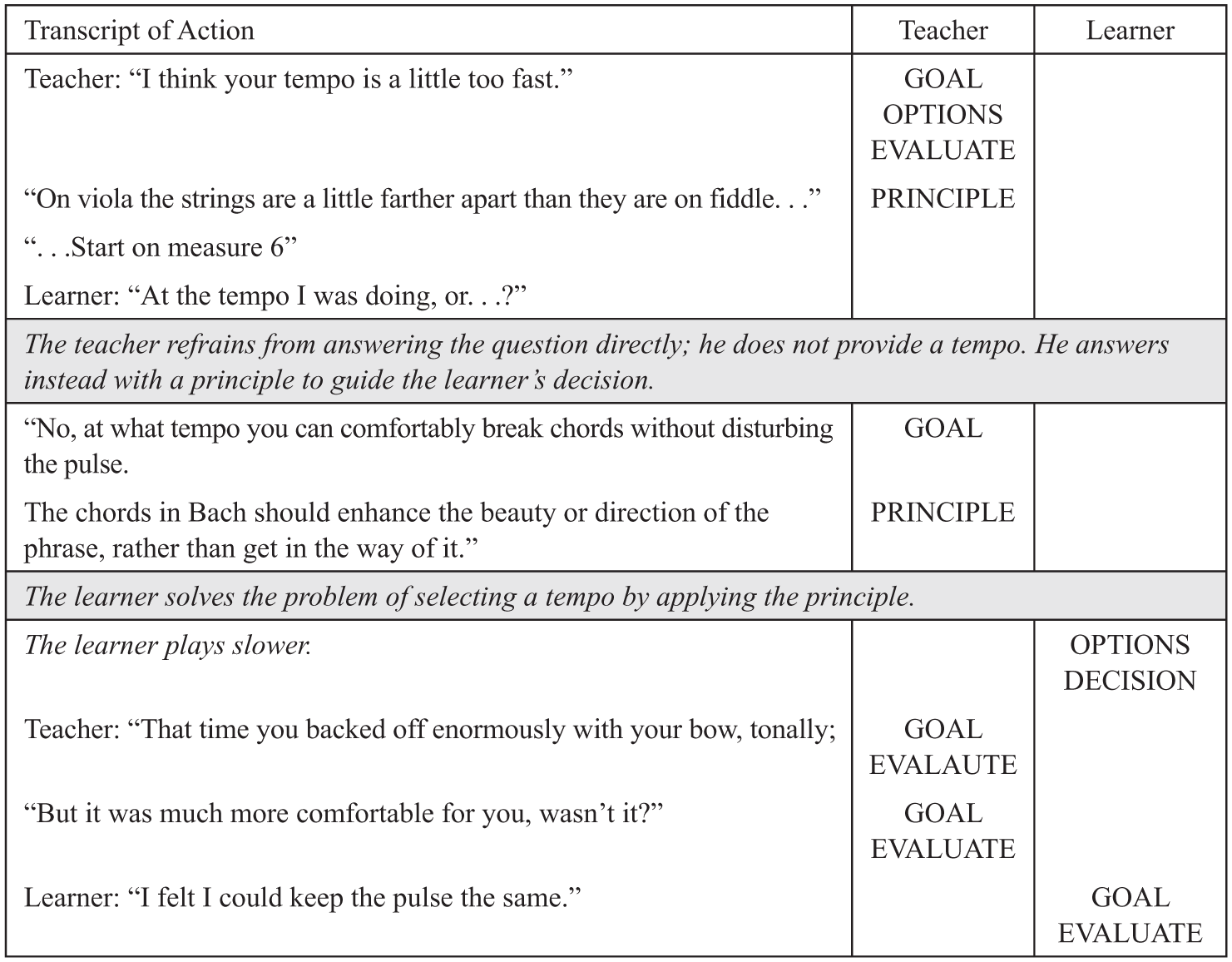
Rehearsal Frame 1: Refraining From Answering and Stating a Principle
I began selecting rehearsal frames that illustrated productive work toward the accomplishment of identifiable goals (i.e., students successfully accomplished the targets defined), and I labeled every problem-solving behavior within each, attributing each problem-solving behavior to teacher or student. As my analysis continued, I selected rehearsal frames to represent a broad spectrum of problem-solving involvement on the part of learners, executing none, some, most, or all components of the process instead of their teachers, depending on the rehearsal frame. I noted which and how many problem-solving behaviors learners performed in each rehearsal frame and assigned each rehearsal frame a place on a continuum of learner problem-solving involvement. (See Table 1 for an example of some of these rehearsal frames on the continuum.) Rehearsal frames were selected until they adequately represented the varying types and extent of learners’ involvement in problem solving that occurred during lessons until I reached a point of saturation, in that I found little more variation in problem-solving behavior between teacher and student beyond what I had already extracted.
Number and Type of Problem-Solving Behaviors Attributed to Teachers and Learners Within 10 Rehearsal Frames, in Order From Least to Most Learner Involvement.
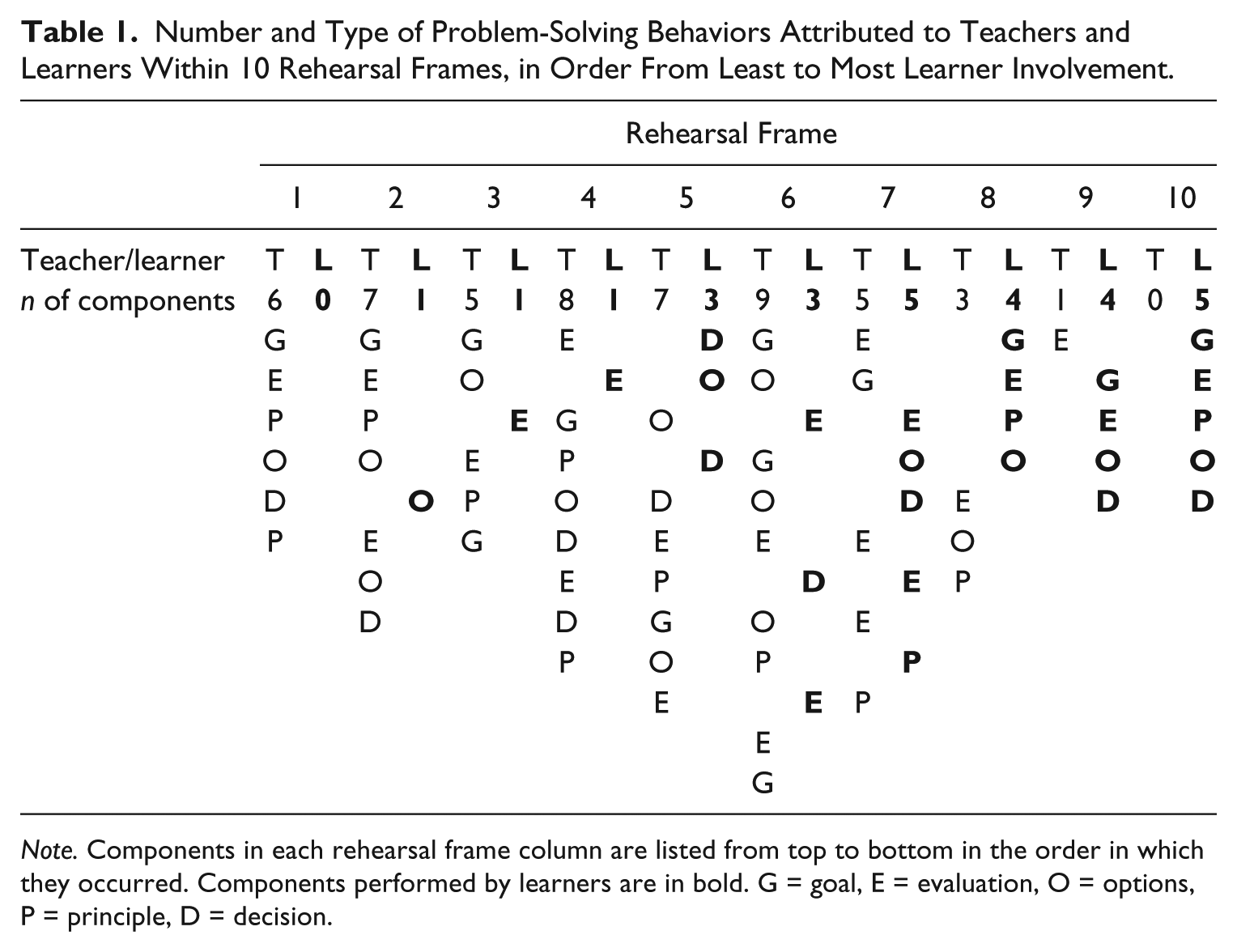
Note. Components in each rehearsal frame column are listed from top to bottom in the order in which they occurred. Components performed by learners are in bold. G = goal, E = evaluation, O = options, P = principle, D = decision.
When rehearsal frames adequately reflected learners’ varied involvement in the problem-solving process, the number of rehearsal frames totaled 161, selected from 43 lessons with these 5 teachers. They represented approximately 5 to 15 minutes from each lesson, or 10% to 25% of each lesson’s total time. An analysis of every behavior within 15 full-length lessons (3 lessons for each of these 5 teachers) revealed that these rehearsal frames were representative of the frequency and relative proportion of the behaviors that occurred during the lessons from which they were excerpted (see Roesler, 2013), thus confirming the validity of the current rehearsal frame analysis. In the analysis of full-length lessons, almost all on-task behaviors during full-length lessons were categorized as problem-solving behaviors, with a few exceptions. 3
Reliability
Three reliability observers, all trained researchers, labeled 370 total problem-solving components performed by teachers and learners within 35 randomly selected rehearsal frames (each viewed 10 to 13 different rehearsal frames). I created a text version of each rehearsal frame, transcribing all verbalizations and describing all observable behaviors. Observers underwent a training period on three to four examples different from those assigned to them. When they felt confident that their responses were reliable with mine, observers watched their assigned video recorded segments and wrote their responses alongside each line of transcript. They watched each segment as many times as they wished until they were comfortable with their responses. Total observer coding agreed with mine in 322 of 370 instances, or 87.0% agreement in the 35 randomly selected rehearsal frames. Reliability between each individual observer and myself was as follows: Observer 1, 87.9 % (109 agreements in 124 responses); Observer 2, 83.1% (103 agreements in 124 responses); Observer 3, 90.2% (110 agreements in 122 responses). Observer coding of learner problem-solving behaviors agreed with mine in 94 of 107 instances, or 87.8%. Reliability between each individual observer and myself was as follows: Observer 1, 90.0% (36 agreements in 40 responses); Observer 2, 87.5% (28 agreements in 32 responses); Observer 3, 85.7% (30 agreements in 35 responses).
Results
The following are reports of two distinct analyses. First, I identify teacher behavior categories that preceded learner problem solving. I then report the frequency that each learner problem-solving component followed each type of teacher behavior.
Analysis 1: Teacher Behaviors Preceding Learner Problem Solving
The purpose of the following analysis was to examine how teachers may have influenced learners’ involvement in problem solving that I had observed. I sought to describe the teacher behaviors that preceded learner problem-solving behaviors.
Analysis 1 method
According to principles of grounded theory (Corbin & Strauss, 2008), I began with no preconceived model as to the means by which teachers may prompt learners to solve problems. Having established the extent and type of learners’ problem-solving involvement in each rehearsal frame, I returned to each rehearsal frame and observed the teacher behaviors that occurred prior to each learner problem-solving behavior. When I observed learners performing one or more problem-solving components, I noted the teacher behaviors that preceded students’ problem-solving behaviors. As patterns emerged, I categorized and labeled these teacher behaviors and developed behavioral definitions for each.
Reliability
After three reliability observers labeled teacher and learner problem-solving behaviors as described previously, they were then directed to identify the teacher behaviors that preceded learner problem solving in the same 35 rehearsal frames. The reliability observers’ labels matched my own in 94.8% of responses (91 of 96 behaviors).
Analysis 1 results: teacher behaviors preceding learner problem solving
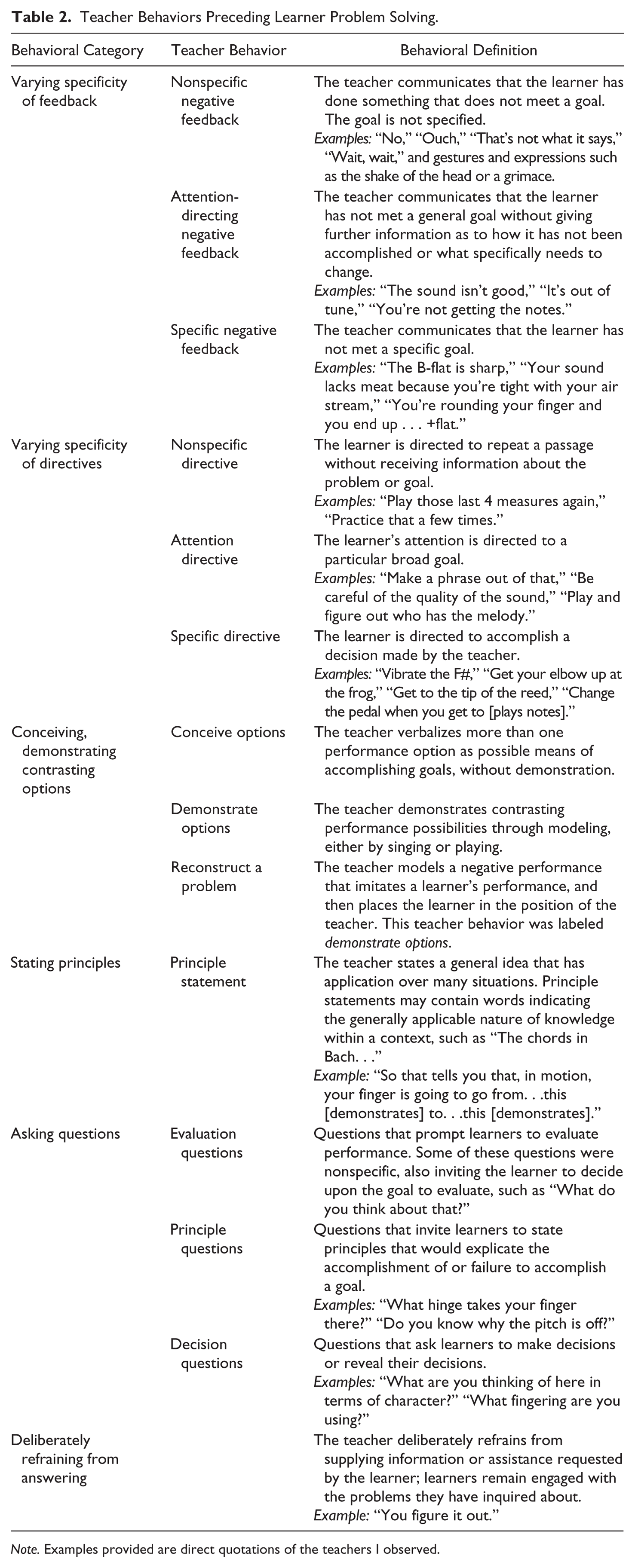
I found several identifiable teacher behaviors that preceded learners’ involvement in problem solving. Each of these teacher behaviors served the same general function: They each promoted learner participation in components of the problem-solving process by instigating or carrying on the pursuit of a goal while also “holding back” and inviting learners to participate in problem solving. I labeled these teacher behaviors in the following categories:
Varying specificity of directives
Varying specificity of feedback
Conceiving, demonstrating contrasting options
Stating principles
Asking questions that invite practice of problem-solving skills
Deliberately refraining from solving the problem for learners.
Behavioral definitions and examples of each of these teacher behaviors are reported in Table 2. For examples of these behaviors in context, see Rehearsal Frames 1 through 6. 4
Teacher Behaviors Preceding Learner Problem Solving.
Note. Examples provided are direct quotations of the teachers I observed.
Analysis 2: Learner Problem-Solving Behaviors Following Each Teacher Behavior
Once I established the behavioral definitions for teacher behaviors that preceded learner problem solving, I sought to identify patterns in learner problem solving that followed each specific teacher behavior.
Analysis 2 method
I identified the teacher behaviors within each of the 161 rehearsal frames. I totaled these teacher behaviors across all rehearsal frames, whether or not I observed learner problem solving following these behaviors. I then identified the learner problem-solving behaviors that followed each of the teacher behaviors when both the teacher behavior and learner behavior(s) occurred in relation to the same target. I then counted the number of learner problem-solving behaviors following each category of teacher behavior across all rehearsal frames.
Analysis 2 results
Table 3 presents instances of observable learner behaviors following the identified teacher behaviors in the rehearsal frames analyzed. The total number of each teacher behavior across all 161 rehearsal frames is in the leftmost column, ranging from 3 instances (Refraining From Answering) to 137 instances (Principle). The second column indicates the number of teacher behaviors in each category that were followed by examples of student problem solving, ranging from 3 instances (Refraining From Answering) to 45 (Demonstration of Options). The third column indicates the number of learner behaviors that followed each category of teacher behaviors. The remaining columns indicate the number of student problem-solving instances in each category of problem solving. The total number of learner problem-solving components observed was 374, ranging from 23 (Establish Goal) to 144 (Decide Action).
Number and Frequency of Learner Problem-Solving Behaviors Following Each Teacher Behavior Across 161 Rehearsal Frames.

Note. Numbers in parenthesis represent the frequency of learner problem-solving behaviors following each teacher behavior across 161 rehearsal frames. Frequencies were calculated by dividing the total number of learner problem-solving behaviors that followed each teacher behavior by the total number of occurrences of that teacher behavior in 161 rehearsal frames. Learner problem-solving behaviors include those that followed a given teacher behavior when both occurred in relation to the same goal. In a few instances, two or more teacher behaviors directly preceded learner problem solving; therefore, a given learner problem-solving behavior may be represented following more than one teacher behavior on the table.
I used these data to calculate the frequency at which individual learner problem-solving behaviors followed each teacher behavior (Table 3, in parentheses). Some teacher behaviors I identified were not always followed by learner problem-solving behaviors as often as for others (e.g., learners exhibited problem-solving activity after 13 of the 14 instances of nonspecific negative feedback I observed, compared with only 15 of 115 instances of specific negative feedback). I felt it was important to represent such a varied response within the data presented; therefore, I divided the total number of each learner problem-solving component behavior by the total instances of the defined teacher behavior, whether or not problem solving followed each instance. For example, learners were observed evaluating 19 total times following teachers’ demonstrations of options. I divided this number by the 116 total instances of teachers’ demonstrations of options across rehearsal frames to determine the frequency of learner behavior following each instance of this teacher behavior (in this case, .16 problem-solving behaviors per instance).
The extent of learner problem solving following given teacher behaviors differed depending on the teacher behavior. The greatest extent of learner problem solving was observed following instances of nonspecific feedback (2.79 problem-solving behaviors per instance), refraining from answering (2.33), nonspecific directives (2.25), and attention directives (2.12). Frequency of learner problem solving per instance of other teacher behaviors were as follows: attention-directing negative feedback (1.63), decision questions (1.58), principle questions (1.37), evaluation questions (1.36), demonstrations of options (0.48), principle statements (0.28), and specific negative feedback (0.22). It should also be noted, however, that the teacher behaviors that preceded the most learner problem-solving activity (e.g., nonspecific feedback and directives and refraining from answering) were far less frequent than were those teacher behaviors that preceded the least learner problem-solving activity (e.g., specific negative feedback and principle statements). Figure 2 is a graphical representation of these data.
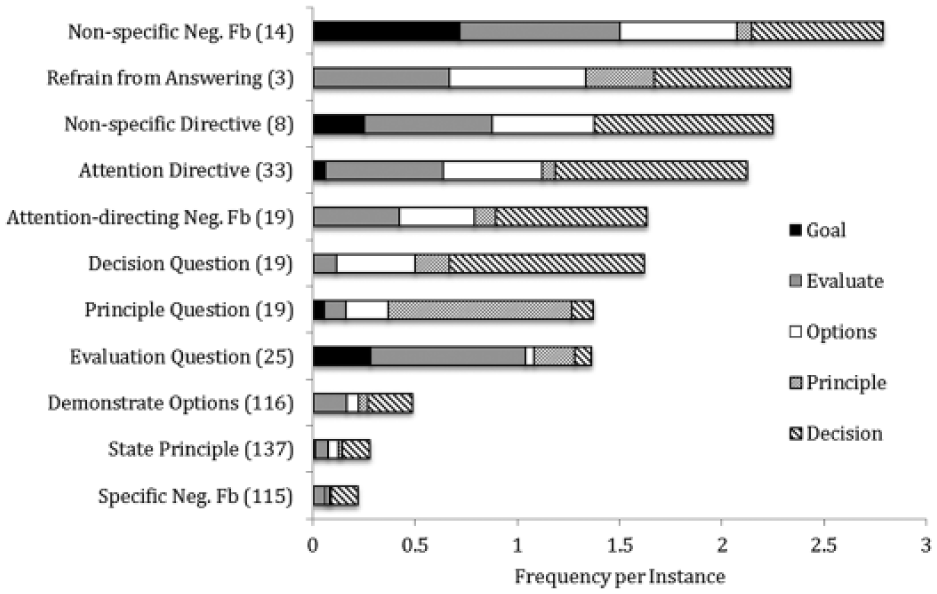
Frequency at Which Each Learner Problem-Solving Behavior Followed Each Teacher Behavior Across 161 Rehearsal Frames
Some teacher behaviors typically preceded a broader range of learner problem-solving behaviors than others. For example, nonspecific negative feedback and nonspecific directives were followed by a wide variety of learner problem-solving behaviors; at times I observed many in one rehearsal frame. On the other hand, decision questions were followed most frequently by learner decisions, sometimes accompanied by learners’ observable consideration of options, and rarely followed by evaluations and principle statements.
The student problem-solving behaviors that followed each teacher behavior varied; certain problem-solving behaviors tended to follow particular teacher behaviors. For example, I never or rarely observed learners establish goals after principle questions, decision questions, principle statements, or teachers’ demonstrations of options. On the other hand, learners established goals as frequently as other problem-solving behaviors following teachers’ nonspecific feedback.
Furthermore, the frequencies at which specific learner behaviors occurred following teacher behaviors also differed. Learners performed some behaviors at a frequency of nearly one problem-solving behavior per teacher behavior. For example, learners made decisions nearly every time they were given nonspecific directives or asked decision questions. Alternatively, although deciding on a course of action was the most prominent learner behavior following specific negative feedback, learners only made observable decisions following about one out of every eight instances of specific negative feedback.
Discussion
The present study revealed identifiable teacher behaviors that preceded learner problem solving: Teachers varied the specificity of feedback and directives, asked questions, stated principles, demonstrated contrasting options, and deliberately refrained from answering students’ questions. Some of these teacher behaviors, such as nonspecific feedback/directives and deliberately refraining from answering, preceded a higher number of learner problem-solving behaviors, on average, than did others. Furthermore, certain learner problem-solving behaviors commonly followed certain teacher behaviors. For example, I often observed learners considering options and making decisions following teacher decision questions, and I observed learners evaluating, generalizing principles, and making decisions following teachers’ demonstrations of options. I observed learners establishing goals only following nonspecific feedback, nonspecific directives, and nonspecific evaluation questions. Considering the importance of the selection of proximal and long-term performance targets in successful independent practice, this is an important finding that warrants further investigation.
Perhaps the most important contribution of this analysis is the illustration of how teachers can provide learners opportunities to practice components of problem solving. Learners were most involved in problem solving as these teachers did less for their students. By strategically doing less, teachers provided learners the opportunity to do more of what teachers do. This finding reflects similarities with the problem-based learning tutorial process, which includes the premise that teachers must essentially get out of the way and allow students to perform various problem-solving skills (Hmelo-Silver, 2004). Although there are differences between a true PBL setting and the setting I observed (e.g., students were not working in collaborative groups to solve problems their teachers had posed to them), many of the behaviors by teachers and students I observed align with the tenets of this approach. At times, teachers reconstructed problems and allowed students to figure out what was happening and why, or teachers encouraged learners to reflect and evaluate through questions. Although these teachers frequently provided knowledge in the form of principle statements to guide learners’ decision making (in contrast with PBL), they also provided opportunities for learners to construct knowledge on their own by encouraging them to answer their own questions. Further investigation is needed to determine expert teachers’ intentions with regard to developing learner independence, but it is compelling that all the students of all five teachers were observed participating in the process of problem solving.
Beyond similarities with PBL, these findings indicate that problem solving may be made possible for learners through a scaffolding process, thus bringing the skill of problem solving within students’ zones of proximal development (Vygotsky, 1978). Teachers can remove themselves from any one or more parts of the change-effecting process and give learners the opportunity to fill that role in lieu of the teacher. Thus, teachers may provide the means of isolating a particular aspect of problem solving in need of practice (e.g., evaluating) without burdening students with the cognitive load of the entire process. As teachers perform certain problem-solving component behaviors but not others, learners are prompted to perform the necessary behaviors to improve performance. For example, a teacher may establish goals, evaluate, and outline a principle for a student but then withhold any demonstration about how a passage should be executed, thereby allowing the student to make a decision based on the goal and principles outlined. It is in this way that these teachers not only bring about change in learners’ performance but also structure ways for students to practice bringing about change in their own performance. These examples demonstrate that teachers may have considerable influence over their students’ development of problem-solving skill if learners are invited to participate in the process while in their teachers’ presence.
It is conceivable that teacher education practice may also involve the training of problem solving for preservice teachers in a similar way. Teacher training could include a scaffolded means of involving aspiring teachers in problem solving during rehearsals. Perhaps the instructor may focus students on specific problem-solving components during peer-teaching activities or ask questions that promote problem-solving skills. As the teachers I observed placed their students in the position of the teacher by removing themselves from components of the teaching process, music teacher educators may similarly provide means for preservice teachers’ training in solving problems.
These observations elucidate ways in which teachers may overcome the inherent difficulties of training learners to solve problems independently. Teachers may be reluctant to turn over problem solving to learners due to limited instruction time or because of the difficulties learners often encounter with problem solving on their own. Learners’ attempts to solve problems are often unsuccessful or inefficient. Indeed, this analysis indicates that problem solving is a complex activity that may demand more of learners than teachers often anticipate. Despite its complexity, however, I observed teachers structure problems in ways that were tractable for learners. Instead of suddenly throwing students into the process of learning unassisted, the expert teachers I observed provided them with opportunities to do some part of the problem solving and musical decision making on their own. Such processes would seem to be appropriate and beneficial not only for collegiate musicians but for learners at all levels of musical skill (Bruner, 1977).
One of the most intriguing manifestations of this phenomenon was through variation in the specificity of teachers’ feedback and directives and learners’ concomitant involvement in problem solving. Commonly, specific feedback has been valued above nonspecific feedback as an effective teaching behavior (Biddlecombe, 2012; Nápoles & Bowers, 2010; Price & Yarbrough, 1993), and indeed, these five renowned teachers exhibited a high frequency of specific feedback, much more often than nonspecific feedback. However, nonspecific feedback and directives were also found among their repertoire of effective teaching strategies, suggesting a more nuanced understanding of the role of specificity in teaching. As Duke (2012) and Maxfield (2013) acknowledge, varying the type and amount of feedback given to students can enhance learning. As I have observed, appropriately decreasing the specificity of feedback and directives can serve to decrease learners’ dependence on teachers and may be utilized as a means of engaging students in problem solving while also maintaining a rapid instructional pace.
Although the teachers whose work I analyzed differ in their personal styles and approaches to their instruments, all consistently provided students opportunities to practice the components of problem solving. These teachers facilitated situations in which learners received opportunities to practice the skills needed to successfully teach themselves. 5 In many instances, the teachers in my sample demonstrated that they are all capable of solving problems more efficiently and effectively than learners are. At times, teachers explicitly carried out all components of problem solving, bringing about noticeable improvements in learners’ performances. But these teachers did not always solve problems for learners in this way; instead, they periodically, strategically withdrew themselves from part or all of the components of problem solving, allowing learners to do what the teachers did not do for them.
Learners’ eventual acquisition of problem-solving skill is not addressed in the present study. During some full-length lessons, however, I did observe a decrease in the teacher’s involvement and increase in the learner’s involvement even during the course of an hour (see Roesler, 2013). The means of obviating the teacher’s role over the long term could be a compelling topic for future investigation.
Teachers who wish to increase learners’ independence may consider providing opportunities for learners to bring about change in their own behavior during instruction time. Opportunities for learners to effect change occur when teachers strategically withhold instruction and allow learners to instruct themselves. As a teacher’s role decreases, a learner’s role may increase. Learners become their own teachers.
Footnotes
Declaration of Conflicting Interests
The author declared no potential conflicts of interest with respect to the research, authorship, and/or publication of this article.
Funding
The author received no financial support for the research, authorship, and/or publication of this article.

Notes
Author Biography
References
Supplementary Material
Please find the following supplemental material available below.
For Open Access articles published under a Creative Commons License, all supplemental material carries the same license as the article it is associated with.
For non-Open Access articles published, all supplemental material carries a non-exclusive license, and permission requests for re-use of supplemental material or any part of supplemental material shall be sent directly to the copyright owner as specified in the copyright notice associated with the article.
