



Abstract
The purpose of this study was to investigate the relationship between phonological awareness and music aptitude. I administered the Intermediate Measures of Music Audiation (IMMA) to second-grade students in a rural school in Pennsylvania (N = 17). Speech-language specialists administered a hearing screening and The Phonological Awareness Test 2 (PAT-2) individually to participants and scored the measures. Findings indicated a moderate, positive relationship between PAT-2 standardized composite scores and IMMA raw Tonal subtest scores (r = .485). A linear regression indicated IMMA raw Tonal subtest scores predicted PAT-2 standardized composite scores. The relationship between music aptitude and phonological awareness has implications for students, music teachers, and professionals who may remediate literacy skills, such as reading specialists, speech-language pathologists, and music therapists.
Students are expected to achieve literacy outcomes under the Common Core State Standards (National Governors Association Center for Best Practices & Council of Chief State School Officers, 2010). However, 31% of students do not read at the basic level by fourth grade (National Center for Education Statistics [NCES], 2015, p. 3), and only 36% of fourth-grade students read at or above the proficient level (NCES, 2015, p. 4). When students do not meet standards for reading, they may require one-on-one instruction (Elbaum, Vaughn, Hughes, & Moody, 2000) and, consequently, may be removed from typical classroom settings (Hurt, 2012). Although deficits in reading ability often manifest early in life, problems can persist into adolescence. These statistics are unsettling, and the need for a variety of effective strategies to assist students is clear.
Background
Reading development can be influenced by many factors, including language development, disability status, home literacy environment, and phonological awareness (Snow, Burns, Griffin, & Committee on the Prevention of Reading Difficulties in Young Children, 1998). Phonological awareness, considered a building block of reading (Bauman-Waengler, 2012), has been shown to correlate positively with reading acquisition (Ehri et al., 2001; Kleeck, Gillam, & McFadden, 1998; Torgesen et al., 2001; Wagner & Torgesen, 1987; Yeh & Connell, 2008; Yopp & Yopp, 2000) and is one of the best predictors of future reading success (Ehri et al., 2001; Yeh & Connell, 2008; Yopp & Yopp, 2000). Students with deficits in phonological awareness may be more likely to have reading deficits; a deficit in phonological awareness is a frequent and specific characteristic of reading disability (Morris et al., 1998, pp. 367-368).
Phonological Awareness
A person’s phonemic inventory begins developing before birth and is generally in place by age 7 (Bauman-Waengler, 2012). Phonological awareness, a type of phonological processing (Wagner & Torgesen, 1987), is a person’s ability to analyze and manipulate the sounds of language, including units within words and/or entire words (Degé & Schwarzer, 2011). Phonological awareness can be measured by a person’s ability to rhyme, segment, isolate, delete, substitute, and blend phonemes 1 and syllables (Frost & Katz, 1992, pp. 194-195; Robertson & Salter, 2007; Yeh & Connell, 2008; Yopp, 1988). Phonemic awareness is a feature of phonological awareness referring to the phoneme, or single sound, level (Bauman-Waengler, 2012). Through the elementary years, students with phonological deficits may be more resistant to phonological awareness training alone and may respond better to more complex treatments (Blachman, 1994). Previous researchers have demonstrated the relationship between phonological awareness and music aptitude, a cognitive variable that may be influenced up to age 9 (Gordon, 2012).
Music Aptitude
Aptitude generally is viewed as a person’s natural ability for a particular activity, feat, or endeavor; however, approaches to the understanding of music aptitude and its measurement vary (Gordon, 1986; Nardo & Reiterer, 2009; Stevens, 1987). Nichols (1999) defined aptitude as “a natural talent or ability; quickness in learning or understanding” (p. 15). Summarizing this sentiment, aptitude may be understood as a person’s natural ability to learn or understand something. Hence, music aptitude may affect how easily a student learns from and understands musical information. In discerning the differences between understandings of music aptitude, Nardo and Reiterer (2009) suggested music aptitude also may be understood as talent (preexisting ability). Stevens (1987) constructed a test of musical aptitude for young children and defined it as “potential talent in music” (p. 3). Gordon (2012), who also developed measures of music aptitude for children, defined it as “one’s potential to learn music” (p. 44).
Stevens’s (1987) and Gordon’s (2012) definitions share similarities. The word potential is included in both definitions, which is important because potential is “the capacity to be developed” (Nichols, 1999, p. 195). Both authors noted that potential can lead to high achievement, but they marked the difference between the two. Both recognized that music aptitude can improve through the early years of a student’s life and noted that one purpose of aptitude testing should be to individualize instruction for each child. Finally, both asserted a person’s music aptitude is determined by an ability to draw generalizations, which aligns with general understandings of intelligence outside the musical realm (Campione & Brown, 1978).
However, differences existed in how they approached the construct of music aptitude and its consequent measurement. While both indicated a window of development—recognizing the early years of a child’s life were important years for developing of music aptitude—Stevens (1987) was influenced by the assertion that music aptitude could stabilize around age 6 or 7, if not before. Drawing on previous research (e.g., Gordon, 1967; Stanton & Koerth, 1933; Wing, 1968), Gordon (1980, 1986, 2012) theorized that music aptitude stabilized at approximately age 9. Additionally, Stevens (1987) indicated music aptitude was determined by a person’s “ability to aurally perceive music” (p. 194). Gordon (2012) furthered this concept through his construct of audiation. Gordon (2012) stated that “audiation is the process of assimilating and comprehending . . . music momentarily heard performed or heard sometime in the past” (p. 3). Using audiation as a construct to be measured, Gordon sought to discover how well students understand and assign meaning to music. The ability to audiate is determined by music aptitude (Gordon, 2012). Hence, as a construct to be measured, music aptitude “is based on how well a person can draw generalizations from specific information and experience” (Gordon, 2012, p. 46).
Although music aptitude is not the sole determinant of final achievement, music aptitude can provide information regarding the person’s potential to achieve and ability to derive meaning from musical events (Gordon, 1986). Every person is born with a certain level of musical aptitude and potential to learn music, known as developmental musical aptitude. Developmental musical aptitude is “ever changing, moving up and down as it develops” (Gordon, 2012, p. 46). It can be influenced by outside factors, such as musical experiences, until age 9 and is stabilized thereafter.
Measuring music aptitude
Music aptitude is a construct not reliably observable but that can be operationalized and measured through the use of specialized tests. In the relevant literature, tests of music ability and/or music aptitude may include assessments that measure different dimensions of music, such as volume, pitch, duration, tempo, rhythm, harmony, melody, mode, meter, phrasing, or cadence. Test materials often are organized in terms of tonal (e.g., tonal, melody, harmony), rhythmic (e.g., tempo, rhythm, duration), and expressive (e.g., volume, phrasing) domains. To measure these musical constructs, test materials could contain questions about family background or personal interest in music, production/performance tasks (i.e., perform a musical example), discrimination tasks (i.e., indicate same/different), notation tasks (i.e., read notation and/or write from dictation), perception/awareness tasks (i.e., distinguish a characteristic and identify the difference between, e.g., higher/lower, louder/softer), preference tasks (i.e., indicate which is more pleasing/appropriate), or memory tasks (i.e., recall previously heard sounds) (Gordon, 1986; Nardo & Reiterer, 2009; Stevens, 1987).
Gordon’s interpretation of music aptitude and its measurement were chosen for this investigation for several reasons. Empirical evidence exists supporting Gordon’s conceptualizations of music aptitude and audiation (Gordon, 1967, 1975, 1981). Among the literature examined pertaining to the measurement of music aptitude and its relationship with phonological awareness, Gordon’s (1986) tests (Primary Measures of Music Audiation [PMMA] and Intermediate Measures of Music Audiation [IMMA]) were the most frequently used standardized measures of music aptitude. Furthermore, Gordon’s understanding of music aptitude pertains to deriving meaning from musical events based on analysis, which aligns with current understandings of phonological awareness based on a person’s ability to analyze the sounds of language. Therefore, a comparison of Gordon’s theory of music aptitude may relate to the construct of phonological awareness and provide useful insight into the relationship between the two.
Music Aptitude and Phonological Awareness
Music ability often encompasses a person’s current level of achievement (Gordon, 1986), and researchers have reported statistically significant correlations between musical abilities and phonological awareness in children ages approximately 3 years, 9 months, to 10 years, 1 month 2 (e.g., Anvari, Trainor, Woodside, & Levy, 2002; Bolduc & Montésinos-Gelet, 2005; Forgeard et al., 2008; Lamb & Gregory, 1993; Lathroum, 2011; Loui, Kroog, Zuk, Winner, & Schlaug, 2011; Moritz, Yampolsky, Papadelis, Thomson, & Wolf, 2013; Peynircioǧlu, Durgunoǧlu, & Öney-Küsefoǧlu, 2002). Some previous studies purporting to have measured a particular musical ability utilized standardized or researcher-designed tests of music aptitude to measure said abilities (e.g., rhythm skills, music perception, musical discrimination, pitch processing) rather than the construct of music aptitude. Because music aptitude is not synonymous with musical ability, it is not necessarily assessed in the same manner (Gordon, 1986). Although music aptitude tests may measure music ability/achievement to some degree under certain conditions (Gordon, 1986), utilizing measures intended to assess a construct different from the construct under investigation could make interpreting results problematic.
When measures of music aptitude were utilized in previous investigations employing correlational data analyses, researchers reported varied relationships among phonological awareness and musical domains. Relationships between phonological awareness and music aptitude were found when the tonal and rhythm domains were combined into a single variable (Lathroum, 2011; Peynircioǧlu et al., 2002; Rubinson, 2010). 3 Other researchers found relationships between phonological awareness and a single musical domain (Bolduc & Montésinos-Gelet, 2005; Forgeard et al., 2008; Moritz et al., 2013). 4 Bolduc and Montésinos-Gelet (2005) reported a correlation between phonological awareness and the tonal domain only, finding no significant correlation with the rhythm domain. Conversely, Moritz et al. (2013) identified relationships between phonological awareness and the rhythm domain; the tonal domain was not measured. Researchers also have reported that both the tonal and rhythm domains correlated with phonological awareness separately (Forgeard et al., 2008; Lathroum, 2011; Rubinson, 2010). Yet, results of studies reporting correlations between phonological awareness and both musical domains separately have indicated tonal relationships were stronger (Forgeard et al., 2008; Rubinson, 2010).
Of the investigations previously discussed, four utilized the PMMA or IMMA to examine relationships with phonological awareness. Findings from these studies indicate that music aptitude, as determined by these tests, has a relationship with phonological awareness, with tonal relationships being more pronounced. Furthermore, these studies provide evidence supporting the relationship between music aptitude and the phonological tasks of initial sound fluency, segmentation (Rubinson, 2010), deletion (Forgeard et al., 2008), syllabic identification, and rhyming (Bolduc, 2008). Due to their direct connection to the concept under investigation, they are discussed in greater detail, highlighting the specific phonological tasks measured.
Rubinson (2010) found a relationship between PMMA composite scores and phonological awareness in kindergarten students (N = 62, mean age = 5 years, 5 months), as measured by initial sound (r = .39, p = .002) and phoneme segmentation (r = .323, p = .009) fluency. Rubinson (2010) also found relationships between phonological awareness scores and the Tonal and Rhythm subtests separately. Raw scores on the PMMA Tonal subtest correlated with initial sound (r = .37, p = .003) and phoneme segmentation (r = .32, p = .010) fluency. A significant correlation (p < .05) was also found between the PMMA Rhythm subtest and initial sound fluency (r = .31, p = .014).
Bolduc and Montésinos-Gelet (2005) reported a very strong correlation between PMMA Tonal subtest scores and phonological awareness among kindergarten students (N = 13, mean age = 5 years, 6 months; r = .975, p < .001). Bolduc (2008) reported that relationships with perceptive melodic tasks were most pronounced among syllabic and rhyme identification tasks. No significant correlation was found between phonological awareness and PMMA Rhythm subtest scores (r = –.072, p = .815). Researchers did not report comparing PMMA composite scores to phonological awareness scores.
In a longitudinal investigation, Forgeard et al. (2008) reported relationships between PMMA scores and phonemic awareness, as measured by deletion tasks among children (N = 44; mean age = 6 years, 6 months). At baseline, phonemic awareness correlated with both subtests after controlling for verbal IQ, age, and socioeconomic status (SES; ps < .01). After 31 months, improvement in phonemic awareness was not predicted by improvement in the PMMA Rhythm subtest but was predicted by PMMA Tonal subtest improvement (partial r2 = .09, p = .06), as measured by change scores. In another investigation, Forgeard et al. (2008) examined music discrimination and phonemic awareness among children diagnosed with dyslexia and above-average intelligence (N = 31, mean age = 10 years, 1 month). Musical discrimination, as measured by IMMA, correlated with phonemic awareness scores, and phonemic awareness was predicted by both the IMMA Tonal subtest (partial r2 = .12, p = .07) and the Rhythm subtest (partial r2 = .10, p = .10) after partialing out SES and age.
Music training also may be effective for helping improve phonological awareness. In addition to correlational designs, researchers have employed quasiexperimental and experimental designs to examine the effects of music on children’s phonological awareness. Typical music activities, such as singing or playing musical games, have been connected to improvement in phonological awareness among preschoolers (Degé & Schwarzer, 2011) and kindergarten students (Gromko, 2005; Moreno, Friesen, & Bialystok, 2011; Moritz et al., 2013; Richards, 2011). Music experiences also have been shown to help improve phonological awareness training when added to preliteracy or phonological programs for these age groups (Bolduc, 2009; Bolduc & Lefebvre, 2012; Colwell, 1988; Herrera, Lorenzo, Defior, Fernandez-Smith, & Costa-Giomi, 2011; Register, 2004; Walton, 2014).
Rationale
Previous research investigating music aptitude and phonological awareness varies greatly, and young children with developing phonological inventories often have been the focus of study. Differences among approaches may be due to the ways in which phonological awareness and music aptitude are defined and, consequently, measured. Although phonological awareness can be measured reliably in young children, including children younger than age 7 in studies requires careful consideration. Their phonological inventories may be less developed, which could lend to imprecise measurement if appropriate procedures are not followed. Additionally, improvement in phonological awareness may be easier to achieve due to natural developmental processes.
Although previous investigations have utilized standardized measures, scores obtained from music aptitude measures were not consistently operationalized in these terms. Hence, I located only one study that measured both phonological awareness and music aptitude using standardized tests designed to measure the constructs reported (i.e., Rubinson, 2010). This study was completed with kindergarten students (mean age = 5 years, 5 months), whose phonological inventories and music aptitude are still developing (Bauman-Waengler, 2012; Gordon, 2012). Still, no study was located that utilized standardized measures to examine the relationship between music aptitude and phonological awareness among students whose phonological inventories are more complete (age 7) and whose music aptitudes are still developing.
Demonstrating a positive relationship between developmental music aptitude and phonological awareness in students whose phonological inventories are more nearly complete could serve several important functions. Through the elementary years, students with phonological deficits may be more resistant to phonological awareness training alone and may respond better to more complex treatments (Blachman, 1994). Music aptitude, a cognitive process that involves deriving meaning from musical events, still can be influenced by outside experiences until age 9. Moreno et al. (2009) found that music training enhanced the neural responses, as measured by event-related brain potentials, of 8-year-old children for both speech and music and indicated that musical training may help improve phonological representations. Hence, music aptitude is a cognitive variable that can be improved even after the phonological inventory is nearly complete, and the transfer effects of that training could have positive implications for students with phonological deficits (Moreno et al., 2009). Rather than being removed from typical classroom settings for individualized services, students could participate in group musical experiences that would improve phonological and musical domains simultaneously. Furthermore, this information could improve the educational experience for all students by promoting the need for more time spent improving music skills.
Purpose
The purpose of this study was to determine the nature of the relationship between phonological awareness and music aptitude. I also sought to examine whether musical aptitude can predict phonological awareness in second-grade students after ensuring normal hearing acuity. Given that IMMA scores have predicted phonological skills in a previous investigation (Forgeard et al., 2008), it is reasonable to assume that music aptitude could predict phonological awareness skills in the age group under investigation. Therefore, it is also expected that a reliable formula for predicting phonological awareness scores using IMMA scores can be determined. The questions that guided this study were as follows:
What is the nature of the relationship between phonological awareness and music aptitude?
Can potential to achieve in music predict phonological awareness achievement?
Method
Design
In this study I utilized a correlational design. Evidence was obtained from standardized measures of music aptitude and phonological awareness: IMMA (Gordon, 1986) and the Phonological Awareness Test 2 (PAT-2; Robertson & Salter, 2007). I also gathered demographic information to determine variance contributed and to define the sample further.
Participants
The sample comprised second-grade students enrolled in a charter school in rural Pennsylvania. All students in the two second-grade classrooms were invited to participate in the study (N = 28), and 18 students returned consent forms. One student was removed from the study because music aptitude data were not collected due to the student’s absence on testing days. Remaining participants (n = 17; 7 female, 10 male) were between 6 years, 9 months, and 8 years of age (M = 7 years, 5 months). Ten students were in Class A, and seven students were in Class B. Demographic information reported from guardians indicated all participants spoke English and no additional languages, were Caucasian non-Hispanic, and had no identified disabilities. Due to the homogeneity among the sample pertaining to languages spoken, race, ethnicity, and disability status, only the variables of sex and classroom teacher were examined to determine the amount of variance they contributed to IMMA and PAT-2 scores.
Instruments
I chose measures for hearing, phonological awareness, and music aptitude based on recommendations from speech-language pathologists and experts in children’s musical development. The use of standardized measures provides valid and reliable assessments of student performance and allows for interpretation compared to national norms and to results from previous studies.
Hearing screening
Hearing loss impacts the perception of speech and other sounds and could affect scores negatively on phonological awareness and musical aptitude tests, which require normal aural acuity. Speech-language professionals administered hearing screenings at the research site, following school parameters and those set by the Department of Health (2001). Each ear was tested individually, and a lack of participant response at any frequency in either ear would constitute a failure. All participants passed the hearing screening.
Phonological awareness
The PAT-2 was utilized as a measure of phonological awareness. Developed for children ages 5 to 9 (Grades K–4), the standardized measure of phonological awareness takes approximately 30 min to complete. Graduate students in speech-language pathology administered the six subtests (Rhyming, Segmentation, Isolation, Deletion, Substitution, and Blending), which contain 10 to 30 items each, to each participant on a one-to-one basis. To ensure reliability, the certified speech-language pathologist at the research site oversaw test administration and scoring. Standardized scores often are used to identify students with deficits and, therefore, were used in the present analysis. Standard scores provided in test materials range from 55 to 145 (M = 100, SD = 15).
Music aptitude
The IMMA was utilized as a standardized measure of developmental musical aptitude and is suitable for students in Grades 1 to 6 (Gordon, 1986, 2012). The IMMA utilizes same/different discrimination tasks in the tonal and rhythm domains and produces three scores: tonal, rhythm, and composite (the combined total of the Tonal and Rhythm subtests). Each subtest contains 40 items and the test takes approximately 40 min to complete in its entirety. Raw scores were used for analysis based on previous analyses (e.g., Rubinson, 2010) and recommendations in the test materials.
Demographic information
Guardians completed a questionnaire that was included with the consent form. Demographic information collected included classroom teacher, sex, age, ethnicity, race, languages spoken, and identified disabilities. In previous research, relationships between music aptitude/ability and phonological awareness remained present even after controlling for factors of age, SES, musical training, and/or intelligence (Forgeard et al., 2008; Loui et al., 2011; Moritz et al., 2013). Although music aptitude can be influenced by outside sources until age 9, understanding the factors that contribute to music aptitude was not an aim of this study. Therefore, demographic information regarding SES and previous music training was not collected.
Procedure
After approval from the appropriate institutional review board, second-grade classroom teachers distributed consent forms. The speech-language pathologist at the research site collected signed parental consent forms. Participants were pulled from general education classrooms to complete hearing screenings and phonological assessments on an individual, rolling basis as consent forms were returned.
The hearing screening and PAT-2 were administered by speech-language specialists within 1 month prior to IMMA testing and in accordance with standardized administration procedures. The last participant was tested 15 days after the first participant.
The IMMA was administered within 1 month of the phonological testing to each intact classroom, a time frame that follows precedents set in previous research (Lathroum, 2011). Test materials indicate that IMMA measures aptitude best when subtests are completed on separate days. Due to time constraints and scheduling at the research site, the primary researcher (a music specialist) administered both subtests on the same day. After the Tonal test, students participated in a short movement call-and-response activity for approximately 3 min before completing the Rhythm subtest. Otherwise, the IMMA was administered and scored in accordance with standardized procedures. Class A was tested prior to Class B, and students absent from Class A during the initial test were tested with Class B.
Data Analysis
The speech-language specialists scored the hearing screening (pass/fail) and the PAT-2. Standardized scores on subtests and a composite score were determined for each participant. The primary researcher scored the IMMA, yielding raw numerical scores for subtests and a composite score. In addition to participants’ materials, IMMA answer sheets for nonparticipants also were blind-scored by the primary researcher and were provided to the music teacher at the research site.
Data were analyzed using the Statistical Package for the Social Sciences (SPSS) software. All alphas were set to .05. I used t tests to examine mean differences between groups (i.e., sex, classroom) on measures of music aptitude and phonological awareness, and Pearson product-moment correlation coefficients to examine relationships among scores obtained from the IMMA and PAT-2 subtests and composite scores. Partial correlations also were computed, controlling for sex. Finally, I used a regression with IMMA scores to develop a mathematical model for predicting PAT-2 composite scores.
Results
Means, standard deviations, and ranges are reported in Table 1. All PAT-2 composite scores were within normal limits (85–115), and all subtest scores were within 2 standard deviations of the mean. With a skewness of −1.99 (SE = 0.55) and kurtosis of 5.16 (SE = 1.06), the Rhyming subtest was non-normally distributed. The Isolation subtest was also non-normally distributed, with a skewness of −1.24 (SE = .55) and kurtosis of 1.32 (SE = 1.06). The relatively high skewness and kurtosis may be related to the age of the sample. Such tasks are early developing phonological skills, typically in place before age 7 (Moats & Tolman, 2009). The IMMA scores were relatively low when compared to percentiles provided in test materials and met assumptions for normality.
Means, Standard Deviations, and Ranges.

Note: PAT-2 standardized M = 100, SD = 15. PAT-2 maximum possible represents 3 standard deviations above the mean noted in test materials. PAT-2 = Phonological Awareness Test 2; IMMA = Intermediate Measures of Music Audiation.
Classroom teacher and sex were examined to determine any relationships with the constructs. Because instruction is related to student achievement, comparisons between classroom teachers were considered; I found no differences between groups on either assessment. Although sex had not been reported as a significant contributor of variance in test materials, I examined sex to determine whether the sample exhibited similar characteristics. There were no significant differences between males and females (ps > .05) among PAT-2 scores. However, independent-samples t tests revealed mean differences between males and females on IMMA Rhythm subtest scores (t = 2.443, p = .028, df = 14.857, dCohen = −1.143) and IMMA composite scores (t = 2.750, p = .015, df = 15.000, dCohen = −1.266), favoring males. On the Rhythm subtest, males averaged 27.700 (n = 10; SD = 4.244) and females averaged 23.286 (n = 7; SD = 3.200). Among composite scores, males averaged 58.700 (n = 10; SD = 8.125), while females averaged 49.571 (n = 7; SD = 5.563). Although the difference approached statistical significance, a statistically significant difference was not found between Tonal subtest scores for males and females (p = .064).
Relationships among variables were determined using Pearson’s r and linear regressions. Pearson’s r revealed statistically significant relationships among subtests and composite scores. Table 2 provides a description of zero-order correlations, and Supplemental Table S1 (available with the online version of this article) provides correlations among all variables. I found positive, significant relationships between scores on the following: PAT-2 Rhyming subtest and IMMA Tonal subtest (r = .549, p = .022), PAT-2 Rhyming subtest and IMMA composite (r = .483, p = .050), PAT-2 Deletion subtest and IMMA Tonal subtest (r = .588, p = .013), and PAT-2 composite and IMMA Tonal subtest (r = .485, p = .048). Given that sex was associated with IMMA Rhythm and composite scores, partial correlations were run controlling for sex; a description is provided in Table 3. After controlling for sex, positive, significant relationships were revealed between scores on the PAT-2 and IMMA composite (rpartial = .508, p = .045, df = 14), as well as between scores on the PAT-2 Blending subtest and IMMA Tonal subtest (rpartial = .579, p = .019, df = 14). Additionally, the correlation between scores on the PAT-2 Deletion subtest and IMMA Tonal subtest was stronger when controlling for sex (rpartial = .650, p = .006, df = 14). Finally, a linear regression indicated IMMA Tonal subtest scores predicted PAT-2 composite scores, R2 = .236, F(1, 15) = 4.624, p = .048, SE = 6.560.
Correlations Among PAT-2 and IMMA Test Scores.
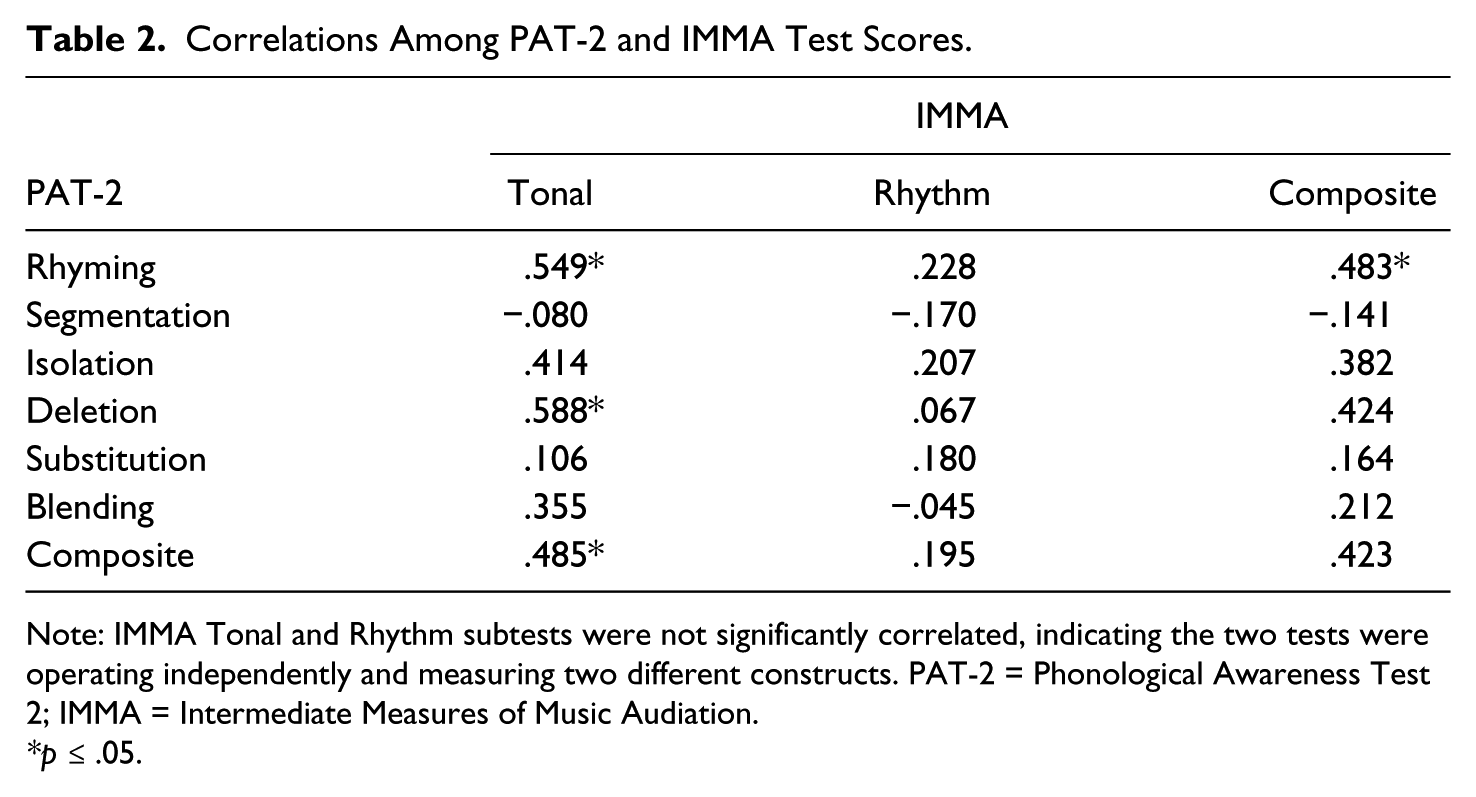
Note: IMMA Tonal and Rhythm subtests were not significantly correlated, indicating the two tests were operating independently and measuring two different constructs. PAT-2 = Phonological Awareness Test 2; IMMA = Intermediate Measures of Music Audiation.
p ≤ .05.
Partial Correlations Among PAT-2 and IMMA Test Scores, Controlling for Sex.
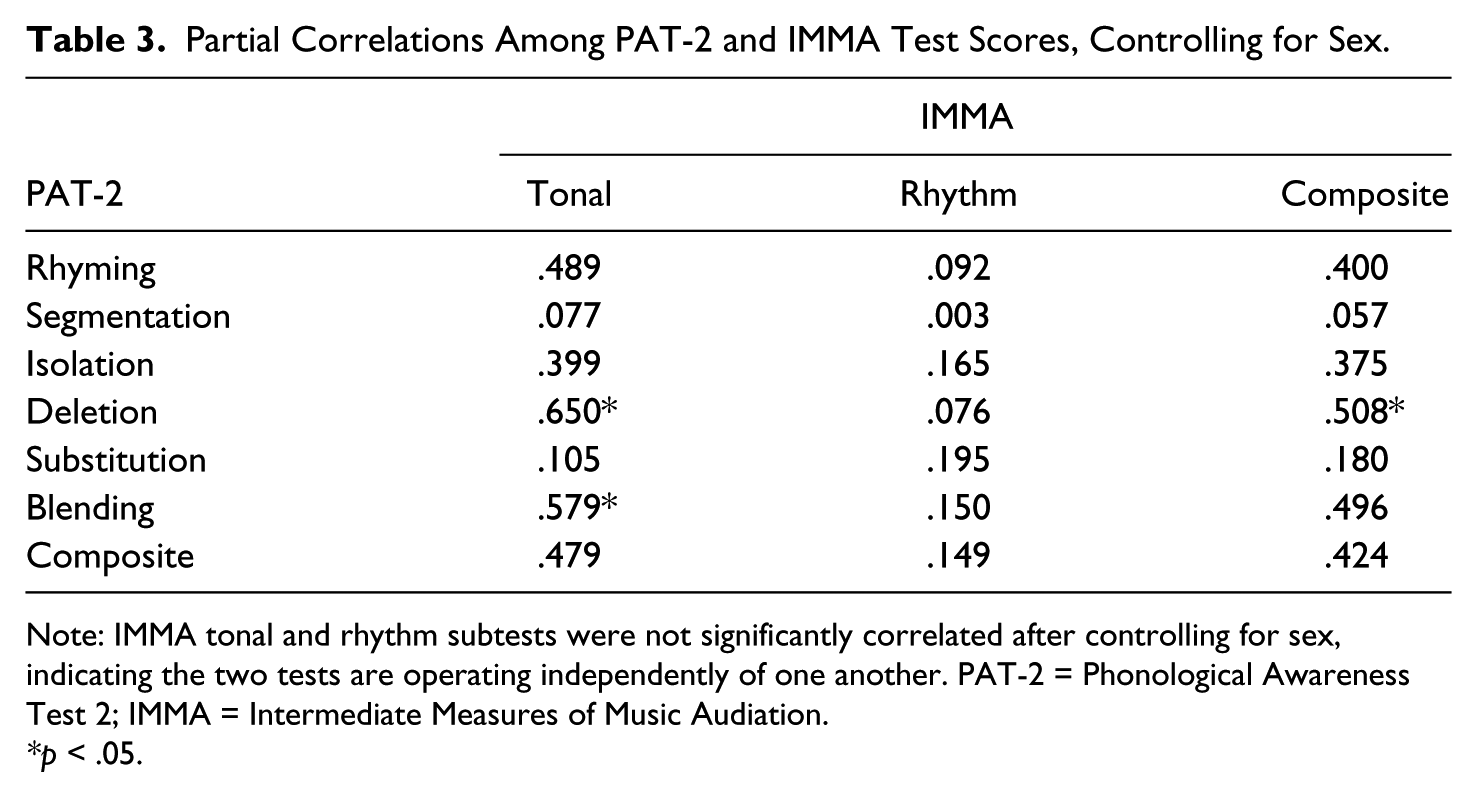
Note: IMMA tonal and rhythm subtests were not significantly correlated after controlling for sex, indicating the two tests are operating independently of one another. PAT-2 = Phonological Awareness Test 2; IMMA = Intermediate Measures of Music Audiation.
p < .05.
Discussion
Results of this investigation into the relationship between phonological awareness and music aptitude in second-grade students extend previous research. The positive, predictive relationship between tonal music aptitude scores and phonological awareness indicates that the relationship between the constructs may exist past first grade (age 6) for typically developing children (Bolduc & Montésinos-Gelet, 2005; Forgeard et al., 2008; Rubinson, 2010). Furthermore, the IMMA can help predict this relationship before age 10 (Forgeard et al., 2008).
Differences in music aptitude scores between sexes in the small sample may indicate that participants were not representative of the larger population and may be attributable to the small sample size. The IMMA test materials do not indicate sexes should be expected to score differently on the assessments, and Rubinson (2010) did not indicate a difference between sexes when measured at baselines (p. 91). However, drawing conclusions about the exceptionality of this finding is difficult because previous researchers did not report consistently whether differences were found between sexes. Yet, the effect of sex in the current sample attenuates the correlations, which could have been different and/or stronger in a sample where males and females performed similarly on all measures.
Findings from this study align with those from Bolduc and Montésinos-Gelet (2005), who found a significant relationship between phonological awareness and only the tonal domain of music aptitude. Like Bolduc and Montésinos-Gelet (2005), the present study did not find a significant relationship between the rhythm domain and phonological awareness. Furthermore, results align with previous studies reporting a relationship between phonological awareness and the tonal domain, separate from the rhythm domain (Bolduc & Montésinos-Gelet, 2005; Forgeard et al., 2008; Lathroum, 2011; Rubinson, 2010). A relationship between composite scores was not found, which does not align with findings of previous research studies (Lathroum, 2011; Peynircioǧlu et al., 2002; Rubinson, 2010). This study did not support the findings of research studies that found relationships between phonological awareness and the rhythm domain of music aptitude (Forgeard et al., 2008; Lathroum, 2011; Moritz et al., 2013; Rubinson, 2010). Overall, findings support the notion that phonological awareness may be associated more closely with the tonal domain rather than the rhythmic (Forgeard et al., 2008; Rubinson, 2010). Furthermore, findings support the assertion that music aptitude as measured by Gordon’s (1986) IMMA is related to phonological awareness, particularly, tonal aptitude (Forgeard et al., 2008). Studies that utilized Gordon’s measures did not consistently report relationships between phonological awareness and music aptitude composite (Bolduc & Montésinos-Gelet, 2005; Forgeard et al., 2008) or rhythm scores (Bolduc & Montésinos-Gelet, 2005). However, all previous investigations examined reported relationships between tonal aptitude and phonological awareness (Bolduc & Montésinos-Gelet, 2005; Forgeard et al., 2008; Rubinson, 2010).
Phonological Tasks
Findings of the current study align with previous research correlating Gordon’s measures of music aptitude with phonological rhyming and deletion tasks. Forgeard et al. (2008) also reported a positive relationship between deletion tasks and tonal music aptitude. The relationship between tonal music aptitude and rhyming was also found among kindergarten children (Bolduc, 2008). The present study supports and extends these previous findings by contributing evidence that composite (tonal and rhythm) music aptitude scores correlate with rhyming. Furthermore, the presence of this relationship in the current sample suggests the relationship persists over a period of years. Current findings do not align with Rubinson (2010), who reported a relationship between music aptitude and segmentation skills among kindergarteners. The level of segmentation skill measured could explain this discrepancy. Rubinson measured segmentation at one level (phoneme), where in the present study I measured three tasks (phoneme, syllable, and sentence).
Predictions
Predictions reported in the present study support and extend those reported by Forgeard et al. (2008), who found IMMA tonal and rhythm scores separately predicted phonemic awareness in participants approximately 10 years of age diagnosed with dyslexia. Current findings differ from those of Forgeard et al., because a predictive relationship was not found between phonological awareness and rhythm aptitude. In addition to participant age and characteristics, this could be explained because the significance threshold was more stringent in the current study than that of Forgeard et al. (p ≤ .1). For this reason, my findings also extend Forgeard et al.’s previous research by creating a prediction model using IMMA Tonal subtest scores with a more stringent significance threshold. Finally, in the current study I illuminated the presence of a predictive relationship between IMMA tonal scores and phonological awareness in typically developing children younger than those previously investigated.
Limitations
The limitations of the study are similar to limitations found in other studies utilizing small samples investigating relationships between phonological and musical domains (e.g., Bolduc & Montésinos-Gelet, 2005, N = 13; Lamb & Gregory, 1993, N = 18). The relatively small and homogenous sample, which was similar across several demographic variables, does not lend strongly to generalizability to the larger population. Additionally, administering both the Tonal and Rhythm subtests of the IMMA on the same day could have affected scores on the rhythm measure, as it was administered second.
Implications for Music Teaching and Learning
The relationships found between music aptitude and phonological awareness in the present study have implications for music teaching and learning. Results of this study could help support music teachers in allotting time for music aptitude testing. First, understanding a student’s developmental music aptitude can help music teachers tailor instruction (Gordon, 2012; Stevens, 1987) to help the student better achieve more appropriate musical goals and ultimately reach a higher stabilized music aptitude (Gordon, 1986, 2012). Higher levels of music aptitude can lead to greater musical achievement over the course of the student’s life. Second, the correlational nature of the relationship between the constructs indicates that a measure of tonal music aptitude could be useful when assessing phonological awareness abilities. Because students with low music aptitude also may have low phonological awareness, a tonal music aptitude score may assist in identifying children who may benefit most from additional musical and phonological assistance. In this way, the music teacher could gather valuable data to aid instruction in multiple areas.
Although previous researchers have indicated that music instruction naturally bolsters phonological awareness in young children (Degé & Schwarzer, 2011; Gromko, 2005; Moreno et al., 2011; Moritz et al., 2013; Richards, 2011), music teachers should continue to consider the connections between the two constructs when planning for instruction. Reading skills may be aided best by music experiences when phonological instruction is added to preexisting music curricula (Standley, 2008). Music teachers also should inform reading specialists, speech-language pathologists, music therapists, and other professionals who may remediate literacy skills about the positive effects of music experiences on phonological awareness development when added to phonological skill–building programs (Bolduc, 2009; Bolduc & Lefebvre, 2012; Colwell, 1988; Herrera et al., 2011; Register, 2004; Walton, 2014), because music added to other areas of students’ education can serve to improve their musical skills overall.
Implications for Future Research
Given the relationship identified in the present investigation, the need for future research is evident. Correlational studies investigating the relationship between music aptitude and phonological awareness establish links between the constructs but do not establish a causal relationship. Although evidence exists supporting the benefits of music instruction on phonological awareness, much research has been conducted with students below second grade. Therefore, experimental research designs should be used to examine how this relationship could serve to bolster phonological skills in naturalistic music environments for students this age and older.
Finally, this investigation has illuminated the need for the relationship between phonological awareness and music aptitude to be investigated in students with speech and language disabilities, particularly those students with phonological processing deficits. Previous research has revealed the relationship between music aptitude and phonological awareness in students with dyslexia (Forgeard et al., 2008), a learning disability that has been connected to deficits in phonological processing (Shaywitz & Shaywitz, 2005). Hence, future investigations should examine the relationship between music aptitude and phonological awareness in students with phonological processing deficits.
Conclusion
Phonological awareness is considered a building block of reading and one of the best predictors of future reading success (Ehri et al., 2001). Even though reading proficiency is the most fundamental skill to academic success (Lyon, Shaywitz, Shaywitz, & Chhabra, 2005, p. 209), deficits may go unnoticed until after first grade. When remediation is needed, elementary students may be removed from typical classrooms to receive additional support (Elbaum et al., 2000; Hurt, 2012). Previous researchers have demonstrated the relationship between music aptitude and phonological awareness in kindergarten children (Bolduc & Montésinos-Gelet, 2005; Rubinson, 2010) and the phonological benefits that can be realized by participating in musical activities for that age group (Gromko, 2005; Moreno et al., 2011). The relationships between music aptitude and phonological awareness found in the current study with second-grade students, when combined with previous evidence, provide support for students beyond kindergarten to participate in music classes, as both musical and language skills may be enhanced.
This study supports the notion that tonal music aptitude is a reliable predictor of phonological awareness abilities in second-grade students. Given previous findings supporting the efficacy of music in phonological training programs for students below second grade (Bolduc & Lefebvre, 2012; Herrera et al., 2011; Richards, 2011; Walton, 2014), the relationships found in the present study between tonal music aptitude and phonological rhyming and deletion tasks have implications. Using pitched activities during instruction targeting these phonological tasks could increase efficacy for students in second grade. Experimental research is needed to examine whether enhancing tonal music aptitude could help improve second-grade students’ abilities to execute these phonological tasks.
Due to the shared variance between phonological awareness and music aptitude, as well as previous research supporting the addition of music to preliteracy or phonological training programs, music teachers and reading specialists should consider the connections between the two constructs when planning for instruction. It may not be advantageous for students to be removed from music classrooms to work on phonological awareness skills. Music teachers may be able to build students’ musical skills in natural ways that bolster music aptitude, without adding specialized phonological training to help improve students’ phonological awareness. Reading teachers and specialists are encouraged to include music in their instruction, because music also may assist phonological awareness development in those settings.
Footnotes
Declaration of Conflicting Interests
The author declared no potential conflicts of interest with respect to the research, authorship, and/or publication of this article.
Funding
The author disclosed receipt of the following financial support for the research, authorship, and/or publication of this article: This research was supported by a Beels Dunikoski Grant for Graduate Research.
