




Abstract
With the intent of improving understanding of cuts to elementary arts programs, the purpose of this research was to investigate how one urban school district (Lansing School District in Lansing, Michigan) eliminated its elementary arts specialists. Research questions were (1) What policy conditions enabled the Lansing School District’s decision to cut its elementary arts specialists? and (2) How did the decision-making process unfold? This instrumental case study drew on policy analysis, and data sources included 18 interviews with former Lansing School District teachers, current employees, and community arts provider representatives as well as related documents and researcher memos. After coding for themes, I used the Advocacy Coalition Framework to organize findings by research question. Findings showed that a confluence of macro- and microlevel policy conditions enabled the cuts, including declining enrollment, budget problems, and a negative perception of elementary arts teachers facilitated by permissive teacher certification/assignment policies. Analysis also showed that the decision-making process was characterized by rival coalitions whose membership was defined by belief systems. Based on the findings, I offer critical reflection on a number of topics and offer general recommendations as well as implications for researchers.
Keywords
In March 2013, the Lansing School District (LSD) in Lansing, Michigan, reached a decision with its teachers’ union on a five-year contract. The district had been faced with a large budget deficit, and closing this gap would require layoffs or a sizable pay cut. After the negotiating team finished its work, educators in the district faced a stark choice: All teachers could either accept a 15% pay cut spread over three years, or they could agree to give up their daily planning time and receive a $5,000 stipend in return. A cut to planning time would effectively eliminate 80 teaching positions, including the entire elementary art and music teaching staff of 27 educators. With these teachers gone, the responsibility for elementary arts and physical education would fall to the classroom teachers. After a tense period of discussion, the voting results showed that over 80% of union members chose to maintain salaries and give up planning time.
The decision initiated a public debate, with local and national arts groups decrying the decision and the district countering that the arts programs had not been cut, merely redesigned and improved. Early communication from the district suggested the arts would now be contracted out to “community artists,” which surprised Lansing’s local arts organizations (Wells, 2013). Without notice to these arts groups, Lansing School District Superintendent Dr. Yvonne Caamal Canul suggested plans for future collaborations: “We kind of wanted to redesign the arts, music, and P.E. [physical education] program to bring in community expertise” (Li, 2013). A memo from the superintendent to staff from the same time echoed this purported partnership: “The district . . . will begin redesigning our arts and physical education programming efforts in grades K–5 so that there are high levels of inclusivity with the community” (Monday Morning Memo, March 25, 2013). Over the following summer, the district hired back 7 arts teachers (of the 27 laid off) as consultants to create lesson plans and give guidance to the classroom teachers who would now teach arts and physical education.
At first glance, this may seem to be a rather unremarkable instance. After all, curricular/personnel cuts in urban areas are not new or exceptional. As Roza (2010) suggested, “it is an annual ritual in many urban school districts these days: figuring out where to nip and tuck the budget and how to spread the pain” (p. 47). This also is not the only recent example of cuts to arts specialist positions in urban areas. High-profile cases of proposed or executed cuts include districts in Buffalo (Kingston, 2014), Milwaukee (Trafi-Prats & Woywod, 2013), and Los Angeles (Plummer, 2014). The Center for Arts Education (2013) reported an 18% reduction in certified arts teachers at the middle school level in New York City between 2004 and 2012. As an instrumental case study, however, the LSD’s decision provides a compelling example of how a confluence of factors can cause vulnerability for urban elementary school arts programs. Studying the Lansing School District provides insight into the questions that plague many urban school districts. These questions are timely in the sense that they reference recent policy developments and represent persistent issues of justice, equity, and stakeholder values.
Review of Selected Literature
Under No Child Left Behind (NCLB), curriculum was narrowed to focus more on tested subject matter. Because NCLB only mandated tests in math and reading in Grades 3 through 8 (and less frequently in science; U.S. Department of Education, n.d.), other subjects were somewhat ignored by comparison. Studies have documented reduced instructional time and resources for nontested subjects, with data on general narrowing culled from national surveys (Abril & Gault, 2006, 2008; Center on Education Policy, 2006, 2007, 2008), examinations of the School and Staffing Survey (SASS) data (Dee, Jacob, & Schwartz, 2013; Fitchett, Heafner, & Lambert, 2014), studies within states and large metropolitan areas (Gerrity, 2009; Jacob, 2005), and localized qualitative studies (Spohn, 2008; Watanabe, 2007). Researchers have also clarified specific accountability-related mechanisms for this narrowing. Because NCLB specified certain proficiency targets for schools (i.e., a percentage of the school must achieve a certain test score, also called “adequate yearly progress” or AYP), schools often responded strategically by focusing test prep efforts on the students most likely to help the school meet required goals. Booher-Jennings (2005) termed the practice of ignoring high and lower performers in favor of these students near the proficiency cutoff as educational triage. The triage practice seems to have become commonplace, with kids considered to be on the proficiency “bubble” taken out of art and music electives for extra practice in math and reading (Lipman, 2004; Rutledge & Neal, 2013).
Curriculum narrowing has been found to be concentrated in high-poverty, high-minority settings (Government Accountability Office, 2009; Parsad & Spiegelman, 2012). These schools often lacked the capacity to deal with accountability reforms (e.g., making AYP), resulting in extensive reallocation of resources toward testing and away from sequential, standards-based arts courses. Other recent reports have shown ties between low arts participation and race (Elpus, 2014; Rabkin & Hedberg, 2011; Salvador & Allegood, 2014), with authors calling this concentrated lack of access to enriched coursework an “educational apartheid” (Kozol, 2005).
As resources have been diverted to tested subject areas, the status of arts education in schools has also fundamentally shifted. Sequential standards-based arts education has been reshaped (or supplanted) by the arts integration movement and its related notion of “STEAM” curriculum (i.e., an integration of science, technology, engineering, arts, and mathematics). Additionally, numerous arts teaching positions have been eliminated in certain locations (Burrack, Payne, Bazan, & Hellman, 2014). In places where arts education programs have fundamentally shifted to embrace arts integration or in places where arts specialists have been eliminated, classroom generalists (i.e., primary school teachers without specialized arts backgrounds) have moved into arts instruction roles. Researchers, however, have long suggested that classroom teachers mostly lack the expertise, confidence, and/or interest necessary to teach the arts (Bresler, 1994; Byo, 1999; Colwell, 2008). As a result, arts instruction by these generalists is uniformly reported to be inconsistent, superficial, or nonexistent (LaJevic, 2013; Mishook & Kornhaber, 2006).
States differ in terms of policies governing arts teacher certification and mandated instructional time for the arts (Arts Education Partnership, 2014). As a result, access to high-quality arts instruction is decidedly local. Researchers have suggested that arts education programs require specific support from parents, administrators, and community members (Fields, 1982; Major, 2010, 2013; Schultz, 2006). Major (2010, 2013) presented a case study of a district in a suburb of Detroit, Michigan, that had not targeted its music programs when budget cuts had occurred. Through an analysis of district documents and interviews with administrators, Major found that decision makers spoke of a commitment to a well-rounded education. The decision makers considered their personal philosophies and values and demands of the students and parents in the community. Music students often sacrificed taking advanced placement courses to enroll in secondary music classes, which sent messages about the importance of these programs. Administrators also spoke of keeping music programs strong for fiscal reasons, including keeping students (and per-pupil funds) in the district, attracting new residents to the district, and the “bang for the buck” often offered by music programs (e.g., over 100 students in a marching band class).
The Present Study
Major’s (2010, 2013) study is one of only a few to address the decision-making process at the heart of a local arts education policy change. However, since the district in Major’s study maintained arts programming, these findings do not directly address the numerous cases in which dramatic cuts have occurred. Recent cuts to arts instructional time and teaching positions have been documented (e.g., Burrack et al., 2014), but few (if any) studies have addressed the policy conditions and actual decision-making processes surrounding such cuts. In the present study, I sought to understand how cuts were enacted in an urban district (Lansing School District) and illuminate gaps in the literature and inform stakeholders in their attempts to strengthen policy and local support for arts education.
With the intent of improving our understanding of cuts to elementary arts programs, the purpose of this research was to investigate how one urban school district cut its elementary arts specialists. The research questions were (1) What policy conditions enabled the Lansing School District’s decision to cut its elementary arts specialists? and (2) How did the decision-making process unfold?
Method
Design
This study drew on both case study design and policy analysis, functioning as an example of a “policy footprint” approach (McLaughlin, 1987), in which policy analysis uses a local instance to represent, as McLaughlin (1990) says, both macro perspectives and micro realities. First, case study design can be defined as “an intensive, holistic description and analysis of a single entity, phenomenon or social unit” (Merriam, 1988, p. 16). I chose to use a case study design to investigate the LSD’s decision so that I could engage in sustained, in-depth data collection and offer a rich description of these data (Creswell, 2009). In a complex and contested situation such as the one that is the focus of the present study, a case study allowed for a plurality of viewpoints (Stake, 1995, 2006). This case study was intended to be instrumental in its design (Stake, 1995), using the nuances of the LSD situation to focus attention on the phenomenon of cuts to urban school district elementary arts programs.
Second, because this study was concerned with the genesis of a local-level policy regarding the delivery of elementary arts education, I also used policy formation analysis to structure the inquiry. I drew on an accepted policy formation conceptual framework, Sabatier and Jenkins-Smith’s (1993) Advocacy Coalition Framework (ACF; see Figure 1 for a pictorial representation of the framework model). I chose the ACF because it focuses on how policies are formulated by coalitions of like-minded actors. As shown in Figure 1, a policy subsystem (defined by coalitions) interfaces with long-term (“relatively stable parameters”) and more sudden forces (“external events”) to advance policy agendas. While the ACF has been most frequently used to provide a means for understanding large-scale policy developments (e.g., national air transportation policy), researchers also have used it in smaller scale analysis of educational contexts (see Houlihan & Green, 2006; Stout & Stevens, 2000).
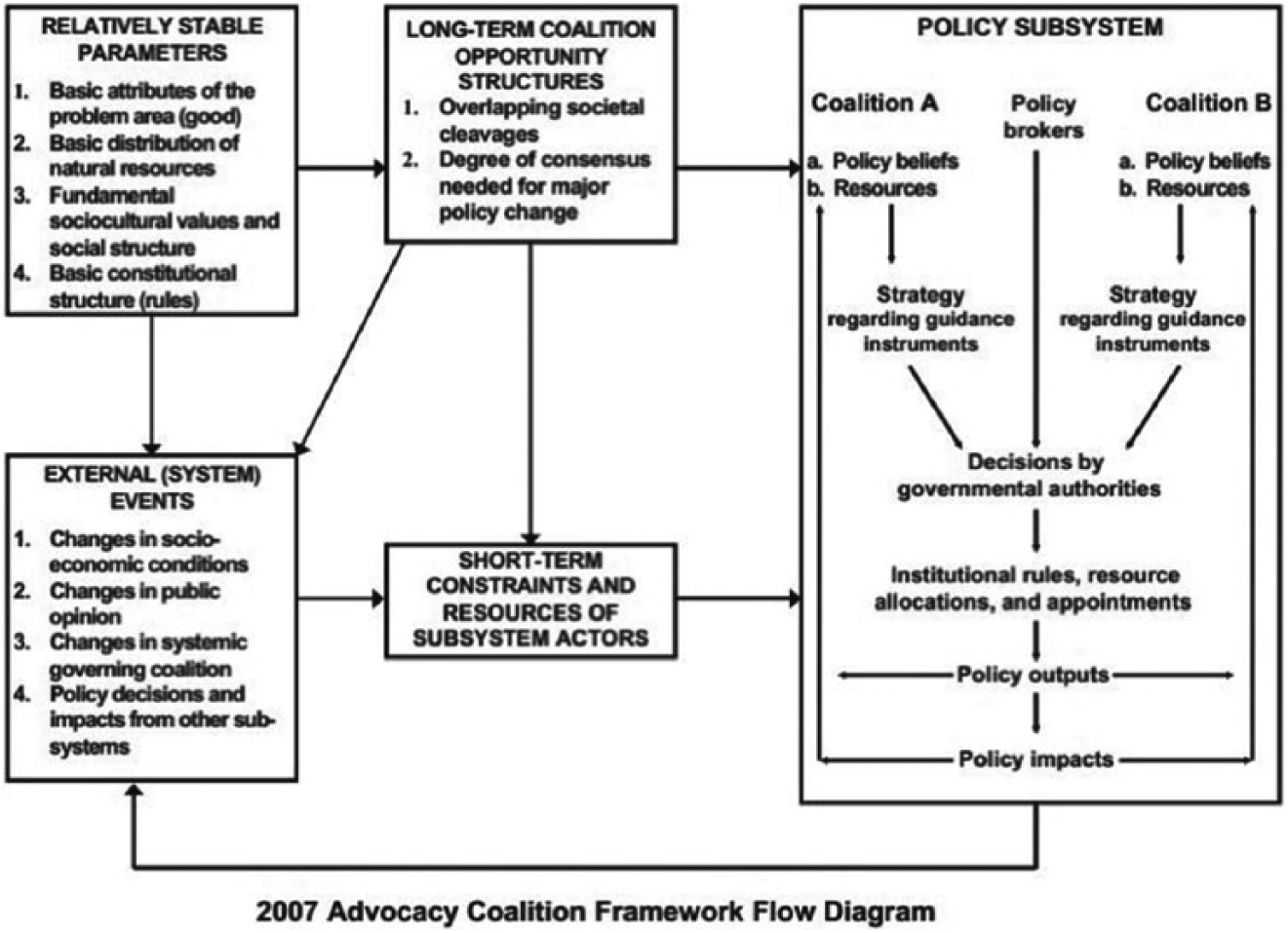
Advocacy Coalition Framework Flow Diagram From Sabatier (2007) (reprinted with permission).
Description of Research Site
This study used purposeful sampling to select an “information rich case” from which “one can learn a great deal about issues of central importance” (Patton, 2014, p. 230). Spanning around 35 square miles, the city of Lansing houses state government buildings, two law schools, four hospitals, and a community college. Lansing is also adjacent to East Lansing, which houses Michigan State University. The Lansing School District faces challenges of student poverty and changing demographics caused by post–World War II “white flight” and subsequent decades of desegregation orders and school choice laws (Sturm, 2002; Wisenbaker, 1976). See Table S1 (in the online version of the article) for information about Lansing’s demographics and district information.
Several issues factored into the decision to identify the district instead of using a pseudonym. First, because the goal of the research was to understand particular circumstances that influence urban arts education cuts, I had to consider and explain specific state policy and local school district conditions. I felt that any attempt to not identify the particular school district would harm the readers’ ability to adequately interpret the findings. Second, because one of my research questions focused on coalition behaviors surrounding the decision-making process, I needed to analyze how various actors used policy imaging (i.e., rhetoric) to frame outcomes. This necessitated an analysis of news sources and public quotations, which could not be rendered anonymous.
Researcher Lens
I approached this study both with connections to the research site and some notable distance. I grew up less than an hour from Lansing and formerly taught public school music nearby. Most significantly, at the time of researching and writing this study, I was a graduate student at Michigan State University. Not only was the Lansing School District located less than five miles away from where I went every day to learn, work, and teach, I also supervised an intern teacher in Lansing’s Eastern High School. All of these factors brought immediacy to the site and research topic, and this proximity to the topic potentially lent insight and empathy to my research report. However, it also is important to acknowledge the distance that exists between the researcher and the research site, participants, and phenomenon of interest. As a White, middle/upper-class doctoral student, I recognize that I lacked understanding about the culture, values, and priorities in the LSD. As a part of my identity, I carry power and privilege that may hinder my abilities to understand the topic of my research (Bradley, 2007). These issues notwithstanding, I believe that studies of contexts like the LSD should not be avoided due to issues of researcher privilege and unfamiliarity. Researchers must, however, engage in critical self-examination (Merriam, 2009). I attempted to ensure trustworthiness, addressing my positionality and potential biases by approaching interviews with a sense of “deliberate naïveté” (Kvale, 1996, p. 33), seeking disconfirming evidence, engaging in a peer audit of my initial analysis, and engaging participants in several member-checking processes (Lincoln & Guba, 1985).
Data Sources
Interviews
In total, I interviewed 18 people involved with Lansing’s decision, purposefully sampling (Patton, 2014) informants who were closely involved with and affected by aspects of Lansing’s policy decision. I bounded this to include (a) current LSD teachers, instructional support staff, administrators, and school board members; (b) music and art specialists who retired, moved to a different school district, or lost their jobs after the March 2013 decision; and (c) community arts providers who were engaged in conversations about providing arts instruction in LSD. Within this population, I built a list of potential participants from personal contacts, contacts provided by a colleague, and names found in news stories about the Lansing decision. As the research progressed, I also used snowball sampling (Patton, 2014) to find participants who were willing to speak on the issue. Interviews were semi-structured so that participants both could address similar topics and pursue topics of individual importance.
Secondary data sources
While interview transcripts formed the main data source, I studied related documents (school board meeting agendas and minutes, the Superintendent’s “Monday Memo” to LSD staff, the district’s monthly newsletter, human resources documents, materials from meetings of the Department of Innovative Arts and Fitness, lesson plans, and news articles about the LSD decision) and wrote researcher memos using these other sources as a means of triangulation.
Analysis
Interview transcripts resulted in 126 pages of single-spaced text. When reviewing individual interview transcripts, I first followed an eclectic coding method (Saldaña, 2013) that draws on multiple coding methodologies (e.g., values coding, in vivo coding, emotions coding). Based on ongoing reflection, comparison across the data set, and constant reference to the research questions, I then updated and revised my initial codes (Lincoln & Guba, 1985). I used code-mapping (Saldaña, 2013) to group codes into a list of subcategories and categories and then arranged these broader categories by research question. I also drew on the ACF (Sabatier & Jenkins-Smith, 1993) to help analyze the policy conditions that enabled the decision in the Lansing School District (Research Question 1) and the decision-making process (Research Question 2).
Findings
Policy Conditions in the Lansing School District
The ACF (Sabatier & Jenkins-Smith, 1993) seeks to explain policy formation by illuminating how a policy subsystem operates within larger external constraints (see Figure 1). The external constraints include “relatively stable parameters” and “sudden shocks” (Sabatier & Jenkins-Smith, 1993). While the differentiation between stable and sudden is not always clearly delineated, for the purposes of this analysis, I define relatively stable parameters as those participants described as long term or ongoing and/or those that seem to fit the ACF’s definition of being stable over time and demonstrating resistance to change (Weible, Sabatier, & McQueen, 2009). Stable policy conditions that contributed to Lansing’s decision to cut its elementary arts specialists include declining enrollment, budget problems, and the negative perception of art, music, and physical education (AMPE) teachers facilitated by the structural weakening of AMPE programs.
Declining enrollment and school choice
As discussed briefly in the description of the research site, declining enrollment had been a longtime problem for the Lansing School District. Participants told me that a major cause of the enrollment drop was Michigan’s school choice law. Michigan’s “school of choice” provision was enacted in 1996 as part of the State School Aid Act, and it allowed parents to send their students to out-of-district schools more easily (Sturm, 2002). While some states allow only intradistrict choice/open enrollment (i.e., families may only opt into schools within a given district), Michigan allows both intra- and interdistrict choice (Michigan Department of Education, 2013).
In the first six years of the school of choice law being in effect, the LSD lost around 1,200 students to other districts, which accounted for $6 million in budgetary losses (Sturm, 2002). In a March 2015 bond proposal presentation, the superintendent discussed updated numbers: Of the 19,277 students eligible for grades K–12, 7,637 students were choosing to go elsewhere (Caamal Canul, 2015). Discussing the declining enrollment, one former music teacher remarked,
[There’s been] just a mass exodus out of the urban area. Schools of choice killed Lansing. East Lansing, I believe, has 35% of their students that are school of choice. Where do they come from? Lansing schools. Those who are left anymore are the captive audience, people who can’t go anywhere else. (interview transcript, January 21, 2015)
Facilities issues and state aid decreases
In addition to the problems associated with declining student enrollment, the Lansing School District had seen the “relatively stable parameter” of financial problems affected by poor facilities, declining state aid revenues, and debt/credit problems. In terms of facilities, the LSD was faced with a combination of vacant, underused, and crumbling buildings. These capital improvement issues are problems for Lansing because of how Michigan’s school funding structure works. In 1994, when Michigan revamped its school aid structure, it directed most funds through the state (i.e., the school aid fund) but required that funds for facilities fall solely on local districts (Arsen, 2013; Davis & Arsen, 2008). Facilities issues are, of course, also related to enrollment. When buildings are old and in disrepair, it can be a factor in school choice decisions, making a district less attractive. Also, when enrollment declines steeply, as it has in the LSD, a district can be left with many underused or vacant properties that also cannot be maintained due to declining per-pupil funding (Arsen, 2013; Davis & Arsen, 2008).
While overall education funding has recently increased slightly in Michigan, these funds have largely gone toward employee retirement costs and have not staved off the financial hardships felt by districts like Lansing (Brush, 2014; Moody’s Investors Service, 2015). Several participants were quick to place the blame for the 2013 cuts squarely on the state’s lack of education funding. One former art teacher pointedly said, “It’s the state’s fault that that decision had to be made.” A current teacher agreed: “We did what we had to do to keep the district moving forward. . . . And whose fault is that? The district’s or the state? The teachers’ or the state?” (interview transcript, March 5, 2015).
Non-endorsed teachers placed in specialist roles
By far, the most commonly discussed factor enabling the cuts to specialist positions was the district’s practice of placing non-endorsed teachers into art, music, and physical education positions at the elementary level. Michigan’s elementary teachers were—in most situations—shown to be highly qualified by passing the MTTC Elementary Education Test (Test No. 103). Passing this test certifies the elementary teacher to teach “all subjects” after 2008 changes to preparation programs required generalists to take one or two courses in integrating performing and visual arts as part of their degree program (Michigan Department of Education, 2008). However, even though generalist teachers are certified in all subjects, official guidance clarified that these teachers “should not be assigned as a specialist in a program outside the self-contained classroom context” (Michigan Department of Education, 2008, p. 4)
Participants described to me how the teachers’ union (the Lansing Schools Education Association) had formally instituted the placement of classroom generalists in specialist positions in “layoff situations.” A former music teacher said, “In Lansing, there is contractual language that states that in a layoff situation, you don’t have to have a music certification to teach general music” (interview transcript, January 21, 2015). What began as a “letter of agreement” to this effect was later added as contractual language. This practice, which may have started out as a temporary way to avoid laying off all-subjects certified teachers, became common practice as the LSD was almost always in a “layoff situation.”
Specialists and classroom teachers agreed that as a result of this policy, the elementary arts instruction was uneven across the district. With around half of the AMPE department being non-endorsed at the time of the cuts, there were some teachers who were highly respected and many others who were regarded as incompetent. The incompetent teachers angered both specialists and classroom teachers, with specialists especially angry at how this poor instruction reflected on the AMPE department as a whole. One former music teacher remembered,
We had one music teacher in there who, for the first year, he taught the recorder the wrong way—he put the wrong hand in the wrong place, and whenever he wrote his [music] notes, he’d write ’em backwards, you know, which just infuriated me. (interview transcript, January 20, 2015)
Another participant echoed this same type of story: “God—there were people teaching music that could not even read music. Like, really? . . . I saw people teaching music that had the music book upside down. . . . Your sheet music—upside down!” (interview transcript, January 5, 2015).
Negative perception of elementary AMPE teachers and content areas
Participants consistently voiced that the LSD did not value the arts except as a means of providing planning time to other teachers. As a former music teacher put it, “Lansing never took the idea ‘art for art itself,’ they always did it, ‘Okay, this is just for planning time’” (interview transcript, January 20, 2015). Participants discussed feeling as though they were regarded as less important than classroom teachers. They perceived this attitude from some classroom teachers who would bring their classes to appointed art or music time late. One former art teacher said the classroom teachers in her building “considered the art program to be nothing, so they didn’t even bother to come if [they thought] what they were doing was more important than anything we were doing” (interview transcript, December 16, 2014).
Former arts teachers said that the lack of value on the arts was especially obvious because of how administrators and union leaders referred to the teachers and the AMPE department. I heard from several former teachers that they were often referred to as “planning time specialists” or “release time teachers,” implying that their purpose was purely to provide a break for, as my participants said, the “real teachers.” One former music teacher remembered being referred to as a “babysitter”:
The union president of the Lansing School Education Association at the time was in a meeting with all of the AMPE people. . . . But he said to all of us, he called us “release time specialists.” And there was a big uprising. People were very angry of course because we’re educators, we’re educators, and for somebody to be referred to in that matter was very degrading. And that was the breakdown—part of the beginning of the breakdown between—the relationship between the AMPE staff and the union. (interview transcript, January 6, 2015)
Coalitions and Interactions
In the Lansing decision, coalitions included the union leadership, district leadership, AMPE teachers, and non-AMPE teachers. As the ACF hypothesizes, coalitions come into being through grouping processes based on belief systems (Sabatier & Jenkins-Smith, 1993). In the case of the Lansing coalitions, these belief systems centered around beliefs on what should happen in the impending contract adoption (termed policy core beliefs). The coalitions clarified these policy core beliefs through a series of pivotal events that served as a means of policy-oriented learning (Sabatier & Jenkins-Smith, 1993). In this section, I discuss several coalition-building “events”: AMPE teachers hearing “whisperings” and “rumblings” about the possible cuts, negotiations between the union leadership and district leadership, and the union’s general membership meeting to announce the proposed cuts. I also report on the policy framing that followed the general membership meeting and subsequent contract ratification vote. See Figure 2 for a pictorial representation of the coalitions and their interactions.
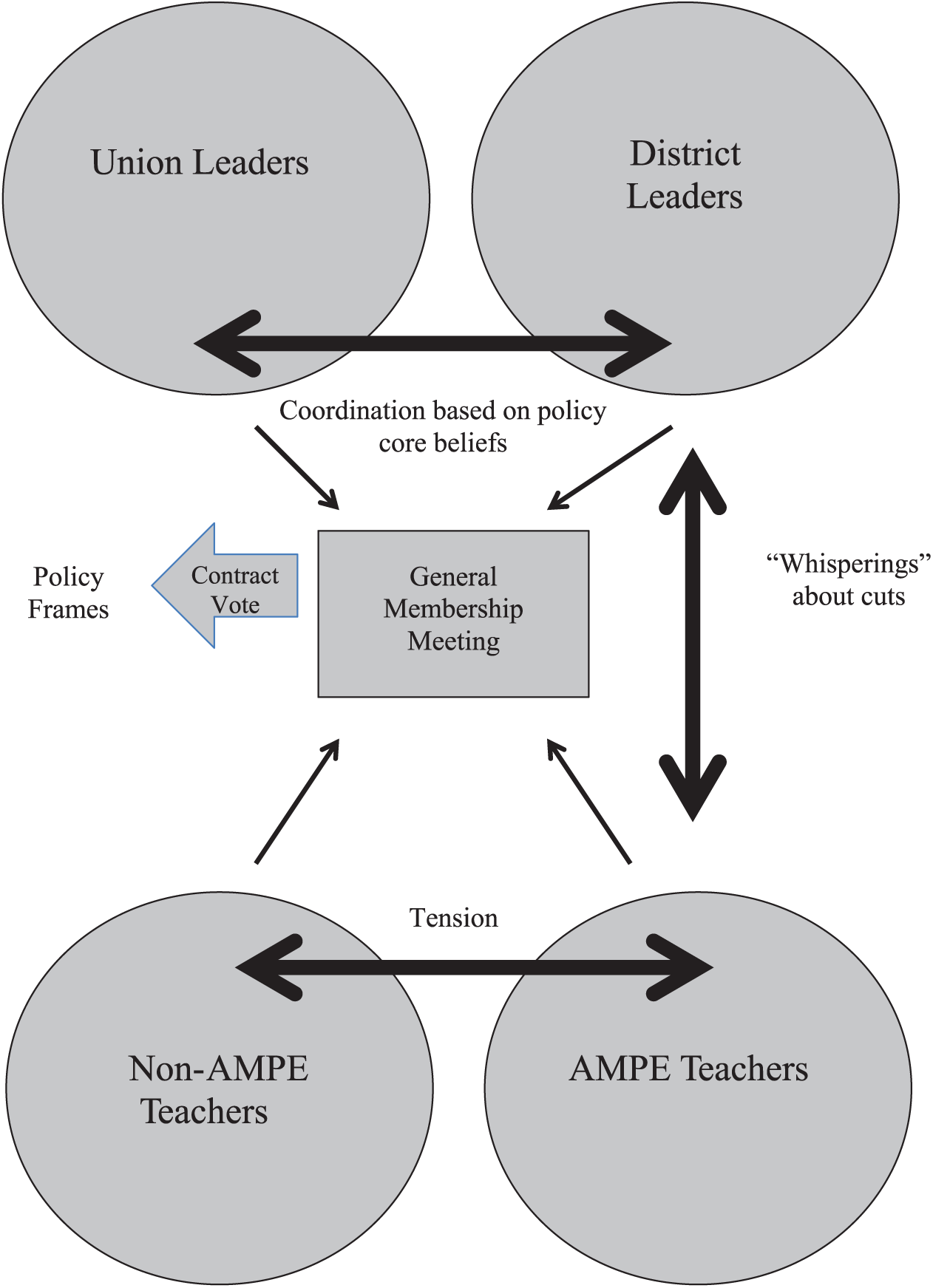
Coalitions and Interactions.
“Whisperings,” tension, and coordination
Former AMPE teachers with whom I spoke remembered how in the fall of 2012 an elementary principal gave them a “heads-up” that they would likely lose their jobs at the end of the year. The principal was upset with an AMPE teacher in his building who was delivering subpar instruction and was venting to other AMPE teachers at a steering committee meeting he was overseeing. He told the AMPE teachers that the administration had done an efficiency study to look at ways to save money, and as a former teacher recalled,
He said, “You better be looking for something, some other job, because the district did a study and they found it was cheaper to pay teachers comp time than to pay your salaries. They did the math.” And that was—that sent shock waves. (interview transcript, December 16, 2014)
Another former teacher described the principal as saying the district “could save a bunch of money” if they “cut the elementary art, music, P.E, and library too, and give everybody a stipend for losing their planning time” (interview transcript, March 16, 2015).
As shown in Figure 2, early interactions began to set up the coalitions as rivals in the policy subsystem (I use the darker arrows here to demonstrate the early stages of interaction). These “whisperings” began to make clear coalition positions and membership, setting up the district leadership in opposition to the AMPE teachers. As the AMPE teachers learned of the possible cuts, tension grew between AMPE and non-AMPE teachers. The non-AMPE teachers would soon have the power to keep or cut colleagues’ positions, and participants noted how this led to stress for both coalitions. Finally, the other early interaction shown in Figure 2 took place between the union leaders and district leaders. In these types of negotiations, small teams often meet together to work out details of a proposed contract, with each side taking opposing positions and working for compromise. However, the district leadership and union leadership ultimately seemed to do little negotiating and reached a consensus with an alacrity that startled many of the participants. The quick consensus on the two policy options that would be voted on at the general membership meeting—a pay cut or loss of planning time—led some to accuse the two coalitions of collusion.
The general membership meeting
One of the most discussed interactions between coalitions occurred at the union’s general membership meeting in early March 2013. The meeting was pivotal because it was the site of the bargaining team’s announcement of the two options it was bringing to its membership. At this meeting, the union leaders told members that they would soon vote to either accept a 5% pay cut each year for three years or eliminate planning time. For a number of participants, this meeting brought shock and disbelief. The AMPE teachers remembered texting each other angrily about the options being presented. Emotions ran high, with some teachers crying and others arguing with the union leadership. As the proposal was presented at the meeting, lines between the coalitions (and their desired policy actions) were further solidified. I put this meeting at the center of Figure 2 to portray its centrality in the coalition-forming process.
Several participants remembered how an AMPE teacher stood up and pointedly questioned the union leadership in an effort to clarify the impact of the cuts, making it clear “that cutting planning meant that there will be no more art, music, P.E. teachers” (interview transcript, January 21, 2015). This teacher also wanted the classroom teachers to realize they would be responsible for those subjects and that they would “have those dear children in [their] classroom 6½ hours a day with no breaks except for recess and lunch” (interview transcript, January 21, 2015). This former AMPE teacher remembered asking the union president to say exactly who would lose jobs and noted that it was difficult to speak pointedly without making an overly emotional appeal:
I tried to make it as not emotional as possible. I wanted to be very pragmatic about it. And I didn’t want to incense anyone—that was not ever my goal nor did I want to be perceived that way, as a rabble-rouser. I just wanted my colleagues to see the face of a person who was going to lose their job, whose household income is going to be cut in half. And I said, “Yeah, $5,000 for you guys is a cut, it’s a lot of money. But $57,000 for me is a lot more. So that’s my job that’s gone.” (interview transcript, January 21, 2015)
The teacher remembered that this protest at the meeting was met with “silence.” A lot of the non-AMPE teachers turned away to avoid eye contact.
Lack of a community/parent coalition
In describing the coalitions and the ways in which they interacted to refine their policy positions, one coalition that is conspicuously missing is a parental/community coalition. The lack of such a coalition was likely of significant importance for the final decision since vocal groups of parents and community members who rally behind school district causes can wield enormous influence. Several of the participants discussed how the absence of concerned citizens was a major problem. A former art teacher said, “Another issue is parents in the Lansing School District aren’t as collective in terms of coming to a school board meeting. We did have a couple people then but, you know, their concerns are greater than this” (interview transcript, January 5, 2015).
A former music teacher said that parents who were “left” in Lansing after years of declining enrollment did not care enough about the cuts (at the time) to mount a protest:
A big part of it is parents. Again, we’ve got the lowest common denominator left. The parents are not speaking up enough about this, because the parents who are left are, I perceive, the ones who don’t really care that much about it. But think about any other district. If you get parents to a school board meeting who are absolutely saying this cannot happen, they’re going to find a way to fix it. (interview transcript, January 21, 2015)
I also found that when a community arts provider coalition surfaced after the cuts were announced, its influence was hindered by internal disagreements. Local orchestras, art galleries, visiting artists, and Michigan State University representatives convened frequently in the summer after the cuts. But as they attempted to agree on their role in the district, disputes arose over whether to continue to provide services to the LSD. Some cultural groups felt that working with the LSD was tantamount to supplanting the teachers who were laid off, while others felt they were especially needed in the face of the cuts. Ultimately, the coalition splintered.
Policy Framing and Rhetoric
The ACF predicts that coalitions will seek to influence the public, the media, and other groups by intentionally framing policy issues in the way that is most advantageous to their desired outcome. This framing can occur in the buildup to policy change and may be a significant factor in moving a policy proposal to become noticed. Framing also may function as a strategy after a policy change has occurred as coalitions seek to shape subsequent action and debate (Sabatier & Jenkins-Smith, 1993). Analysis showed that after the contract vote to eliminate the AMPE teachers, each of the coalitions sought to frame the issue in specific ways. This process is represented in Figure 2.
Union leadership framing tactics
The union leadership seemed to use several framing tactics as it brought the proposal options to its general membership. The first of these was to frame the decision as taking a pay cut or being given a stipend to lose planning time—effectively ignoring the staffing cuts. While not characterizing the options presented as dishonest, participants felt the framing was used to intentionally obscure the resulting AMPE staffing cuts. Numerous participants expressed frustration at this “euphemistic” framing, with a former music teacher discussing the framing strategy:
The funny thing was they actually just talked about it as eliminating planning time. They rarely came out and said we’re cutting art, music, and P.E. “This is reduction of planning time.” That pissed me off. You can’t put that in there. That pissed me off to no other, because they weren’t actually talking about what it was, what the programmatic change was going to be here. They were trying to make it as euphemistic as possible. “We’re just going to give you some money to teach on your planning. That’s all it is.” (interview transcript, January 21, 2015)
AMPE teachers’ framing tactics
Analysis of how the AMPE teacher coalition framed the policy issue reveals several approaches. These teachers generally relied on the strategy of framing the issue in terms of opportunities for students and the long-term health of the district. This approach came through in the story of a former art teacher who brought an art student to speak out against the cuts at a school board meeting. The student expressed sadness at the loss of arts programming, as the teacher explained:
I brought [the student] to the board meeting to speak to the board. And ooh, that didn’t go over very well [laughs]. He stood up in front of the board. His parents brought him because they were very active about it. His parents brought him, and he got up to podium and bawled and bawled and said, “Please don’t cut these art programs. I don’t know what I would do without art on a weekly basis.” And he cried. (interview transcript, January 16, 2015).
AMPE teachers used this framing in their appeals to union leadership and the non-AMPE teachers ahead of the membership vote. They discussed cultural capital by noting how the cuts would take away “life possibilities” from students, and a former art teacher recalled telling other teachers that, “This isn’t about people, it’s about the students. It’s the program loss and what that means for these kids long-term, over time” (interview transcript, January 5, 2015).
District leadership’s public rhetoric
My analysis of LSD responses shows that the district attempted to frame the issue as a problem of poor teaching that needed to be solved. The district leadership then framed their proposed solution as superior and innovative. As they detailed how community arts providers would step in to fill the void left by the departing specialists, their public rhetoric drew the community arts provider coalition into the public debate over the issue. In sum, the cuts were framed as a win for the district. First, they called into question the AMPE teachers’ qualifications, noting that there were non-endorsed educators teaching these subjects. A news story from March 26, 2013, quotes the district spokesperson:
“We’re going to take some of these community arts programs and put them in schools, rather than have a lot of uncertified art, music, and P.E. teachers [italics added],” he says. Right now, only half the current art, music, and gym teachers are certified in those subjects, says Kolt [italics added]. (Wells, 2013)
Second, other framing positioned the AMPE program as being in need of redesign and students being in need of better teaching. Spokesperson Bob Kolt was quoted as saying,
“I think it’s an opportunity to reshape and enhance the arts [italics added],” Kolt said. “That’s how the Superintendent and the teachers looked at it.” . . . “The experience will not be replaced, it will just be a better product and learning opportunity [italics added],” he said. (Wittrock, 2013)
Third, the district leadership framed the new approach—several consultants, community arts providers, and classroom teachers handling arts instruction—as innovative. A news article quoted spokesperson Bob Kolt as saying, “What we’re doing is very exciting—there’s not a model that we’re looking at” (Lavey, 2013). The district followed this framing in its naming of the team of consultants who were hired to write lesson plans for elementary art, music, and physical education, calling it the “Department of Innovative Arts and Fitness.”
Discussion
The Advocacy Coalition Framework allowed for detailed analysis of how coalitions may relate to one another when arts education programs are at stake. As discussed, prior studies have documented cuts (Burrack et al., 2014; Schultz, 2006), and Major’s (2010, 2013) study analyzed stated reasons for maintaining programming (Major, 2010, 2013). In the present study, I chronicled the interaction of policy conditions with local coalition behaviors (e.g., grouping based on belief systems, policy-oriented learning, policy framing attempts), illuminating the process of negotiations surrounding cuts. One of the unexpected coalition interactions that emerged concerned unions and their goals. While one often expects teachers’ unions and district leadership to interact as rival coalitions, they instead engaged in what the ACF calls coalition coordination—an alignment of policy options designed to advance an agenda (Sabatier & Jenkins-Smith, 1993). To align and coordinate with the district leadership, the teachers’ union took a position that alienated a portion of its membership—here, the music, art, health, media specialists, and physical education teachers—leaving a relatively powerless group to fight for sequential arts instruction.
Even as participants pointed to the most immediate causes of the LSD cuts, one cannot reduce the discussion about Lansing to one that is only about budget problems or union politics. The underlying issues deserve critical appraisal, and I argue that it is impossible to understand the dynamics of the Lansing situation without addressing the role of class and capital. Class disparities made evident by comparing Lansing with surrounding districts point to troubling realities about inequity in schooling and the expectations for what urban schools provide. The inequity most evident in this situation is the lack of a challenging, intellectually rich, and well-rounded education, ignored in favor of “basic skills” and accompanying tests that drive recent accountability mandates (Kozol, 2005). There seems to be a feeling, expressed by some of the participants (though notably not by teachers), that districts serving lower class students simply cannot offer everything. One participant commented that districts have to decide whether to cut the arts or the school nurse and questioned why urban districts like Lansing should have to make this choice while middle- and upper class districts do not.
When problematizing the narrative of which schools are expected to provide which curricular offerings, it is difficult not to conclude that society is willing to withhold certain educative experiences from low socioeconomic status students. Justifying arts education cuts seems to suggest that until children in struggling urban schools can show proficiency on “basic skills” like reading and writing, urban districts cannot or should not begin to worry about well-rounded programs full of art, music, and physical education. With recent accountability systems (e.g., No Child Left Behind) requiring improvements in these basic subjects without necessarily “addressing the inequitable conditions under which children learn” (Noguera, 2007, p. 1), urban schools that lack resources and capacity for improvement can be further penalized. The more recently enacted Every Student Succeeds Act (ESSA) provides for more local flexibility in accountability but maintains NCLB’s testing regimen in a narrow range of subjects. Accountability of this kind can block access to intellectually rich and challenging curriculum. As I mention in the discussion of framing tactics, the AMPE teachers discussed this as an alarming example of denying Lansing students important cultural capital.
The relative inability of parents and community members to mount an effective opposition coalition is worth considering both in relation to social capital and deficit models. The lack of such a coalition was likely of considerable importance for the final decision since vocal groups of parents and community members who rally behind school district causes can wield enormous influence. Several participants were frustrated with the lack of parental uproar about the cuts, and their anger seemed to follow a popular complaint: that urban parents are not engaged in their children’s school and must not care. But the assumption that Lansing parents did not turn out in earnest opposition because they did not care is problematic, relies on deficit thinking, and ignores the numerous possible reasons for a lack of parental voice (e.g., not knowing details of meeting topic, time, and place; parents busy with work or child care commitments). Finally, it is also possible that certain parents—those for whom English is not a first language and those who are poor—may not feel comfortable speaking out in a public forum. In sum, parents could have sensed that they lacked the social capital and voice to be heard (Barnyak & McNelly, 2009).
One need not look far to understand the role that capital can play in mobilizing effective parental and community opposition to school district actions. There are numerous examples of parental/community coalitions forming to successfully delay or stave off cuts to music programs in more affluent, suburban communities. As an example, East Grand Rapids, a small, wealthy district an hour from Lansing, recently considered reducing its elementary “specials” classes (Moroney, 2015). In reaction, parents held yard sales and funneled donations through a foundation. About 60 community members marched in protest, and students and parents held signs that read: “Our Music, Art, & Gym Are Important” and “I Don’t Want a School Without Music or Gym and Art.” The response—including nearly $300,000 in funds raised—saved the classes (Moroney, 2015). The contrast between the responses in East Grand Rapids and Lansing could not be much more stark and speaks to the power of social capital and parent mobilization.
A rarely discussed issue central to the interpretation of these findings involves the relationship between a district’s arts education programs and school choice provisions. While research on exact reasons for pursuing school choice options is scarce (Schneider & Buckley, 2002), professed reasons for opting out of a district like Lansing are likely to include concerns over safety, graduation rates, and curricula (Sturm, 2002). Because public school districts in states like Michigan must compete with one another for students, they must consider these potential parental concerns. Unfortunately, competition and choice, when operating in the “marketplace” of public schools, does not necessarily lead to school districts automatically improving their safety, graduation rates, and curricula (Arsen & Ni, 2012). In sum, the competition caused by school choice can lead districts into difficult situations where they must attempt to improve—or appear to improve—even when they lack the tools necessary (Jabbar, 2015; Spillane & Diamond, 2004). As shown by the district’s efforts to frame positively their policy choices, competition without capacity may lead to a district engaging in “spin” about what it offers in terms of curricular offerings, speaking to the press with carefully crafted rhetoric, and evading tough questions about cuts. As shown in Lansing, the arts can become a part of a district’s marketing plans in times of competition and choice.
Implications and Recommendations
As exemplified by the case in Lansing, when facing difficult budgetary situations and mandated improvement on test scores in tested subjects, districts will respond rationally. Without strong arts education policy, arts curricula will be cut or “hollowed out” (Abril & Gault, 2006, 2008; Gerrity, 2009). Therefore, stronger policy language related to teacher certification is necessary. Specifically, arts education should be provided by teachers with subject-specific endorsements rather than “all-subjects” certifications. As with other certification provisions, there always will need to be flexibility for extraordinary situations, such as instances where geographically isolated districts cannot reasonably comply with such rules. However, such arrangements should be handled through a discretionary approval process.
Second, policy language concerning a guaranteed opportunity to learn in the arts is needed, specifically related to minimum contact time requirements for arts instruction. Forty-six states have already adopted some sort of K–5 arts instructional mandate, though these vary in specificity (Arts Education Partnership, 2014). The clearest mandate would specify that all students receive weekly instruction (or twice weekly) and also specify a minimum number of minutes per meeting (e.g., 30–45 minutes if twice weekly, 60 minutes if once weekly). In addition, policy makers should strengthen language on teacher certification. Though it is beyond the scope of this inquiry, I did gather data on the quality of the arts instruction performed by classroom generalists after the cuts. All participants interviewed reported that arts education by nonspecialists was either nonexistent, inconsistent, or of low integrity, mirroring past findings (Bresler, 1994; Byo, 1999; Colwell, 2008; LaJevic, 2013; Mishook & Kornhaber, 2006). Strengthening policy in the ways discussed would begin to ensure that all students see a qualified expert and are able to build skills and knowledge through sequential curriculum.
Finally, communities must understand the value of a proactive arts education coalition that stems from meaningful relationships. Without active relationships—between arts teachers and community arts groups, between arts teachers and district parents/booster groups—cuts like the ones in Lansing can be considered, voted on, and ratified before any substantial opposition is organized. In an urban district like Lansing where mobilizing parents proved difficult, community arts providers and surrounding cultural institutions may need to lead the coalition organizing. But parent booster groups should not be ignored, and elementary arts teachers should consider building and convening parent booster groups focused on advocacy (Elpus, 2007). Being proactive can be challenging since contract negotiations are not always transparent. However, public pressure seems to be an important strategy (Elpus, 2007).
Epilogue
After three years of working through myriad challenges associated with Lansing’s cuts, the district superintendent contacted professors from nearby Michigan State University to ask for help with reviving the elementary music program. The district is now in the middle of hiring back several music teachers, with the university working informally to find able candidates. Thus, the final implication is that situations surrounding cuts to arts education are likely to be fluid and changing. Researchers should continue to study how and why such cuts take place, and stakeholders should work to assess the health and support for local arts education programs.
Footnotes
Declaration of Conflicting Interests
The author declared no potential conflicts of interest with respect to the research, authorship, and/or publication of this article.
Funding
The author received no financial support for the research, authorship, and/or publication of this article.

Author Biography
References
Supplementary Material
Please find the following supplemental material available below.
For Open Access articles published under a Creative Commons License, all supplemental material carries the same license as the article it is associated with.
For non-Open Access articles published, all supplemental material carries a non-exclusive license, and permission requests for re-use of supplemental material or any part of supplemental material shall be sent directly to the copyright owner as specified in the copyright notice associated with the article.
