



Abstract
The purpose of this study was to test the domain specificity of achievement goals across music, visual art, and sports specializations, as measured by Elliot’s 2 × 2 achievement goal framework. Participants in the study were 103 volunteer student teachers from a teacher training institute in Singapore specializing in music, visual art, and physical education. Data were collected via self-report questionnaires that included measures of (a) the 2 × 2 achievement goal orientation constructs; (b) incremental and entity beliefs among the participants in music, visual art, and sports; and (c) participants’ enjoyment, perceived competence, effort, and tension while being engaged in music, visual art, and sports. MANOVA analyses indicated that (a) achievement goals are domain-specific and are highest in participants’ area of specialization; (b) implicit theories can be generalized across the three specializations, with higher incremental beliefs than entity beliefs reported across all specializations; and (c) enjoyment was highest for those who specialized in that particular area. Finally, mastery-approach goals positively predicted enjoyment in each specialization.
Keywords
Music, visual art, and sports are often incorporated into the school curriculum as part of a holistic approach to education. In the Southeast Asian city-state of Singapore, for example, these three subjects have played important roles in the education of its young since the early years of nationhood (Aplin, Kunalan, Tan, & Quek, 2010; Singapore Ministry of Education, 2010, 2014). Yet while research on achievement goal theory is well developed in traditionally academic domains (e.g., Van Yperen, Blaga, & Postmes, 2014), it is comparatively nascent in music and visual art. Furthermore, existing domain-specificity research is limited to either assessments of achievement goals in the music and sports domains separately (e.g., Duda, 1989; Miksza, Tan, & Dye, 2016; Schmidt, 2005; Smith, 2005) or the comparison of achievement goals in either music or sports to traditionally academic domains (e.g., Duda & Nicholls, 1992). The precise nature of how achievement goals work across music, visual art, and sports domains remain unclear. Would a child who is motivated toward music exert similar effort in visual art and sports? Can a band director infer from a child’s insecurity toward playing the clarinet that the child will be similarly insecure toward her ability to draw? These issues of domain-specificity are crucial both practically for the classroom and for research purposes in determining the levels at which motivational constructs can be validly assessed (Hornstra, van der Veen, & Peetsma, 2016).
In this present investigation, we examined domain specificity of achievement goals in music, visual art, and sports concurrently. More specifically, we focused on achievement goals of individuals focusing on a career in the music, visual art, and sport domains—samples who possessed highly specialized skills over a period of rigorous training and were exposed to the challenge of delivering their peak performances in competitions and other evaluative settings. They were examined based on their self-report levels of achievement goals (Elliot & McGregor, 2001; Wang, Biddle, & Elliot, 2007), implicit beliefs of intelligence (Biddle, Wang, Chatzisarantis, & Spray, 2003; Dweck, 1999; Wang & Biddle, 2001), and intrinsic motivation (McAuley, Duncan, & Tammen, 1989).
Achievement Goal Theory
Contemporary researchers studying motivation and performance in achievement contexts have adopted a social-cognitive perspective where achievement goals are perceived as purposes behind which individuals engage in competence behaviors (Nicholls, 1989). Although researchers have used different terminologies, two types of achievement goals in the form of goal orientations consistently emerge in this line of research: task and ego orientations. Nicholls (1989) posits the two types of goal orientations as ways of defining success. Specifically, task orientation is defined as the evaluation of one’s standard against an absolute benchmark. On the other hand, ego orientation is defined as the evaluation of what one is able to do against a normative standard that takes into account the performances of others (Nicholls, 1989). A central tenet of Nicholls’s achievement goal theory is based on differentiation of the conceptions of ability. In the undifferentiated conception, effort and ability are conflated where one achieves through increased effort and learning. In contrast, in the differentiated conception of ability, effort and ability are kept separate, such that a person is deemed to be able when higher performance is attained with the same amount of effort put in. Accordingly, task orientation follows the undifferentiated conception of ability, while ego orientation follows its differentiated counterpart.
Since the late 1990s, there have been new developments in achievement goal theory in which an approach-avoidance dimension was added to the traditional mastery-performance distinction (Elliot & McGregor, 2001). This led many researchers to reexamine the relationships between achievement goals, related outcomes, and consequences (e.g., Wang et al., 2007; Wang, Liu, Lochbaum, & Stevenson, 2009). In modern achievement goal theory, Elliot (2005) proposed to separate achievement goals from dispositional tendencies and reasons for engaging in various tasks. Elliot views achievement goals as “aims” toward which individuals strive and notes that this conceptualization is consistent with the “prototypical use of the term in the broader motivational literature, and it affords conceptual precision without, ultimately, sacrificing conceptual breadth” (p. 65). In his framework, perceived competence is seen as the antecedent of achievement goals. Competence can be defined as the standard for evaluating either mastery of the task itself in a self-referenced way (mastery) or when comparing against others’ performance (performance). It is also characterized by valence in that the focus is on a positive possibility (approach) or a negative possibility (avoidance). This resulted in the formulation of 2 × 2 achievement goals.
Mastery-approach goals focus on achieving task-based or intrapersonal competence. The aims include skill development, mastery of task, and self-improvement. Mastery-avoidance goals focus on avoiding task-based or intrapersonal incompetence, that is, to avoid not learning or not completing the task. Performance-approach goals focus on achieving normative competence, with the objective to perform better than others, win the competition, or show others that one is the best. Performance-avoidance goals focus on avoiding normative incompetence, with aims to avoid losing or performing badly compared to others. Interestingly, modern achievement goal theory does not assume that these various goals (i.e., performance-approach, performance-avoidance, mastery-approach, and mastery-avoidance) are mutually exclusive; rather, it recognizes that every individual will vary along each of these 2 × 2 dimensions. Furthermore, individuals can simultaneously have high (or low) levels of mastery and performance goals (Pintrich & Garcia, 1991).
Researchers have found evidence that these four goals predict different cognitions, affects, and outcomes. These four achievement goals reflect the personal perspective of motivation (Lau & Nie, 2008). Generally, mastery-approach and performance-approach goals contribute to positive affects and consequences, while mastery-avoidance and performance-avoidance goals predict and produce less adaptive motivational patterns (Elliot & McGregor, 2001; McGregor & Elliot, 2002; Rawsthorne & Elliot, 1999; Schmidt, 2005; Van Yperen et al., 2014; Wang et al., 2007). In particular, both mastery-approach and performance-approach goals have been found to positively relate to performance attainment (Baranik, Stanley, Bynum, & Lance, 2010).
Although limited in comparison to traditional academic and sports settings (e.g., Van Yperen et al., 2014), a number of key themes have been found in music research that pertain to achievement goal theory. These include positive relationships between mastery goal orientations and performance achievement among secondary band students (Miksza, 2009; Schmidt, 2005); positive associations between mastery-orientated motivational environment and social cohesion, collective efficacy, and task cohesion (Matthews & Kitsantas, 2007); and positive correlations between mastery-approach orientations and flow among band students (Miksza et al., 2016; Tan & Miksza, 2018). Taken together, the body of research indicates that music educators should seek to foster mastery-approach orientations among their students and create task- rather than performance-oriented teaching environments. Accordingly, music research on achievement goal theory remains a worthwhile and meaningful endeavor.
Implicit Theories of Intelligence
According to Dweck (1999) and her colleagues, humans hold entity and incremental implicit theories of intelligence. On the one hand, individuals who hold entity beliefs regard ability as being relatively fixed, innate, and unchangeable. On the other hand, individuals who endorse incremental beliefs view ability as being malleable and acquirable through effort and practice. Researchers have found significant relationships between learners’ theories of intelligence and their learning goals (e.g., Dweck, 1999; Mueller & Dweck, 1998; Smith, 2005). Learners who lean toward the entity theory of intelligence tend toward performance goals and often select easy tasks in order to avoid demonstrating their lack of ability. By contrast, those who hold an incremental theory of intelligence are more likely to choose challenging tasks as they focus their attention on increasing their ability; they also see mistakes as being integral to the learning process. Dweck has therefore proposed that implicit theories are the antecedents of achievement goals.
Intrinsic Motivation
Intrinsic motivation is defined as enjoyment of and interest in an activity for its own sake and is an important outcome of achievement goal theory and implicit theories (Cury, Elliot, Da Fonseca, & Moller, 2006). It is an important consideration when examining participation in challenging tasks that require sustained levels of effort, such as learning to perform music, draw, or engage in long physical activity programs (e.g., Stanko-Kaczmarek, 2012). When learners engage in activities for their own sake and intrinsic value, they may even enter into a phenomenological state of awareness known as “flow” (Csikszentmihalyi, 1990), an important psychological construct in sports and the arts (e.g., Miksza & Tan, 2015).
Scholars have proposed close conceptual links between achievement goals, implicit theories, and intrinsic motivation (e.g., Cury et al., 2006; Wang et al., 2009). In particular, the literature has generally established that entity beliefs predict performance goals, while incremental beliefs predict mastery goals. Mastery-approach goals positively predict intrinsic motivation, whereas mastery-avoidance and performance-avoidance goals undermine intrinsic motivation. Performance-approach and intrinsic motivation were not related (e.g., Biddle et al., 2003; Cury et al., 2006; Wang & Biddle, 2001; Wang et al., 2009). Figure S1 (in the online version of the article) shows the general associations of implicit theories, achievement goals, and intrinsic motivation.
Domain Specificity
The issue of whether achievement goals are generalizable across achievement domains is one that has generated considerable debate (Duda & Nicholls, 1992; Mischel, 1973; Van Yperen et al., 2014; Weiner, 1990). Broadly speaking, studies across the academic, music, and sports domains (e.g., Ames & Archer, 1988; Duda & Nicholls, 1992; Smith, 2005) have found that while task orientation is related to adaptive achievement strategies, ego orientation leads to maladaptive achievement strategies. In a meta-analysis of 98 studies across work, academic, and sports domains, Van Yperen et al. (2014) found that, on the whole, while approach goals (mastery or performance) were positively related to performance attainment, avoidance goals were negatively associated with performance attainment. However, achievement domain moderated these relationships. For example, in comparison to the academic or work domains, there were no negative relationships between avoidance goals and performance in the sports domain, indicating that associations between avoidance goals and performance work differently in sports compared to academic endeavors and work. Furthermore, relative to the academic and sports domains, the positive association between mastery-approach goals and performance attainment in the work domain appears strong. In other words, the positive relationship between mastery-approach and performance attainment is stronger among workers compared to students and athletes.
Researchers who have compared achievement goals between participants in music and sports have found notable differences between the two achievement domains. In a study by Lacaille, Whipple, and Koestner (2005), elite musicians and athletes were asked to recollect a “peak” and “catastrophic” performing event and recall their achievement goals prior to the event. While both groups reported mastery goals as being more prominent before the peak performance, musicians reported higher levels of performance goals (both approach and avoidance) than the athletes before the catastrophic performance, suggesting that musicians respond more negatively to performance goals than athletes. Although the findings among the athletes were in line with those in the academic domain in that a combination of mastery- and performance-approach goals were related to optimal performance, the results among the musicians indicated that performance goals were detrimental to musicians. The researchers proposed that this may be due to the fact that performing music inherently provokes anxiety, thereby rendering both performance-approach and performance-avoidance goals problematic. In a follow-up study with musicians, actors, and dancers, Lacaille, Koestner, and Gaudreau (2007) similarly found that performance goals have deleterious implications for performing artists. More specifically, performance-approach orientations related positively to performance anxiety, while performance-avoidance orientations were associated with intentions to quit. In light of these findings, the researchers proposed that learners in domains with high amounts of performance anxiety might benefit from focusing on the enjoyment of being thoroughly absorbed in an activity rather than achievement goals.
In a study involving university band students (non-music majors) from Singapore (n = 200) and the United States (n = 227), Tan and Miksza (2018) gathered data using a self-report questionnaire that included measures of achievement goal orientations toward band and participants’ academic majors. Contrary to previous research that found differences in motivational goal orientations between individualistic and collectivistic countries (e.g., Xiang, Lee, & Shen, 2001), no cross-cultural differences in participants’ motivational orientations were found, replicating the same unexpected findings from an earlier study involving high school and polytechnic band students from Singapore and the United States (Miksza et al., 2016). Based on the results from the two studies, the authors suggested that the ways in which achievement goals work in band and other large ensemble settings may be different from traditional academic or sports domains. What was particularly noteworthy about Tan and Miksza’s findings, however, was that participants from both countries reported being more motivated toward their major academic field than band, indicating that it is achievement domain rather than culture that accounted for motivational differences between the two samples.
Given the moderating potential of achievement domains noted previously, it is clear that there is a need to determine how and to what extent findings in one domain can be generalized to other domains. Comparisons across achievement domains remain relatively rare (Hulleman, Durik, Schweigert, & Harackiewicz, 2008; Van Yperen et al., 2014), as is achievement domain research that simultaneously investigates different subject areas. As far as can be determined, no studies have examined achievement goals across music, visual art, and sports domains concurrently. An understanding of how achievement goals work across these three domains is potentially illuminating as these domains require participants to possess highly specialized skills over a period of rigorous training. Students in these domains are also exposed to the challenge of delivering their peak performances in competitive and other evaluative settings. Given the relations between achievement goals, implicit theories, and intrinsic motivation as noted previously, it is also potentially instructive to examine how these constructs work across the three domains in relation to achievement goals.
Purpose
The purpose of this study was to examine the domain specificity (or lack thereof) of achievement goals across music, visual art, and sports specializations, as measured by Elliot’s 2 × 2 achievement goal framework. In addition, Dweck’s (1999) implicit theories of intelligence across the three domains were also examined. Finally, the outcomes associated with the achievement goals were examined using the intrinsic motivation indices (enjoyment, effort, competence, and tension). The specific research questions were: (1) Are achievement goals specific to each domain, or can they be generalized across music, sports, and visual art? (2) Are participants’ implicit theories specific to each domain, or can they be generalized across music, sports, and visual art? (3) What are the intrinsic motivation indicators of the participants in each specific domain? Can this be generalized? and (4) What are the relationships between achievement goals and intrinsic motivation indicators within each specialization? For the first three research questions, we hypothesized that achievement goals, implicit theories, and intrinsic motivation would be specific to each achievement domain. In particular, it seems reasonable to expect that students would report higher goals, implicit theories, and intrinsic motivation toward their own subject specialization. For the last research question, we hypothesized that only mastery-approach goals positively predict enjoyment within each domain.
Method
Participants and Procedures
Participants in the study were student teachers from a major teacher education institute in Singapore (N = 103). The sample consisted of 39 participants specializing in music, 30 specializing in visual art, and 34 specializing in physical education. There were 37 males and 66 females (M = 26.98 years, SD = 4.79). Ethical approval for this project was granted by the University’s Ethical Review Board. Following the IRB requirements, informed consent was collected from participants, and they were told that their participation was voluntary. Data were collected via a 40-item self-report questionnaire that consisted of items measuring 2 × 2 achievement goals, incremental and entity beliefs, and enjoyment, perceived competence, effort, and tension across music, visual art, or sports. That is, all participants completed the questionnaires across three domains. The questionnaires were administered in quiet classroom settings either at the beginning or the end of classes with the permission of the lecturers. The participants took about 20 to 30 minutes to complete the questionnaires. The participants were told that there were no right or wrong answers and that their responses would be kept confidential.
Measures
The 2 × 2 Achievement Goal Questionnaire
The students’ 2 × 2 achievement goal adoption in music, sports, and visual art were obtained using the 12-item Achievement Goal Questionnaire (AGQ; Wang et al., 2007). Participants were asked to respond to statements that represent types of goals they may or may not have for the three domains (music, sports, and visual arts) in general. There were four subscales with three items each: (a) mastery-approach (e.g., “It is important to me to perform as well as I possibly can”), (b) mastery-avoidance (e.g., “I worry that I may not perform as well as I possibly can”), (c) performance-approach (e.g., “It is important to me to do well as compared to others”), and (d) performance-avoidance (e.g., “I just want to avoid performing worse that others”). A 7-point Likert scale was used (1 = strongly disagree to 7 = strongly agree). The AGQ has only been used in the sport setting with satisfactory internal consistency. For example, in Wang et al.’s (2009) study, the alpha coefficients for mastery-approach, mastery-avoidance, performance-approach, and performance-avoidance were .83, .76, .85, and .70, respectively.
Implicit Theories
The Conception of the Nature of Athletic Ability Questionnaire II developed by Biddle and colleagues (2003) was adapted to examine the two beliefs, incremental and entity beliefs, among the participants in music, sports, and visual art. There were six items for incremental beliefs; for example, “You need to learn and to work hard to be good at music/sports/art” is an item for incremental; and six items for entity beliefs, for example, “You have a certain level of ability in music/sports/art, and you cannot really do much to change that level.” All responses were provided on 7-point Likert-type scales anchored by 1 (strongly disagree) and 5 (strongly agree). In Wang et al.’s (2009) study, the alpha coefficients for incremental and entity were .79 and .81, respectively.
Intrinsic Motivation Inventory
The Intrinsic Motivation Inventory (IMI; McAuley et al., 1989) is a multidimensional measurement device intended to assess participants’ subjective experience related to a target activity. The instrument assesses participants’ enjoyment, perceived competence, effort, and tension while performing a given activity. The enjoyment subscale is a measure of intrinsic motivation (e.g., “I usually enjoy playing sports”). Perceived competence was measured with five items (e.g., “I think I am pretty good at it”). The effort (e.g., “I put a lot of effort into it”) and tension (e.g., “I am anxious while working on it”) subscales consisted of three items each. Items were measured on a 7-point scale ranging from 1 (strongly disagree) to 7 (strongly agree). Past studies have reported high reliability for perceived competence (α = .90 in Wang et al., 2009), enjoyment (α = .93 in Wang et al., 2009), effort (α = .91 in Wang, Koh, Biddle, Liu, & Chye, 2011), and tension (α = .68 in McAuley et al., 1989).
Data Analysis
Before conducting the main analysis, preliminary analyses were conducted. These included missing data analysis and psychometric examination of the main measures. A total of nine confirmatory factor analyses (CFA) were conducted to examine the validity of the three main measures (2 × 2 achievement goal measure, implicit theories measure, and IMI) across the three domains (music, sports, and visual art) using Mplus 7.0 (Muthén & Muthén, 2012). There was evidence of multivariate non-normality in the distribution of the measures. Therefore, robust maximum likelihood estimation method was used in the CFAs. Model fit was evaluated using the following indices: Satorra-Bentler scaled chi-square statistics, the non-normed fit index (NNFI), the Comparative Fit Index (CFI), incremental fit index (IFI), and root mean square error of approximation (RMSEA). Chi-square and degree of freedom information will be presented but was not used in evaluating model fit given the size of the sample (see Kelloway, 1998). For the first three indices of model fit, values close to .90 indicate a good fit of the model. An RMSEA below .10 indicates a reasonable fit (Hu & Bentler, 1999).
We computed the internal reliability coefficients, means, and standard deviations of each of the variables using SPSS 23.0. Skewness and kurtosis of the variables were also examined, and there was no indication of univariate non-normality and outliers. To answer the first three research questions, three sets of one-way MANOVAs were conducted with the three specializations as independent variables. Box’s M tests were used to test the equality of variances across the groups. To avoid the issue of multicollinearity of the dependent variables in MANOVA, the analyses between groups for achievement goals, implicit theories, and IMI variables were conducted in separate MANOVAs (Tabachnick & Fidell, 2007). All the dependent variables were collapsed by constructs.
The first MANOVA was conducted with the 2 × 2 achievement goals (mastery-approach, mastery-avoidance, performance-approach, performance-avoidance) as dependent variables; the second MANOVA was conducted with implicit theories (incremental and entity) as the dependent variables; and the third MANOVA was done with the outcomes variables as dependent variables (enjoyment, competence, effort, and tension).
Follow-up ANOVAs were conducted after the MANOVAs to examine the differences between the three specializations in each of the dependent variables. Type I error was controlled using the Bonferroni procedure, and each ANOVA was tested at the .0125 level of significance.
To answer the last research question, we conducted a series of regressions to examine the relationships between the achievement goals and enjoyment within each domain. The four achievement goals were used as independent variables and enjoyment as the dependent variable.
Results
Table S1 (in the online version of the article) presents the results of the CFAs for the measures of achievement goals, implicit theories, and IMI across the three domains (music, sports, and visual art). The results showed that all the measures used in this study had adequate factorial validity.
Table 1 presents the internal reliability coefficients, means, and standard deviations of the achievement goals variables. All the assumptions of MANOVA were met. The results of the first MANOVA showed significant differences in the 2 × 2 achievement goals between the three specializations, Wilk’s Λ = .25, F(24, 158) = 6.59, p < .001, η2 = .50. Follow-up ANOVAs showed significant differences in all achievement goals, except in performance-approach goals in music and performance-avoidance in music, sports, and visual art (all p < .01). A consistent pattern was observed among the three specializations, that is, achievement goals were higher for students who specialized in that particular area: Music students scored higher in mastery-approach, mastery-avoidance, performance-approach, and performance-avoidance in music; sports students reported higher scores in mastery-approach, mastery-avoidance, performance-approach, and performance-avoidance in sports; and visual art students reported higher scores in mastery-approach, mastery-avoidance, performance-approach, and performance-avoidance in visual art compared to other specializations. The evidence suggests that achievement goals are specific to each domain and may not be generalized across the three domains. The group differences are showed in Table 1.
Descriptive Statistics and Group Differences of the Achievement Goals Measures.
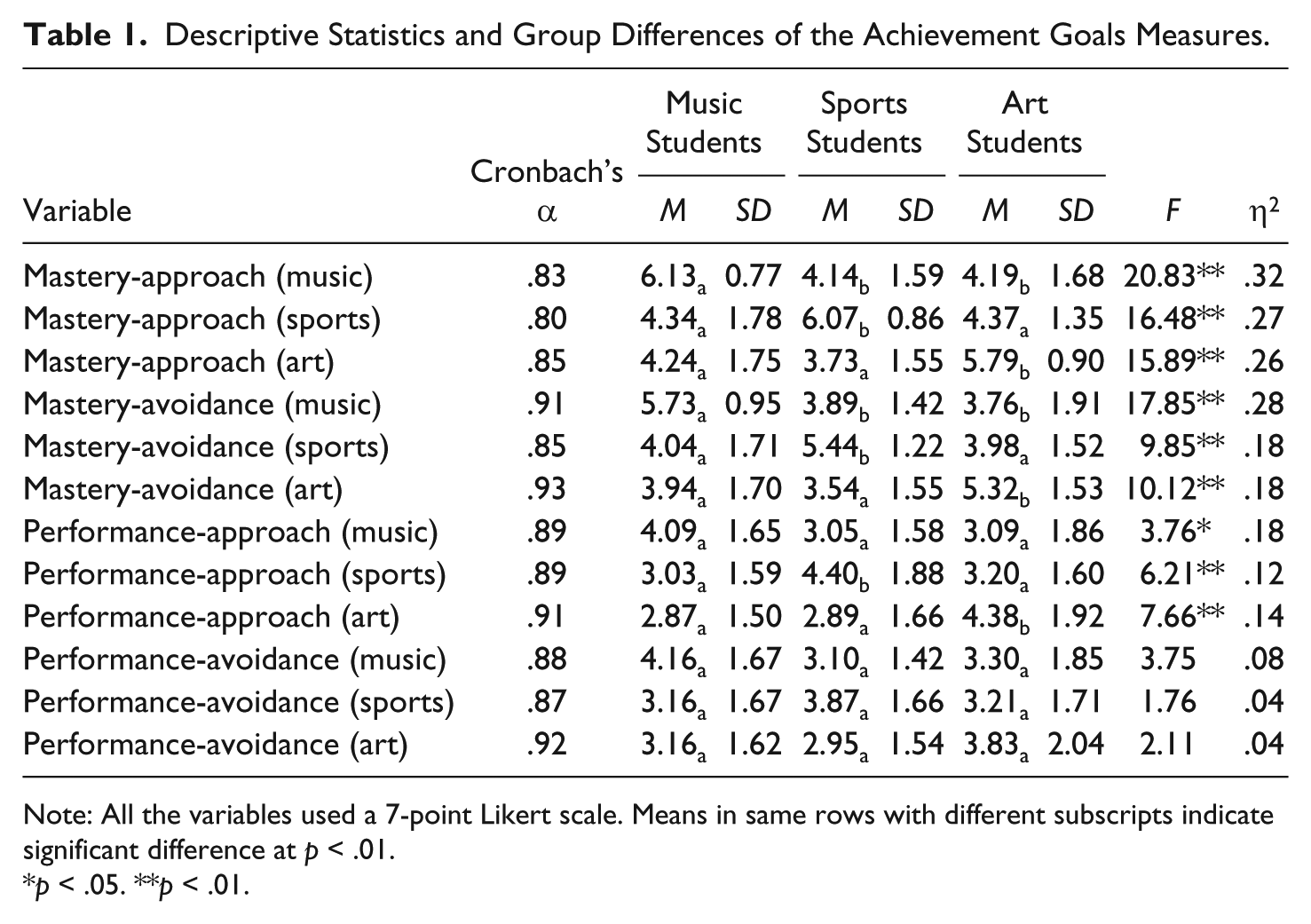
Note: All the variables used a 7-point Likert scale. Means in same rows with different subscripts indicate significant difference at p < .01.
p < .05. **p < .01.
The results of the second MANOVA showed significant differences in implicit theories among the three specializations, Wilk’s Λ = .54, F(12, 174) = 5.17, p < .001, η2 = .26. Follow-up ANOVAs showed that only incremental beliefs in sports had significant differences among the three specializations, F(2, 92) = 7.47, p < .001, η2 = .14. Post hoc pairwise comparison tests showed that incremental beliefs were highest for those who specialized in sports compared to those who specialized in music. Therefore, it is concluded that implicit theories may be generalized across the three specializations. In general, regardless of specializations, the students reported higher incremental beliefs than entity beliefs (see Table 2).
Descriptive Statistics and Group Differences of the Implicit Theories and Outcome Measures.

Note: All the variables used a 7-point Likert scale. Means in same rows with different subscripts indicate significant difference at p < .01.
p < .05. **p < .01.
The results of the last MANOVA found significant differences across the three groups in intrinsic motivation indicators, Wilk’s Λ = .12, F(24, 160) = 12.45, p < .001, η2 = .65. Follow-up ANOVAs showed that the three groups differed in enjoyment, competence, and effort exertion but not in tension. Post hoc Tukey’s tests showed that enjoyment was highest for those who specialized in that particular area, that is, music specialization students rated the highest scores for enjoyment in music, sports specialists rated the highest scores for enjoyment in sports, and visual art students rated the highest scores for enjoyment in visual art. This is the same for competence and effort exertion (see Table 2).
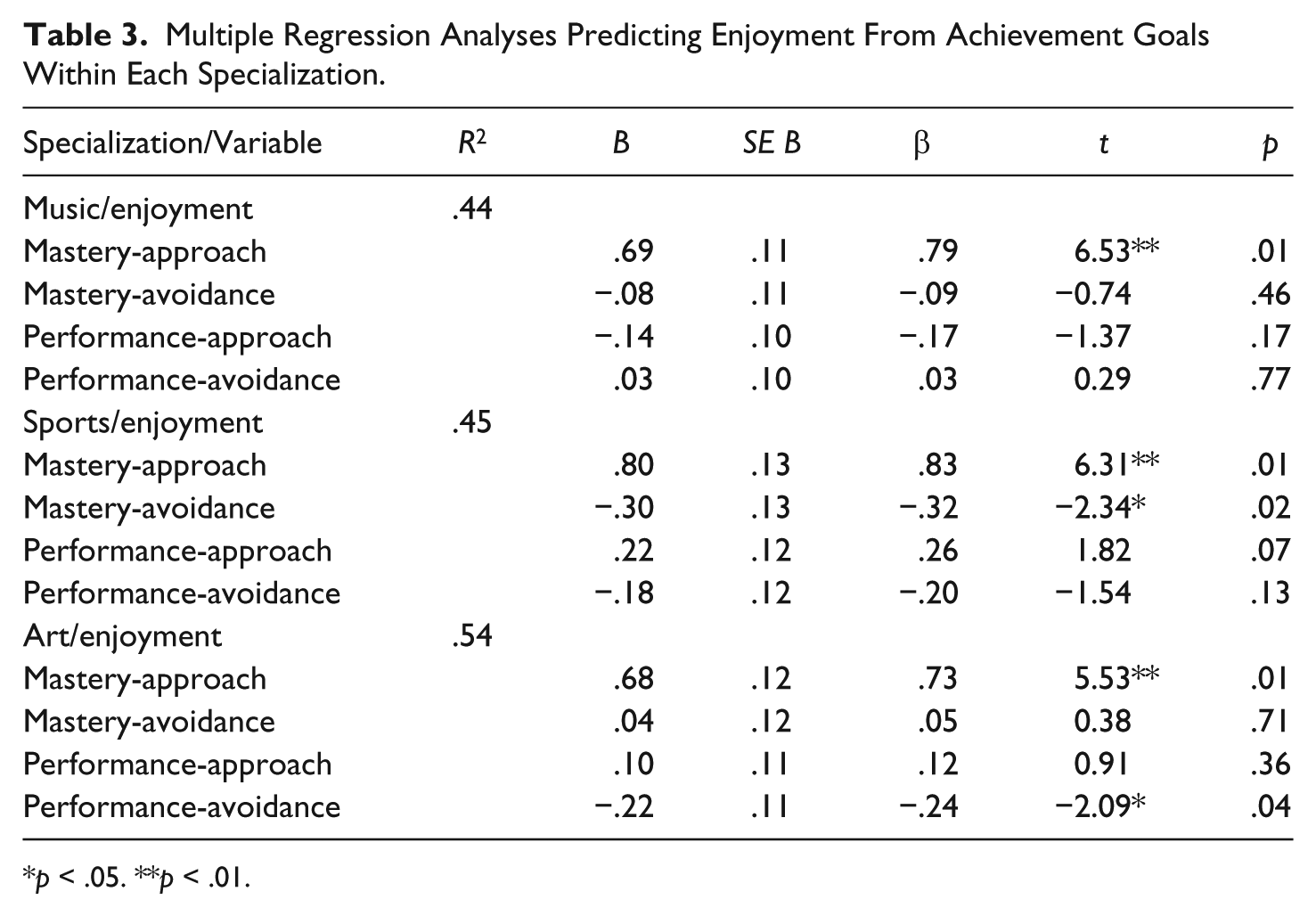
Table 3 shows the results of the multiple regressions analyses of the predictors of enjoyment using the four achievement goals. Across the three specializations, mastery-approach emerged as a significant predictor of enjoyment (all p < .05). In visual art specialization, performance-avoidance was a negative predictor of enjoyment (p < .05).
Multiple Regression Analyses Predicting Enjoyment From Achievement Goals Within Each Specialization.
p < .05. **p < .01.
Discussion
The purpose of this study was to examine the domain specificity of motivational goal orientations across music, visual art, and sports specializations. Consistent with our hypothesis, findings indicated that students in each domain scored higher in all four aspects of achievement goals in their own area of specialization than the other two nonspecializations. In other words, students are more motivated toward their specializations than their nonspecializations. This should not come as a surprise as students are likely to specialize in the subject they are most motivated. The converse is also true: Students are likely to be the most motivated toward their own specializations. While previous research has indicated the moderating potential of achievement domains (e.g., Van Yperen et al., 2014), this study is one of the very few studies in the literature that examined three specializations concurrently and found that the 2 × 2 achievement goal is not generalizable across different domains. Applied to the college context, an undergraduate music major who is highly motivated toward music is not necessarily motivated in a similar manner toward other subjects; conversely, a college student who dislikes basketball may very well be motivated toward playing the clarinet in the college band. It is crucial, therefore, for music educators to ignite their students’ passion for music, regardless of students’ motivation for other domains; a college student who does not enjoy visual art may indeed find his or her love in band.
Dweck’s (1999) proposition that implicit theories are the antecedents of achievement goals led us to examine if participants’ implicit theories are generalizable across music, sports, and visual art. Findings indicated that although achievement goals were domain-specific, implicit theories were generalizable as students reported higher incremental beliefs than entity beliefs across all three domains. In other words, while implicit theories about the nature of ability were similar across the three domains, the orientations of achievement goals were very different. Students may indeed believe that through effort and practice, they are able to excel in not only their own areas of specialization but also in other domains. Ultimately, this study demonstrates it is their own area of specialization for which students are truly motivated. When introducing the added dimension of domain specificity, implicit theories may work differently in relation to achievement goals. While further research is needed to determine if a consistent pattern emerges, the results in this study suggest that music educators may emphasize the importance of incremental beliefs and effort in their classrooms and rehearsal halls. The teacher may use the effort a student puts in during soccer practices to help the student understand that with similar effort, he or she can excel in playing the trumpet (e.g., “If you practice your scales on the trumpet like you work on your soccer skills, you will excel in no time”). Conversely, a fine saxophone player may be motivated to exert effort on his or her physical fitness using music as a reference point (e.g., “Work hard and have fun with your physical fitness like you practice on your saxophone!”). Since students do not study only music in schools, lessons may be drawn from other subjects to aid music and vice versa.
Our finding that achievement goals were specific to the participants’ area of specialization is in line with Van Yperen et al.’s (2014) meta-analysis and Tan and Miksza’s (2018) more recent work that found that achievement domain accounted for motivational differences among university band students. It also appears consistent with the intrinsic motivation indicators of the participants within each specific domain. Throughout all three specializations, our sample of student teachers indicated the highest levels of enjoyment, competence, and effort exertion in their area of specialization. This suggests that students are not only the most motivated but also derive the greatest satisfaction, feel the most competent, and are willing to invest the most amount of effort in their own specialization. No significant differences were found as a function of tension across the three domains, indicating that student teachers do not feel more pressured being engaged in their specialized domains compared to the other two. Consistent with extant research (e.g., Duda & Nicholls, 1992; Liu, Wang, Tan, Ee, & Koh, 2009; Wang et al., 2009), this study found that mastery-approach goals positively predicted enjoyment in each of the specializations. Consistent with previous studies (e.g., Matthews & Kitsantis, 2007), this suggests that music teachers and ensemble directors may continue encouraging mastery rather than performance goals in their classrooms and rehearsal halls. A student teacher participating in his or her college wind ensemble should work toward a beautiful tone quality and enjoy achieving that for its own sake rather than be told to practice hard to win the first chair. He or she should find such an approach more enjoyable and intrinsically satisfying than trying to outdo fellow ensemble musicians.
The findings of this study are limited in several ways. To begin with, the participants were all from the same teacher education institute in Singapore. The teacher-training program could have impacted the students’ beliefs, that is, it may have enhanced the trainees’ incremental beliefs. This in turn may also have led to higher task or mastery goal adoption. The small sample size of the present study limits generalizability. It also does not allow for more complex statistical analyses, such as path analysis or multilevel approaches, to be conducted. Additionally, as links between the constructs were primarily correlational, larger claims of causality could not be made. As this study was conducted in Singapore, often identified in the psychological literature as a collectivistic country (e.g., Liu et al., 2009), generalizability to broader populations, such as individualistic European or American contexts (e.g., Urdan, 2004), may be limited. Researchers have found that achievement goals may work differently between Western and Asian cultures (e.g., Dekker & Fischer, 2008; Maehr & Nicholls, 1980). Finally, given that this study prompted participants to respond to their “performance” across the three different domains, future research may further tease out participants’ motivation across a wide variety of musical contexts, such as ensemble, soloistic, and less formal musical settings.
Nonetheless, the results of this present study present several possible fruitful avenues for future studies. For example, our finding that achievement goals and intrinsic motivation are not generalizable across domains but are higher in participants’ specialized area offers fresh insights into motivational research. Do participants choose their area of specialization because they are motivated and derive satisfaction from that area, or is it the other way around? Future research might test this empirically. Our finding that implicit theories are generalizable across domains but achievement goals are domain-specific is also one that would benefit from further sustained research. Future studies could expand the sample size to test the relationships between the effect of implicit theories on achievement goals and related outcome variables. The sampling could also be extended to include participants beyond the student teacher participants in this study, including polytechnic students and secondary students in specialized music, visual art, and sports schools. In addition, cross-cultural comparisons may be made across countries to determine if there are potential interaction effects of culture and achievement domain. Whether in the academic or any of the three specialized domains investigated in this present study, the study of motivation remains crucial to continue to advance teaching and learning in fruitful directions.
Supplemental Material
DS_10.1177_0022429418784563 – Supplemental material for Achievement Goals, Implicit Theories, and Intrinsic Motivation: A Test of Domain Specificity Across Music, Visual Art, and Sports
Supplemental material, DS_10.1177_0022429418784563 for Achievement Goals, Implicit Theories, and Intrinsic Motivation: A Test of Domain Specificity Across Music, Visual Art, and Sports by Chee Keng John Wang, Leonard Tan and Eugene I. Dairianathan in Journal of Research in Music Education
Footnotes
Declaration of Conflicting Interests
The authors declared no potential conflicts of interest with respect to the research, authorship, and/or publication of this article.
Funding
The authors received no financial support for the research, authorship, and/or publication of this article.

Author Biographies
References
Supplementary Material
Please find the following supplemental material available below.
For Open Access articles published under a Creative Commons License, all supplemental material carries the same license as the article it is associated with.
For non-Open Access articles published, all supplemental material carries a non-exclusive license, and permission requests for re-use of supplemental material or any part of supplemental material shall be sent directly to the copyright owner as specified in the copyright notice associated with the article.
