




Abstract
This article addresses the psychosocial functioning of young people with artistic abilities. The study involved 354 students from music, art, and general education schools, ages 16 to 19 years. The research hypothesis was that the diversity of situations experienced by students studying at different types of schools could generate differences in their socio-emotional functioning, focusing on features such as emotional intelligence and coping strategies. The variables connected with emotional intelligence were acceptance, empathy, controlling, and understanding, and the variables connected with coping strategies were task-, emotion-, and avoidance-orientation. The results indicated that music students differed significantly from art students in the level of their emotional intelligence in general results and on the Acceptance scale; they are more aware of the positive and negative emotions that they feel, express their emotions more easily, and can effectively use their knowledge about the emotions they experience. Moreover, in stressful situations, music students exhibit task-oriented coping strategies significantly more often and are significantly less likely to engage in substitute actions than are art students.
The functioning of music school students is conditioned by many factors. The obvious element that distinguishes music school students from students in other types of schools (artistic and nonartistic) is the presumption of an increased level of musical ability and activity. There are also specific requirements in music education characterized by, among other factors, (a) the maintenance of regular, individual relationships between students and teacher-artists; (b) intensive daily practice on an instrument; (c) cooperation with other students in a number of music groups; and (d) frequent public performances that are connected to assessment.
Research on music school students and professional musicians (Bogunović & Krnjaić, 2013; Davidson et al., 2009; Jankowski, 2002; Lehmann et al., 2007; Sękowski, 1989) shows that many activities that are based on the requirements of music education are also strongly connected to developing particular traits in the range of psychological functioning. Primarily, these traits refer to specific temperaments or personality traits, intellectual and social competence, emotional and motivational characteristics, and preparedness to cope in difficult situations (Buttsworth & Smith, 1995; Gaunt & Hallam, 2009; Kemp, 2009; Klickstein, 2009; Konaszkiewicz, 1987; Popek, 2010; Stoeber & Eismann, 2007). The emotional sphere becomes more important because an important area of music students’ functioning is their ability to cope with both school and concert requirements; it is in these moments that emotional intelligence plays a key supportive role (Kaschub, 2002). Therefore, I examined the role of emotional intelligence in the process of music education with reference to Polish music students’ strategies for coping with stress in difficult situations.
Emotional Intelligence and Coping With Stress in Music Education
Emotional intelligence is related to personality, motivation, and social and cognitive characteristics (Strelau & Zawadzki, 2008). The relationship between emotional intelligence and key aspects of mental health implies that the domain of emotional intelligence is important for success in life (Goleman, 1997). Musicians and music students with an appropriate, elevated level of emotional intelligence have an increased probability not only of functioning well at school or in the music profession but also of maintaining mental well-being and even better health. There is also evidence that the length of musical training increases the level of emotional intelligence (Petrides et al., 2006).
Emotional intelligence was defined by Salovey and Mayer (1990) as a set of capabilities to process a variety of emotional information, such as (a) perceiving and expressing emotions, (b) supporting emotional thinking, (c) understanding and analyzing emotions, and (d) controlling, directing, and regulating emotions. Dealing effectively with one’s own emotions, understanding the emotions of others, and maintaining emotional control are all important human adaptation competencies (Matczak, 1994). Therefore, it is likely that emotional intelligence is a key element of the psychological profile of young musicians (see also Kaschub, 2002) because (a) it is involved in the process of adaptation to the requirements of educational and concert activities and (b) it is a factor that increases emotional sensitivity during the process of musical expression (Sloboda & Juslin, 2001).
Emotional expression in music is a relevant topic in music psychology literature. Particular attention has been paid to the properties of emotional communication between those involved in the process of creating, performing, and hearing music (see also Juslin & Persson, 2002; Woody, 2000) and musicians’ abilities to control or modify their experience of music performance anxiety (Juslin, 2009; Kenny, 2011; Steptoe, 2001; Wilson & Roland, 2002). Relatively few studies directly refer to the measurement of emotional intelligence as a separate factor in the psychosocial structure of people with musical abilities. Schellenberg (2011) measured the extent to which engaging with music, music lessons, and playing an instrument is associated with the development of emotional intelligence; Schellenberg’s results did not confirm the existence of such a relationship. In a subsequent study, Schellenberg et al. (2015) noted that social competence, including emotional understanding, can increase in children who characterize themselves as having low levels of social competence before taking part in music classes. The results of research by Rescinow et al. (2004) indicated that there is a connection between emotional intelligence and the ability to identify emotions in music. However, other studies found no significant correlations between emotional intelligence and individual differences in music consumption (Chamorro-Premuzic et al., 2010). On one hand, it may seem surprising to obtain such diverse results regarding the relationship between emotional intelligence and the different dimensions of the functioning of music professionals. On the other hand, such diverse results allow for the supposition that emotional intelligence is a feature that significantly codetermines achievements in the field of musical activities.
The results of research in other subdisciplines of psychology indicate that elevated levels of emotional intelligence positively correlate with academic and professional achievements (Mavroveli & Sánchez-Ruiz, 2011; Parker et al., 2004). A higher emotional intelligence level denotes greater development of creativity (Noorafshan & Jowkar, 2013) and social competence in teamwork situations (in the context of cooperation and teaching; Gertis et al., 2005; Goleman, 1997). Moreover, together with an increased level of emotional intelligence, quality of life in terms of health, relationships, and coping with difficulties in life is increased (Austin et al., 2005; Ciarrochi et al., 2001; Hunt & Evans, 2004; Palmer et al., 2002). The results of various studies offer evidence that the level of emotional intelligence can often be influenced by age and life experience (Fernández-Berrocal et al., 2012). It is also commonly believed that women exhibit a higher level of emotional intelligence. However, selected research results also indicate that men can have a comparably high level of emotional intelligence when compared to women (Ahmad et al., 2009). It remains to verify whether gender differentiates the level of emotional intelligence among individuals displaying musical abilities.
The ability to cope with stress or music performance anxiety is one of the elementary competencies that may characterize young musicians. In their theory of stress, Lazarus and Folkman (1984) defined coping with stress as the cognitive and behavioral ability to fulfill certain requirements in a situation recognized by a person as difficult. The ability to cope with stress is recognized as the skills of a person to cope more or less effectively with a task in a situation of perceived stress (Strelau et al., 2005). Endler and Parker (1990) stated that remedial actions taken in a stressful situation are the result of an interaction between the characteristics of that situation and the characteristic coping style of the person in the situation. However, it is important to note that there are various types of coping styles. These include problem-focused and emotion-focused coping, direct and indirect coping, active and passive coping, behavioral and avoidance coping, positive and negative coping, and meaning-based coping, which is dichotomized into situational and global meaning (Kenny, 2011). There is no agreement as to whether any of these styles is better or worse because everything depends on the broadly understood context of music’s functioning and personal circumstances (Weber, 1997). In this article, the style of coping with stress is presented as the nature of intentional action, which increases the efficiency of dealing with a specific situation (see also Łosiak, 2008). Music education provides students with many situations that they perceive as difficult, such as exams, concerts, contests, and recitals. Equally stressful situations may be associated with participation in individual or small group lessons where the level of a student’s musical ability is constantly assessed and evaluated by teachers or peers. Research on a group of music students carried out by Bonneville-Roussy and colleagues (2017) found a substantial role of motivation and stress-coping strategy connected with assessment. The study results confirmed that women experienced higher levels of stress but that men were more negatively affected by the use of disengagement-oriented coping strategies.
At the same time, the experience gained from learning to play an instrument and coping with the requirements of music education form the basis for developing a number of nonmusical competences, among which coping with stress and psychological resilience are crucial (Hallam, 2008; Sękowski, 1989). Stress-coping strategies can be factors that predict a musician’s fear level when exposed to public performance (Biasutti & Concina, 2014; Steptoe, 1989). The results from research on a group of Chinese students revealed that the ability to better cope in stressful situations is influenced by, among other factors, increased levels of emotional intelligence in terms of the ability to assess their own emotions, the emotions of others, the regulation of their own emotions, and emotional disclosure (Xie & Cui, 2016). The results of research conducted on a group of Polish music students indicated that the dominant stress-coping strategy is the ability to focus on the effective implementation of a task despite the negative emotions experienced or felt (Poraj, 2012). Research carried out on a group of Japanese musicians showed a significant relationship between task-, emotion-, and avoidance-based coping and stress with positive and negative forms of perfectionism (Kobori et al., 2011).
The results from these studies show that emotional intelligence and stress-coping strategies might have something in common within the structure of individual human traits. It is well known that positive temper and attitude facilitate efficient ways of coping with stress (Fredrickson, 2001). The results of research conducted among students show that emotional intelligence is positively associated with problem-focused and positive emotional-focused coping styles and negatively associated with negative emotional-focused coping styles (Noorbakhsh et al., 2010). The results of research in the IT industry also show that emotional intelligence has a positive impact on employees (Kaur, 2013). Extant research concentrates on many different aspects of emotional intelligence and stress-coping strategies among people of varied ability levels who participate in different musical and nonmusical activities. However, the measurements of such traits in previous studies did not reveal whether music school students differed substantially from art students and nonart students. With regard to the complex context of music education, these traits may be important for effective coping given the requirements of artistic environments. Therefore, in this article, I focused on measuring emotional intelligence and stress-coping strategies as features of psychosocial human functioning among music students.
Purpose of the Study, Research Questions, and Main Hypothesis
The main goal of this study was to identify the differences in emotional intelligence and stress-coping strategies among music students. The individuals studied also included art students and general education students. An additional goal was to explore the correlation between emotional intelligence and stress-coping strategies among students with artistic abilities (i.e., those in music and art schools). The research questions were as follows: (1) Do music students differ from art and general education students in terms of their emotional intelligence and use of stress-coping strategies? and (2) Does gender differentiate the level of emotional intelligence and stress-coping strategies among students in music, art, and general education schools?
Due to the differences in the specific aspects of music and art education, students in these two types of schools may exhibit different levels of emotional intelligence and stress-coping strategies (Nogaj, 2013; Popęrzycka, 2005). Compared to art students, music students experience an increased number of difficult situations and stronger emotions when giving performances (Stachowicz, 1975; Steptoe, 2001; Tsagarelli & Nikiforov, 1991). Therefore, I adopted the following hypothesis: Music students have greater emotional intelligence and use task-oriented coping strategies more often than do art students.
Method
Measures
The Popular Questionnaire of Emotional Intelligence (PQEI) developed by Jaworska and Matczak (2005) was utilized in this study. The questionnaire, which only comes in a Polish-language version, is used to measure emotional intelligence based on the model of Salovey and Mayer (1990), which is based on six main components: (a) the ability to understand one’s own emotions and to appreciate their importance; (b) the ability to express emotions appropriately; (c) the ability to recognize emotions in others; (d) the ability to understand emotions, namely, their causes and consequences; (e) the ability to support thinking emotionally; and (f) the ability to control and regulate emotions.
The questionnaire consists of 94 questions, and the answers are scored on a scale from 1 to 5 points, wherein 1 = I definitely disagree, 2 = I rather not agree, 3 = neutral, 4 = I rather agree, and 5 = I definitely agree. Factor analysis (using the main component method) indicated the best four-factor solution (where factor charges oscillated around values from 0.55 to 0.74), distinguishing such scales as
- Acceptance (ACC): expressing and using one’s own emotions in action (15 questions; minimum value for raw answers = 15, maximum value = 75);
- Empathy (EMP): understanding and recognizing the emotions of other people (18 questions; minimum value = 18, maximum value = 90);
- Control (CON): a cognitive control over one’s own emotions (11 questions; minimum value = 11, maximum value = 55);
- Understanding (UND): understanding and awareness of one’s own emotions (10 questions; minimum value = 10, maximum value = 50).
The questionnaire examines the general level of emotional intelligence, which is the sum of the results of all four subscales, and moreover provides separate results within individual subscales and aspects of emotional intelligence. The following are the most important research results from particular PQEI construction stages. Standardization of the scale was based on research carried out with 414 students and 265 adults ages 14 to 71 years old.
I carried out a reliability analysis of results of particular scales (in the tool standardization process) on a group of students (N = 354; Cronbach’s alpha) without division into gender and type of education; results ranged between α = .78 (Understanding scale) and α = .89 (Empathy scale). Relevance analysis was performed using a correlation matrix of each test score with a general result. The correlations of each scale of emotional intelligence with general results ranged from .79 to .88. The obtained results confirm the high reliability and accuracy of the tool used (Jaworska & Matczak, 2005). The results of reliability carried out on the participants from this study indicated Cronbach’s alpha coefficients of .82 for the Acceptance scale, .85 for the Empathy scale, .73 for the Control scale, .74 for the Understanding scale, and .87 for the general outcome of emotional intelligence.
I also used an adaptation of the Coping Inventory for Stressful Situations (CISS) developed by Endler and Parker (1990). The Polish adaptation of this questionnaire was produced by Strelau et al. (2005). As noted earlier, Endler and Parker stated that remedial actions taken in a stressful situation are the result of an interaction between the characteristics of that situation and the characteristic coping style of the person in the situation.
The Polish adaptation of the CISS questionnaire (Strelau et al., 2005) consists of 48 statements pertaining to a variety of behaviors that people may exhibit in stressful situations. Each scale contains 18 questions, within which one can receive (at the level of raw results) from 5 to 90 points. The questionnaire contains three main scales that feature the following:
- Task-Oriented Coping (TOC): A high score on this scale indicates a person’s tendency to attempt to solve problems by focusing on the performance of the task in stressful situations.
- Emotion-Oriented Coping (EOC): A high score on this scale indicates a person’s tendency to focus on themselves in stressful situations and on their own emotional experiences when experiencing emotions such as anger or guilt.
- Avoidance-Oriented Coping (AOC): A high score on this scale indicates a person’s tendency in stressful situations to refrain from thinking about and experiencing the situation in exchange for accepted alternative forms of behavior, such as distraction (enganging in substitute activities – D; and social diversion – SD).
The adaptation of the Polish-language version of this questionnaire was used to interview over 1,600 people (N = 1,686; range = 16–79 years old). The accuracy of the scale, measured with Cronbach’s alpha, ranges from .82 to .88 for the TOC and EOC scales and from .74 to .78 for the AOC scale (which could have affected the accuracy of the SD scale, which was less than .70 due to the small number of items). The standardization of the questionnaire was performed on individuals in the three age groups that were developed: (a) 16 to 24 years of age, (b) 25 to 54 years of age, and (c) 55 to 79 years of age (Strelau et al., 2005). The results of the reliability carried out on the participants in this study indicate Cronbach’s alpha coefficients of .75 for task-oriented coping strategy, .78 for emotion-oriented coping strategy, and .72 for avoidance-oriented coping strategy.
Participants and Procedure
All tests were carried out in groups (school classes) that were attended by the researcher and helpers who supervised students’ completion of the tasks. The groups totaled between 20 and 30 participants. The participants were asked to anonymously complete the PQEI and CISS. The investigation was usually completed within 30 to 45 min.
The study was conducted from January to March 2013 among students at music, art, and general education secondary schools in the Kuyavian-Pomeranian Voivodeship (Poland), in cities with more than 300,000 citizens. The respondents ranged in age from 16 to 19 years (M = 17.32; SD = 1.12). There were 354 participants, of whom 45% were music students (n = 156; women = 99; men = 57; age M = 17.95, SD = 1.15), 28% were art students (n = 100; women = 79; men = 21; age M = 16.99, SD = 0.78), and 27% were general education students (n = 98; women = 54; men = 44; age M = 16.64, SD = 0.79). There was a disparity in the number of women and men attending art schools compared to general education students. This tendency also occurs at the population level and has been confirmed in other studies of students at Polish art schools, where references were made to statistics from the Central Statistics Office while interpreting the obtained data (see also Chruszczewski, 2004).
Due to the limited number of art schools in the Kuyavian-Pomeranian Voivodeship, the studies included almost all students in the selected age groups in selected schools. The allocation of general education students to the comparative students’ group was random. All underage students had written permission from their parents to participate in the study, and adult students agreed on their own in compliance with institutional guidelines.
STATISTICA software was used to calculate the results of the study. The analysis of the normal distribution, using the Shapiro-Wilk test, allowed for the use of parametric analyses. To answer the question about the existence of relationships between emotional intelligence and coping strategies, I used Pearson’s correlation analysis. To verify whether school type and gender differentiate students in the scope of the indicated variables, an analysis of covariance (ANCOVA) was used.
Results
Descriptive Analysis
Descriptive statistics (Table 1) show that the students in question demonstrated an average level of occurrence of each of the variables tested in terms of emotional intelligence and stress-coping strategies. The average scores for all types of schools and the scores analyzed separately for music, art, and general school students fall within the range of 4 to 6 points, which on the Stanine scale, represents the average level of intensity of these features. The results of skewness and kurtosis were also presented because in each of the studied groups, a high level of variation coefficient was found (V > 20%), which indicates high individual diversity within each of the studied student groups.
Means (M), Standard Deviations (SD), Skewness (S), and Kurtosis (K) of 10 Variables Among Three Research Groups.

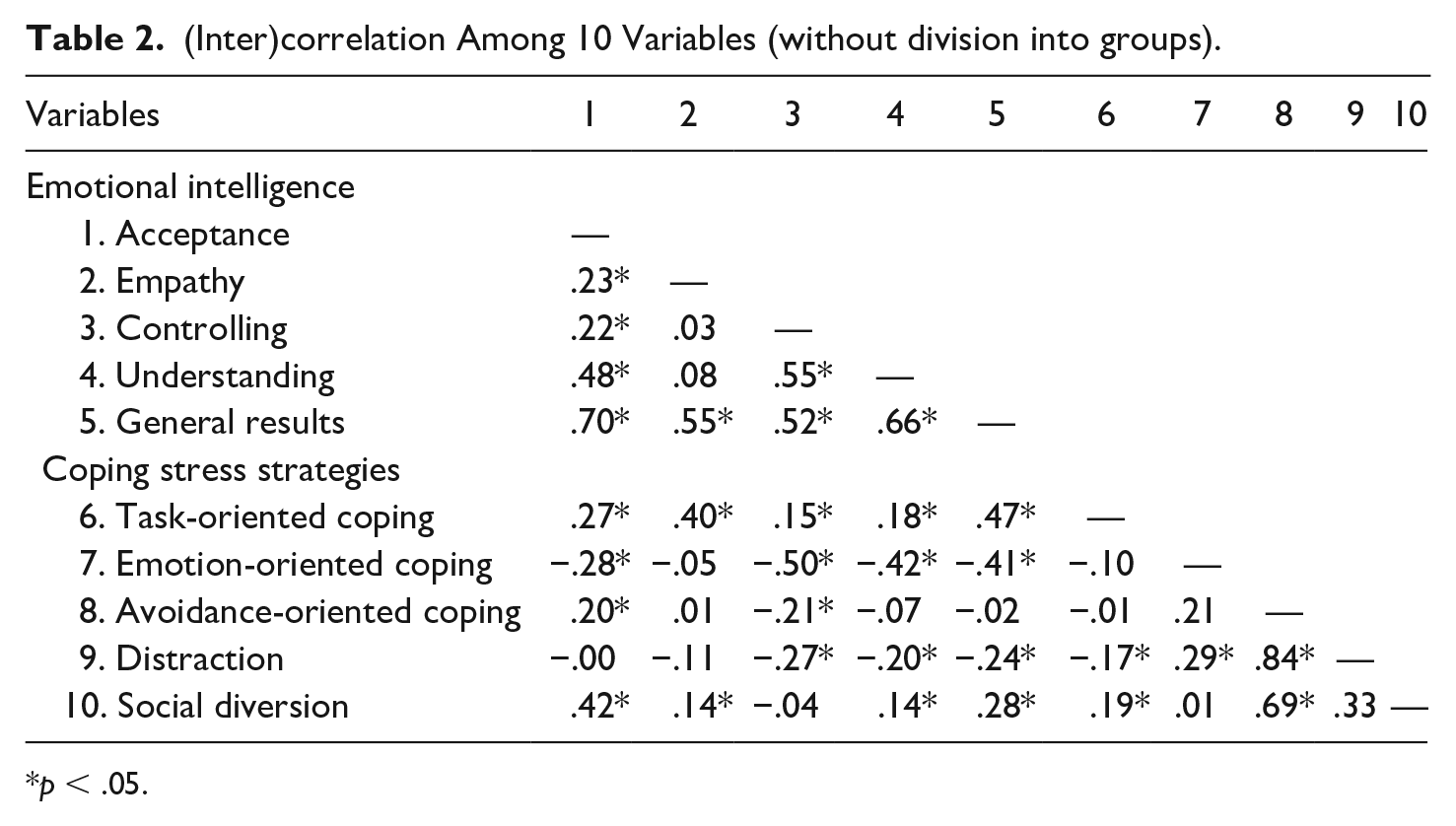
Taking into account correlations between the main variables (Table 2), namely, emotional intelligence and stress-coping strategies, it was noted that among all students (regardless of the type of school), there was a significant positive correlation between emotional intelligence and the use of task-oriented coping strategies (r = .47, p < .05). The higher the level of emotional intelligence shown by the students surveyed, the more often they declared the ability to employ task-oriented coping strategies in times of stress. In particular, there was a moderate correlation between the Empathy scale and task-oriented coping strategies (r = .40, p < .05). There was a negative correlation between emotional intelligence and emotion-oriented coping strategy (r = – .41, p < .05); namely, the higher the level of emotional intelligence, the less often students used emotion-oriented coping strategies.
(Inter)correlation Among 10 Variables (without division into groups).
p < .05.
An analysis of the correlation between emotional intelligence and avoidance-oriented coping strategies (distraction: r = – .24, p < .05; social diversion: r = .28, p < .05) revealed the lowest interrelation of variables and that the existing correlations occurred at a low level. The higher the level of emotional intelligence on the Acceptance scale, the higher the level of avoidance in a stressful situation (r = .20, p < .05), especially in the field of social diversion (r = .42, p < .05). Similarly, the higher the level of emotional intelligence on the controlling scale, the lower the level of avoidance in a difficult situation (r = – .21, p < .05). However, in view of the fact that the avoidance-coping strategies consist of two separate subscales in terms of their content, differences in their results can be noted. The higher the level of strategic emotional intelligence, such as the scale of controlling and understanding, the less likely it is that students will engage in substitute activities. In turn, the higher the students’ experiential emotional intelligence, such as the scale of acceptance and empathy, the more likely it is that they will seek social contact in a stressful situation.
Differences Among Music, Art, and General Education Students
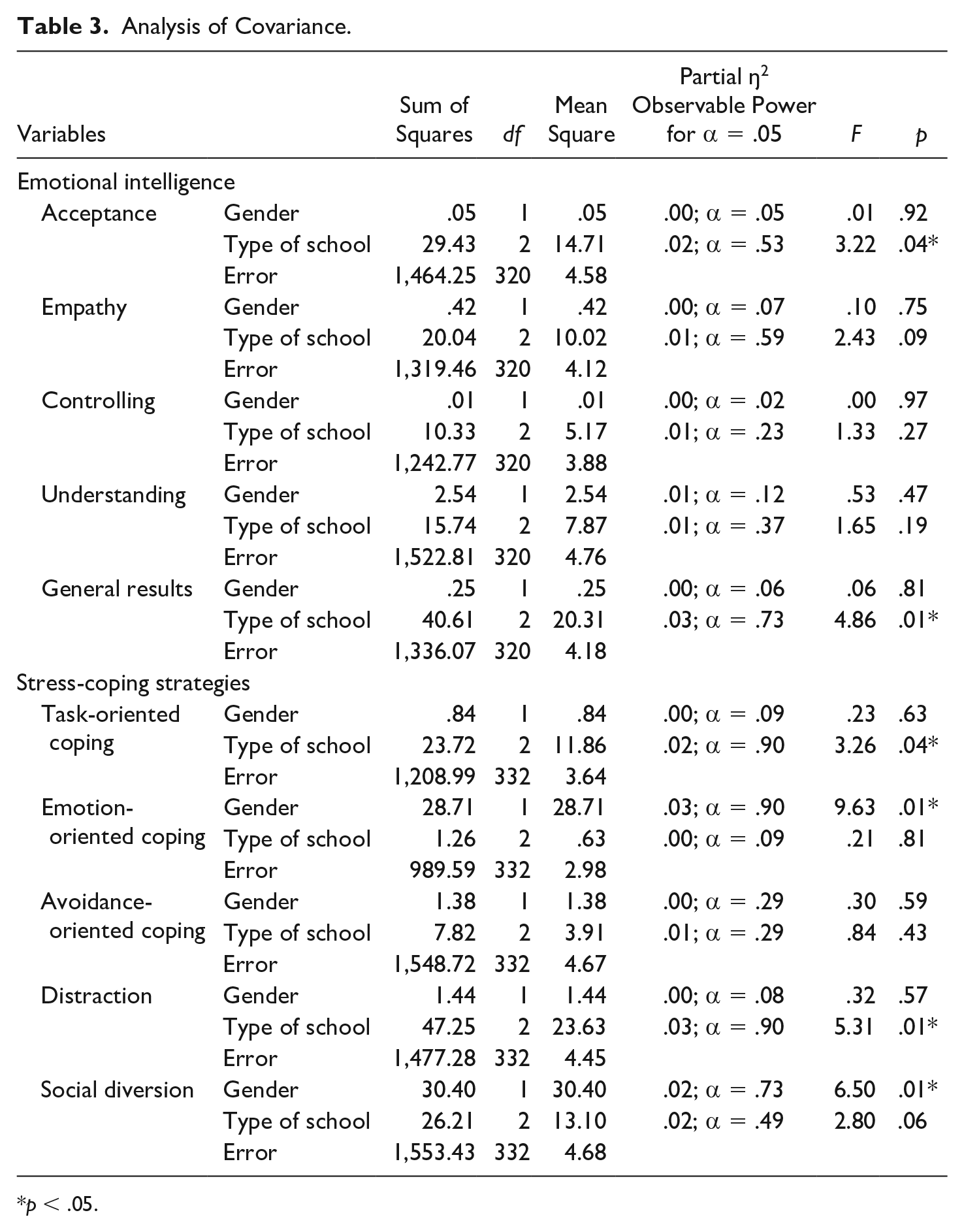
While moderate scores for particular emotional intelligence traits and stress management strategies were at an average level (Table 1), the differences between the results of pupils of particular types of school and pupils of different gender were more noticeable. These data were examined through two ANCOVAs, in which gender was identified as a covariate, the type of education was the independent variable, and emotional intelligence and coping strategies were dependent variables.
The results of the first analysis of covariance (Table 3) show that the type of school significantly differentiated the overall level of emotional intelligence, F(2, 320) = 4.86; p = .01, especially in the Acceptance subscales, F(2, 320) = 3.22; p = .04. Scheffe’s post hoc analysis showed that students in music schools (Mmusic = 5.70, SD = 1.70) exhibited significantly higher levels of emotional intelligence than students in art schools (Mart = 4.86, SD = 2.18).
Analysis of Covariance.
p < .05.
The second ANCOVA, in which the dependent variable was coping stress styles (Table 3), showed differentiated effects of gender and education types on different stress-management styles. The type of school significantly differentiated students in the task-oriented coping stress style, F(2, 332) = 3.26, p = .04, and in coping with stress by seeking distractions, F(2, 332) = 5.31; p = .01. Scheffe’s post hoc analysis showed that students of music schools (Mmusic = 6.26, SD = 1.81) and general schools (Mgen.edu. = 6.33, SD = 2.03) in stressful situations were more likely to choose task-oriented coping stress styles than were students in visual arts schools (Mart = 5.67, SD = 1.93). On the other hand, students of visual arts schools (Mart = 6.13, SD = 2.04) chose to resort to replacement activities in cases of stress more often than did students of music schools (Mmusic = 5.25, SD = 2.06).
Independent of school type, students’ reports of emotional stress and social distraction differed as a function of gender. In general, girls in all types of schools were more likely to use emotion-oriented coping strategies (Mgirls = 6.47, SD = 1.70; Mboys = 5.81, SD = 1.77) and avoid stress through escapism (Mgirls = 5.34, SD = 2.21; Mboys = 4.78, SD = 2.10).
It should be emphasized that although the results obtained in the ANCOVAs indicated the existence of differences between groups of students, these were small differences when considering partial eta squared effect sizes. Therefore, it is important to note that the magnitude of the differences between students from music, visual art, and general education schools are not large and that the practical import of these findings is questionable.
Discussion
Among students at Polish music schools, in relation to two comparative groups consisting of students at art and general education schools, selected dimensions of emotional intelligence (emotional intelligence in the general outcome and Acceptance scale) and stress-coping strategies (task-oriented coping and one dimension of avoidance-oriented coping) are variables that significantly differentiate music school students from their peers, who manifest different abilities and interests. Analysis indicated that in accordance with the assumption of the hypothesis, music students have greater emotional intelligence and use task-oriented coping strategies more often than art students. Music students exhibited significantly higher levels of emotional intelligence, especially in terms of acceptance, expression, and the use of their own emotions in action, compared with art students. The reported levels of emotional intelligence among art and general education students were not significantly different. It is worth noting that the surveyed music students achieved results in emotional intelligence more similar to general education students than to art students. In contrast, in terms of stress-coping strategies, music students were significantly more likely to use task-oriented coping strategies and had a lower tendency to engage in substitute activities than art students. This shows their ability to better adapt to difficult situations. Gender, as a covariant, differentiated the students in emotion-oriented stress style and escapes in social contacts, but no gender effects were observed in the different groups of learners in different types of schools.
These results suggest that music students are more aware of the emotions they feel, both positive and negative; express their emotions more easily; and can effectively use their knowledge about the emotions they experience. A higher score in terms of acceptance, expression, and use of their own emotions could be the result of these students’ daily work on a musical instrument, in which the emotional expression of music is consciously analyzed (Resnicow et al., 2004). After all, a high-quality musical performance is impossible without emotional involvement in the musical content performed (Juslin & Persson, 2002; Persson, 2001). Moreover, emotional intelligence is a significant component of creativity (Noorafshan & Jowkar, 2013) and is an important part of young artists’ creative abilities.
In terms of stress-coping strategies, in this study, cross-group comparisons showed significant differences among the three groups of students. In stressful situations, music students were significantly more likely to exhibit task-oriented coping strategies and less likely to engage in substitute actions when compared to art students. These results relating to dominant coping strategies among Polish music students are comparable to the results of a study of Japanese musicians by Kobori et al. (2011).
Previous research investigating musicians’ coping strategies support the results of the current study, indicating musicians’ readiness to effectively and efficiently manage mental tension during public performances (Biasutti & Concina, 2014; Kenny, 2011; Wilson & Roland, 2002). However, the results of the current study are in opposition to research that identified a highly elevated level of neuroticism among students with musical abilities (Kemp, 2000; Manturzewska, 1974, 2014). Research on current Polish youth studying at music schools indicated low levels of neuroticism, which is also one of the predictors of music achievement (Chruszczewski, 2004). One of the explanations for such diverse results for this variable may be related to the fact that in the past decade, knowledge in the area of music and educational psychology and psychological preparation for public performances has become a familiar topic. Expanding the psychological competence of students could significantly reduce the anxiety experiences related to frequent public exposure or the need to meet numerous obligations (Nogaj, 2014; Nogaj & Ossowski, 2017).
It was surprising that this research showed differences between women and men only in emotion-oriented coping strategies and escaping into social contacts in stressful situations because the results of other studies indicated greater differentiations between genders (Bonneville-Roussy et al., 2017). Such small differences by gender may be related to artistic specificity and, at the same time, the higher level of artistic sensitivity characterizing the participants. Moreover, previous research did not record gender differences within groups of music, art, and general education students on any subscale of emotional intelligence.
An important conclusion is that the higher the students’ level of emotional intelligence, the more often they used efficient and effective strategies to cope with stress; specifically, they focused more on the task and less on their emotions. This is consistent with the results of studies indicating musicians’ enhanced emotional adaptation to the challenges of music competitions (Juslin, 2009; Kenny, 2011) and a relationship between emotional intelligence and effective stress-coping strategies among Chinese music students (Xie & Cui, 2016).
These studies include two important dimensions of music school students’ psychosocial functioning: emotional intelligence and stress-coping strategies. On one hand, the choice of these variables is a limitation because the research did not take into account the entire spectrum of psychosocial characteristics of people with artistic abilities. On the other hand, the choice is a distinguishing feature in this study because emphasis was placed on features that are not considered a priority in studies of music students. These results provide a basis for further exploratory and explanatory studies investigating the range of factors that distinguish students from different types of art schools (e.g., research using discriminant analysis) because the personal and emotional variables selected in this study were not the only factors that influenced the diversity of the psychosocial functioning of art school students. A range of situational, social, and organizational factors, as well as other dimensions of individual differences that affect human ontogenetic development, were found to shape the overall dynamic profile of a musical performer. It should be noted that a limitation of this research was the use of self-reporting as a method of measuring emotional intelligence. Additionally, the significant differences found among students from music, visual art, and general education schools also must be interpreted with caution because adjustments to the alpha criterion were not employed to account for the multiple statistical tests.
The implementation of research without consideration of the intercultural context also should be considered a restriction. The research was conducted on a group of Polish artistic school students in a system that is not common in Western European countries, the United States, or Canada. However, because the Polish education system ensures a common, professional education (in day and afternoon music schools) at every stage of development of children, adolescents, and adults, one can notice similar psychological functioning among late adolescents studying in Poland and among students at music schools who have been educated in other countries. Enhanced psychological functioning is the result of similar educational standards that allow students to achieve professional competences in music performances (e.g., Bresler, 2007).
The main practical implication of the research is the need to enhance the development of emotional intelligence among music school students particularly in light of research showing that emotional intelligence is a predictor of academic achievement (Mavroveli & Sánchez-Ruiz, 2011). To increase the emotional intelligence level in a student, a sense of accomplishment, self-confidence, appreciation of emotional engagement in task fulfillment, and self-esteem maintenance must be strengthened. These actions will also contribute to the enhancement of effective stress-coping strategies. Although music school students are distinguished by a tendency to adopt task-oriented coping strategies, this does not mean that they are always able to cope with public appearances (Steptoe, 1989, 2001). It can be stated that the requirements connected with public appearances substantially contribute to an increase in stress resistance and thus contribute to the application of effective nervousness coping strategies by musicians (Biasutti & Concina, 2014). Music and visual art education require from students different work styles and generate diverse emotions associated with presentation of a prepared work. Such different artistic activities cause consequential differences in the psychological functioning of art school students in terms of coping strategies and in the area of emotional intelligence. In addition, increasingly often in Polish artistic schools, emphasis is placed on expanding the psychological competences of teachers to attend to the development of students’ emotional intelligence and support students’ adoption of effective coping strategies (Hawash, 2015).
Footnotes
Declaration of Conflicting Interests
The author declared no potential conflicts of interest with respect to the research, authorship, and/or publication of this article.
Funding
The author received no financial support for the research, authorship, and/or publication of this article.