




Abstract
The Journal of Research in Music Education (JRME) is the longest running serial dedicated to music education research, and its articles are widely considered exemplars in the field worldwide. This is a bibliometric study of the sources cited in articles published in the JRME from its inception in 1953 to 2015. We extracted 31,679 references from 1,341 the JRME articles; rank-ordered those frequently cited journals, articles, and authors; investigated the interdisciplinarity of cited journals; observed the age density of cited sources; and studied the proportional distribution of reference types. Results were then compared across 10-year spans, except for the first, which was 12 years, and discussed in light of known parameters for research in other fields. These analyses have revealed several interesting trends reflecting the evolution and maturation of the journal and music education research.
Keywords
Examining the cited sources in other disciplines’ primary journals is often employed by bibliometricians to investigate the evolving enterprise of research and scholarly communications (e.g., de Solla Price, 1965; Moed, 2006). Findings from these “research-on-research” studies have identified the major outlets involved in disseminating research results (e.g., Garfield, 1972; Tahai & Rigsby, 1998), confirmed the long-term impact of articles (e.g., Nicholas et al., 2005; Walters, 2011), and highlighted the interdisciplinarity and interconnectedness among cited sources (Narin et al., 1972; Porter & Rafols, 2009). In addition, these investigations have underscored the importance of specific articles, individuals, and journals (Meho & Yang, 2007; Pasadeos et al., 1999), the application of which has been used by bibliometricians to gauge the maturation of research journals and their concomitant fields of study (e.g., Jones et al., 1972; Schubert & Maczelka, 1993).
Bibliometric studies of research in the natural and physical sciences are plentiful, with one mutual characteristic being the frequent citation of journal articles over all other media. In contrast, studies comparing citation practices between disciplines have shown that researchers in the humanities and arts tend to cite artistic works, monographs, and performances more so than journal articles (Garfield, 1982; Huang & Chang, 2008; Moed, 2006), which complicates comparisons of citation practices and research impact. Other unique attributes of research in these disciplines include the production of many studies that remain uncited for years (Hancock, 2015; Hancock & Price, 2016), if ever (Hamilton, 1991), and a trend for scholarship to have lower rates of self-citation (3%) when compared with figures from the physical sciences (15%), social sciences (6%), and all other fields (9%; Snyder & Bonzi, 1998).
Some critics consider self-citation an objectionable practice given that questionable motives were often associated with this convention (e.g., boosting impact, self-promotion); however, recent thinking advocates self-citation as symptomatic of groundbreaking lines of inquiry that are inherently dependent on an author’s cumulative efforts and evolving ideas. Accordingly, self-citation has been recognized as a hallmark of a highly productive scholar (Mishra et al., 2018) and, in some cases, indicative of research authored by research teams over individuals (Wuchty et al., 2007). Interestingly, the dominance of self-referencing by journals (i.e., articles with citations primarily to other articles published in the same journal) can be considered a significant landmark because it suggests scholars have reached a consensus around specific outlets for sharing results germane to the central problems vexing a field (Fanelli & Glänzel, 2013, p. 6). Yet, many bibliometricians in the past have censored or controlled for self-referencing in an effort to reduce “perceived” bias. Obviously, such limits are not always a desirable practice and depend on a study’s purpose. For example, in relatively niche disciplines such as music education research, journal self-referencing is prevalent, and mitigating its data would run counter to the goal of determining journal eminence via citation frequency (Hamann & Lucas, 1998).
Studies of the Journal of Research in Music Education
Bibliometric studies of research in music education have focused on many facets of the enterprise, with most concentrating on the published articles and aspects of the flagship journal of the field, the Journal of Research in Music Education (JRME). For example, in 1984, Yarbrough reviewed all research published in the JRME from 1953 through 1983 (N = 658) to determine the percentage that originated as theses and dissertations along with the research basis for each article. These works were also studied regarding their research methodologies, subject matter, and sample characteristics, such as age and training. The studies published in this 31-year period were descriptive (40.6%), experimental (32.1%), and historical (17.0%), with philosophical, behavioral, and other types of research accounting for the remaining 10.3%. In 2011, Lane found that qualitative research in the JRME had increased considerably from 1983 to 2008. Ebie (2002) conducted an examination of the JRME’s research samples employed from its founding through 2002. Among other factors, the author found that the participants’ schooling levels were 34%, 21%, and 19% from colleges, elementary, and secondary schools, respectively.
Abeles and Carroll (1981) studied several research journals published between 1965 and 1975, including the JRME, to identify productivity of individual authors, research methodology used, and funded support. In an extension of this and previous research, Yarbrough (2002) looked at the first 50 years of sources and their research methodologies in the JRME. Interestingly, she reported that the JRME articles based on dissertations and theses have reduced over time, from 42% initially to 28% in 2002.
A paper presented at the Annual Meeting of the Mid-South Education Research Association in 1992 by Daniel examined the use of statistical procedures across 5 years of the JRME publication: 1987 to 1991. Over the 5 years, he found that quantitative studies predominantly used analysis of variance (ANOVA) and chi-square, with chi-square use reducing over time. A more recent analysis of statistical power of articles published in the JRME from 2000 to 2010 found that statistical power reports were not incredibly low but were not yet up to the typical level expected by a leading journal (Overland, 2014).
Grashel (1996) studied the test instruments used in the JRME from 1980 through 1989. In these 10 years, he found that there were 10 different published tests used and that they varied from the 1954 Watkins-Farnum Performance Scale to the 1987 Measure of Creative Thinking in Music. In a later study, Grashel (1998) examined women’s contributions to the JRME publications from 1953 to 1994 and found no bias against women, possibly a result of the blind review process that the JRME follows.
Humphreys and Stauffer (2000) examined characteristics of the JRME editorial committee members from 1953 to 1992. Women board members have increased over time, but it still was less than the proportion of women who published in the JRME during that time frame. Also, board members represented a wide range of geographic areas, universities attended, and affiliated institutions. In 2007, Grashel examined the terminal degrees and university affiliations of the JRME authors, editors, and editorial committee members in the 418 articles published from 1990 to 2005. Florida State University graduates, under the leadership of Clifford K. Madsen, were significant article contributors, accounting for 25% of the publications. Also, 19 graduates from this university have been on the Editorial Committee, along with the current and prior editors.
The JRME authors who had published two or more studies in the over 40-year history of the serial prior to 1994 (N = 926 articles) were surveyed (N = 183) to determine those sources “that have had the greatest impact on the field, have withstood the test of time in importance to the profession, and/or have added significantly to the body of knowledge about the effects of music and music teaching” (Price & Orman, 1996, p. 60). Respondents (N = 84) listed many articles (N = 154), but only seven were mentioned by six or more authors, and the publication years ranged from 1963 to 1993. This is a broad range of time represented; however, 12 or more of the respondents only listed three articles, all from the JRME: LeBlanc’s (1981) “Effects of Style, Tempo, and Performing Medium on Children’s Music Preference”; Madsen et al., (1993) “An Empirical Method for Measuring the Aesthetic Experience of Music”; and Madsen et al.’s (1989) “Demonstration and Recognition of High and Low Contrasts in Teacher Intensity.” Furthermore, 11 studies were listed by five or more of the respondents; these publications had a remarkable breadth of ideas that appeal across many areas.
In 1995, Grashel and Lowe investigated the studies published in the first 40 years of the JRME to see if they were authored or coauthored by a current K–12 music educator. Forty-one studies met this criterion, with the first one published in the initial year. Unfortunately, the ratio of those articles with K–12 music educators among its authors was just over one article per year. There is something important to note regarding people who publish research across music fields. Although there were many personal factors that contributed to people choosing to do this work, the most important intrinsic motivator was the reinforcing nature of the research process, with salary being the most critical external reward (LeBlanc & McCrary, 1990).
Silvera and Diaz (2014) examined student teaching work from 1997 to 2011 in the JRME, Bulletin of the Council for Research in Music Education (BCRME), Update: Applications of Research in Music Education (UPDATE), and Journal of Music Teacher Education (JMTE) and identified the key articles and journals for research on this topic. Other factors that have been examined include disability discourse (Dobbs, 2012) and music education research paradigms (Jorgensen & Ward-Steinman, 2015). We should also note that the studies in the JRME did not have a bias for or against any type of research (Sims et al., 2016).
Citation Analyses in Music Education
Considering the substantial number of articles investigating music education research, as previously described, a second body of work examined the citations and references found in music research articles to determine aspects of influence and importance. For example, Standley (1984) and later, Brittin and Standley (1997) identified eminent scholars and institutions in music education by examining citations to specific authors in the JRME, BCRME, and Journal of Music Therapy (JMT) from their inceptions through 1982 and again through 1997.
Schmidt and Zdzinski (1993) examined citations to quantitative research published from 1975 to 1990 (N = 922) in the JRME, BCRME, JMT, Psychology of Music (POM), Contributions to Music Education (CME), and the Missouri Journal of Research in Music Education (MJRME). They created a list of the most cited articles in descriptive and experimental research considering all sources citing these articles, excluding self-cited or coauthors’ studies. There were 26 articles that received 12 to 24 citations, with 19 (73%) published in the JRME. Those 26 items had 6, 17, and 3 articles from the 1960s, 1970s, and 1980s, respectively. Behavioral research at this time was quite influential, with C. K. Madsen and R. D. Greer along with their colleagues being cited four times each—more than a quarter of the 26.
A replication (Rutkowski et al., 2011) of Schmidt and Zdzinski’s (1993) work examined studies from 1990 to 2005; the only difference, in 17 years between them, was the exclusion of MJRME. Results included a total of 1,026 articles, of which 28 were in the 25 most cited. There was a five-way tie for the 24th most cited work, hence 28 articles. Of these most cited articles, 21 (75%) were in the JRME; this is a duplicate of findings from 1993, although Rutkowski et al. (2011) noted a wider variety of sources than were found previously. The most cited article was Leblanc’s (1981) “Effects of Style, Tempo and Performing Medium on Children’s Music Preference” in the JRME. Interestingly, a study of theoretical frameworks in the JRME’s publications for 1979 to 2009 found that LeBlanc’s (1982) “An Interactive Theory of Music Preference” was the most cited source (Miksza & Johnson, 2012).
An examination of citations in six music research journals from 1990 to 1995 found three research journals represented 80% of the total. The JRME alone accounted for 55% of the citations, which is more than twice the combined 25% of the other two, BCRME and POM (Hamann & Lucas, 1998). A tertiary analysis of citations to professional music journals was similarly conducted because they also “play an important part in the overall communication of ideas in our profession” (Hamann & Lucas, 1998, p. 410). Results confirmed this point with the Music Educators Journal (MEJ) being the most cited publication with 238 citations—making it the fourth most cited music education journal despite its nonresearch emphasis.
More recently, there was an examination of the references in papers presented at 10 meetings, an 18-year period (1988–2006) of the biennial International Research Commission Seminars, operating under the International Society for Music Education. There were 283 papers with 4,535 citations. Although many presenters tended to rely on publications from their own region, the JRME was the most referenced journal throughout the entire sample. This finding speaks to its worldwide relevance and importance (Price et al., 2010).
Hancock’s (2015) recent study examined the immediacy of the first citation regarding articles published in the JRME. There were 617 articles examined from 1988 through 2013 and 6,930 references to those articles from Google Scholar. Many aspects were discussed from this work, but the initial outreach of articles in the JRME is strong, with 50% of these articles cited in their first year and 75% by the eighth. A year later, Hancock and Price (2016) examined the speed of initial impact of 619 articles published in POM from its 1973 inception to 2012. More recent publications of POM tended to cite its own studies faster than other serials, but it was not that way before 1993. Basically, the JRME and POM each now tends to cite its articles more rapidly than other journals. This indicates that newly published research in these two serials quickly contribute to the forefront of scholarly discourse among their respective readerships.
Bibliometric Research Methods Applied
In a bibliometric study not in music but closely related to our investigation, Schubert and Maczelka (1993) examined references in the bibliometric research journal Scientometrics to determine the scientific maturation of the publication and research discipline in that journal. Characteristics of the journal were compared with those for publications in the natural and social sciences, humanities, and other areas. They found that authors cited more recently published works over older materials and more citations to articles in journals than other sources. Based on their experience with the foundational principals of bibliometrics as described by de Solla Price (1965) and the history of science as told by Kuhn (1970), they noted the patterns observed were largely “the natural consequence and indicator of the crystallization of the underlying research field around this very journal . . . [reflecting] the increasingly structured character of the communication network [in the field] becoming organized” (p. 577). They concluded the journal and field evolved to a codified paradigmatic science, where researchers operated within a dominant paradigm; in essence, the field moved from resembling a “soft” science to an intermediary position between “softer” and “harder” sciences (p. 579).
Finally, Fanelli and Glänzel (2013) explored the long-held view of a hierarchy of the sciences based on the degree of consensus among scholars in a field. Researchers in harder sciences were presumed to share a background that allowed them to easily ascertain the validity and significance of new findings. Consensus was measured in terms of the speed of the field’s research front (i.e., reliance of recently published results over older scholarship) using the de Solla Price Index (dSPI). Different research fields fell “along a continuum of complexity” (p. 1) based on the characteristics of research articles (e.g., number of authors, number of references, percentage of newer materials cited, proportion of cited monographs, diversity of sources). Results demonstrated that an article’s discipline was predictable, with humanities articles being generally longer, referencing a larger number of sources, citing older materials, drawing on a more diverse body of work, and listing more monographs compared with articles from other fields. In essence, through their findings and those of others, they concluded more complex fields—such as those in the humanities—explored more diverse topics, investigated nonlinear relationships, and had difficulty determining causality, making replication problematic and rare. Essentially, due to a lack of consensus, longer descriptions were required by researchers to express their ideas and explain results (pp. 1–2). It should be noted that the authors were keenly aware that the long-standing characterization of fields as hard and soft sciences had fallen out of favor, and thus, they presumed that the practices they observed were “arbitrary and culturally imposed” according to those in the discipline and not based on some ideal version of scientific activity (p. 9).
Purpose and Research Questions
These findings and others in the scientific record suggest bibliometric investigations that are discipline-specific are needed to understand the evolution, maturation, and future of research in fields such as music education. We chose to pursue a bibliometric study of cited materials and sources in the JRME because it is widely considered the premiere research journal worldwide for music education. Previous research used cited sources to determine the “intellectual health and academic status” of music education research (Schmidt & Zdzinski, 1993, p. 5). Our work includes the types of sources (e.g., dissertations, theses, books, archives, conference presentations, and journals) that were cited in the JRME articles. Within the citations, we investigated what sources the journals were from and the frequency of specific referenced studies. Additionally, we examined the frequency that authors were cited, the age of materials referenced in the JRME, and what that may say about currentness and depth of music education research. The following research questions were investigated regarding the JRME articles: (1) What is the mean number of cited sources in an article? Has it changed over time? (2) What are the types of sources and their frequency? Have they changed over time? (3) What is the relative age of sources? Are they newer or older materials? Has this changed over time? How does it compare with other fields? (4) What are the journals cited and their subject areas? Have these changed over time? and (5) Are there specific studies or authors who are cited frequently? Has this changed over the life of the journal?
Through the investigation of these questions, we sought ways to present the evolving enterprise of music education research and the JRME during its first 62 years of publication. We commandeered the concepts of consensus, complexity, and research maturation, as has been done by bibliometricians with other journals not in music for this purpose.
Method
Database Overview
To conduct the study, we first built a relational database 1 involving a matrix of citing articles from the JRME and a second matrix of the cited sources referenced in each of those articles.
Matrix 1: citing articles
The first matrix contained information about the examined articles in the JRME and included data fields for author, volume, issue, title, year, pages, direct object identification number (DOI), and journal editor. The items in the first matrix were coded into one of six periods, each covering 10 years, except for the first one: 1953–1965, 1966–1975, 1976–1985, 1986–1995, 1996–2005, and 2006–2015.
Using the SAGE Publications web portal for the JRME, we extracted bibliographic data for articles published from the inception of the journal in 1953 (Volume 1, Issue 1) to 2015 (Volume 63, Issue 3). These data were imported into the first matrix of the database. We then removed those without cited sources, such as announcements, bibliographies, codes, forums with no sources, introductions, indexes, instructions, lists, and reviews. One article was published in two concurrent issues of the journal, so we removed the recent article. Because of this process, the first matrix contained records for 1,341 citing articles.
Matrix 2: cited sources
Cited sources from the reference lists and footnotes of the articles were extracted from the references compiled in the JRME web portal for each citing article, tagged with the citing article’s DOI number, and imported into the second matrix of the database. Because the second matrix included fields for author(s), article/chapter title, book/journal title, formatted citation, reference type, and year, we recruited research assistants (6 graduates, 17 undergraduates) to manually parse the bibliographic data into the appropriate fields. When the references in a citing article were not compiled or incorrectly listed on the web portal, we manually copied those directly from electronic versions of the citing articles and supplemented our data with reference lists compiled by other digital hosts, such as Academic Search Premier, JSTOR, and PsycINFO. All references to cited sources in the articles were then examined for duplicate, incorrect, and missing entries; discrepancies were reconciled through internet searches, consultation of print and pdf versions of the citing articles, and cited sources when available. The resulting database contained 31,679 records in the second data matrix, which were the sources cited in the JRME articles during the first 62 years of the journal.
Relationship between matrices
Because data in both matrices were tagged with the DOI number from the citing article found in the first matrix, we designated the DOI number field as the primary key value to establish the relationship between the two matrices. In essence, the database was structured so a single record in the first matrix was associated with multiple records it cited in the second matrix.
Cited Sources
Source-type classification
We classified the cited sources into 11 categories based on standard bibliographic types: books and book sections, conference sources, dissertations and theses, journals, miscellaneous sources, music, newspapers and magazines, personal communications, references, reports, and tests. The proportion of source types referenced in the citing articles were examined overall and across periods. To classify unfamiliar sources, we employed various internet-based tools such as search engines (e.g., Google.com), retail websites (e.g., Amazon.com, Abebooks.com), library catalogues (e.g., WorldCat.org, Petrucci music library), and scholarly databases (e.g., ProQuest, ERIC, Ulrichsweb, Web of Science) until we were confident in the classification of every source.
Relative age of cited sources
To examine the relative age of sources cited in the JRME and how that has changed over time, we subtracted the year of publication of cited sources from the publication year of the citing article. Positive values represented the source’s age when the citing article was published, which reflects the usual citation process; negative values indicated the cited source was in press or forthcoming when the citing article was published. A value of zero indicated the cited source was published in the same year as the citing article. We graphed the age of all cited sources onto six density plots across 10-year periods (except the first, which was 12 years) and charted the overall median cited source age—a common bibliometric measure—for comparison. We then used another common metric in bibliometric research, dSPI, which is the percentage share of cited sources that were 5 or fewer years old at the time an article was published (de Solla Price, 1965, 1986), to assess how reliant the JRME authors are on recent literature over older materials and to see what it told about us about the speed of the research front (i.e., how much new research contributes to the dialogue among music education researchers as demonstrated through citations) when compared with other research fields (e.g., Fanelli & Glänzel, 2013).
Publication years were available for 31,535 (99.6%) of the cited sources, and in general, we used the year of publication referenced in the citing article in our calculus; however, numerous exceptions were considered. For example, cited sources with slash-listed publication years (e.g., 2005/2006) were recorded using the oldest date. For each cited source identified as in press or forthcoming, internet searches were conducted to find the year of publication. When a cited source had more than one year affiliated with it, we selected the most recent year; this also includes dissertations where the most current year typically referenced the publication year in Dissertation Abstracts International rather than the acceptance date. In sum, inaccurate referencing to a source was edited to reflect the most accurate record we could ascertain.
Cited Journals
Titles
To address our goal of knowing those journals most frequently cited in the JRME, we tallied the number of times a journal was cited, rank-ordered the list, and reported those most cited overall and by period. We used the reported title for each journal as identified by the author of the citing article and made corrections to incomplete and misspelled entries; some had changed titles or joined with another one, and these were calculated as one journal. The most cited journals overall and across time periods were examined.
Discipline
The subject areas of the cited journals were determined by consulting the Ulrichsweb Global Serials Directory and classifying each into one of eight disciplines: business, education, medical, music education, music, natural science, psychology, and social sciences based on our prior bibliographic research (Hancock & Price, 2016). We examined the proportion of journal subject areas overall and across periods.
Articles
Cited journal articles were tallied, and rank-ordered lists were created for those most cited overall and by period. We confined our analysis to determine the 25 most frequently cited studies overall and the top 5 by period when possible.
Authors
To determine the number of times specific authors of cited journal articles were referenced in the JRME, we noted the frequency authors were cited regardless of whether they were the first author and rank-ordered the top 50 overall and 25 by period.
Results and Discussion
Cited Sources Per Article
In answer to the first research question, we found the mean sources cited per an article was 23.62 (SD = 18.04) across the 62 years of the journal. Mean cited sources per article for the six consecutive periods of 1953 to 1965, 1966 to 1975, 1976 to 1985, 1986 to 1995, 1996 to 2005, and 2006 to 2015 were 11.74 (SD = 13.18), 10.43 (SD = 8.38), 17.64 (SD = 11.86), 28.52 (SD = 18.19), 27.85 (SD = 13.67), and 40.57 (SD = 19.79), respectively. This was from approximately 12 references to 41 in the last 10 years we examined, a 341% increase. When comparing those results, we noted significant differences between means, F(5, 1335) = 138.58, p < .001, η p = .34, with successive time spans showing significant increases (p < .001) in citations per article occurring in the 1976–1985 (59% increase over the previous time span), 1986–1995 (62% increase), and 2006–2015 (68% increase) periods.
Discussion
There probably are a number of reasons for this increase in materials cited over time. Generally, these trends seem to reflect the referencing behaviors in several scientific fields, where reference lists continue to expand (Milojević, 2012), and may suggest music education researchers are exploring newer topics than those established in prior eras and therefore require more explanation and justification, which could be evidenced by paradigm shifts occurring sometime in the 1976–1985 era, as was argued by Jorgensen and Ward-Steinman (2015), as well as in the 1986–1995 and 2006–2015 time spans, when new research journals and topics were emerging (Hancock & Price, 2016; Price & Chang, 2000). At the same time, the number of references per article eclipses those in other fields. Fanelli and Glänzel (2013) found that papers in the humanities, where there is less consensus within the research community due to topic complexity, may simply require more citations to support detailed rationales for the work, thereby giving readers and reviewers more context to determine validity and importance. A simple explanation is that there has been substantial growth in new relevant research for scholars to cite and improved access to older sources previously unavailable or difficult to acquire (e.g., back issues of journals).
Types of Cited Sources
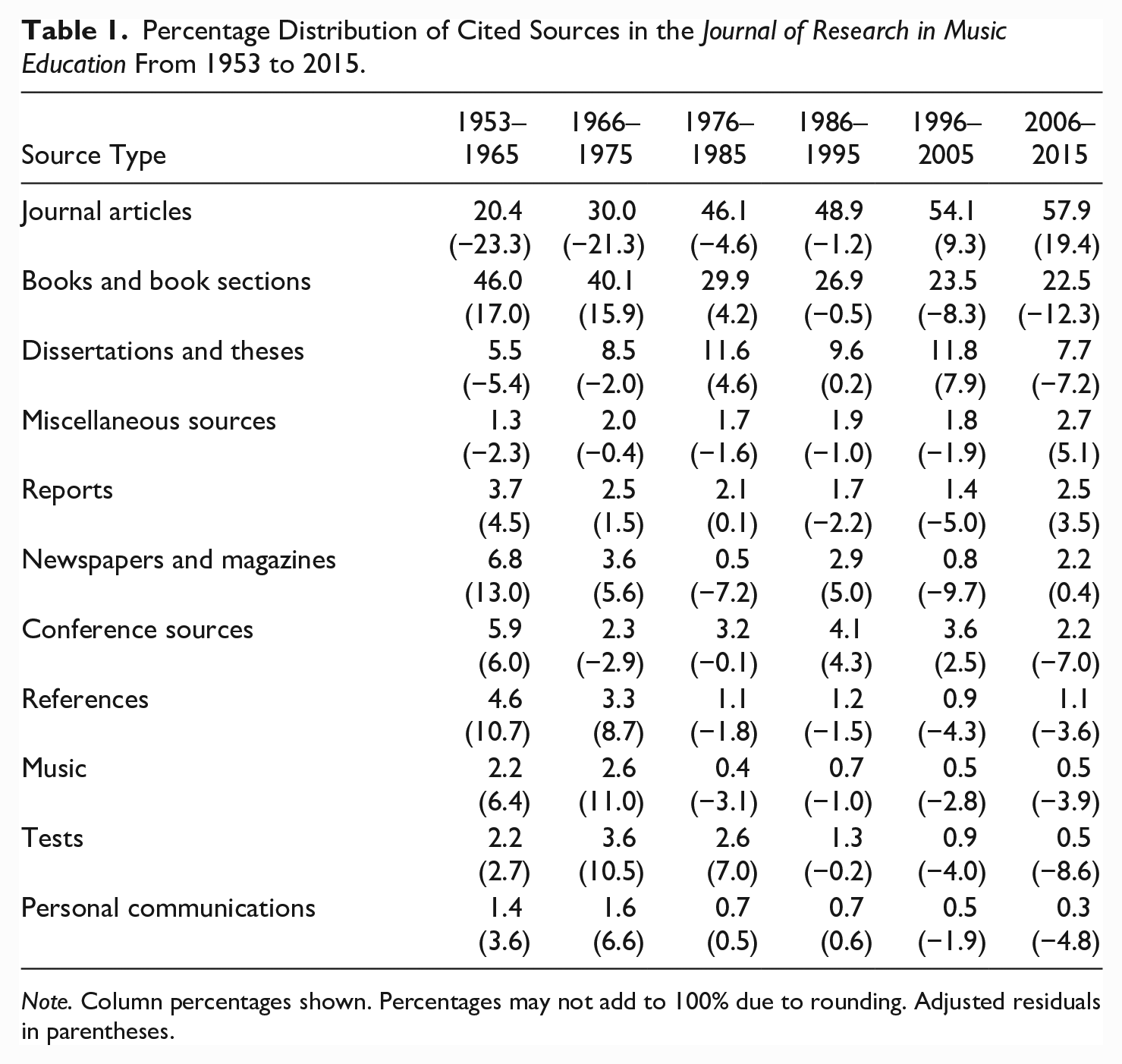
In answer to the second set of research questions regarding the types of cited sources in the JRME over the history of the journal, we found that most of the 31,679 citations were to sources classified as journals (15,706, 49.6%) and books and book sections (8,595, 27.1%). Less common citations were to dissertations and theses (3,028, 9.6%), conference sources (1,019, 3.2%), newspapers and magazines (668, 2.1%), reports (660, 2.1%), references (453, 1.4%), and tests (436, 1.4%). The smallest numbers of citations had fewer than 1% representation each and were to music (246, 0.8%), personal communications (207, 0.6%), and miscellaneous sources (661, 2.1%) such as software, manuals, booklets, audiovisual media, websites, items, assorted artifacts, and other unpublished materials.
To reveal changes in sources cited by the JRME authors across time, we disaggregated the data across the six periods and recalculated the proportional distributions as shown in Table 1. An association between reference type and period was confirmed, χ2(50) = 2,409.36, p < .001, Cramer’s V = 0.12, so we examined the residuals in each cell to identify possible trends across time within each reference category. Adjusted residuals were used in place of standard residuals to compensate for the large differences in observed frequencies.
Percentage Distribution of Cited Sources in the Journal of Research in Music Education From 1953 to 2015.
Note. Column percentages shown. Percentages may not add to 100% due to rounding. Adjusted residuals in parentheses.
Based on the data in Table 1, the proportion of citations to journals increased from approximately 20% of the total to 58% most recently, an increase of approximately 290%. Simultaneously, there has been a strong increase in the raw number of journal articles cited by the JRME authors, from approximately 26 to 552 annually (>2,100% increase).
There has also been a smaller increase in the number of books and book sections referred to annually, from approximately 58 initially to 214 (>360%). However, the proportion of books and book sections decreased from approximately 46% to 23% over time. An observed change of positive to negative residuals reinforces the decline and indicates that it primarily occurred after the first 23 years compared to the last 20 of the JRME.
Results for the other reference categories are less clear. For example, dissertations and theses appear to look a bit like an inverted U overall. They began with approximately 6% of the total, and in the last 10 years they were roughly 8%. Between these years was a peak of approximately 12%. Moreover, newspapers and magazines, references, tests, and music were more prominently cited during the first 23 years of the JRME than later years. This could be due to a slight decrease in citations to these documents overall, but over time, it simply appears the dominance of citations to journal articles proportionally suppressed growth of these sources.
To place these results in the context of a single article from the JRME, we considered the number of articles published and mean number of cited materials referenced in the JRME by period and then calculated the number of sources by type. References in an average article from the JRME published between 1953 and 1965 comprised 2 to 3 journal articles, 5 to 6 books/book sections, a dissertation/thesis, a newspaper/magazine article, a conference paper/presentation, and a reference source (e.g., dictionary), while the references in an average article from the JRME published in 2006–2015 comprised 23 to 24 journal articles, 9 books/book sections, 3 dissertations/theses, a report, a newspaper/magazine article, a conference paper/presentation, and a miscellaneous source (e.g., computer program or website).
Discussion
One indicator of the JRME evolving into a scientific publication is the predominance of citations to journal articles over other sources. The prevalence of this cited source type demonstrates that our field has arrived to what one would expect in a mature scientific research discipline, being mainly focused on the most current findings as published in journals rather than a dependence on books and other references, which tend to serve as repositories of accepted information and ideas. Interestingly, this apparent consensus around the importance of journal articles largely differs from other serials in the humanities and arts where sources such as books, performances, and artistic works are most often referenced (Fanelli & Glänzel, 2013; Garfield, 1982; Huang & Chang, 2008; Moed, 2006) and places this citation practice, as exhibited in the JRME from 1976–1985 through 2006–2015, closer to those for journals in the social sciences and other science-related fields. This is not to say that the other source types are not important to researchers in music education. Indeed, with the increased number of sources cited per an article across publication eras of the JRME, the reliance on some sources actually increased the number of book references increased from five per article in the earliest era to nine in the last as shown in Supplemental Table S1 (in the online version of the article), suggesting that books are still important sources used to construct their studies and convey findings, echoing work by Kratus (1993) and others in music education.
Age Distribution of Cited Sources
To examine the third set of research questions regarding the relative age distribution of cited sources and whether it changed over time, we first compared the median age in each period with the overall median using a nonparametric equality-of-medians test to determine whether citing articles in different periods were mostly citing newer or older sources and then conducted a visual analysis of these distributions to see how the ages were grouped around the medians. Next, we examined cited sources that were less than 5 years old with the dSPI and compared those to other research fields indices (i.e., a comparison of research fronts) to see how much newer sources contribute to the dialogue among music education researchers.
Equality of medians
Test results showed the medians were significantly different from one another, χ2(5) = 281.26, p < .001, Cramer’s V = 0.04, and suggested that mostly sources older than 12 years were cited in 1953–1965 (Mdn = 22 years) and 2006–2015 (Mdn = 13 years) and newer than 12 years in 1976–1985 (Mdn = 10 years) and 1996–2005 (Mdn = 11 years). Despite the significant statistical result, we observed a very low effect size for the test, attributable to the large number of observations overall, and values equal to the median; hence, our focus shifted to the visual analysis and dSPI calculus.
Density plots
The six density plots shown in Figure 1 illustrate the age of the cited sources in the JRME across six periods and show the distributions were clearly skewed, favoring newer sources; the solid vertical line plotted at Year 12 indicates the overall median age for all cited sources from 1953 to 2015. A visual analysis of the density plots indicates that the JRME authors cited sources across a wider time range between 1953 and 1965 and 1966 and 1995 than later authors, as shown by the flatter distribution in the 1953–1965 and 1966–1975 plots. The markedly peaked distributions for 1976–1985 and 1996–2005 plots indicate the JRME authors mostly cited sources that were 11 or fewer years old, with the largest number of cited sources being between 5 and 7 years. For the JRME articles published between 2006 and 2015, a slight shift in the distribution reveals that authors cited more older sources (aged 13 or more years) than in prior periods.

Citation density plots by period illustrating the relative age distribution of cited sources in the Journal of Research in Music Education no older than 60 years.
dSPI
To assess how reliant the JRME authors are on younger versus older sources when citing materials in their articles (i.e., the speed of the JRME’s research front), we followed the lead of Fanelli and Glänzel (2013) and calculated the dSPI for the journal, which was the proportion of sources as old as 5 years overall and for each period. Results showed the overall speed of the JRME’s research front for these 62 years of the journal was 22.2%, which indicates it is just past the cusp of being similar to research in the social sciences (21%–42%) versus the natural sciences (>42%) and nonsciences (<21%). When demarcated by era, the dSPI changed over time, with the progression of indices resembling an inverted U as it accelerated from 19.7% in 1953–1965, peaking at 26.0% in 1976–1985, and then seemed to slow to 20.9% in 2006–2015.
Discussion
The age of these sources suggests music education research is “archival” in that researchers rely on fewer younger sources (22% ≤ 5 years) when compared with practices in the natural sciences where mostly newer sources (42%–70% ≤ 5 years) are cited. This places the citation practices for research published in the JRME in line with the social sciences, where a relative balance of older and newer sources informs scholars’ works. The implications of this for music researchers is that to contribute to the field, they are expected to have an understanding of both older and newer research. At the same time, this result supports the notion that music education research published in the JRME remains highly citable for years (Hancock & Price, 2015) and that the uptake or time to first citation is relative quick (Hancock, 2015). It should be noted that some types of research (e.g., historical) depend on references to archival materials, so citing a preponderance of newer sources may not always be realistic or desired.
Cited Journals
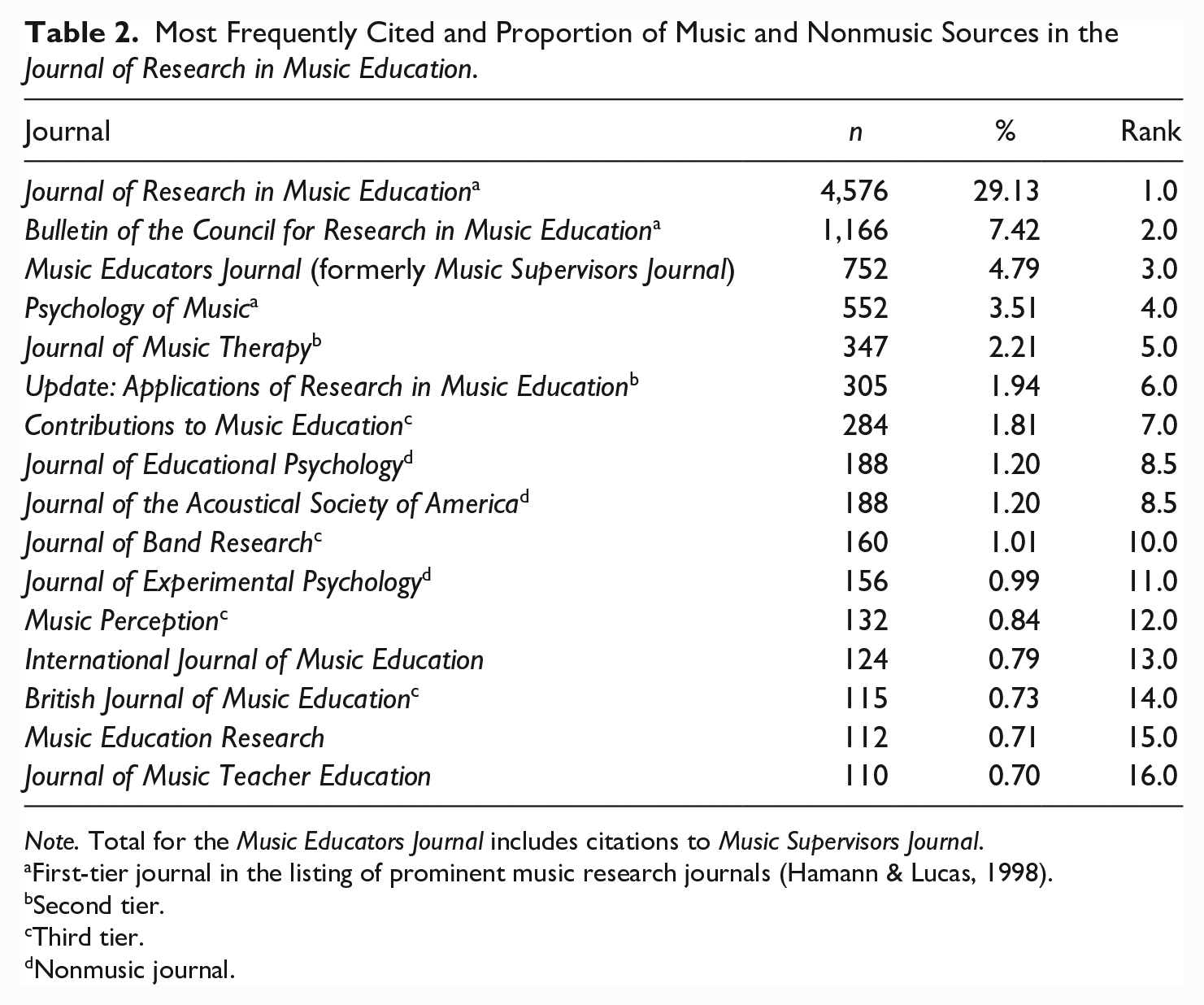
To examine the fourth set of research questions concerning cited journals and their subject areas, we first determined that there were 1,321 journals. Table 2 lists the 16 most cited journals (>100 references) and their proportion of the total, representing 9,267 (59%) of 15,706 total citations. The top 50 serials account for 71.8%, but only the first 5 represent more than 2% each. No source was referenced near the JRME (29.1%), with BCRME the only one above 5%.
Most Frequently Cited and Proportion of Music and Nonmusic Sources in the Journal of Research in Music Education.
Note. Total for the Music Educators Journal includes citations to Music Supervisors Journal.
First-tier journal in the listing of prominent music research journals (Hamann & Lucas, 1998).
Second tier.
Third tier.
Nonmusic journal.
To provide additional context for the ranking of these top cited journals, we indicated in Table 2 those previously ranked and binned into tiers according to citation frequency (Hamann & Lucas, 1998, p. 409). The top six journals were similarly ranked with the exception of the MEJ. It was the third most frequently cited journal in the present study and the top nonresearch journal in Hamann and Lucas (1998). We should note that in Table 3, we combined the tallies for the MEJ and its immediate predecessor, the Music Supervisors Journal, because these were the same publication.
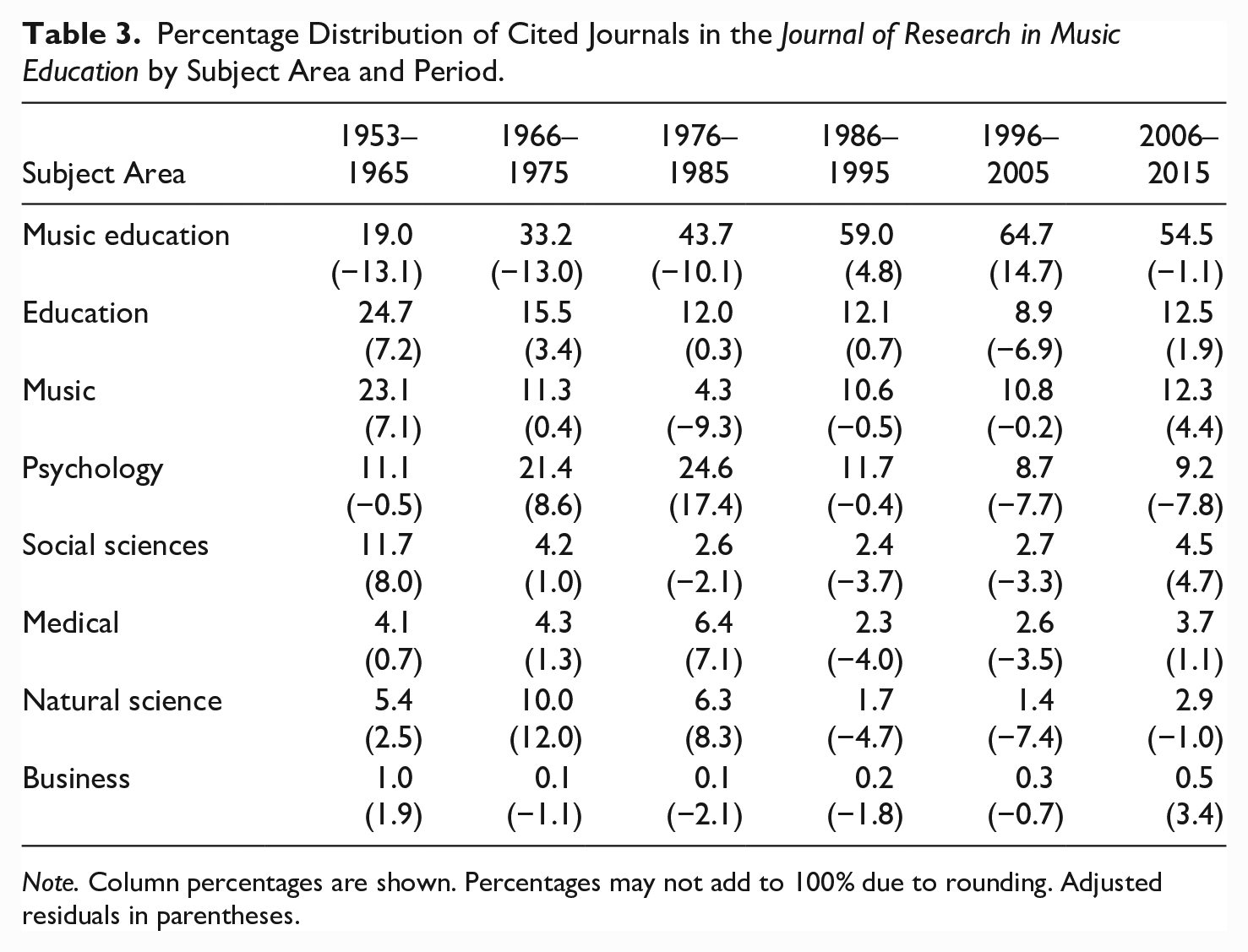
Percentage Distribution of Cited Journals in the Journal of Research in Music Education by Subject Area and Period.
Note. Column percentages are shown. Percentages may not add to 100% due to rounding. Adjusted residuals in parentheses.
In Supplementary Table S2 (in the online version of the article), we disaggregated the citations to journals by periods and found several interesting points. During the first 22 years of the JRME, authors cited a wide variety of journals, with 14 accounting for nearly half (48.2%) of the citations to journals from 1953 to 1965, of which 8 (57.1%) were not music journals. Similarly, 13 journals accounted for nearly half (49.0%) of the citations to journals from 1966 to 1975, and 9 (75.0%) were not in music-related fields. However, most of the cited journals for the next 40 years were dedicated to music.
The number of titles accounting for half of the citations to journals in the JRME decreased from 15 initially to 4 in 1986–1995 (JRME, MEJ, BCRME, POM) and 1996–2005 (JRME, BCRME, POM, MEJ). Conversely, for the last era examined, the number of titles needed to represent half of the cited journals increased to 9. Interestingly, with the exception of the first era when the MEJ was the most cited journal, for the past 50 years (1966–2015), the JRME was referenced considerably more than any other journal. It should be noted that the MEJ was ranked among the top 4 cited journals for every era, except for 1976–1985, where it was the fifth most cited journal.
In Table 3, we analyzed the subject areas of the cited journals, disaggregating the counts across the six periods, and calculated the percentage distributions. An association between the subject area of the cited journals and period was confirmed, χ2(35) = 1,285.64, p < .001, Cramer’s V = 0.13. Examination of the adjusted standardized residuals in each cell resulted in one clear trend—an increase in citations to music education journals from 19% during the first 12 years of the JRME, with a consistent rise of the percentage to 55% in the past 10 years, a proportionate increase of approximately 290%. Results indicate that during the first 12 years of the JRME, education and music journals were cited the most. In the subsequent 20 years, music education and psychology journals were predominately referenced, while in the past 30 years, music education journals were cited more than others. Education and music journals were proportionately reduced by about 50% and social sciences by a larger amount.
Discussion
During the eras examined, there has also been an expansion in relevant journals publishing music education research (cf. Hancock & Price, 2016; Price, 1997), which were increasingly cited over journals in other disciplines (see Tables 3 and S2). It appears that citation norms consolidated around a set of discipline-specific journals in the 1986–1995 and 1996–2005 eras. These were the JRME, BCRME, MEJ, and POM, all publishing works in music education, suggesting that communication of important scholarly work crystalized around these four “core” journals with the JRME consistently being the foremost source (see Table 2). The emergence of a central research journal and establishment of a principal set of discipline-specific serials are strong bibliographic indicators of a robust scientific research field operating in a paradigmatic state. However, an increase in journal titles cited from four to nine during the latest era (see Supplementary Table S2, 2006–2015) may foreshadow a paradigmatic shift in the breadth of cited journals that are discipline-specific but have different aims and purposes.
Our data indicate a lot of support for how strong the JRME is to the music education profession around the world (Price et al., 2010). There were 50 journals that represent 72% of the JRME’s cited journal articles, with 1,272 representing the other 38%. The breadth of journal sources cited by the JRME authors is remarkable and suggests some openness to the ideas present in other disciplines’ publications. We should note, however, the top seven journals alone represented 51% of the cited journal articles found in the reference lists in the JRME, and the JRME itself constituted 29%. This crystallization of the structure of the “communication network . . . organized around the journal” is a positive marker of journal and discipline health (Schubert & Maczelka, 1993, p. 577) and a common characteristic of scientific research where specific journals are valued more so than others (Fanelli & Glänzel, 2013, p. 6). Although this is a positive sign, we also need to remember the need to broaden our sources across areas, including those not in music, to enhance our perspectives.
Cited Articles and Authors
To examine the fifth set of research questions, we first determined those articles that were most often cited, examined the overall frequency of references from 1953 to 2015, and ranked the order. Supplementary Table S3 (in the online version of the article) lists the 25 most frequently cited journal articles in the JRME and indicates those previously identified as highly cited in earlier sources (Rutkowski et al, 2011; SAGE Publishing, 2016; Sample, 1992; Schmidt & Zdzinski, 1993). Nineteen (76%) of these articles were previously recognized in four sources, with 15 (60%) by more than one source.
Following that, in Supplementary Table S4 (in the online version of the article), we disaggregated our data to reveal those articles cited more often during specific periods, concentrating our efforts on the top five. This table appears slightly irregular because five articles were not listed every time. Sometimes, the top five articles had a few more listed due to ties, whereas others had an extremely long list tied and consequently were not included. We felt this was the best way to present these data.
Finally, after examining the articles, we focused our observations on authors and the frequency of citations to their journal articles, counting them equally regardless of the order they were in the citations, from first to last. The 50-most cited authors of journal articles that were referenced in the JRME are in Supplementary Table S5 (in with the online version of the article). The most cited author was C. K. Madsen, whose journal articles were referenced 679 times in the JRME and then J. M. Geringer with 399. As occurs in other studies of this type, these two authors have had many coauthored works in addition to carrying out research independently or with other colleagues. The rest of the top 5 cited authors of articles (>265 times) were C. Yarbrough, R. A. Duke, and H. E. Price. Although not as extensive, Yarbrough and Price also coauthored a few studies.
To bolster these results, we cross-checked our list with those authors who were previously identified as highly cited and productive scholars in music education (Brittin & Standley, 1997; Standley, 1984; Yarbrough, 2006) as well as those recognized by the Society for Research in Music Education with the Senior Researcher Award. These results are represented with the superscript letters in online Supplementary Table S5. Of these authors, 32 (62.8%) were previously identified, with 17 (33.3%) by more than one source. Most importantly, two authors, C. K. Madsen and C. Yarbrough, were identified as highly cited in all four sources.
Supplementary Table S6 (in the online version of the article) disaggregates the data from Supplementary Table S5 and lists the top 25 authors of cited research articles for each period. Several of the authors appear on multiple lists, with C. K. Madsen being the only one listed as the most highly referenced person in five (50 years) of the six periods. Next we have J. M. Geringer, A. LeBlanc, and C. Yarbrough, who were highly cited in four lists (40 years), and R. A. Duke, P. J. Flowers, R. D. Greer, R. S. Moore, and H. E. Price were the most cited in three adjacent eras (30 years).
Discussion
Noting the most cited authors of journal articles overall and by era gives us another interesting perspective of the construction of research methods and contributions of scholars over time. The contributions of those we identified are some of the most important to the field of music education, as repeatedly confirmed by studies of music education research. Some of the citations we tabulated are attributable to authors citing their prior work as they embarked on pioneering lines of research, systematically investigating issues derived from a clear research agenda over time. Clearly, this dependence on one’s cumulative efforts to finely hone methods and understanding has been identified as a mark of highly productive scholars (Mishra et al., 2018). Moreover, some of the citations are attributable to the coauthorship of works (Wuchty et al, 2007), which has been steadily increasing in number and authorship in the JRME articles (Sims, 2013). Despite these understandings in the literature, the fact that the work of these scholars as published in journal articles continues to accumulate citations speaks to the foundational importance of their work and the topics investigated to scholars in the field.
The top 50 authors were referenced approximately 5,024 times, which constitutes only 16% of all citations in the JRME. Although these lists were constructed using only citations to their journal articles, this can be interpreted as the pool of cited authors is actually quite large and there are plenty of opportunities for many citable authors to be referenced. This openness to the works of a variety of scholars complements the importance of having an emergent group of highly cited scholars in a field. This indicates robust ongoing research activity by both experienced researchers and others who are developing, which is what we would expect to find in a mature research discipline. At the same time, this number of citations constituted 32% of all journal article citations, which largely reinforces the importance of their scholarship to the field and lends evidence to music education showing signs of consolidation around the work of a core set of scholars.
The examination of the most cited articles was also interesting. There were four articles published in the 1980s and referenced between 30 and 39 times. Of these, two had Yarbrough as the senior author, with total references by 69 articles; indeed, she had three articles among the top eight mentioned for a total of 96 times. The second most referenced senior author, LeBlanc, had four journal articles cited 20 or more times, with a total of 104 citations of his works. Clearly, the topics of these articles should be explored in future bibliometric studies.
Implications
As noted, our analysis of the age of cited sources indicates that music education researchers tend to embrace newer and older source materials. The implication is that newer scholars may need to be well versed in older scholarship aged 12+ years as well as the latest works to frame their research. Fortunately, the posting of journal articles online allows access as far back as the first issue of a journal, as was done in this study.
It should also be noted that new scholars need to be well versed in the scholarship found in the four core journals identified in this study (the JRME, CRME, MEJ, and POM) because they are the primary sources of scholarly communication in our field. The inclusion of the MEJ, a journal without a research emphasis, is an important consideration for the profession because it speaks to the foundational importance of this publication to our collective work. At the same time, scholars at all levels need to consider the work published in other journals, in close and distant fields, to continue to introduce new ideas to the profession (Price, 2018). As has been said before, the emergence of new refereed journals is an indicator of “robust research activity and increased depth of research in our field,” and supporting these only brings greater enlightenment to the profession (Price, 1997, p. 4). Moreover, although journal articles are the primary source for scholarly communication in music education, books and book sections still hold an important position in the literature, as shown by their presence in the references of an average article from the JRME, and should not be overlooked by scholars. Finally, the work of those highly cited scholars and highly cited studies consistently identified over time may provide an excellent starting point for those learning about the research enterprise.
Conclusion
As Kratus (1993) noted over 20 years ago, “as a profession grows and matures, it becomes necessary to take stock periodically of the persons, journals, and books that have helped shape the current state of the field” (p. 22). Through our tabulations, we revealed those authors, disciplines, sources, journals, and studies influential to music education research overall as well those germane during discrete and contiguous eras of the journal. In addition, we overlaid results from other reports onto ours—in essence, addressing the research question posed by letting the data speak for themselves (Fanelli & Glänzel, 2013, p. 1).
Previous studies of research in music education have identified significant articles, influential researchers, and important journals, to name a few. Still others have measured the immediate and long-term impact of music articles on research in related and distant fields. Despite the importance of these studies, most examined a slice of scholarship available at the time of the study. What makes the present study unique is the application of many of those same questions—and several new ones—to the study of the collective citations and referencing behaviors of scholars across 62 years of published articles in the leading journal of the profession, the JRME. In addition, this study expanded the scope of those works by demarcating references among contiguous eras of the journal, which informs us about how the profession has conducted research across those years. “Evidence of changing paradigms in music education research are useful indicators of what counts as important research in the field, what the mind-set driving research practice is, and which particular beliefs, values, and practices are emphasized” (Jorgensen & Ward-Steinman, 2015, p. 267).
Some of the practices we observed suggest the profession is healthy and is developing new research ideas based on older work as well as the most current understandings and growing into new areas well beyond the initial founding of the journal. Other observations show that music education research has matured as a field with well-established journals, seasoned influential scholars, and archetypical articles. Like Schubert and Maczelka (1993), we wanted to better understand trends and shifts in how scholars are carrying out research in our field and how the enterprise has changed over time based on bibliometric evidence. Together, these results and those of other bibliometric studies in music education suggest that we are citing from a healthy pool of source materials and selecting a mix of archetypical works and newer findings. We have a group of established authors producing important research over many years that serves as a foundation for much of what we do. As the profession continues to determine the best means for preparing future researchers and teachers, it seems important to identify those frequently referenced sources and authors that exert a strong influence on our pursuits. It is our view that the more informed we are about our discipline’s research, the better we understand it. Hopefully, these data provide useful insights.
Supplemental Material
Hancock_and_Price_SupplementaryTables_FINAL – Supplemental material for Sources Cited in the Journal of Research in Music Education: 1953 to 2015
Supplemental material, Hancock_and_Price_SupplementaryTables_FINAL for Sources Cited in the Journal of Research in Music Education: 1953 to 2015 by Carl B. Hancock and Harry E. Price in Journal of Research in Music Education
Footnotes
Acknowledgements
We acknowledge the help of graduate assistants E. Danielle Todd, Kaitlyn Traylor, Emily Gray, Brian Lindsay, Arie VandeWaa, and Michelle Scroggie as well as undergraduate volunteers from the University of Alabama with organizing the sources examined in this study.
Declaration of Conflicting Interests
The authors declared no potential conflicts of interest with respect to the research, authorship, and/or publication of this article.
Funding
The authors received no financial support for the research, authorship, and/or publication of this article.

Notes
Author Biographies
References
Supplementary Material
Please find the following supplemental material available below.
For Open Access articles published under a Creative Commons License, all supplemental material carries the same license as the article it is associated with.
For non-Open Access articles published, all supplemental material carries a non-exclusive license, and permission requests for re-use of supplemental material or any part of supplemental material shall be sent directly to the copyright owner as specified in the copyright notice associated with the article.
