



Abstract
The purpose of this study was to investigate processes that led practicing music educators in a graduate course to examine their beliefs and practices regarding inclusion, responsiveness, equity, and justice. Using Charmaz’s constructivist approach to grounded theory, we interviewed 22 participants from MUS 8XX: Philosophy of Music Education. Constant comparative analysis yielded an explanatory framework, which we presented as a model and named “transformative learning processes (TLP) for practicing music teachers encountering social justice.” TLP comprises four interrelated components: “building Gemütlichkeit,” “grappling with difficult material,” “emotional intensity,” and “course structures,” with “stories” acting as a hub for each of the interconnected categories. By describing processes that led practicing teachers to examine their mindsets and plan to change their practices, TLP could provide guidance for music teacher educators at the graduate level regarding how to approach social justice topics in their teaching.
Keywords
The school-aged population in the United States continues to diversify. The proportion of students who are Latinx or biracial is increasing, while the proportion of Black and Asian/Pacific Islander student enrollment holds steady and the proportion of White students declines (Kena et al., 2016). These racial categories do not adequately describe the concurrent increase in both variety and number of students’ places of origin, home languages, and religions (Fortuny et al., 2010; Kena et al., 2016). Increases in student diversity are not limited to racial, ethnic, and cultural characteristics; an increasing number of students receive special education services (Kena et al., 2016), and students are increasingly open regarding gender identification and sexual orientation (Mitchell et al., 2014). Perhaps in response, music education researchers have broadened and intensified their focus on social justice topics, including but not limited to antiracism (Bradley, 2015; Hess, 2017), critical theory (Abrahams, 2005; Regelski, 2005), equitable access to school music instruction (Butler et al., 2007; Elpus & Abril, 2011), inclusive practices regarding gender and sexuality (Palkki & Caldwell, 2016; Silveira & Goff, 2016), inclusive practices for students who receive special education services (Hammel & Hourigan, 2017; Salvador, 2013), and culturally responsive pedagogy (Kelly-McHale, 2013; Lind & McCoy, 2016). Thus, the need for action to increase inclusivity, equity, and justice in school music instruction is firmly established.
It stands to reason that music teacher educators should focus on preparing music educators who are willing and able to teach all students. However, Salvador and Kelly-McHale (2017) found a pervasive difference blindness among music teacher educators, a majority of whom reported that “all children should be treated the same regardless of any difference, that effort and ambition are enough to rectify unfair treatment, or that there is no place within the curriculum for . . . social justice ideals” (p. 19). Treating everyone the same assumes all children are the same, as in color-blind racism (Bradley, 2015), and can be particularly problematic when assumed sameness further marginalizes students of color, students with disabilities, and more. Some respondents to Salvador and Kelly-McHale’s survey reported interest in addressing social justice but cited a lack of time and/or lack of expertise as reasons they did not. It is therefore unsurprising that practicing teachers report challenges teaching diverse learners and cite lack of preparation as one reason they struggle (Kelly-McHale, 2013; Palkki, 2015; Salvador, 2015). Graduate education presents an opportunity to assist practicing teachers in their efforts to teach diverse learners. Although a few recent studies examined teacher experiences of graduate education in music (Conway et al., 2009; Kos & Goodrich, 2012), they did not address inclusive practices or equity specifically. The purpose of this constructivist grounded theory (GT) study was to investigate experiences that led music educators in a graduate course to examine their beliefs about social justice and to plan changes in their classroom practices.
GT researchers disagree about the appropriate time to complete a review of literature when conducting this type of research. Glaser and Strauss originally argued against any literature review prior to GT research in order “to allow categories to emerge naturally from the empirical data during analysis, uninhibited by extant theoretical frameworks and associated hypotheses” (Dunne, 2011, p. 114). Because we recently had read relevant literature (e.g., Hess, 2015; Koza, 2002; Schmidt, 2013), we could not “pretend to be . . . theoretical virgin[s]” (Dunne, 2011, p. 117). Therefore, we chose what Dunne described as middle ground, acknowledging that we had some background in the literature but seeking to allow theory to arise from the data rather than from systematic literature review leading to a hypothesis (Charmaz, 2014). Accordingly, this article begins with a brief rationale, followed by study design and findings. We conclude by situating our findings in the literature and discussing potential implications for research and music teacher education.
Rationale
In summer 2016, Karen taught Allison and Matt in MUS 8XX: Philosophy of Music Education. This three-credit course was part of a master’s degree program for practicing teachers at a large midwestern university (which we will call LMU). In final presentations, philosophy papers, and course evaluations, most participants mentioned changes in mindset and/or intentions to change their practices to become more inclusive educators, and many attributed this intention to their experiences in the course. For example, a comment on one anonymous course evaluation read, “Thank you. I have never been so conflicted and challenged, and I appreciate it. . . . I have grown as a person and as an educator.” Seeking to understand what happened in MUS 8XX that had such an effect on participants, Karen invited participants to study the course and its aftermath. Two students, Allison and Matt, volunteered as co-researchers. 1
Design
Method
Acknowledging that we sought to examine a psychosocial process in which we took part, we selected Charmaz’s (2014) constructivist GT as a method. Glaser and Strauss (1967) proposed GT as a systematic method to objectively examine qualitative evidence, moving beyond thick description of individual or group experiences in search of broader conceptual explanations. Constructivist GT differs from earlier iterations of GT by proposing that neither data nor theory is discovered; it is co-constructed by researchers and participants (Charmaz, 2014). Thus, the research process emerges from interaction, positionality of researchers and participants are consistently interrogated, and because the researcher and researched co-construct the data, “data are a product of the research process, not simply observed objects of it” (Charmaz, 2008, p. 402).
Theoretical Frame
Use of constructivist GT as a set of strategies for generating and examining data required that we frame this article within an ontology of multiple socially constructed realities with roots in pragmatism and social interactionism (Charmaz, 2008, 2017; Creswell & Poth, 2018). In seeking explanatory frameworks for psychosocial processes, we assert these realities can be understood, albeit imperfectly, within the bounds of specific contexts, understanding that “any conclusions developed by grounded theorists are . . . suggestive, incomplete, and inconclusive” (Creswell & Poth, 2018, p. 86). Constructivist GT’s epistemological stance that data are co-constructed had two important implications for our design. First, although research norms dictate we acknowledge that data for this study are self-reported, we reject objectivist paradigms that cast our participants as possibly unreliable objects of an interview rather than as self-aware agents in a co-constructed social process (Roulston, 2013, p. 58). Second, our role as co-constructors required deeply reflexive methodological self-consciousness (Charmaz, 2017). Criteria for evaluating constructivist GT should include credibility, originality, resonance, and usefulness.
Reflexivity
We began this study by writing positionality statements, seeking to understand our roles, identities, and perceptions as participants and researchers, students and professor, white people, male and female, and choral, general, and instrumental music educators. Throughout study design, interviewing, and data analysis, we wrote memos, both as a form of data generation and analysis and as a way to acknowledge and examine our subjectivities and how they may have impacted our perceptions of what participants were saying. In addition, upon receipt of each member-checked transcript, the interviewer completed a reflexivity sheet (Mauthner & Doucet, 2003) intended to promote awareness of subjective reactions, consistent with our “epistemological assumption that intellectual and emotional reactions to other people constitute sources of knowledge” (Mauthner & Doucet, 2003, p. 219) (see Appendix C in the online version of this article).
Researcher lens and roles
We also consciously sought to be transparent regarding our lenses and roles. Karen, a white, atheist, cis female, straight, nondisabled, tenured professor, believes that critical examination of diversity, inclusion, equity, and justice must be interwoven throughout music teacher education. She therefore designed this philosophy of music education course using typical materials (see Appendix D in the online version of this article) but framed and interrogated these materials through a social justice lens. She did not, however, design the course with the intent to study it. Allison reflected that her experiences growing up in culturally diverse suburbs of Cleveland and serving on a social justice team in high school shaped her perspective on this research and the topics covered in the philosophy class. Matt grew up in a less diverse place and comes from a more conservative upbringing. He has surprised himself with “how much time I [now] devote to things other than simply rehearsing music—having critical conversations, allowing time for kids to be vulnerable with each other.”
As the most experienced researcher, Karen led study design and writing and provided materials and guidance regarding interviewing and data analysis. To the degree that it was possible, Matt and Allison were equal partners in interviews and analysis, and Allison contributed significantly to writing this article. Although we are all cisgender, straight, and white, other aspects of our mixed research team (male/female, students/professor, instrumental/choral/general, Mormon/Episcopalian/atheist, regional differences) were critical not only for co-constructing data and deriving theory but also for reflexivity practices. Because each author experienced the course, and two of the authors then returned to their classrooms to grapple in the aftermath, we were positioned to elicit responses, building on our already strong relationships and shared experience as we sought to understand what happened in the course.
Participants
We used comprehensive sampling (Roulston, 2013), inviting all possible participants (N = 26). These 17 women and 9 men were all full-time teachers with 1 to 17 years’ experience, who taught various age groups preK–12 in general music, choir, band, orchestra, jazz, and other classes in 10 states. Participants predominantly were novice teachers (3–7 years’ experience), and only 3 had taught more than 8 years. Individuals revealed a variety of identities that encompassed gender, socioeconomic status, sexuality, race, religion, and age. Most participants were white and came from middle- to upper-middle-class, suburban backgrounds, which reflects the demographics of the music education profession (Elpus, 2015). Being mostly white and female, MUS 8XX also mirrored demographics of graduate students in education programs (King, 2019). Twenty-two participants (85%) consented to share course materials and engage in interviews. (See Appendix A in the online version of this article.)
Research Process
We wrote memos describing our biweekly researcher meetings, in which we discussed GT design and procedures (Charmaz, 2014), studied interview skills and processes (Roulston, 2013), examined artifacts, and designed interview questions. We adopted a semistructured dialogical interview process (Roulston, 2013), explicitly asking participants to co-construct data with us through conversation. Four months after MUS 8XX ended, each interviewer recorded and transcribed a single interview and then talked with this participant about the experience. We then met to review and discuss these interviews, seeking to hone our interview skills but also to develop our abilities regarding constant comparison of data. We conducted the remaining interviews over a 2-month period that involved regular conversations among the authors and frequent memos reflecting on what we were hearing, what we expected to hear, and how we might tailor future interviews to investigate emerging themes (see Appendix B in the online version of this article for interview procedures and timeline). Immediately after each interview, the interviewer reflected in a memo, noting salient moments and flagging potential disconfirming evidence. Each participant member-checked their transcript by editing it as they desired (Roulston, 2013). Then, each interviewer reflected using the reflexivity sheet described earlier. Interviews averaged 45 min, yielding transcripts that ranged from 2,319 words to 6,666 words. 2
Data analysis
We constantly compared data as we co-constructed it, cycling in and out of data generation and analysis, revisiting interview data, artifacts, and memos while also asking, “What’s happening here?” (Charmaz, 2008, p. 161). Artifacts consisted of course materials, course evaluations, and final projects and were used to help generate interview questions, triangulate data, and clarify information elicited from interviews. We each open-coded our member-checked transcripts line by line, using process coding (gerunds) to keep our focus on the participant’s perspective, actions, and meaning (Charmaz, 2014). Next, we randomly assigned a second coder, who first completed open, line-by-line process coding of an uncoded transcript and then reviewed the original interviewer’s coding and reflected on coding similarities and differences in a second coder memo.
Using axial coding, we collapsed codes into themes and themes into categories (Saldaña, 2015). For example, before we could accept “building Gemütlichkeit” as a category, we examined and tested different combinations of themes until we arrived at a category into which the themes and associated data fit logically. We each suggested exemplars and disconfirming evidence and grappled with naming and describing the overarching categories. This process influenced analysis of new data—and also led us to revisit existing data. When possible, we used in vivo codes (the participants’ own words) to describe themes (Saldaña, 2015). For example, the theme “being with people who understood” came directly from Chelsea’s words.
In constructivist GT, data collection and constant comparison continue until saturation, which we defined as both code saturation—we had heard it all—and meaning saturation—we understood it (Aldiabat & Le Navenec, 2018). Our memos indicated code saturation occurred prior to interviewing all 22 participants. Consistent with our belief that participants were partners in a process of co-construction, we persisted in interviewing all who had consented. Our assurances of meaning saturation included triangulation among data sources and peer review of the resonance, usefulness, and credibility of our findings by participants and a professor in the program. Meaning saturation was facilitated by the relative simplicity of our research question, our immersion in the course, and our strong relationships with participants.
Findings
We theorized transformative learning processes (TLP) for practicing music teachers encountering social justice as an explanatory framework for experiences that led this group of participants to work on becoming more inclusive, responsive, and equitable. We chose the word “transformative” because participants used it and also because, by definition, “transformative” aptly describes processes that lead people to change their mindsets and/or their actions. The four nonhierarchical, interdependent categories in TLP were “building Gemütlichkeit,” “grappling with difficult material,” “emotional intensity,” and “course structures.” We constructed a model to illustrate our findings, depicting how the categories interact and influence one another. The center circle in Figure 1 represents “in class.” Imagine each of the four outer circles rotating, meaning that each component within the categories occurred both inside and outside of class at various times, in various combinations, for various participants.
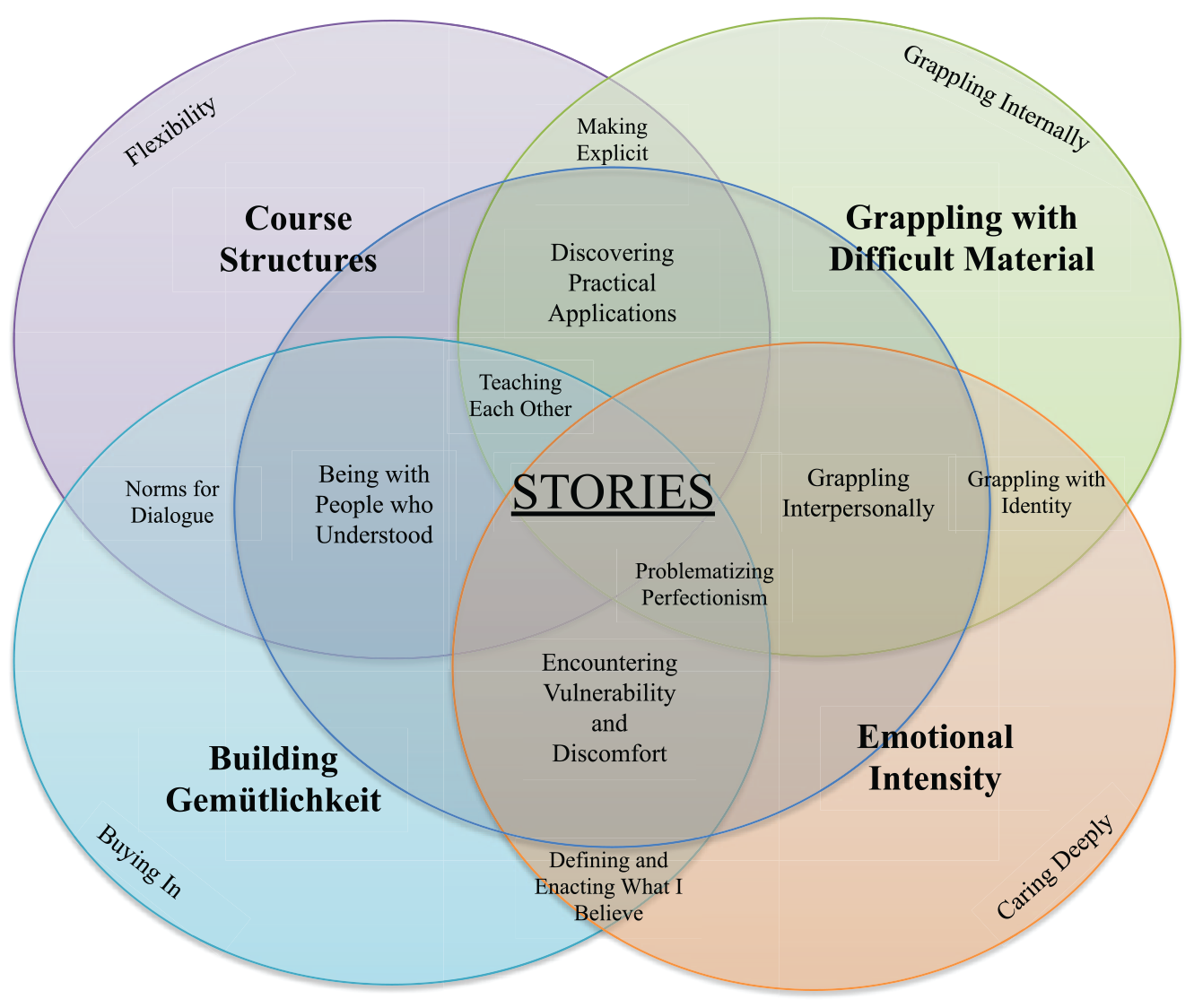
Transformative learning processes for practicing music teachers encountering social justice.
Stories are the central hub of the model because telling and hearing stories connected and intensified each component of TLP. Participants named storytelling as powerful and memorable and mentioned stories in combination with every other theme that emerged from interviews. Hearing and telling stories created Gemütlichkeit by breaking the ice and building empathetic connections. Stories helped participants grapple with material by examining their own experiences, the similar and dissimilar experiences of other participants, and the experiences of people outside of class. Both course norms and assignment descriptions encouraged storytelling as a way to share experiences, provoke discussion, and seek understanding.
Building Gemütlichkeit
The visceral experience of MUS 8XX figured prominently in participants deciding to evaluate their mindsets and plan to change their teaching practices. The class experience encompassed not only course activities but also how participants felt and the relationships they built. In interviews, most participants mentioned the feeling of the course but had difficulty naming it. The words participants offered but dismissed as inadequate come together in the German construct of Gemütlichkeit (noun): a space or state of warmth, friendliness, and good cheer, which includes qualities of coziness, peace of mind, belonging, well-being, and social acceptance (adjective gemütlich). 3
Being with people who understood
Having conversations . . . made me reflect . . . “What am I doing as far as social justice in my classroom?” And I realized I wasn’t doing anything. Being with people that understood—and I felt comfortable completely opening up and being honest with—really made me—I needed to make a change. (Chelsea)
Although the 26 class members taught different music courses and came from 10 states, they were united by feelings of professional isolation. People who understood knew what it was like to dedicate themselves to music and education. Coming together in class frequently and consistently after experiencing isolation contributed to the “special” and “close” aspects of the gemütlich experience—and also to participants’ willingness to engage in interviews, which interviewers and participants described as reigniting feelings of connection. This bond extended outside of classes as participants continued to discuss course materials over lunch and in the evenings. When speaking about feelings of connection to people who understood, most participants described a safe, nonjudgmental space inclusive of debate, disagreement, and even frustration when addressing challenging topics.
Encountering vulnerability and discomfort
I feel like the only way that you’re going to grow as a person is by being put into these uncomfortable situations. . . . Life’s not always going to be easy. And I mean this wasn’t easy. But I feel like I’ve grown as a person . . . I also know a lot more, but I’m just doing a lot more now. So I appreciated the vulnerability in there. (Casey)
The gemütlich course experience simultaneously fostered and benefited from participants’ vulnerability and discomfort. Participants agreed that discussing the “whys” and the “hows” of meanings, values, and beliefs in music education was much more personal than their undergraduate teacher preparation, which they remembered as more focused on the “whats” of curriculum and instruction. Discussing inclusion and justice in music education, participants struggled to reconcile their shared belief that music education is for everyone with research exposing exclusivity and oppression in school music education. Participants talked about feelings of vulnerability related to enacting equity and justice in their teaching and worried about how students, administrators, and communities would respond to changes that could be seen as political or to the potential learning curve if they tried something new. Shared vulnerability led to a feeling of supporting one another, being supported, and being accepted as part of the group.
This acceptance led to more vulnerability, as participants risked revealing themselves as members of identity groups and shared stories, such as personal perspectives of racial identity, religious affiliation, or sexual orientation. Some participants expressed discomfort with their own privilege, lack of action, and/or lack of understanding regarding inclusion, equity, and justice in school and in their lives. These personal stories sometimes highlighted actions or feelings that the storyteller was ashamed to share—but more often than not, another participant admitted similar struggles. Thus, the opportunity to share vulnerability was also an opportunity to build empathy and feel empowered to change going forward and contributed to buying in.
Buying in
When I saw that I had to take philosophy class I was like, “That’s bullshit.” You know, a class that I just have to deal with, and take, and I’ll be the same person I was at the end of the class I was at the beginning of the class. (Mike)
Most interview participants related a moment when they “bought in” to MUS 8XX and decided that the course would change them and their teaching practices. Many participants mentioned initial concerns that a philosophy class was irrelevant or worries that they would say something wrong. However, after the first few participants broke the ice by revealing personal connections to the material or by trying out new ideas in class, buy-in increased. For some participants, classmates making themselves vulnerable created a virtuous cycle, in which intimate sharing led to more connectedness, which led to better and more challenging dialogue. Buying in also included components of deciding to take materials to heart, deciding to “put in the work” on challenging material, and committing to contribute to class discussions.
Grappling With Difficult Material
Everything I believed or I thought I understood about my profession and my feelings about music were questioned. Down to the very essence of why do I do this? Why do I teach what I do? How do I teach? . . . I had never been challenged in that way. (Megan)
Participants described seeking out a graduate program where they anticipated rigorous study. However, some participants’ expectations for the content of graduate education did not include a philosophy course, let alone examination of inclusion, equity, and justice. Moreover, participants found course requirements challenging, including reading lengthy academic prose, analyzing complex ideas, and discussing their own practices in light of new information. Thus, grappling with difficult material was integral in participants rethinking how they taught and resolving to make changes toward more inclusive, equitable, and just teaching practices.
Grappling internally
Participants first encountered texts as material to read alone, followed by participant- or instructor-led presentation and discussion. Participants also each selected one philosophical research article to present in class. They characterized the process of reading the two textbooks and their selected article as challenging but also rewarding and engaging. Many participants described their selected article as being particularly memorable and meaningful, as were other article presentations that the group as a whole found provocative or controversial. For example, Maria described intentionally avoiding an article presentation (regarding Koza, 2002) she thought could jeopardize her comfort in leading an annual student trip to a Disney theme park. Her strategy did not succeed, because discussion of the issues raised in the article continued outside of class.
As Maria’s experience demonstrates, grappling internally was particularly salient when participants confronted ideas that did not align with their current teaching practices, their ideas about content and curriculum, or their understandings of themselves as educators. Furthermore, focus on beliefs and values led to many questions without a “right” answer, which proved to be a source of discomfort for some participants. Trying to integrate what he was learning into a coherent philosophy of music education caused Matt to “confront what I actually believe” and “be responsible for my beliefs in music education.” Similarly, Tessa said, “I was being forced to think on my own for these social justice things, and I really wanted to be certain of what I thought, and why I thought that.” Zoey related her internal grappling to her struggle with admitting imperfection, saying, “I want to believe I know what I’m doing.” Robin found it particularly challenging to tackle assignments, especially ones that sparked a passion in me, which were most of them. . . . I never wanted to stop researching and collecting information and ideas that seemed to continuously produce new intriguing associations and discoveries that excited me. It was like I was incapable of just doing the assignment.
Participants also frequently expressed personal gratification and excitement—even joy—associated with the processes of grappling internally.
Grappling interpersonally
Grappling interpersonally included questioning, challenging, and supporting one another. The gemütlich environment, cultivated through large- and small-group discussions, allowed participants to reveal themselves by telling personal stories, including describing personal and professional flaws or uncertainties. Vulnerability risked by each individual encouraged the group to empathetically address new ideas introduced through course readings and peer discussions with the width, depth, and breadth of perspective informed by their own teaching contexts. One participant who struggled to form relationships with classmates became frustrated by feelings of isolation, but the remaining participants described not only grappling interpersonally with other participants in and out of class but also talking with Karen, friends, family, and colleagues about the course.
Discovering practical applications
I had this image of, “This is how I teach and this is exactly what I do” but then constantly challenging: “Well is that really the best approach to how I’m doing things? Or is it really what I want my students to be doing? Or to be the ideas that I want to come across?” (Morgan)
In interviews, participants talked about moving beyond grappling with what Patrick called “words about words” to changing their mindsets and actions. The themes “noticing more” and “becoming more conscious” arose as participants related the frustrating and empowering experience of recognizing the weight of their words and deeds as teachers. Participants initially struggled with this responsibility through their speech and actions in class, then later in their own teaching contexts. Tessa, a white woman, said that her experiences in MUS 8XX helped her see and problematize the inordinately high rate of discipline incidents involving black students in her majority-white district. Recognizing what she called “white supremacy at work,” Tessa decided to intentionally and visibly increase relationship building with her African American students and their families. As Laura said, “[MUS 8XX] made these topics much more about my own responses . . . and how I might plan to change what I am doing about it.”
Emotional Intensity
I tell [friends] it was a great experience. I also tell them that every class, someone was crying. . . . Talking about what [teaching music]means to us and why we do what we do, I think people just kind of find themselves in it and there was just a deeper understanding, which made it even more personal because I think every person in there understood what was going on. (Wes)
In addition to grappling with difficult material in a gemütlich environment, participants identified the emotional intensity of their summer experience as a reason that they examined their beliefs and decided to change their practices. During LMU’s summer master’s program, most participants lived in an unfamiliar city while taking three or four graduate courses over 6 weeks. Moving to a new place, separation from family and friends, and the grueling amount of intellectual grappling could be part of why emotions were close to the surface, but participants singled out MUS 8XX as emotionally provocative. Elizabeth unwittingly synthesized the feelings of other participants, describing her most vivid recollections as “how much this course challenged me to think, and how emotionally reactive I often was to some of the things I read, heard, or thought about. . . . Stressed. Awesome. Empowered. Worthless. Motivated. Anxious. Tired. Inspired. All at different times, of course.”
Caring deeply
[We] all went into teaching music because we love working with the students and we love music and we love sharing that with them. (Joshua)
Participants were enthusiastic musicians, dedicated to their students, and passionate about the importance of music and music making in people’s lives. If participants did not care deeply about music teaching and learning—without that emotional connection to music and to students—they may not have taken the materials seriously and grappled with tough questions alone and as a group. In addition to caring deeply about students, teaching, and making music, participants also grew to care deeply about each other, which combined with Gemütlichkeit to produce experiences that Zoey (and others) named as therapeutic: “I struggled . . . emotionally, a lot. In a really good way. . . . I was more moved in that class than I probably ever have been. . . . [The class] changed me, a lot, and not just as a teacher but really as a person” (Zoey).
Grappling with identity
Attempting to align beliefs, values, practices, and research led participants to grapple with their professional and personal identities. For example, Erin wondered, “‘OK, how do I fit these ideas with my Catholic beliefs?’ I think it was really good for me to really think about how I can love my students and provide what’s the best for them and also be true to my beliefs.” Many participants indicated they had never been asked to define—or take responsibility for enacting—beliefs and values in music education. Participants who recalled such discussions from their undergraduate study reported that experience as a teacher changed the nature and intensity of their grappling: Prior experience thinking philosophically did not necessarily mitigate emotional struggle.
Emotional intensity arose from materials and discussion that led to discomfortable information or revelations that were inconsistent with a participant’s identities. Materials and discussion offered participants the opportunity to form identities in relation to ideas and values about inclusion, equity, and justice in education or music education—sometimes for the first time. Participants reported strong emotions when materials and discussion revealed exclusion or oppression in music education, especially when these revelations caused participants to question their own previous beliefs or actions. Participants worried that their efforts to enact more equitable and just music education would not align with current expectations for what an excellent music teacher does or what an excellent school music education program produces.
Problematizing perfectionism
We are pleasers and we don’t disappoint people. We as a profession and me as an individual, we will go above and beyond whatever is asked of us. . . . I can struggle, but I can’t fail, I shouldn’t be asking for help, and I should deliver. (Megan)
Megan’s language highlights elements of perfectionism: “should” statements, trying to please others, and fearing failure (B. Brown, 2012). Many participants wanted a “right way” to enact inclusivity and equity, and they struggled to reconcile the contextual and emergent nature of social justice with the clearly defined demands and processes in their schools and in music education. Perceiving that enacting social justice might interfere with their need to excel within valued systems, such as a contest or festival and teacher evaluation, led some participants to express feelings of frustration, guilt, inadequacy, and shame. Many participants recalled class discussions problematizing perfectionism as empowering them to embrace enacting social justice as an imperfect and vulnerable process. In contrast, Mike consistently expressed discomfort being vulnerable in class or with his students. “I’m still too terrified to try out vulnerability. Perfection—I’ll revamp the way I think about perfection.”
Defining and enacting what I believe
Participants’ increasingly daring personal disclosures, ideas for transformation, and commitment to making changes also contributed to emotional intensity. For final presentations, nearly all participants chose to write and present a “This I Believe” (TIB) essay. Rather than simply telling a story of something that happened, this capstone experience required participants to tell the “story of my beliefs about music and music education” in a succinct, 5-min statement (see Appendix D in the online version of this article). Although formats varied, participants often started with a story and transitioned into articulating a set of beliefs. TIB presentations served as individual testimony, including stories of successes, failures, fears, joys, inadequacy, and strength. Participants shared about leaving a poor, rural school for a high-tuition, private school; the power of making music after students committed suicide; the meaning of excellence; leaving a student with a disability home from festival; wanting to leave teaching and why she stayed; being a father to his students; a mentor who wished she were a boy; embracing culturally relevant and responsive practices; and more. Nearly all participants named writing, sharing, and/or witnessing TIB presentations as their most vivid memory from the course and as creating a lasting impact on their thinking and practices. Tessa expressed the feelings of several participants when she said, “It was just great to see just fellow colleagues who I’ve got really close to the past 2 years . . . share some of their strongest values about music education.”
In interviews, many participants described an emotional process of growth and change. Chelsea shared that MUS 8XX completely changed who I was as a person and as a teacher. . . . During the course I was on an emotional roller coaster . . . but the end result. . . . I’m still amazed sometimes about what it empowered me to do—for myself first and then with my kiddos.
Because there is not a right way, defining and enacting beliefs regarding social justice might mean committing to live in a state of disequilibrium—an emotionally intense proposition, to be sure. Participants also reported emotional intensity related to defining and enacting beliefs at work, as nearly half of interview participants described trying something they were afraid might fail as a part of their efforts to become more inclusive, equitable, and just.
Course Structures
Participants discussed norms, flexibility, teaching each other, and making explicit as course structures salient to examining their mindset and/or changing their teaching practices. 4 (For the course syllabus, see Appendix D in the online version of this article.) Participants focused on how, in the first class meeting, Karen set norms and ground rules. These included (a) allowing self and others to change their mind about an idea; (b) listening with the intent to understand rather than to respond; (c) being honest, even if that meant disagreeing with classmates and/or instructor; and (d) asking participants to “step back” (creating space for others to speak) and/or “step up” (frequent listeners intentionally voicing their thoughts). In interviews, participants cited various course norms as being helpful for facilitating ways to contribute to discussion as well as for critically grappling with identity and difficult materials regarding social justice.
Participants described MUS 8XX classes as “organic,” with room for “tangents” and emergent topics. Patrick said, “I liked when passion drove our discussions versus whatever was in the reading or some term that we were learning.” This flexibility involved leaving space within the course design for emergent material, consistently revisiting expectations and norms in class, and decentering grading in favor of individualized feedback and opportunity for revision. Course flexibility also resulted from choices participants made: Participants selected an article to present to the class, decided which presentations to attend, chose topics and groups for discussion, and determined the content and scope of their final projects and presentations.
Referring both to their own experience of teaching the class and to learning from their peers, participants described leadership as one of the most enjoyable and effective elements of the course. Teaching in the graduate seminar required each participant’s voice, including those who initially felt less comfortable sharing. Several participants stated that the material they taught was particularly impactful or memorable when they looked back on the course. This could be because of the level of mastery they acquired or because they exercised choice in what to present and with whom to collaborate. Some participants reported increasing leadership opportunities for their students because of their experience of participant leadership in MUS 8XX. Although teaching each other was an important component of TLP, two course evaluations indicated participants “wanted more time with Karen in front of the class. While I understand the purpose of the presentations, I felt I was most challenged with [her] in front.”
Grappling with questions about inclusion, equity, and social justice in music education required explicitly naming and exploring racism, (cis)heteronormativity and misogyny, ableism, cultural appropriation, authenticity, and other challenging topics. When setting norms the first day, Karen provided vocabulary and suggested specific strategies for how to stay present in difficult conversations, explicitly asserting that graduate education is not only cognitive; it is also emotional and embodied. Participants recalled speaking explicitly about embodied responses, emotions, vulnerability, and personal connection. We also explicitly discussed and named vulnerability, shame, and perfectionism, which can be crucial in empowering changes in thinking and practices (B. Brown, 2006, p. 50).
Positioning TLP in the Literature
In the preceding section, we described TLP for practicing music teachers encountering social justice, including building Gemütlichkeit, grappling with difficult material, emotional intensity, and course structures. This model emerged from constructivist GT analysis of interviews and course artifacts, specifically seeking to understand processes that led practicing teachers in a graduate course to reevaluate their beliefs and decide to work toward more inclusive, equitable, and just teaching practices. Although we described each category separately, the categories reciprocally supported and even created one another and must be interpreted as nonhierarchical and holistic: The confluence and interrelationships among categories led to self-examination and consideration of changes in teaching practices. Because this model emerged from data rather than a testable hypothesis developed from literature review (Charmaz, 2014), the following discussion situates our findings in the literature, identifying ways TLP supports or questions extant findings.
TLP as Transformative Learning
TLP seems closely related to Mezirow’s transformative learning (TL; Mezirow & Taylor, 2011). According to Mezirow (2003), TL takes participant frames of reference and makes them “more inclusive, discriminating, open, reflective, and emotionally able to change” (p. 58). TL is a theory of adult learning predicated on foundations including Freire’s (1973) critical pedagogy, in particular the idea of “conscientization” (Kitchenham, 2008). Freire’s critical pedagogy also informed MUS 8XX course structures and materials, and TLP themes “grappling internally,” “grappling with identity,” and “making explicit” seem related to conscientization. Learning as described in TL and supported by TLP is not just “an epistemological process involving a change in worldview and habits of thinking . . . [It is also] an ontological process where participants experience a change in their being in the world” (Lange, 2004, p. 137). Taylor’s (2011) synthesis of more than three decades of research on TL established six interdependent core elements, which align with TLP (see Appendix E in the online version of this article). Although the conceptual literature on TL discusses learner-centered teaching and explicates a process of meaning making in adult learners, (Taylor, 2007), few studies explore the realities of fostering TL in the classroom (Taylor, 2011). By describing classroom practices and interactions, TLP illustrates one possible set of processes for TL in graduate education.
Critical reflection and grappling with identity
TL proposed that a disorienting dilemma acts as a catalyst for critical reflection that leads to transformation ((Mezirow & Taylor, 2011). In TLP, this disorienting dilemma arose from defining beliefs and values about music education, weighing these beliefs and values with current practices in music education, and reflecting on personal practices. Berger (2004) characterized challenges that push students to the edge of their understanding as a “liminal space [where] we can come to terms with the limitations of our knowing and thus begin to stretch those limits” (p. 338). Berger’s work invites consideration of the ways that TLP helped participants find the edge of their understanding, provided “good company at the edge, and helped [them] build firm ground in a new place” (Berger, 2004, p. 346).
Emotional intensity and relationships
Discussing applications of TL to research in teacher change, Taylor (2015) asserted that researchers have neglected two important constructs: emotions and relationships (p. 22). Indeed, emotions (emotional intensity), and relationships (building Gemütlichkeit) were two of TLP’s most robust findings. Studying educational administrators seeking to transform schools into equitable, socially just institutions, K. Brown (2006) concluded that learners rarely change through a rational process (analyze-think-change). Instead, “they are much more likely to change in a see-feel-change sequence” (K. Brown, 2006, p. 732). In intent and findings, K. Brown’s work relates closely with TLP, particularly in singling out roles for emotionally intense learning experiences in transformation for professional educators interested in creating equitable preK–12 learning spaces. In Mezirow’s original conception of TL, the disorienting dilemma fomented “self-examination with feelings of guilt or shame” (Kitchenham, 2008, p. 105). During MUS 8XX, expressions of shame led to explicit teaching regarding B. Brown’s (2006, 2012) work on moving through shame. TLP seems to be the first model to explicitly incorporate B. Brown’s (2006) shame resilience theory in transformative education or in graduate teacher education.
Problematizing TL and TLP
Taylor (2011) asked educators interested in TL to consider issues of positionality, specifically how an educator could seek to change students’ perspectives and yet also operate “within a theoretical orientation that advocates a learner-centered approach to teaching, free of coercion, and assumes the educational experience is never value neutral” (p. 27). In her initial positionality statement while designing this study, Karen wrote, “I did plan to foment critical thinking and to ‘trouble the waters’ around exclusivity and oppression in school music education. But I did not anticipate the depth of personal reflection and transformation that participants reported.” Karen’s intent was not “transformation.” She was surprised by student responses in class to final projects and on course evaluations—that was why she suggested studying the course. Although grading was downplayed in favor of feedback and revision, Karen’s position was nevertheless a professor among students. Some participants may have adopted Karen’s language because she was in a position of power. The possibility that an intent to create TL experiences could translate into coercion is something that educators who care about emancipatory and empowering education must constantly interrogate.
TLP and Social Change
Although TLP aligned with TL, our findings questioned the individualism of Mezirow’s theory. This individualism “emphasize[s] personal transformation and growth, where the unit of analysis is primarily the individual” (Taylor, 2011, p. 28). In contrast, more social/collectivist theorists, such as Freire (1973), positioned TL as emphasizing social change so that personal change and social transformation are inherently linked. Our analysis revealed both individual/internal and social/collectivist findings, and the impetus toward transformation seemed to stem from planning for action toward social justice. Thus, TLP also illustrates an activist transformative stance, in which learning is made meaningful through identity development carried out through a “purposeful life agenda” focused on social practices and change (Stetsenko, 2009, p. 6).
TLP and Ally Identity Development
In MUS 8XX, members in dominant identity groups (race, gender, class, etc.) struggled through confronting their role(s) in hegemonic systems, in ways described by white identity development theory (Helms, as cited in Tatum, 1992). Within this paradigm, the emotional intensity of the disintegration phase may result in what DiAngelo (2018) refers to as “white tears”: the tendency of white people, particularly women, to pull attention back to themselves via outwardly emotional reactions. Several key considerations differentiate TLP and participants’ interactions with it from DiAngelo’s description of “white tears.” Course norms prohibited behaviors known to be damaging to minoritized people, such as asking them to represent a group and questioning their experiences. Participant expressions of guilt, sadness, or anger were met with “When you know better, you do better” and refocusing on how individual teachers and music education structurally could become more inclusive, equitable, and just. The emotional intensity in MUS 8XX was not only “white”; it also reflected grief about student deaths, beliefs and values about the importance of musical interactions, frustration with taking on the role of “student” again, and acknowledging impacts of sexism, misogyny, heterosexism, and ableism. Similar to the emotional consequences of disintegration in white identity development, these tears seemed to be a stage that participants moved through as they became ready to act, not only as antiracists but as allies for people across a spectrum of identities. TLP may present one pathway to address the color-blind racism Bradley (2015) described and overall difference blindness in music teacher education identified in Salvador and Kelly-McHale (2017).
TLP and the Literature on Music Teacher Education
Very few studies in music teacher education focus on methods for approaching social justice or on transformative experience in graduate education. Similar to participants in this study, participants in Lind’s (2007) study of a music educator–specific collaborative development institute (CDI) “described their participation as ‘life-changing’ and expressed a desire for similar experiences to continue throughout their teaching careers” (p. 15). CDI shared characteristics with TLP, including “meaningful intellectual, social, and emotional engagement with ideas, with materials, and with colleagues . . . explicit[ly valuing] the contexts of teaching and the experience of the teachers. . . [and] support for informed dissent” (Lind, 2007, p. 3). In 150 hours over an academic year, CDI focused on collaborative planning and observation of student learning based on understanding by design but did not directly address social justice topics, such as inclusion, responsiveness, equity, or justice.
MUS 8XX lacked CDI’s immediate application to student learning and outcomes, which experts consider an important facet of teacher professional development and learning (Darling-Hammond & Richardson, 2009). Nevertheless, TLP led to changes in beliefs and also planned action toward creating more equitable, inclusive, and just music teaching and learning environments. By providing an explanatory framework of processes and conditions that led teachers to examine their beliefs and values and to then plan social justice–oriented changes in teaching practices, TLP may represent an important addition to the music teacher educator literature.
Implications for Future Research and Conclusions
In interviews, participants described changes to their practices that specifically addressed being more inclusive, equitable, and just regarding multiple aspects of human difference. However, the salient question that emerged in this grounded theory was “What happened so they decided to take action?” not “What are participants doing?” Additional research could examine actions that teachers take after TLP. Although we believe we reached saturation with this group of participants about our shared experience, this was one group of students, and they were predominantly white, straight, cisgender, middle class, novice teachers, and female. Although this demographic mix is typical both in the music education profession (Elpus, 2015) and in graduate teacher education programs (King, 2019), additional research could examine if TLP describes other music teacher education courses and settings, particularly with more diverse groups. Such studies should explicitly consider the following: How is TLP a theory for self-discovery and ally development for those already in a dominant group? What knowledge and actions are required so the process does not injure or further marginalize any person? What facilitator/instructor knowledge is needed about history, “-isms,” and ally identity development for TLP to be effective?
We believe collaboration among course participants and professor was a valuable asset as we co-constructed data and as we sought to be reflexive about what participants told us. Therefore, we suggest that mixed research teams might strengthen constructivist grounded theory research with practicing teachers, from both epistemic and ontological perspectives. We cannot ignore the likely impact of participating in this interview process on respondents’ continued resolve to be more inclusive, equitable, and just in their practices, so future research could investigate the role of follow-up/support in TLP.
Darling-Hammond and Richardson’s (2009) review suggests TLP might be more effective as professional development if it took place while participants were teaching, both so they could apply what they were learning and so their learning could be more connected to student outcomes. Studying TLP over a school year could add important insight about changes in mindset and also regarding what actions teachers and their students found most meaningful and effective. However, researchers should consider the unclear delineation between graduate education and professional development (Conway, 2008); perhaps graduate education is an important opportunity to step away from the everyday demands of the classroom and take a bigger-picture view. Because the power of TLP appeared to arise from intimacy engendered by frequent and ongoing interactions, it may be applicable in professional learning communities for music educators (see Lind, 2007; Stanley, 2011).
We noticed that in interviews, several participants essentially said, “I don’t know if this is social justice, but . . .” and then described changes to their practices that increased inclusion and equity. Media casting “social justice warrior” as a pejorative (Ohlheiser, 2015) may have reduced some participants’ willingness to use the term “social justice” to describe evolving ideas and/or changes to practice that they viewed as positive. Reflecting on this observation, Matt wrote, I wonder if they didn’t realize we were talking about social justice because it was done in a thoughtful, supportive setting. If someone like my dad [took] the class, [he] would have expected social justice issues to be addressed with accusations and blame. (personal communication, February 2, 2017)
Music teacher educators who study and/or teach inclusion, equity, and justice may need to deconstruct the term “social justice” with participants and may even wish to study this specific phenomenon.
By describing processes that led practicing teachers to examine and define their beliefs and values, and to then plan to change their practices, TLP could provide guidance for music teacher educators who are unsure how to approach social justice topics in their teaching. We do not intend this model as prescriptive. Instead, we hope that this model suggests processes to further extend consideration of equity and justice into music teacher education and thus increase our ability to create equitable and inclusive music learning environments and experiences for all students in our increasingly pluralistic society.
Supplemental Material
JRME3886OnlineAppendicesInPress_FINAL – Supplemental material for “We All Have a Little More Homework to Do:”: A Constructivist Grounded Theory of Transformative Learning Processes for Practicing Music Teachers Encountering Social Justice
Supplemental material, JRME3886OnlineAppendicesInPress_FINAL for “We All Have a Little More Homework to Do:”: A Constructivist Grounded Theory of Transformative Learning Processes for Practicing Music Teachers Encountering Social Justice by Karen Salvador, Allison M. Paetz and Matthew M. Tippetts in Journal of Research in Music Education
Footnotes
Acknowledgements
We thank Abby Lewin-Ziegler, Jim Van Eizenga, and Joanna VanEizenga for their assistance with this article.
Declaration of Conflicting Interests
The authors declared no potential conflicts of interest with respect to the research, authorship, and/or publication of this article.
Funding
The authors received no financial support for the research, authorship, and/or publication of this article.

Supplemental Material
The appendices are available in the online version of the article.
Notes
Author Biographies
References
Supplementary Material
Please find the following supplemental material available below.
For Open Access articles published under a Creative Commons License, all supplemental material carries the same license as the article it is associated with.
For non-Open Access articles published, all supplemental material carries a non-exclusive license, and permission requests for re-use of supplemental material or any part of supplemental material shall be sent directly to the copyright owner as specified in the copyright notice associated with the article.
