




Abstract
The purpose of this research was to investigate the potential relationships between self-regulated learning with regard to instrument practice, amount of instrument practice time, and Big Five personality traits. Participants were 172 preservice teachers enrolled in music teaching undergraduate programs of three universities in Turkey. Data were collected via a demographics questionnaire, musical behaviors questionnaire, the Big Five Inventory (BFI), and the Self-Regulated Learning in Instrument Practice Scale (SRLIPS). BFI includes neuroticism, extraversion, openness, agreeableness, and conscientiousness dimensions, and SRLIPS has forethought, performance, and self-reflection dimensions. The results revealed that preservice music teachers’ last exam grade and daily practice hours on their main instrument and SRLIPS scores did not differ significantly by their year of study. Participants’ last exam grades correlated significantly with their scores on the dimensions of conscientiousness, forethought, performance, and self-reflection. Daily practice hours correlated with the dimensions of conscientiousness, forethought, and performance. Years of playing the main instrument correlated significantly with performance dimension. Moreover, each SRLIPS dimension correlated significantly with each dimension in the BFI. Regression analyses revealed that forethought and self-reflection were predicted by conscientiousness and performance scores were explained by openness. Finally, last exam grade was predicted by forethought and conscientiousness dimensions.
Keywords
The process of learning an instrument involves systematically acquiring the necessary performance skills (Schleuter, 1997). Being able to achieve the desired success while learning an instrument depends not only on an individual’s innate talent in music (Meyers & Bal, 2021; Sloboda, 1985; Vinkhuyzen et al., 2009) but also on the effort they put into the learning process. Instrument practice, which is the most observable example of such an effort, is seen as the most essential task that a musician has to perform in the instrument learning process (Özmenteş, 2007). In addition, instrument practice plays an important role in developing a musician’s capacity to perform well (McCormick & McPherson, 2003). Mastering a musical instrument is a demanding activity that requires years of dedicated practice and study (Araújo, 2016). Therefore, instrumental musicians spend a significant amount of time on individual practice in order to acquire and develop the necessary musical skills and abilities (Ersozlu & Miksza, 2015; Miksza, 2007). Although some studies focusing on the relationship between the amount of instrument practice time and instrument performance showed a positive relationship between these two variables (Jørgensen, 2002; Özmenteş 2012; Sloboda et al., 1996; Wagner, 1975), others reported no such relationship (Miksza, 2006; Williamon & Valentine, 2000). However, the quality of the practice plays an important role, as does the quantity, in terms of improving instrument performance (Hallam et al., 2012; Krampe & Ericsson, 1996).
Recent research on music learning and teaching has emphasized the importance of understanding the processes students adopt to develop their autonomy and self-sufficiency as part of the instrument practice process (Madeira et al., 2018). Additionally, educators argue that teachers should teach students to become more autonomous and self-regulated in order to teach themselves to learn music outside of their lessons (Pike, 2017). There is a broad consensus in the music profession that it is necessary to practice an instrument effectively for successful learning and performance (Chaffin et al., 2002; Pike, 2017). In this context, the quality of a person’s instrument practice and the degree of the individual’s deliberate and self-regulated practice capacity are important determinants of success in terms of playing the instrument (Miksza, 2015; Williamon & Valentine 2000). From this point of view, it is important to determine to what extent students can regulate their own learning during the instrument practice process in terms of being independent and effective learners. On the other hand, there is a need for studies in instrument education that deal with the extent to which self-regulated learning can itself be considered learnable (Bidjerano & Dai, 2007) or whether it is a feature that can be attributed to preexisting individual differences. In this study, the aim was to reveal the potential relationships between self-regulated learning with regard to instrument practice, amount of instrument practice time, and personality traits in the form of the Big Five personality traits.
Self-Regulated Learning in Instrument Practice
Due to its multifaceted structure that includes behavioral, cognitive, emotional, and motivational processes, researchers have had different views on the components and definitions of self-regulation (Ilgar & Karakurt, 2018). Self-regulation includes internal cognitive factors and external behaviors (Bundy-Myrow, 2005) and involves strategically engaging in behavioral, cognitive, metacognitive, and motivational processes for achieving a particular goal (Zimmerman & Schunk, 2011). More specifically, self-regulated learning is defined as “the ability to be metacognitively, motivationally, and behaviorally active participants in the learning process” (Zimmerman, 1989, p. 329; see also Zimmerman, 1986) and is associated with perceived competence and academic achievement (Zimmerman, 2002). Individuals with self-regulated learning skills can plan, organize, conduct, observe, and evaluate every stage of their learning process. In addition, they see themselves as sufficient, effective, and autonomous in terms of motivation and can create the most suitable environment for learning (Cobb, 2003). Zimmerman’s (2000) cyclical model is often included as a fundamental component of studies on self-regulated learning in the context of music education (Hatfield et al., 2017; Ludovico & Mangione, 2014; McPherson et al., 2019; Nielsen, 2001). In this model, the self-regulated learning process consists of three phases—forethought, performance control, and self-reflection.
The forethought phase affects the conditions prior to engaging in a behavior or task, precedes learning efforts, and is designed to enhance these efforts (Zimmerman, 2008). This phase is based on the management of task analysis (goal setting and strategic planning) and self-motivation beliefs (self-efficacy, outcome expectation, intrinsic motivation; McPherson, 2005). During the forethought phase, learners generate goals, identify learning strategies, assess their intrinsic and extrinsic motivation, and assess the degree of their self-efficacy beliefs (Bembenutty et al., 2016). Self-regulating musicians analyze the task they are about to engage in and draw on a set of intrinsic motivational beliefs that will form the basis of their rehearsal or performance approach (McPherson et al., 2019). They also identify goals and problem areas and strategically plan their practice (Suzuki & Mitchell, 2022).
The performance phase is that which takes place during learning and affects concentration and the quality of the work involved. During the performance phase, learners monitor their goals, beliefs, and strategy use by comparing their performance with appropriate standards. Learners also seek help from appropriate knowledgeable sources, such as parents, teachers, peers, and technological resources, while engaging in social and environmental control (Bembenutty et al., 2016). In the performance phase, when learning takes place, self-regulated musicians focus their attention on the task and use appropriate strategies to achieve their goals (Suzuki & Mitchell, 2022). They also apply various self-control and self-observation skills that help focus attention on the music being performed (McPherson et al., 2019). The self-control process helps musicians concentrate on their musical performance and optimize their efforts, and self-observation processes involve focus on progress or deficiencies in performance skills and instrumental techniques (Ludovico & Mangione, 2014).
The self-reflection phase occurs after the learning effort and is designed to optimize a person’s reactions to the results of the work (Zimmerman, 2008). This phase consists of self-evaluation, causal attribution, self-satisfaction/affect, and adaptivity (Zimmerman & Campillo, 2003). During the self-reflection phase, learners evaluate their academic progress and examine their level of satisfaction with the completed task (Suzuki & Mitchell, 2022). If the outcome of the self-reflection is positive, learners move on to the next task; otherwise, they go to the previous phases to try to correct errors (Bembenutty et al., 2016). Self-reflection influences predictions about subsequent learning efforts and thus completes the circle of self-regulation (Nielsen, 2001).
Self-regulation during instrument practice is positively related to instrumental performance achievement (Bartolome, 2009; Bonneville-Roussy & Bouffard, 2015; Hallam, 2001; Miksza, 2012, 2015; Nielson, 2001). It has been found that successful musicians plan their practice and set goals but that less successful musicians cannot use the strategies of planning, identifying problems, and evaluating themselves effectively (Suzuki & Mitchell, 2022). Boon (2020) stated that students with high instrument success have higher planning and goal-setting skills. On the other hand, other studies have reported that the use of self-regulation strategies has indirect effects on performance through self-efficacy (McCormick & McPherson, 2003; McPherson & McCormick, 2006) and that practice time has an effect on self-regulation (Boon, 2020; Leon-Guerrero, 2008; McPherson & Renwick, 2001; Pitts et al., 2000).
Big Five Personality Traits
The Big Five personality model (Goldberg, 1981) is widely accepted among psychologists in terms of understanding human personality and the role of personality in behavior (Atabek, 2019). This model, which has been developed and tested in a number of studies, has arguably become the most common (John & Srivastava, 1999) and dominant (Piechurska-Kuciel, 2018) personality traits model. It incorporates five personality dimensions: emotional stability (neuroticism), extraversion, openness to experience, agreeableness, and conscientiousness (Karim et al., 2009). The Big Five personality traits are intended to reflect basic aspects of human personality and those that have strong effects on behavior (Costa & McCrae, 1992; Komarraju & Karau, 2005).
Neuroticism is defined as the emotional stability of an individual and includes aspects of anxiety, hostility, self-consciousness, impulsivity, and vulnerability (Patrick, 2011). Neuroticism also reflects the tendency to be depressed, hostile, imprudent, and anxious (Smidt, 2015). Individuals who are highly neurotic have strong feelings of fear and frustration, and such individuals frequently experience disturbing thoughts and worrisome emotions that are disproportionate to the actual situation in their lives (Ashwini et al., 2018). They are also more likely to experience psychological distress (Patrick, 2011).
Extraversion reflects an individual’s tendency to be active, assertive, sociable, happy, thrill-seeking, friendly, talkative, and warm (Arif et al., 2012; Smidt, 2015). Non-extroverts tend to prefer to be alone rather than with others and can be more reserved and quieter than others. In contrast, extroverted people tend to be more social, energetic, and optimistic (Patrick, 2011).
Openness to experience is an individual’s tendency toward intellectual curiosity, imagination, aesthetic and emotional sensitivity, and originality (Dunn et al., 2012; Yoo et al., 2018). This dimension includes the personality traits most consistently associated with creativity in different fields (Ivcevic & Brackett, 2015) and the extent to which an individual is broad-minded, curious, imaginative, and original (Costa & McCrae, 1992). Whereas individuals who are open to experience are highly motivated to actively seek new experiences, individuals who are not are more conservative and tend to prefer traditional ideas rather than unique ones (Du et al., 2019).
Agreeableness is the tendency of an individual to be altruistic, helpful, sympathetic, and empathetic toward others (Dunn et al., 2012; Yoo et al., 2018). Agreeable individuals tend to be sensitive, cooperative, trusting, forgiving, and warm (John & Srivastava, 1999). Agreeableness includes social and prosocial or beneficial behaviors (Butrus & Witenberg, 2013).
Conscientiousness is the Big Five trait that “describes socially prescribed impulse control that facilitates task- and goal-related behavior” (John et al., 2008, p. 120). Conscientiousness, generally defined as the motivation to work hard (Ventura et al., 2012), emerges as the personality trait most consistently and strongly associated with academic achievement (Poropat, 2009). Conscientiousness is also a personality trait that is closely related to the self-regulation of behavior (John et al., 2008).
The Big Five personality traits have been found to be related to self-regulated learning (Bidjerano & Dai, 2007; Bruso et al., 2020; Dörrenbächer & Perels, 2016) and academic achievement (Babakhani, 2014). Bruso et al. (2020) found that learners high in openness, conscientiousness, extraversion, and agreeableness were more skilled self-regulators than those high in neuroticism. Similarly, Dörrenbächer and Perels (2016) stated that more skilled self-regulators showed lower neuroticism and greater degrees of extroversion, conscientiousness, agreeableness, and openness to experiences. Another study revealed direct and significant relationships between personality traits and academic achievement (Babakhani, 2014). Babakhani (2014) found that with the exception of neuroticism, personality traits and self-regulated learning strategies together were predictive of changes in academic achievement and that the self-regulated learning strategies variable was stronger than personality traits in predicting academic achievement. Furthermore, Bidjerano and Dai (2007) found an overlap between the Big Five personality factors and self-regulated learning strategies and suggested that the personality trait of openness to experience made an independent contribution to student achievement. It has also been reported that the conscientiousness dimension has a positive effect on success in a variety of educational contexts (Ventura et al., 2012).
Music Teacher Education in Turkey
It is important that preservice music teachers be adequately trained in musical knowledge and skills (Ballantyne & Packer, 2004). The music teacher training program in Turkey was revised in 2018 and requires that preservice music teachers learn more than one musical instrument. In this program, preservice teachers are required to take piano lessons in the first two semesters of their undergraduate education, and starting from the first year, they are also required to take seven semesters of 1-hour-per-week lessons in another musical instrument. Preservice teachers are free to choose their “main instrument,” but their educators consider their physical characteristics, and some may choose to take vocal training instead of instrument training. In addition to piano and main instrument training, each preservice music teacher is required to take guitar lessons for two semesters and two semesters of baglama lessons (a traditional Turkish music instrument). Once they graduate from a bachelor’s program in music education, music teachers are qualified to be employed as full-time music teachers in all levels of education from early childhood education to higher education. Music teachers teach music courses according to the specific instructional program of those educational institutions. In addition, they can set up instrumental and singing ensembles with willing students and give private instrument lessons to those willing students.
Present Study
During their undergraduate education, preservice music teachers are expected to develop the skills allowing them to teach music effectively and also to become qualified musicians. Therefore, they need to develop effective practice routines and allocate a sufficient amount of time to practicing their instruments in order to be successful. Preservice music teachers, who have to fulfill the obligations of many intensive courses, can often allocate only a limited amount of time to their instruments during the day. This requires them to become independent and effective learners. However, these individuals may encounter difficulties in the process of becoming independent learners, thus the development of self-regulated learning skills becomes very important (Boon, 2020). Bembenutty and White (2013) reported that teaching practice lessons alone are not sufficient for preservice teachers, and they suggest the need for the integration of self-regulated learning strategies into the teacher-training curriculum. On the other hand, evaluating the personality traits of preservice music teachers can inform music teacher educators about which individuals may be more likely to develop self-regulation skills on their own and those who might find it more difficult to develop these skills without explicit training (Bidjerano & Dai, 2007). With knowledge of the relationship between personality and self-regulated learning, music teacher educators will be in a better position to explain and predict preservice teachers’ practice behavior patterns and design individualized interventions accordingly.
Although previous studies have examined the relationships between instrument performance and practice time (Jørgensen, 2002; Özmenteş, 2012), the relationships between personality and self-regulated learning (Bidjerano & Dai, 2007; Bruso et al., 2020; Dörrenbächer & Perels, 2016), and the relationships between personality and achievement (Babakhani, 2014), the relationships between all these variables have not been examined in a single framework. In addition, there is no study examining the relationships of Big Five personality traits with self-regulated learning, achievement, and practice time among preservice music teachers. This study aims to contribute to the extant literature by considering all these variables in a single framework. For this reason, answers to the following questions were sought in this study: (1) Do preservice music teachers’ last exam grade, daily practice hours, and their scores on the dimensions of the self-regulated learning in instrument practice differ significantly by their year of study? (2) Are there significant correlations between preservice music teachers’ years of playing the main instrument, daily practice hours, last exam grade, and their scores on the dimensions of the self-regulated learning in instrument practice and the Big Five personality traits? (3) Do preservice music teachers’ scores on the dimensions of the Big Five personality traits predict their scores on the dimensions of the self-regulated learning in instrument practice? and (4) Do preservice music teachers’ scores on the dimensions of the Big Five personality traits and self-regulated learning in instrument practice predict their last exam grade?
Method
Participants
The participants were 172 preservice teachers enrolled in the music teaching undergraduate programs of three public universities from the western, northern, and southern parts of Turkey. Participants were recruited through convenience sampling. There were 84 (48.8%) female and 88 (51.2%) male students. Participants’ ages ranged between 17 and 35 (M = 21.69 years, SD = 2.95). Thirty-two (18.6%) were first-, 26 (15.1%) were second-, 72 (41.9%) were third-, and 42 (24.4%) were fourth-year students. Only consenting individuals participated in the research.
Data Collection
Data were collected by a paper-and-pencil survey comprised of a demographic questionnaire, a musical behaviors questionnaire, and two psychometric scales—the Big Five Inventory (BFI) and the Self-Regulated Learning in Instrument Practice Scale (SRLIPS). The demographic questionnaire collected information about sex, age, year of study, and main instrument of the participants. The musical behaviors questionnaire consisted of three questions: (1) “How many hours a day do you practice your main instrument?” (daily practice hours), (2) “How many years have you been playing your main instrument?” (years of playing the main instrument), and (3) “What is the grade you got from the last main instrument exam?” (last exam grade). We assumed that daily practice hours were reported as an average value that encompassed weekend and school times. Last exam grade was interpreted as instrument performance achievement in the study. Grading scale is 0 to 100 for last exam grade. Grading is consistent across all departments and in all grades in higher education in Turkey. Higher scores are superior. However, there is no specific rating category such as “95–100 is outstanding.” Students need to get at least 60 for passing the exam (see Appendix A included in the supplemental document included with the online version of this article for a grade conversion table). It should be noted that a threat to validity arises as a limitation of the study from the fact that last exam grade was a self-reported value—just like the items of the demographics questionnaire, musical behaviors questionnaire, and the psychometric scales.
BFI
The BFI was developed by John et al. (1991) to measure the most prototypical traits associated with each of the Big Five dimensions by using short phrases (Benet-Martínez & John, 1998; John, 1990). The five personality dimensions are neuroticism, extraversion, openness, agreeableness, and conscientiousness. The BFI was adapted for Turkish users by Sümer et al. (2005). The BFI consists of 44 items, and participants respond to each using a 5-point Likert-type scale ranging from 1 (disagree strongly) to 5 (agree strongly). Sixteen of the items are reverse coded. John and Srivastava (1999) reported that Cronbach’s alpha scores for the dimensions ranged between 0.75 and 0.90, and 3-month test–retest scores ranged between 0.80 and 0.90. Benet-Martínez and John (1998) reported that Cronbach’s alpha scores for the original English BFI were 0.88 for extraversion, 0.79 for agreeableness, 0.82 for conscientiousness, 0.84 for neuroticism, and 0.81 for openness. For the adapted Turkish BFI, Cronbach’s alpha scores were 0.66 for extraversion, 0.64 for agreeableness, 0.75 for conscientiousness, 0.72 for neuroticism, and 0.77 for openness (Sümer et al., 2005). Validity of the BFI was demonstrated by confirmatory factor analyses that produced satisfactory fit indices such as χ2 = 337.8, df = 140, χ2/df = 2.4, comparative fit index = 0.93, Δχ2 (0, 170) = 127.8, p < .05 (Benet-Martínez & John, 1998; John & Srivastava,1999).
SRLIPS
The SRLIPS was developed by Özmenteş (2007) to measure individuals’ self-regulated learning skills in instrument practice, and it includes three dimensions: forethought, performance, and self-reflection. The SRLIPS consists of 36 items, each paired with a 5-point Likert-type scale (1 = strongly disagree, 5 = strongly agree). Six of the items are reverse-coded. The forethought dimension has 12 items, such as “I am very committed to instrument working hours” (Cronbach’s α = 0.75). The performance dimension has 16 items, such as “I can envision the piece I am practicing on as a whole” (Cronbach’s α = 0.80). The self-reflection dimension has eight items, such as “I’ve always been good at my instrument” (Cronbach’s α = 0.89). Higher scores indicate being more skillful in self-regulated learning in instrument practice.
The Ethical Principles of Psychologists and Code of Conduct were followed (American Psychological Association, 2002) for this correlational study. The research commenced after ethical approval was obtained from the Scientific Research and Publication Ethics Committee of Akdeniz University, where the authors work.
Results
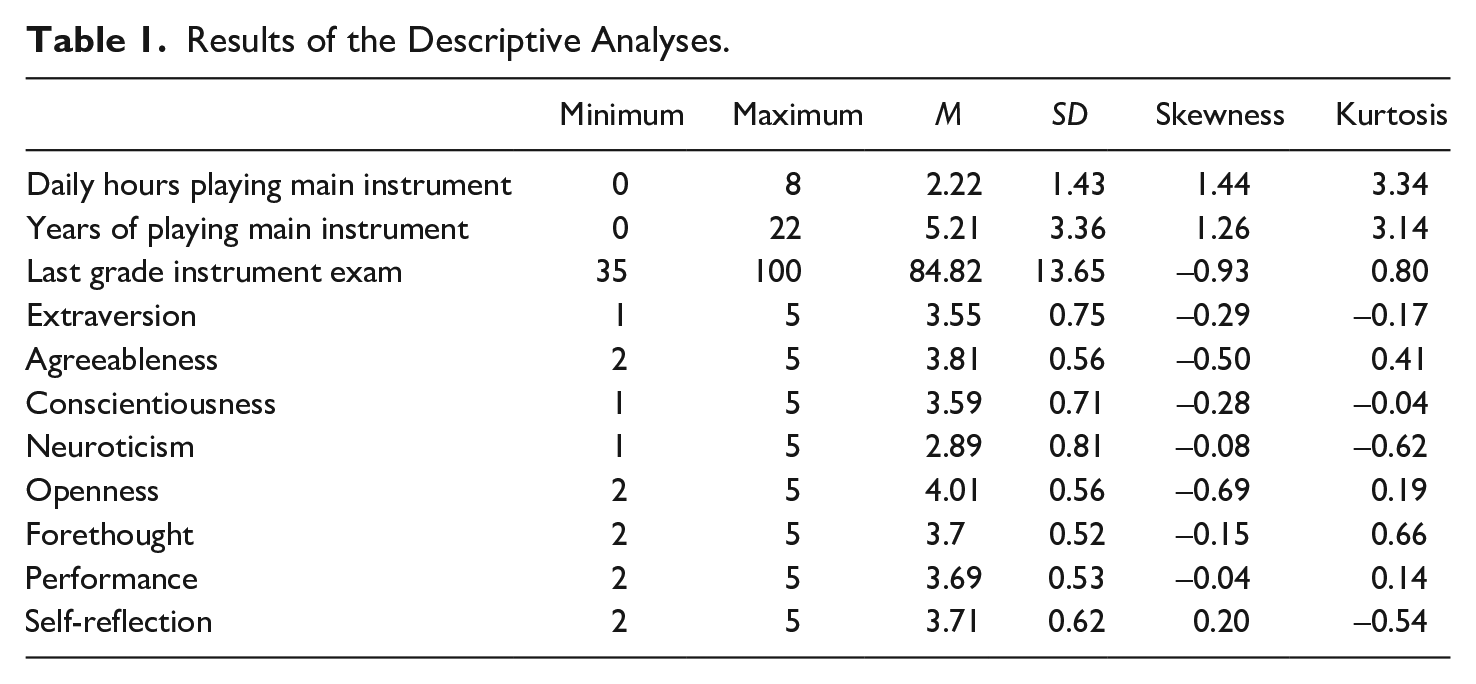
First, all variables were analyzed by descriptive statistical techniques (Table 1). As shown in Table 1, the daily practice hours and years of playing the main instrument variables were not normally distributed, but the values of all other variables were normally distributed. No adjustments were made to the values.
Results of the Descriptive Analyses.
Do Preservice Music Teachers’ Last Exam Grade, Daily Practice Hours, and Their Scores on the Dimensions of the SRLIPS Differ Significantly by Their Year of Study?
A one-way analysis of variance was conducted to determine to what extent preservice music teachers’ last exam grades and SRLIPS scores (forethought, performance, and self-reflection) vary according to their year of study. Neither scores for forethought, F(3, 163) = 1.022, p = .385; performance, F(3, 163) = 0.898, p = .444; and self-reflection, F(3, 163) = 1.191, p = .315, nor last exam grades, F(3, 155) = 1.238, p = .298, differed significantly by participants’ year of study. Moreover, a Kruskal-Wallis H test was conducted to determine to what extent preservice music teachers’ daily practice hours varied as a function of year of study. This test revealed that preservice teachers’ daily practice hours did not differ significantly by participants’ year of study, H(3) = 1.946, p = .584.
Are There Significant Correlations Between Preservice Music Teachers’ Years of Playing the Main Instrument, Daily Practice Hours, Last Exam Grade, and Their Scores on the Dimensions of the SRLIPS and the Big Five Personality Traits?
Pearson’s product-moment correlation coefficients revealed that the preservice music teachers’ last exam grades were not correlated significantly with their scores on the extraversion, agreeableness, neuroticism, and openness dimensions of the BFI (p > .05). However, preservice music teachers’ last exam grades were correlated significantly with their scores on the conscientiousness dimension of the BFI (r = .209, n = 157, p = .009) in addition to the performance (r = .298, n = 154, p < .001) and self-reflection (r = .248, n = 154, p = .002) dimensions of the SRLIPS. Participants’ last exam grades were also correlated significantly and negatively with the forethought dimension of the SRLIPS (r = –.33, n = 154, p < .001).
Second, Kendall’s τ rank correlation coefficients were computed to investigate whether preservice music teachers’ daily practice pours and years of playing the main instrument correlated significantly with their last exam grade and with their scores on the dimensions of the SRLIPS and the BFI (Table 2). Analyses revealed that the preservice music teachers’ daily practice hours were not correlated significantly with their scores on the dimensions of extraversion, agreeableness, neuroticism, openness, and self-reflection (p > .05). However, their daily practice hours were correlated significantly with their last exam grade (τ = .158, n = 159, p = .011) and with their scores on the conscientiousness (τ = .134, n = 169, p = .022) dimension of the BFI and the forethought (τ = .278, n = 166, p < .001) and performance dimensions of SRLIPS (τ = 0.190, n = 166, p = .001).
Rank Correlations Between Daily Practice Hours, Years of Playing the Instrument, and the Scores on the Dimensions of the Self-Regulated Learning in Instrument Practice Scale and the Big Five Inventory.
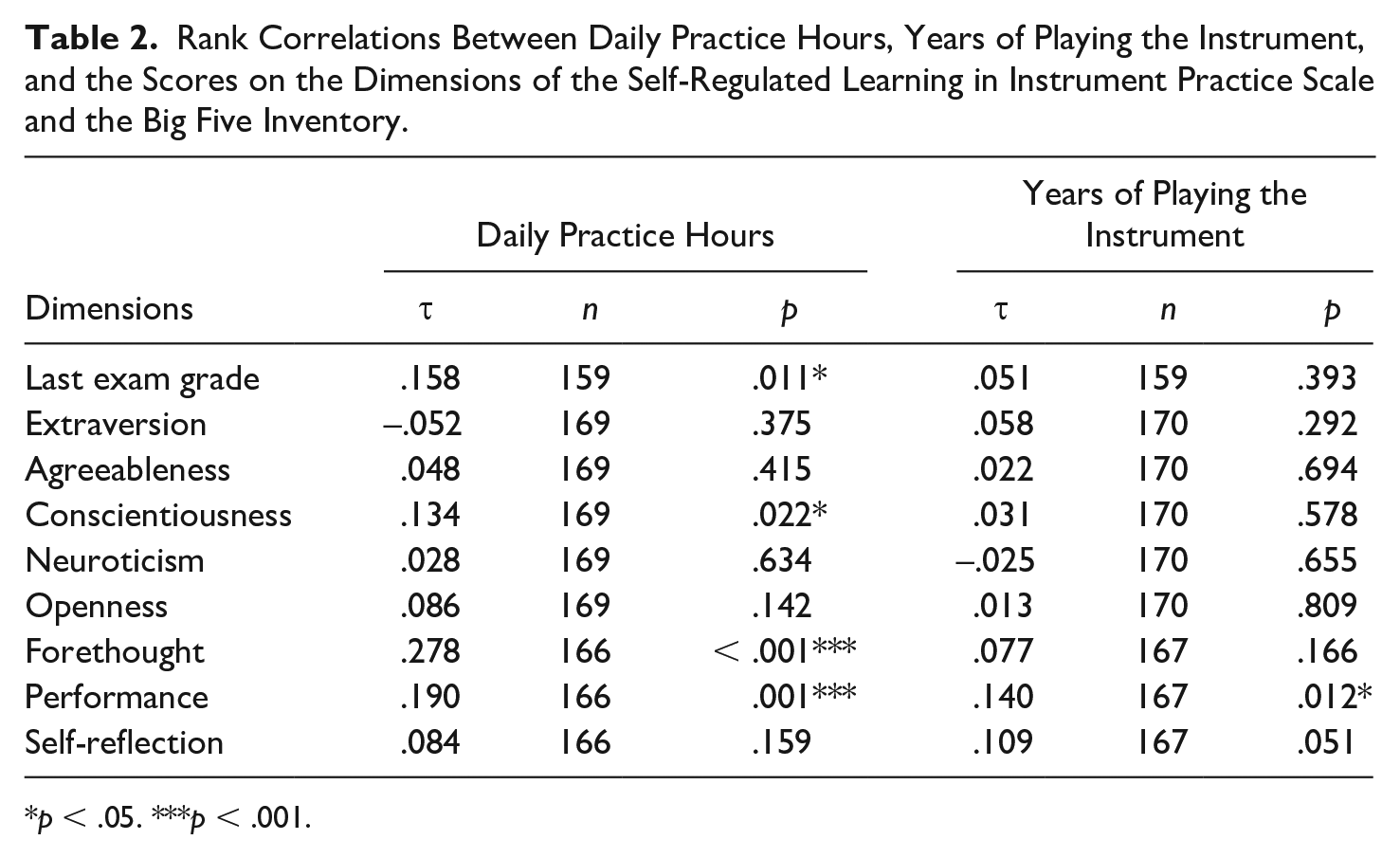
p < .05. ***p < .001.
As seen in Table 2, Kendall’s τ analyses also revealed that the preservice music teachers’ years of playing the main instrument were not correlated significantly with their last exam grade, their scores on the dimensions of forethought and performance, or their scores on any of the dimensions of the BFI (extraversion, agreeableness, conscientiousness, neuroticism, openness; p > .05). On the other hand, their years of playing the main instrument were correlated significantly only with their scores on the performance dimension of the SRLIPS (τ = .140, n = 167, p = .012).
Do Preservice Music Teachers’ Scores on the Dimensions of the Big Five Personality Traits Predict Their Scores on the Dimensions of the SRLIPS?
Pearson’s product-moment correlations showed that each dimension in the SRLIPS correlated significantly with each dimension of the BFI (see Appendix B in the supplemental document included with the online version of this article). Preservice music teachers’ forethought skills were correlated significantly with their scores on extraversion (r = .30, n = 166, p < .001), agreeableness (r = .31, n = 166, p < .001), conscientiousness (r = .53, n = 166, p < .001), and openness (r = .32, n = 166, p < .001). In addition, forethought skills were correlated significantly and negatively with their scores on neuroticism (r = –.37, n = 166, p < .001). Preservice music teachers’ performance skills were correlated significantly with their scores on extraversion (r = .32, n = 166, p < .001), agreeableness (r = .18, n = 166, p = .017), conscientiousness (r = .35, n = 166, p < .001), and openness (r = .38, n = 166, p < .001). Similar to forethought, performance skills were correlated significantly and negatively with their scores on neuroticism (r = –.20, n = 166, p = .009). Preservice music teachers’ self-reflection skills were correlated significantly with their scores on extraversion (r = .22, n = 166, p = .004), agreeableness (r = .17, n = 166, p = .024), conscientiousness (r = .39, n = 166, p < .001), and openness (r = .25, n = 166, p = .001). Similar to forethought and performance, self-reflection skills were correlated significantly and negatively with their scores on neuroticism (r = –.19, n = 166, p = .010). Notably, correlation between scores on neuroticism and on the dimensions of the SRLIPS were consistently negative. The strongest correlations were between scores on conscientiousness and scores on forethought and self-reflection skills. The strongest correlation for performance skill was with the scores on openness.
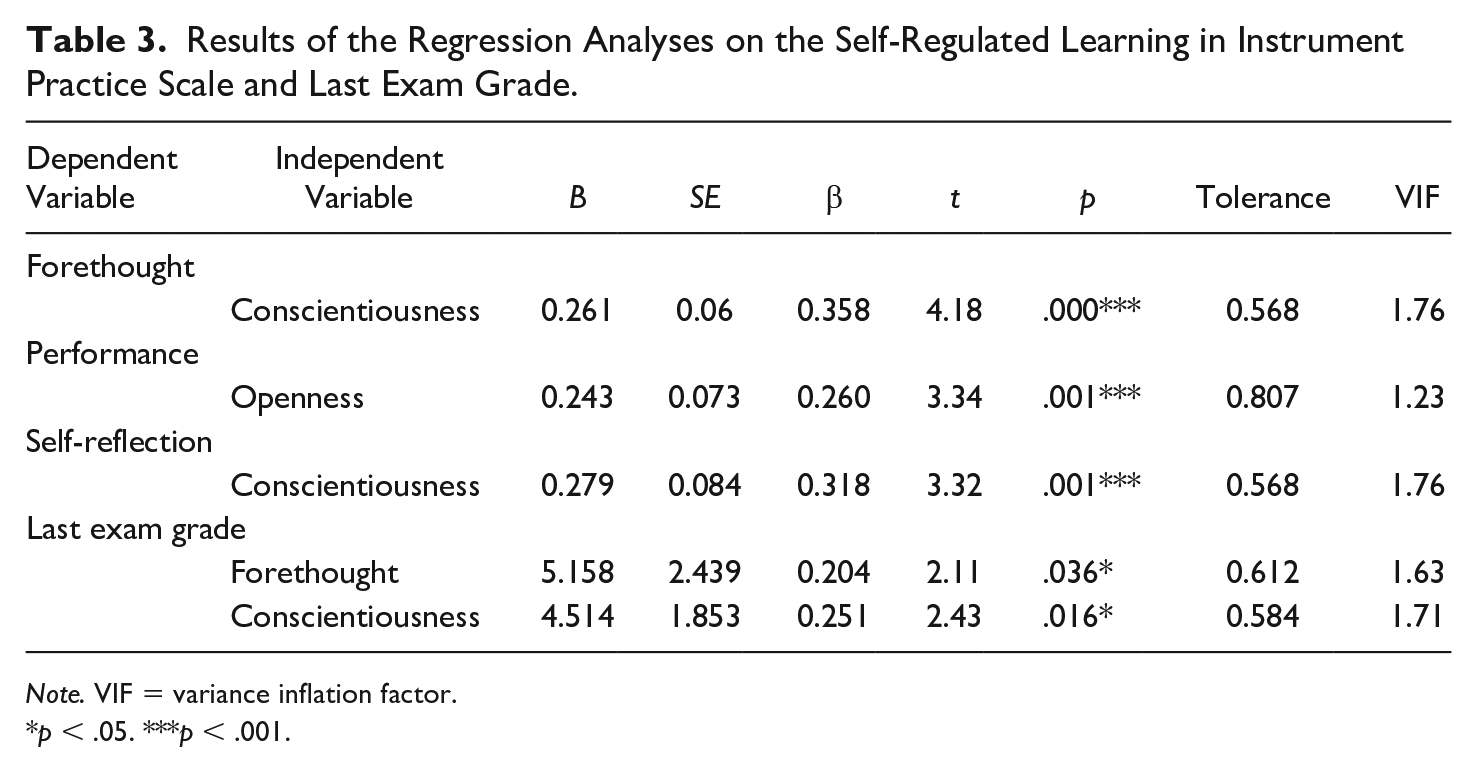
Next, we conducted a series of multiple linear regression analyses to investigate whether preservice music teachers’ scores on the dimensions of the BFI (neuroticism, extraversion, openness, agreeableness, and conscientiousness) significantly predicted their scores on the dimensions of the SRLIPS (forethought, performance, self-reflection; Table 3). The results of the first regression model indicated that 33.7% of the variance in forethought scores was explained by conscientiousness, F(5, 160) = 16.23, p < .001. The results of the second regression model indicated that 21.8% of the variance in performance scores was explained by openness, F(5, 160) = 8.926, p < .001. Finally, the results of the third regression model indicated that 16.9% of the variance in self-reflection scores was explained by conscientiousness, F(5, 160) = 6.515, p < .001.
Results of the Regression Analyses on the Self-Regulated Learning in Instrument Practice Scale and Last Exam Grade.
Note. VIF = variance inflation factor.
p < .05. ***p < .001.
Do Preservice Music Teachers’ Scores on the Dimensions of the Big Five Personality Traits and the SRLIPS Predict Their Last Exam Grade?
An additional series of multiple linear regression analyses were conducted to investigate whether preservice music teachers’ scores on the dimensions of the BFI (neuroticism, extraversion, openness, agreeableness, and conscientiousness) and SRLIPS (forethought, performance, self-reflection) significantly predicted their last exam grade (Table 3). The results of the first regression model indicated that 16% of the variance in last exam grade was explained by forethought, F(3, 148) = 9.397, p < .001. The results of the second regression model indicated that 7.6% of the variance in the last exam grade was explained by conscientiousness, F(5, 149) = 2.435, p = .037.
Discussion
The purpose of the research was to reveal the potential relationships between self-regulated learning with regard to instrument practice, amount of instrument practice time, and Big Five personality traits. The findings showed that there is a significant relationship between the amount of the time preservice music teachers allocate to playing their instruments and the level of use of self-regulated learning strategies with regard to instrument practice. Preservice music teachers who tend to commit to relatively more daily instrument practice also tend to report greater degrees of forethought and performance phases strategies. Similar to this finding, Boon (2020) revealed that preservice music teachers who practice their instruments for 3 or more hours a day have higher self-regulated learning skills than those who practice for less and that these students use more self-directed learning strategies to plan, monitor, and evaluate their learning experiences. Findings from various studies also show that a high level of self-regulation is positively associated with more time spent practicing (Austin & Berg, 2006; Miksza, 2012; Miksza et al., 2018). In this study, a significant relationship was also found between the number of years practicing the instrument and reports of performance phase aspects of self-regulation. According to this finding, preservice music teachers who have practiced their instruments for more years also tended to report focusing and using appropriate strategies for studying during their practice to a greater extent than those who have practiced their instruments for fewer years. This finding is in line with previous research showing that the strategies used by beginner and intermediate musicians tend to be generally inadequate (Hallam, 1997; McPherson & Davidson, 2002; McPherson & Renwick, 2001).
In this study, significant relationships were found between some of the personality traits of preservice music teachers, their use of self-regulated learning strategies, and their reported practice time. The conscientiousness dimension of the personality of the preservice music teachers significantly predicts the forethought and self-reflection phases of self-regulated learning, whereas the openness dimension significantly predicts the performance phase. Conscientiousness and openness to experience are personality traits that accompany effective learning styles that encompass self-regulated learning skills (Dörrenbächer & Perels, 2016). In addition, conscientiousness is defined as the tendency to be goal-oriented, to plan, and to delay gratification (Roberts et al., 2009) and has been associated with motivational beliefs (Ventura et al., 2012). The definition of conscientiousness overlaps with the strategies used in the forethought phase of self-regulation. Therefore, preservice music teachers with high conscientiousness scores may have a greater tendency to determine learning goals and strategies in advance and may benefit from adaptive motivational beliefs in the forethought phase more frequently. Conscientiousness also significantly predicts the self-reflection phase of self-regulation. Self-reflection emerges after the learning effort and includes self-evaluation of one’s learning (Bembenutty et al., 2016). Also during this phase, the necessary motivational decisions for the next phase of study are made (Nielsen, 2001). These decisions made in terms of self-reflection coincide with the ability to manage learning efforts conscientiously.
We also found that openness significantly predicts the strategies preservice music teachers use in the performance phase of self-regulated learning. The performance phase includes behaviors such as controlling and regulating the social environment and asking for help from actors in the social environment (Bembenutty et al., 2016). This finding suggests that preservice music teachers who are intellectually curious and open to new experiences and ideas may also be more likely to seek help from actors in the social environment and are open to their ideas. A significant relationship was also found between conscientiousness and preservice music teachers’ daily instrument practice time. Similar to this finding, it has been reported that a higher rate of conscientiousness contributes to the fulfillment of a higher amount of work at a task (Matošková, 2016). Gembris et al. (2020) found that musicians who practiced their instruments at a high level intensively had significantly higher values in the conscientiousness dimension of personality than the neuroticism and agreeableness dimensions. Additionally, it has been reported that conscientious people do not need guidance to work hard (Bakker et al., 2012) and have the motivation to work hard (Ventura et al., 2012).
Significant relationships between the performance achievements of the preservice music teachers and the amount of instrument practice time, their personality traits (conscientiousness), and their use of self-regulated learning strategies in terms of instrument practice were also found. Those who tended to commit to more daily instrument practice time also tended to have greater performance achievement scores, which is a finding that is consistent with the results of previous research (Jørgensen, 2002; Özmenteş, 2012). Jørgensen (2002) found that conservatory musicians who received “excellent” performance test assessments reported significantly more study time than those who received only “good” grades. Similarly, Özmenteş (2012) reported that the daily instrument practice times varied as a function of instrument achievement grades. According to their study, the grades of the students who practice their instruments for less than 1 hour a day differed significantly from the grades of the students who practice their instruments more (Özmenteş, 2012). Hallam et al. (2012) reported that as expertise develops, the amount of time learners devote to study increases. On the other hand, there are also studies that did not find a significant relationship between the amount of time spent practicing in a single practice session and instrument performance success (Miksza, 2006).
Previous research revealed that musicians are more successful when they have higher self-regulated learning skills (Boon, 2020; McPherson & Renwick, 2011). The present study supports such previous research, given that instrument performance achievement was positively related to the participants’ reports regarding the forethought phase of self-regulation. The forethought phase includes motivational beliefs such as self-efficacy as well as setting goals and strategies. This finding is similar to those of McCormick and McPherson (2003) and those of McPherson and McCormick (2006), who reported that the relationship between self-regulation strategy use and performance was mediated by self-efficacy. In addition, we found that conscientiousness significantly predicted instrument performance achievement. Conscientiousness has emerged as the personality trait most consistently and strongly associated with academic achievement (Poropat, 2009) and has been reported to have positive effects on achievement in many educational contexts (Ventura et al., 2012). Conscientiousness is a characteristic that involves impulse control (John et al., 2008), and achieving challenging goals such as performance success requires the ability to control impulses, the willingness to work hard, and the ability to manage emotions related to goal pursuit (Ivcevic & Brackett, 2014).
It is important to consider the findings of this study in lieu of its limitations. A threat to measurement validity arises from the fact that the study relies on self-reported information. Participants may not have been honest in answering the questions. To help mitigate this issue, we employed highly tested, trusted scales such as the BFI and the SRLIPS. We also provided the participants with a strong sense of anonymity and ensured them that there was no reason to be fearful of reprisal. It should be noted that this study was carried out on preservice music teachers, not on music majors or music professionals. Although teaching music includes performing music, the psychological states of an individual who is fully oriented to performing music may well be different from those of an individual who is oriented to teaching music. Therefore, research on self-regulated learning, Big Five personality traits, and achievement with students in other music degree programs would be helpful. Another limitation was that the last exam grades of the participants at the four grade levels of the three universities were given by different professors. However, a single grading scale standardized by the Higher Education Council is used at all university and levels in Turkey. The course passing grade was also the same for all participants. Last exam grade was normally distributed. It should also be noted that nearly all of the correlations were weak in strength.
Conclusion
In this study, significant relationships were identified between preservice music teachers’ self-regulated learning strategies, personality traits, amount of instrument practice time, and instrument performance achievement. In this context, the significant relationships between the trait conscientiousness, the amount of instrument practice time, self-regulated learning, and instrument performance achievement were particularly interesting. This is because conscientiousness may have both direct and indirect effects on the preservice music teachers’ instrument performance achievement. Consequently, taking into account the personality traits of preservice music teachers could be beneficial with regard to their training for using self-regulated learning strategies. Future studies that examine more complex networks of relationships among these constructs, such as through structural equation modeling techniques, would be beneficial.
This study revealed the relationships between success in instrument education, Big Five personality traits, and self-regulated learning, which constitute an important dimension of music teacher education. Success on an instrument is an important indicator of proficiency in music. Preservice music teachers are expected to gain the necessary skills for teaching music while also developing as musicians. Based on the findings obtained in the study, it can be suggested that music teacher educators teach preservice teachers self-regulated learning strategies that they can use while practicing their instruments while also taking into account their personal characteristics (e.g., personality traits). In the future, experimental studies could be conducted to reveal the possible effects of teaching self-regulated learning on the success of music teacher candidates as well.
Footnotes
Declaration of Conflicting Interests
The authors declared no potential conflicts of interest with respect to the research, authorship, and/or publication of this article.
Funding
The authors received no financial support for the research, authorship, and/or publication of this article.
Consent to Participate
Informed consent was obtained from all individual participants included in the study.
Ethics Approval
Scientific Research and Publication Ethics Committee of Akdeniz University (30.11.2021/419).

Data Availability
The data that support the findings of this study are available on request from the corresponding author. The data are not publicly available due to privacy restrictions in addition to institutional and national regulations and laws.
Author Biographies
References
Supplementary Material
Please find the following supplemental material available below.
For Open Access articles published under a Creative Commons License, all supplemental material carries the same license as the article it is associated with.
For non-Open Access articles published, all supplemental material carries a non-exclusive license, and permission requests for re-use of supplemental material or any part of supplemental material shall be sent directly to the copyright owner as specified in the copyright notice associated with the article.
