




Abstract
Young people with specific language impairment (SLI) are at risk for poorer outcomes with respect to employment in adulthood, yet little is known of how early school-age prework experiences prepare them for the job market. This study examined whether young people with SLI engage in similar types of early work experiences as their typically developing (TD) peers. A total of 139 young people with a history of SLI and 124 TD peers attending their final year of compulsory secondary education were interviewed about early work experiences, current part-time employment, career aspirations, and perceived workplace challenges. Individuals with SLI experienced different types of work placements and were more likely to aspire to manual tasks, whereas their TD peers aspired to professional roles. Differences in early prework experiences and vocational aspirations are already evident in 16-year-old young people with SLI. Several challenges and potential barriers to employment are identified.
For all young people, adolescence is a foundational period for learning the skills, specialized languages, social rules, and institutional knowledge that societies expect of well-adjusted and economically autonomous adults (Larson, Wilson, Brown, Furstenberg, & Verma, 2002; Shanahan, Mortimer, & Krüger, 2002; Trainor, 2008; Vondracek & Porfeli, 2003). Within this context, there is considerable interest in the ways in which young people are prepared for their entry into the workforce. This interest is fuelled partly by a recognition that ill preparedness of the individual or shortcomings of the system pose serious obstacles to vocational opportunities (Caspi, Wright, Moffitt, & Silva, 1998; Shanahan et al., 2002; Vondracek & Porfeli, 2003) and partly by evidence that young people who are well prepared and have a positive career orientation are less likely to manifest problem behavior through their adolescence and more likely to have rewarding adult lives (Nurmi, Salmela-Aro, & Koivisto, 2002; Savickas, 1999; Skorikov & Vondracek, 2007). Various government initiatives, such as the 1994 Federal School-to-Work Opportunities Act in the United States and the 2003 Every Child Matters agenda in the United Kingdom, have reflected these concerns, leading to substantial economic and organizational investment in the preparation of young people for employment.
In this investigation, we examine the early work-related experiences (prework placements and part-time employment) of a large group of young people with histories of specific language impairment (SLI) as they approach the end of compulsory schooling. We compare the early work-related progress, perceived challenges, expectations, aspirations, and enjoyment of young people with SLI with those reported by a group of typically developing (TD) young people. Evidence on the experiences of individuals with disabilities is important in its own right (Kohler & Field, 2003; Rylance, 1998) but also because it helps to identify competencies and potential that may bear more generally on adolescent readiness for work.
Adolescent Preparation for Work: The U.K. Context
The present study was conducted in the United Kingdom. In 2003, the British government completed a review of children’s services and identified important outcomes to be considered when planning and addressing young people’s needs (Department for Education and Skills [DfES], 2003). One of the target outcomes was to ensure that the individual young person should have the support that he or she needs to “achieve economic well-being.” Achieving economic well-being requires young people to progress to gainful employment and be able to support themselves and their families. This placed employment and access to employment as a priority in the U.K. government’s agenda for change.
Importantly, the DfES recognized that all young people have the right to experience a work placement toward the end of compulsory secondary education. Thus, a period, typically of 1 to 2 weeks, of work experience or work shadow placement is built into Key Stage 4 (years 10 to 11) of the school curriculum, when students are typically between 15 and 16 years of age. Decisions about work placements usually involve a two-way negotiation between the students and their school. Young people are encouraged to think about the subjects that they are studying and the career they would like to follow in the future. The school then determines whether it already has links with a company that closely matches the young person’s needs or whether it may be able to set up links with a new company. Extra advice is available through a variety of mechanisms, including career teachers, school advisors, or the young person’s local Connexions office. Connexions offices provide information and advice to 13- to 19-year-olds in a number of areas relevant to making decisions and choices in their lives including learning, careers, and work. The DfES (2002) states that the period of work experience should meet a number of specific aims and should be a constructive learning opportunity. The aims include developing students’ future employability and providing an opportunity to experience a career. In addition, young people in the United Kingdom are also able to work part-time while in full-time education (e.g., weekend, evening, or vacation jobs). This is available to young people from the age of 13, subject to legal requirements. Hence, work placements and part-time employment provide a valuable opportunity to study the nature of early prework experiences of young people generally and young people with disabilities in particular.
Young People With Disabilities
In the past two decades, professionals, policy makers, and researchers have been concerned with improving the school to employment transition services of young people with disabilities (Johnson, Stodden, Emanuel, Luecking, & Mack, 2002). Much progress has been made in the United Kingdom since the passage of the Individuals With Disabilities Education Act (1990), which mandated transition planning for students with disabilities. Findings in both the United Kingdom (Learning and Skills Council, 2006) and the United States (Benz, Yovanoff, & Doren, 1997; Fabian, 2007; Hasazi, Johnson, Hasazi, Gordon, & Hull, 1989) reveal that whether or not a young person with disabilities completes a work placement significantly predicts entry into competitive employment and wages received. A good work placement conducted while at school has the potential to make a better transition from school to employment; it can advantageously contribute to the future of young people with disabilities.
However, gaps in support and services still exist. An examination of employment statistics continues to reveal that, in general, young people with disabilities still tend to achieve lower rates of employment and less prestigious jobs than the rest of the population (Blackorby & Wagner, 1996; Cameto, 2005; Caspi et al., 1998; Hasazi et al., 1989; Levine & Nourse, 1998). The available research covers a range of difficulties, such as learning disabilities, sensory impairment, physical disabilities, and emotional-behavioral problems. Transition experiences and outcomes are different depending on the nature of the disability or problem (Fabian, 2007; Kohler & Field, 2003; Szymanski & Hanley-Maxwell, 1996; Trainor, 2008; Weller & Strawser, 1987). For example, young people with sensory impairments (e.g., vision or hearing) are more likely to experience better transitions and obtain better employment than young people with emotional-behavioral difficulties.
Furthermore, evidence from the United States and Europe (including the United Kingdom) suggests that disability can intersect with race/ethnicity as well as socioeconomic status (SES; Luciak, 2006; Strand & Lindsay, 2009; Trainor, Lindstrom, et al., 2008). Although there are notable variations between countries and among cultural groups (Strand & Lindsay, 2009), it is well established that some young people of color (e.g., African Americans or Black Caribbeans in the United Kingdom) are disproportionately represented in a variety of disability categories, including learning disabilities and emotional-behavioral problems. In turn, young people with disabilities who come from low socioeconomic backgrounds tend to have poorer transition experiences and employment outcomes than their peers from higher socioeconomic groups. For example, data from the second National Longitudinal Transition Study (Newman, Wagner, Cameto, & Knokey, 2009) in the United States suggest that young people with disabilities who come from higher income families (more than $50,000) are almost twice as likely as their peers from households with incomes of $25,000 or less to have enrolled in 2-year colleges (57% vs. 30%) and substantially more likely to have been employed since leaving high school (81% vs. 61%). The findings discussed above suggest that type of disability, SES, and ethnic background are some of the key variables that bear on the transition experiences of students with disabilities.
Young People With SLI
In this study, we examine the early work-related experiences of young people with SLI toward the end of their compulsory education. In terms of public awareness, SLI is perhaps one of the lesser known disabilities (Bishop, 2009; Conti-Ramsden, 2009). Young people with SLI have deficits in language learning and use that cannot be explained by factors such as low nonverbal IQ, hearing impairment, or neurobiological damage (Leonard, 1998). In other words, in most respects individuals with SLI appear “normal,” with no outward sign of their difficulties. It is not a question of numbers: SLI is not a low-incidence difficulty and has been estimated to affect 7% of the population (Tomblin et al., 1997). Children with SLI face difficulties in several domains, but not least social interactions and peer relations, literacy, and numeracy (Bishop, 1997; Conti-Ramsden & Botting, 2004; Cowan, Donlan, Newton, & Lloyd, 2005; Leonard, 1998; Snowling, Bishop, & Stothard, 2000). Although much research has detailed the effects and consequences in childhood, it is becoming increasingly apparent that effects of SLI extend through adolescence and into adulthood. Problems continue with peer relations and friendships (Durkin & Conti-Ramsden, 2007), socioemotional well-being (Clegg, Hollis, Mawhood, & Rutter, 2005), and academic performance (Conti-Ramsden, Durkin, Simkin, & Knox, 2008; Snowling, Adams, Bishop, & Stothard, 2001).
There is a dearth of research on the transition services for young people with SLI, in particular their prework experiences. The information that is available involves examination of occupational outcomes posteducation. Even these studies have been few in number and are mixed in their findings. Rutter and colleagues (Clegg, Hollis, & Rutter, 1999; Howlin, Mawhood, & Rutter, 2000) found that most young adults with SLI in their sample did not have permanent employment. Most had experienced long periods out of work or had only ever had temporary employment. Furthermore, those who did secure employment were working in jobs that were largely manual and unskilled, such as street cleaner or kitchen porter. Felsenfeld, Broen, and McGue (1994) reported similar rates of employment in a sample of adults with a history of language and communication impairments when compared to adults without. However, those with language impairment were more likely to be employed in unskilled and manual positions, whereas the comparison group was more likely to be employed in professional capacities. Despite the differences in occupation level, no significant differences were found between the groups in terms of their job satisfaction. Similar findings have also been reported by Records, Tomblin, and Freese (1992) who investigated quality-of-life measures in a group of young people with history of SLI and a comparison group without a history of SLI. Again, they found that although levels of attainment differed between these two groups, levels of satisfaction were similar.
Thus, at the level of individual abilities, there are several reasons to expect that young people with SLI will be disadvantaged in respect of preparation for the workforce. They are less likely to have the interpersonal skills and self-confidence that support the transition, and they are at risk for gaining poorer or fewer qualifications. The limited amount of research on adult occupational outcomes in SLI yields findings consistent with the prediction of disadvantage and indicates that people with this disability tend to be satisfied with lower attainments and less prestigious employment.
The Present Study
The broad research question motivating the present study was to determine whether young people with SLI engage in similar types of prework experience during their final year of compulsory schooling as their TD peers. In light of theoretical considerations and previous findings on employment outcomes in individuals with SLI, we expected that differentiation would already be apparent at this early stage of career exploration. We made two predictions: (a) young people with SLI would be more likely than TD young people to undertake work placements in lower status, less skilled jobs and (b) measures of language ability, interpersonal and communication skills, organization, and literacy and numeracy would contribute to the prediction of part-time employment status. Given the dearth of research in this area, we aimed also to obtain information on the perceived challenges, expectations, aspirations, and enjoyment of young people with SLI.
Method
Participants
Young people with a history of SLI
Young people with a history of SLI (hereafter referred to as young people with SLI), originally recruited at 7 years of age as part the Conti-Ramsden Manchester language study (Conti-Ramsden & Botting, 1999a, 1999b; Conti-Ramsden, Crutchley, & Botting, 1997), were invited to participate in the present stage of the study in the school year they would turn 16 years of age (final year of compulsory secondary education in the United Kingdom). The original cohort of 242 children represented a random sample of children attending Key Stage 1 language units across England. Language units are specialist classes usually attached to mainstream schools, in which there is regular speech and language therapist input as well as specialist teachers and high teacher–pupil ratio. The cohort had been previously followed up at 8 years of age (n = 234), 11 years of age (n = 200), and 14 years of age (n = 130). In the present stage of the study, 139 young people (42 girls) agreed to participate. These young people did not differ on any early variables of language, cognition, SES, or emotional or social measures compared to those who did not participate. At 7 years of age, the children showed a variety of different language profiles, with the majority described as having both receptive and expressive difficulties. The mean age of the SLI group was 15 years and 10 months (SD = 5 months).
TD young people
A comparison group of young people from a broad background participated in the study. They had no history of special educational needs or speech and language therapy provision. A total of 124 TD young people (47 girls) were recruited, with a mean age of 15 years and 11 months (SD = 4 months). Census data as per the 2001–2002 General Household Survey (Office of National Statistics, 2002) were consulted to target young people who would be representative of the range and distribution of households in England in terms of maternal education and household income (i.e., a sample stratified to the general U.K. population).
Maternal education and household income
As a group, the families of the young people with SLI had a wide spread of SES representative of the range and distribution of households in England in terms of maternal education and household income. In terms of maternal education, the mothers of 24.1% had no educational qualifications, 61.7% had GCSE/O levels, A levels (nationally recognized certificates of educational attainment based on examinations taken at approximately ages 15 and 17 respectively), or a college education, and 14.3% had a university or postgraduate education. In terms of household income, it needs to be noted that the average household income in the United Kingdom at the time of data collection was roughly £21,500 per annum. The distribution of household income bands (£ per annum) was as follows: 15.8% were living in households earning less than £5,200 to £10,400 (low income bracket), 27.8% were living in households earning £10,401 to £20,800 (lower than average income bracket), 34.6% were living in households earning £20,801 to £36,400 (average and above average income bracket), and 21.8% were living in households earning £36,401 to more than £52,000 (high income bracket).
In terms of race/ethnicity, the young people with SLI were predominantly of a White background (86.1%), with some of a mixed background (6.6%), some of an Asian background (2.2%), some of a Black background (2.1%), and the remainder (2.9%) of other racial/ethnic backgrounds (e.g., Chinese).
For the TD comparison group, in terms of maternal education, the mothers of 17.1% had no educational qualifications, 66.7% had GCSE/O levels, A levels, or college education, and 16.2% had a university or postgraduate education. In terms of household income bands (£ per annum), 12.7% were living in households earning less than £5,200 to £10,400 (low income bracket), 24.6% were living in households earning £10,401 to £20,800 (lower than average income bracket), 29.7% were living in households earning £20,801 to £36,400 (average and above average income bracket), and 33.1% were living in households earning £36,401 to more than £52,000 (high income bracket). In terms of race/ethnicity, the TD young people were predominantly of a White background (92.4%), with some of a mixed background (4.1%), some of an Asian background (0.8%), some of a Black background (1.6%), and the remainder (0.8%) of other ethnic backgrounds (e.g., Chinese).
Comparability of the SLI and TD groups
Given the findings in the literature regarding the potential relationships among SES, race/ethnicity, and disability, care was taken for the two groups to be comparable in terms of maternal education, household income bands, and race/ethnicity. Post hoc analyses revealed there were no significant differences between the young people with SLI and their TD peers in maternal education levels, χ2(2, n = 234) = 1.756, p = .416, or household income bands, χ2(3, n = 235) = 4.391, p = .222. Importantly therefore, the TD young people were similar to the young people with SLI in terms of key SES indicators. In terms of race/ethnicity, recall that the participants with SLI were predominantly of a White racial/ethnic background attending language units in the United Kingdom when they were 7 years of age. For this reason, the comparison TD group was recruited also to be predominantly White. Thus, the present study provides data that are relevant to individuals of White racial/ethnic backgrounds and is not necessarily informative with regard to other racial/ethnic backgrounds. There was no significant difference between the young people with SLI and their TD peers in the distribution of White versus other racial/ethnic background, χ2(1, n = 254) = 2.148, p = .143.
In addition, at the time of the study, all young people were of similar age and were attending their last year of compulsory secondary education. There were no significant differences in the proportions of gender in each group (SLI = 42 female of 139, TD = 47 female of 124; Fisher’s exact p = .20).
Concurrent language, literacy, and performance IQ (PIQ)
Concurrent language was assessed using one expressive subtest (Recalling Sentences) and one receptive subtest (Word Classes) from the Clinical Evaluation of Language Fundamentals–Revised (Semel, Wiig, & Secord, 1987). Literacy was measured using the Wechsler Objective Reading Dimensions (Wechsler, 1993), and both the Reading Accuracy and Reading Comprehension subtests were administered. Because of time constraints, literacy measures were available for only 69 TD young people. Nonverbal IQ was also examined using the PIQ subtests from the Wechsler Intelligence Scale for Children–Third Edition battery (Wechsler, 1992).
Psychometric data were available at 16 years for all TD young people and either at 14 years (n = 92) or 16 years (n = 47) for those young people with SLI. For ease of reading, no differential is made and these are referred to as concurrent scores. The PIQ, language, and literacy scores obtained by each group of young people are shown in Table 1.
Performance IQ, Language, and Reading Standard Scores for Young People With Specific Language Impairment (SLI) and Typically Developing (TD) Young People
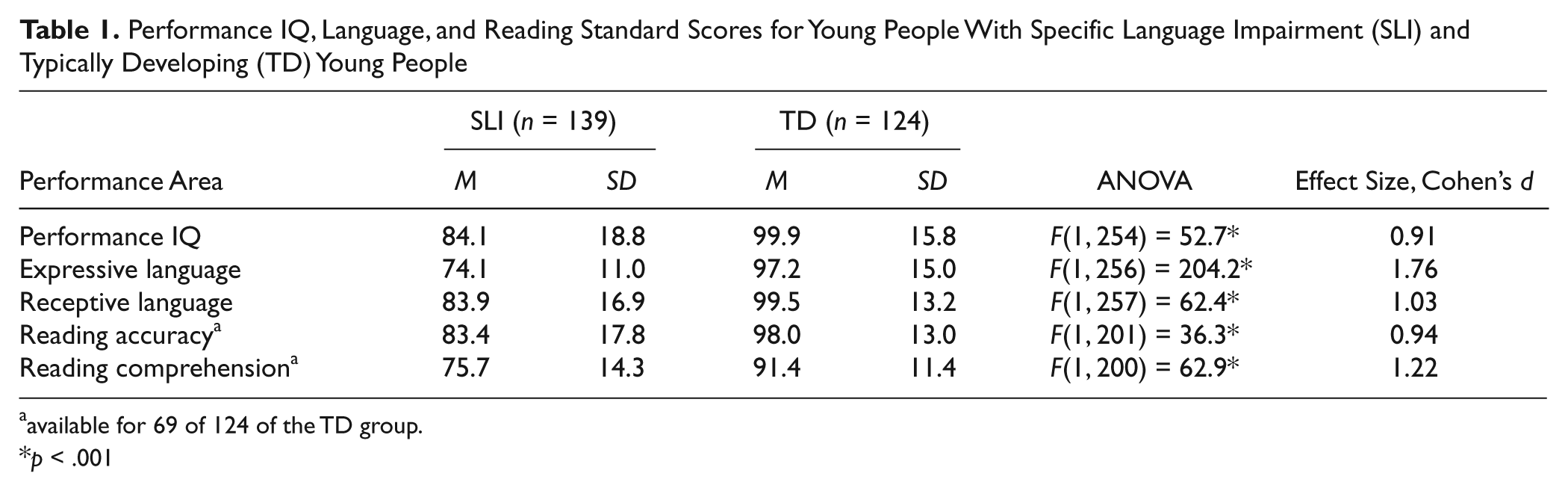
available for 69 of 124 of the TD group.
p < .001
Materials
Young people’s work experiences and career aspirations
A structured interview investigated the young people’s prework experience placement, current part-time employment status (weekend, evening, or vacation job), future work expectations, and career aspirations. The majority of the questions were factual, for example, “What did you do for your work experience?” and “Have you ever had a part-time job?” The responses to these questions provided quantitative data on which across-group comparisons were based. Given the large sample size, three different researchers conducted the interviews.
Obtaining more qualitative data on work experience enjoyment and difficulties
We chose to include two questions in the interview with the hope of eliciting more qualitative information about the young people’s prework experiences. The first inquired about what they liked or enjoyed about their work experience, and the second inquired about what they found difficult. Probe questions were used to elicit specific examples and scenarios. Participant responses were noted by the researchers in an attempt to obtain qualitative data on the young persons’ experiences. However, responses were limited in depth and breadth and essentially produced three broad categories of quantified responses that then formed the basis of the coding scheme. These categories were the following:
Environment related, for example, “I enjoyed being in the nursery with all the art materials and toys” and “I found it difficult because the garage was really noisy and dirty.”
Job related, for example, “I enjoyed learning how to use the tills to scan the items” and “I found it difficult to use the computer system in the library.”
People related, for example, “I enjoyed meeting people like me, who were interested in the same things, like computers” and “I found it difficult to chat to customers because I didn’t know them.”
Coding was conducted post hoc by the team of researchers with consensus reached before the code or response theme was accepted. An independent researcher confirmed the reliability of the response themes by recoding 25% of the data. The level of agreement ranged from substantial (environment theme Cohen’s κ = .63, job theme κ = .72) to almost perfect (people theme κ = .89), suggesting adequate reliability (Viera & Garrett, 2005).
Assessing young people’s skills and difficulties as they relate to the work environment
Young people also completed relevant items from the Hidden Disabilities Questionnaire (HDQ; Rack, 2005). The HDQ comprises of a series of questions relating to different aspects of the working environment and examines areas of difficulty, or hidden barriers, that may be faced by young people. Responses were made on a 5-point Likert-type scale with the response options strongly no, no, no preference, yes, and strongly yes. Three subscales were selected from the HDQ for examination by the present study. The HDQ does not have published reliability and validity information. However, we provide, for each subscale we used, reliability information for our sample. In addition, as part of our analysis (see the results section), we examine the association of these three subscales with standardized psychometric assessments, thus providing some evidence of construct validity. The three subscales used were the following:
Interpersonal Communication Skills (18 items): Sample items included, “Do you get your ideas over clearly when you are talking or explaining something?” “Do you find it hard to follow what people are saying in a group situation?” and “Do people sometimes get upset or angry because they get the wrong idea about what you are trying to say?” Cronbach’s α for this sample was .80.
Literacy and Numeracy Skills (16 items): Sample items included, “Do you feel that your reading and writing skills will get in the way of what work you could do?” “Do you find filling in forms difficult and confusing?” “Did you find it easy to learn your times tables at school?” and “Do you find it difficult to work out how much several items of food will cost if you are ordering food?” Cronbach’s α was .79.
Organization Skills (8 items): Sample items included, “Do you find time-keeping and organization is a problem that affects your work/school?” “Do you find it hard to keep tidy?” and “Do you mix up dates and times and miss appointments?” Cronbach’s α was .72.
Composite scores were calculated for each of the three subscales. High scores indicated good functioning and lower scores indicated poorer functioning.
Finally, additional items from the HDQ were used to examine further areas of potential difficulty. These were broadly grouped as attitudes to manual work, concentration ability, learning and remembering, and telephone use. Responses were made on a 5-point Likert-type scale with the response options of strongly no, no, no preference, yes, and strongly yes.
Procedure
The young people with SLI and their TD peers were assessed and interviewed either at home or at school on the above measures as part of a wider battery. All assessments were conducted in a quiet room or area. The standardized assessments of language, literacy, and IQ were administered in the manner specified by the test manuals. The structured interviews were carried out in a conversational style following the young people’s pace and encouraging them to fully communicate their responses. Care was taken to ensure that all participants comprehended the questions and the interviewers were able to provide additional clarification, rephrasing, and/or repetition of the target and probe questions as often as necessary. Questions from the HDQ were read aloud to the participants. Individuals indicated their responses either by responding verbally or by pointing to the response options presented visually. Each testing session lasted for either a morning or afternoon with appropriate breaks. Ethical approval was gained from the University of Manchester. Informed written consent was gained for all participants.
Results
What Did the Young People Do During Their Work Experience Placements?
We asked the participants what they did during their work experience placements. Responses were coded based on the Standard Occupational Classification (Office of National Statistics, 2000) system. This subdivides occupations into nine categories: managerial and senior officials, professional occupations, associate professionals, administrative roles, skilled trades (e.g., plumbers, electricians), personal services (e.g., child carers, beauticians), sales and customer service roles, machine operatives, and elementary occupations (e.g., manual laborers and shelf stackers). It was found that the young people experienced a range of different employment types, covering seven of these nine categories.
Those who had not completed work experience by the time of the interview were removed from the analysis (20 young people with SLI and 2 TD young people), as were those who did not turn up for their placement (10 young people with SLI and 8 TD young people) and those who could not remember details of their placement (1 young person with SLI). This resulted in a sample of 108 young people with SLI and 114 TD young people who completed questions on their work experience placement.
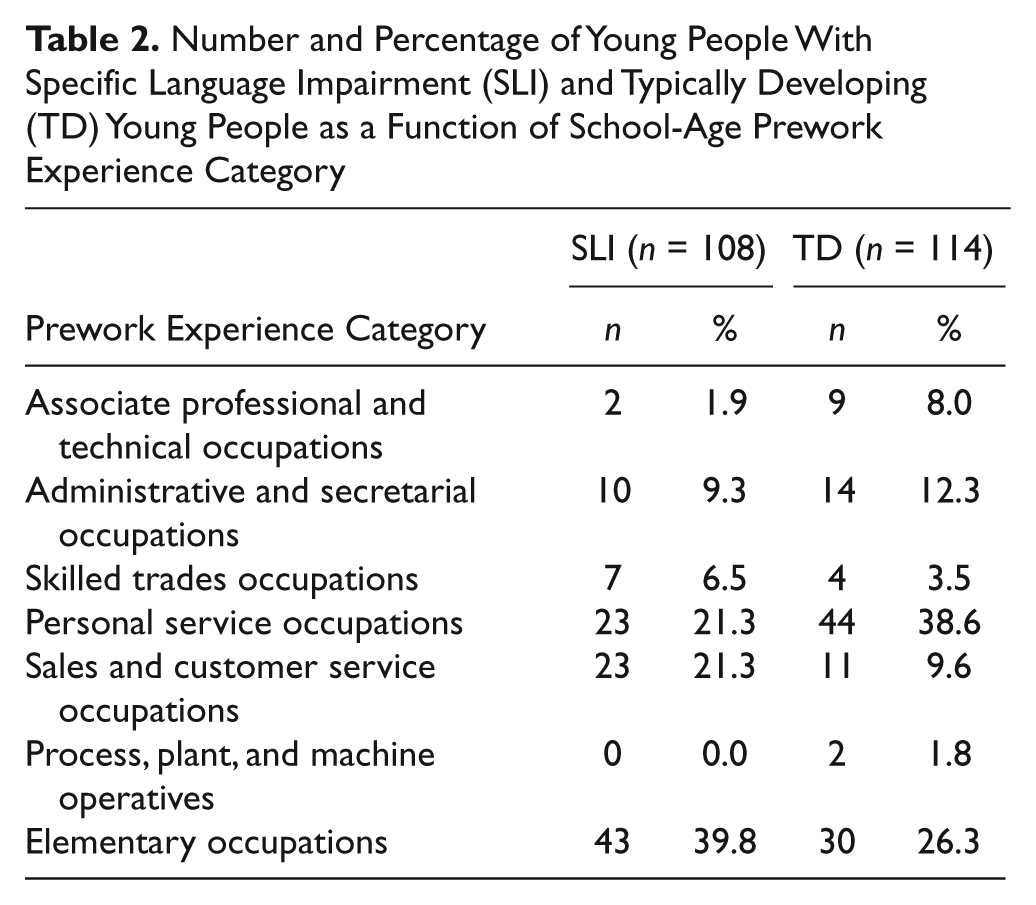
Table 2 indicates the distribution of employment types experienced by each group. The largest percentage of young people with SLI had employment classified as elementary. Examples included shelf stacking, laboring for skilled tradespeople, and working in bars and cafés. A smaller, but still considerable, proportion of their TD peers was also placed in this type of employment. The proportion of young people with SLI placed in sales and retail employment was more than double that of TD peers. The largest percentage of TD young people undertook work experience that involved delivering a personal service. Examples included teaching or classroom assistants, working in a hairdresser, and working with animals. A smaller, though still substantial, proportion of young people with SLI worked in similar situations. Differences in the distributions of work experiences were significant, χ2(6, n = 222) = 20.93, p = .002.
Number and Percentage of Young People With Specific Language Impairment (SLI) and Typically Developing (TD) Young People as a Function of School-Age Prework Experience Category
What Did the Young People Enjoy During Their Work Experience Placements?
Of those who had completed a work experience placement by the time of the interview (108 young people with SLI and 114 TD young people), the majority reported that they had enjoyed it (SLI: 90.7%, TD: 92.5%). Most reported that the job itself was the most enjoyable aspect of their work experience (SLI: 67.6%, TD: 64.3%). For both groups, approximately half of the sample reported that working with people was enjoyable (SLI: 49.5%, TD: 41.7%). Smaller percentages of each group indicated that the environment was an enjoyable aspect of their work experience (SLI: 19.3%, TD: 27.0%). There were no significant differences between groups on each of the three questions. That is, the two groups of young people did not differ in the types of things they had enjoyed about their prework experience placement.
What Did the Young People Find Difficult During Their Work Experience Placements?
Participants were asked what they found difficult during their work experience placement. Responses were coded into three areas: job-related difficulties, people-related difficulties, and environment-related difficulties. Recall that 108 young people with SLI and 114 TD young people had completed a work experience placement at the time of the interview.
It was found that 11 of 108 (10.2%) of the young people with SLI indicated that working with people was difficult for them, with 3 of 114 (2.6%) of TD young people reporting this difficulty, χ2(1, n = 222) = 5.36, p = .021. Similar percentages of TD young people (44 of 114, 38.6%) and young people with SLI (33 of 108, 30.6%) reported difficulties that related to the job itself. Very small numbers reported difficulties that related to the environment in which they worked (2 of 108, 1.9% of young people with SLI and 1 of 114, 0.9% TD peers). The two groups of young people did not differ in respect to the latter two categories of difficulties.
Obtaining Current Part-Time or Casual Employment: Who Had Employment, What Did They Do, and How Did They Get It?
Young people were questioned about their current employment experience, including part-time, weekend, and summer jobs, hereafter referred to as part-time work. A significantly higher proportion of young people with SLI (86 of 139, 61.9%), reported never having a job (other than the preparatory work experience placement discussed above) than was the case for their TD peers (40 of 124, 32.3%), χ2(1, n = 263) = 23.03, p < .001.
For those young people who reported having part-time work (53 SLI, 84 TD), type of employment was coded using the same procedure as that used for type of work experience placement, that is, the 9-point Standard Occupational Classification system. When the young people with SLI did secure a part-time position, the types of jobs they worked in were not found to be significantly different from those of the TD comparison group, χ2(5, n = 137) = 5.46, p = .362. Table 3 shows the type of part-time employment category reported by the young people.
Number and Percentage of Young People With Specific Language Impairment (SLI) and Typically Developing (TD) Young People as a Function of Type of Part-Time Employment Category
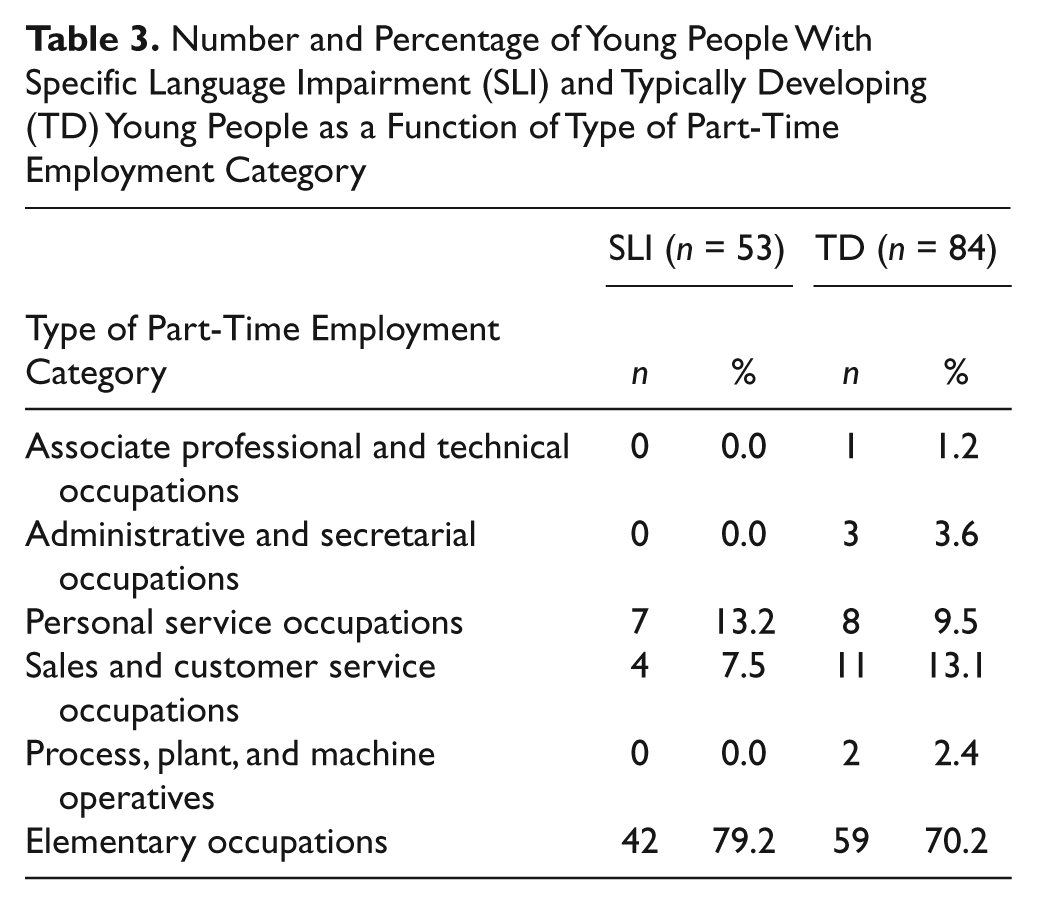
The majority of young people in both groups (SLI: 79%, TD: 70%) reported that they had secured part-time employment in the elementary category, the most frequent of which was described as having a newspaper round.
Participants were further queried about how they got their most recent part-time job. After removing those who could not remember how they secured their employment (SLI = 5, TD = 7), it was found that the percentage of young people obtaining jobs through someone else rather than themselves organizing it was higher for the group with SLI (SLI: 33 of 48, 68.8%; TD: 35 of 77, 45.5%), a significant difference, χ2(1, n = 125) = 6.47, p = .01.
How Do Young People Perceive Their Skills and Difficulties in the Work Environment?
Self-perception of skills and difficulties
The self-perception of the young people’s skills and difficulties was examined through the HDQ (after accounting for three cases of missing data). One subscale of the HDQ examined Interpersonal Communication Skills. As expected, the young people with SLI obtained significantly lower scores on this scale (M = 54.5, SD = 8.4) than did the TD group (M = 63.3, SD = 7.2), F(1, 259) = 80.81, p < .001, Cohen’s d = 1.12. Similar findings were evident for the Literacy and Numeracy subscale. Again, the young people with SLI reported self-perceived difficulties with literacy and numeracy and obtained significantly lower scores (M = 47.1, SD = 6.9) than the TD group (M = 56.3, SD = 7.2), F(1, 258) = 108.82, p < .001, Cohen’s d = 1.29. The Organization subscale also indicated a disadvantage for young people with SLI with respect to this aspect of the workplace. The mean score obtained by the young people with SLI (M = 23.4, SD = 4.5) was significantly lower than that of their TD peers (M = 27.8, SD = 4.1), F(1, 261) = 67.42, p < .001, Cohen’s d = 1.017.
Self-perceptions and directly assessed skills
To examine whether young people’s perceptions of their language and literacy skills (as measured using the HDQ) were associated with their directly assessed skills (as measured by the psychometric assessments), a series of Pearson correlations were conducted (see Table 4).
Correlations Between Hidden Disabilities Questionnaire (HDQ) Subscales and Measures of Performance IQ, Language, and Literacy

Note: All correlations significant, p < .001.
Significant moderate correlations were found between the three HDQ subscales and direct measures of PIQ, language, and literacy. The correlational analyses also revealed strong relationships among the three HDQ subscales.
What Variables are Associated With Employment Status?
Three logistic regressions were conducted to investigate whether sociodemographic indicators (maternal education and household income) and intrapersonal factors (the young people’s perceptions about their difficulties) were related to their employment status (having or not having a part-time job by 16 years of age). In each case, a single-step procedure was used with maternal education and household income included in addition to one of the HDQ subscales. Maternal education and household income did not significantly contribute to the prediction of attaining part-time employment in any of the analyses, but each of the subscales of the HDQ did contribute. Results for the Interpersonal and Communication Skills subscale revealed that for every 1-point increase, the young person has a 7% greater chance of being employed part-time, Exp(B) = 1.07, p < .001, 95% confidence interval (CI) = 1.04, 1.10. For the Literacy and Numeracy subscale, every 1-point increase related to a 4% increase in the chance of being employed part-time, Exp(B) = 1.04, p = .0152, 95% CI = 1.01, 1.07. Finally, for the Organization subscale, every 1-point increase related to a 9% increase in the chance of being employed part-time, Exp(B) = 1.09, p = .001, 95% CI = 1.04, 1.15.
Other potential areas of difficulty
The HDQ also provided the opportunity to examine other potential areas of difficulty through questions relating to areas of functioning such as concentration, manual tasks ability and attitudes, telephone usage, skill in social situations, and learning and remembering. Each of these questions was considered separately, and group differences were examined using t tests (see Table 5).
Additional Areas of Difficulty (Hidden Disabilities Questionnaire Items) for Young People With Specific Language Impairment (SLI) and Typically Developing (TD) Young People

p < .05. **p < .001.
Several significant differences between the groups were found. Adolescents with SLI were more likely to report difficulties with multitasking, using tools for detailed manual work, copying down text quickly, and using telephones (including using keypads designed for dialing numbers and remembering numbers when dialing).
New employment entails learning and remembering new materials and procedures. The HDQ also allowed an opportunity to assess how the young people cope in this area. Three questions asked, “Do you enjoy learning new things?” “Once you have learnt a new skill or procedure do you find that you never forget how to do it?” and “Do you have any strategies to help you remember things or how to organize your time?” Interestingly, there were no significant differences between groups, and both showed similar views on learning and using strategies, such as making lists to help them remember.
What Were the Young People’s Future Work Expectations and Career Aspirations?
The structured interview contained questions relating to the future work expectations and aspirations of the young people. Percentages are based on all 139 young people with SLI and 124 TD young people.
Readiness to seek work
Young people were asked whether they would try to secure a job when they needed one. Virtually all young people said that they would seek employment (SLI: 95.0%, TD: 100.0%). A small proportion (3.6%) of young people with SLI responded that they “did not know,” and 1.4% responded that they would not seek employment.
Obtaining a future job
Young people were asked whether they thought they would be able to get a job. All of the TD young people anticipated this outcome, compared to 91.2% of the young people with SLI (4.4% of the SLI group did not think they would find a job and 4.4% did not know).
Finding a liked job
Young people were asked whether they thought they would get a job they liked. The majority of young people thought they would (SLI: 86.1%, TD: 95.2%). It was found that 10.2% of the young people with SLI thought they would not get a job they liked, whereas 4.8% of their TD peers anticipated this outcome. Of the young people with SLI, 3.6% did not know whether they would find a job they liked. This difference between groups was significant, χ2(2, n = 261) = 7.57, p = .023. Once again, a small proportion of young people with SLI had more negative attitudes toward their future employment prospects.
Job–skills match
Participants were asked whether they thought their future jobs would match their skills. Most thought they would find a job that matched their skills (SLI: 85.4%, TD: 95.2%). A small minority (SLI: 8.8%, TD: 4.0%) of the young people did not think they would find a job that matched their skills. It was found that 5.8% of young people with SLI (and 0.8% of TD peers) did not know whether they would get a job that matched their skills. This difference between groups was significant, χ2(2, n = 261) = 7.70, p = .021, once again highlighting the more negative views held by a small proportion of young people with SLI in terms of their future employment prospects. The young people were also asked whether they thought that the job they got would be below their abilities. This was true of slightly more adolescents in the SLI group (22.6%) in comparison to their TD peers (16.9%), a difference that was found to be significant, χ2(2, n = 261) = 10.48, p = .005.
Career aspirations
The type of future employment that the young people aspired to was coded using the Standard Occupational Classification system as before. It was found that 19 of 139 (13.7%) of young people with SLI and 16 of 124 (12.9%) TD young people responded that they “did not know” what type of future employment to which they aspired. Figure 1 presents this information for 120 young people with SLI and 108 TD young people.
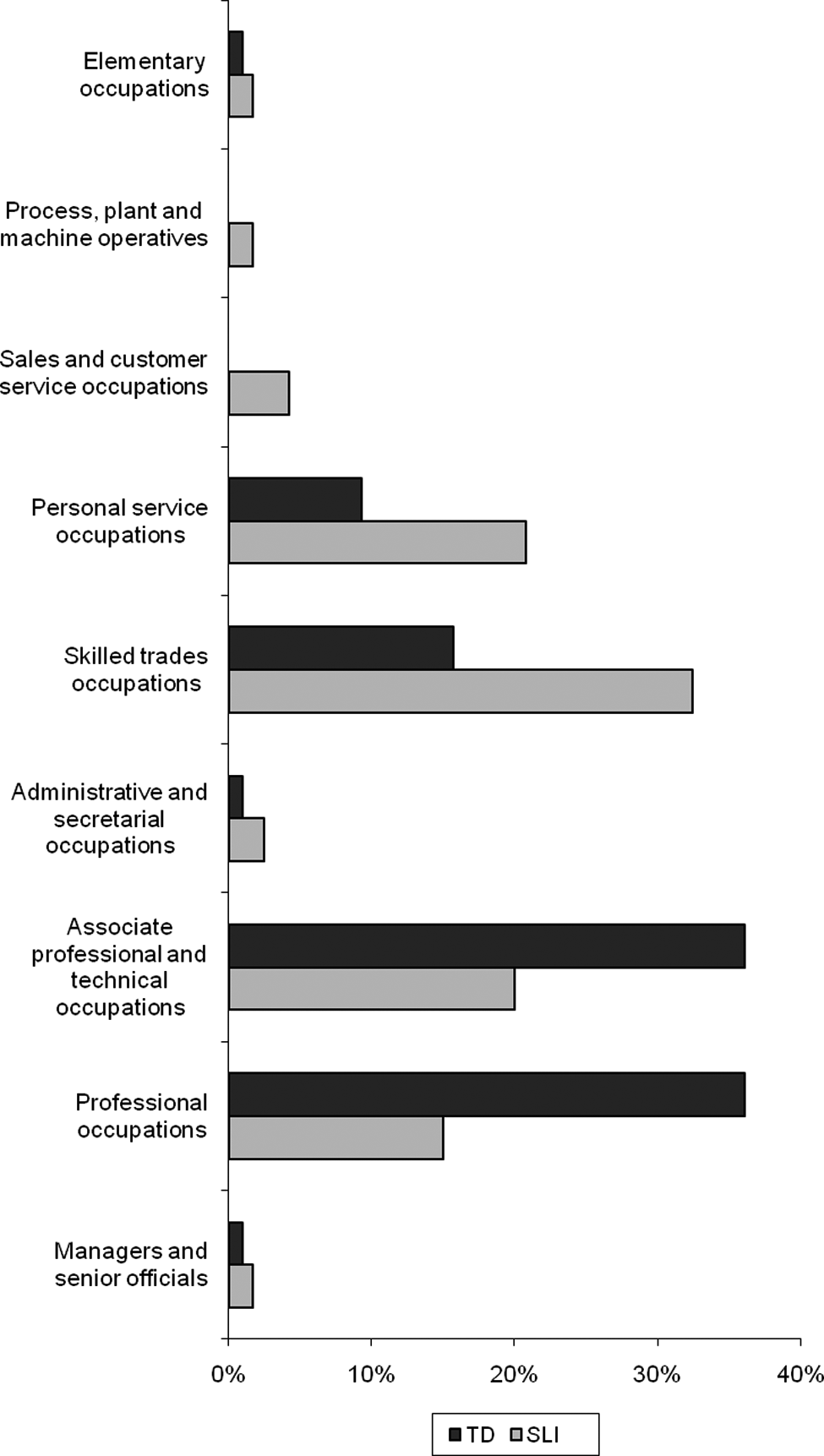
Proportions of young people with SLI and typically developing (TD) young people aspiring to work in different levels of future employment.
The pattern of responses differed significantly between the groups, χ2(8, n = 228) = 34.51, p < .001. Most notably, the proportion of young people with SLI who aspired to being a skilled tradesperson (32.5%) was more than double that of their TD peers (15.7%). Similarly, the percentage of young people with SLI who aspired to work in a personal service occupation (20.8%) was more than double that of their TD peers (9.3%). In marked contrast, almost three quarters of the TD young people (72.2%) aspired to jobs that were classed as professional or associate professional, compared to approximately one third (35.0%) of the young people with SLI.
Discussion
The present study was conducted to investigate whether young people with SLI engage in similar types of work experience as their normally developing peers, to determine to what extent communication difficulties bears on early work experiences and future work aspirations, and to solicit information on the areas of work life that the young people perceived as difficult. Working with a large sample of young people with SLI, we found that their experiences and expectations do indeed differ from those of their peers.
Short work placements are built into the school curriculum in the United Kingdom, and consequently the majority of our young people had completed a placement, allowing for direct comparisons to be made between the groups. Those with SLI were more likely to be placed in lower skilled, elementary jobs (e.g., shelf stacker). In contrast, their peers were more likely to be placed in employment that was considered personal service (e.g., child carer, classroom assistant). This indicates that, even early on in their careers, differences are apparent in the types of jobs that young people with communication difficulties undertake when compared to their peers.
We also examined actual (part-time or casual) employment experiences. The percentage of young people with SLI reporting never having had a job (other than preparatory work experience placements) was almost twice as high as the percentage of TD young people (62% vs. 32%). In terms of the level of the positions obtained, the young people with SLI did not differ significantly from the comparison group. However, the majority in both groups reported that they had undertaken employment in the elementary category, with the most commonly obtained work being having a newspaper round. Thus, at this stage, unskilled work is the main form of part-time or temporary employment available, irrespective of the young person’s characteristics or abilities.
Even though the employment available is elementary and the language demands of the job may not be great, it appears that it is difficult for young people with SLI to gain access to work. This may reflect a combination of factors, although future research is required to investigate these further. One possible factor is that young people with SLI perceive themselves less ready or less equipped to initiate and complete the process of finding work than do TD young people. We found that participants with SLI scored lower on self-report measures (subscales of the HDQ) of work-related skills, including Interpersonal Communication, Literacy and Numeracy, and Organization. Indeed, the psycholinguistic assessments we administered confirmed that the participants with SLI were poorer than their peers in terms of their literacy skills. This is consistent with other findings that language difficulties are associated with poor literacy (Snowling et al., 2000).
A second, though not necessarily alternative, factor may be the directions and expectations that other people convey. Consistent with this interpretation, we found that the early employment opportunities of young people with SLI are more likely to have been facilitated by others than are those obtained by TD young people. These results support the conclusions of Conti-Ramsden and Durkin (2008) that young people with SLI are less independent than their peers. Key individuals (e.g., caregivers, teachers) may form views of the young person’s capabilities and limitations and organize or constrain opportunities accordingly.
A third possibility is that employers are less enthusiastic about taking on a young person who presents with communication and related difficulties. We do not have data on employers’ attitudes or selections, but we did find that work-related skills significantly contributed to the prediction of whether or not participants had obtained part-time employment whereas sociodemographic factors did not. It may be that employers find young people with language and literacy impairments more difficult to interview and/or that employers have concerns about the demands of managing exceptional youth who may have poorer numeracy and organizational skills. Research has shown that stereotyping among employers may be related to the types of employment that young people experience (Francis, Osgood, Dalgety, & Archer, 2005). These three factors, then, of self-selection, influence of key socializing parties, and employer barriers may each contribute to circumscribing the nature of school-based work experiences and part-time employment during the adolescence of young people with SLI. However, further research is needed to evaluate in more detail the contribution of these factors. In addition, there is a need for research to identify other variables that are likely to influence the transition experiences of young people with SLI.
When young people were queried about difficulties that they had experienced during their work placements, the two groups again showed signs of divergence. TD young people were most likely to refer to task related difficulties of the job itself. Young people with a history of SLI also reported that aspects of the job itself were difficult, but, in addition, they were more likely to respond that working with people was a difficult feature compared to the TD young people. It is well established that difficulties with social relationships are experienced by many children and young people with SLI (Brinton & Fujiki, 1999, 2002; Conti-Ramsden & Botting, 2004; Durkin & Conti-Ramsden, 2007). The present findings suggest that the ramifications of these problems extend into early experiences in the workplace. Interpersonal difficulties are associated with, and perhaps exacerbated by, difficulties in communication. Because young people with SLI may present with communicative disfluencies or hesitancy, others may react to them in unfavorable ways, thus instigating cycles of negative interactions. Specific questions relating to multitasking and telephone use revealed also that the difficulties faced by young people with SLI may extend beyond their communication problems into other areas of their life and that this may further affect their success in the work environment. Taken together, these considerations highlight a potential vulnerability and disadvantage to young workers with SLI. Importantly, in practical terms, they identify a need for support and guidance in a number of areas in preparation for employment.
The young people’s accounts of their career aspirations revealed further differences between the two groups. Many of those with a history of SLI aspired to jobs that were classed as skilled manual, whereas their TD peers were more likely to aspire to professional or associate professional occupations. Previous work indicates that, in general, people with a history of SLI attain jobs that are considered to be of a lower level than those attained by their peers (Clegg et al., 1999; Felsenfeld et al., 1994). The present findings suggest that people with communication impairments may set their sights lower at the point of entry into the workforce.
A small number of young people with a history of SLI thought they would not be able to secure a job following the end of their education. They also were more likely to suggest they would be unhappy in the job and that any job they did obtain would be below their abilities. The pessimistic views that some young people with SLI hold about their prospects may be a reflection of stereotypes held in relation to young people with special needs. Teachers, for example, sometimes perceive the employment and training prospects for adolescents with learning disabilities to be lower than objective data indicate (Trainor, Carter, Owens, & Swedeen, 2008). At the same time, negative views may also be a reflection of poor self-esteem sometimes observed in this group (Jerome, Fujiki, Brinton, & James, 2002; Lindsay, Dockrell, Letchford, & Mackie, 2002).
In line with previous findings (Records et al., 1992), both the young people with SLI and those in the comparison group indicated similar levels of enjoyment of their work experience placements. Thus, although the early stages of occupational differentiation are detectable and are less favorable to young people with SLI, it appears that they are reasonably satisfied. On one hand, it is good news that these young people tend to enjoy their placements; on the other hand, there is a potential disadvantage to them if they are inclined to accept poorer experiences and outcomes than their peers and, at least in some cases, than their capabilities would warrant.
Current vocational development policies in the United Kingdom, the United States, and other advanced industrialized nations highlight the importance of supporting young people toward attaining “economic well-being” (e.g., DfES, 2003). To achieve this aim, young people need to gain relevant experiences and training, become independent, and obtain employment in a competitive job market. The ethos of the “every child matters” statement stresses that these goals should be upheld for all children. The present study goes some way toward understanding what is likely to be involved in facilitating the transition from school to employment for young people with SLI. Our study, nonetheless, is limited to the scope of the factors examined, and there is much research yet to be done. We would like to stress that multiple factors are likely to bear on early progress toward employment, including the young person’s special needs but also the interventions and support of others (e.g., in facilitating access to part-time work), the attitudes and expectations of employers (including possible discomforts or biases), and the match between abilities and the kinds of employment available. The evidence presented here indicates that young people with SLI do face a number of challenges and potential barriers, and it highlights specific issues for practical attention by professionals and policy makers concerned with this crucial aspect of adolescent development.
Footnotes
Acknowledgements
Thanks to the research assistants who were involved with data collection and the schools and families who gave their time so generously.
The author(s) declared no potential conflicts of interest with respect to the authorship and/or publication of this article.
The author(s) disclosed receipt of the following financial support for the research and/or authorship of this article: We gratefully acknowledge the support of the Nuffield Foundation (Grants AT 251 [OD], DIR/28 and EDU 8366), the Wellcome Trust (Grant 060774), and the Economic and Social Research Council (fellowship to Gina Conti-Ramsden, RES-063-27-0066).