



Abstract
The humor styles and family functioning of parents of children with disabilities are understudied subjects. This study seeks to shed quantitative light on these areas. Seventy-two parents of children with disabilities completed the Family Adaptability and Cohesion Evaluation Scales (FACES IV) and the Humor Styles Questionnaire (HSQ). The FACES IV measured several dimensions of family functioning: cohesion, flexibility, communication, and satisfaction. Cohesion and flexibility were variously scored to indicate whether a balanced or unbalanced propensity for these existed within the family. The HSQ was used to examine whether two adaptive styles of humor (affiliative and self-enhancing) and two maladaptive styles of humor (aggressive and self-defeating), were associated with balanced and unbalanced cohesion and flexibility, as well as with the presence of communication and satisfaction. The most significant results indicated a persistent correlation between prosocial humor styles and family communication and satisfaction. Further exploratory research is urged.
One of the most familiar human emotions is humor, which has been the subject of countless essays and scholarly books. Humor has also become the subject of much study as a method by which people cope with the world around them. Most researchers agree that humor can provide coping resources, welcome social relief and positive mental affect, for both the provider and recipient of communicative humor. It also can be used deleteriously, as with put-downs and self-deprecation. Some of the most intimate uses of positive and negative humor come within the context of families. This is perhaps why educational and family researchers have become interested in how humor relates to other aspects of family functioning.
This study investigates whether positive (adaptive) and negative (maladaptive) styles of humor, as measured by the Humor Styles Questionnaire (HSQ; Martin, Puhlik-Doris, Larsen, Gray, & Weir, 2003), are correlated with positive and negative family coping and functioning in the parents of children with disabilities, as predicted by the Circumplex model, and as measured by the Family Adaptability and Cohesion Evaluation Scales (FACES IV; Olson & Gorall, 2003) tool.
The impact of humor on family functioning is little studied. Following an extensive search of the available literature, we believe that the two above instruments (the FACES IV questionnaire and the HSQ) have never before been compared. Such a lack of study has actually been noted in the literature before, for example, Kazarian and Martin (2006): “Although there has been some research on humor styles in friendships (Martin & Ward, 2003) and dating relationships (Martin et al., 2002), no previous studies have examined the HSQ in relation to general family functioning” (pp. 409–410). We are even more certain of this dearth with respect to families of children with disabilities. We therefore feel that it is important to contribute to the quantitative literature on family functioning and humor, as anecdotal evidence exists for humor’s important and positive role in family coping and functioning (Jevnikar, 2007; Rieger, 2004a).
The Circumplex Model of Marital and Family Systems
Various models have been proposed in the literature for understanding family coping and functioning. These include the McMaster Family Assessment Device, or FAD Index (Epstein, Baldwin, & Bishop, 1983), and The Beach Center Family Quality of Life Scale (Hoffman, Marquis, Poston, Jean, & Turnbull, 2006). However, the Circumplex model of Marital and Family Systems, measured via the FACES (Olson & Gorall, 2003), is considered one of the most comprehensive and widely applied theoretical frameworks of the family environment (Kouneski, 2000; Olson, 2011). According to the Circumplex model, there are four different dimensions that contribute to how a family successfully copes and adapts in a balanced manner—cohesion, flexibility, communication, and satisfaction.
Cohesion is defined as “the emotional bonding that couple and family members have toward one another” (Olson & Gorall, 2003, p. 516).When cohesion is balanced and moderate, family members both maintain individual identities and identify as being connected with other members of the family. However, when cohesion is immoderate, it can manifest with either an excessively high level (what Olson and Gorall termed enmeshment) or an exceedingly low level (what they called disengagement). These extremes are negatively correlated with good family functioning, because balanced cohesion is a necessary precursor to that functioning (Olson & Gorall, 2003).
Family flexibility consists of “the quality and expression of leadership and organization, role relationships, and relationships rules and negotiations” (Olson & Gorall, 2004, p. 5). A balance is required for an optimally functioning family; this is especially so because leadership has to take place, in which family members willingly accede authority to an individual of greater competence in areas where trust has been established. Unbalanced families are those with either too much or too little flexibility. In rigid relationships, one individual is dominant and controlling. Everyone else’s role is defined, and rules are rigid. In the latter case, that of a chaotic relationship, there is too little structure, no one is in charge, and roles are ill-defined.
Communication is conceived of as a horizontally facilitating factor that acts as the conveying vessel of both cohesion and flexibility. It includes listening skills, speaking skills, the ability to self-disclose, and respect and regard (Olson & Gorall, 2003). Satisfaction is theorized as the expression of contentedness with family functioning (Olson & Gorall, 2003). Satisfaction, like communication, is also a positive and linear concept, correlated specifically with high levels of cohesion and flexibility (Kusada, 1995).
The Circumplex Model of Marital and Family Systems has been used to broaden our understanding of family dynamics in populations that have disabilities. For instance, Seligman and Darling’s (1997) research demonstrated that healthy family functioning ranges were most closely related to moderate levels of both cohesion and adaptability for populations of exceptional families. Morrison and Zetlin (1988) indicated that families of children with learning disabilities who scored higher on cohesion demonstrated most effective and positive patterns of communication.
In the most recent study on this subject, Barnett and Hunter (2012) examined the family dynamics in children with mental health problems and siblings’ adjustment. Their results revealed that the levels of cohesion and flexibility were within the typical range when compared with the normative sample of the FACES IV.
Family Coping Theory
Stress and its impact on family functioning as a unit have long been an important area of research (Ferguson, 2002). For instance, cognitive stress theories (Lazarus & Folkman, 1984) have emphasized that stress is mediated by cognitive appraisal that results from the interaction between the person and the family environment. When the stress level is too high for individuals and when demands prove more than resources available to them, individuals cognitively reappraise the situation and develop coping strategies to identify those resources that will help them reduce stress and improve their family functioning.
Similarly, Hill (1949) had developed a model of stress and coping called the ABCX family crisis model, in which he suggested that a stressor event (A) interacts with a family’s available resources to meet the crisis (B) and with the meaning the family makes of the event (C) to produce the crisis (X). Thus, according to this model, how a family adapts to a critical event is determined by the interaction between family resources and family perceptions.
Coping strategies include various tools and strategies that families use to reinstate balance in family functioning (Manning, Wainwright, & Bennett, 2011). Research has long emphasized the importance of active coping strategies in decreasing stress among parents of children with disabilities and yield successful functioning (Ferguson, 2002). For instance, Manning et al. (2011) using the Double ABCX model (an elaboration of the ABCX) examined the parental stress of having a child with autism. Their findings indicated that reframing, or reappraisal, was most strongly related to successful parental coping and family functioning.
Jones and Passey (2004) reported that parents of children with developmental disabilities who used such coping styles as focusing on family integration, co-operation, and optimism showed lower overall stress indicating that coping strategies were the strongest predictor of family adaptability. The coping strategy explored in this article is humor, and more specifically, the humor styles used by families of children with disabilities.
Humor and Parents of Children With Disabilities
There is emerging research suggesting that humor can serve as a positive coping mechanism available to families of children with disabilities. Rieger and McGrail (2013) conducted a hierarchical regression study that showed that coping humor predicted, albeit modestly, cohesion and flexibility in parents of children with disabilities. Humor is thus often used as a strategy that the literature suggests may be consciously or subconsciously used to relieve tension, enhance self-worth, aid cohesiveness, and improve overall functioning (Eckstein, Junkins, & McBrien, 2003; Martin et al., 2003; Ziv, 1984). Given these positive characteristics of humor, it is not surprising that humor is recognized as an important dimension in the lives of parents challenged by rearing a child with a disability.
Using a qualitative methodology, Rieger (2004b) established that families who had children with diverse disabilities interchangeably used such terms related to humor as “smiling, laughter, mirth, funniness, and playfulness” (p. 435). This ability to generate humor among family members was reported to help them reduce stress, ensure a sense of safety and freedom, reduce the pain of being perceived by the public as different, express their emotions, promote acceptance and closeness in the family, and overall to develop a humorous approach to life, which facilitated their successful functioning as a family.
Taken together, the literature reviewed here suggests that humor serves as an effective coping strategy contributing to family overall functioning. However, determining specific types or styles of humor, including positive and negative humor, can provide even more valuable information about families for family researchers. The influence of these various forms of humor on balanced family functioning is an understudied concept, especially regarding families where a member has a disability.
Humor Styles
Martin et al. (2003; Martin, 2007), working from the definitions of Freud (1928), Maslow (1954), and others, posited four styles of humor production (affiliative humor, self-enhancing humor, aggressive humor, and self-defeating humor), resulting from Martin’s use of a self-report mechanism called the HSQ. Affiliative and self-enhancing humor are considered adaptive humor styles that are beneficial for individual well-being and social interactions, while aggressive and self-enhancing humor are considered maladaptive styles of humor that are detrimental to individual and social well-being.
Affiliative humor is characterized by engaging in spontaneous humor and telling jokes or anecdotes to entertain an audience, facilitate relationships, and lessen interpersonal tensions (Lefcourt, 2001; Martin, 2007; Martin et al., 2003). Self-enhancing humor relates to an ability to use humor to deal with stress or adversity by maintaining a cheerful and humorous perspective on life. It entails using humor to regulate one’s own emotions and moods (Kuiper, Martin, & Olinger, 1993; Martin, 2007; Martin et al., 2003). Aggressive humor is evidenced by the use of humor to demean and manipulate others through sarcasm, teasing, put-down, or ridicule (Kuiper, Grimshaw, Leite, & Kirsh, 2004; Martin, 2007; Martin et al., 2003). Finally, self-defeating humor consists of tendencies toward excessive self-disparagement, as well as negatively ingratiating and allowing oneself to be the “butt” of others’ humor to gain acceptance from them or to avoid dealing constructively with one’s problems (Fabrizi & Pollio, 1987; Martin, 2007; Martin et al., 2003).
Despite significant variation, there is a substantial degree of overlap among the different styles of humor in the HSQ. Research also shows that this tendency toward intracorrelation extends across the divide to include both prosocial and more deleterious styles of humor (Reff, 2006). For example, affiliative humor may share some, but not all, of the characteristics of a non-pro-social humor style, such as aggressive humor. It is thus necessary to control for the intracorrelation that may exist between any two scales, in order that the results of our investigation into associations within and between surveys remain independently meaningful. When Martin et al. (2003) developed the HSQ, they used a construct-based scale construction approach recommended by Jackson (1970), so as to produce measures that would have strong internal consistency and minimal overlap between scales. This resulted in scales that were somewhat positively intercorrelated, but ones in which overlap was minimized and thereby discriminant validity maintained.
A significant step in developing the current FACES IV instrument was a study by Tiesel (1994), in which she developed four unbalanced scales aimed specifically at the low and high extremes of cohesion (disengaged and enmeshed) and flexibility (rigid and chaotic). This work yielded four scales tapping the very low and very high levels of cohesion (disengaged and enmeshed) and flexibility (rigid and chaotic). These four scales were found to be reliable and valid and were found to discriminate between problem and nonproblem families. Using these four unbalanced scales, Craddock (2001) found support for the basic hypothesis that families with higher scores on these scales had higher levels of family stress and lower levels of satisfaction.
As mentioned before, there is relatively little research on humor styles with respect to familial disability. However, we are sanguine about the models that we use here. Each of them has been thoroughly vetted with diverse populations and has been the subject of independently mounted investigations into its robustness of reliability and validity. At the same time, we remain unaware of studies that use the HSQ with families where a member has a disability. While there are studies using some of the concepts used by the Circumplex Model/FACES that involve families dealing with disability (e.g., Morrison & Zetlin, 1988), they are not numerous. This notable dearth is addressed by this study.
Earlier research has suggested that we should anticipate that the two balanced dimensions of family functioning would be associated with adaptive humor production in the parents of children of disabilities (Rieger, 2004a; Rieger & McGrail 2013). Contrapositively, we should also expect that the various unbalanced dimensions of family functioning would be associated with maladaptive humor production. Therefore, based on the extant literature on humor production, family functioning and families coping with children with disabilities, we propose the following hypotheses:
Method
Participants
For inclusion in the study, the potential participant had to be an adult who comes in direct contact with, and provides daily emotional and/or physical care for a child with any federally recognized disability between the ages of 3 and 21. “Caring for a child with a disability” was operationalized to mean giving care to a child who used special education services that were provided under the Individuals With Disabilities Education Act (Department of Education, 2006). The federally recognized child disability range encompasses the ages between 3 and 21.
Although the protocol of the present study permitted the inclusion of caregivers other than parents, 100% of the 72 participants were parents, with 59 (81.9%) being mothers and 13 (18.1%) being fathers (see Table 1 for all demographic information). In addition, information related to the parents’ children, namely their gender, age, and disability was provided by them. As regards gender, 44 or 61.1% of related children were male, and 28 or 38.9% were female. Although the parents’ children ranged in age from 3 through 19 years of age, a plurality (19, or 26.4%) were 4 years of age, with 5-year-olds being the next most populous, at 10, or 13.9%. Every age year from 3 through 19 was represented, but most by only 2 to 4 children, except for children aged 15, who comprised 8, or 11.1% of the parents’ children.
Parents’ Demographic Information (N = 72).
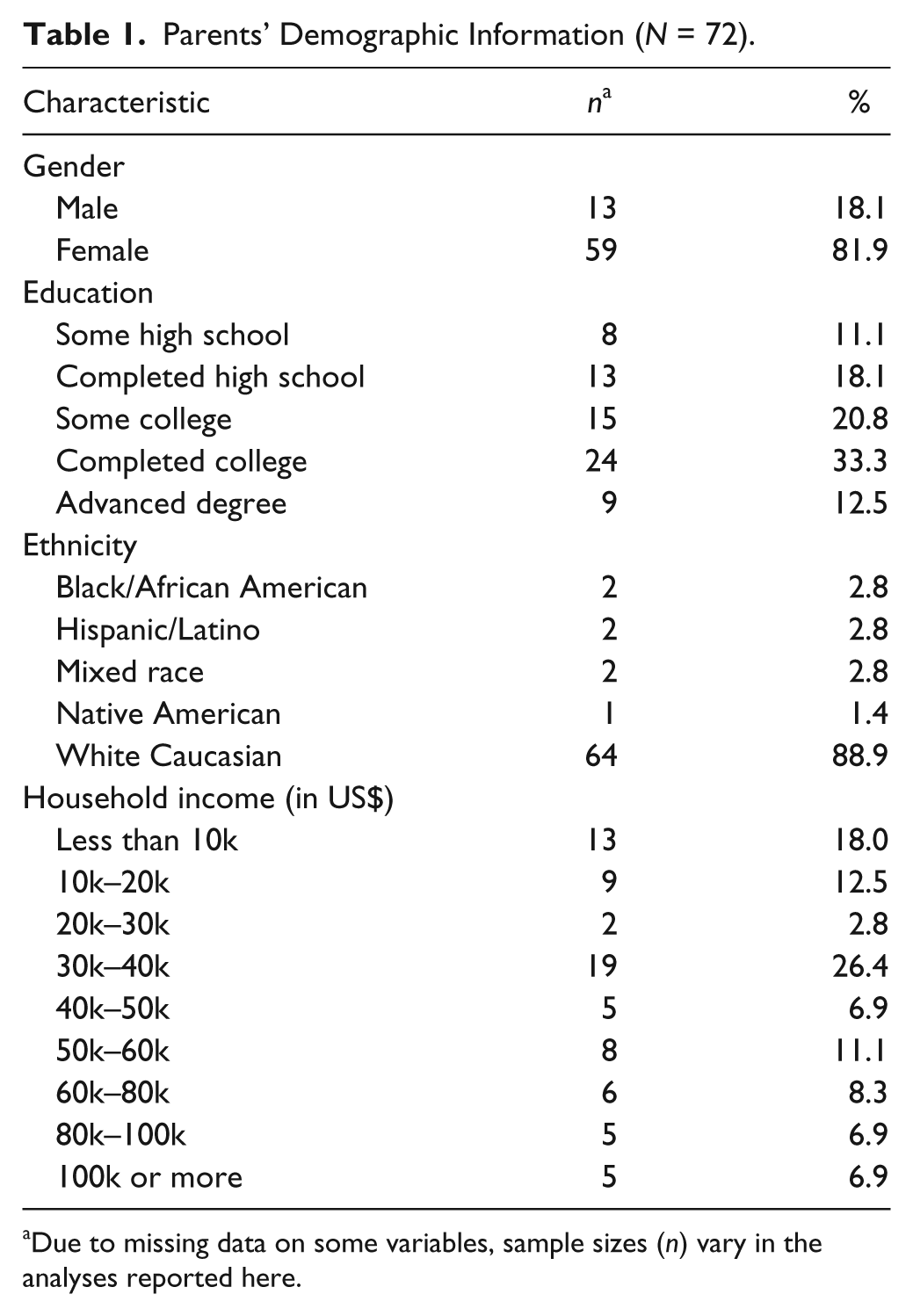
Due to missing data on some variables, sample sizes (n) vary in the analyses reported here.
Several types of disabilities and multiple disabilities were found among the children of the studied parents. Autism spectrum disorder accounted for a plurality of disabilities, at 27, or 37.5% of related children. The next highest represented disability was the category of multiple disabilities, which accounted for 17, or 23.6% of the parents’ children. The other disabilities, including attention deficit disorder/attention-deficit hyperactivity disorder (ADD/ADHD), learning disabilities, traumatic brain injury, Down syndrome, speech and language impairments, other impairments, emotional disturbances and bipolar disorder, accounted for the rest, but no single disability from these rose to double digits in number or percentage.
A nonrandom purposive sampling method (Smith, 1983) was used for this study for identification of the participants. With the help of family support agencies and family support groups, participants were asked to volunteer for the present study. These included volunteers from a teacher center, a resource center for independent living, a health care center, United Cerebral Palsy, and family support groups such as the Down Syndrome Parent Support Group, and Families for Effective Autism Treatment. After the approval from the Institutional Review Board, individually coded survey packets were distributed to the participants by the identified agencies. Participants were asked to complete the Humor Style Questionnaire, the FACES IV survey, a demographic query on a child’s disability, age and gender, and return all materials to the referring agency. For their data to be considered for analysis, the participants had to respond to all items on the survey instruments, except for demographic information.
A total of 185 survey packages were distributed to potential eligible family members. From this number, a total of 81 participants from intact family units volunteered to participate in the study, creating an initial response rate of 44%. However, because nine packets had insufficient data or were not returned in time, 72 survey packets were available for data analysis, yielding a final response rate of 39.6%. Even though this sample size is relatively small, it is still considered a satisfactory sample size for conducting correlational research in the subject literature (Fraenkel & Wallen, 2006).
Instruments
The HSQ is a 32-item self-report scale that examines four different styles of humor, two of which, affiliative humor and self-enhancing humor, are considered adaptive (“positive”) humor and two of which, aggressive humor and self-defeating humor, are considered maladaptive (“negative”) humor. Each dimension was rated via 8 items, and each item was rated on a 7-point Likert-type scale. The scale’s indicators were (1) “totally disagree,” (2) “moderately disagree,” (3) “slightly disagree,” (4) “neither agree nor disagree,” (5) “slightly agree,” (6) “moderately agree,” and (7) “totally agree” (Martin et al., 2003).
In the present study, the four scales (Affiliative Humor, Self-Enhancing Humor, Aggressive Humor, and Self-Defeating Humor) of the HSQ had acceptable internal reliability and the Cronbach’s α were .85, .86, .67, and .70, respectively. These results are consistent with prior reports of the internal consistency and reliability reported by Martin et al. (2003) of α scores that ranged from .77 to .81.
The FACES IV Package (Olson & Gorall, 2003) measures both optimal and less desirable functioning. FACES IV (Olson & Gorall, 2003) contains 42 items across six Likert-type scales that measure the following: balanced cohesion, with its unbalanced components, disengagement and enmeshment, and balanced flexibility, with its unbalanced components, and rigidity and chaos. It also contains 10 items that represent communication, as well as the Family Satisfaction Survey, or FSS, which also uses 10 items to report on the presence of satisfaction. The total was thus 52 items plus 10 FSS questions for a total of 62 five-point Likert-type response items.
Respondents for the first 52 items were asked to rate a specific behavior with possible responses ranging from (1) “does not describe our family at all,” (2) “slightly describes our family,” (3) “somewhat describes our family,” (4) “generally describes our family,” and (5) “very well describes our family.” For the final 10 FSS questions, the 5-point Likert-type scale provided the following items: (1) “very dissatisfied,” (2) “somewhat dissatisfied,” (3) “generally satisfied,” (4) “very satisfied,” and (5) “extremely satisfied” (Olson, Gorall, & Tiesel, 2004, p. 9).
Alpha reliability calculated for the FACES IV scales was found to be consistent with previous research. The six scales (Cohesion, Flexibility, Disengagement, Enmeshment, Rigidity, and Chaos) demonstrated acceptable internal consistency and reliability with Cronbach’s α scores of .86, .73, .85, .71, .77, and .89 respectively. Previous research had found reliability coefficients between .77 and .89 (Olson & Gorall, 2003). The most recent study of the validity of FACES IV and the Circumplex model (Olson, 2011) has confirmed that all these six scales were both reliable and valid.
Results
In H1, we asserted that adaptive styles of humor used and appreciated by parents of children with disabilities would be associated with balanced family functioning. In H2, we theorized that maladaptive humor production and reception by the parents of children with disabilities would be positively associated with unbalanced family functioning. In H3, we hypothesized that adaptive humor production and reception would be associated with increased family communication. In H4, we asserted a positive association between adaptive humor production and increased family satisfaction.
To test these hypotheses, we used the HSQ and correlated responses from it with the Circumplex Model of Family Functioning via the FACES IV metric in two steps. In Step 1 of the research design, bivariate, two-tailed correlations between each of the four measures of humor styles (affiliative, self-enhancing, aggressive, self-defeating) and each of the six family functioning measures (cohesion and flexibility, disengagement, enmeshment, rigidity, and chaos) were run, along with the two horizontal factors, communication and satisfaction. This provided us with 12 variables available for initial correlation (see Table 2).
Bivariate Correlations for All Variables (N = 72).

Correlation is significant at the .05 level (two-tailed). **Correlation is significant at the .01 level (two-tailed).
Means and standard deviations for the humor styles and family functioning measures are presented in Table 2. The obtained values for all of the four scales of the HSQ are consistent with previous findings (Martin et al., 2003). Similarly, the values obtained for the family functioning measures are congruent with past research findings (Olson & Gorall, 2003).
Significant correlations that were confirmatory of earlier, intramodel research were discovered. For example, we found that cohesion was strongly correlated with family communication (r = .71, p < .01) and family satisfaction (r = .77, p < .01) as well as being moderately correlated with flexibility (r = .53, p < .01). Moreover, our research indicated negative correlations in many places where these relationships had been predicted, such as between cohesion and disengagement (r = −.78, p < .01; cohesion and enmeshment (r = −.38, p < .01) and cohesion and chaos (r = −.68, p < .01). These findings lend credence to and confirm the stability of the models we used.
Nevertheless, in Step 1, our research was partially disconfirmatory of significant correlations between indices of balanced family functioning (cohesion and flexibility) and adaptive humor styles (affiliative and self-enhancing humor). Specifically, we found no significant correlation between cohesion and affiliative humor (r = .18, ns), nor one between flexibility and affiliative humor (r = .22, ns). We did find significant, if weaker, correlations, however, between cohesion and self-enhancing humor (r = .28, p < .05) and flexibility and self-enhancing humor (r = .37, p < .01).
In Step 2 of the research design, we more fully tested our hypotheses by compensating for the high number of intercorrelations among different humor styles that previous research had predicted, and we corrected for possibly spurious correlations between the FACES IV and the HSQ, by using one-tailed partial correlations.
To test H1, we measured the association of the two balanced aspects of family functioning (cohesion and flexibility) and the two adaptive styles of humor production (affiliative and self-enhancing), while controlling for, or “partialing out,” the influence of the unbalanced aspects from the Circumplex model/FACES IV and the maladaptive styles from the HSQ. Thus, we partialed out disengagement, enmeshment, rigidity, and chaos on the Circumplex side, and the aggressive and self-defeating styles of humor on the HSQ side. When we partialed out the unbalanced and maladaptive variables, balanced cohesion continued to be associated with balanced flexibility, albeit more weakly than in Step 1 (r = .32, p < .01). However, cohesion bore no significant association with either affiliative or self-enhancing humor, but flexibility continued to be significantly associated with self-enhancing humor, though at a somewhat lesser intensity than in Step 1 (r = .28, p < .05). Flexibility was not significantly associated with affiliative humor. H1 is thereby partially confirmed but is also partially disconfirmed to a somewhat greater extent.
To test H2, we reversed the process and partialed out the influence of the balanced forms of functioning from the Circumplex Model/FACES IV and the adaptive types of humor from the HSQ, and compared only the unbalanced Circumplex constructs with the maladaptive types of humor. For H2, we found a significant but weak positive correlation between aggressive humor and enmeshment (r = .24, p < .05). We also found self-defeating humor to be positively but weakly correlated with chaos (r = .23, p < .05). Therefore, H2 is also partially confirmed and partially disconfirmed.
To test H3 and H4, we measured correlations among affiliative humor, self-enhancing humor, family communication, and family satisfaction, while controlling for aggressive and self-defeating humor. We found that family communication and satisfaction were strongly correlated with each other (r = .81, p < .01), confirming earlier research. Affiliative humor continued to be positively and moderately correlated with self-enhancing humor (r = .48, p < .01), but somewhat more weakly correlated with family communication (r = .31, p < .01) and satisfaction (r = .37, p < .01). Self-enhancing humor, however, was weakly to moderately correlated with family communication (r = .33, p < .01) and moderately with family satisfaction (r = .43, p < .01). We are therefore able to confirm H3 and H4.
Discussion
All research designs have limitations. The collection of data via the use of self-report measures for all family functioning and humor styles variables, and the study’s voluntary nature of participation, coupled with obtaining the data from only one parent per family suggest that the findings from this study must be interpreted with caution. As the data from self-reports tend often to be confounded with social popularity, defensiveness, and other reactive concerns (Livneh & Wilson, 2003), the results from this study may be partially based on biased self-reports from respondents who represented more motivated and supportive views on humor in their lives rather than from other families who may have differing perspectives on humor. Furthermore, as the families were recruited from family support agencies and groups, they may not be representative of all families. This may have impacted their perspectives on FACES IV and the HSQ.
It is also important to note that most of the families in this study were middle-class Caucasians, and most had education above high school. There was also relatively little representation of ethnic minority populations. As Olson and Gorall (2003) cautioned, what might appear as nonnormative functioning for a Caucasian may be a normative style of functioning for certain ethnic minority families. To sum up, we stress that this is a data snapshot, rather than a full statistical portrait of how different humor styles may be used to enhance family functioning where a child has a disability.
The most robust finding we uncovered was the identification of a positive correlation between flexibility and self-enhancing humor. That is, those parents who balance the twin needs of stability and flexibility in the family appear to use self-enhancing humor to deal with stress and adversity. This finding is interesting because it confirms the notions of dealing with stress by maintaining a humorous outlook on life reported on in the qualitative studies on humor discussed in the literature review above.
On the maladaptive side, we found a significant but weak positive correlation between aggressive humor and enmeshment. This may mean that those parents who appear to use humor for the purpose of demeaning or manipulating others (in aggressive ways) are involved in enmeshed, or overly close relationships in the family. They may be almost exclusively focused relationships on the inside of family circles, at the cost of having limited outside-the-family individual relationships.
We also found self-defeating humor to be positively but weakly correlated with chaos. It may be that those parents who appear to use humor to make fun at themselves and to avoid dealing constructively with individual problems tend to be engaged in chaotic relationships, in which roles are unclear and leadership is limited.
Taken together, these findings provide some context to earlier findings from other qualitative studies mentioned in this article on the connections between humor and family functioning. The families in those studies rejected the use of aggressive and other maladaptive forms of humor as not conducive to their healthy family functioning. Instead, they followed the principle of laughing with, rather than at, those in the family with a disability.
Our final hypotheses were that adaptive styles of humor would be positively correlated with family communication and with family satisfaction. Both of these hypotheses received robust support. Thus, parents who maintain a humorous perspective on life in times of stress (self-enhancing humor) and who use humor to facilitate social interactions (affiliative humor) are more likely to demonstrate effective overall communication skills, and are more likely to be satisfied with their family functioning.
The findings from this study can contribute to those full-service and community schools that provide comprehensive and integrating support for children and families. “Full-service or community schools have a single point of delivery, [and] meet the holistic needs of the students within the context of their families” argued Turnbull, Turnbull, Erwin, Soodak, and Shogren (2011, p. 276). Some of these services may consider the practice of supporting families in schools by a dissemination of information about the benefits of coping humor for their healthy family functioning. They could offer programs, workshops, and individual meetings to help families identify their preferred humor styles, and how to use those styles to support their day-to-day family interactions and communications with school professionals.
In addition, the styles of humor generated by family members may provide relevant school professionals with important information about a family member’s views, attitudes, assumptions, and feelings, thus providing insights into their mental and emotional functioning (Martin, 2007). This in turn may assist professionals in determining if students or other family members have some control over their individual problems or feel overwhelmed (Martin, 2007). Such an approach might subsequently help provide them with individualized supports and guidance, if needed.
Humor, if it is used in a genuine and caring manner, may also be helpful in reducing social distance and promoting emphatic understanding between school professionals, parents, and children (Martin, 2007). The topics of humor and the understanding of humor styles should be a part of the school’s professional development activities to increase school professionals’ awareness of its benefits for building such positive and emphatic partnerships with families.
After-school strengths-based and resiliency programs with parental and teacher involvement could benefit from this study as well, as they could teach children how to use their preferred humor styles for dealing with daily stresses and challenges, especially now that an increasing number of children enter today’s schools with multifaceted problems and risks that impact their healthy family functioning (Federal Interagency Forum on Child and Family Statistics, 2012).
Footnotes
Acknowledgements
We would like to thank the editor, Dr. Fred Spooner, and the reviewers for their very helpful comments and suggestions; this article is much improved as a result.
Declaration of Conflicting Interests
The author(s) declared no potential conflicts of interest with respect to the research, authorship, and/or publication of this article.
Funding
The author(s) received no financial support for the research, authorship, and/or publication of this article.