




Abstract
Special education scholars have traditionally experienced a significant disconnect between their experience as researchers and the fast-paced realities of policy and politics. We propose that higher education leaders should be drivers of change, not recipients of outcomes, and by extension, that there is a need to ensure that the preparation of future special education faculty and leaders includes multiple opportunities for them to engage in development of competencies related to policy-making, implementation, and evaluation. This article uses an exploratory qualitative approach to describe an experiential learning model referred to as the “Short Course,” established to provide opportunities for doctoral students to experience the policy process and to develop an advocacy disposition and skills for future roles in the broad field of special education. Questionnaire data gathered over 4 years suggest the potential for this model to increase advocacy and policy engagement among future special education researchers, faculty, and leaders.
Keywords
Beginning with the enactment of the Education for All Handicapped Children Act in 1975 (renamed the Individuals With Disabilities Education Act [IDEA] in 1990, and last reauthorized in 2004), special education policy has become an increasing presence in federal education law. Over time, components of the IDEA have become intertwined with the Elementary and Secondary Education Act (ESEA), reauthorized as the No Child Left Behind Act (NCLB) in 2001, and the Every Student Succeeds Act (ESSA) in 2015. Provisions of the IDEA (2004) and ESSA (2015) have resulted in dramatic changes in public education, including changes to accountability systems for students and teachers, increased use of research-based practices in P–12 settings, and greater attention to the needs of learners with language and learning differences. At the same time, the policy-making process has become increasingly complex and fraught with partisan wrangling, leaving many education leaders and practitioners with the sense that their voices, professional knowledge, and research are being left out of the policy conversation (McLaughlin, West, & Anderson, 2016). This sentiment may be particularly present for scholars in higher education settings who have traditionally experienced a significant disconnect between their experiences as researchers, engaged in a careful and painstaking scientific process, and the fast pace of social and political realities (Birnbaum, 2000; Henig, 2008; Rippner, 2016).
In this article, we argue that leaders in our field, including those who teach and conduct research in higher education, need to know about policy and advocacy. We propose that higher education leaders should be drivers of change, not recipients of outcomes, and by extension, that there is a need to ensure that the preparation of future special education faculty and leaders includes multiple opportunities for them to engage in development of competencies related to policy-making, implementation, and evaluation. In particular, we advocate for a leadership curriculum that includes opportunities for doctoral students to experience the policy process, and to develop advocacy disposition and skills that they can take into their future roles in the broad field of special education. Therefore, the purpose of this article is to describe one approach to providing opportunities for doctoral students to experience the policy process, and to develop an advocacy disposition and advocacy skills for future roles in the broad field of special education.
The Importance of Advocacy
Significant aspects of special education are driven by decisions occurring through the legislative and judicial processes (Kiarie, 2014; Rude & Miller, 2018; Thorius & Maxcy, 2015). Therefore, it is important to understand and engage in activities that inform the legislative process such as advocacy. Advocacy efforts of individuals with disabilities and their families were vital to the initial passage of landmark special education and disability legislation (Landmark, Zhang, Ju, McVey, & Ji, 2016; Yell, 2016) and continue today to exert a powerful influence on policy makers (Yell & Bateman, 2018). The Endrew F. v. Douglas County School District decision is the latest example of the importance of driving change in the field rather than being recipients of outcomes. As a result of Endrew F. v. Douglas County Schools (2017), the definition of educational benefit, which must be met to achieve a free and appropriate public education (FAPE), now includes the term “progress,” where previously educational benefit was defined as more than “de minimis,” loosely translating to more than nothing (Yell & Bateman, 2018). This new benchmark of education delivery to individuals with disabilities is just one indication of the evolving political climate, given multiple societal and political forces.
In recent years, advocacy and social justice movements, defined as “the fundamental valuing of fairness and equity in resources, rights, and treatment for marginalized individuals and groups of people who do not share equal power in society” (Constantine, Hage, Kindaichi, & Bryant, 2007, p. 24), have taken rise across the social sciences, including education (Nilsson, Marszalek, Linnemeyer, Bahner, & Misialek, 2011). As a result, increasing numbers of special education faculty are engaging in advocacy activities to elevate critical issues in special education (e.g., McLaughlin et al., 2016; Smith & Montrosse, 2012; Spaulding & Pratt, 2015). Special education researchers have the potential to contribute to the development of sound education policy, but their focus on a long-term research trajectory does not generally match the immediate and more politicized needs of state- and federal-level policy makers. “Policymakers and academics are different breeds who speak different languages” (Goodwin, 2013, para. 7). Researchers who are capable of sharing their work in a digestible manner for elected officials by focusing on exchanging knowledge that is free of jargon, leverages brevity, and combines both academic and nonacademic data (Goodwin, 2013) can empower policy makers to take action in support of students with disabilities and their families. Dissemination of information is critical to advocacy and one of many skills required for future leaders who strive to be drivers of change in the special education field.
Training Future Advocates
Given the uniqueness of advocacy activities when compared with other faculty responsibilities, including, but not limited to, differing approaches to communicating ideas, advocacy is a skill that must be taught. Current special education leaders, whether in higher education or elsewhere, may not see the role of advocate as central to their professional identity, but it is becoming increasingly clear that doctoral students preparing for special education faculty positions will need to view themselves as advocates (deBettencourt, 2014; deBettencourt, Hoover, Rude, & Taylor, 2016). The historical and well-documented disconnect between policy, advocacy, and core activities of special education faculty, leaders, and teachers (Henig, 2008; McLaughlin et al., 2016) results in limited policy training in special education doctoral programs. Specifically, policy courses taught in most doctoral programs tend to focus on the theoretical aspects of policy, rather than its application in authentic contexts. In the absence of an intentional focus on policy and advocacy at the doctoral level, the field of special education risks a lack of readiness for action when pressing issues bubble to the surface.
Although the advocacy field continues to gain momentum, the field remains “unsupervised” and there is a lack of clarity with regard to who will train future advocates (Burke, 2013). Multiple scholars have made the point that, as faculty in higher education, we are preparing future leaders who will in turn prepare future teachers, faculty, and leaders in the field, including those who will work in policy, educational administration, and professional organizations (West & Shepherd, 2016; Whitby & Wienke, 2012). Intervening at the doctoral level will allow us to enhance the capacity of the field to engage with policy and advocacy, from many levels (Burke, Goldman, Hart, & Hodapp, 2016; Burke, Mello, & Goldman, 2016). Therefore, the purpose of this article is to use an exploratory qualitative approach to describe an experiential learning model referred to as the “Short Course,” established to provide opportunities for doctoral students to experience the policy process and to develop an advocacy disposition and advocacy skills for future roles in the broad field of special education.
Method
Setting and Participants
The Higher Education Consortium on Special Education (HECSE), a national organization for institutes of higher education (IHE) preparing doctoral-level special education personnel, participates actively in national advocacy efforts, given the organizational stance on the importance of higher education in public education infrastructure. As an organization, HECSE engages in dialogue with national leaders in the U.S. Congress, federal agencies, professional organizations, and advocacy groups to focus on topics and issues in special education and disability services. In an effort to promote appropriate and effective training for prospective special education faculty, HECSE established rigorous doctoral program standards for their nearly 90 member institutions. One of HECSE’s keystone activities is an annual January summit held in Washington, D.C., that includes an annual business meeting as well as multiple opportunities for members to learn about and engage with current policy issues. Given the ideal location and timing of the annual summit, the longtime consultant to HECSE (third author), the HECSE president at the time (second author), and affiliates of HECSE thought it would be strategic to extend the summit and include doctoral students by embedding a special set of activities for them within the preexisting structure.
The first cohort of doctoral students engaged in this experiential learning model in January 2015. Since then, three additional cohorts (2016, 2017, and 2018) completed the experience. Each cohort included 10 special education doctoral students who were selected from a competitive pool of member universities in HECSE. Because of the multiple in-person meetings, which took place in the offices of the speakers in Washington, the enrollment of doctoral students in the Short Course was limited to 10. This allowed for in-depth discussion and cohort cohesion. On occasion, due to the dynamic nature of the Hill, meetings took place in less formal settings such a cafeteria or tight quarters such as a congressional office. Groups larger than 10 would likely lack the nimbleness needed to move meetings or gather in small offices, which was a necessity when asking for meetings with congressional staff. In addition, these intimately sized cohorts allowed for informal, yet essential, participant–instructor dialogue walking from one meeting to the next.
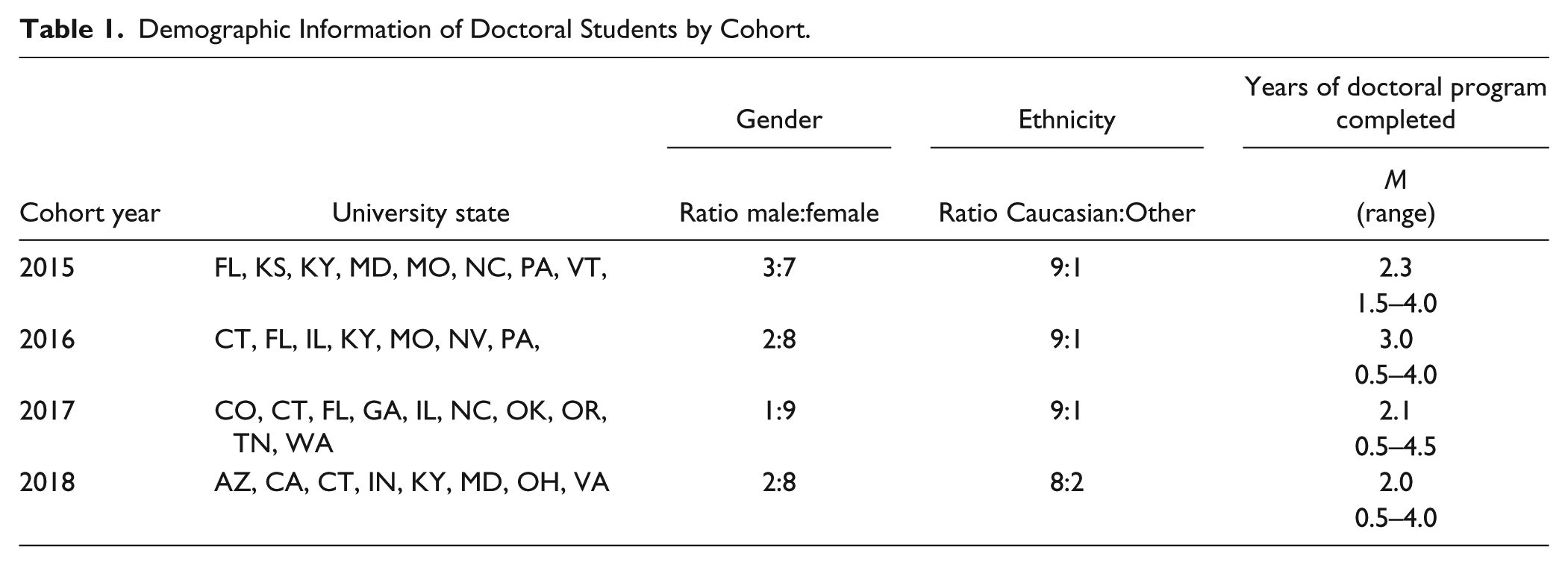
The Short Course application process included faculty member sponsorship and an essay describing applicants’ background and interest in this experiential learning opportunity. Final selection of Short Course participants was based on merit and geographical diversity given the applicant sample pool. The aim was to include doctoral students from across the country whose different geographical, experiential, and political backgrounds would form a well-rounded voice when advocating for special education issues during the Short Course. Table 1 includes participants’ characteristics by cohort, including a breakdown by gender and ethnicity, state in which they attended their doctoral program, and years completed in their doctoral program. All participants were enrolled in programs with a special education focus, and all were pursuing careers in special education leadership, whether in higher education or elsewhere. All 40 Short Course graduates opted into the resulting evaluation measure designed to explore perceptions of the effectiveness of the intervention.
Demographic Information of Doctoral Students by Cohort.
Procedures
The overarching goal of this experiential learning model referred to as the “Short Course” was to develop, field-test, and explore the feasibility of a special education advocacy training program for doctoral students to better understand and engage in advocacy as it relates to education policy-making. The intended distal outcome for Short Course participants was an action orientation applicable in their future roles as special education leaders and faculty.
The Short Course targeted three doctoral student-learning objectives:
develop students’ understanding of organizational structures and key players in special education–related policy-making in the nation’s capital, including government agencies, nonprofit organizations, and coalitions;
prepare students to describe the basics of the legislative process;
empower students to be able to demonstrate the skills and knowledge needed to become effective advocates on behalf of students with disabilities, including specific considerations that address special education and equity.
The doctoral students stayed onsite for 6 days, and Short Course discussions including in-person meetings with staff involved in the policy-making process centered on the “four Ps”: policy-making, people, process, politics and policy. Meeting conversations were constructed to pull out these critical aspects of policy-making, which must be understood for effective advocacy to take place. Prior to arriving in D.C., all participants were assigned precourse readings outlining the policy-making process and key pieces of legislation under consideration at the time. Doctoral students also researched their U.S. Senators and House Representatives. All Short Course cohorts followed the same syllabus and general format including (a) instructional sessions facilitated by the Short Course instructors (first and third authors), (b) structured visits with members of Congress and their education staff, (c) conversations with leaders in the U.S. Department of Education, and (d) presentations with question-and-answer sessions with leaders of key national organizations and special interest groups associated with special education, higher education, teacher quality, and teacher preparation (i.e., unions, coalitions, associations, and civil rights groups). Participants also debriefed through daily discussion sessions.
Although the format and instructors remained constant across cohorts, the specific people the doctoral students met with and the content discussed during these interactions changed year to year based on election results, shifts in organizational initiatives, and annual themes addressed in the Short Course (see Figure 1 for a list of themes by year). The advantages to this flexible model included the opportunity for doctoral students to engage with standardized and general information about the policy-making process, as well as to experience current and authentic policy-making activities in action. The Short Course capstone assignment required each participant to determine an act of advocacy in the public policy arena that they planned to implement in their home institutions or communities following completion of the Short Course. Participants shared plans for their capstone project during the final discussion session.
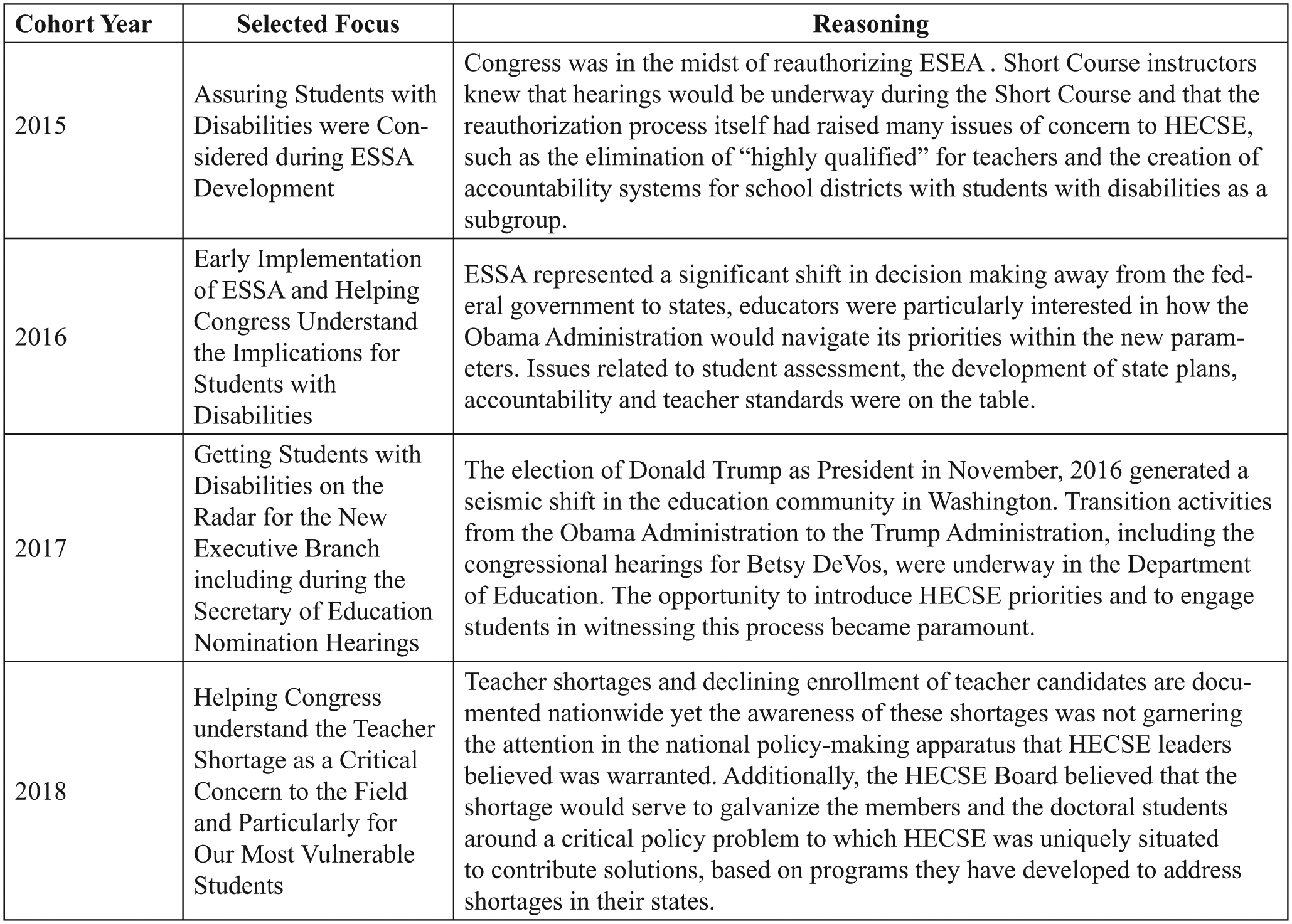
Short course focus by year.
Measures
The evaluation strategy included two participant self-reported measures: an evaluation questionnaire administered directly after the Short Course and a 1-year follow-up questionnaire. The purpose of the evaluation questionnaire was to capture participant perceptions immediately after the experience and to encourage participants to articulate how the experience might change their future plans (reflective in nature). The follow-up questionnaire was intended to determine the potential lasting impacts of the Short Course by checking in with participants 1 year later to see whether any of their plans were enacted. Both measures included Likert-type questions as well as open-ended questions. All surveys were collected electronically and the responses were not forced so that individual questions could be skipped. For the purpose of this exploratory study, only the open-ended questions were analyzed because the goal was to learn about the thinking of the participants rather than to draw comparisons between participant self-ratings.
Evaluation questionnaire
The four open-ended questions in the initial questionnaire asked participants to identify (a) their goals, including their ability to achieve such goals; (b) aspects of the course that contributed to these achievements; (c) aspects of the course that could be improved; and (d) their major takeaway from this experience overall. Evaluation questionnaire response rates were 9 of 10 (2015 cohort), 10 of 10 (2016 cohort), 10 of 10 (2017 cohort), and 9 of 10 (2018 cohort).
One-year follow-up
Doctoral students completed a researcher-developed follow-up questionnaire 1 year after completing the Short Course to capture lasting impacts, by asking participants to identify acts of advocacy- or policy-related activities they engaged in since the Short Course as well as plans for future policy- and advocacy-related activities. Two open-ended questions asked participants to identify “acts of advocacy” or policy-related activities they engaged in since the Short Course as well as plans for future policy-related activities. One-year follow-up response rates were 10 of 10 (2015 cohort), 7 of 10 (2016 cohort), and 8 of 10 (2017 cohort). Given the timing of this reporting, the 2018 cohort has not participated in the follow-up survey.
Data Analysis Procedures
For the purposes of this article, we report on the qualitative themes emerging from analyses of the open-ended items on the initial evaluation questionnaire and the 1-year follow-up (see Kelley, Clark, Brown, & Sitzia, 2003, for strengths of using surveys for evaluation research) as one combined data set because of the overt linkages between questions (Creswell & Plano Clark, 2007). A grounded theory qualitative approach to axial coding the open-ended questions (Corbin & Strauss, 2015) was used to construct preliminary themes and subcategories as an exploratory investigation of participant perceptions (Corbin & Strauss, 2015).
First, two independent coders (first and fourth authors) took a qualitative approach to reviewing the evaluation questionnaire data. Given the potential for subjectivity to influence interpretation of data, it was important to have an objective analysis of the data. The fourth author was not involved in the Short Course and not aware of the purpose of this article prior to reviewing the data. The 2018 data set was used to develop exploratory themes and then the themes and subcategories were tested using the 2015, 2016, and 2017 cohort responses (see Corbin & Strauss, 2015). Second, after the two coders analyzed the data independently, codes were compared and both general themes and subcategories for the 2018 data set were established. Although there were no major disagreements or divergent themes identified between the two coders, slight variations in wording did exist. The themes as identified by the objective coder (fourth author) were used in these instances to further control for subjectivity. Third, the themes were checked by the second and third authors to assure agreement in interpretation of the data. Fourth, the 1-year follow-up data were used to begin to explain the themes identified through analysis of the evaluation questionnaire (see Burke, 2013, for field-testing exemplar and Johnson & Christensen, 2013, for exploratory research methodology). This approach to demonstrating how a phenomenon operates is a preliminary step in best practices in qualitative research and an important starting point during field-testing (Johnson & Christensen, 2013; Kelley et al., 2003). Last, member checking was done to improve the trustworthiness of the findings (see Creswell, 2013). Participants received a transcript of this article with themes, subcategories, and data tables and were asked to review everything for accuracy. Due to the nature of anonymous survey procedures, individual responses could not be sent to participants. The decision was made to present participants with the complete report to assure that reporting was valid. Participants were contacted via email and given 2 weeks to reply with suggested edits. All the feedback was positive and no changes were requested.
Results
Perceptions of the Effectiveness
Two general themes were identified through axial coding the evaluation questionnaire. First, doctoral students reported that advocacy became part of their professional identities. Second, doctoral students expressed an awareness of the human element of advocacy. These two general theme were evident in all four cohorts’ responses. Three additional subcategories were identified: (a) participants felt that their new understanding of advocacy and policy empowered them to engage in advocacy, (b) participants felt that the process of advocacy was demystified and included building relationships and making connections, and (c) participants felt it was necessary to find common ground with other “players” in the policy-making arena. Again, evidence of subcategories was present across all four cohorts.
Participants felt that their new understanding of advocacy and policy empowered them to engage in advocacy
Doctoral students shared the realization that they could instill change. For example, one 2016 student wrote, “I have a much better idea of how I can personally contribute to changes in law and policy in the future.” A 2017 student shared, “I feel empowered knowing the process of advocacy and policy change is more accessible than I ever imagined.” A second 2017 student put it simply, “Our voices matter.” Some students gave concrete examples regarding how they planned to put their new advocacy skills into action. For example, one 2018 student wrote, “I want to be an effective advocate through my research and relationships.” Similarly, another 2018 student wrote, “I want to guest lecture in special education policy class at [my university] to talk about advocacy related to teacher quality and the teacher shortage.”
Participants felt that the process of advocacy was demystified and included building relationships and making connections
Many students used the specific phrasing about making connections and building relationships when discussing their plans for future action, including mentioning “make connections with the ‘players,’” “forming trusting relationships over time,” and “begin to build relationships.” One 2015 doctoral student wrote, “There is extraordinary value to developing relationships with a broad range of professionals in the field as a highly effective method of promoting our overall mission.” Another explained, “I plan to prioritize staying in touch with senators and congressional members.”
Participants felt it was necessary to find common ground with other “players” in the policy-making arena
Doctoral students discussed the importance of being able to work with all types of people from varied political backgrounds. For example one 2017 student wrote, “I realized that building relationships and trust with policymakers affords the opportunity to find common ground with influential offices in both the house and senate and across political parties.” Another 2017 student explained, “ . . . despite our differences there is always a way to create a working relationship with all stakeholders.” Similarly, a 2015 student explained, “My biggest take away is there is always room for common ground, once you have that building the bridge is possible.” In terms of the effectiveness of the Short Course to prepare students to find common ground, one 2018 student explained, “I now know how to prepare for and have a discussion with policymakers on either side of the aisle on issues I care about which affect our students.”
Explaining the Short Course 1 Year Later
An exploratory qualitative approach was used to begin to explain the phenomenon by providing examples of how advocacy became part of the students’ professional identities as well as how students enacted the human element of advocacy. One year after the Short Course, students across 2015, 2016, and 2017 cohorts articulated active engagement in advocacy as part of participants’ professional efforts.
Students reported a variety of activities including both direct acts of advocacy and professional activities that support advocacy initiatives. Specifically, activities included making Hill visits, writing scholarly papers, teaching others about advocacy, engaging in additional professional development in the areas of policy and advocacy, focusing on current research in these areas, and even beginning new employment in professional roles specific to education policy. For example, one 2015 student wrote, “I work with [a national organization] as their student rep focused on advocacy and policy.” Other students provided examples of individual acts of advocacy. For example, one 2016 student explained, “I have gone on Hill visits to advocate on behalf of special education specifically regarding appropriations and the teacher prep regs.” Similarly, a 2017 student shared examples of engaging in advocacy, “I sent letters to federal legislators regarding education funding, teacher preparation regulations, and the DeVos nomination.” One 2015 student went as far to say their career trajectory changed when sharing, “I was awarded a [foundation] public policy fellowship. I now work [on the Hill] and engage in policymaking daily.”
Professional activities that support advocacy initiatives included writing scholarly works and teaching courses or guest lecturing. For example, one 2015 student said, “Realizing you can instill change, I am currently writing up a national survey on policy, and a ‘how to guide.’” A 2016 student wrote, “I presented in a seminar about the experiences and what I have learned from the HECSE Short Course and ways we can engage in advocacy at the state-level.” Some students wrote that they felt empowered to engage in advocacy but did not report engaging in any such activities. For example, a 2016 cohort member wrote, “I have a much better idea of how I can personally contribute to changes in law and policy in the future.” A 2017 cohort member wrote, “I feel empowered knowing the process of advocacy and policy change is more accessible than I ever imagined.” One 2018 student went as far as to express the need for additional follow-up training.
Participants also shared examples of building relationships, making connections, and finding common ground in a collaborative spirit focusing on a common purpose related to special education or serving students with disabilities. Some students even went as far as to share additional plans for future activities related to maintaining newly established relationships. For example, one 2016 cohort member included relationships building within a list of ongoing professional efforts: Maintaining a relationship with representative, forming new relationships with local policymakers and advocates, guest lecturing at different institutions about policy and advocacy, participating in summits a few times this year, joining the local public policy committee for emerging leaders, being a resource for parents locally, helping the advocacy effort for the FY2017 spending bill and personnel prep funding.
Discussion
This exploratory qualitative approach to describe an experiential learning model known as the “Short Course” provides emerging evidence of a strategy that might be used more broadly to ensure policy makers hear the voices of education leaders and practitioners. Findings suggest that a focus on policy and advocacy engagement, carried out in an authentic setting and including a capstone experience, is a powerful concept that resonated strongly with the participating doctoral students. Moreover, the Short Course content was recognized by participants as critical, yet often lacking from many doctoral program curriculums. To that end, we believe this model represents an innovative approach to increasing participation of doctoral students in advocacy immediately following the experience as well as long term. Experiences such as those provided in the Short Course are important not only for increasing doctoral students’ knowledge of and engagement with the policy-making process but also for reinforcing the need to ensure that education research is conducted and disseminated in ways that inform the political discourse and resulting education policies and practices.
The Short Course served to remind scholars and faculty sponsors of the need for the field of special education to remain vigilant about approaches to leveraging scholarship in the policy-making process (McLaughlin et al., 2016). By witnessing authentic examples of political discourse and policy-making, scholars were able to observe both the need for and the lack of a broader discourse that connects educational expertise and research with the realities of the political process. Opportunities such as the Short Course may result in the preparation of future special education faculty and leaders who will be intentional and focused on policy in their teaching, research, and service; in turn, their efforts could result in the preparation of a teacher workforce that is also better equipped to engage with the policy process.
Lessons Learned
Research Question 1 focused on identifying participants’ perceptions of the Short Course; and, our analysis of responses to open-ended questions suggested that participants’ experiences were overwhelmingly positive. Short Course participants identified a number of strengths that were central to the design of this experiential learning model, including (a) the active engagement in acts of advocacy, (b) discussions with policy makers about their approach to decision making, and (c) networking and brainstorming action steps with individual stakeholders versed in advocacy. Importantly, they found the Short Course to have had a profound impact on their perceptions of their professional identity. At the conclusion of the Short Course experience, participants identified numerous ways in which they envisioned expanding their current roles and activities to include acts of advocacy. Many reported feeling that policy was more accessible than they had imagined, and several spoke about ways in which the experience was likely to have an effect on their future research and teaching. Perhaps, a more unexpected finding emerged through the second theme, in which participants identified a new understanding of the human elements of advocacy. Short Course participants identified core elements of advocacy as being linked to trust, relationship building, and communicating with people whose ideas were, at times, different from their own. Their comments indicated that the Short Course provided them with the opportunity to gain skills and knowledge related to advocacy, as well as to witness the policy process in a way that highlighted its interactive and human elements. As a result, participants experienced a sense of belonging and purpose within this sphere of the profession. Something both the instructors and participants often discussed was the ability to “have the words” when talking to various stakeholders and policy makers, regardless of level of agreement on a given topic for discussion (i.e., teacher shortage).
One thing we learned as instructors was that we needed to help participants realize, through observation and then engagement, that the most impactful “words” were not memorized dissertation summaries, but instead speaking from their own experiences as constituents and informed individuals on a topic, to help share perspectives and grow common understanding. This realization was empowering for many students who worried they needed cheat sheets of data at the ready. Commonly, during debriefing sessions, participants shared surprise that they could make a difference even as one individual. We learned that an important role as instructors was to reinforce this new realization and to share examples of how advocacy can manifest itself differently across federal, state, and local levels as well as across scholarship, teaching, and service spheres in the profession.
Research Question 2 focused on the extent to which participants demonstrated a deep understanding of the phenomenon of advocacy over time. Analysis of participants’ responses to the 1-year follow-up questionnaire indicated that the Short Course had great impact on most participants, and was particularly transformative for some. Some reported that their research foci had been affected by their participation in the Short Course, whereas others gave examples of ways they were participating in local, state, and national policy-making processes. They used terms such as “empowerment” and “voice” in ways that suggested the impact of the Short Course on their actions as well as their evolving identities as advocates, and they spoke about continued professional relationships with instructors and fellow cohort members that had been initiated through the Short Course. A very small number of responses indicated that participants were still developing confidence in their advocacy and/or had not yet had time to enact their planned acts of advocacy, but for the most part, responses demonstrated a great deal of growth and activity.
Remaining Challenges and Future Directions
One challenge of this learning model is the intensity of resources necessary to immerse participants in such an experience. Participants and instructors were required to remain onsite for the week and participated in 12-hr days, where even meals included both structured and semistructured group and small-group discussions. In addition, despite the findings being replicated across four cohorts, the generalizability of this one model is limited, particularly given the key aspect of the D.C. setting of the Short Course. This experiential approach may not be readily available to the majority of doctoral students in special education or feasible to replicate across various types of leadership training models. As this model continues to be refined and similar models are enacted, further research should include a comparison of approaches. A second area requiring additional research relates to the long-term impact of the Short Course. The 1-year follow-up questionnaire suggests the potential for the Short Course to have impact over time; however, additional research is needed to explore specific ways in which initial outcomes are sustained as participants transition into faculty and leadership positions.
Conclusion
Special education is a field that has been and will continue to be significantly influenced by public policy. When special education leaders are unfamiliar with how to engage with the policy process, or when they are uncertain as to how to translate their research in ways that are useful to policy makers (Birnbaum, 2000; Henig, 2008; Rippner, 2016), the field suffers, as policy is less likely to achieve the intended results without the benefit of the knowledge and expertise of those who are expected to implement policy. Being a special education leader means being a policy participant. It is up to today’s special education leaders to equip tomorrow’s special education leaders with the knowledge and skills they need to carry out that important role. It is worth noting that the Short Course participants sought out this learning experience, which likely means the need to build buy-in regarding the importance of policy awareness and advocacy engagement may be different for the broader special education doctoral student population. With the goal of ensuring that tomorrow’s special education leaders are policy savvy and authentically engaged in an ever-changing policy context, we propose that the Short Course is but one of many professional development strategies that can be developed, deployed, and evaluated.
Footnotes
Declaration of Conflicting Interests
The author(s) declared no potential conflicts of interest with respect to the research, authorship, and/or publication of this article.
Funding
The author(s) received no financial support for the research, authorship, and/or publication of this article.