



Abstract
Nearly one quarter of all youth with disabilities attend rural schools. Supporting the successful postschool transitions of these youth can be a complex and challenging endeavor. In this study, we used “community conversation” events as a methodology for identifying the practices and partnerships needed to improve transition outcomes for students with disabilities in rural school districts. We analyzed the diverse ideas (N = 656) for preparing youth with disabilities for adulthood generated by a cross section of the local community in five participating rural school districts. Although practices related to employment and family engagement were prominent, fewer suggestions addressed postsecondary education and community living. Perceptions of existing school–community partnerships varied within and across districts. We offer recommendations for research and practice aimed at strengthening the capacity of rural communities to prepare their students with disabilities well for life after high school.
Strengthening the postschool pathways of students with disabilities has been a long-standing focus of both policy and practice. The transition mandates of the Individuals with Disabilities Education Improvement Act define transition, a coordinated set of activities that . . . is designed to be within a results-oriented process, focused on improving the academic and functional achievement of the child with a disability to facilitate the child’s movement from school to postschool activities, including post-secondary education, vocational education, integrated employment (including supported employment), continuing and adult education, adult services, independent living, or community participation . . . (IDEA, 2004, §602.34)
For more than three decades, numerous researchers have worked to develop and evaluate an array of planning processes, instructional approaches, curricular materials, support models, technologies, and community partnerships that schools can use to support seamless and successful transitions for their students. This collective work reflects best practices in the field of transition.
For local school districts, assembling this constellation of practices into effective transition programs is a complex endeavor. While the professional literature identifies a large number of practices that may improve certain outcomes for individual students (National Technical Assistance Center on Transition, 2019), districts are charged with the daunting task of organizing these multiple practices into comprehensive programs to meet the needs of hundreds of students with disabilities (or even more) each school year. Likewise, districts often struggle to develop strong community partnerships to prepare students with disabilities for a wide range of valued outcomes after graduation. Knowing which practices and partnerships to pursue requires careful reflection and thoughtful prioritization at the local level. Although several tools identify key components of high-quality transition programs (e.g., Kohler et al., 2016; National Collaborative on Workforce and Disability for Youth, 2009), each district must still decide for themselves what form their own programming will take.
The ongoing question of how best to support successful transitions for students with disabilities is particularly important for rural school districts. Nearly one in four youth resides in a rural community (U.S. Department of Education, 2013). Although transition can be challenging anywhere, a number of factors distinguish rural districts from their urban and suburban counterparts (Test & Fowler, 2018). For example, rural communities often have (a) a narrower range of employment or postsecondary education opportunities, (b) more limited transportation options, (c) fewer adult service providers, (d) less school staff available, and (e) different expectations for life after high school. Yet, the empirical literature is still very thin when it comes to transition programming in rural communities. Questions abound: What steps should rural communities take to improve outcomes for their students with disabilities? What community partners could be drawn upon to support them in this work?
In this study, we explored “community conversations” as an avenue through which rural school districts could invite input into the design and delivery of transition programming for their students with disabilities. Adapted from the World Café model (Brown & Isaacs, 2005), these structured community dialogues are designed to uncover a range of formal and informal solutions to address issues important in the lives of people with disabilities (Carter & Bumble, 2018). They also recognize the need to develop highly localized action steps aligned with each community’s unique culture, priorities, and available resources. Solutions and strategies are generated by a broad cross section of community members—some of whom are (e.g., educators, service provider, and families) and some of whom are not (e.g., employers, community leaders, and faith communities) typically involved in discussions about disability. Engaging a wide range of partners is especially important in rural areas where social networks are smaller and more “close-knit” (Debertin & Goetz, 2013).
Community conversations all follow a common process (Swedeen et al., 2011). A core planning team invites a cross section of local citizens (usually 30–60 individuals) to an event at which they will participate in three rounds of small-group discussions—each focused on a single question (e.g., What can we do as a community to improve outcomes for youth with disabilities? How can we all partner together more effectively to deliver best practices?). Attendees sit with 4–8 of their neighbors and switch tables between rounds to elicit diverse ideas and resources from individuals who may see the community from very different vantage points. During a final round of whole-group discussion, each table shares out the most promising ideas they heard. Extensive written notes are taken so that every idea shared is captured. After the event, the planning team reviews the numerous ideas generated, identifies which they will move forward on, and invites attendees to be part of subsequent changes.
Community conversations have been used to examine an array of disability issues (see review of 28 studies by Bumble and Carter, in press). Three of these studies have focused specifically on some aspect of transition services for youth with disabilities. Trainor and colleagues (2012) hosted events focused on access to summer employment for youth with disabilities. Likewise, Dutta et al. (2016) hosted one event focused on increasing summer employment opportunities. Finally, Parker-Katz and colleagues (2018) taught special education graduate students to host their own community conversations addressing various transition-related topics (e.g., employment, postsecondary education, program development, and recreation). These studies highlighted the value of engaging new voices within a community.
The purpose of this mixed methods study was to examine the application of “community conversations” to transition education in rural school districts. We addressed the following four research questions:
Method
Rural School Districts
Five rural school districts participated in this study as part of their receipt of technical assistance during the 2018–2019 school year. Applications for free technical assistance were available to all school districts in the state of Tennessee. Each district applicant committed to establishing a core team to work with us, compiling and sharing relevant data with us, providing program information, soliciting stakeholder feedback (e.g., educators and parents), hosting one community conversation event focused on strengthening the district’s transition services, and working with us to evaluate changes resulting from the technical assistance. We selected 10 districts to receive support—five beginning in the fall and five in the spring. The first five districts were rural communities and became the focus of this study. As shown in Table 1, district enrollment ranged from 4,012 to 6,459 students (M = 5,280). Most students were White (M = 88.9%) and many were eligible for free or reduced-cost meals (M = 35.5%).
Demographics of Districts and Event Attendees.

Includes both middle schools and combined K–8 schools. bAttendees were asked which of the options best described their current role; more than one role could be selected.
Community Conversation Events
Venue selection and recruitment
Each district adopted the same structure for their event; however, they also personalized it to fit their particular community. Four events were held in the school (e.g., cafeteria and auditorium) and one was held at the county’s technology center. Refreshments were available and tables were decorated. One event was held during a professional development day (9:30–11:00 a.m.) and four were held in the evening (5:00–6:30 p.m. or 6:00–7:30 p.m.). The core team for each district was responsible for recruiting at least 35 attendees with representation across multiple stakeholder groups (e.g., special educators, general educators, school administrators, school board members, employers, disability agencies, civic leaders, parents, students, and community programs). We met by phone with the team leader (e.g., special education administrator) to discuss recruitment strategies. To encourage new perspectives, we also encouraged teams to recruit at least half of attendees from outside the school system. We provided a list of 20 stakeholder groups to invite and encouraged them to track recruitment efforts using an online spreadsheet. We created example flyers and email invitations for the team that described (a) the focus of the event (i.e., strengthening career development and transition preparation for students with disabilities), (b) who should attend, and (c) the time/location.
Event procedures
At the event, attendees signed in, enjoyed refreshments, and joined small tables of 4–8 people. Table tents listed the questions for each event and outlined conversation etiquette (Brown & Isaacs, 2005). We provided a paper placemat for each attendee to write down ideas they did not verbalize during discussion. A table host was assigned to each table and was responsible for leading initial introductions, writing down all ideas shared by attendees at their table, and keeping the conversation solution-focused and on topic. Each table host was chosen by the local planning team leader and consisted of staff affiliated with the local district (e.g., special educators, principals, school board members, superintendents, and vocational rehabilitation counselors). They met with us briefly (e.g., 5–7 min) right before the start of the event to learn their responsibilities. Each received a facilitator recommendation sheet with tips for facilitating discussion and structured sheets for taking notes to standardize data collection.
A member of the technical assistance team facilitated each 1.5-hr event to ensure consistency and to allow all district team members to actively participate in the conversation. The first 10–15 min included a brief welcome, a short presentation addressing the purpose of transition education, and an overview of the structure for the ensuing conversation process. At all five events, someone from the district also shared personally why transition was so important for their students. We then previewed the three event questions to prime subsequent discussion:
What are we already doing to prepare students with disabilities well for college, career, and community?
What could we do better or differently to prepare students and their families?
How might we strengthen partnerships beyond our school to improve outcomes for our students with disabilities?
We held three rounds of small-group discussion—each lasting 15 min and addressing a different one of these questions. Attendees shared their own ideas, drawing from personal experiences and perceptions of local needs and opportunities. Attendees had the opportunity to react to, build upon, refine, and add to each idea shared within their small group. We placed no parameters on the types of responses that could be shared but asked attendees to focus the conversation on solutions and possibilities, rather than barriers. Table hosts wrote down all ideas generated through each round of discussion and encouraged attendees to write down additional ideas on placements if unable, uncomfortable, or unwilling to share verbally. Between rounds, everyone except the table hosts transitioned to a different table comprised of a new group of attendees. Shifting table configurations increased opportunities to hear from different stakeholders and encounter new ideas. During the final “harvest” round of whole-group discussion (15–20 min), attendees shared the most promising or exciting ideas they heard throughout the event. Harvest ideas were written down as they were shared. At end of the event, the facilitator thanked everyone for attending and invited them to complete a brief, anonymous survey (5 min). At Event B, a student with disabilities then shared about his work-based learning experiences. At Event C, an educator shared about the school’s new transition program.
After each event, we developed a six-page, community-specific report that summarized the focus of the event, the number of attendees by role, selected ideas raised during each round, local barriers to successful transitions, and a summary of community strengths. It also included figures summarizing views of the event and school–community partnerships. We distributed these to the core planning team and all event attendees.
Data Sources and Analyses
We analyzed conversation notes and end-of-event surveys to address our research questions. At least two research team members attended each event to make observations, to collect surveys and notes, and to provide any needed on-site support (e.g., signing-in attendees and distributing surveys). All procedures were approved by our Institutional Review Board (IRB).
Conversation notes
We collected ideas generated throughout the event, including table host notes (n = 39 sets; range: 5–15 per event) and notes taken during the whole-group discussion. We did not analyze ideas written on placemats due to the unintelligibility of a majority of ideas shared through this source. These combined data sources yielded 734 ideas across the five events.
End-of-event survey
All attendees were provided an anonymous, 16-item survey at the end of each event (see Table 2). Eight items asked attendees to share their views on the event and were drawn from prior studies of community conversation events (see review by Carter & Bumble, 2018). Attendees rated their agreement with each statement using a 4-point, Likert-type scale: 1 = strongly disagree, 2 = disagree, 3 = agree, and 4 = strongly agree. Cronbach’s alpha for this section was .93. Eight items (using an identical scale) were developed for this study and addressed attendee’s perceptions of school partnerships with various community groups. Cronbach’s alpha for this section was .87. Two open-ended questions included: What do you consider to be the biggest barrier to successful transitions of youth with disabilities in your community? What do you consider to be the biggest strength of your community? Surveys were completed by 180 of 234 attendees (76.9%).
End-of-Event Survey Findings Across Events (n = 180).
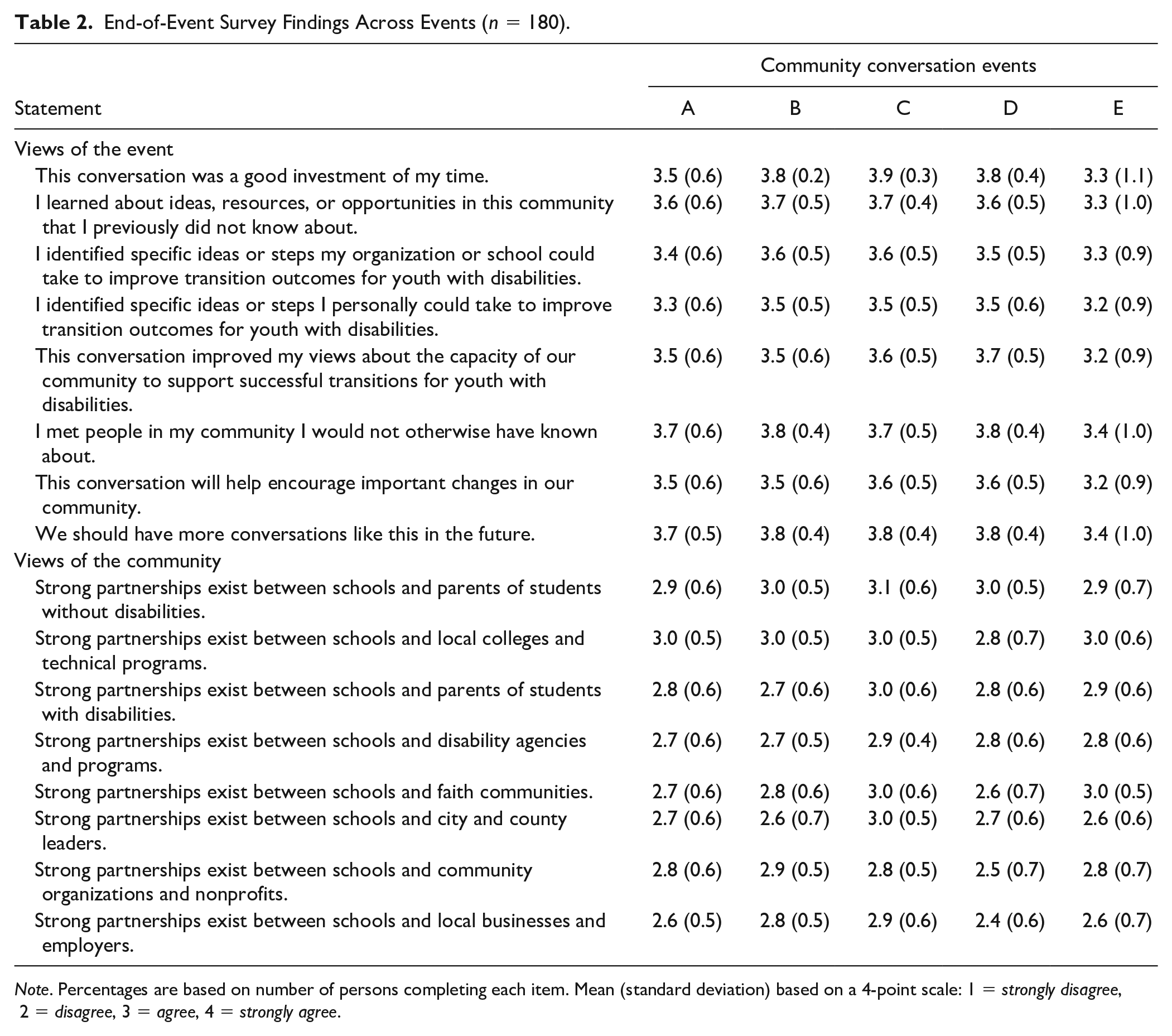
Note. Percentages are based on number of persons completing each item. Mean (standard deviation) based on a 4-point scale: 1 = strongly disagree, 2 = disagree, 3 = agree, 4 = strongly agree.
Data Analysis
We used both qualitative and quantitative analyses to address our research questions. We adopted this mixed methods approach to integrate findings from both the ideas that were shared verbally and the close-ended surveys completed privately. First, we used a modified approach to consensual qualitative research analysis (Spangler et al., 2012) to examine the comprehensive list of ideas generated within and across events and documented on table host and harvest notes. We combined all ideas on a spreadsheet to develop a master list. Ideas with multiple parts were separated into discrete entities and coded separately. For example, we separated the idea “increase work-based learning sites and also host a job fair” into “increase work based-learning sites” and “host a job fair.” The 734 units available for subsequent analyses were grouped by event and ordered chronologically by round within each event (cf., Carter et al., 2016). We were unable to code 78 of these units due to their ambiguity or irrelevance to the questions. This left 656 codable units.
Four members of the project team—including one faculty member, one doctoral student, and two staff members—participated in coding procedures. The first two team members initially read through the comprehensive list of notes and developed a general framework by which to approach coding of the data. Consistent with Spangler et al. (2012), we discussed our experiences related to special education and postsecondary transition to identify potential biases that could affect our coding. Next, the same team members developed themes and categories by writing out a comprehensive list, applying possible codes to 10% of the data, and editing the list as needed until reaching consensus. We did not use a list of preexisting themes or categories. Upon reaching consensus, an independent auditor familiar with the field of transition and the community conversation approach examined these themes and categories to provide input on their clarity and relevance. We made edits until consensus was reached.
Next, all four team members met to apply the themes and categories to one third of total ideas. We adapted the coding framework until all coders felt confident it provided a representative and relatable way of communicating ideas reflected in the data. Everyone except the faculty member independently coded the remaining two thirds of all data. A statement could be assigned multiple themes and categories. The three coders coded all units, met to compare themes and categories at the unit level, and adapted the coding system as needed until reaching consensus. The coding system was revised and, when necessary, we recoded previous themes and categories to the adjusted framework. Finally, we examined each category and determined whether further editing was needed based on highly infrequent, minor, or overlapping categories.
We worked to ensure that our approach aligned with recommended practices in qualitative research. We included individuals with a wide range of perspectives and from varied community types, providing multiple opportunities to triangulate our findings within and across community conversation events. Multiple researchers independently analyzed event data prior to collaboratively developing the coding framework, minimizing the likelihood of unchecked biases influencing the results. Similarly, we each coded the data independently prior to meeting for consensus to mitigate the likelihood of a single coder dominating the process. We debriefed at multiple points throughout the process for additional critique of assumptions, conclusions, and decisions to adjust the framework we made as a team. We also shared our coding with an independent auditor to solicit unbiased feedback. Finally, as a form of member checking, we shared summary briefs back with each of the five school district teams and discussed their reactions during in-person meetings; no changes were needed.
This process resulted in 14 distinct categories of ideas falling within six broader themes. Given the iterative nature of coding within and across events and our goal of reaching consensus, we did not calculate interrater agreement. We determined the response frequency by dividing the frequency of each category by the total number of categories. This produced a proportion of ideas falling within each category. Although these frequency counts do not necessarily correspond to the importance attributed to such ideas, we were interested in understanding how often particular areas of action were discussed within and across events.
For the end-of-event survey, we used descriptive statistics to summarize attendee responses by event. We presented findings of the survey with percentages and average ratings (see Table 2). We analyzed survey results by event to determine whether perceptions of the events and school partnerships varied by community.
Findings
Who Participates in Community Conversations Hosted by Rural Districts?
Across the five events, a total of 234 community members participated (M = 46.8; range: 25–90 per event). See Table 1 for information about each event. Attendees identified themselves via the end-of-event survey as (a) educator or school staff (n = 139; 59.4%), (b) parent/family member (n = 28; 12.0%), (c) representative of a disability agency (n = 39; 16.7%), (d) representative of a community organization (n = 20; 8.5%), (e) employer or business representative (n = 17; 7.3%), (f) city or county leader (n = 5; 2.1%), (g) member of a community civic group (n = 4; 1.7%), (h) middle or high school student (n = 3; 1.3%), or (i) other (n = 24; 9.9%). The remaining attendees did not identify their role on the survey or did not complete the survey; percentages could exceed 100% as some attendees selected multiple roles.
What Practices Do Rural Communities Advocate Pursuing to Improve Transitions?
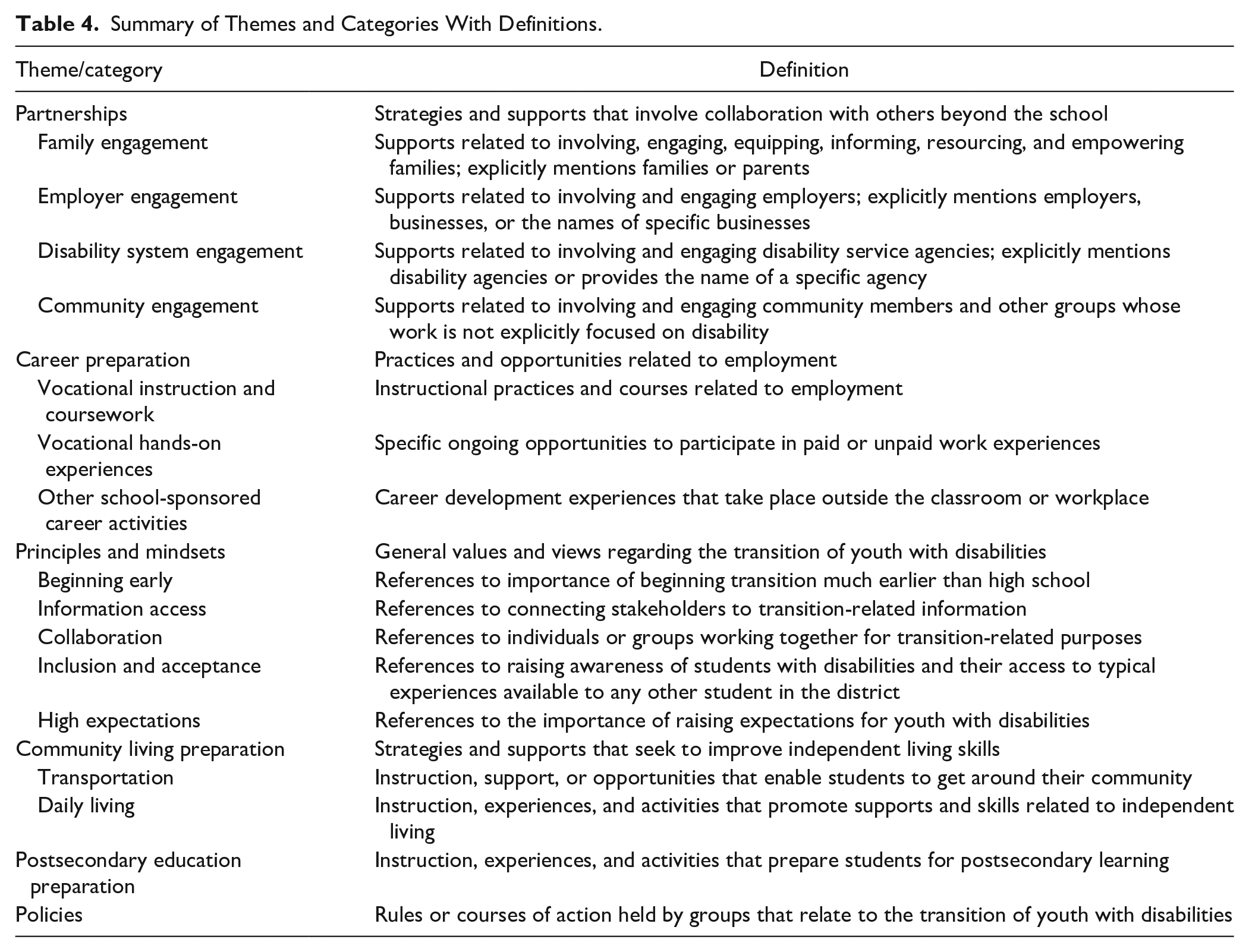
We coded 656 ideas across all five events (M = 131; range: 78–264 per event). Communities with more attendees tended to generate more ideas. Table 3 displays the frequency of each category across all events and the percentage of all ideas reflecting each of the six themes and 14 categories. Table 4 includes definitions for each theme and category.
Community-Generated Ideas Organized by Theme and Category Across Events.

Note. Values are represented as frequency (percentage). Frequency refers to the number of times themes and categories were referenced within and across events. Percentages refer to the number of times the themes and categories were referenced out of the total references. Total row refers to the overall number of strategies analyzed from each event. Bolded values reflect totals for each theme.
Summary of Themes and Categories With Definitions.
Partnerships
The largest proportion of ideas generated by all attendees addressed partnerships between the school and other individuals and groups (35.7% of all strategies; range across events, 27.7%–51.2%). Many of these ideas involved partnering with the families of students with disabilities. For example, attendees discussed educating parents and raising expectations for their youth, bringing parents into the school for a transition fair, and connecting parents to postsecondary resources. Other ideas focused on engaging employers to improve the outcomes of youth, such as creating new opportunities at local businesses for students to participate in work-based learning, bringing local professionals into schools as career speakers or mentors, and connecting potential business partners with employers currently employing youth with disabilities. Some ideas addressed partnerships with disability service system agencies, such as creating new opportunities to collaborate with vocational rehabilitation providers. Similarly, attendees suggested engaging other community groups, such as faith-based institutions, to create volunteer opportunities.
Career preparation
The second most frequent theme across events addressed career preparation (29.3% of all strategies; range across events, 11.6%–41.3%). A majority of these ideas (n = 99) addressed vocational instruction and coursework. For example, many attendees discussed ways to increase access to career and technical education (CTE) for students with disabilities. Other attendees shared ideas related to the delivery of pre-employment transition services (Pre-ETS). Another prominent focus of this conversation addressed ideas for increasing hands-on vocational experiences (n = 51), such as opportunities for job-shadows, job try-outs, and internships. Many of these ideas also centered upon creating needed supports, such as training job coaches. Finally, a number of ideas (n = 42) addressed other school-sponsored career activities outside the classroom, such as hosting job fairs, field trips to places of work, and arranging for job speakers to come to schools. Emphasis here was also given to involving students in career assessments.
Principles and mindsets
The third most prominent theme centered upon transition-related principles and mindsets (18.1% of all strategies; range across events, 13.6%–23.3%). This theme was unique in that it pertained to critical viewpoints, rather than specific strategies or practices. For example, many attendees discussed the need to begin implementing transition practices earlier than current requirements, such as during middle school or elementary school (n = 38). Moreover, attendees discussed the need to increase information access among all stakeholders—including staff, families, and agencies—through various avenues of information sharing (n = 38). Similarly, many conversations addressed the general need for increased collaboration between stakeholders through more effective contact lists, more regular meetings, and alternative means to collaborating electronically (n = 16). Other ideas concerned the need to promote the inclusion and acceptance of youth with disabilities (n = 14). Examples included supporting youth in peer social activities and including students in school activities, such as school guidance initiatives. Finally, ideas focused on raising expectations of families, employers, and others (n = 13).
Community living preparation
The fourth theme focused on ideas for community living preparation (10.4% of all strategies; range across events, 6.4%–16.5%). A majority of ideas under this theme pertained to addressing transportation challenges (n = 43). For example, attendees across communities discussed remedies to the public transportation gap, the need for alternative options, and access to driver’s education for youth with disabilities. Other ideas involved daily living skills (n = 25), such as money management skills, home maintenance, problem-solving skills, and self-determination. Attendees primarily discussed the need for increased or improved instruction in these areas and expanding such instructional opportunities to more students with disabilities.
Postsecondary education preparation
The fifth theme addressed ideas pertaining to preparation for college (4.9% of all strategies; range across events, 0.0%–6.8%). These ideas included expanding dual credit opportunities, informing students and families about financial aid options, and strategies for increasing knowledge about and involvement in local trades and apprenticeship programs.
Policies
The least common theme concerned policies relating to transition (1.7% of all strategies; range across events, 0.0%–2.3%). This theme was quite diverse. Some attendees discussed advancing state legislation related to new diploma types for students with severe disabilities. Other conversations centered upon how government benefits could be revised to better support individuals with disabilities and avoid disincentivizing work. For example, attendees discussed concerns regarding the impact of individuals with disabilities working on their receipt of supplemental social security and other disability benefits.
How Do Community Members View These Events?
Views of the events were very favorable. Nearly all attendees who completed the end-of-event survey agreed or strongly agreed that the event was a good investment of their time (96.6%), they learned information about their community of which they were previously unaware (97.0%), they met new people in the community they did not already know (97.1%), and the community should have more conversations in the future (97.5%). Most attendees also agreed or strongly agreed that they identified ideas or steps their organization could take (96.6%)—or they personally could take (96.1%)—to improve transition outcomes, the conversation. Finally, most attendees (96.1%) agreed or strongly agreed that the conversation improved their views about the capacity of the community to support successful transitions for youth with disabilities. Table 2 summarizes survey responses across communities.
How Do Community Members View Existing School and Community Partnerships?
Views of attendees regarding partnerships among schools and other community stakeholders were more mixed. Across events, more than half of attendees agreed or strongly agreed that strong partnerships existed between schools and parents of students without disabilities (83.7%), schools and local colleges (84.4%), schools and parents of student with disabilities (74.3%), schools and disability agencies (70.1%), schools and faith communities (69.7%), schools and city leaders (69.4%), schools and community organizations (68.6%), and schools and businesses (60.7%). See Table 2 for responses across communities.
Discussion
Equipping students with disabilities for life after high school is a primary purpose of special education (IDEA, 2004). Although schools and communities across the country are all responding to this charge, rural districts encounter unique considerations and complexities related to serving transition-age youth with disabilities. We supported five rural communities in hosting community conversation events designed to inform their next steps for strengthening the reach and impact of transition education. Findings from this new application of the community conversation approach extends the transition literature in several important ways.
First, stakeholders at each of the rural communities were able to generate a substantial number of diverse ideas for how they might move forward to improve transition outcomes locally. Indeed, we coded more than 650 ideas that spanned 16 dimensions of transition services and supports. Such generativity is consistent with other applications of community conversations to other issues like integrated employment (Carter et al., 2016), inclusion in postsecondary education (Bumble et al., 2019), and summer employment (Trainor et al., 2012). Many ideas were in concert with recommended or research-based transition practices. For example, attendees advocated increased career development programming, self-determination instruction, and family engagement (Haber et al., 2016). Yet, others were quite clever and reflected novel suggestions (e.g., developing mentorship programs in which employers currently employing students with disabilities provide guidance to other interested employers, presenting visual resumes of job-seeking students at monthly Chamber of Commerce meetings, and collaborating with career-technical education teachers to recruit new work-based learning sites at community job fairs). Regardless, all of the ideas emerged from within the community rather than being imposed by an outside entity (e.g., state department of education and technical assistance project). Moreover, these ideas were raised by attendees as having relevance to local needs. Districts that are not currently finding ways of engaging such a cross section of community stakeholders may be missing out on valuable opportunities to tap into the creativity and commitment of people already in their midst.
Second, not all areas of transition received similar levels of attention from communities. Although the event questions focused on preparation for college, career, and community life, it was employment that received the most coverage across the five events. This was reflected both in the practices that schools could adopt (i.e., vocational instruction and coursework, hands-on experiences, and other career development activities) and in the businesses that schools could engage. This emphasis on career preparation is consonant with evidence-based practices focused on promoting early work experiences, job skills training, and broader preparation for the world of work (e.g., Carter et al., 2012; Gilson et al., 2017).
The engagement of families was also addressed extensively across events. Many of the suggestions focused on informing parents about opportunities, services, and supports available after high school. This need to provide families with accessible and timely information remains a recurring theme within both transition policy and research (e.g., Gilson et al., 2017; Hirano et al., 2018). However, attendees identified practical avenues for sharing this information with local families through parent workshops, transition fairs, brief tip sheets providing clear and comprehensible information on various services, and visits to local agencies and programs. Other suggestions focused on involving parents more fully throughout the transition process. Such recommendations respond well to studies documenting the uneven or limited involvement of many families during the transition years (e.g., Hirano et al., 2016).
In contrast, much less attention focused on the area of postsecondary education. Local opportunities for attending college or other training programs were much more limited in these rural counties than in most urban and suburban communities in Tennessee. Moreover, residents of rural communities overall are much less likely to earn a college degree (U.S. Census, 2016). Yet, we were surprised by how few recommendations were offered for strengthening these powerful pathways to future careers. Similarly, preparation for community living received only modest consideration. It may be that community members felt this domain was best addressed elsewhere (e.g., by families) or that other areas of emphasis were greater priorities. For example, a focus on independent living skills was hardly mentioned in the first round when attendees addressed what was already being done to prepare students with disabilities for the future. It may be prudent to recommend research-based practices with rural schools in the areas of postsecondary education and independent living.
Third, community members viewed current partnerships with schools as somewhat mixed. According to end-of-event survey results, partnerships were considered to be strongest between schools and parents of students without disabilities and local colleges or technical programs, but somewhat weaker with community organizations and nonprofits and businesses and employers. Moreover, there were attendees at each event who characterized prevailing collaborations in very different ways from others in their same community. The desire to strengthen existing school–community partnerships was a primary impetus for first holding these events and it was the focus of the third small-group discussion question. Thus, it was encouraging that so many different ideas were offered for engaging families, employers, disability systems, and other community members (see Table 3). Although the transition literature emphasizes the importance of forging strong transition collaborations (Carter & Bumble, 2018), it includes very little research-based guidance on how to involve individuals from beyond formal service systems (e.g., schools and disability agencies). Community conversations seem to hold particular promise for inviting these informal groups into this dialogue.
Fourth, nearly all of the attendees viewed these community events quite positively. Ratings on anonymous surveys indicated that attendees felt that the events generated actionable ideas, spurred new relationships, improved views of the community, and encouraged important changes locally. Anecdotally, we noticed many attendees lingering afterwards, exchanging business cards, and commenting on their enjoyment of the event. Such findings are consistent with applications of the World Café approach across other locales and topics (Bumble & Carter, in press). The widespread recommendation that other events like this be held in the future further affirms the acceptability of the approach within rural communities.
Limitations
The following study limitations should be considered. First, a member of our technical assistance team facilitated each of the five events. Although this ensured consistency in process across the communities and promoted an air of openness, the conversations may have played out somewhat differently if led by local school district leaders. However, multiple other studies have found that local team members can readily lead these events when provided training and resources (e.g., Bumble et al., 2018; Carter et al., 2012). Second, context and depth can be more limited when relying entirely on written notes from table hosts. Consistent with prior studies, we avoided audio or video recording out of concern that it might stifle open conversation (i.e., anonymity encourages honesty) and because of difficulties picking up individual voices in the midst of multiple table conversations in the same room. Still, it is important to identify ways of improving the quality of notetaking in future projects. This might include having project staff take notes, having table hosts review their notes with attendees before switching rounds, or asking participants to review table notes shortly after the conversation. Third, most ideas shared by attendees were presented quite broadly without specifying which practices might be most relevant for which subgroups of students with disabilities. Transition services and supports should be tailored to meet the individualized needs of students with disabilities. Fourth, we are not yet able to speak to how these districts will incorporate the breadth of ideas into their transition programming. Recruiting good ideas is one thing; putting them into practice is quite another. Although our technical assistance team is supporting each district to move forward on a few of the areas identified at their community conversations (e.g., establishing family workshops, developing year-by-year transition timelines, and creating local transition advisory teams), the extent to which other suggestions will be acted on is yet to be seen.
Implications for Practice
This study has several implications for practice. First, community conversations are a practical, efficient, and valued way of soliciting input from a cross section of a rural community. Although districts focused their events on improving transition education, the approach could be readily applied to other educational issues such as reducing school dropout, improving school climate, expanding inclusive education, or other areas of school reform. Second, community conversations provide a concrete way of spurring new partnerships with entities beyond the borders of a school. This is particularly important in rural communities in which service systems may be more limited and natural supports may be more essential. Although such collaborations are often advocated, they can be difficult to achieve. Third, a next step for districts involves culling, prioritizing, and incorporating the best of the suggestions they heard into the everyday practices of their schools. Each district received a list of all of the ideas generated at their event and had a team in place to make these decisions. Fourth, supporting community conversations across multiple districts could help other technical assistance providers identify patterns in transition-related practices and needs across their state. As we heard recurring issues and concerns across these rural communities (e.g., difficulties engaging employers, uncertainty about how best to organize recommended practices into cohesive transition programs, and limited awareness of adult services), it has helped us to prioritize the development of resources and trainings that could benefit multiple districts. Indeed, the majority of Tennessee school districts are in rural locales. Fifth, community conversation findings are inevitably influenced by who attends. Most of the districts in this project struggled to recruit numerous individuals beyond the formal educational and disability service systems, such as employers, civic groups, and local community leaders. Moreover, only two events involved students themselves. Yet all of these stakeholders have important perspectives on their communities and the opportunities available to youth with disabilities who reside there. Districts may need additional guidance on the importance of recruiting beyond the usual suspects and effective strategies to do so well.
Implications for Policy
This study also has many implications for policy. First, discussion of postsecondary education opportunities was limited in these rural communities. Indeed, disparities in postsecondary education has been documented elsewhere. In Tennessee, inclusive higher education programs for students with intellectual disability existed only in the state’s urban areas. None of the community and technical colleges in rural areas offer such supports. Barriers to the development of these programs in rural areas should be reviewed and studied.
Second, attendees emphasized the need for stronger collaborations and partnerships. Across other areas—for example, transportation, health care, and economic development—rural systems and networks are already in existence. Transition staff should explore how existing rural networks could be drawn upon to benefit students with disabilities. In some states, legislation or executive orders regarding rural communities have already been established. For example, the new Tennessee Governor’s first executive order called for a review of the state’s most rural counties and recommendations for better serving their needs. In addition, other entities such as the Appalachian Regional Commission exist and have focused efforts for rural communities including a capacity-building effort and a telecommunications and information technology initiative to strengthen communities and help organizations fulfill their mission in an effective manner.
Third, American Job Centers—reorganized and strengthened in the Workforce Innovation and Opportunity Act (WIOA)—should be a resource for rural communities in the area of employment. The establishment of American Job Centers—previously known as One-Stop Career Centers—provides “one-stop shopping” for individuals seeking employment information and access to jobs, training, and related services. There is a need to examine the key features that shape this system and how those features could benefit the employment of students with disabilities in rural areas. As required by the WIOA, many American Job Centers’ delivery systems are moving toward enhanced integration, partnerships, and service delivery. How might they meet the needs of jobseekers in rural communities? Policies and programs in rural areas should be reviewed to strengthen the capacity of rural communities to prepare jobseekers, including students with disabilities in transition programs, for employment.
Conclusion
Secondary schools are primary players in efforts to support students with disabilities to transition well to adulthood. But they cannot be the only players if students are to have the very best chances for long-term success. Community conversations provide a practical avenue for rural communities to invite the input and involvement of stakeholders from both within and beyond the district. Such events provide districts a data-driven approach for districts to strengthen the quality of their transition services and increase the reach of their community partnerships. We encourage continued application and refinement of this promising approach for engaging rural communities in collective action.
Footnotes
Declaration of Conflicting Interests
The author(s) declared no potential conflicts of interest with respect to the research, authorship, and/or publication of this article.
Funding
The author(s) disclosed receipt of the following financial support for the research, authorship, and/or publication of this article: The work reported in this article was supported in part by a contract with the Tennessee Department of Education.
