



Abstract
This paper aims to analyse the growth of the taxi and shared taxi industries in Nigeria after the 1980s Structural Adjustment Programs. The reduction of public bus services and growing urbanisation fuelled the rise of (paid) car-pooling and eventually a change in the taxi regime. This new system offered an increasingly flexible shared service which (partially) met urban mobility demands. Although this system is common to many African cites, and similar to post-1989 socialist states in Europe and central Asia, focusing on the city of Kano (Nigeria) allows us to identify some of its peculiarities. Relying on secondary sources and on interviews with witnesses, this paper traces the trajectory of shared taxi services from the 1950s to today.
Introduction
Most African cities share some common characteristics: a growing urban population, increasing mobility demands, inadequate public transport systems in states of decline, and inefficient and conflictual divisions of labour among the agencies responsible for planning and implementing transport solutions. The lack of public budget and its misuse also led to deteriorating transport infrastructure and very poor facilities for non-motorised transport (e.g. walking and cycling). 1 In the past decades, those elements have led to a massive growth in the use of minibus, shared taxi, and shared bike services, as well as to a growing dependence on private transportation (cars and motorcycles). This situation in sub-Saharan Africa is deeply rooted in the global economic crisis of the 1980s, which resulted in inflation and high cost of living. In an attempt to bail out the situation, international financial institutions offered loans. 2 However, preconditions like SAPs, trade liberalisation, and privatisation were tied to the assistance. 3
Proponents of the SAPs aimed to weaken the economic role of the state in order to give more power to market forces to grow the domestic economy and increase global commercial exchange. Among the principal benefits, this privatisation of public services was intended to reduce the deficit. In order to achieve this and other goals, a series of actions that severely impacted the transport industry were implemented, including a reduction in public investment and the sale of government-owned enterprises. 4 The overall outcomes of this strategy were different from those expected, and altogether the economic situation worsened. This period coincided with massive urban population growth, which led to an increased demand for transportation services and widened the gap between supply and demand. For example, in 1967, Dar es Salaam (Tanzania) had a population of 273,000 inhabitants. According to the national census, by 1978 this figure had nearly tripled to 769,000; and by 1988, the Bureau of Statistics recorded some 1,360,850 residents. 5 Similar population growth can be seen in the city of Kano (Nigeria): In the last three decades, the population grew from nine hundred thousand in 1983 to almost four million in 2012. 6
Already weakened by national policies, transport service providers failed to meet this increasing demand. For the public transport suppliers, the shortage of funding and strong currency violently affected the supply: the lack of resources made it too problematic to purchase the buses necessary to match the increasing demand for transport. In addition, the financial situation was so difficult that even the maintenance of the existing (and ageing) fleet became an issue: the lack of imported spare parts delayed the repair of the surviving buses and this slowly took its toll on service provision. In order to confront this troubled situation, shared transport systems – minibuses, shared bikes, and shared taxi systems – were developed in several African cities, including Douala (Cameroun), Kano and Lagos (Nigeria), and Kampala (Uganda). The use of such shared urban transport has grown very rapidly in the last three decades. 7 In cities like Ouagadougou (Burkina Faso) and Bamako (Mali), the use of privately owned motorcycles for passenger transport is now also common. 8
This paper aims to define and analyse the growth of the taxi and shared taxi industries in Nigeria after the implementation of the SAPs policy. The subsequent reduction of public bus services, growing urbanisation, and new demands for mobility all fuelled this change in the taxi industry. Taxis and shared taxis offered more flexible services, which (partially) met the urban demand. Although this system is common to many African cities, and similar to post-1989 socialist states in Europe and central Asia, focusing on the city of Kano (Nigeria) let me to define Kano’s particular characteristics of shared taxi service. 9 Relying on secondary sources and on interviews with witnesses, this paper traces the trajectory of the shared taxi industry between mid-1980s to the present.
The focus of my analysis is the service offered by shared taxis operating (informally) as a bus-like system. These shared taxis operate using sedan-style automobiles with a carrying capacity of c. six passengers. The routes followed by these shared taxis largely overlap with those of regular urban buses, though the service is also available outside of those main avenues. Drivers pick up and drop off upon passengers’ requests, and detours are possible along the expected journey. This is unlike the ‘conventional’ minibuses, which can carry roughly between twelve and twenty-five passengers, but are restricted to particular routes. Fairly well developed in many African cities, these minibus ‘taxis’ tend to have colloquial names, such as tro-tro in Accra (Ghana), danfo in Lagos, gbaka in Abidjan (Ivory Coast), sotrama in Bamako (Mali), and matatu in Nairobi. 10
In order to understand the role and function of shared taxis in sub-Saharan Africa, it is important to remark that in many African cities, walking accounts for most urban trips, despite the facilities for pedestrians being very poor. The use of non-motorised vehicles (like bicycles and rickshaws) is surprisingly low, and dedicated lanes and infrastructures for biking are non-existent (except in Ouagadougou). Small-scale suburban rail networks exist in Dakar (Senegal), Kinshasa (Democratic Republic of the Congo), Lagos (Nigeria), and Nairobi (Kenya), but account for less than 2 per cent of ridership. While highly desirable, urban light-rail systems are generally expensive to build and maintain. As such, most African municipal governments cannot afford to build them. 11
The rise of the taxi industry in Kano after the 1950s
The taxi service was first introduced in Kano in the 1950s by European commercial firms such as Niger Motors Limited, J. Allen & Co Limited, and Fuwo Garages & Transport Company. Not surprisingly, most of the taxis were stationed at Kano Airport and offered service to the passengers towards the city of Kano, or other smaller towns such as Katsina, Zaria, and Bauchi. As most of their customers were European visitors to Kano, the fare system was based on hourly, daily, or weekly rates. In the early 1960s, there was also a taxi service for passengers and goods from the Kano railway station to Sabon Gari, the Kano district whose residents were not indigenous to Hausa lands. 12 The taxi drivers, employees of those commercial firms listed above, were mostly Yoruba and Igbo migrants from south-west and south-east Nigeria, although some West African immigrants (such as Ghanaians and Sierra Leoneans) were also engaged as drivers. 13 However, with the exodus of Igbo and Yoruba migrants during the Nigerian Civil War (1967–70), 14 and the ensuing Enterprises Promotion Decree in 1972 (which forbade foreigners from participating in any form of small and medium local enterprises), native Hausa began venturing into the taxi business and eventually filled the vacuum. The ethnic shift in the composition of the taxi driver workforce also encouraged indigenous entrepreneurs to venture into the market as business owners 15 and led to the establishment of the first taxi union in Kano in 1976 (today defunct). 16 Despite these developments, between the 1950s and the late 1970s, taxi services still followed the original model: taxis were hired by individual passengers and the vehicles were mostly stationed at the airport and near luxury hotels. 17 This meant that the taxis were out of reach for the average population, being accessible only to the richest residents or in very exceptional occasions. 18
1970’s ‘Oil Boom’ and the development of the automobile industry
The so-called oil crisis that affected Western countries in 1973 (and then in 1979) was considered an age of growth in oil-producing countries like Nigeria. The 1970’s ‘Oil Boom’ era was a period of increased incomes for average Nigerians, which led to unprecedented private and commercial vehicle ownership rates. 19 In this period, there were also massive investments in road infrastructure, which permitted smoother and easier mobility. These factors further fuelled urbanisation by allowing for easier access to the main cities. In the case of Kano, between 1971 and 1976, six major urban axes were built as part of a wider modernisation plan developed by military administrator Audu Bako in 1967. 20 The extensive plan not only impacted mobility patterns, but influenced housing strategies as well, as many of the new Kano inhabitants were housed along those corridors. These factors played a very important role in determining the population distribution, the location of different economic activities, and the pattern of expansion of the metropolitan area. 21 As an overall consequence, the population growth and urban expansion during the 1970s led to increasing demand for commuter transport services. Indeed, already in this period, the existing Kano urban buses could not meet the growing demands.
It is also important to remark that the Yoruba and Igbo migrants who pioneered the taxi business (and left Kano during the Nigerian Civil War period in 1967–70) returned to the city in the mid-1970s. These migrants returned to the taxi industry as well, developing a system of vertical integration in their businesses: several Yoruba entrepreneurs became motor vehicle dealers and introduced a sort of taxi purchase loan programme. One of the most prominent of these companies was the ‘Owodunni and Sons Nigeria’ which dominated the market, supplying sedan cars and buses which were used for urban transport. The financial arrangement made with the taxi drivers was on mixed basis: vehicle buyers paid half of the vehicle price up front, and the other half was paid over a twelve-month period at a high interest rate. Such a credit system enabled a considerable number of drivers to purchase a vehicle, and thus to enter the taxi industry. 22
SAPs and the birth of shared taxi services in Kano
The Structural Adjustment Program policies introduced by General Babangida’s military regime in 1986 worsened the economic crisis that it aimed to solve, 23 heavily impacting the transport sector. As a side effect of the SAP, Nigeria underwent a period of great inflation, which affected the cost of imported goods like motor vehicles. 24 Consequently, it became increasingly difficult to replace ageing vehicles with new ones. In Nigeria, motor vehicle imports went down from 15,750 units in 1979 (e.g. the oil boom period) to only 2729 units in 1986 when the SAP policy was implemented. 25 This also impacted the number of buses in circulation: according to the Kano state official statistics, in 1982 about five thousand buses were registered, but by 1986, that number fell to 565. 26 In addition, SAP led to a noticeable decline in government support for public transport services and to the privatisation of public assets.
This line of action clashed with the growing urban population and their demand for better mobility services. With the involvement of the individual states, in January 1988, the Nigerian federal government proposed a huge investment of 700 million Naira (equivalent to c. 310 million US dollars today) for the implementation of various urban mass transit projects. The project, called the ‘Federal Urban Mass Transit Program’, aimed to support the purchase of minibuses and large buses both at the state and federal levels. The federal government paid for over two thousand buses, which were put in to use in the public transport systems across Nigeria. 27 About 85% of those buses were given to state-owned companies under concessionary loan conditions, which included no deposit and payment over a three- or five-year period (with an interest rate varying between 3 and 6 per cent). The remaining 15 per cent were distributed as grants to the federal colleges, universities, and other institutions and specialised agencies. 28 Despite the massive investment, the actual outcomes were very meagre. Most of the vehicles procured during the ‘Federal Urban Mass Transit Program’ were soon left parked in garages due to lack of spare parts; there was widespread poor management, or even blatant corruption, and public financial resources were often misused. 29
Filling the gaps: The development of the shared taxi system
In the late 1980s and early 1990s, the Nigerian transport regime was faced with both the full repercussions of the SAP policy and the collapse of the Federal Urban Mass Transit Program. This situation had consequences. First, the prohibitive exchange rate made it practically impossible to buy new cars, except for the very wealthy. This pushed many private entrepreneurs to import used cars (called Tokumbo) and to custom them. Many taxi industry stakeholders also started to refurbish old cars, bringing them back to use. 30
However, in addition to these new ways of feeding the motor vehicle market, there was also an impressive shift in the use of existing, private automobiles. During the oil boom period, many civil servants and middle-class households purchased automobiles; but during this period of implementation of the SAP policies, these households also suffered the effects of the crisis. This combination of elements nudged owners to convert vehicles from private use only to shared and commercial use. Usually, the people engaged in this type of business operated before or after their regular working hours with the obvious aim of generating additional income. Driver to customer connections were made through personal, local, and informal acquaintances, and prices were lower than regular taxis. The informality was further boosted by the lack of any legal guidelines for this kind of service and as such, the shared taxis operated in a shadow economy. The routes travelled by these ‘taxis’ followed those of the vehicle-owner’s daily commute, with some possible, minor detours. 31 This practise, described as kabu-kabu, Okada or Achaba, was the predecessor for the development of shared taxis in Kano and many other Nigerian cities.
This model was rapidly copied by private entrepreneurs, who further enhanced the offer: ‘regular’ taxi drivers, who had operated individual passenger services, quickly changed their business model to offer more bus-like shared services.
32
Under the new system, the taxi driver carried between two to six passengers (when the car was full, two passengers sat at the front and four in the rear seat). Eventually, the taxi industry itself, rather than private automobile owners, dominated the shared taxi market. As a consequence, starting in the late 1980s, competition between the buses and taxis in Kano became very common. The shared taxi services shadowed the main bus routes at a higher price, but with more flexible service. The change of the taxi regime also carried other effects: for example, in addition to the airport taxi cab operators, who pioneered the service, similar services were offered at each of the main transport stations in Kano and other districts, such as Gidan Murtala, Zoo Road, Bayero University, Kano (old campus), and Kabuga. Figure 1 shows the development of the service was so successful that the number of shared taxi terminals increased rapidly, eventually becoming more numerous than bus stations.
33
Some major taxi routes in Kano Metropolis and their destination.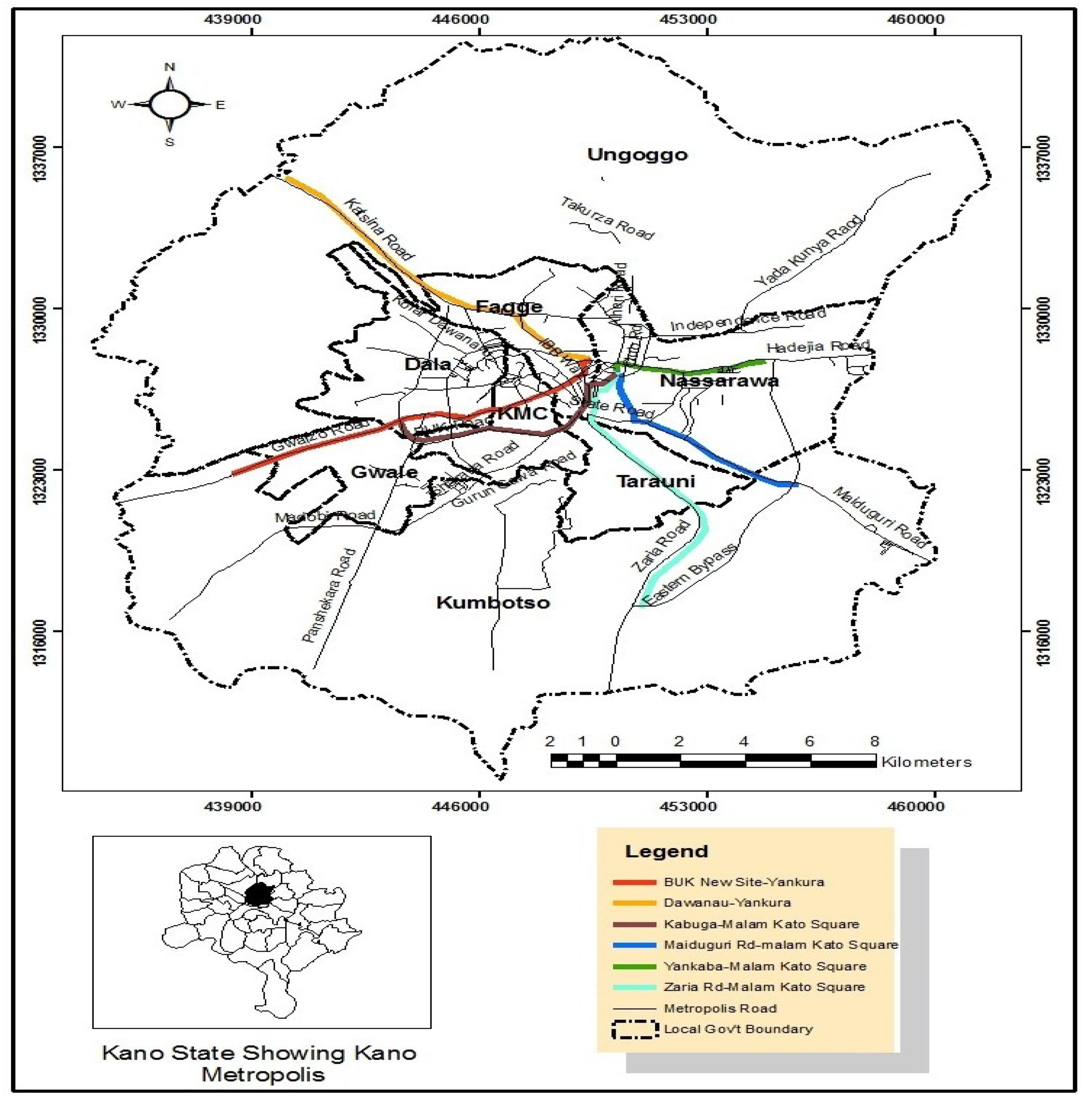
Major taxi service routes within Kano Metropolis and distance in kilometre (km).
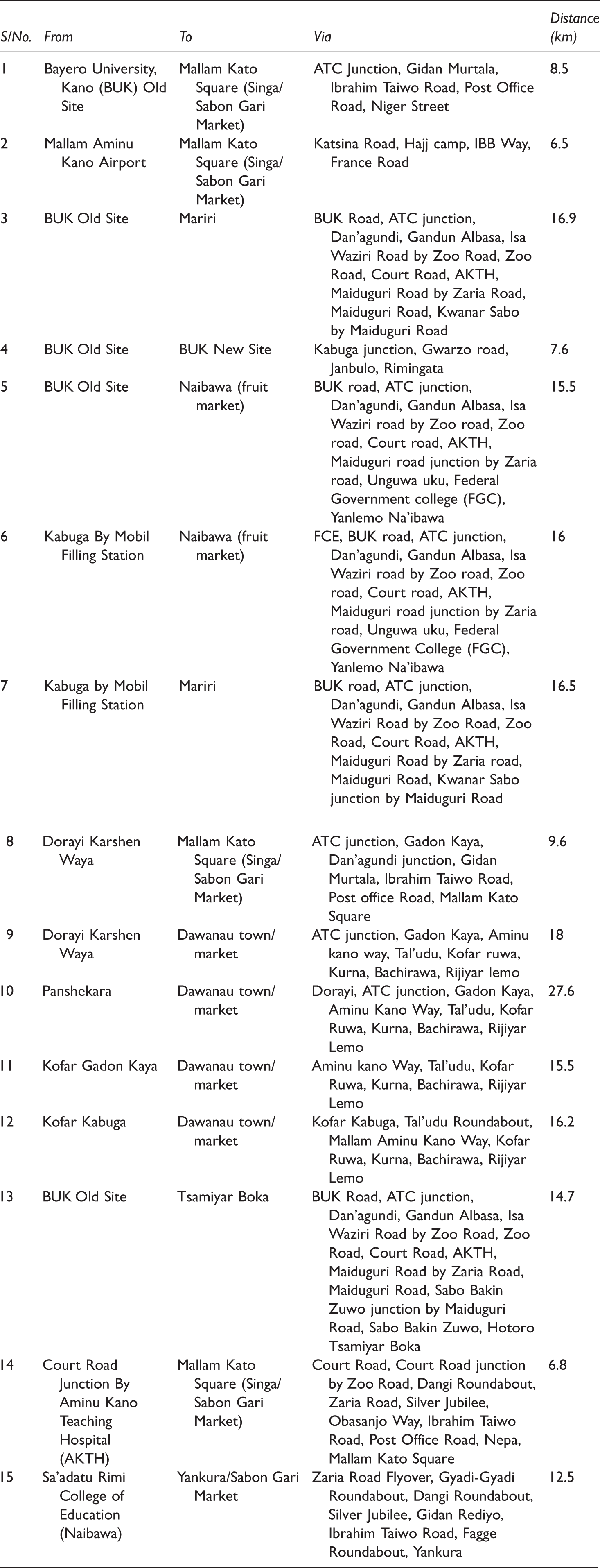
Source: Author’s elaboration from A Report on Kano Bus Mass Transit Route Mapping Study (Kano, Nigerian Infrastructure Advisory Facility (NIAF), 2011), esp. pp. 51–5.
Shared taxis in Kano: The industry and the drivers
As of 2014, there are over two thousand shared taxis in operation in Kano. Each vehicle is painted yellow and blue and carries up to six passengers (see Figure 2). The passengers are coordinated by a central taxi association, which operates between 6.00 a.m. and 10.00 p.m. The fares are in some cases regulated by the association, in other cases unregulated. Each time a passenger arrives at his or her destination, the driver seeks a new client along the route travelled. When unregulated, the taxi driver bargains with the new passenger before accepting the service.
Taxis in Kano city.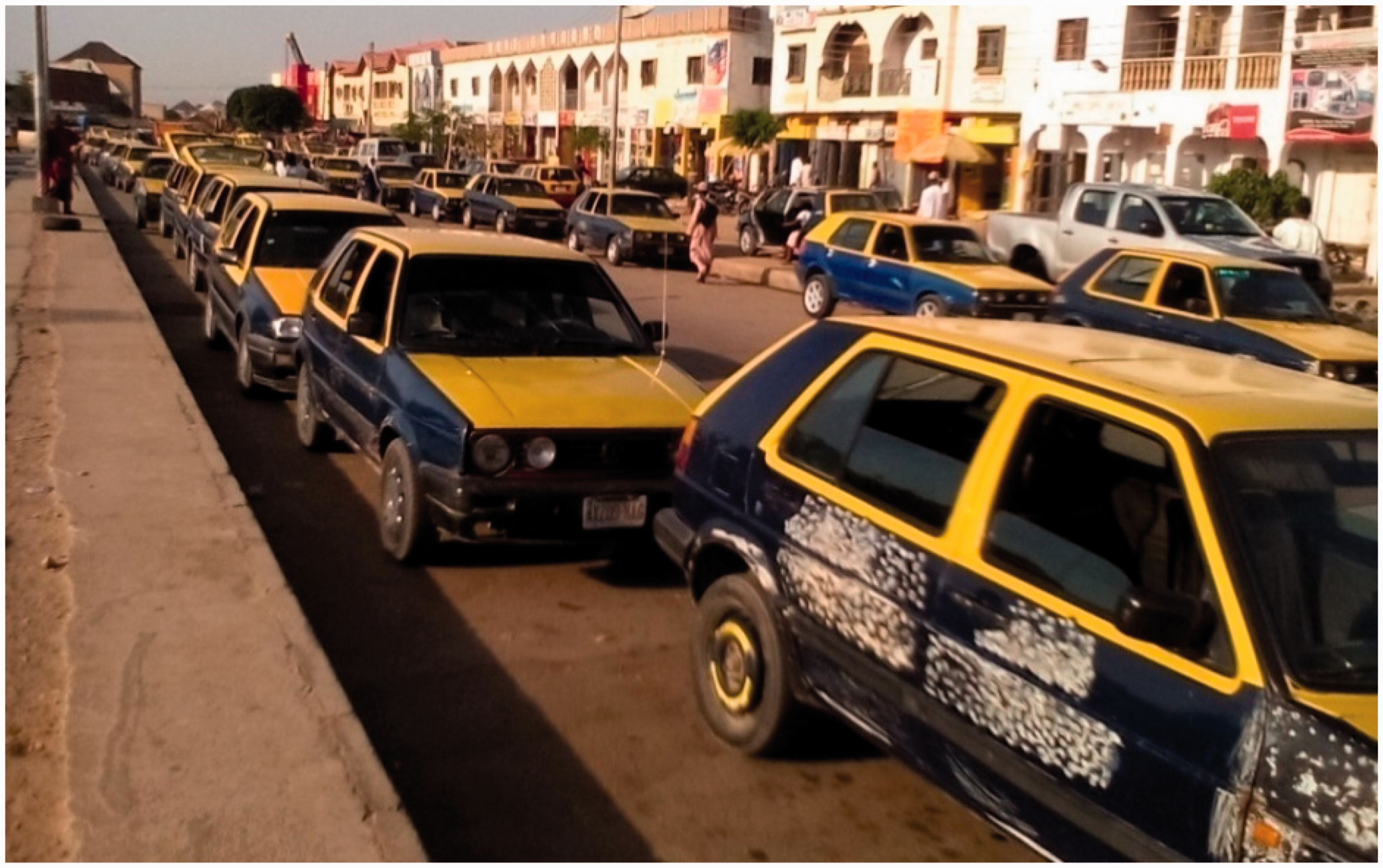
Most taxi drivers operate a motor vehicle owned by a third party and report an average of $3 US daily income, after expenses and fees paid to the vehicle owner. 34 In Kano, this income is considered appealing, a fact that further explains the growth of the industry. Of course, Kano taxi drivers usually aim to own the vehicles they drive, though they often lack the capital needed to do so. This led to the creation of a taxi drivers’ organisation, needed to improve the economic status of the members, provide financial support in terms of loans, and protect drivers against harassment or intimidation by the police and other public agents. In addition, the lack of proper training for the drivers led to high fatality rates in the industry. As such, taxi industry workers pushed for better training beyond simply owning a driving licence. 35
The ‘Kano State Taxi Drivers Association’ (KSTDA) was established in 2000 by thirty taxi drivers operating between Bayero University, Kano Old Campus, and New Campus. Membership of the union was later extended to cover all taxi operators in the Kano metropolitan region, 36 and by 2012 more than two thousand members were in the union. 37 KSTDA coordinates the activities of the taxi drivers, manages a passenger lost-and-found items office, regulates the service, and takes disciplinary measures against any member who violates the ethics and code of conduct of the union, particularly those who harass or victimise passengers. Some of the punishments include fines and suspension. KSTDA was also successful in fixing some standard prices for journeys for fixed routes. 38 Tsaya da Kafarka, the nickname for the organisation, is a play on words in the Hausa language. Its meaning doubles as ‘self-support’. The cooperative goal of KSTDA is to raise the funds needed to make personal ownership of motor vehicles for taxi drivers possible. Through contributions made by members, the union developed a micro-credit scheme, transforming de facto KSTDA from a professional organisation to a provider of credit. 39
Nevertheless, despite the growing influence of the shared taxi industry, a niche market for individualised traditional services still exists in Kano. In Kano, this more traditional taxi regime is today limited to service at the airport, operating according to individual requests, and under stricter regulation than shared taxis. The fares in this industry are also strongly regulated, leaving very little room for bargaining (unlike the shared taxi). Due to the individualised character of the service, the price is also higher. Curiously enough, airport taxis are unpainted, but definitely in better operating condition than the shared-service painted ones. Airport taxi drivers are required to register with the Kano Airport Taxi Association, which asks an annual fee. 41
Conclusion
The shared taxi industry started in Kano during the late 1980s as a complement to urban public transport services, performed by buses. Shared taxis then grew in relevance and in number, becoming an indispensable asset for the city and covering important areas, which otherwise would have been isolated. It is remarkable how this innovative transport regime, at least for the case of Kano, was rooted in a bottom-up development, largely originating from private citizens who owned motor vehicles and implemented the industry as an additional form of income. This system strongly impacted the pre-existing local taxi industry, which was already under pressure from the SAP programmes, and which relied on an inadequate business model and old cars. The weakened supply from the traditional transport suppliers, like the public bus system, further fuelled the raise of the shared taxi industry in Kano. The critical mass suddenly reached by the industry led to cooperative forms of management, as exemplified by the KSTDA. Reaching its maturity, the shared taxi industry was thus able to be at the front line of the transport innovation. Furthermore, the industry provides financial stability for the drivers and the opportunity to pursue the dream of becoming automobile owners.
Thus, the introduction of the shared taxi business helped to sustain and further enhance the multifarious economic activities and continuous growth of urban Kano. Without the shared taxis, many important commercial areas would have been isolated and ceased to function within the greater economy. Hence, as was the case in cities in Eastern Europe and central Asia in the 1990s, the shared taxi saved urban transport from imminent collapse in Kano. However, while the shared taxi industry showed many strengths, it is necessary to add that Kano (and Nigeria generally) still lacks an adequate transport policy, able to address the negative externalities in the energy sector, in the environment, and in the social exclusion related to unfulfilled mobility. 42
Footnotes
Declaration of conflicting interests
The author(s) declared no potential conflicts of interest with respect to the research, authorship, and/or publication of this article.
Funding
The author(s) received no financial support for the research, authorship, and/or publication of this article.