



Abstract
This article reflects on the role of the walking stick in the nineteenth-century city and explores the nature of the criticisms directed at it. The criticism and mocking of certain ways of holding the cane display the deep conflicts within the culture of urban strolling concerning how to take part in it, and who were allowed to do so. By identifying an irritation with canes, we see that there was a conflict between the purposeful culture of walking and the superficial culture of performativity and display, which forced Victorian men to be extremely careful of how their behaviour was perceived. By bringing the walking stick to the fore, the paper illustrates its role in a struggle between ostentation and sobriety and how its importance in cultures of both self-possession and flamboyance is indicative of aspects of the history of urban walking.
‘Not few are the inventions which plain utility recommended in their origin, but which in process of time the power of fashion has debased into useless decoration.’ Thus speaks the anonymous author of a small early nineteenth-century pamphlet entitled Hints to the Bearers of Walking Sticks and Umbrellas. 1 This satirical work is an early example of the irritation that numerous writers during the following century would feel towards one of the most common accessories of the age – the walking stick. The modern walking stick may have evolved from the staffs and ceremonial rods of ancient times, but by the late eighteenth century it had very little to do with such implements. As early as the sixteenth and seventeenth century, canes with little more than a decorative function started to appear among the well-to-do spheres of western cities. Stylised and thin, replacing the sturdy and tall walking staffs of shepherds and wanderers, these new sticks, according to Joseph Amato, developed thanks to the smoother surfaces of urban streets and royal courts. 2 Whether city streets were smooth and regular in the early modern period is debatable, but as decorative canes at least until the eighteenth century were the prerogative of a minor elite, the shining floors of palaces were probably enough to bring about the evolution of such an accessory.
The walking stick had unquestionably been an item of ‘useless decoration’ for quite some time when the anonymous author of the quoted pamphlet complained of this condition, so what lay behind the reproachful attitude? As we will see, the disapproval of the walking stick as an item of decoration was to become commonplace. Although it is voiced as early as the eighteenth century, 3 the latter part of the nineteenth century constituted an era of growth and democratisation when it comes to urban walking and cane usage, and the debate surrounding it became more connected to certain groups and identities. In the following article, I will reflect on the role of the walking stick in the nineteenth-century city and explore the nature of the criticisms directed at it. What was it in its existence and use that caused such irritation, and what does this tell us about notions of urban walking in the nineteenth century? By bringing the walking stick to the fore, I wish to illustrate how it became a key symbol in a struggle between ostentation and sobriety and how its importance in cultures of both self-possession and flamboyance is indicative of aspects of the history of urban walking that have yet to be explored.
Walking in the nineteenth century has started to attract attention from scholars in recent years. Identified as a new popular pastime among the emerging middle classes, recreational walking has been interpreted as a result of improved country roads and a decrease in highway robbery towards the end of the eighteenth century, a trend that gave way to the cult of ‘romantic walking’ indulged in by poets and painters. The growth of cities, however, also initiated the advent of walking city streets for pleasure as a means of socialising and admiring the new urban scenery. 4 Thus, urban and rural walking emerged as quite distinct activities, although both were in essence reactions to modernity. As the nineteenth century went on, and urban culture became increasingly distinct, urban walking grew to be ever more multifaceted, acquiring highly varied connotations, from the associations of prostitution and streetwalking, to leisure pursuits including street markets and fairs, from commuting and travelling between home and work, to the emblematic practice of flânerie. 5 We tend to characterise the modern city that evolved as a place of crowds, traffic and consistent flows, but alongside the pulse of city life, urbanism was also a breeding ground for performative practices. As the street crowd turned into something like an audience in the mind of the urban dweller, role playing and new forms of social interaction were established. 6
The historiography of the promenade
Urban walking in the nineteenth century thus had many forms and arenas, but when walking in the street was conceived as a socialising and performative practice, it was consigned to certain places and subject to certain definitions and rules. The customary term for this phenomenon was the ‘promenade’, denoting both the place where it went on and the practice itself. Perhaps the most distinct analysis of the promenade is David Scobey’s article on its importance in nineteenth-century New York. ‘At prescribed times and places’, writes Scobey, ‘the city’s propertied men and fashionable women gathered in public, circulated past one another, and exchanged salutations.’ In the strictly discerning and hierarchical urban society that Scobey depicts, the promenade acted as a ‘performative utterance of gentility’ and a ‘trial of legitimation organized around the offer or refusal of recognitions’. 7 Mona Domosh offers a slightly more complex picture in an influential article which shows that the promenade was far from the exclusive domain of propertied men and fashionable women. She sees a ‘micropolitics’ incorporated into the minor oppositional gestures and transgressions performed by the working classes, blacks and women in urban promenading. Through an appropriation of de Certeau’s idea of ‘tactics’, Domosh claims to detect instances of street behaviour that run counter to the bourgeois norms of the promenade, concluding that the public streets of the nineteenth century (in this case also New York) were neither completely controlled nor totally democratic spaces. As it was possible for groups who did not live up to the bourgeois norms to engage in the promenade, their participation simultaneously disrupted and confirmed the standards. 8
Domosh’s tentative article is thought provoking, and her quite limited empirical study leaves much more work to be done. Some recent studies on the ‘disruptive’ participants of the promenade suggest crucial tensions in conceptions of public appearance on a purely practiced everyday level. Work on the ‘larrikins’ of nineteenth-century Australia has revealed the presence of groups of young men and women in promenades whose behaviour, in the words of Cameron White, ‘transgressed the norms of middle-class’ conduct ideals. 9 A corresponding conflict in European cities identified groups of ‘lower-class’ dandies as invasive and disruptive to the promenade, 10 but there were also alternative versions of the promenade, exemplified primarily by the ‘monkey parades’ of English working-class neighbourhoods. Jenny Birchall has shown that these constituted new forms of sexualised public display which aroused the concern of some commentators but essentially were signs of ‘new forms of public space use’. 11 Common to the various types of promenades was the aspect of dressing up and appearing in your best clothes. The promenade seems also often to have been about flirting or encountering potential candidates for romantic involvement, but this was evidently a contested issue. Hiding behind much of the discourse surrounding the promenade are various ‘civilising’ forces in the mentality and reactions to instances of vulgarity and ostentation.
As demonstrated by the geographical range of the case studies of promenading, this culture seems to have been common to all western(ised) countries, and one might conclude that the practice was essential to the social life of nineteenth-century cities. It is distinct from those aspects of urbanism which were to become more tangible in the following century, such as heavy traffic, speed and congestion. As a phenomenon characterised by elegance and face-to-face interaction, it might be said to have more links with the past, but given its apparently ubiquitous nature in the nineteenth century and into the early twentieth century, it appears to contain something modern as well. Rebecca Solnit connects it with the urban development of the nineteenth century, noting how the period saw the emergence of more orderly and idyllic thoroughfares designed for public socialising: places that were ‘little more than outdoor salons and ballrooms’, ‘anti-streets, segregated by class and disconnected from everyday life’. 12 To what extent such a segregation was a trademark of the promenade is debatable, and it is clear from some of the evidence provided by the cited articles that this arena could contain conflicts.
In the vast array of theoretical and empirical writings centring on walking practices produced during recent decades, a majority seems to have focused on the way they are being governed and the strained relationship between pedestrianism and civic control. 13 However, walking as a social and performative activity has also been explored in the footsteps of Erving Goffman and Michel de Certeau. Tim Ingold and Jo Lee Vergunst stress the social aspect of walking: ‘In their timings, rhythms and inflections, the feet respond as much as does the voice to the presence and activity of others.’ 14 This line of reasoning goes back to Marcel Mauss’ seminal essay ‘Techniques of the body’, which establishes the theme that bodily practices are ‘civilised’ as the internalisation of social norms gradually suppress ‘disorderly movements’ when a person grows up. 15 Mauss’ article was highly influential on the writings of Maurice Merleau-Ponty and Pierre Bourdieu, who both emphasised the role of unreflected bodily dispositions in the agency and decisions of individuals. 16 However, the theoretician who has probably had the most influence on studies of walking is de Certeau, whose dichotomy of strategies and tactics identifies the way in which everyday practices such as walking constitute a creative appropriation of structurally imposed conditions. This framework has become such a commonplace in walking studies that David Pinder recently expressed criticism of the insistence that walking be viewed as ‘creative resistance’, saying that it builds upon a very ‘partial reading’ of de Certeau. 17 Anyone who has tried reading de Certeau understands that any other reading than a partial one is difficult to achieve, and although Pinder’s comment is probably true, the essence of de Certeau’s idea, or at least the interpretation of it that has gained ground, gets at something very basic about how everyday practice in modern society may be understood.
The conflicting ideals and negotiations that surround public walking as encountered in the nineteenth century may be interpreted in tandem with de Certeau’s theories, but I will speak here rather of conflicting notions of relatively equal standing than of a hierarchical relation between societal structures and ordinary people. The following exploration will try to paint a picture of definitions of urban strolling during the nineteenth century (focusing on the latter half) and how they clashed with one another. In my recent monograph on urban body language in this period, I make use of street photography, 18 but for a more brief survey such as this, the best way of pinpointing the conflict is to look at what views were expressed in the press, both in terms of journalists or correspondents who stated their views on how one ought to walk, and reports and complaints of various examples of how one oughtn’t walk. Comments on walking-stick use specifically provide us with a suitable window onto changing conceptions of walking halfway between the civil society of the early modern city and the subcultural heterogeneity of the modern city. The discussion that follows thus rests on the assumption that what is commented on in the paper in some way reflects existing practices or at least various people’s perceptions of such practices. We will not be concerned very much with political or civic aspects of the urban flow, but with the clashes of conduct ideals that have left traces in the urban newspapers of the nineteenth century. It is thus more a matter of a clash between conduct ideals than about the conflict between strategies and tactics.
The role of the walking stick in the nineteenth century
The following brief survey of remarks on walking-stick use will focus on examples from a British context, although the phenomena spoken of were not unique to Victorian culture. A survey of periodical material from Sweden, the German-speaking countries and America has also been made, and I will occasionally mention examples from these contexts. In the urban centres of Western Europe, a quite uniform culture of appearance and deportment was established during the nineteenth century, and emblematic symbols such as the cane sent out very specific signals. Although the stereotypical conception of the man with the walking stick is tinged with an aristocratic or bourgeois flair, the identity that such an accessory indicated was not necessarily connected to economical divisions. There are indications, however, that the walking stick was infused with gentility and symbolised a very specific social belonging to some people. 19 Data on the diffusion of such accessories in various social strata are difficult to come by, but Diana Crane, in her study of French working-class dress in the late nineteenth century, states that the attributes of cane and gloves were nonexistent lower down the social scale. 20 It has also been suggested that the introduction of reed grasses such as bamboo and cane into the manufacture of sticks, leading to the establishment of the term ‘cane’, caused a division between walking sticks and canes. The maxim ‘one strolls with a walking stick, and swaggers with a cane’ is sometimes quoted in reference to this. 21
The walking stick, then, is connected to various walking styles, and the terms ‘stroll’ and ‘swagger’ denote two related ways of walking which seem to have been ascribed with varying qualities. The word ‘swagger’ in its noun form, denoting a superior or insolent behaviour, can be traced as far back as the early eighteenth century, although it stems from a verb which is used by Shakespeare. 22 Strolling and swaggering are both very masculine ways of moving, and we shall observe how these could be performed in the period in focus, but the body language dealt with in this chapter is not exclusively male. Although walking sticks were uncommon among women, a corresponding gender-transgressive accessory grew popular in the nineteenth century – the umbrella. In poses, the umbrella was used in much the same way as a walking stick, but its basic functionality might have made it less conspicuous or showy, an item carried in the event of rain rather than as just an elegant cane. It was this sensible quality that made umbrellas popular among English gentlemen in the late eighteenth century, adopted from Asian parasols, and used as such until their usefulness as protection from the rain became apparent to western patrons. Historian Ariel Beaujot has identified the purposes of female and male umbrella uses in the nineteenth century, noting that women used parasols to shade the face and make it look more attractive, and the various intricate ways of putting them up and down contained a secret language of flirtation. For men, the umbrella worked chiefly as a symbol of social distinction, and writers at the time distinguished between the tightly furled umbrella of the aristocratic gentleman – furled so tight that it was almost impossible to tell apart from a walking stick – and the clumsily furled working-class umbrella, its whalebone ribs sticking out and a rope twirled around it, resembling ‘the cinched waist of a woman rather than the strait (sic), tight figure of a gentleman’. 23
The umbrella was not exclusive to a certain social class, and the social associations of the walking-stick were contradictory, if we consider what sociologist Thorstein Veblen wrote in his 1899 treatise The Theory of the Leisure Class. Here he states that those who are in the habit of carrying a walking stick are both men of the ‘leisure class’ and ‘lower-class delinquents’. Veblen curiously connects the ‘pecuniary upper-class man’ with the lower-class delinquent in that both types share certain characteristics, both being unscrupulously engaged in profitable activities, disregarding ‘the feelings and wishes of others’, and their taste for gambling and ‘aimless emulation’ are further signs of their ‘predatory human nature’. In both these classes, idleness is praised, and so ‘the walking stick serves the purpose of an advertisement that the bearer’s hands are employed otherwise than in useful effort, and it therefore has utility as an evidence of leisure.’ 24 Veblen’s writing is strictly categorical and he tends to see races where there are only diffuse social groupings, but his observation of the use of the walking stick in groups across the social scale is suggestive, and deserves closer inspection.
Walking-stick usage and its discontents
The way men handled their canes in the nineteenth century has turned into stereotypical poses and gestures that might lead one to think the elegant ideal of the time was fairly straightforward and homogeneous, but men could make many different things with their walking sticks, some that did not seem to strive towards the same impression of elegance as others. We see this perhaps most clearly in the many comments in the press on the practice of carrying the walking stick by the middle, so that it is held horizontally, or even upside down. This seems to have been interpreted as a sign of nonchalance or demonstrative indifference, and it appears to have aroused violent emotions. Often, the criticism concerned the potential risk of hitting or poking other pedestrians or fellow omnibus passengers.
25
‘One of the most careless and dangerous habits in which some people indulge to a great extent’, wrote one magazine, ‘is that of tucking their umbrellas or walking-sticks under their arms, letting them stick out almost, if not quite, horizontally, and thereby endangering, as well as incommoding, people who are so unfortunate as to be behind them in the street’.
26
But to many observers, the way you carried your stick also signified who you were. A Swedish article complaining about the superior manners of snobs, laments the spread of such practices down the social scale, where ‘carrying the walking stick or furled umbrella horizontally’ is seen as a sign of being ‘a man of the world’.
27
An English article mourns the passing of the ‘good old-fashioned style’ of using a cane by pressing it to the ground ‘in a sort of rhythmic accompaniment to the feet’, which has been superseded by a more performative practice: In masher-land it is inelegant to employ a cane as a walking stick. You must expose the ornamental handle to full view, and the ferrule should seldom or never touch the side-walk. It is necessary hence for the wearer to grasp the cane a foot or so below the handle, and hold it in a slanting position, with the handle forward. A good effect is produced if you walk with strides that suggest to the passers-by that you are wearing knee-caps beneath your nether garments after the manner of a horse.
28
Not surprisingly, most pieces on this topic are found in the London press and especially in those conservative newspapers that often contained complaints – either in the form of articles or letters to the editor – from elderly or respectable gentlemen on the practices of the young and snobbish. An elaborate article in one such periodical, the Pall Mall Gazette, of 1889 under the heading ‘How to Carry A Walking-Stick’ seems to derive from the same sources of irritation as the one quoted above. ‘To carry a stick in a manner that will not only look graceful, but without danger and annoyance to others’, begins the author, ‘requires both thought and practice’. He goes on by emphasising that the main purpose of a walking stick is ‘to give assistance in walking, or as a means of assisting our locomotion, and not to poke our neighbour’s eye out, or do other grievous bodily harm’. The author also complains that the stick is no longer seen as a practical tool but only as an ‘ornament’ and he paints a picture of a bygone golden age – ‘the days of Brummel’ [sic] – when men knew how to carry their canes with grace. Cane-carrying has many connotations to this author, but behind most of the vexation lies nothing more than the annoyance with the new-found horizontality of walking sticks. ‘Having had a front tooth knocked out, and been severely prodded about various parts of the body, we can speak from painful experience as to this danger in our midst.’ The problem is connected to a certain type of men whose sticks have a ‘formidable knob or projection’ at the end, for they are in the habit of carrying the cane ‘by grasping it in the centre, in a horizontal position, and naturally swings his arm backwards and forwards as he walks’. Equally problematic is the man who carries the stick under his arm. ‘If he should happen to stop suddenly, or turn to look into a shop window, as we have often seen him do, he kindly upsets the equilibrium of your hat, or you narrowly escape having your eye cut out.’ 29
The criticised uses of the walking stick are invariably associated with current fashions and a younger generation of men. The author of the Pall Mall Gazette piece conveniently forgets that dandyist tendencies were just as derided fifty or so years earlier as they are towards the end of the century. The annoyance with inconsiderate cane-carrying in omnibuses had been around as long as that type of transport existed. A Times article in 1846, for instance, complains of the ‘umbrella or walking stick, pointed horizontally on a level with the passengers’ faces’ that was carried by thoughtless gentlemen when entering the carriage.
30
Cartoons, especially in Nordic and Central Europe, routinely depict this type of carrying to make fun of pompous male pedestrians (Figure 1). Nearer the end of the century, however, the aforementioned ‘masher-land’ was the main association of this type of illicit practice. ‘The man who has pretentions to dandyism or dudeism, or any position as a “masher”’, states a Daily News article, must give heed to the changes of fashion in stick-carrying.
31
Once again, we encounter the word ‘masher’, which was used – mainly in the 1880s and 90s – to denote lower-class parvenu dandies. These men, apart from being constantly derided in the press, seem to have made up their own subculture and distinguished themselves by dressing in ways that deviated from discreet bourgeois conventions of gentlemanliness. Among the fashions ascribed to them were high starched shirt collars, small bowler hats, short coats, wide garishly coloured trousers, monocles, and, not least, short, thick walking-sticks that were completely useless as walking aids. The synonyms for these men were numerous – dudes, swells, chappies, johnnies – and their appearances corresponded to similar groups in other countries, particularly the Gigerl in Vienna and the grilljanne in Stockholm.
32
Cartoon in the Swedish journal Söndags-Nisse, 1890s.
The fashions of these young men aroused much irritation, but most effort seems to have been made in the disparagement of the way they carried their canes. This is not only found in traditionalist newspapers, but also in more comic form in satirical journals. Looking at both the writings on walking sticks in this period and the cartoons that made fun of street types and urban behaviour, a veritable sign language of walking-stick usage transpires. Clearly, some ways of carrying the cane were seen as unsuitable by representatives of the press, but these practices seem to have been widespread, and one wonders if they had specific meanings for the men who ignored the criticism and carried their canes in an irregular manner. The horizontal cane was part of a type of self-presentation designed to come across as confident and brash, and it was accompanied by a strutting arrogant walk often referred to as ‘swagger’. ‘Swagger is found among pretty nearly all classes of society’, states an article in a comic magazine that addresses the phenomenon directly, adding, with irony: ‘but it prevails mostly among very young men, because, of course, they have done so much more to be proud of than anyone else, and are, consequently entitled to more respect’. The article goes on to inform the reader that swagger is best carried out accompanied by ‘a gushing suit of clothes’, and if you cannot afford one you can always get it on credit. ‘Most young men can put on quite a lot of swagger in a suit of clothes that really belongs to their tailor.’ The next requisite is a walking stick, ‘which must be held at the wrong end to let people see that you know what it is meant to be used for’. But the most central aspect of the swagger is of course the walk. In walking, you roll yourself from side to side with every step; and as you swing your arms about in the air, that stick will describe pleasant little circles around you, and enable you to take up more room on the pavement. This sets you off much better, especially if the street is at all crowded; and, besides, it gives other people the idea at once that the whole of that side of the street really belongs to you, and that you are letting them have the use of it temporarily.
33
By isolating the walk of the dandy for special treatment, this article falls into a category of writings that identified certain walking styles among the street types of Victorian cities. In London, the ‘Piccadilly Lounger’ became a label for the type of semi-respectable men who spent too much time in the entertainment establishments around Piccadilly, particularly the popular Criterion Bar, frequented by ‘the man who dons evening dress simply to be seen here by his friends’. 34 These men were considered to have a special way of walking, dubbed the ‘Piccadilly crawl’ by the press, which was thought to be affected and flamboyant. One writer describes it thus: ‘It consists of putting out the left leg manfully, as if for a mile race, and drawing the right slowly along, not dragging on the ground, but as if the hip joint were a little out of order.’ 35 A slang dictionary published in 1889 explains the term as ‘a languid walk much affected about ten years ago’. 36 The term was picked up by the authors of music hall songs and accounts of music hall acts claim that several performers made their own impersonations of this eccentric gait, although it is difficult to acquire a vivid picture of exactly how it looked. 37 Nevertheless, it illustrates the link between affected body language and urban spaces that became areas of display, showing both how certain places encouraged a very distinct type of behaviour and how body language easily acquired performative dimensions as a result of the emerging nature of certain spaces.
Urban streets such as Piccadilly were not typical promenade areas in the way that parks and seaside esplanades were, but while the term ‘promenade’ was linked to a certain activity, the practices involved in that activity existed outside the promenade and could be indulged in in various spaces. Irritation with certain ways of walking stems partly from contrary interpretations of the nature of the space. While some saw Piccadilly as the heart of respectable London, it was also one of the key areas of entertainment, and it became vital territory for the types of young men often labelled ‘mashers’, whose conduct combined the external elegance of the gentleman with a raucous waywardness. The conveyance of indifference, haughtiness and distinction appears to have been key to this way of behaving and when the gait is related to the contexts that can be ascertained, namely the nature of the places where it was performed, the clothes it was coupled with and the arrogance that the performers exuded, then the body language comes across as indicative of a self-contained subculture built on a display of self-possession and elegance. It is as if the appearance of elegance and wealth was more important to these men than the actuality of it, in contrast to what was exhorted in advice manuals of the time. 38 Their performance was also exaggerated to the point where it became almost a parody of a rich man, and it seems that the behaviour was consciously stylised in defiance of the restrained and sensible conduct codes that were around at the time.
The basis of much of the critical voices focusing on the walking stick is an annoyance with the lack of consideration that these men exhibit. The debate seems to stem from a persistent conflict in the nineteenth-century city concerning mobility and decorum. The advice to not be in the way of others is ever present in writings on Victorian street life. ‘Take care not to tuck your umbrella or your walking-stick under your arm in such a manner as to endanger the integrity of the eyes of the people pressing on behind you’, advises George Augustus Sala in one of his books on the topic of crowded London thoroughfares. 39 Articles in the press on the same subject encompass much more emotions and a sense of urgency, revealing the authors’ frustration from actual encounters with this type of men, and the sarcasm would not have worked if they could not rely on readers’ own experiences of this behaviour. As indicated, nineteenth-century urban life contained many clashes between different notions of how to behave in the public sphere. They might be summed up as a conflict between, on the one hand, an emerging subdued ideal, adapted to the increasing crowdedness of streets and associated with the modern city as a place of anonymity and lack of social interaction, and on the other hand a rowdy and burly culture, the successor of early modern carnival culture. 40 But the conflict of the walking stick signals something more complex. Here these two opposite ways of using the street had come together within the same culture – that of promenading and the culture of elegant display. The problem of the walking stick indicates that this was a practice indulged in by people from various walks of life, following the same basic rules of elegance in dress, strolling at a moderate pace and polite socialising, but doing it in slightly differing ways, thus stirring up heated emotions in the more conscientious participants.
Nevertheless, the walking-stick debate was not only about being in the way of other pedestrians. Complaining of the horizontal cane-carrying and the swaggering gait as disrespectful was logical, but there were other sides to it. When writers mocked the way some men held their canes horizontally or by the wrong end, they expressed annoyance with how they robbed the walking stick of its original function. This was not only done by holding the stick horizontally; another way of carrying it which can be seen in numerous cartoons from the late nineteenth century was to put it in the coat pocket, so that it reached up to the head instead of down to the ground. This manner of carrying the stick would hardly have meant any immediate danger to fellow pedestrians, and one does not find as many references to it in writing, but in cartoons it appears to have become associated with the caricature of the masher, and was used to signal certain characteristics. It was especially connected to dandyism in various forms, as in the Phil May cartoon published in Punch 1896 (Figure 2), where a flashily dressed gentleman awakens the curiosity of two newspaper boys. Swedish, German and Austrian satirical journals were even better at picking up this fad and deriding it in their cartoons, and perhaps such discreet practices were more visible in the relatively limited public sphere of 1890s Stockholm than in the multiplicity of fashions and street types seen in London.
Cartoon from Punch 1896. Source: With the permission of Lund University Library.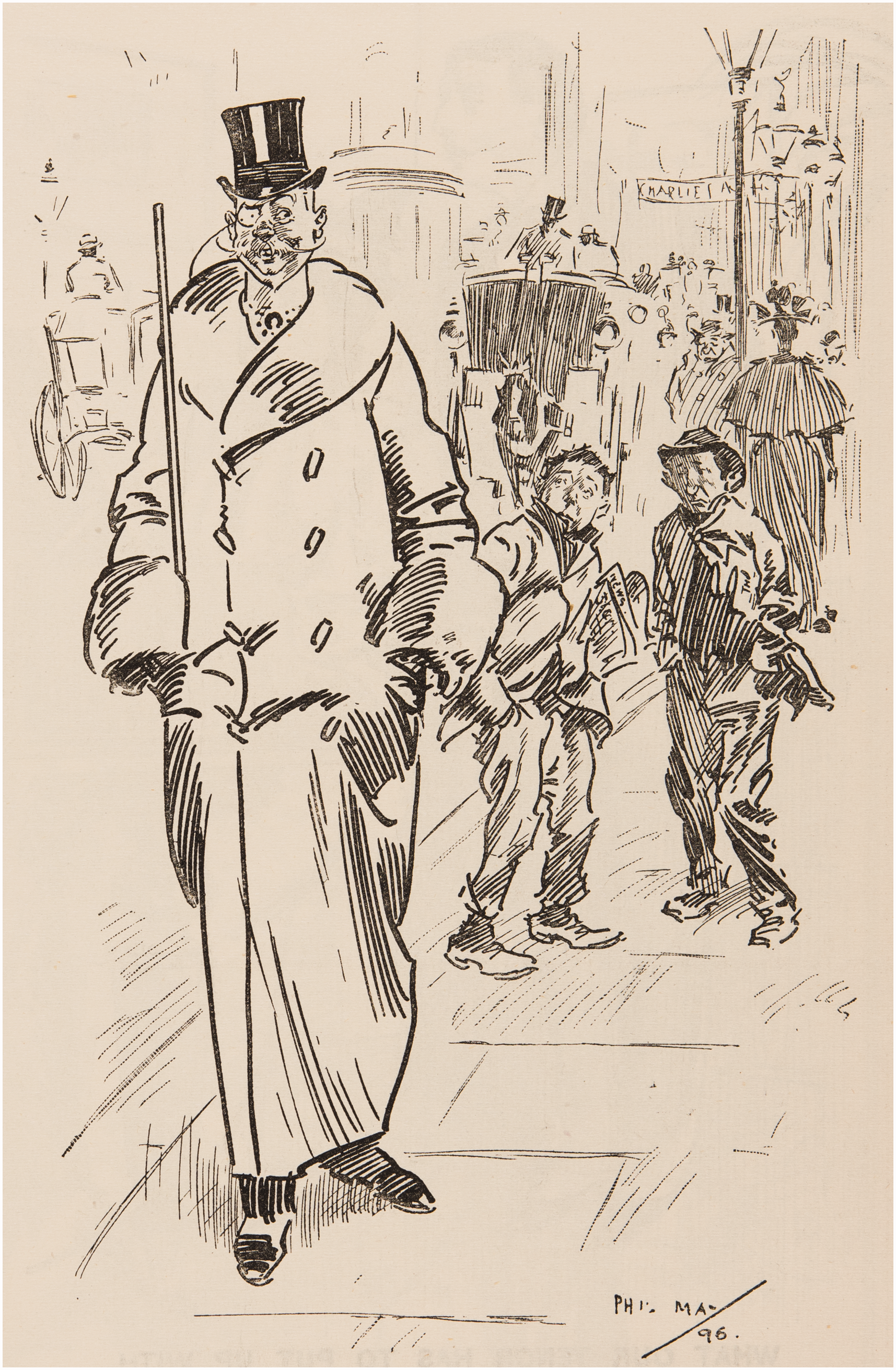
Conclusions
Thus, the walking stick and the various ways it was carried are particularly illustrative of how the culture of the promenade was haunted by conflicting notions of mobility and deportment. If the walking stick was carried in such a way that its function as a walking aid was completely absent, it was deemed as ostentatious and inappropriate. At the same time, the strolling that even the most respectable people engaged in, although without any other function than that of being seen, was considered perfectly legitimate. Promenading culture here cuts through the well-known Victorian tension between idleness and thrift, and connects it with issues of mobility. If the promenade was about display and elegance rather than movement or speed, then why did ostentatious ways of carrying the cane arouse such hostility? It seems that the walking stick to many symbolised the act of movement that nonetheless was an integral part of the promenade. It was a reminder of the ancient and taxing connotations of walking that the promenade stemmed from. But then it became the ubiquitous accessory of the dandy, and as it lost its associations with strenuous trekking, it was increasingly adorned and made quite useless for leaning on.
The way the walking stick should be held according to the written discourse turns it into a nonverbal symbol for groundedness. Keeping contact with the ground is a signal of sobriety and dignity. Statues of great men seldom show them holding their canes in any other way. As other means of mobility started to become common towards the end of the nineteenth century, particularly cycling and eventually motoring, walking was increasingly portrayed as something archaic and traditional. ‘Walking is among recreations what ploughing and fishing are among industrial labours: it is primitive and simple; it brings us into contact with mother earth and unsophisticated nature; it requires no elaborate apparatus and no extraneous excitement’, wrote Leslie Stephen in his essay ‘In praise of walking’, in which he contrasts walking and cycling in order to demonstrate the contemplative solitude that only the walker may obtain. 41 Walking as a poetic and romantic act had become connected to the early romantics, thus enjoying an established position that cycling still lacked. However, walking as a practice had during the course of the nineteenth century been coloured by preconceptions typical of the age. The concept of walking as recreation was a product of the transport revolution, first the emergence of advanced coaches, then the impact of railways. 42 Suddenly, walking was not as necessary as it had been, nor was it any longer the standard way to travel, and it was therefore increasingly seen as something that could be indulged in for pleasure. However, while the rural walk was a way of escaping modernity and urbanism, urban walking became a way of engaging with it. The growth of cities made the practice of flânerie a vital ingredient in new forms of literature and journalistic writings, but while flânerie was about observing, promenading was about being observed.
Attracting attention was a sensitive issue in the late nineteenth century. Much of social life depended upon it, but the slightest indication that a person made an effort to be noticed – rather than being natural and spontaneous – would lead to instant condemnation. And here the main clash of the period transpires, between subtlety and forthrightness, between moderation and vulgarity, elegance and swagger. The late nineteenth-century streets were the scene of a conflict between expansive and restrained behavioural ideals. In written texts, the restrained ideal was undoubtedly the most expressed but an expansive and relaxed body language was at least as common as it is now and it is visible in photographic material and partly in the mocking and criticism of such behaviour that occurred in the press. A discreet thing as how a man held his walking stick could signal very clear things to people of the period and one way of carrying the cane was associated with vulgar dandies while another was seen as more respectable. The division was partly social. Alongside the most respectable promenades were the working-class monkey parades, where young men and women paraded with a more expressive code of conduct, and more overt ambitions of courtship. But practices of vulgar display and expressive conduct also existed in the theatres and entertainment venues of the wealthy. In such arenas, more expansive gestures and ways of walking emerged, challenging the discreet movements of the respectable ladies and gentlemen. The division was a question of age just as much as class.
The texts examined here contain some of the few traces of male subcultures in the nineteenth-century city who consciously resisted conventions of behaviour and turned them topsy-turvy. The way their practices are portrayed here exaggerates them and turns them into comic set pieces. Their actual way of walking is probably lost for ever beneath several layers of parody and sarcasm, but the descriptions of how they held their canes allow us to see a bit more clearly a nonverbal language that may have signalled a certain identity and a certain belonging to people at the time. It is as apparent an example as any of tactics, if by this we mean the reappropriation of a given commodity in a way that goes against the received notion of how it should be used. By using it in the ‘wrong’ way, its function is lost, and it is made into something else. It is telling that it is a tool for ambulation that should be treated with such iconoclasm. The simultaneous rebellion and flamboyance of the practicians of popular dandyism was all about resistance to the sensible and useful ideals of their betters – or fathers. Something that these men had in common with twentieth-century youth subculture. 43
Neither the gentility of the promenade nor the coarseness of the monkey parade were walking cultures that appropriated walking as conveyance. Walking in the late nineteenth century was still a means of getting from A to B, in the city especially for those numerous men and women who could not afford public transport, and thus walked several miles every day between their homes and their places of work. But walking was also turning into a tool in the modern culture of display. In the countryside, walking was a means of exploring. In the city, walking was a means of becoming. In order to attain the status to which people aspired, they had to exhibit themselves in the public spaces of the city. Knowledge of who you were was replaced by knowledge of what you looked like. Thus, aimless performative walking had not yet been overthrown by determined targeted walking. In fact, the urban promenade of the nineteenth century was perhaps the culmination of an urban development that had turned walking from a mode of conveyance to a method of self-presentation. The introduction of new modes of transport at the end of the nineteenth century helped make walking both a performative practice and a leisure pursuit, but it would never again be the preferred means of transport of the wayfarer in the western world. In many countries, the ritual of the promenade lives on. It is most tangible in Italy, perhaps, where the passeggiata is an essential ingredient of every Sunday. 44 The continuous existence of this phenomenon shows that it is far from a homogeneous or socially excluding practice, and that the urban streets can still be conceived as stages for pedestrian performance just as much as thoroughfares for traffic.
Through this little case study, dealing with a seemingly trivial aspect of everyday life in the nineteenth century, I hope to demonstrate that there is a history of walking beyond the dimensions of civilising processes or civic control. It is the history of the civilising and friction that goes on between pedestrians of (relatively) equal standing, about conflicts integral to the users of the public street. Although social divisions and geographical segregation can never be ignored, it is important not to lose sight of everyday agency and the wordless conflicts that create divisions both between groups of people and within individuals.
Footnotes
Declaration of conflicting interests
The author(s) declared no potential conflicts of interest with respect to the research, authorship, and/or publication of this article.
Funding
The author(s) received no financial support for the research, authorship, and/or publication of this article.