



Abstract
When Portugal began building railways in its mainland territory in the 1850s, the main goal was to connect its harbours (mainly Lisbon) to the border with Spain (and beyond to Central Europe). This strategy left out of the network vast areas of the nation, some of which were perceived as very rugged, poor, and with low economic potential, where the construction of a railway was not cost effective. The same quandaries existed in the colonies, where investment in public works started in the 1870s. To bring railroads to these regions, it was necessary to find a low-cost technical solution. That solution was narrow-gauge railroads. In this paper, we analyse how this technology was transferred from Central Europe to Portugal and its colonies via a travel circuit of learning by Portuguese engineers and how it was developed through a mixture of Portuguese and foreign expertise.
Introduction
In the 1850s, Portugal began an ambitious public works programme to modernise the kingdom, based on the Saint-Simonianist ideology of progress, which emphasised industrialisation, science and technology as promoters of social change. 1 Portuguese technocrats were engaged with Saint-Simonianism since the 1820s, having encountered it while they attended engineering schools in Central Europe. 2 Within this frame, one technology played a decisive role: the railway, considered the epitome of progress that would reduce distances, create civilisation, promote circulation, and eventually unify different peoples. 3
In Portugal, railways (together with harbours) could take advantage of Portugal’s position in the westernmost corner of Europe and turn it into a cornerstone in the trade between the Old and the New World. In 1888, Portugal had five transnational railways across the border. 4
However, many Portuguese (peripheral) regions benefited little (if at all) from these railroads. Those territories, specifically in the northeast of Portugal, were perceived as poor and with low economic potential. Some were hilly areas, where railway construction expectedly was more difficult and costly. 5
Similar predicaments existed in the Portuguese colonies, as those areas fell under scrutiny since the late 1870s, as the geographical obstacles in their path would certainly increase the construction costs. Although overseas domains were considered endless sources of wealth, it was nonetheless anticipated that operation would not be profitable for many years to come. 6 It became necessary to find a low-cost technical solution for these regions. That solution was narrow-gauge railways.
In this paper, we analyse the introduction of narrow-gauge railways in Portugal, both in the mainland and in the overseas domains. We examine narrow gauge as a large technological system in the distinct stages of its evolution: implementation, development, and especially transfer. 7 We focus on the system builders 8 who acted in each phase. Following them in their travels of learning, 9 through their books, papers, and techno-economic reports 10 published in the Portuguese technical press (especially the Revista de Obras Publicas e Minas, edited by the Portuguese Association of Civil Engineers), and through their input in the advisory bodies of the Ministry of Public Works, we reconstruct the implementation of the Portuguese narrow-gauge system. 11
The importance of the gauge in the railway operation and cost (both of building and maintenance) attracted a good deal of attention after the first decades of railway fever. 12 As it is well known, the gauge is the distance between the rails and in the first years of railway construction, there was worldwide a variety of different standards. As time went by, the Stephenson gauge (1435 mm) prevailed in most of Europe, but also broader standards were used (most notably, in the Russian empire, North America, India, Australia, and Ireland). Initially, in the early 1850s, Portugal used the Stephenson gauge, but because Spain had chosen a broader standard (1667 mm), it was forced to re-gauge its existing network. 13 Since the early 1860s, construction of slender locomotives became more practical, which made it feasible to build railways with narrower gauges. Engineers believed that this solution could lead to lower construction costs, as it allowed tighter curves that diverted the route from large geographical obstacles and avoided the building of expensive engineering works. 14
Belgium and Norway, influenced by British engineers, were the first countries to introduce narrower gauges (1150 and 1067 mm) in their systems, in 1848 and 1854. 15 Elsewhere in Europe, different engineers and State officials advocated narrow gauge throughout the 1860s as a low-cost solution for mountainous regions, for light traffic of local significance, and as ‘tools of economic development in places that would otherwise have no railways at all’. 16 This was the case in France, where in 1863 a committee nominated to improve the existing lines suggested the construction of narrow-gauge railroads to meet the transport needs of regions with low economic dynamics. Two years later, a law conceded a wide array of privileges to promote construction, which flourished in the 1870s, although financial speculation was also favoured. 17
These first examples were followed by a global narrow-gauge fever: from 1865 onwards, narrow gauge flourished in Britain, motivated by ‘a general outcry’ for cheaper railroads that could pay their way satisfactorily. 18 The technology was then transferred to the British colonies. In India, metre gauge coexisted with the original 1676 mm standard since 1865, 19 and similarly, in Australia. 20 In South Africa, the first track, inaugurated in 1862, used the 1435 mm standard, but British engineers like Richard Hall and Robert Fairlie suggested that narrower gauges were more effective in that context. 21 In the United States, narrow gauge was not used exclusively for hilly territories as it was also a low-cost solution for regular traffic. Initially used in private mining tramways in 1866, it was employed in 1870 in different projects (gauges ranging from 910 to 1067 mm). Between 1871 and 1883, a narrow-gauge fever spread across the country, materialising in a network extending throughout 12,000 km. 22
Coming back to Portugal, its neighbour Spain was also attentive to these innovations: in 1866 the government ordered the study of narrow-gauge railways, seeking cost-effective transport solutions for its peripheral provinces, where broad gauge was too expensive or where demand was not large enough. Construction began in the 1870s. 23
Learning about narrow gauge
We mentioned previously that the major goal of the Portuguese technocrats was to build broad-gauge lines to the border with Spain. Until 1870, opening cost-effective railways in the peripheries was a minor concern. The possibilities that narrow gauges opened for the railway industry were soon reaching also Portugal. Since the late 1850s Portuguese engineers were investigating cheaper technical alternatives to broad gauge, including innovations in the rolling stock, traction systems, and rail setting. 24 The construction costs of new lines were a main concern in Portugal as well: in order to keep control of the budgets, for instance, in 1867 the Portuguese national government set a limit of construction cost of 30-contos/km (1 conto equals 1 million réis, Portuguese currency of the time; 30 contos is equivalent to 743,000 today’s US$) 25 for two new broad-gauge railways connecting Porto to Minho and Douro provinces, respectively. 26 However, geography in those regions was too harsh to meet that budgetary constraint; or as congressman, José Morais, so aptly put it, ‘not even an engineer who descended from heaven could do it’. 27 Keeping control of costs required more than a legislative limit.
Another solution debated at the time was tramways, usually constructed along existing ordinary roads. However, this alternative did not appeal to Portuguese technocrats: it was not a solution for long-distance mobility, and it did not offer the same speed, haulage, and ‘technical sublime’ (to borrow the expression of Kasson and Nye) 28 associated with railways. Additionally, Portuguese engineers claimed that national roads – too narrow, steep and winding – were not fit for tramways. 29 Moreover, an experiment with a steam tramway in the hills surrounding Lisbon in the early 1870s (the so-called Larmanjat) was an utter failure. 30 As in other countries, also in Portugal, tramways were circumscribed to urban settings where they effectively met short-distance urban mobility needs. 31
Nevertheless, as mentioned previously, in the late 1860s there was a growing debate about narrow gauge from which Portugal could learn. In 1870, the Portuguese government sent engineer Xavier Cordeiro on a training trip so to learn more about the topic. 32 His mission was the starting point of an intense debate amongst the community of Portuguese engineers, in the Ministry of Public Works, and within the Association of Civil Engineers. In 1871, shortly after Cordeiro’s return, the advisory body of the Ministry of Public Works (Junta Consultiva de Obras Públicas that gathered the elite of Portuguese engineers) resumed the discussion. Following an established concept, also the Junta believed that narrow-gauge lines should act as feeders of the broad-gauge network: considering its low-cost nature, it was assumed that the investment should fall upon the shoulders of private companies (although private capital needed a financial support from the State). 33
The Association of Civil Engineers used its journal to develop further the discussion. Between 1871 and 1872, it published a paper confirming the practicability of 1 m gauge and advising its use as ‘tributary’ lines of the broad-gauge network. The minor lines should be built and operated by private firms with no public subsidies, with this as an additional incentive to build as cheaply as possible. 34 Additionally, the Revista also advertised the fruitful effects of narrow-gauge lines on the regions they served in Europe and North America, as well as the profits made by their stockholders. 35 Indeed, the United States was undergoing in these years a narrow-gauge fever as much as in Europe: winding, metre-gauge tracks were common, coexisting with gauges ranging between 760 mm (in Germany), 891 mm (Sweden), 950 mm (Italy), and 1067 mm (Russia and the Netherlands). 36
Propositions to build narrow-gauge lines, 1872–80.
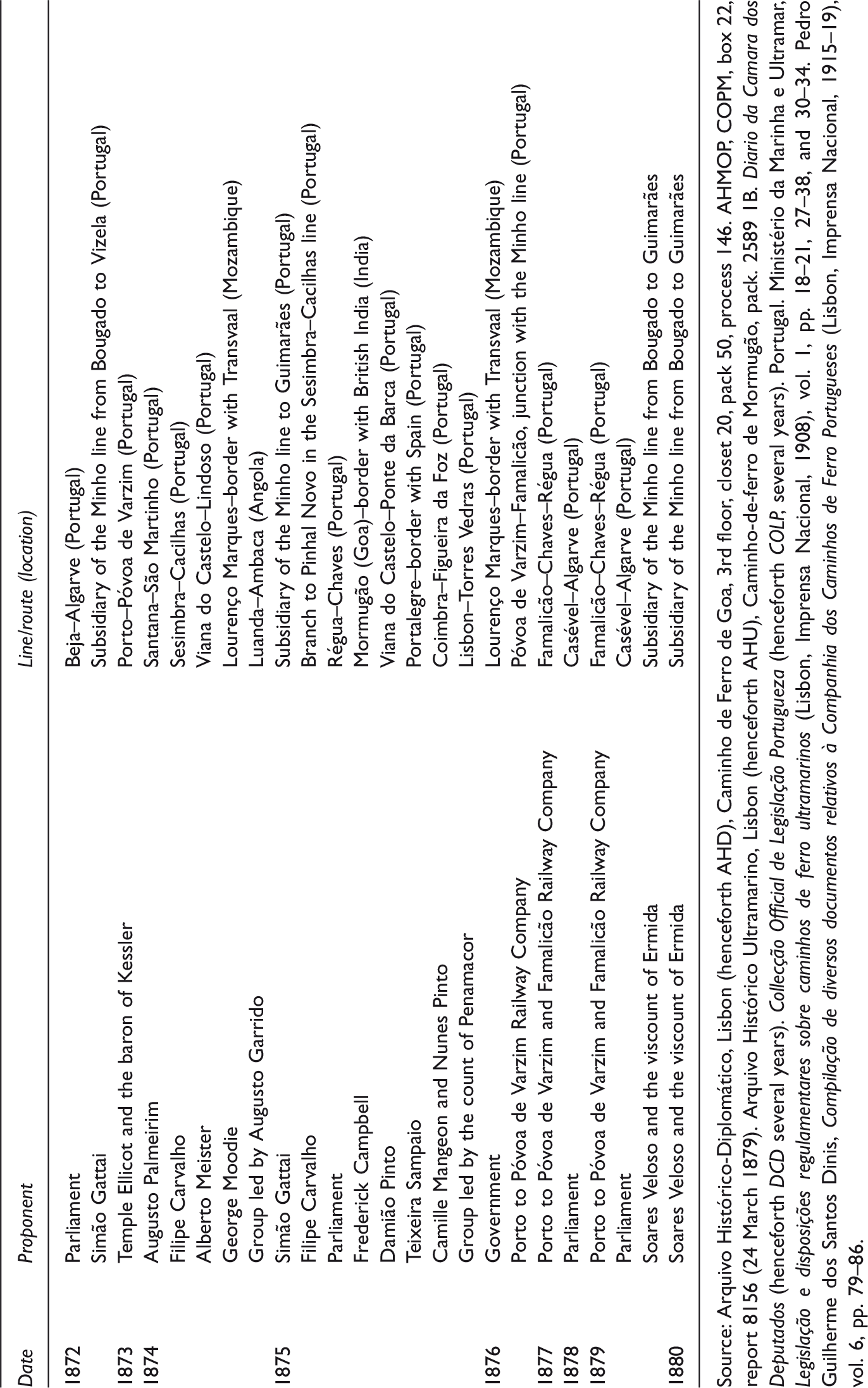
Source: Arquivo Histórico-Diplomático, Lisbon (henceforth AHD), Caminho de Ferro de Goa, 3rd floor, closet 20, pack 50, process 146. AHMOP, COPM, box 22, report 8156 (24 March 1879). Arquivo Histórico Ultramarino, Lisbon (henceforth AHU), Caminho-de-ferro de Mormugão, pack. 2589 1B. Diario da Camara dos Deputados (henceforth DCD several years). Collecção Official de Legislação Portugueza (henceforth COLP, several years). Portugal. Ministério da Marinha e Ultramar, Legislação e disposições regulamentares sobre caminhos de ferro ultramarinos (Lisbon, Imprensa Nacional, 1908), vol. 1, pp. 18–21, 27–38, and 30–34. Pedro Guilherme dos Santos Dinis, Compilação de diversos documentos relativos à Companhia dos Caminhos de Ferro Portugueses (Lisbon, Imprensa Nacional, 1915–19), vol. 6, pp. 79–86.
Most of these offers were accepted by the government, but just one was fulfilled: the 900 mm gauge line between Porto and the small fishing village of Póvoa de Varzim, inaugurated in 1875 (see Figure 1).
37
For the most part, they were mere speculative ventures – the proponents sought to grasp the concession and sell it to the highest bidder, a common practice in the railway business at the time. The 900 mm gauge line between Porto and Póvoa de Varzim was also a major step for the national narrow-gauge system. Even though it was set in a region without significant orographic obstacles, the railways that used British technology supplied by the Fairlie Engine Company
38
became a practical niche that demonstrated the technical and financial feasibility of the new technological system.
39
Narrow-gauge and main broad-gauge lines in the north of Portugal.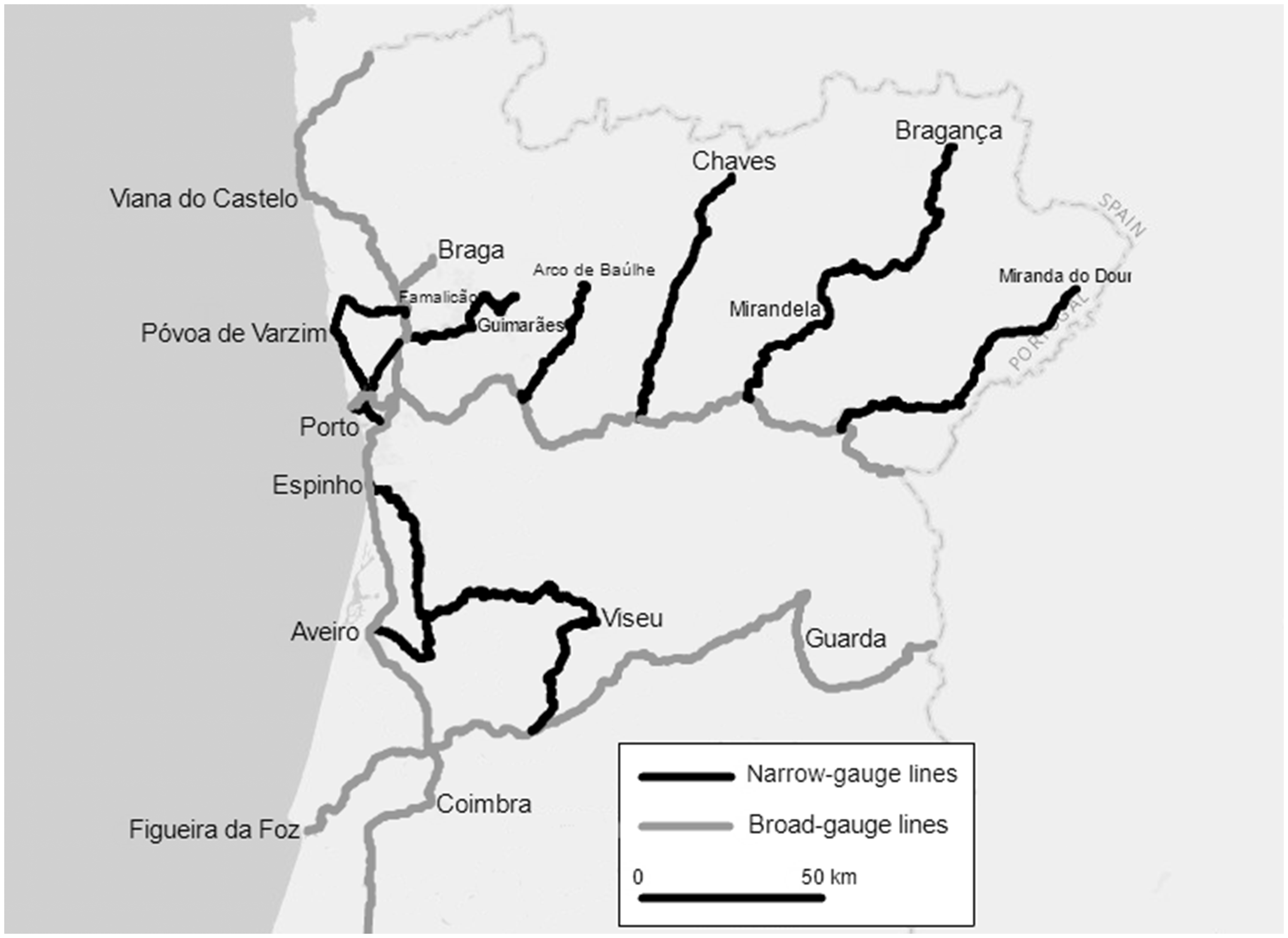
Nevertheless, after this first example, the growth of the narrow-gauge network in Portugal was limited, with only two more lines (extending throughout 60 km) added to the system. The Porto to Póvoa de Varzim railway was extended to Famalicão (inauguration in 1881) and – in 1880 – the government authorised local entrepreneurs, Soares Veloso and the viscount of Ermida, to build a metre-gauge line connecting the town of Guimarães to the Minho line. Operation began in 1884. 40
The financial return of the Póvoa de Varzim line was low (1.6%), 41 which naturally decreased the already low interest of investors in narrow-gauge ventures, even more because it was accompanied by a crisis in the Portuguese banking system. 42 The private capital was indeed left alone in its attempt to develop new narrow-gauge lines, mainly because the Portuguese government hesitated to provide substantial funding.
The absence of financial support from the State contributed to the lack of success of the projects, not only in mainland Portugal but also in the colonies. The case of the proposal presented in 1874 by the group led by Augusto Garrido to build a railway in Angola is paradigmatic: the entrepreneurs tried to raise capital in Belgium and Britain, but without a guarantee of yield from the State, their efforts were fruitless. 43 Nonetheless, this Angolan project was a key step in the implementation of narrow gauge in Portugal. One of its authors, engineer Sárrea Prado, 44 travelled to Angola to survey the territory between Luanda and Ambaca, keeping in mind the suggestions of European railway authorities, such as French engineer Couche (professor of Construction and Railways at the National School of Mines, in Paris), or British expert Charles Easton Spooner (director of the Ffestiniog Railway and North Wales Narrow Gauge Railways companies). In illustrating his study with practical examples from Europe, North America, India, and Australia, engineer Prado concluded that narrow gauge was the simplest and cheapest way to build the 356 km railway between Luanda and Ambaca. The overall cost was only 5700 contos (e.g. 150 million today’s US$) or 16 contos/km (421,000 US$). 45 These were very low figures, when compared with the mainland experience and the 30 contos as lowest cost as envisioned by Portuguese legislature in the 1860s.
In 1875, the national government granted an allowance for the construction of a line in Mozambique between Lourenço Marques and the Transvaal, but the subsidy was too small, 7 contos/km (e.g. 177,000 today’s US$), to attract investors. 46 The only other support was a tax exemption to narrow-gauge companies, but the Portuguese Parliament limited that to the Porto–Famalicão line. 47
The travels of learning of Xavier Cordeiro and Sousa Brandão
Although the scope of the narrow-gauge mania was vanishing in Portugal, nevertheless the authorities’ attention was not reduced. In 1878, the government ordered Xavier Cordeiro to return to France to visit the Paris World Fair and study the state of the art of narrow gauge. 48 Upon his return to Portugal, he published Memoria acerca dos caminhos de ferro de via reduzida (i.e. Essay on narrow-gauge railways), a long techno-economic dissertation about all the aspects regarding construction and operation of narrow-gauge lines, including track bed, stations, engineering works, rolling stock, length and speed of trains, break of gauge, and fares. 49 The work was clearly influenced by other French authors of the time, 50 even though Cordeiro allegedly said he was unable to find reliable bibliography to support his mission. 51 It was also very up to date to the use of narrow gauge in different countries, although Cordeiro seems to ignore the use of the 1067mm gauge which was used in South Africa, and the previous experience and know-how of North American engineers. Cordeiro focused on European experiences, according to European cultural approach of those times. The Memoria is a very rich and detailed piece of engineering theory that deserves a thorough analysis that does not fit in the scope of this paper. For the sake of our argument, it is sufficient to enunciate its main deductions.
According to Cordeiro, narrow gauge (between 900 and 1000 mm) was the best way to save money during construction. By admitting tighter curves (minimum radius 120 m) and inclinations up to 30 mm/m, narrow-gauge lines could easily avoid the most expensive lands and the main geographical obstacles (and thus avoid the construction of expensive engineering works). Cordeiro estimated an average saving of 36% compared with broad-gauge railroads, but in the ending years of the nineteenth century, savings in European metre-gauge tracks peaked at 30–40%. 52 Savings would be even larger if railway components (ballast, sleepers, rails, crossings, signals, telegraph, stations, workshops) were of the simplest type. On the downside, the wear and tear of the infrastructure was faster. The locomotives were slower, but they required more tractive power and consumed more coal. Another unavoidable nuisance was the trans-shipment procedures in the junctions with broad-gauge lines. All of this burdened the fares during operation.
Therefore, there was a trade-off between cheap construction and expensive operation. In theory, narrow gauge was suitable: (1) in lines disconnected or with just one junction with the main network, (2) in very rugged areas, and (3) whenever speed was not a priority or the traffic of goods was expectedly low. The question was to determine whether the savings during construction would not be a higher burden in the long term, causing higher cost in operation and maintenance. At the end of the day, all this cost–benefit analysis was based upon reliable estimates of traffic. In this regard, the British engineer Richard Rapier hit the nail on the head when he wrote: ‘if the expected traffic and the estimated cost of works [that is, construction, operation, and maintenance] will admit a full-sized railway, by all means let the full gauge be adopted’. 53 In the absence of trustworthy data, it was wiser to opt for narrow gauge and in the future re-gauge the line. Quoting Rapier once more, ‘one of the greatest blunders has been making railways with too great a regard for the future, and not sufficient consideration of the immediate present’. 54 Hence, the absolute need to conduct thorough surveys to evaluate accurately the cost of construction and the volume of traffic. 55
Shortly after Cordeiro’s return, the Portuguese government sent abroad one of his peers, Sousa Brandão, to study the mountain railways of Italy and Switzerland, so to gain a good grasp on railways in mountain regions. Brandão, twenty years older than Cordeiro and also a former graduate from the École Nationale des Ponts et Chaussées, was one of the leading railway experts in Portugal. 56 In two short reports, he observed the railways of Saint Gallen–Appenzell and Righi (both metre gauge with inclines between 36 and 250 mm/m, including a rack system), but concluded that no railway in Portugal would require conditions so strict. 57
Building from this experience and from the feedback provided previously by Cordeiro and Prado, Brandão wrote in 1880 a detailed report envisioning an extensive narrow-gauge network in the northeast of Portugal (Trás-os-Montes), one of the poorest and most rugged provinces of the kingdom. The network spread throughout 650 km (half the mileage of the national network at the time), with maximum inclines of 25 mm/m, 200 m curve radii, and a cost of 14000 contos (equivalent to 383 million today’s US$) that should be financed directly by the State. 58
One year later, Pereira Dias, a pupil of Brandão, presented a similar plan to the neighbouring province of Minho. The main goal was to build feeder lines to local harbours and to the Minho line. Unlike Brandão, Dias argued that a private company should be responsible for the enterprise, for an estimated cost of 7600 contos (e.g. 210 million today’s US$). 59 The Junta Consultiva also provided its inputs with a long report of 142 handwritten pages on the use of narrow gauge in the colonies. The Junta was not completely convinced of the advantages of narrow gauge in the colonies, but it admitted that a 900/1100 mm gauge line was sufficient to meet the commercial, economic, and political goals of the investment. 60
Putting words into practice: The Mormugão railway
After Cordeiro’s return to Portugal, in 1879 the government put his expertise to use. Following the 1878 agreement with Britain about the creation of a customs union in India, the Portuguese government had to deal with the construction of a railway linking the harbour of Goa (Mormugão) to the British network. The line traversed the Western Ghats, a forested mountain range at the border of Portuguese India. It was expected that narrow gauge rendered the work financially feasible, 61 and the government sent Cordeiro to Goa to work with the British firm Hawkshaw, Son & Hayter on the survey of the territory. 62
It was an enormous opportunity for Cordeiro to practice what he had preached in his previous work. For almost a year, he surveyed the region, estimating construction costs and operational revenues. Cordeiro provided different techno-economical alternatives for construction (single or double track; different kinds of rails; and, of course, comparing narrow and standard gauge) 63 and he analysed statistical data about population, production, fares, exports, and consumption of Goa and the neighbouring British territories. In his final reports (September/October 1880), he concluded that ‘one does not need to be a prophet to assert that this railway shall become one of the main lines in all India’: he estimated a capital return rate ranging between 3.04 and 4.16% in the first year. Therefore, he did not recommend the use of narrow gauge: Narrow gauge would mean increased maintenance costs, those that would absorb all savings accomplished during construction; moreover, the transport capability would be substantially lower and fares would be overwhelmingly higher. 64 Cordeiro’s option reflected exactly his previous recommendations: he studied the territory and its economic activity in detail and then decided accordingly, considering the saving of the construction stage, but also the long-term maintenance costs.
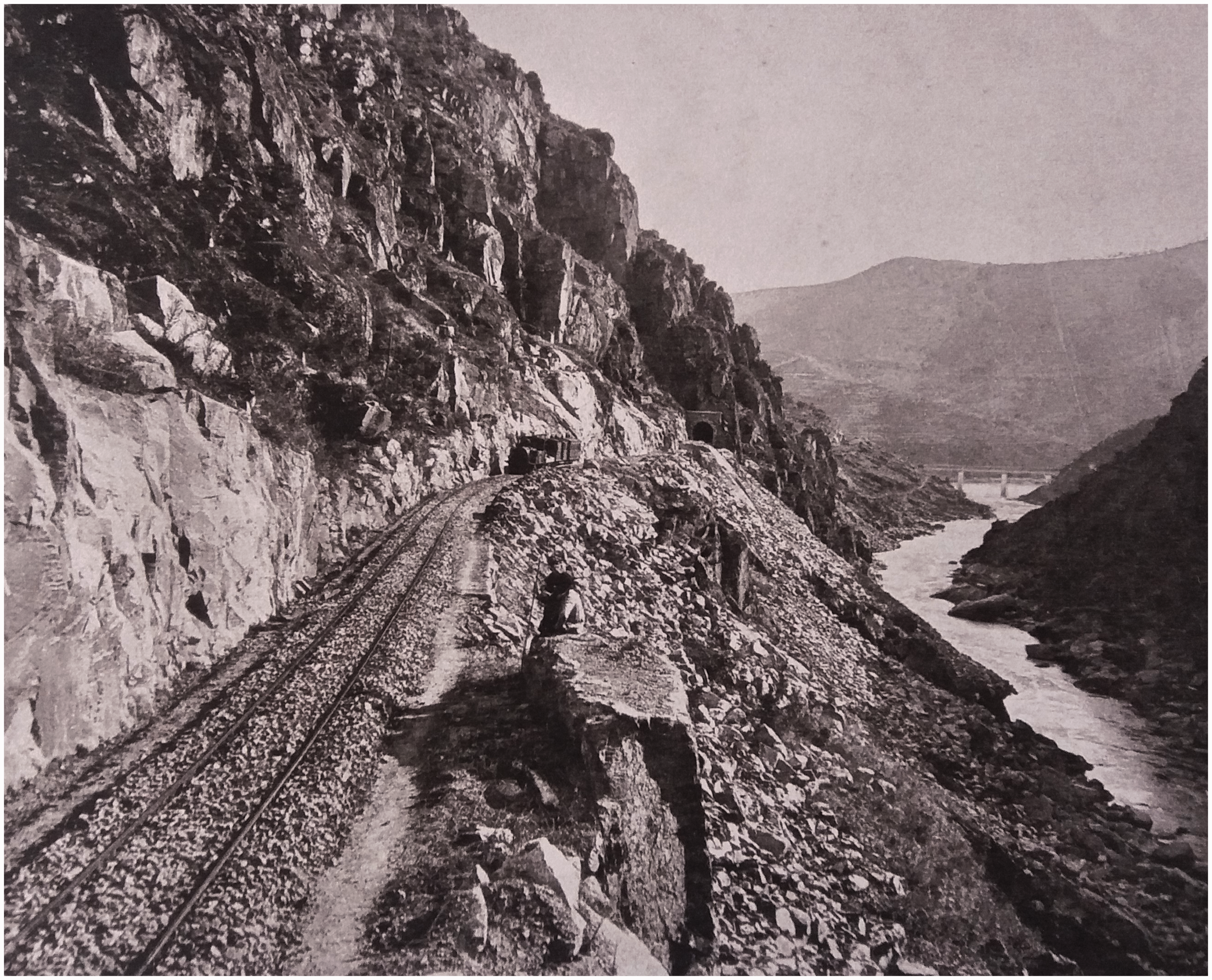
Nevertheless, politics spoke louder. Britain did not accept broad gauge and it imposed metre gauge on the Portuguese enclave. Lisbon accepted the British imposition and in 1881 it offered a guarantee of yield to the British firm, West of India Portuguese Guaranteed Railway Company, to build and operate the line. Cordeiro remained in India as fiscal director. He oversaw works during the following four years until criticism from the Minister of Marine and Overseas led to his resignation. 65 Operation began in 1888 (see Figures 2 and 3). 66
The development of the Portuguese narrow-gauge network
With the Mormugão line, the government realised that only State guarantees would convince private entrepreneurs to invest in narrow gauge. In 1883–84, the parliament indeed approved a bill conceding a guarantee for the construction of a pair of metre-gauge railways in the mainland’s countryside, linking the towns of Mirandela and Viseu, across the valleys of the Tua and Do rivers, to the broad-gauge lines of Douro and Beira Alta, respectively. Both were adjudicated to the Count of Foz, one of the wealthiest men in Portugal, who founded the National Railway Company. The lines were designed by Portuguese engineers and inaugurated in 1887 and 1890 (Figure 4 illustrates the operation of the Tua line to Mirandela). 67
This financial model was also partially applied in Africa. In 1885, the government granted a guarantee of yield to the Companhia do Caminho de Ferro Através de África (Royal Company of Railways Through Africa), hired to build and operate the metre-gauge line from Luanda to Ambaca in Angola.
68
The choice for the metre gauge reflected Cordeiro’s, Brandão’s, and Prado’s suggestions, but also the French colonial experience with metre gauge.
69
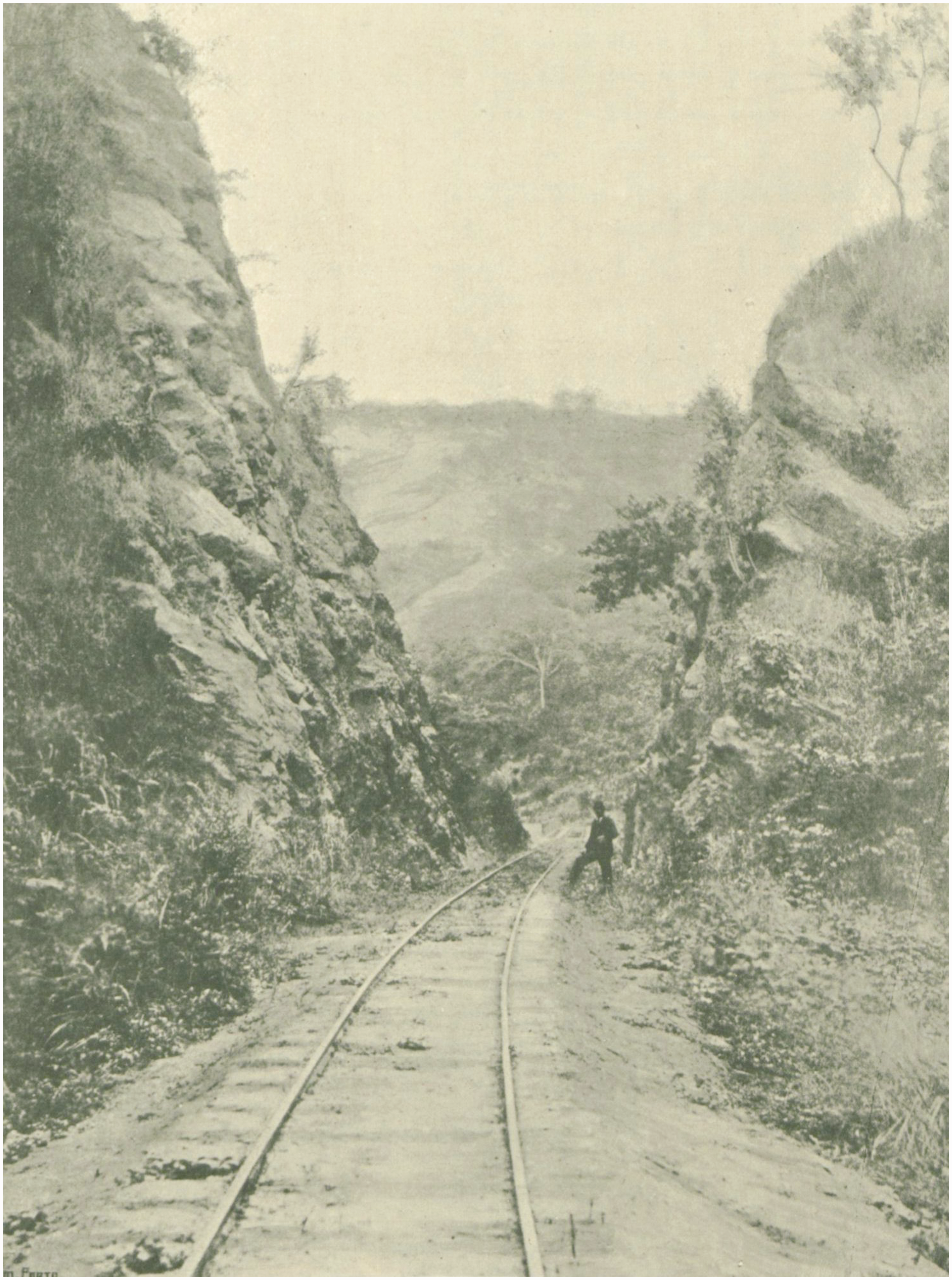
Construction, directed by a team of Portuguese and foreign technicians, extended across fourteen years before arriving in Ambaca, 364 km away from Luanda (Figures 5 and 6).
70
The Mormugão railway. The Mormugão railway in the Dudhsagar Falls on the Western Ghats (1929). Source: L. Bismarck Dias, ‘Resumido relato sôbre os resultados financeiros da exploração do caminho de ferro e pôrto de Mormugão, movimento do pôrto, tráfego de mercadorias, comércio, etc.’, Boletim Geral das Colónias, 5:49 (1929), 250–64, here 257. The Tua line (1887). Narrow-gauge system of Angola. A cutting in the Ambaca railway (late nineteenth century).


In Mozambique, in 1883, the government signed a contract for an ‘African-gauge’ railway (1067 mm) between Lourenço Marques and the Transvaal without any financial support. Given the extreme geopolitical relevance of the line (it connected Transvaal to a non-British port), the entrepreneur, American colonel Edward McMurdo, believed he could sell the line to the South African republic. Construction was directed by foreign engineers and overseen by Portuguese fiscal directors. After some bureaucratic and techno-diplomatic disputes that ended with the nationalisation of the line by the Portuguese government, operation began in 1895 (Figure 7).
71
Narrow-gauge system of Mozambique.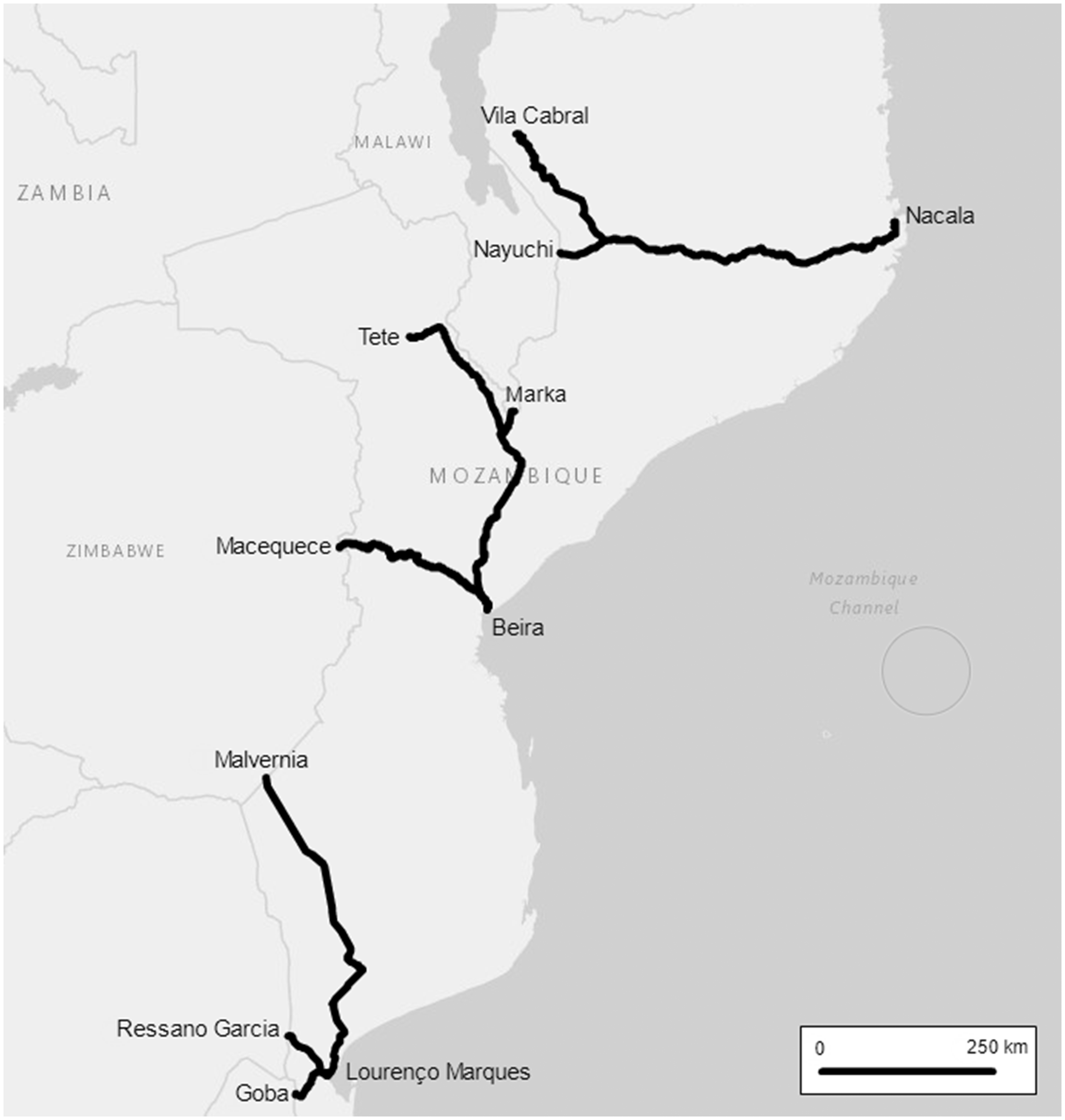
Propositions to build narrow-gauge lines, 1885–92.
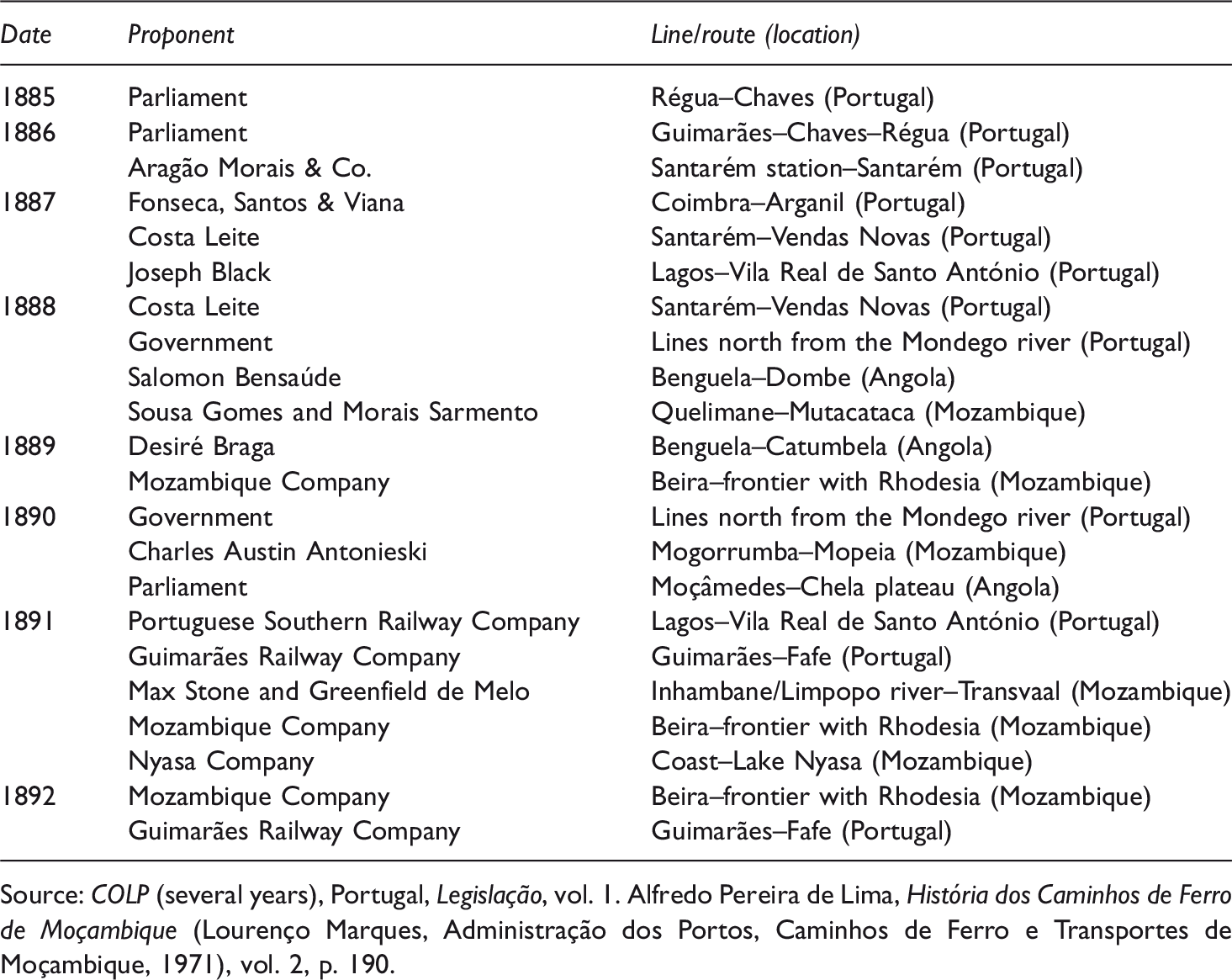
Source: COLP (several years), Portugal, Legislação, vol. 1. Alfredo Pereira de Lima, História dos Caminhos de Ferro de Moçambique (Lourenço Marques, Administração dos Portos, Caminhos de Ferro e Transportes de Moçambique, 1971), vol. 2, p. 190.
In Africa, the government tried a different approach: railway concessions through chartered companies, created to manage large areas of the Portuguese Empire, especially in Mozambique. Just one was built, the Beira railway, hired in very particular techno-diplomatic circumstances (in particular, an imposition of Britain upon Portugal, in the aftermath of the British Ultimatum of 1890). The 600 mm gauge line, set by a British contractor, was so simple and light it was called a toy railway (see Figure 8). In 1899, it was re-gauged for the South African standard (1067 mm). 73
None of the other lines were accomplished. Investors realised that savings promised by narrow-gauge enthusiasts were not as significant as expected. The Mormugão railway cost 37 contos/km (equivalent to 1.1 million today’s US$); Ambaca cost 34 contos/km (939 thousand US$); in the mainland, construction cost superseded the State’s guarantee. 74
The 1892 State bankruptcy prevented the government from giving any financial support to new railways, but it did not impede the submission of new offers, mainly in the colonies (Table 3). However, the period was not auspicious for new investments and, apart from a small industrial line in the harbour of Leixões (Porto) refurbished for passenger service,
75
no new lines were added to the system.
The Beira line traversing the Amatongas Forest (1902). Propositions to build narrow-gauge lines, 1893–1900. Source: COLP (several years). Portugal, Legislação, vol. 1. Lima, História, vol. 2, p. 26, 169.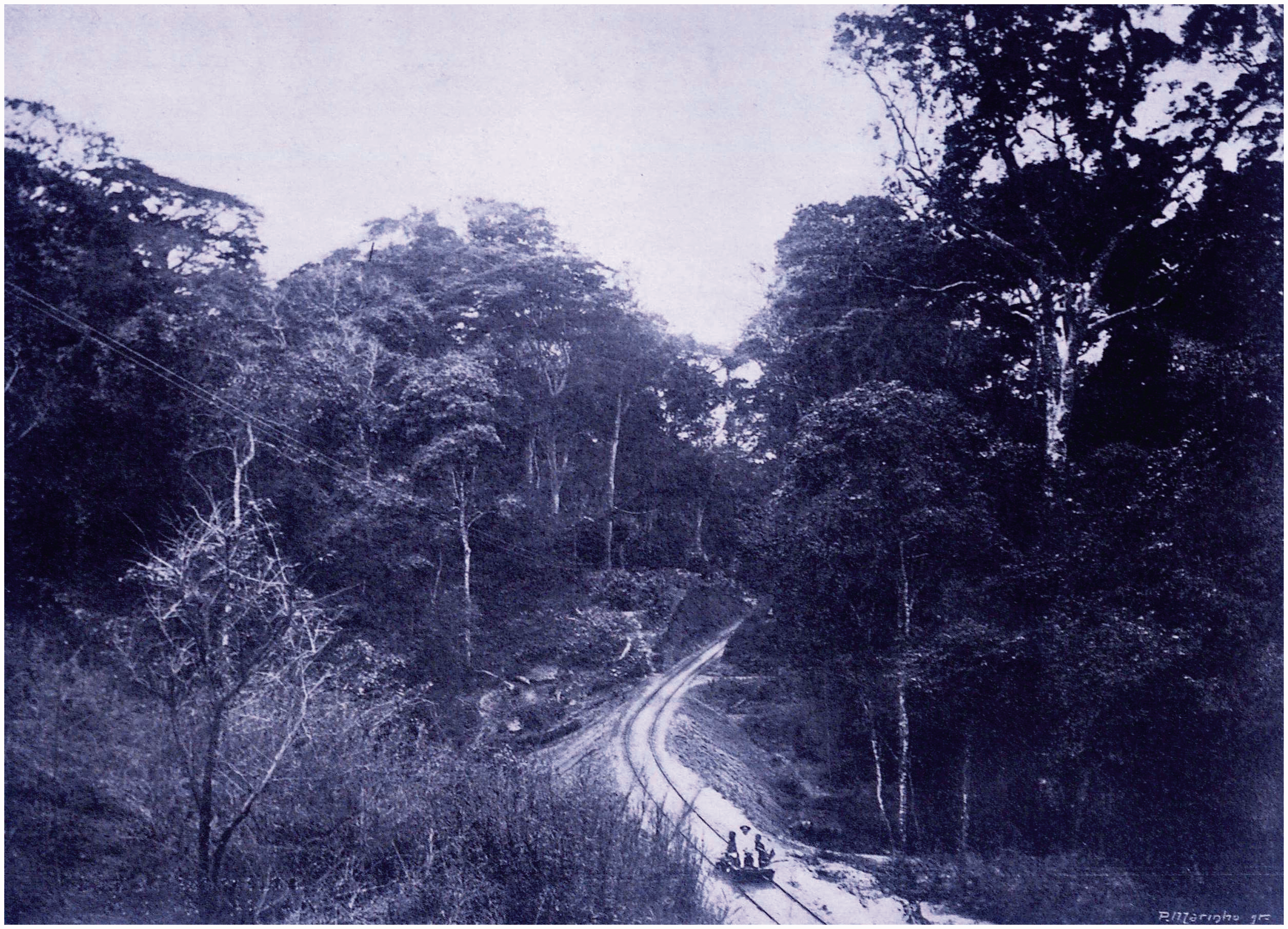

The turn of the century brought a set of decisions that promoted construction of new narrow-gauge lines in the mainland and in the colonies. In 1899, the parliament approved a bill that created a special fund to build new railroads. Between 1900 and 1907, a thorough survey of the land, including inquiries to Portuguese municipalities and technical experts, supported the elaboration of a list of lines that should be added to the system. Metre gauge was given a significant part in this plan. It accounted for 1370 km of new tracks (45% of the overall mileage) with a total cost of 27500 contos (e.g. 742 million of today’s US$) or an average cost of 20 contos/km (539,000 US$). 76
However, the accomplishments fell short of the expectations and were concentrated in the northern areas of Portugal. Between 1903 and 1905, State engineers began construction of three new railroads, tributaries of the Douro railway (Tâmega to Arco de Baúlhe; Corgo to Chaves; and Sabor to Miranda do Douro). In 1903, the government conceded a guarantee of yield to the extension of the railroad from Mirandela to Bragança and in 1907 a similar allowance was given to the Vouga railway (Espinho–Viseu–Aveiro, a project that relied on the technical support of Xavier Cordeiro). The other narrow-gauge companies, Guimarães and Porto to Famalicão, added a few miles to their concessions (without any public subsidy) and the latter re-gauged its system to metre gauge. Construction continued slowly for four decades: the last stretch of track was inaugurated in 1949, when the metre-gauge network extended throughout 762 km (Figure 1). 77
In the African colonies, the Portuguese government never approved a general plan. The system evolved according to circumstances with narrow gauge as a key element. Gauges ranged from 600 to 1067 mm, reflecting a diversity that also existed throughout other colonies. 78 From 1908 to 1969, the lines of Swaziland, Tete, Limpopo, and Nacala were added to the Mozambican rail system (Figure 7). Smaller and less important railroads (Inharrime, Xinavane, Quelimane, Xai-Xai, Marracuene) were also built. Until 1941, Angola built three new lines (Benguela, Moçâmedes, and Porto Amboim) and extended the Ambaca railway to Malange and Alto Dondo (Figure 5). A mix of Portuguese/foreign expertise and State/private initiative was employed in these undertakings: some built entirely with Portuguese engineers and funds (Moçâmedes, Malange, and Swaziland), others set by British technicians hired by private companies (Benguela). 79 Narrow gauge in Africa was also a subject for some innovations that escaped the framework designed by Cordeiro: for instance, the Beira and Moçâmedes lines used a 600 mm gauge (although they were re-gauged to the African standard decades later) with curves with radii less than 120 m and inclines steeper than 30 mm/m.
Conclusion
Narrow gauge in Portugal was essentially a product of transfer of technical knowledge from Central and Northern Europe. The first narrow-gauge railway that marked the start of the implementation of this technology in Portugal relied on British ingenuity developed on the mountains of Northern Wales. Later, the survey conducted by engineer Prado was inspired by many examples from abroad. The travels of learning of Brandão and Cordeiro to Italy, Switzerland, and France allowed them to witness first-hand those countries narrow-gauge systems, after which they brought that knowledge to Portugal.
Cordeiro’s role was particularly relevant in this process. His Memoria constituted the theoretical background for building railways in rugged territories that became widely available for other Portuguese engineers to read (in the Revista de Obras Publicas) and to learn from (in the Engineering programme of Lisbon’s Army School). Moreover, his practice in the survey and construction of the Mormugão railway illustrated his theoretical work. The Memoria’s technical recommendations were later followed by some of Cordeiro’s colleagues in their practical studies and surveys on new lines. In this sense, Brandão’s work also became decisive for the future development of the narrow-gauge network. He suggested a vast system for the province of Trás-os-Montes, but only the main lines (in the valleys of the Tâmega, Tua, Corgo, and Sabor rivers) were in fact built.
With the feedback provided by its engineers, the Portuguese State realised that narrow gauge could be a feasible solution to extend the network to the nation’s peripheries (in the continent and in the colonies) and it decided to invest more decisively in this technology, by granting in a first stage several guarantees of yield to investors. Under this financial umbrella, the network both grew in the mainland and it was extended overseas. In the case of the latter the implementation of narrow gauge was conducted mainly by foreign experts, but who worked closely with Portuguese fiscal directors (who oversaw their work). Therefore, the transfer of knowledge also occurred at this level in a more practical rather than theoretical fashion. Additionally, when the interest of private enterprise in narrow gauge wilted, the State intervened directly in the process of extending the narrow-gauge network both in the mainland (Tâmega, Corgo, and Sabor) and the colonies (Swaziland, Malange, and Moçâmedes), relying on the expertise and knowledge of Portuguese engineers.
The process of knowledge transfer of narrow-gauge railways can thus be considered the result of a peer-to-peer process across borders. Portuguese engineers learned directly from their foreign comrades either in travels of learning or in an actual construction context. Later, the former ensured that technical knowledge became available to a broader group, using the journal of the Engineers Association or the State’s National Press (that published Cordeiro’s essay as a book). The State promoted these contacts either by subsidising those travels or by surveying the works of foreign contractors.
The development of narrow gauge in the mainland and in the colonies had one common denominator. Its alleged cost-effectiveness was the answer to the dilemma faced by decision-makers to provide better transport systems (and to bring the progress embodied in steam locomotives) to areas where traffic flow and density of traffic were expectedly low. By bringing down construction costs, narrow gauge could make the operation cost effective and the overall investment feasible.
Besides this common ground, narrow gauge followed two distinct paths in the mainland and in the colonies. In the former, the lines never took the role of feeders of the broad-gauge network, as they were too concentrated in the northern areas of the country (only the Douro and Minho railways benefited substantially from their traffic), although they were important for the mobility of the peripheries (especially the north-eastern province of Trás-os-Montes) and in the traffic around Porto. 80 This outcome was similar to what occurred in Spain, where narrow gauge never truly complemented the broad-gauge network, 81 but it contrasted with other European countries, where narrow-gauge networks were relatively successful and extended throughout over 40,000 km (on the eve of First World War). In France, the narrow-gauge network was 10,000 km long (and accounted for 25% of the entire grid); in Belgium, in 1930, almost 50% of the network was narrow gauge (4800 km). Other nations also had extensive grids (Austria-Hungary: 2500 km; Italy: 1600 km; Germany: 9500 km; Sweden: 3300 km; Switzerland: 1400 km; Greece: 1000 km). 82
On the other hand, in the Portuguese African colonies, narrow gauge was crucial for the provision of rail lines from the Angolan and Mozambican hinterlands to the harbours in the coast, and its overwhelming presence in the system redefined it. Whereas in Europe, metre-gauge tracks were considered of secondary importance and destined to serve peripheral areas of the countryside, in the Portuguese colonies, 1067 mm gauge or metre-gauge roads were considered the standard as they met the goal of facilitating the transport of goods from the interior to the coast83.
In any case, narrow gauge was a crucial technology that drew the (ultra-)peripheries of Portugal closer to its centre, even if the promised savings during construction were not as substantial as expected. Narrow gauge promoted mobility and the transport of goods and passengers to those peripheral regions and, more importantly, it carried progress and the idea of modernity to previously godforsaken areas of the mainland and the Empire.
Footnotes
Acknowledgements
The authors would like to thank Massimo Moraglio and Anne McCants for their comments, suggestions, and the English revision of the text. The authors also wish to acknowledge the institutional and academic support provided by CIUHCT – Interuniversity Center for the History of Science and Technology and the Institute of Railway Studies.
Declaration of conflicting interests
The author(s) declared no potential conflicts of interest with respect to the research, authorship, and/or publication of this article.
Funding
The author(s) disclosed receipt of the following financial support for the research, authorship, and/or publication of this article: This research was funded by the Foundation for Science and Technology, Portugal (doctoral fellowships SFRH/BD/46011/2008 and SFRH/BD/68283/2010, and post-doctoral fellowship SFRH/BPD/95212/2013), through CIUHCT (UID/HIS/00286) and CITCEM (UID/HIS/04059).