



Abstract
This article examines how the national carrier Iran Air projected competing visions of modern Iran to domestic and international audiences from the late 1960s through the late 1970s. Drawing on advertising materials from English- and Persian-language periodicals, tourism publications and archival correspondence, it analyses how the airline mediated between different audiences through bilingual messaging, mythological symbolism and representations of hospitality and material culture. By the mid-1970s, Iran Air was widely described as one of the world's fastest-growing airlines. Campaigns for international audiences foregrounded geographic connectivity, tourism and developmental modernisation, while those targeting Persian-speaking audiences more frequently invoked literary idioms, mythological references and national symbolism. The article further traces a shift in the late 1970s, when Iran Air's advertising moved away from themes of cultural prestige and dynastic grandeur towards developmental statistics and economic achievement, reflecting mounting pressures on the monarchy's image of modern Iran during the Pahlavi era's final years.
Keywords
Introduction
A jet cuts across the corner of the image, half outside the frame. Below, a man leads two horses carrying a veiled woman in a covered litter. Beneath them, the caption reads: “The OLD and the NEW – a reminder of the bygone days and a symbol of Iran today”. 1 Issued by Iran Air in 1972, the advertisement turned the contrast between past and present into a national allegory. The aircraft, partly unseen, suggests that modernity has already taken flight, leaving the traditional scene below suspended in its wake (Figure 1). Few images captured the ambitions of late Pahlavi Iran more succinctly: a country intent on moving forward, even as its representations of progress remained tethered to the very past, they sought to transcend.
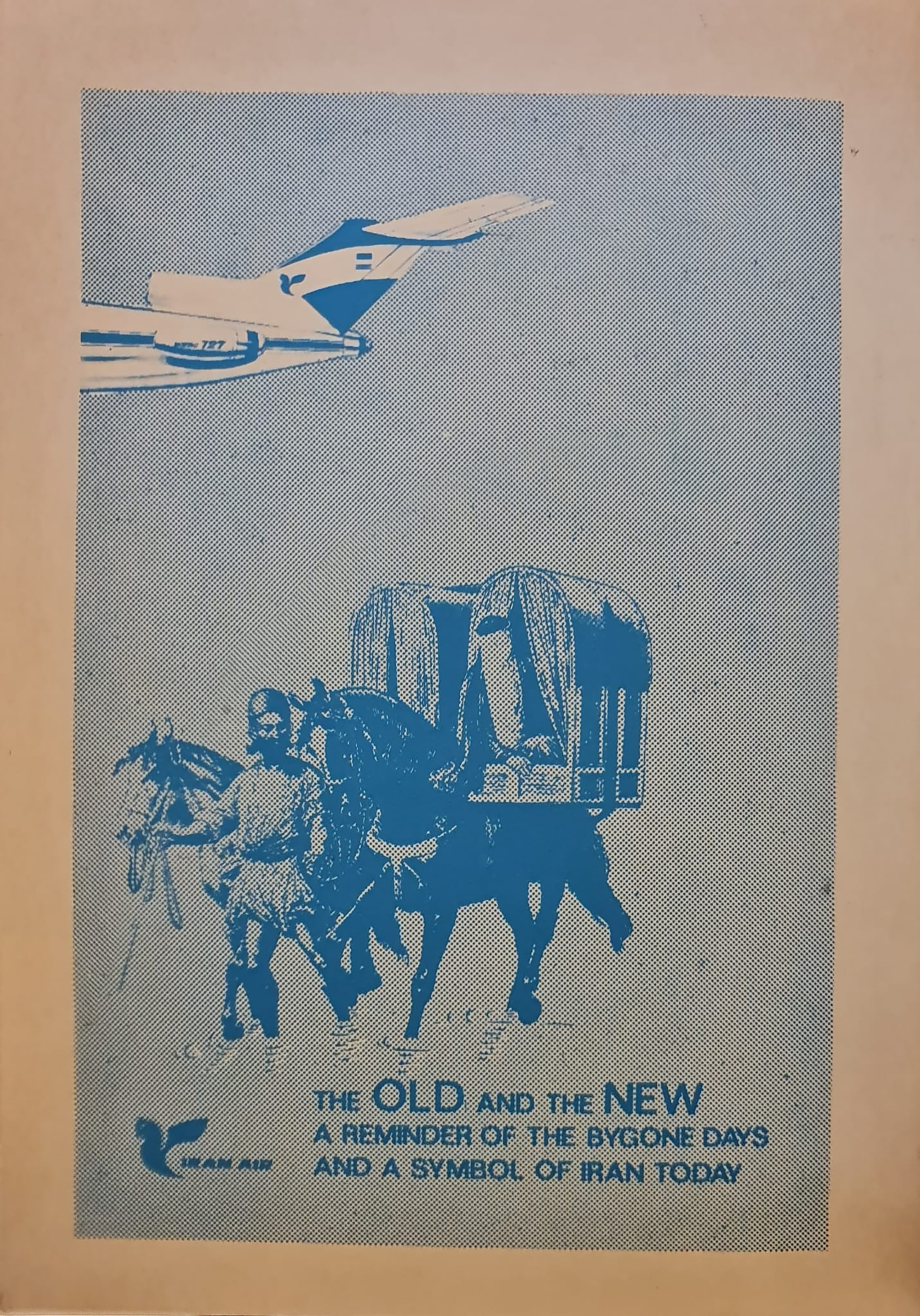
“The Old and the New”, Iran Air advertisement (1972).
This article examines Iran Air's advertising campaigns during the late Pahlavi period, drawing its title, “The Fantasy That Was Persia”, from a 1975 advertisement published in The New York Times. 2 It argues that the airline became a key site through which competing images of Iranian modernity were articulated, combining aviation technology, imperial heritage, tourism and national identity in distinct ways for domestic and international audiences.
The corpus examined here spans the period between the 1967 coronation of Mohammad Reza Shah, which marked a shift in the monarchy's symbolic self-presentation, and the 1979 Revolution, which brought an abrupt end to the Pahlavi regime and its image-making apparatus. This time frame coincided with Iran Air's entry into the jet age, following the introduction of Boeing aircraft in the mid-1960s and rapid expansion into international routes. These campaigns emerged within the broader context of late Pahlavi developmentalism, fuelled by rising oil revenues and large-scale investment in transport infrastructure, industrial development, urban expansion and military build-up. The state also pursued welfare reforms and limited forms of social liberalisation through the White Revolution (enqelab-e sefid), the Shah's state-led programme of socio-economic transformation officially launched in 1963. 3
Throughout this period, the airline drew on a range of images and symbols to position Iran as both technologically modern and historically distinguished. One of the earliest ways it did so was by associating itself with royal ceremonies and state occasions thereby establishing prestige through connections to the monarchy. By the late 1960s, advertisements expanded from modest black-and-white columns into full-page colour layouts with wider international circulation. From 1975 onwards, campaigns increasingly foregrounded Iran's developmental achievements alongside the airline's services, turning national progress itself into part of the travel experience.
These connections were carried across multiple media and registers, linking technological development with images of national identity and historical continuity. Local aviation managers considered Iran Air a “top-tier” international airline and “a great source of national pride” that reflected Iran's growing international profile. 4
Research in mobility and transport history has shown that movement involves not only the circulation of people and goods but also the movement of images, ideas and cultural meanings. Mimi Sheller and John Urry's “new mobilities paradigm” emphasised how infrastructures and communications together organise social life by moving representations as well as bodies. 5 In the Iranian context, Mikiya Koyagi's Iran in Motion demonstrated how transport infrastructures helped reshape ideas of geography and nationhood in the twentieth century. 6 This article extends that discussion into the era of commercial aviation.
Like other national carriers in the Middle East and Asia, Iran Air operated at the intersection of modernisation, tourism, international diplomacy and commercial aviation. Its campaigns participated in broader regional efforts to link air travel with historical heritage and national identity, while drawing heavily on imperial continuity and dynastic imagery under the late Pahlavi monarchy.
Branding modernity: Civil aviation and state power
Throughout the 1960s and 1970s, Iran experienced rapid economic growth, sweeping modernisation projects and expanding international visibility alongside increasing political repression. The monarchy invested heavily in infrastructure, industry and military capacity while maintaining strict control over public discourse through censorship, the secret police, and, from 1975 onwards, a single-party political system. Iran's alliance with the United States positioned it as a regional counterweight to the Soviet Union and reinforced the state's broader emphasis on modernisation, technological development and international connectivity. 7 These developments also increased the importance of public imagery and international publicity.
Civil aviation became central to these projects. 8 Although commercial air travel had begun in Iran in the 1940s, Iran Air was officially chartered on 24 February 1962 through the state-backed merger and consolidation of Iranian Airways (established in 1944) and Persian Air Services (1954). The creation of a unified national carrier reflected wider efforts to centralise and expand transport infrastructure during a period of rapid economic growth and internationalisation. Known domestically as HOMA, the Persian acronym for the National Airline of Iran (Havapeymai-ye Melli-ye Iran), Iran Air initially operated regional passenger and freight services using Vickers Viscounts and Douglas aircraft. 9
The introduction of Boeing 707 in 1965 and 727 three years later ushered Iran into the jet age and initiated a sustained period of fleet and route expansion. By the end of the decade, the airline linked Tehran to major European and Middle Eastern cities. 10 Its network radiated from Tehran to provincial centres including Mashhad, Shiraz, Isfahan, Tabriz and Abadan (Figure 2). By its fifteenth anniversary, it had carried 7.39 million domestic passengers and 2.44 million international passengers, reflecting both the geographic integration of Iran's dispersed territory and the mobility demands of the foreign workforce concentrated in oil industry centres. 11
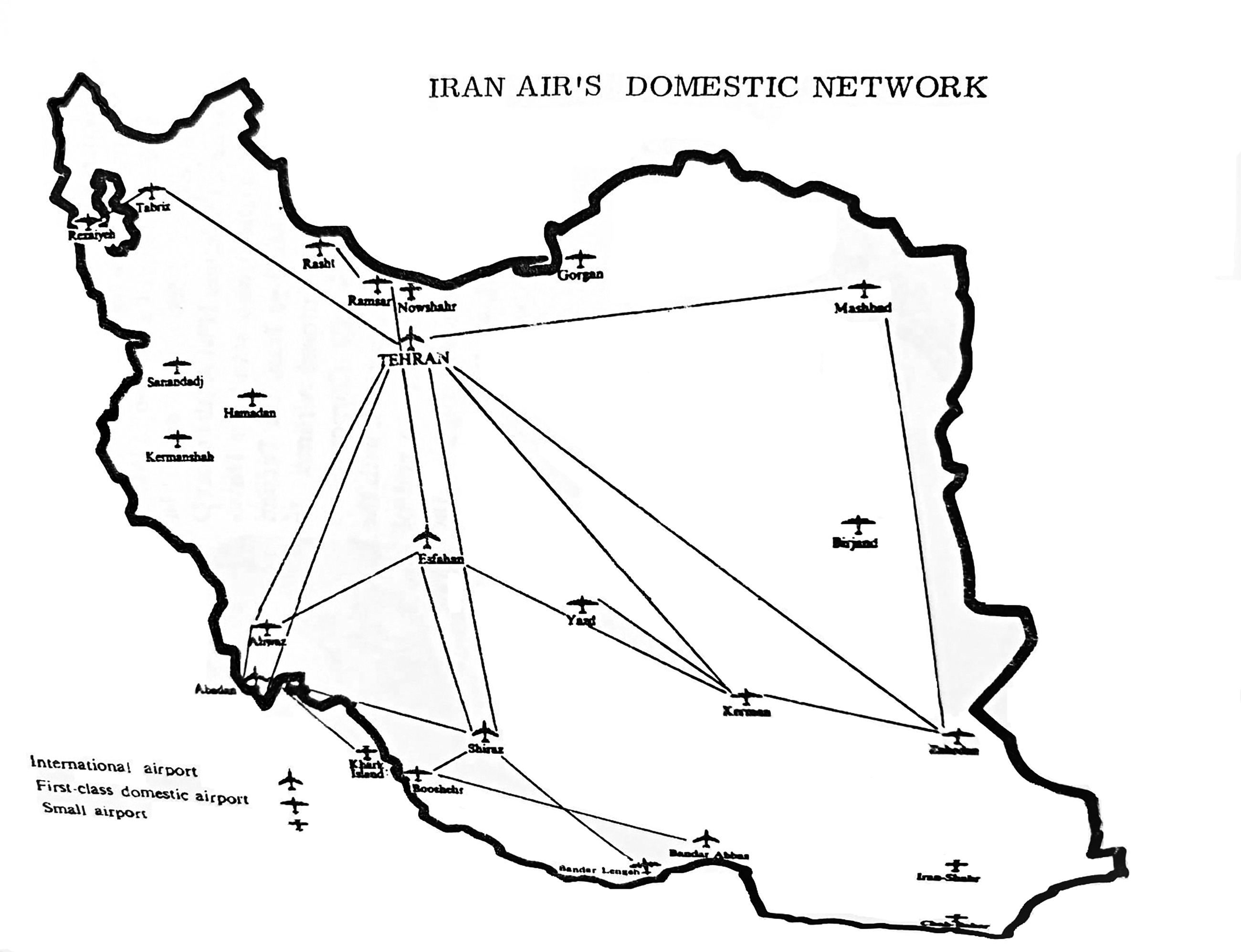
Tehran as hub with connections to major provincial cities (1970).
Under the leadership of Lieutenant General Ali Mohammad Khademi, who led Iran Air for 17 years, the airline initially pursued a restrained, reliability-focused mission. Widely credited with professionalising Iran's civil aviation sector, Khademi prioritised technical competence over spectacle. “We have no desire to show the flag and cross oceans”, he declared in 1963. A year later, he reaffirmed this approach, insisting on “a solid basis of passengers’ security and a reputation for reliability, not with new paint and flashy advertising”. 12
For much of its first seven years, Iran Air functioned primarily as a domestic utility, with limited international presence. The shift towards international expansion soon became visible in operational priorities. In 1967, Iran Air carried 32,000 pilgrims to Mecca, but Hajj operations declined to fewer than 9,000 annually by 1970. 13 The reduction was indicative of a strategic reorientation: as the airline invested in jet aircraft optimised for long-haul scheduled service, it moved away from seasonal charter operations towards year-round international routes. This shift also reflected a growing emphasis on commercial viability. Despite being wholly government-owned, the airline prided itself on its financial self-sufficiency, insisting that its expansion came “from within the airline itself, not from treasury handouts”. The pursuit of commercially viable long-haul routes was presented as both economically necessary and closely tied to Iran Air's international ambitions. 14
In terms of institutional recognition, Iran Air's growing international stature was formally acknowledged through its membership in the International Air Transport Association (IATA) in 1964. The airline's managing director, Khademi, was elected IATA president for the 1970–1971 term, while Tehran was selected to host the association's annual congress the following year. 15
Iran Air's international expansion was shaped by commercial considerations as well as by the geopolitical context of the Cold War. During its formative years, Pan American World Airways provided technical support and administrative assistance, a partnership that reflected broader US engagement with Iranian modernisation. 16 As Iran Air entered transcontinental markets, it confronted competition from regional and more established Western carriers. Early campaigns acknowledged this disadvantage explicitly: “We may not be big, but we try to be good”, one advertisement declared, positioning the airline as an “out-of-the-rut” carrier offering superior comfort and efficiency. 17 To persuade passengers to switch from competitors, advertisements offered practical reassurances: “precision and smoother flight under U.S.-trained pilots on the flight deck”, alongside aircraft quality and safety standards. Pilots were depicted as “artists of the serene take-off and the feather-light touchdown”, framing technical competence through aesthetic language. 18 While Iran Air's advertising frequently presented the pilot as a calm and authoritative figure associated with technological expertise and modern air travel, memoir accounts point to a more complex reality behind this image. Recalling the first time lightning struck his aircraft, during a flight over the Zagros mountains, the Iran Air pilot Amir Kasravi wrote: “Never in my life had I been so intensely afraid, although fear during flights was no stranger to me”. On later flights, having come to know from experience how the aircraft withstood such strikes, he no longer felt that fear – a terror, he reflected, that had fed on his own inexperience. 19
In its thirteenth year of operation, Khademi reported that for the first time all department heads were Iranian, including a female head of management services, though the airline still employed foreign staff from 24 countries. 20 The combination of expanding national expertise and continued international collaboration reflected Iran Air's broader effort to position itself within global aviation standards while maintaining a distinct national profile. Advertising campaigns reinforced this balance through claims of personalised service, technical reliability and cultural distinction. The strategy proved commercially successful: by the fiscal year of 1974–75, the airline reported net profits of $22.4 million, while international passenger traffic had grown 28-fold since 1965. 21
As the airline secured its reputation for reliability, its campaigns moved away from Khademi's early focus on quiet competence towards full-page colour layouts with higher frequency and global circulation. The change was evident in the airline's evolving slogans. Early campaigns stressed modesty and service quality, presenting distinction through reliability rather than scale. By 1977, the language had become more outwardly ambitious. A US-oriented campaign announcing “America, we're growing your way” launched on 35 American radio stations, signalled Iran Air's intensified pursuit of the American market. 22
Iran Air's international advertisements were created in collaboration with Western agencies, including US-based firms Gaynor & Ducas Inc., Carl Byoir & Associates and Ruder & Finn. Placed in outlets such as Newsweek, Time and The Economist, these campaigns targeted English-speaking professional audiences and presented Iran Air as a modern, competitive carrier. The same campaigns were later translated or adapted for Persian-language publications, where slogans and textual emphasis shifted according to audience and context. Correspondence from Ziba-McCann Erickson in 1977 discussed the coordination of German, French, English and Persian-language versions, including adjustments to layout, illustration order and bilingual formatting across editions. 23
Iran Air's advertising evolved within an increasingly competitive regional aviation environment already shaped by carriers such as Iraqi Airways (1945), Saudi Arabian Airlines (1946) and Pakistan International Airlines (1955). This competitive landscape heightened the importance of distinguishing Iran's national carrier through a combination of technological investment, international connectivity and cultural branding. Iran's geographic position between Europe and Asia was increasingly presented as a commercial and strategic advantage. Tehran appeared in advertising campaigns as a cosmopolitan hub, while Iran Air promoted the country through images of heritage, prestige and international mobility. 24
Taken together, these developments recast Iran Air's advertising through a combination of international aviation aesthetics, national imagery and narratives of modernisation. The airline drew on globally circulating design styles while presenting Iran as a nation that was at once technologically advanced, internationally connected and rooted in antiquity. At the same time, the campaigns reflected tensions between commercial ambition, national identity and the monarchy's evolving self-image.
Similar efforts to link commercial aviation with modernisation and national identity appeared across Asia and the Middle East during the Cold War era. Pakistan International Airlines, for example, became closely associated with state-building under Ayub Khan, while carriers such as Singapore Airlines and Malaysia Airlines projected developmental confidence through internationally branded service cultures. 25
Dynastic visuality and civilisational continuity
Iran Air's visual branding drew heavily on imperial imagery and mythological references associated with ancient Persia. Through these motifs, the airline linked modern aviation with narratives of historical continuity and national heritage. Central to this visual identity was the airline's logo: the homa bird. The logo, selected through a 1961 competition and designed by Iranian–Armenian architect Edward Zohrabian, drew from a griffin statue perched atop the columns of Persepolis, the ancient ceremonial capital of the Achaemenid Empire (sixth to fourth centuries BCE). The homa was rendered as a stylised winged creature, combining an eagle's head, a cow's ears and a horse's mane. 26 This streamlined mark made it easy to mobilise mythic associations in subsequent campaigns.
In Persian mythology, the homa is a celestial creature that is perpetually in the sky and never lands because it has no legs, bringing fortune to those who glimpse its shadow. Iran Air's branding activated this symbolism to frame the airline as more than a modern carrier. One campaign declared, “homa stands for all the best things about flying”, and further credited the bird with inspiring Cyrus the Great to found the Persian Empire. 27
One of the most elaborate uses of the Homa motif appeared in a 1975 advertisement that linked aviation technology with imagery of reproduction and continuity. Bold cyan-blue eggs labelled “BOEING 747SP” dominated the lower page, while the stylised head of the homa bird hovered above them like a guardian figure (Figure 3). The headline declared: “The ‘Homa's’ new babies are Jumbos”. 28 Rather than underlining technical specifications, the advertisement presented the arrival of new Boeing aircraft as a natural extension of the existing “Homa fleet”. Through maternal imagery and visual references to birth and lineage, the campaign framed technological expansion as organic continuity rather than abrupt change.
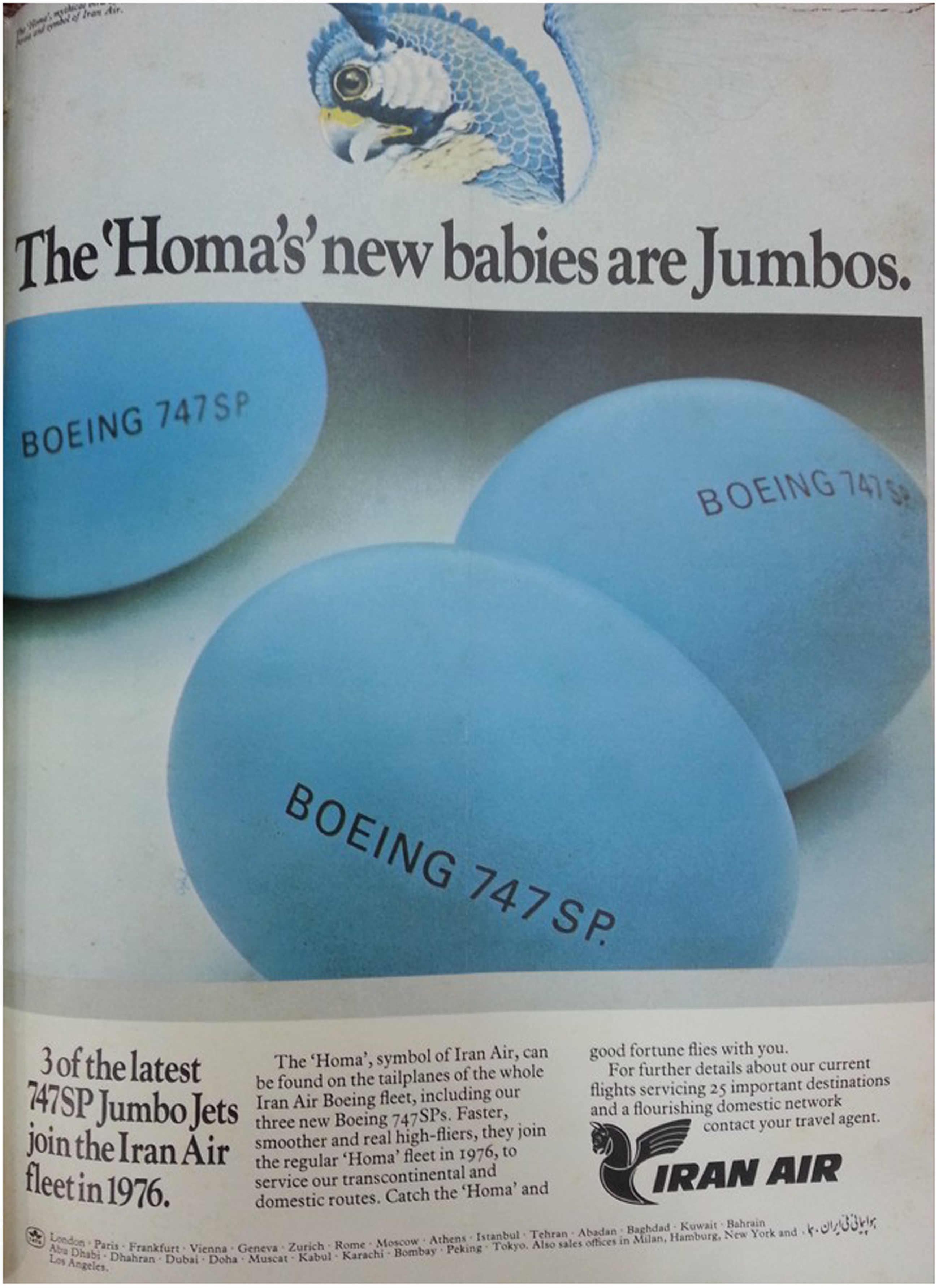
“The ‘Homa's’ new babies are jumbos”, Iran Air advertisement (1975).
Another striking example in Iran Air's visual repertoire appeared in an advertisement depicting a flock of stylised birds forming the shape of an aircraft in flight, an allusion to The Conference of the Birds (Mantiq al-Tayr), the twelfth-century Sufi poem by Farid al-Din ‘Attar (Figure 4). The airline's logo, the mythical homa bird, appears at the base, leading the formation towards a stylised globe rendered as a clock face. The image linked collective motion to spiritual ascent, recasting the medieval allegory of the birds’ journey in the idiom of modern aviation. In Iran Air's version, mystical transcendence was translated into technological progress: flight became both a literal and symbolic achievement, fusing national mythology with the temporality and precision of the jet age. 29
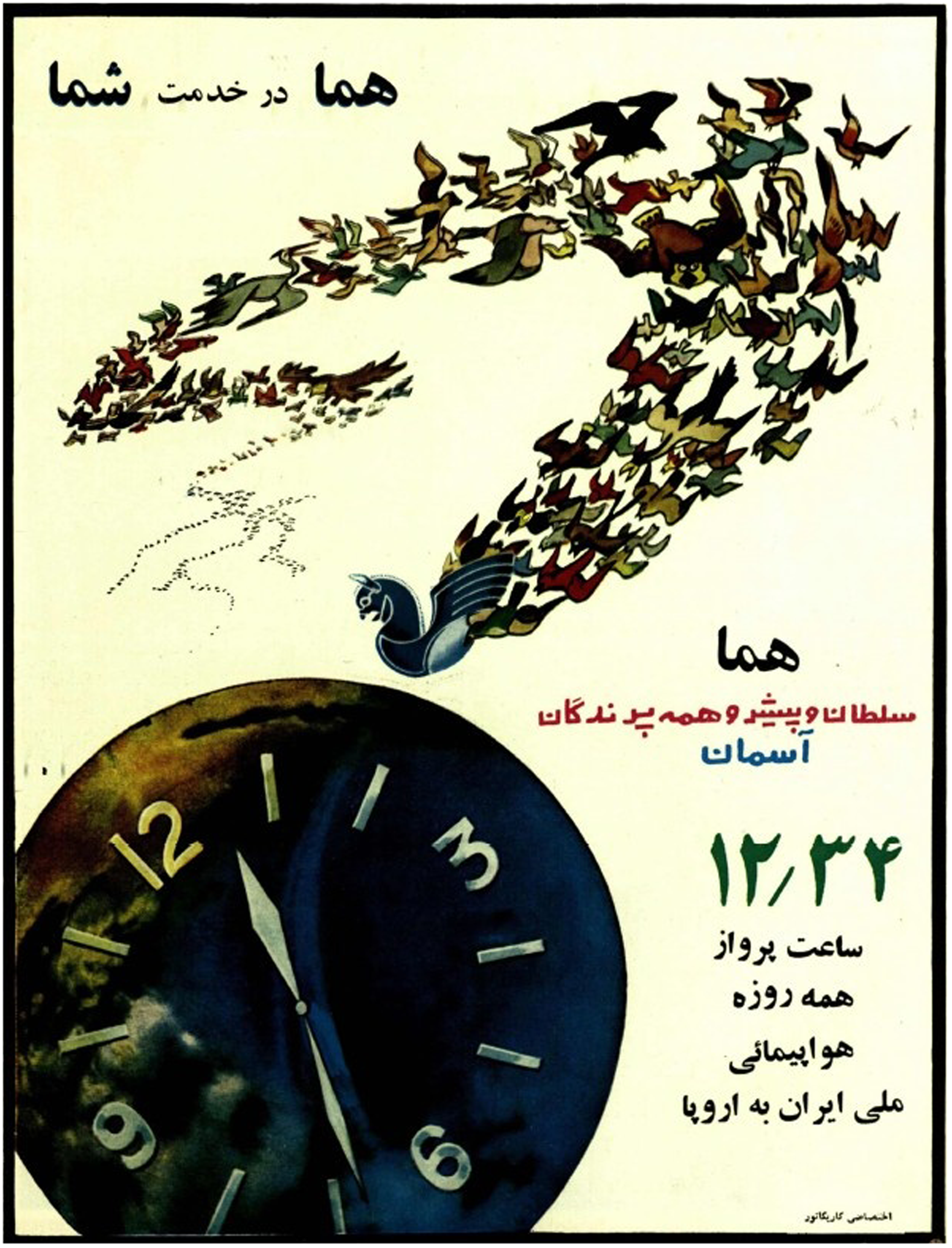
“Homa at your service”, Iran Air advertisement (1969).
Yet the political charge of this symbolism was already evident in earlier campaigns, where Iran Air participated in state-sponsored rituals that linked aviation to dynastic authority and imperial revival. This fusion of mythic heritage with technological display extended across Iran Air's promotional efforts, particularly in moments of orchestrated national ceremony. The airline became closely integrated into the ceremonial and visual culture of the Pahlavi monarchy, linking commercial aviation with imperial ceremony and royal spectacle. In 1967, Iran Air advertisements marked the coronation of Mohammad Reza Shah, noting that “a great number of visitors coming from Europe to the coronation of H.I.M. the Shahanshah [King of Kings] travel by Iran Air”. One such advertisement featured a photograph of the imperial throne, visually associating the airline with royal ceremony and imperial authority. 30
In 1971, Iran Air was named the official carrier for the 2,500th Anniversary Celebrations of the founding of the Persian Empire, transporting dignitaries and delegations to Persepolis. 31 Staged as a global spectacle of imperial revivalism, the event became a focal point of the regime's international image campaign. 32 This participation reinforced Iran Air's association with imperial ceremony and national prestige, visible across brochures, in-flight magazines, route maps and advertising spreads that projected continuity, style and reach. A full-page advertisement in Newsweek invited travellers to witness “the incredible scenery of one of the world's oldest civilizations”, presenting Iran Air as both a transport provider and a gateway to Persian antiquity. 33
In 1976, the regime introduced a calendar reform that redefined national chronology in imperial terms. By replacing the conventional calendar with one dated from Cyrus the Great's assumed coronation (559 BCE), the year abruptly shifted from Hijri 1355/Gregorian 1976 to 2535. This transformation was celebrated in an Iran Air advertisement showing a Boeing 747 ascending through blazing skies under the headline, “It's 2535 – the new Iranian calendar year!” 34 The visual metaphor was clear: as the aircraft climbed skyward, Iran would leap forward in time by reclaiming its ancient origins. This fusion of antiquity and futurity mirrored the airline's broader visual logic, presenting modernity as the culmination of imperial time. Yet, as with the regime's symbolic order itself, the uniformity proved fragile. The reform, however, met widespread resistance, particularly from the clergy, and was soon abandoned.
Complementing these temporal claims were spatial assertions about Iran's place within global networks. Advertisements highlighted Tehran's geographic position, with one assuring business travellers that stopovers “make sound business sense” and another proclaiming that “wherever you want to go, you can start with Homa”. 35 In these campaigns, Tehran appeared as a crossroads between East and West and as a strategic hub within international air routes. Together, these advertisements linked imperial chronology with geographic centrality, presenting modern aviation as continuous with older narratives of Iran's historical significance.
Bilingual advertising and rhetorical adaptation
In a context where national identity had to be communicated across both domestic and international audiences, bilingual advertising posed a challenge for maintaining a unified image. Iran Air, therefore, had to craft campaigns that addressed publics shaped by distinct cultural and linguistic expectations without compromising visual consistency. Layouts, images and emblems such as the homa bird, architectural backdrops and route maps were held constant, while captions and slogans were adapted to different registers. The following cases show how the same visual designs carried divergent meanings in Persian and English, revealing how variation was managed within a shared symbolic system.
One such campaign, published in both Persian and English, featured a stylised architectural gateway with an Iran Air aircraft flying through a gradient sky, an image that conveyed transit, aspiration and the nation's passage into global modernity. In the Persian version, the slogan read “Toward farther horizons” (be suy-e ofoghha-ye doortar), a phrase that drew on a long-standing literary idiom in which horizons evoke spatial yearning and historical aspiration. 36 In Persian literary tradition, the motif of the horizon often carries associations of distance, longing (hasrat) and destiny, themes that recur in both classical ghazals and modernist verse. The slogan, therefore, tapped into a cultural lexicon already charged with meanings of movement and transcendence. The English version retained the horizon motif but reframed it as a developmental prospect: “The promise of fresh horizons (…) with Iran Air”, followed by copy that stressed concrete expansion: “another new horizon for Homa's growing route network with services to Peking and Tokyo”. 37
The language of “fresh horizons” echoed a wider Cold War idiom of “new frontiers”, familiar in the rhetoric of technological development and global outreach in the 1960s and 1970s. For international readers, the phrase aligned Iran Air with discourses of expansion, modernisation and progress that circulated through advertising and diplomacy alike. By linking the imagery to East Asian destinations, the English campaign anchored aspiration in logistical realism, positioning Tehran as a bridge between the Middle East and the rising economies of East Asia. While both versions cast flight as forward-looking, the Persian text activated a cultural imaginary grounded in literary heritage, whereas the English text articulated pragmatic international connectivity framed by developmentalist language.
In another example, an advertisement depicted a pilot's hand spanning a globe between Tehran and London (Figure 5). The composition translated institutional authority into a single gesture: the hand not only grasped global space but also appeared to reduce distance, visually collapsing continents into a manageable span. The globe was marked with flight paths, reinforcing the airline's cartographic centrality, while the hand itself, rendered in crisp uniform detail, conveyed assurance and control. In the English version, the tagline read, “With Iran Air, Tehran to London is just a short hop”, a phrase that highlighted speed, cosmopolitan reach and efficiency of service. The Persian version stressed institutional reliability: “With the fast and reliable service of Iran's national airline ‘Homa’, distances become shorter”. 38 The explicit emphasis on “speed and reliability” (sariʿ-va-motmaʾen) framed the airline as an extension of state competence and national trustworthiness. For international readers, by contrast, the same visual projected cosmopolitan efficiency, with Tehran as the pivot of an emerging Europe–Asia network.
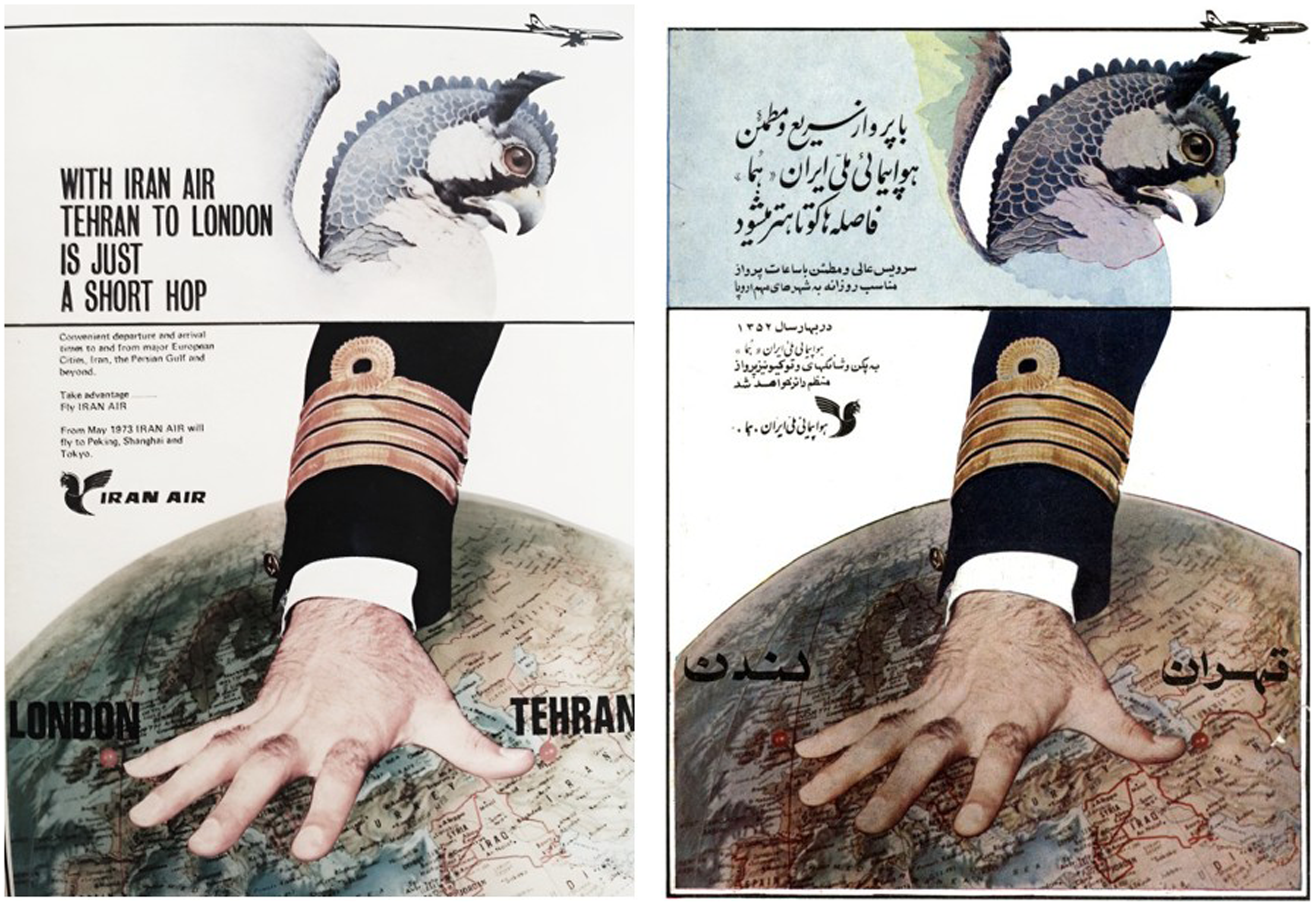
“Tehran to London is just a short hop”, Iran Air advertisement (1973).
Perhaps the most monumental register appeared in a campaign that juxtaposed the homa bird and a Boeing 727 in flight with globally recognised remains of ancient civilisations: The Parthenon, the Colosseum and the Great Wall of China. These images placed Iran Air in visual dialogue with both Europe's classical empires and Asia's dynastic legacies, situating Iran within a broader frame of historical prestige. By placing Persepolis's emblematic bird alongside these world monuments, the campaign linked international mobility to narratives of cultural distinction and civilisational heritage. English-language captions such as “Iran Air links Europe with Iran and the Persian Gulf” and “A bridge linking two ancient cultures – Abadan-Athens” further underscored geopolitical connectivity and cultural equivalence. 39
Persian-language versions paired the same imagery with phrases that stressed national service and achievement, such as “Homa, a reliable means for travel to important cities”. 40 In contrast to the horizon campaign, where the Persian text had drawn on poetic idioms and the English text promoted global expansion, here the registers were inverted to reinforce Iran's civilisational claims. The result was that identical images carried different symbolic weight: for international audiences, Iran Air appeared as a bridge between empires; for domestic readers, it was cast as a dependable national institution aligned with a lineage of antiquity.
Internal correspondence from Iran Air's publications department revealed similar tensions over the translation of Persian cultural references for international audiences. In a 1978 exchange concerning an article on the classical poet Sa’adi for the airline's in-flight magazine, a staff member addressed its omission from the English-language edition. She explained that while Western readers might recognise Omar Khayyam through the Rubaiyat, they remained largely unfamiliar with other major figures of Persian literature. 41
Viewed across languages, the campaigns adapted similar visual material to different audiences and rhetorical contexts. While imagery often remained consistent, slogans and textual registers shifted between literary, developmental, institutional and civilisational modes. Across these paired campaigns, a constant visual grammar absorbed two distinct rhetorics, pragmatic and developmental in one register, literary and institutional in the other, without ever appearing to contradict itself.
The material dimensions of branding
Iran Air's branding positioned hospitality as central to the passenger experience. Advertisements invoked Persian traditions of welcoming guests, with slogans such as “Sit back and learn the Persian meaning of the word ‘welcome’”, linking air travel to cultural customs. 42 Passengers were promised “fresh food picked up en route (never frozen)” and invited to choose between French gourmet dishes and Persian staples. French options included Canard à la Bigarade (roasted duck) or Tournedos en Croûte (beef Wellington), which were served alongside Persian dishes such as Lobia Polo (a rice dish with green beans and meat), described as “prepared to a recipe first cooked by ancient Persians two thousand years ago”. 43 Every element of menu design and cabin service reflected Iran Air's broader brand narrative, turning the logistics of in-flight dining into a showcase of national refinement and historical tradition. These gastronomic choices offered passengers a distinctive travel experience that blended cosmopolitan luxury with cultural authenticity, presenting Iran to international audiences through the shared language of food and hospitality.
Iran Air's notion of hospitality was not confined to the cabin. The airline's advertising applied the same ethos of service to the experience of travel itself, positioning the journey as an unfolding act of welcome. Promotional materials invited passengers to move seamlessly from the comfort of the aircraft to the landscapes and monuments of Iran, where the promise of Persian hospitality continued on the ground. The relationship between nation and airline was reciprocal: narratives of Iran's ancient tradition of hospitality informed the airline's service culture, while the performance of service on board rearticulated that cultural heritage within the technological and aesthetic framework of modern aviation.
The same logic shaped the curated visual geography presented in Iran Air's advertising. Promotional materials constructed a curated landscape featuring ancient ruins, monumental architecture, Caspian resorts and Tehran's modernist skyline, destinations that embodied both cultural heritage and contemporary sophistication. Religious landmarks appeared less prominently than imperial and monumental imagery; when Islamic architecture was featured, it was typically incorporated into broader narratives of historical continuity and cultural heritage rather than presented primarily in devotional terms. Isfahan's Friday Mosque appeared alongside Persepolis, Sasanian rock reliefs and luxury hotels, presented through touristic imagery as one of several “dreaming mosques with domes of turquoise or yellow”. 44 The visual strategy presented Iran as a destination that welcomed international travellers while maintaining an aura of refined distinctiveness.
Central to this visual and symbolic geography was the Shahyad Archway (later Azadi Tower), which rose to prominence in Iran Air's advertising following its completion in 1971. Designed by architect Hossein Amanat and erected at the western gateway to Tehran near Mehrabad International Airport, the monument was strategically positioned for visibility from both incoming flights and the city's arterial roads, serving as a literal and symbolic point of entry. Built to commemorate the 2,500th anniversary of the Persian Empire, the tower displaced the older National Garden Gate (sardar-e bagh-e melli) as the dominant landmark in Iran Air's iconography. 45
In contrast to earlier gates that marked thresholds and enclosures, the Shahyad's open arch suggested centrality and futurity. As Talinn Grigor observes, its form was promoted as “stable on the ground and bursting to the sky”. 46 Blending Sassanid, Islamic and modernist architectural influences, the structure embodied the Pahlavi regime's ideological claim that Iran's monarchy was simultaneously anchored in antiquity and aligned with technological progress. Reproduced across Iran Air's advertising, the Shahyad functioned as both landmark and brand device, demonstrating how monumental architecture became integrated into Iran Air's visual branding.
Throughout the 1970s, Iran Air's advertising exhibited a rhetorical shift from poetic cultural invitation to pragmatic economic appeal. Early campaigns emphasised hospitality and civilisational allure, using minimalist designs and affective language. Later advertisements increasingly targeted business travellers and diplomats. 47 One campaign asked, “Why you'll be a good deal better off doing business in Tokyo via Tehran”, while another framed Iran Air's “Silk Route” as the fastest way to the Far East, flanked by images of the Great Wall and kimono-clad women. 48 This transition paralleled global advertising trends that saw airlines courting executive travellers with promises of efficiency and regional connectivity. Yet Iran Air's pragmatic turn remained distinctively inflected by the regime's ideological imperatives. Rather than adopting purely functional appeals, these business-oriented campaigns maintained the visual and textual markers of imperial grandeur: positioning Tehran not merely as a convenient stopover but as the natural centre of ancient trade routes now modernised for jet-age commerce.
Campaigns targeting American business travellers became increasingly direct. A Los Angeles Times advertisement explicitly acknowledged low brand recognition (“Until your travel agent told you about it, you had never heard of Iran Air”), then repositioned the carrier as a fast-growing airline, depicting first-class passengers as “briefcase-bearing businessmen […] putting the finishing touches on their multi-million dollar proposals” seeking “a share in Iran's economic boom”. 49 The advertisement transformed unfamiliarity into opportunity, framing Iran Air not as an exotic curiosity but as infrastructure for American corporate expansion into Iran's oil-fuelled economy.
The material approach to projecting heritage and imperial legitimacy shifted between late 1975 and 1978 towards a markedly different rhetorical format. Iran Air's advertising adopted a new quiz format that reframed national development achievements as popular trivia. These advertisements invited readers to identify which country had increased its education budget by 36 per cent, installed the largest microwave telecommunications network, or joined the world's leading steel producers. The answers were invariably Iran, with claims ranging from infrastructure growth to progressive labour policies requiring private manufacturers to offer 49 per cent of shares to workers.
50
The visual layout was playful, combining cartoons, flags, checks, flowers and athletes with multiple-choice boxes. Beneath the quizzes, the advertisements explained their purpose explicitly: We believe that an airline is only as great as its country of origin. So that by telling you about Iran, her potential and resources, and how they’re put to use, we tell you more about Iran Air than if we just promised tastier food and prettier girls to serve it.
51
Conclusion: Flying between antiquity and modernity
Iran Air's ambitions were perhaps most dramatically illustrated by an acquisition that never materialised. In 1972, buoyed by operational profitability, the airline ordered two supersonic Concorde aircraft with an option for a third. 53 The Shah personally championed the Concorde as a symbol of national prestige, yet Iran Air's senior management opposed the purchase, citing both prohibitive costs and a fundamental geographic constraint: the airline's routes ran primarily over land, while supersonic flight was restricted to overwater corridors. 54 The order was quietly cancelled in early 1979, exposing tensions between royal aspiration and operational pragmatism within the airline's late-Pahlavi administration. 55 Even unrealised, the Concorde order aligned Iran symbolically with Britain, France and the small group of states associated with the presumed future of commercial aviation.
Across the 1960s and 1970s, Iran Air's advertising linked modern aviation with imperial imagery, hospitality, tourism and national development. Through multilingual campaigns, the airline adapted these themes to different audiences while maintaining a recognisable visual identity centred on mobility, heritage and modernity. Repeated motifs such as the homa bird, ancient monuments, modern aircraft and Tehran's geographic centrality allowed Iran Air to articulate different versions of Iranian modernity across Persian- and English-language campaigns.
By the late 1970s, however, the tone of these campaigns began to shift. Earlier advertisements had emphasised cultural prestige, historical continuity and hospitality, while later campaigns increasingly relied on developmental statistics, infrastructure projects and economic growth as evidence of national achievement. In one of the last advertisements of the monarchical era, published eight days before the Shah left Iran in January 1979, Iran Air abandoned dynastic imagery for a retrospective timeline and the slogan: “Sixteen years ago we only flew at home. Now we’re at home flying all over the world”. Gone were the metaphors of imperial ascent and civilisational grandeur. Within weeks, the airline's operational network collapsed. Staff strikes halted service for 52 days, while revolutionary turmoil forced the cancellation of routes to North America and Asia, reducing operations to a fraction of the global network the airline had previously celebrated as among the fastest growing in the world. 56
Footnotes
Acknowledgements
This article has benefited from discussions with colleagues at the Alliance Center for Iranian Studies and the participants of the “Cultural History of Late Pahlavi Iran” workshop. The author would also like to thank the anonymous reviewers for their thoughtful feedback on earlier drafts of this paper.
Copyright and permissions statement
The advertisements reproduced or quoted in this article are used under the fair dealing provisions of the UK Copyright, Designs and Patents Act 1988 for the purposes of criticism, review and scholarly analysis. All images and text excerpts are reproduced solely for noncommercial, educational purposes.
Data availability statement
No datasets were generated or analysed for this article. All materials referenced are publicly accessible through archives and published sources.
Declaration of conflicting interests
The author declared no potential conflicts of interest with respect to the research, authorship, and/or publication of this article.
Ethical approval and informed consent
Not applicable. This research is based on publicly available archival and published materials.
Funding
The author received no financial support for the research, authorship and/or publication of this article.

Notes
References
Archival sources
Author’s private collection.
Private archive of Dr. Ali -Asghar Azizi (Director of Iran Air Public Relations).