



Abstract
Laboratory animal professionals (LAP) are faced with various situations and tasks influencing their mental well-being. A systematic review has been conducted to investigate whether there are specific stressors for LAP and which moderators are relevant for the development of psychological strain. A comprehensive search following PRISMA Guidelines was carried out in June 2021. Results include 12 studies and have been summarized qualitatively in narrative synthesis and tabular presentation. Available literature indicates that LAP are facing stressors but does not allow for conclusions on specific stressful job duties other than euthanasia.
Signs of strain are present in LAP. Specifically, participants in qualitative studies reported acute symptoms, while chronic manifestations were in focus in quantitative studies. Although a wide variety of moderating factors have been investigated, only social support has been rated as relevant by multiple qualitative and quantitative studies without contrasting results.
According to current data, there is a risk for psychological strain in LAP. However, there is limited understanding of specific stressors and data on moderators is diverse. Further studies that focus on domain-specific knowledge and clearly distinguish stressors from moderators are necessary to set up institutional programmes addressing psychological strain in LAP.
Introduction
Mental health issues among laboratory animal professionals (LAP), such as veterinarians, scientists, technicians or caregivers, recently gained increasing attention in the scientific literature1–10 and at academic conferences.11–13 LAP often are passionate of taking care of others, in terms of either the experimental animals themselves or the patients that might benefit from biomedical research.14–18
However, the daily routine of LAPs regularly requires causing or tolerating pain, suffering and distress in the study animals. This discrepancy between taking care of and tolerating or inducing harm in the same animals can lead to cognitive dissonance, psychological stress and strain,1,15,18,19 which potentially influences proper animal care1,6,16 and, thus, the outcome of scientific projects.20,21 In addition, absences and high staff turnover due to psychological strain can have long-term consequences on the facility’s organizational and economic situation. 22
Consequently, guidance on how to mitigate LAPs’ psychological stress and strain has become highly relevant for organizations and institutions23–27 and there is increasing consensus that a ‘culture of care’ in the laboratory animal setting needs to foster both animal and staff wellbeing.
Although it is well known that working in the context of animal experimentation has the potential to cause psychological distress, a differentiated evaluation of the phenomenon is lacking. In order to develop programmes and individual strategies to foster well-being in LAP, it is important to clearly distinguish between potentially stressful tasks or situations (‘stressors’), the reactions or symptoms that might result from being exposed to stressors (‘strain’) and the variables that increase or decrease the likelihood that stress results in strain (‘moderating factors’ or ‘moderators’). 28
Those three aspects are linked to each other; they should, however, not be intermingled. According to Lazarus and Folkman, people facing stressful tasks evaluate their possibilities to cope with the situation based on their resources. Those resources include personal moderating factors such as training level, but also situational factors such as support from colleagues or general workload. Stressful situations that are not manageable with the resources available have the potential to induce strain. 29
From a practical perspective, a clear picture of both the stressors and the moderating factors is needed, both for further investigations on the topic and for the set-up of occupational health and safety programmes. Where stressful tasks are inherent to the job, they pose a risk to mental health and need to be identified to allow the evaluation and modification of associated moderating factors.
To date, no systematic review exists, to the authors’ knowledge, which summarizes what kind of stressors and associated moderators have to be considered for LAP.
The only systematic review that includes aspects of the intended work was published in 2015 by Scotney et al. 30 The authors conclude that especially the performance of euthanasia was associated with strain on staff working in animal shelters, veterinary clinics and laboratories. However, Scotney et al. could only include one study involving LAP besides research from different animal-associated professions and settings. Thus, the results are not readily transferable to the specific situation of LAPs.
Qualitative reviews published in 2019 8 and 2020 7 discuss potential mitigating strategies and provide summaries of the literature available and the terms for psychological strain mostly used in research concerning this topic. However, these reviews do not systematically distinguish between the underlying stressors and the moderating factors that contribute to or buffer against the development of strain.
Consequently, the question arises of whether there are specific tasks and situations in the field of animal research that have the potential to act as stressors in LAP and which moderators are potentially associated. To close this gap, the authors aimed to systematically review studies that evaluated psychological workplace stress and moderators that might lead to psychological strain in LAP. In addition, this study provides an overview of the professions, methods and symptoms that have been investigated so far. This might offer guidance for further studies and for strategies to prevent or reduce workplace stress and strain of LAP.
Material and methods
Study design
Updated PRISMA Guidelines were followed in conducting and reporting the systematic evaluation of existing literature. 31
Search strategy
Medline (PubMed), EMBASE, PubPsych and PsycInfo were used for the systematic search of relevant literature. The search was conducted from 1 June to 3 June 2021, publication dates were restricted to from 1990 onwards. Search terms are given in Supplementary Table S5 online.
In addition, reference lists were checked from all records of database search that have been retrieved for full-text screening for additional relevant publications.
Study selection
First, duplications were removed, then all publications in languages other than English and German or published before 1990 were excluded. Publication titles were screened and those articles with no relevance to the project were sorted out before the abstracts of the remaining titles were screened against inclusion criteria. Articles that met inclusion criteria or that could not be excluded by abstract examination were retrieved for full-text screening. Finally, full texts were examined for inclusion criteria.
All steps until full-text screening were conducted by the main author and confirmed in regular feedback rounds. The full-text screening was conducted by all four authors independently from each other and consensus was necessary for a study to be included. Reasons for exclusion were tracked at all steps. No automation tools were used in the study selection process.
Inclusion criteria were defined as follows: relevant articles must have been published in a peer-reviewed journal (1), contribute primary research or systematic review (2), have LAP as the population of interest (3) and investigate psychological strain due to workplace stressors (4).
Publications that did not contain primary data were excluded, as were conference proceedings or other forms that would not allow data extraction. If the studies contained data from multiple workplaces, they were included only if data from LAP could be extracted.
The population of interest was not limited to specific job titles but staff must have been in some way dealing with the housing of or caring for laboratory animals directly or have some responsibility in the preparation, conducting or surveillance of animal experimentation.
Jobs, training or duties that are unpaid or a regular part of curricula such as human medicine were not considered relevant for the purpose of this study, as were jobs in studies that do not meet the criteria for animal experiments as defined by Directive 2010/63/EU.
Only publications that met all inclusion criteria were considered relevant for this review.
Data extraction and synthesis
Data extraction was conducted by the main author and validated by two co-authors. Details extracted included the year of publication, geographic region and method of data collection, study aims, target population, psychological tools and the number of participants analysed. Outcome measures extracted included types of psychological stressors, moderating factors and signs of psychological strain. As reviewed studies contained both quantitative and qualitative data, the results were qualitatively summarized in narrative synthesis and tabular presentation.
Outcome measures have been grouped into signs of psychological strain, stressors, and moderating factors. Due to the variance in study type and set-up, further subcategories for qualitative and quantitative data have been built. Studies with a qualitative set-up as well as qualitative parts of mainly quantitative studies were eligible for synthesis of data from ‘qualitative research’. Quantitative studies and quantitative parts of mixed-method studies were used for the ‘quantitative research’ synthesis.
Neutral terms have been used for summarizing signs of strain, stressors and moderators that have been used with slightly different wording in the relevant studies. Signs of psychological strain have been grouped into acute and chronic manifestations according to their use in the original publications following the framework of Nerdinger et al. 32 and Greif. 33
Data has been categorized as ‘euthanasia’ only if the original publication allowed conclusion that the active killing of an animal is what has been mentioned or investigated.
Data analysis
Quantitative results and qualitative findings on stressors and moderators have been assessed with regard to their correlations, tensions or contradictions within study types but also comparing quantitative and qualitative data.
Risk of bias assessment
Critical appraisal of study quality has been conducted by the main author and cross-checked by the co-authors. The assessment was conducted with the ‘QualSyst’ tool, 34 applying the two different checklists for qualitative and quantitative research according to the design of the individual studies. For mixed-method studies, qualitative and quantitative parts have been assessed separately with the relevant checklist. Total scores have been calculated according to the original publication. 34
No cut-off scores have been set, meaning that all publications meeting the inclusion criteria were considered.
Results
Study search and selection
As displayed in Figure 1, database search led to 1984 records and citation search retrieved another 75 records. Finally, 12 publications were included in the systematic review.1–6,10,14–16,18,35

Study identification and screening process (of a systematic review including 12 references). Reasons for exclusion: no peer review (#1), no primary data (#2), differing target population (#3), differing parameters under investigation (#4).
Study design/psychological assessment tools
Surveys distributed online, via mail or e-mail, or through direct contact were used in seven studies.1,4–6,10,15,35 These studies had a quantitative study design, although some included supplementary open-ended questions.5,6,15 Qualitative methods of data collection were applied in three studies.2,14,18 One mixed-method study 3 was combining qualitative and quantitative methods. Another study did not allow to clearly distinguish whether quantitative methods had been used in addition to qualitative data collection. 16
To allow for a clear distinction between quantitative and qualitative data, results are grouped accordingly in Tables 1–5.
Summary of included studies (in a systematic review including 12 references).
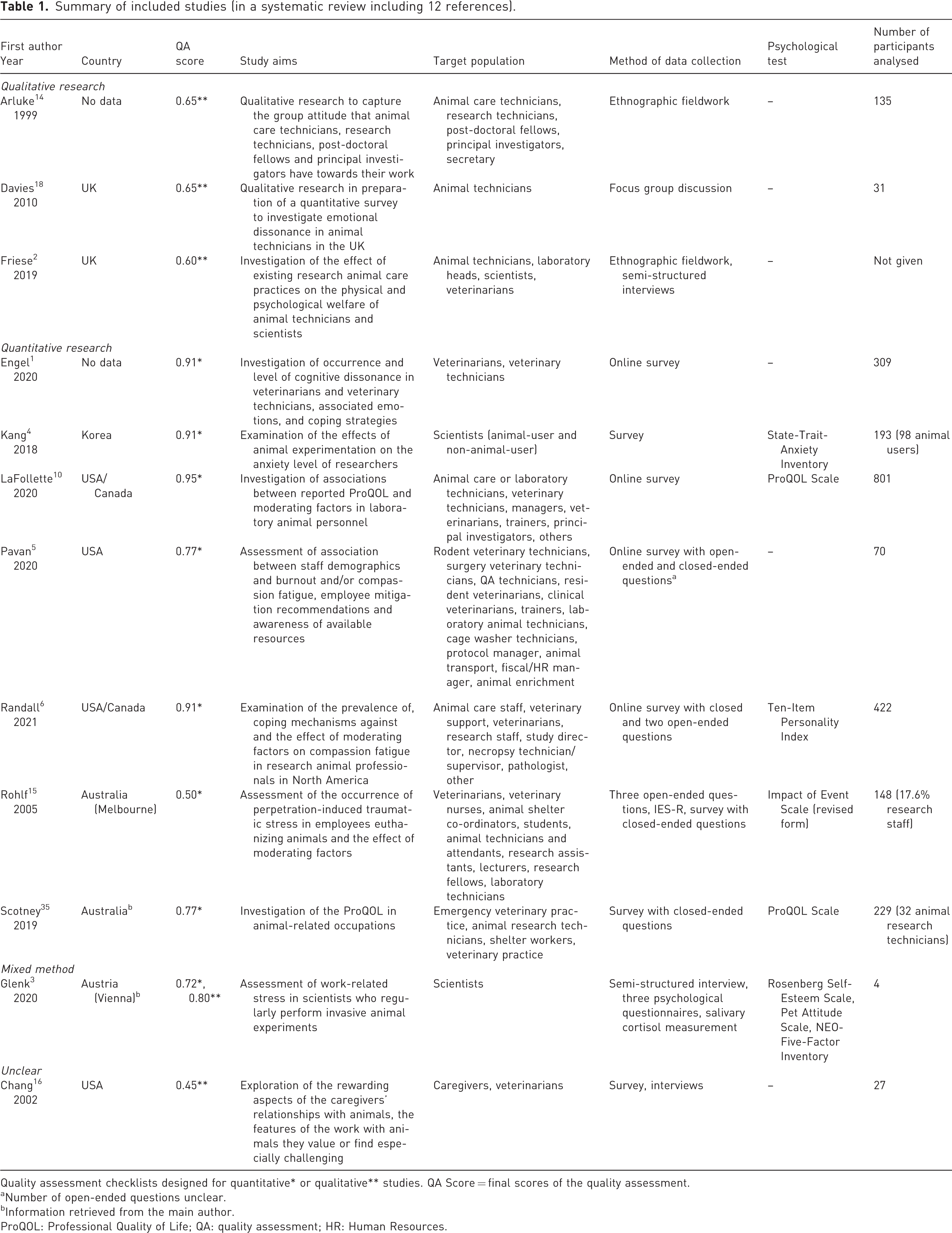
Quality assessment checklists designed for quantitative* or qualitative** studies. QA Score = final scores of the quality assessment.
aNumber of open-ended questions unclear.
bInformation retrieved from the main author.
ProQOL: Professional Quality of Life; QA: quality assessment; HR: Human Resources.
Manifestations of strain (in a systematic review including 12 references).

aFour participants.
Summary of the stressors investigated in qualitative and quantitative studies (in a systematic review including 12 references).

aContribution of laboratory animal professions unclear.
bCause of death not given.
cNot statistically analysed.
Personal moderators investigated (in a systematic review including 12 references).
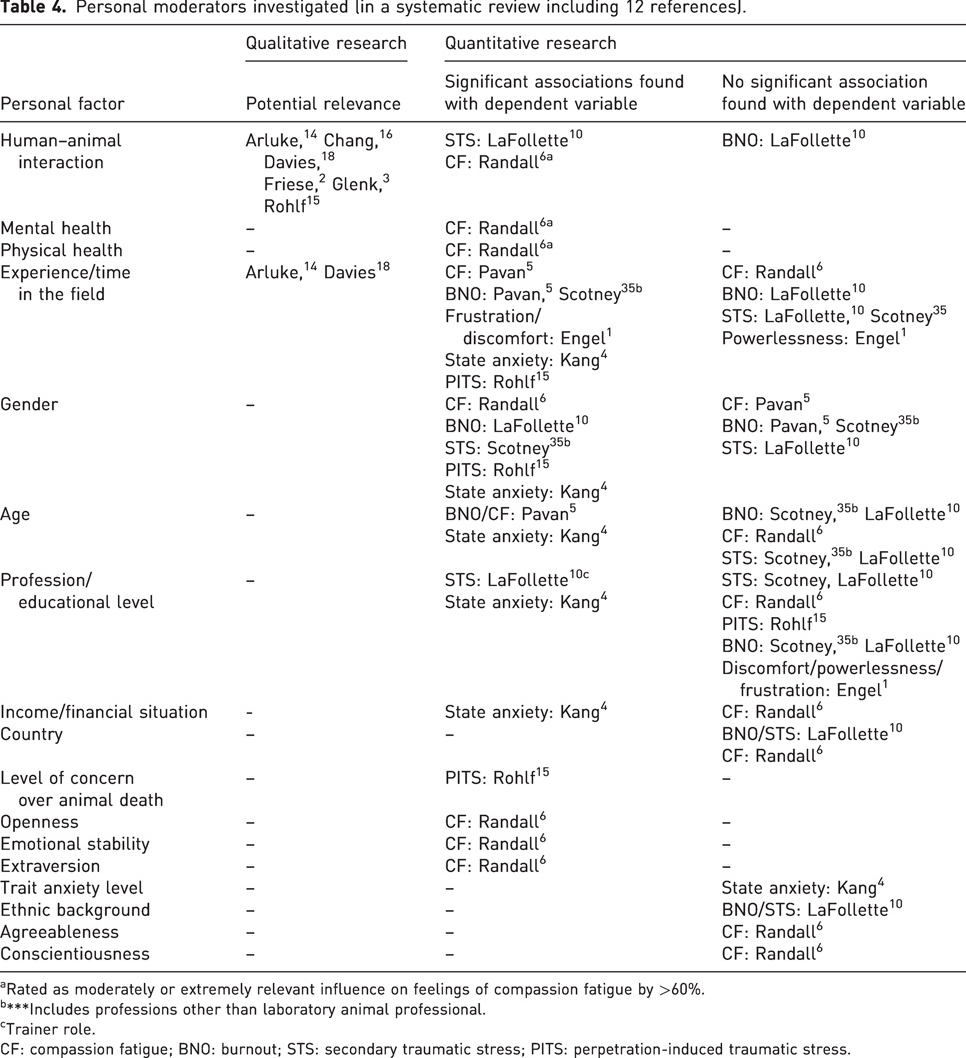
aRated as moderately or extremely relevant influence on feelings of compassion fatigue by >60%.b***Includes professions other than laboratory animal professional.
cTrainer role.
CF: compassion fatigue; BNO: burnout; STS: secondary traumatic stress; PITS: perpetration-induced traumatic stress.
Situational moderators investigated (in a systematic review including 12 references).
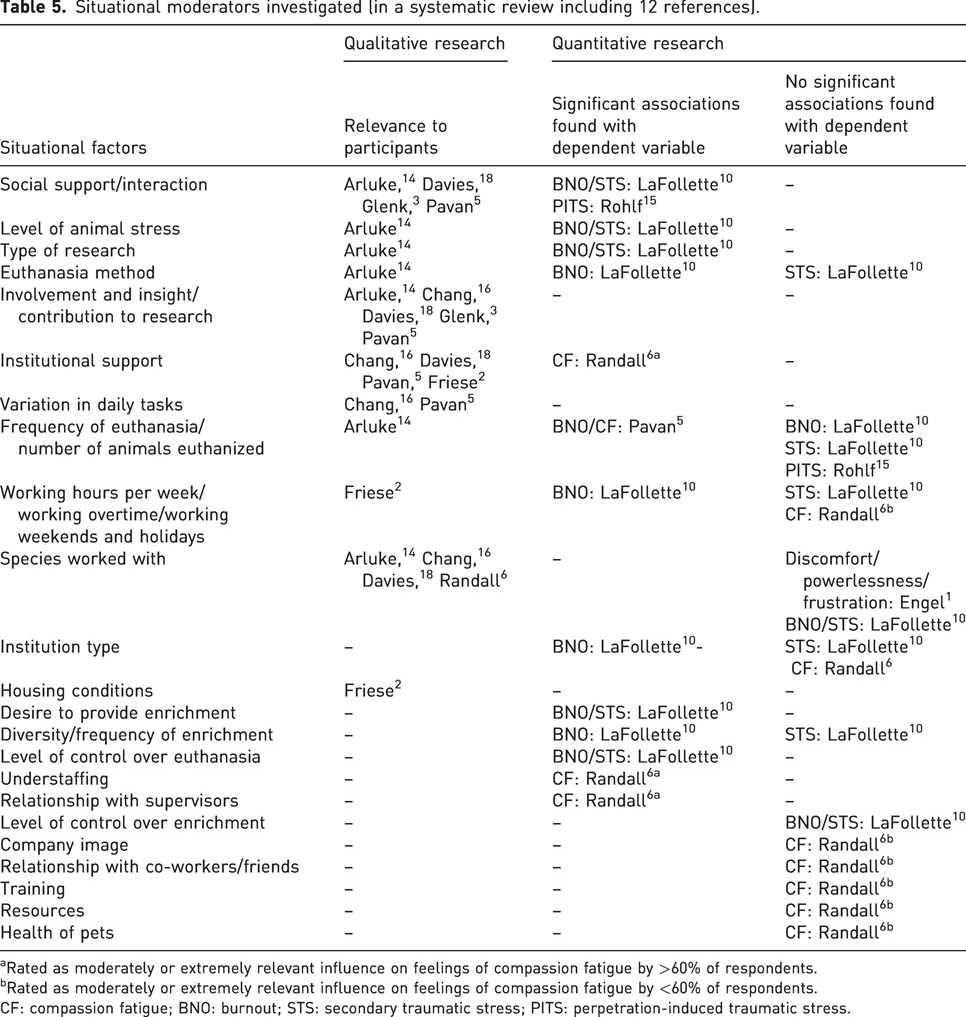
aRated as moderately or extremely relevant influence on feelings of compassion fatigue by >60% of respondents.
bRated as moderately or extremely relevant influence on feelings of compassion fatigue by <60% of respondents.
CF: compassion fatigue; BNO: burnout; STS: secondary traumatic stress; PITS: perpetration-induced traumatic stress.
Psychological assessment tools used in quantitative studies are given in Table 1. Only the Professional Quality of Life (ProQOL) Scale was included twice.10,35
Population of interest
Studies in this review either focused on one or two specific professions such as scientists,3,4 animal technicians, 18 veterinarians and caregivers 16 or veterinarians and veterinary technicians 1 or had a broad spectrum of participants working in the field of laboratory animal housing and care.2,5,6,10,14,15 In two studies15,35 also professions of other fields such as animal shelters or veterinary practice were included.
‘Technician’ was mentioned most often as a job title.1,2,5,6,10,14,15,18,35 However, it was not always clear whether the participants were actively performing experimental tasks or solely providing services not directly connected to the actual experiments.
Risk of bias assessment
Qualitative studies had a trend to leave relevant questions open on sampling strategy, data collection and analysis whereas quantitative studies were at risk of confounding factors. The target population was usually defined by job titles but it was not always clearly delineated what the participants’ tasks included. Final scores of the assessment are given in Table 1; more details on the quality assessment are provided in Supplementary Tables S2 and S3.
Manifestations of strain
Concerning strictly qualitative studies, several acute signs of psychological strain were determined (Table 2). Sadness or grief2,14,16,18 as well as feelings of guilt, emotional dissonance or isolation14,18 were detected by multiple authors. No chronic manifestations of psychological strain were reported in qualitative research.
Across quantitative studies, terms for different signs of psychological strain were used with some variance. Compassion fatigue, for example, was defined as ‘strain that results from exposure to the trauma of others’ which may coexist with burnout5,10 or as ‘profound state of mental and physical exhaustion caused by wanting to help those who are suffering’ that may lead to burnout if left untreated. 6 These studies used compassion fatigue as a stand-alone parameter for their investigations. Others used the term as a summarizing condition for different manifestations like burnout and secondary traumatic stress.10,35 In this review, the expressions for symptoms of psychological strain are used as provided by the respective authors.
Acute signs of strain found to be relevant in LAP in multiple quantitative studies were frustration1,6 and anxiety or fear.4,6 Chronic signs of strain included were compassion fatigue,5,6,10,35 burnout,5,10,35 secondary traumatic stress,10,35 depression 6 and perpetration induced traumatic stress. 15
In summary, participants in qualitative studies did only report acute symptoms of strain, while chronic manifestations or symptom complexes were in focus in quantitative studies.
Stressors
The majority of potential stressors identified by qualitative studies were related to situations and tasks causing harm to animals. This included general descriptions such as being involved in animal experimentation,14,18 conflicting interests of animal welfare and scientific needs2,14,16 or witnessing animals suffering or dying.2,14,15 Specific tasks mentioned were euthanasia14–16,18 and anaesthesia. 14
Stressors not related to animal harm have been detected by Rohlf and Bennett when participants were asked for the ‘worst aspects’ of their job. Aversive work conditions such as smells, untidiness and personal safety hazards were reported as being most important. However, it was unclear to which degree these results refer to LAP. 15
Quantitative research also identified stressors capable of causing psychological strain, including contact with animals in pain, suffering or dying,1,10 facing conflicting interests of animal welfare and scientific needs 1 and the performance of euthanasia.5,10
In summary, contact with animals in pain or distress can act as a stressor for the staff involved but euthanasia is the only defined task that has shown relevance in both qualitative and quantitative studies (Table 3).
Moderators
A summary of personal and situational moderators investigated is provided in Tables 4 and 5.
According to four quantitative studies,4,6,15,35 females are at a higher risk to develop psychological strain but there are contrasting results for compassion fatigue, 5 burnout5,35 and secondary traumatic stress. 10 LaFollette et al. found persons that categorize their gender as ‘other’ to be at a higher risk to develop burnout 10 than male or female participants.
Contrasting results were also found for age and experience. In those studies that did find a significant association, it was not always the younger, less experienced individuals that were found to be at a higher risk. Pavan et al. reported participants in their 30s to be at the highest risk for compassion fatigue and burnout. 5 In Scotney et al., the highest rate of burnout was detected in the group of employees that had been working for 6–15 years. 35
The interaction between animals and humans was reported to be relevant in qualitative research2,3,14–16,18 and a statistically significant association was found with secondary traumatic stress6,10 and compassion fatigue 6 but not burnout. 10
With regard to the profession or educational level, most studies did not find a significant association with the signs of strain assessed.1,6,10,15,35 However, LaFollette et al. reported trainers to be at a higher risk to develop secondary traumatic stress 10 and Kang et al. found higher state anxiety in LAP when compared with researchers that do not use animals. 4 The financial situation of participants was found to have a significant association with state anxiety 4 but not with compassion fatigue. 6 Two authors found no significant association with the country participants came from.6,10
Regarding situational factors, social support was rated as relevant by qualitative research3,5,14,18 and a statistically significant association with perpetration-induced traumatic stress, secondary traumatic stress and burnout was found in two quantitative studies.10,15
Type of research, euthanasia method and level of animal stress were each identified to be relevant in one qualitative 14 and one quantitative study. 10
The frequency of euthanasia or the number of animals euthanized was determined to be associated with signs of strain by two authors5,14 but no association was found by two other studies.10,15
Variation in daily tasks5,16 and the involvement and insight into research, or more generally the feeling to contribute to research,3,5,14,16,18 were reported as potentially relevant in more than one qualitative study but have not yet been investigated statistically.
The institution’s support programme was rated as potentially helpful5,6,16,18 or helpful 2 to mitigate the effects of stressors.
The influence of the time spent at work was reported by one qualitative study. 2 LaFollette et al. found a positive correlation between working hours per week and burnout but not secondary traumatic stress. 10 In another study, less than 60% of participants rated the factors ‘working overtime’ and ‘working weekends/holidays’ as moderate or extremely relevant for the development of compassion fatigue. 6
The species worked with was mentioned as potentially relevant in four qualitative studies6,14,16,18 but no statistically significant association with signs of strain was found.1,10
One study identified a type of institution participants worked at to be associated with burnout but not with secondary traumatic stress, 10 while another study did not determine an association with compassion fatigue. 6
In summary, social support is the only moderating factor that was rated relevant by multiple qualitative and quantitative studies without contrasting results.
Discussion
The purpose of this systematic review was to investigate whether there are specific tasks and situations in the field of animal research that have the potential to act as stressors to employees. In addition, the authors aimed to identify moderators that may be potentially relevant for the development or mitigation of psychological strain.
Despite the attention the topic has recently gained, only 12 studies could be included in the review. These studies were published almost exclusively in parts of the world with an Anglo-American cultural background. This trend is ongoing. After the data collection for this review was finished, additional research from Spain and the USA was published.36–39
The target population in the studies included varies and is usually defined by job title. This approach does not necessarily reveal the potentially stressful tasks employees are actually exposed to. Animal technicians may exclusively perform animal husbandry or take part in experimental procedures. Scientists may solely breed genetically altered animals or perform surgical interventions. Thus, conclusions on associations between job titles and strain should be drawn with caution. To gain more insight, it may be helpful to employ concise task definitions instead of job titles in order to facilitate comparability, as done in other fields of research.40,41
Studies included in this review used both qualitative and quantitative measures and a variety of psychological tools. This additionally reduces the comparability of the conclusions. However, in the most recent studies, a trend toward the use of online quantitative surveys and standardized analysis tools such as the ProQOL Scale10,35–38 exists. This trend can also be seen in research on the psychological well-being of other animal-related occupations40,42–44 and will allow for data comparison across countries and institutions and also over time.
Results reveal that a potential for psychological strain in LAPs exists. Especially acute symptoms were determined in multiple qualitative studies and confirmed statistically.
Acute symptoms such as sadness and frustration but also chronic signs of strain have also been identified in other animal-related occupations.41,45,46 Interestingly, qualitative studies almost exclusively mentioned acute signs of strain, while the majority of quantitative studies investigated chronic symptoms or symptom complexes. Partially, this is related to the psychological tools used in quantitative research but it warrants some caution. Participants might not link their feelings of acute strain to a symptom complex or a chronic manifestation of strain and therefore interpret terms like compassion fatigue or burnout in a different way from that intended by the researchers.6,36
Euthanasia, the sole defined task identified to act as a potential stressor, was also reported in previous reviews in LAP7,8 as well as in other animal-associated occupations.30,41,45,47 Recent research further supports euthanasia being one potential stressor in LAP,36,37,39 although one study did not find ‘a difference between participants that had or had not euthanized animals’ when assessing participants’ ProQOL. 38
The job duties of participants were rarely assessed in detail. Thus the only further but rather general conclusion that seems justified from the data available is that contact with animals in pain or distress and the performance of animal experimentation can act as stressors.
The studies included generally did not focus on the relationship between the potential stressor itself and the resulting strain but directly included various moderators. Potential stressors, symptoms of psychological strain, and moderating factors were investigated in variant combinations. In some studies, information on stressors was not available or could not be analysed statistically.6,35 This strategy has advantages in studies with very heterogeneous job tasks and institutional premises. For the practical implementation of employee support programmes, however, the limited knowledge on specific tasks possibly acting as stressors may prove problematic.
Occupational health and safety programmes imperatively start with the assessment of the workplaces’ potential risks to the employees. This holds true also for any concern regarding psychological well-being. In further steps, moderators to all risks or stressors are to be evaluated and preventative measures can be implemented. However, for any of these steps, a clear understanding of potential stressors is crucial. 48
The wide variety of moderators investigated may result from the limited knowledge of specific stressors. For a few moderators only, conclusions on their relevance seem justified based on current data.
The interaction with other humans is the only factor found to be important in multiple qualitative and quantitative studies without contrasting results. The influence of social support had been reported in other animal-related professions22,41,45 and also for LAP.7,8,36,37 Increased openness about the psychological burden of LAP may change communication among colleagues and may also foster social support from family, friends and the general public.
The interaction between humans and the animals they work with also seems to play an important role, which is well in line with findings from other occupations.41,43 Results show that human–animal interaction (HAI) is able to both decrease and increase the risk of developing psychological strain. This mirrors the underlying dilemma: employees in animal caring professions likely gain satisfaction from being with animals. Conversely, they are at special risk to develop psychological strain when they have to imply or accept harm imposed on these. Reeve et al. aptly call this situation a ‘caring–killing paradox’. 47
Interestingly, contrasting results were found for the association of HAI with different signs of strain, pointing at the complexity of the topic. While a stressor or moderating factor may contribute to the development of secondary traumatic stress, it may not be relevant in the development of other symptoms. Additionally, different factors may work together and influence the development or mitigation of strain.
Furthermore, the importance of moderating factors and the symptoms of strain that become relevant may change throughout working life: for example, young LAP at the beginning of their career may be at a higher risk to experience perpetration-induced traumatic stress or state anxiety when performing a task they recently learned. However, the long-term risk of compassion fatigue or burnout development is dependent on many more factors.
The number of animals euthanized and the frequency of euthanasia, for example, seem to be of ambivalent nature. A certain degree of routinization may help to develop coping mechanisms and adjust to the task. However, higher numbers of animals euthanized may increase the risk for strain.5,14 Regarding the reasons for euthanasia, the available qualitative data allows only the cautious assumption that the feeling of contributing to research might help people to cope better with the killing of animals. However, the quantitative studies have not yet distinguished between different euthanasia reasons. This point should be addressed in future quantitative studies to realize further statistical evaluation and assessment of this moderating factor, for example, regarding whether euthanasia of surplus animals poses a higher risk than euthanasia for scientific or welfare reasons.
It is unclear to date which role the gender of LAP plays with regard to the development of strain. Females working as veterinarians49–51 were found to be at a higher risk to develop signs of strain and there is evidence that females use different coping strategies when facing challenging situations. 52 Hence, further investigations on this factor are warranted, especially as in all studies of this review reporting gender of participants, females posed the majority.3–6,10,16,35
The actual job title of LAP, however, seems to be less relevant. A significant association was found only in one study that compared animal experimenters with those that did not work with animals 4 and one that found trainers to be at a higher risk for secondary traumatic stress. 10 The authors of the latter reasoned that trainers not only face animals in pain or distress but also trainees and the training situation itself, which may result in higher stress levels for both humans and animals. 10 Trainees may also be subject to moral doubts or previous traumatic situations, which may demand providing not only technically correct instructions but also psychological support from the trainers. 53 However, these circumstances pertain only to training situations in which live animals are used. This again highlights the LAP's actual task descriptions being more relevant in determining potential risks than official job titles are.
With regard to species, there is a remarkable difference between results from qualitative research and statistical analyses. Whilst concerns about working with specific species were mentioned by participants of four qualitative studies, no significant association between species and signs of strain was determined in the quantitative studies included in this review. However, it was not always clear whether participants of qualitative research in fact worked with the species they mentioned having emotional difficulties with. Thus the findings might rather represent a ‘feeling’ that it would be demanding to work with, for example, primates, which may explain the different results in qualitative and quantitative results. As HAI has been proven to be a relevant factor, an established human–animal relationship may be of greater relevance than the type of species. 10 However, further research on these factors seems warranted, as a recent quantitative study suggested that working with non-human primates may indeed be associated with higher levels of burnout and secondary traumatic stress. 37
As in all studies, limitations have to be noted. One limitation of this study was the lack of comparative studies, longitudinal data or experimental set-ups in the studies analysed. Only one study had a control group of scientists not working with experimental animals. 4
In addition, some studies did not report data on the occupational duties of the participants or only provided vague information on participants. Furthermore, the heterogeneous terminology complicates the comparison of different professions and signs of strain.
Future research would greatly benefit from continuing mixed-method approaches. Qualitative research may shed light on potential further stressors as well as moderating factors, which have not yet been considered.
Quantitative research, especially if harmonized in terms of the tools and terminology used, will allow for the comparison of data across settings and target groups. Longitudinal studies would be valuable, as they would allow for investigation of psychological strain development in the course of professional life. These may additionally reveal the causes of some individuals being able to develop coping mechanisms whilst others change their career paths.
Special caution should be applied to the risk of misinterpretation by participants when using scientific terms for psychological conditions under investigation.
One limitation of the review process was the relatively low number of studies that could be included due to the strict inclusion criteria. However, regulatory framework and working conditions have significantly changed since 1990, and former stressors may no longer exist in modern institutions. Restricting the target population to employees earning money in the field of laboratory animal science is deemed necessary, as students or volunteers might be freer to leave the field and thus may not experience the same level of conflict.
All steps of the review process besides the full-text screening of studies during the study selection process have been conducted by the main author only. However, all steps along the review process have been cross-checked by the co-authors to limit the risk of bias.
Literature search may be biased since only records in English or German were included. With respect to the increasing numbers of animals used for scientific work in countries such as China and Brazil, 54 the inclusion of further languages might have gained insight into the variety of ethical considerations of LAPs across the globe.
Conclusion
This review demonstrates that potential for both acute and chronic strain in LAP exists. It does, however, also reveal a rather limited understanding of specific stressors in different professions and settings. As a probable consequence, data on moderators is diverse and conclusions should be drawn with caution.
For institutional support programmes, a deeper understanding of the potentially stressful tasks and situations LAP are facing is critical. Only if domain-specific stressors are revealed can associated moderators be investigated that might offer space to improve working conditions. While the stressors are often unchangeable due to the nature of the work, adjustments in moderating factors may support people’s ability to cope with emotionally demanding tasks.
With human and animal welfare as well as scientific validity being linked together closely, further investigations are urgently needed.
Supplemental Material
sj-pdf-1-lan-10.1177_00236772221129111 - Supplemental material for Psychological stress and strain in laboratory animal professionals – a systematic review
Supplemental material, sj-pdf-1-lan-10.1177_00236772221129111 for Psychological stress and strain in laboratory animal professionals – a systematic review by Sonja Rumpel, Regina Kempen, Roswitha Merle and Christa Thoene-Reineke in Laboratory Animals
Footnotes
Acknowledgement
We thank Dr Anne Zintzsch and Dr Nancy Ann Erickson for proofreading and sharing their insight.
Data availability statement
Original data is available to interested parties upon request. Please contact sonja.rumpel@fu-berlin.de.
Declaration of conflicting interests
The authors have no conflicts of interest to declare.
Ethics statement
No ethical board approval was required for this review, as no human or animal trials have been conducted.
Funding
The authors received no financial support for the research, authorship, and/or publication of this article.

Supplemental material
Supplemental material for this article is available online.
References
Supplementary Material
Please find the following supplemental material available below.
For Open Access articles published under a Creative Commons License, all supplemental material carries the same license as the article it is associated with.
For non-Open Access articles published, all supplemental material carries a non-exclusive license, and permission requests for re-use of supplemental material or any part of supplemental material shall be sent directly to the copyright owner as specified in the copyright notice associated with the article.
