



Abstract
The seminar ‘Severity and humane endpoints in fish research’ organized by the University of Bergen, the Industrial and Aquatic Laboratory, together with Fondazione Guido Bernadini, took place on 4 October 2019 in Bergen, Norway. The seminar was followed by a workshop, ‘Establishing score sheets and defining endpoints in fish experiments’, held on 28 January 2020, also in Bergen. The purpose of the seminar was to raise awareness about fish ethics together with severity classification and humane endpoints in fish studies, using examples from farmed fish, mainly salmonids and lumpfish. The overall aim of the workshop was to better define humane endpoints in fish experiments, as well as to discuss suggestions for development and use of score sheets for assessing clinical signs related to endpoints. Endpoints for fish should not only be based on what we know about fish diseases and the lesions they induce but should also take into consideration knowledge about fish species and life stage, fish anatomy, physiology and the general state and behaviour of the fish. For this reason, to reinforce that endpoints should come from the animal’s perspective and needs, we renamed humane endpoints for fish to piscine endpoints. This paper reports the main messages from the workshop sessions including advice on development and use of score sheets.
Introduction
Most of the research animals used in Norway are fish. These are mainly salmonids and marine species that are important to aquaculture. The number of fish used for research each year varies with the type of studies conducted. For instance, in 2019, approximately four million fish were used for research purposes in Norway, whereas one million fish were used in 2017 (Norwegian Food Safety Authorities). The largest number of fish used in research recorded in Norway was in 2016, when as many as 10.2 million salmon were used for two large field salmon lice experiments, which corresponded to 91.4% of all animals used in research that year.
In the last decades, progress has been made in animal welfare assessment, reducing suffering for research animals, and providing them with better accommodation and care during test conditions. However, as stated by Mather, 1 the focus has mainly been on mammals, and animals such as fish and invertebrates have been overlooked. Fish lack facial expressions and are thus not able to convey positive or negative emotions as mice, rats and other animals can, in whom we can recognize such experiences and empathize.2–7 Additionally, animals living in aquatic habitats are not as easily accessible for clinical evaluations as terrestrial animals. Finally, hunting and harvesting practices for aquatic animals differ from those of terrestrial animals, maintaining a culture of acceptance that these animals can be treated with standards different from those accepted for terrestrial mammals.
For many years it has been debated whether fish are able to feel pain.8–12 Nociceptors were first identified in rainbow trout in 2002, nociceptors were first identified in rainbow trout. 8 Despite fish having anatomy capable of nociception, the debates continue as to whether they have the structural capability for the neural processing required for feeling pain, 13 and therefore whether they can suffer or not.14,15 Studies have demonstrated learned behaviour in fish after repeated exposure to a noxious experience in a manner similar to that demonstrated by terrestrial animals and in relation to experiences of pain in humans. 16 It has also been shown that such behaviour can be modulated using pain-relieving drugs – just as in terrestrial animals. 9 These observations strongly suggest that fish have the capability to experience pain from tissue damage and learn from painful experiences in similar ways as terrestrial animals such as birds and mammals. Education and increased awareness about fish species must be more focused on welfare, as there remains a large disconnect between welfare knowledge of the species and the procedures used for the animals. 1
Although salmon have been farmed for several decades, important new scientific discoveries about the anatomy, physiology and behaviour of salmon continue to be published. For instance, fish have analogous functions to those of terrestrial animals, even though they are anatomically different. Examples include the lymphoid tissues in gills 17 and the gland caudal to the urogenital papilla of the cloaca like the bursa of Fabricius in birds. 18 Another example concerns the function and structure of the adipose fin of salmonids. Initially, this fin was thought to be non-functional, and is commonly removed to tag fish for group tracking in experiments.19–21 However, recent investigations have shown that the adipose fin is important for high-velocity swimming and has a function as a flow sensor.21,22 Moreover, the adipose fin is innervated by nervous structures that may detect mechanical water pressure.19,23 Together, these findings question the welfare aspect of fin clipping. In addition to new anatomical discoveries, novel knowledge about behaviour and fish capabilities has been described, such as behavioural fever. 24 Behavioural fever has been described across a range of fish species and is suggested to be a means for ectothermic animals to choose an environmental temperature that will best facilitate the immune response, similar to the function of fever in homeothermic animals. These recent findings demonstrate that there are still many unknowns for one of our most important farmed animals.
The main aim for many fish studies is to better understand pathogenesis in order to develop preventative measures or improve treatments. Chronic diseases may progress gradually in severity and the same may apply to pain and discomfort caused by a disease. Clinical symptoms or signs of pain, suffering or distress develop when the animal cannot compensate for the progressing disease (Figure 1) and, in such cases, there is always a high risk of suffering. 25 How does severe suffering differ from other unpleasant experiences? A rapid shift from pain to unbearable pain may be seen when intense pain is accompanied by negative factors such as loss of control, fear or anxiety. Severe suffering occurs when negative experiences dominate attention and there is limited capacity for distraction or compensation, when a normal life cannot be pursued, and when full recovery cannot occur even if the external situation should improve. It is important to recognize that ‘suffering’ is a continuum: it is not something that can be discriminated into distinct categories. To avoid unnecessary suffering in animals, professional judgement is necessary throughout the experiment, as is staff training to recognize endpoints and solid knowledge of the species in question.

Illustration of how humane endpoints in fish studies can reduce or eliminate development of pain, suffering and distress. In addition to being approved by the authorities, the humane endpoints must be justified by scientific needs and be below the upper limit of justified pain, suffering and distress.
Planning animal studies with early, less serious study-endpoints is an important step towards less severe and more refined animal studies.
25
Humane endpoints should be considered as a concept for continuous refinement of animal studies.
10
Hendriksen and colleagues
10
pinpoint four situations were defining humane endpoints are relevant. First, when scientific objectives are met and there are no reasons to continue. Second, when pain, suffering or distress occurs unrelated to the study, or third when these become more severe than predicted and approved by the authorities. Finally, when pain, suffering or distress are an inherent part of the study, but it is necessary to define the upper level of pain, suffering or distress that can be justified. There are also scientific reasons for applying earlier endpoints in studies. Animals in the late stages of a disease are physiologically dysfunctional and do not always provide reliable scientific information.11,12 A serious clinical condition reflects alterations in the normal physiology and a reduced ability to adapt to maintain homeostasis. When death is imminent, autolytic changes in tissue take place and valuable research material may be lost. If death is discovered by the next scheduled inspection, material will be unsuitable for analysis. Timely termination by euthanasia has the advantage that investigative staff are better prepared for tissue collection.
26
It is therefore important to define endpoints in studies so that they occur in a timely manner, before the animal is suffering.
27
In such situations, negative experiences dominate the animal’s attention, full recovery cannot occur even if the external situation improves, and a normal life cannot be pursued. This scenario echoes what directive 2010/63/EU
28
defines as beyond the upper limit of acceptable experiments, where the animal experiences severe suffering that cannot be ameliorated. The directive reads: From an ethical standpoint, there should be an upper limit of pain, suffering and distress above which animals should not be subjected in scientific procedures. To that end, the performance of procedures that result in severe pain, suffering or distress, which is likely to be long-lasting and cannot be ameliorated, should be prohibited.
The directive also clearly states that death as an endpoint should be avoided and be replaced by earlier, more humane endpoints, to avoid the animal suffering. 28 This statement is also explicitly expressed in the national regulations of European Union countries as well as countries such as the UK and Norway. There is a consensus among regulation authorities that we should move away from death as a target endpoint in animal experiments. 29 Despite the explicit statement in the directive and an increased focus on fish welfare, mortality is still used as a target endpoint in fish trials (e.g. for chemical safety assessment and vaccine studies). One of these tests using death as the endpoint is the Acute Fish Toxicity Test. 30 In recent years, however, there have been extensive efforts and initiatives to refine such studies and to replace death as the endpoint.31–33 Moreover, to let the experiment run until animals reach the moribund phase as endpoint instead of death may be seen as an improvement but remains controversial. In fact, to move away from the moribund state as an endpoint has also been suggested, as animals might suffer more on reaching the moribund state than actually being moribund. 29 It is evident that one’s perception of what is a negative experience for a non-verbal animal without facial expressions or recognizable behaviour is highly influenced by our own experiences and sensory perceptions. For instance, it is likely to score a fish with superficial wounds as being in a more severe state than a fish with pancreas- or heart lesions as experienced for instance during pancreatic disease-development in salmon. But for the fish, the experience of fatigue, viraemia and organ problems may involve significantly more pain, suffering and distress than a wound. Thus, the endpoints for fish should not only be based on what is known about fish diseases and the lesions induced, fish anatomy and physiology, but also take into consideration the general state and behaviour of the fish. For this reason, to reinforce that endpoints should be derived from the animal’s perspective and needs, we renamed humane endpoints for fish as ‘piscine endpoints’. Thus, piscine endpoints should be defined to avoid, eliminate, or minimize pain, suffering or distress before the fish enter the severe and moribund stages.
Fish comprise a highly diverse group with more than 34,300 species identified so far (FishBase). 56 This diversity is reflected in their behaviour, biodiversity, life-history and in their anatomy and physiology. As stated, it is the farmed temperate fish species that are mostly used for research purposes because of the relevant economic impact, thus in particular for these species, an increase in awareness and documentation of welfare in experiments is necessary. The overall aims should be to assess the level of compromised wellbeing, and to enable definition of earlier and more humane endpoints in fish research. Documentation, standardization and improvement of fish studies could be secured by using standardized score sheets (e.g. observations or welfare assessment sheets). Indeed, using score sheets for fish studies is not new, but needs further work to become part of the normal ‘good laboratory practice’ worldwide. In fact, such score sheets are a fundamental aspect of Swiss law (https://www.fedlex.admin.ch/eli/cc/2008/416/de) and Article 135 specifies the need for humane endpoints. The score sheets should, as far as possible, be generic and configurable to adjust for species- and/or project-specific parameters. Importantly, they must ensure the objective assessment of welfare documentation.
Recommendations from workshop participants
To assemble expertise in the field, a seminar on assessing severity and humane endpoints in fish experiments was held in Bergen, Norway on 4 October 2019. This was followed up with a workshop in Bergen on 28 January, 2020. The purpose of the seminar was to increase awareness of ethics in fish studies, together with severity classification and humane endpoints in fish experiments. In a questionnaire after the seminar (45 responses), several participants put forward that the industry perspective was useful for academia and that addressing scoring in industry practices was beneficial.
The aim for the workshop was to define common generic endpoint parameters suitable for reducing severity in fish research. Workshop participants were researchers and clinical scientists from Denmark, the UK and Norway, together with representatives from relevant authorities (Food Safety Authority, Norway), vaccine companies, feed companies and contract research organizations for fish experiments. During the workshop, experiments in which non-infectious pathogenic factors had affected the welfare of the fish were presented, as it is particularly challenging to define humane endpoints in such experiments. This was followed by break-out groups that discussed the following given topics: endpoints related to wounds and skin quality; gill-, eye- and fin lesions; together with the behavioural changes that could be potential criteria for defining humane endpoints. One of the participating groups considered all these aspects but with a focus on lumpfish (Cyclopterus lumpus), as this is a relatively new farmed species used for non-pharmaceutical treatment of salmon lice. The lumpfish has very different behaviour compared with salmon and it is consequently important to increase the knowledge about this species. The findings of the break-out groups were presented and discussed in a plenary session.
In a questionnaire distributed after the workshop in January 2020, 28 out of 41 people (68.3%) provided feedback. The participants found that the workshop was a useful forum for exchanging experiences and practices between researchers, industry and authorities, and reported the group discussions to be especially useful. Twenty-four people (85.7%) saw the need for including score sheets in fish experiments and considered this practice would provide welfare documentation for the trial; 21 people agreed that it would improve standardization of fish studies. A somewhat lower percentage agreed that such score sheets would make it easier to evaluate humane endpoints (83.3%, 20 people) and to decide on mitigating actions (79.2%, 19 people). Six participants thought that including score sheets would be too time-consuming, and five people thought that such score sheets would complicate the application process to the authorities for approval of animal trials.
Pros and cons of using score sheets, together with advice on use
On the use of score sheets for evaluation of humane endpoints in fish experiments, participants found several positive aspects, and recognized that for some studies, score sheets would be useful. Some participants proposed that using standardized score sheets would make it easier for less experienced staff to score animals correctly during sampling events, such as the inclusion of photographs and having a numerical score for all sections. Another comment was that score sheets would increase the reproducibility between studies if definitions or endpoints were standardized. One of the participants also commented that the application process to the authorities would be less complicated with a clearly defined score sheet.
The participants also found several aspects of using score sheets in fish experiments for assessing humane endpoints challenging. Some of them put forward that score sheets should not be mandatory, as they would not be suitable or necessary for all types of study. The use of score sheets, therefore, may be limited to severe experiments. However, this does not exclude the need for more precise humane endpoints in experiments of mild or moderate severity. Participants stated that the variation between studies is high, and anticipated that standardization of parameters in score sheets would thus be difficult and impractical, as study-specific parameters would have to be defined on an individual basis. They highlighted how it is important that score sheets are developed in line with the purpose of the experiment and that a proper scientific-based balance is maintained on what the experiment needs to show and how to preserve animal welfare during experiments. Some scientists stated that most of the pathogen trials run are not standardized across scientific communities and there is a lack of knowledge regarding the development and kinetics of several diseases. Moreover, scoring across scientific communities is not consistent and would require qualifications (training and justification of decisions) on the part of the observer. If scoring sheets are meant to guide us to select appropriate humane endpoints, variation in scoring among scientists will lead to subjective evaluations, despite it being perceived that movement towards objective evaluation is being made. Some participants also highlighted that score sheets could be too complicated, and might even drive animal studies to produce standardized simple score sheets. The nature of fish experiments – that fish are in water – together with the potential for large group sizes and the unpredictable rapid movement of fish within the tanks, make it harder to assess and track individuals visually. That score sheets need to be adapted to species, age and the type of trial also poses challenges. Some endpoint indicators may be difficult to observe or evaluate on a group level during experiments. One of the participants argued that welfare will not be improved by using score sheets, asserting that we must rely on and trust in the education and training skills of the operators. Without such score sheets, animal experimentation will still rely on good fish welfare and have high scientific standards due to the responsible scientists’ education and experience. By introducing score sheets, the language used to describe the study and the humane endpoints will be improved, but this will not necessarily reflect improved fish health in real life. Another view was that, overall, the drive to ensure animal welfare might outcompete the scientific strength of the experiment, the result of which would be poor science, requiring subsequent replication, meaning more animals ultimately used. It was pointed out that if experiments are terminated too early due to stricter regimes leading to running new experiments and using more fish, we will not be working towards the 3Rs.
The participants also offered advice on the use of score sheets: score sheets are relevant for all studies where progressive disease is expected, including studies of infectious diseases, or challenge trials following vaccination, which have been important for the farmed fish industry. The use of score sheets will therefore be highly dependent on the type of study and any adverse effects that may be expected. One participant highlighted how implementation would be very dependent on whether the authority in question has developed basic score sheets and prepared guidelines on how they should be used.
Evaluation of piscine endpoints – feedback and lessons from the workshop
Welfare indicators that can be used as endpoints are defined as environmental-, behavioural-, morphological-, or physiological endpoints. 25
Environmental endpoints
Based on the knowledge of the fishes’ preferences and tolerance limits for various environmental factors, such as temperature and oxygen, we can use measurements of such factors as indirect welfare indicators 34 and consequently define appropriate endpoints. Most of the published literature relates to the effect of environmental parameters on productivity and survival rather than welfare. Examples of environmental endpoint indicators might be factors describing water quality (such as pH, nitrogen levels and metal levels) and those describing the rearing system or practices. 34 However, environmental parameters interact with each other, and their effects are dependent upon fish status, species and life stage. Therefore, it is often difficult to define the limits that will either protect welfare or put it at risk. 34
Behavioural indicators as endpoints
Behaviour refers to movements and actions an animal makes as a response to external or internal stimuli. Behaviour may be the key response to conspicuous physiological changes and possibly the first visible response to adverse physiological conditions – an early warning sign in real time to negative environmental experiences. Behavioural welfare indicators may allow registrations without interrupting (i.e. handling) the animals, which would be a clear advantage. One example is assessment of gill operculum movements (e.g. hyperventilation, hypoventilation). An optimal behavioural endpoint should be able to identify and predict the outcome of a current situation (e.g. if the fish is likely to die or suffer from an infection). However, behavioural endpoint indicators also face certain challenges, as interpretation is not always clear and can be difficult to identify or record on an individual level, especially in large groups of animals.
Appetite
Monitoring appetite is usually a very sensitive, real-time parameter as healthy fish are nearly always interested in food. Loss of appetite can best be observed during feeding time.
Swimming
Swimming behaviour can also be a key indicator for compromised welfare, for instance, changes in swimming behaviour can be a warning sign that vital functions are challenged. Lethargy (e.g. apathy, drowsiness) is characterized by reduced sensitivity to stimuli, often occurring in the final stage of illness, referred to as moribund. 35 Fish that do not respond as usual when the operator is by the tank or when the fish are netted should be followed up to identify possible underlying causes. Examples of behavioural endpoint indicators to look for might include changes in swimming patterns, loss of equilibrium, position in the tank or in relation to the water inlet, panic behaviour, as well as a lack of response that could be a consequence of fatigue.
Morphological endpoints
Morphological endpoints are based on changes in the physical characteristics of an animal. The main advantage with using morphological endpoints is that they are easy to identify and monitor. As the normal condition is well defined, most morphological changes can easily be compared with healthy fish. Welfare scoring systems for morphological lesions have been developed, such as Fishwell and SWIM.34,36,37 Morphological endpoint indicators include compromised skin and mucus condition, scale loss, the presence of ulcers or wounds, any malformations and/or damage to the gills, skeleton, fins or eyes. Damage or malformations to organs such as the gills or fins may compromise basic functions and coping, causing chronic stress in the fish. The level of skin damage can be evaluated, discriminated and scored based on several processes, such as the percentage of body surface affected, the depth of the processes, whether underlying structures are affected, signs of inflammation or infection, healing or scarring, which would be assessed according to a numeric scale or as just present or not present on a binary scale. The main weakness of using morphological endpoints is that they are retrospective, that is, observations are the consequences of or responses to a past event. In addition to this clear disadvantage, morphological evaluation will often involve the handling and restraining of animals, which increases their stress. Finally, the absence of morphological deviations is no guarantee of good welfare.
Wounds and skin changes
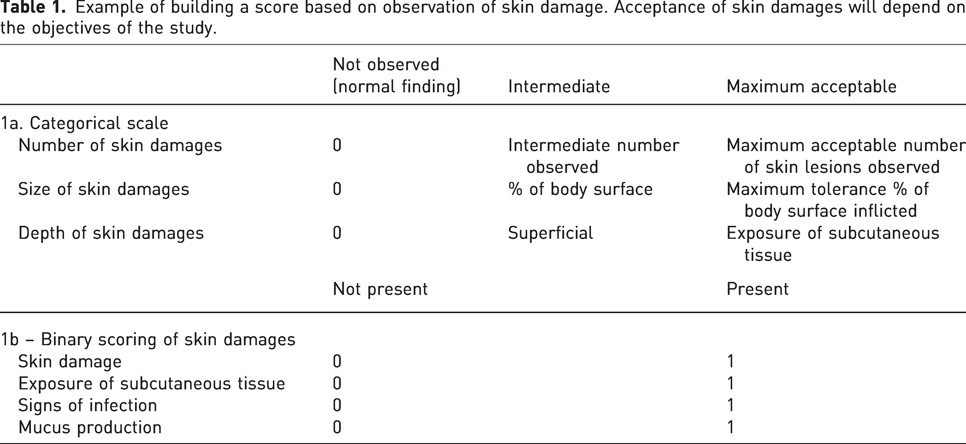
The presence of wounds is a common observation in many fish experiments and an obvious sign of welfare reduction for the animal. The nature of the wounds may be different depending on the study. When evaluating wounds, their severity (for instance a score of 0–3) or a description category could be included (e.g. normal, minor, moderate, severe) (Table 1). It should also be noted whether wounds were expected in the study (e.g. during a disease challenge) or not (for instance, caused by an opportunistic pathogen or due to abrasions or mechanical damage). In all studies involving wounds, exclusion/inclusion criteria for fish with minor wounds are particularly important. If the fish group has minor wounds, a healing period could be considered, thus allowing the experiment to continue. In some cases, wounds may develop and progress rapidly, requiring prompt decision-making concerning animal welfare and the endpoints. Thus, score sheets need to be adaptable in relation to the length of intervals between assessments, with the intervals being shortened when symptoms become more severe. This will improve the welfare of the fish (and the experimental data collection). Conversely, not performing unnecessary handling and assessment of the fish will lead to less stress and better welfare. Other wounds may develop more slowly, such as snout wounds in salmonids, which may be an issue in salmon lice trials. Such snout injuries are related to the fish displaying natural anti-lice jumping behaviour. Similarly, typical shoaling behaviour for herring held in tanks may lead to injuries in the snout and jaw area, most likely a result of mechanical damage from contact with the tank walls. These wounds may lead to secondary infections and malformations in the jaw area. Although most tank-held herring will be able to continue eating with minor malformations to the jaw (pers.obs), they can hinder normal feed intake. In addition, jaw injuries may be painful for fish during the acute phase, as this area is known to be rich in nociceptors in other fish species such as rainbow trout. 8 Wounds also heal more slowly at low temperatures. The dynamics of infections are also temperature dependent: the rate of infection will increase with increasing temperatures, thus wounds caused by bacterial infections, for instance, may develop more quickly at higher temperatures. An example of how to score wounds or skin damage on categorical and binary scales can be seen in Table 1. The degree of skin damage accepted will depend on the study objective. A study aimed at investigating skin damage or pathology, or how to treat wounds, may tolerate more skin damage than if such damage is accidental, or a result of suboptimal animal husbandry.
Example of building a score based on observation of skin damage. Acceptance of skin damages will depend on the objectives of the study.
A general sign of reduced wellbeing, and one of the most common signs of reduced welfare in salmon is skin darkening. 38 Dark-coloured skin can also be linked to cataracts, 34 as fish that have reduced eyesight will adapt their skin to the perceived darker surroundings. However, it is important to note that natural differences between individuals and between fish groups exist when it comes to pigmentation, thus skin darkening as a sign of reduced welfare should always be assessed together with behavioural changes such as appetite and swimming behaviour.
All mucosal surfaces (e.g. skin, gills, digestive tract) in fish are important primary barriers against pathogens, and keeping these barriers intact is essential for the fish to remain healthy. Salmon smolts are especially sensitive to handling; gentle handling and sorting must be conducted during experiments to avoid scale loss and oedema.
Scale loss
In contrast to humans, fish have live cells even at the outermost skin layers, and several layers of epidermis cover fish scales. Thus, any scale loss means that the barriers have been breached with the potential for infectious agents to enter (personal communication, K. Pittman, University of Bergen, Norway).
Skin oedema
Skin is of paramount importance for maintaining osmotic balance, and skin oedema can be lethal for fish if extensive and/or severe.
Mucus
Mucus is an important primary barrier to infections, comprising both a physiological barrier by the entrapping and sloughing of microbes, and a biochemical barrier via harbouring important antimicrobial factors. Stress, type of feed, treatments, handling, lice manifestations, in addition to environmental conditions, may alter the mucosal microbiome and the quality and properties of the mucus, affecting fish health and their ability to fight off pathogens.39–41 Several methods for sampling mucus have been described for various fish species, but there is a need for standardizing and comparing the efficiency of mucus sampling techniques. 42 Changes in mucous secreting cells (i.e. goblet-, sacciform- and club cells) in response to the environment and circumstances can be measured using mucosal mapping, which is a stereology-based method of quantifying mucous cells, 43 but requires terminal sampling or biopsy. Several methods for sampling mucus have been tested, such as placing the fish in a bag for mucus adhesion and subsequent processing, by scraping (removing mucus using microscope slides or the tip of a scalpel), wiping or by adsorption. 42 Mucus sampling methods were recently compared and the mucus adsorption method using sterile medical wipes was identified as the gentlest procedure.42,44
Gill changes
Gills are the organs for gas exchange and for maintaining osmotic and acid/base balance. The short distance from the blood to the surroundings, only separated by an epithelial layer, a glycocalyx- and a mucus layer means that the gills are an important portal of entry for many infectious organisms. 45 Addressing gill status and the quality of gill tissue before trials and especially prior to treatments is important, as the outcomes may depend on this. For instance, pale gills may indicate anaemia or a bleeding disorder (however, this is often so acute that pale gills are frequently only a post-mortem finding). Loss of gill filaments and areas of bleeding in gills may also occur after mechanical- and hydrogen peroxide treatments (personal observation). If the fish has recently undergone an infection (such as amoebic gill disease), gill tissue may be replaced by scar tissue, rendering the fish more vulnerable. Although several such gill lesions may be macroscopically visible as thickened, paler gill tissue, lesions may sometimes not be observed unless examined histologically. For experiments involving gills, therefore, the gill status of the fish group used in the study should be assessed before commencement, to detect any background lesions that could interfere with the study.
Eye lesions
The eyes are important for the visual orientation of the fish, including feeding behaviour. However, eyes are especially vulnerable to mechanical damage. Exophthalmia and cataracts are conditions often seen in fish, and frequently caused by underlying issues such as internal bleeding, infections, or malnutrition/lack of amino acids (especially histidine). Eye lesions may be difficult to evaluate, unless progressed, as it may be hard to spot individual fish with eye lesions in a tank containing large groups. Exophthalmia is often evaluated as one-sided or both sides, and degree of eye protrusion. A cataract is most often evaluated on a scale of 0–5. 46 It is important to remember that fish should be evaluated in tanks from a lateral view, not only from above the tank, as eye lesions may be easier to spot from this angle.
Fin lesions
Fins are important for swimming activity, feeding behaviour and for maintaining position in the water column. Fin damage and erosion are common in fish, but damage to certain fins may have more severe consequences for the fish than damage to other types of fin. Which fins are most important will vary according to the species. In general, the intactness of the pectoral fins is very important, together with the tail fin for propelling the fish through water. For lumpfish, on the other hand, the abdominal suction disc formed by modified pelvic fins may be just as important for their wellbeing, as this disc is required for resting and species behaviour. Eroded fins are often seen after acute damage has healed. Most fish will live well with partly eroded fins if the damage is not too severe or affecting the pectoral fins. Adipose fins are commonly removed for tagging in experiments. Studies have shown that after the adipose fin has been removed the skin surface is rapidly covered by epithelial cells, 47 reducing the risk of infection, though tissue removal that is too deep must be avoided. However, recent investigations have also shown that the adipose fin is important for high-velocity swimming and has a function as a flow sensor.21,22 The adipose fin has also been found to be innervated by nervous structures that may detect mechanical water pressure,19,23 thus raising welfare questions about this practice.
Physiological endpoint indicators – predictive biomarkers and surrogate endpoints
One of the strengths of physiological welfare indicators is the opportunity to identify welfare issues in real time, at an early stage. Several biomarkers have been described for salmon, and such examples of biomarkers or physiological endpoint indicators might be an abundance of proteins, indicative of inflammation or infection, 48 or metabolites measured in blood, 49 mucus or other bodily fluids, or levels of hormones. Physiological endpoints are usually sensitive, simple, validated, and comparable (often quantitative) biomarkers when sampled, analysed and compared with the normal condition. For measurements of physiological parameters in fish, large individual variation in addition to species and life-stage variations must be taken into consideration. Additionally, normal distribution and optimal values are not known for all relevant biomarkers. The fact that several of the physiological endpoints are quantifiable has the advantage that they are less vulnerable to subjective evaluation. 10 The use of biomarkers for monitoring fish welfare has great potential, as this is used to a large degree in both human and veterinary medicine. Strikingly, for fish, it is more common to measure the absence of pathogens and disease than the presence of health and good welfare. Biomarkers may also be called predictive biomarkers or ‘surrogate endpoints’. 11 Such surrogate endpoints are used to predict an outcome in a timely manner, in order to terminate a study before the animal develops severe distress. 50 The main challenges of physiological indicators are that they often involve the manual handling and restraining of fish and, thus, may be laborious to sample; frequent handling is also stressful for the fish. Due to the increasing focus on animal welfare, there is growing interest in monitoring health biomarkers in samples obtained by non-invasive strategies. 51 The sampling of mucus from skin and gills is a promising minimally or non-invasive method for biochemical analyses.39,52,53 Changes in the mucus metabolite composition may provide information about the fishes’ health and welfare, in addition to data about environmental influences, as correlations between metabolites present in plasma and mucus from individual fish have been demonstrated. 53 Non-invasive endpoint indicators, for example biomarkers from water samples (e.g. cortisol levels), will be less stressful for the fish and can be monitored together with other water-quality parameters without disturbing the fish. In recirculating aquaculture systems where stocking densities may be high, key water-quality parameters must be monitored daily and non-invasive sampling could be carried out simultaneously.
Digital tools for monitoring fish welfare
New technological solutions may provide alternative, less intrusive solutions for data collection, in addition to new advances in user-friendly welfare monitoring of fish experiments and the storage of data. A digital score sheet that would enable the flexible monitoring of welfare and endpoints in experiments has the potential for better data collection on an individual- and group level throughout the experiment. Linking individual data to photographic material would also mean that we could collect and compare more data, not only for diseases but also for small anomalies and aberrations in appearance and morphology that are encountered during daily husbandry, such as minor gill operculum shortening and minor fin lesions. This could hopefully lead to a better understanding of the fishes’ ‘everyday disorders’ and improve fish husbandry.
Standardization of endpoints and scoresheets
The usefulness of a generic scoresheet as a tool for deciding when humane endpoints are met is largely dependent on its flexibility and the possibility of adjustment according to species, developmental stage and type of study. If scoring sheets are meant to guide selection of humane endpoints, clear objective criteria are essential to avoid subjective evaluations and different cultural standards for the impacts on animal welfare. The generalization of endpoints could be difficult, 11 but compliance may be increased if measurement of the variables is related to the research objectives and type of experiment, avoiding unnecessary evaluation of variables that appear arbitrary or unrelated to the animal’s condition. 35 It should be underlined that score sheets are not to be static documents from study to study, but rather constantly developed and updated in light of new knowledge and experience, 11 that is, new knowledge of signs of pain, suffering and distress. However, it would disadvantageous if score sheets were subjected to change when experiments were to be compared over time and between companies/research institutions. This could be solved, however, by keeping generic parameters in the score sheets constant, such as registration of appetite, growth (condition factor), abnormal respiratory function, loss of equilibrium, lethargy, abnormal skin pigmentation, and wounds, while adjusting any experiment-specific parameters. The regulation is very clear that unnecessary pain, suffering and distress must be met by mitigating actions. General indicators of poor welfare can only be accepted as study-specific requirements and justified based on a harm–benefit analysis.6,7 Hendriksen and colleagues 10 propose that endpoints should be regularly reassessed as a refinement strategy to improve welfare for research animals, tailormade to the specific study. Additionally, score sheets should be regularly reassessed so that criteria that are never observed can be excluded. 54 Using several general imprecise endpoints for scoring is labour-intensive. It has been suggested that criteria that call for immediate euthanasia should be removed from the list of humane endpoints54,55 – as it might be questioned whether they really are ‘humane’. 29 Rather, such criteria should be listed as ‘emergency procedures for severe conditions and unwanted incidents’.
Conclusions
Although there has been an increasing focus on fish welfare in recent years, this has mainly been for fish in production systems. Moreover, most extant score systems evaluate the development of lesions using examples from euthanized fish and are adapted to farming situations. In fish studies, however, it is important to use score systems and -sheets that can be evaluated for endpoints and on live fish. From the workshop, it was evident that there is no consensus about the use of score sheets or about the parameters that should be included. Although score sheets must be adapted for life stage, species and the nature of the experiment, such score sheets could be helpful tools in recognizing that specified endpoints are approaching and action towards ameliorating pain should be taken. Generic parameters can be included irrespective of the type of study and will be helpful in delivering a more objective evaluation and documentation of welfare and a guide towards the endpoints. For the sake of the animals and the quality of data, it is important that using score sheets becomes common practice worldwide – also for fish studies. A further evaluation of various score systems evaluated on live fish with regard to the actual impact on fish welfare and humane endpoints should be conducted.
A score sheet for fish studies needs to take the following into consideration:
fish species, life stage and size; appetite; behaviour (such as position in the tank, lethargy, apathy) including endpoints; any study-specific morphological changes and endpoints for gills, eyes, fins, and skin (including wounds, oedema); cumulative scores for various scores and observations; observations at group level; emergency procedures for severe conditions and unwanted incidents; they should be adaptable for temporal assessment; they should be revised at regular intervals to remove parameters that are never used.
Supplemental Material
sj-pdf-1-lan-10.1177_00236772231156031 - Supplemental material for Defining piscine endpoints: Towards score sheets for assessment of clinical signs in fish research
Supplemental material, sj-pdf-1-lan-10.1177_00236772231156031 for Defining piscine endpoints: Towards score sheets for assessment of clinical signs in fish research by L Andersen, A Rønneseth, MD Powell and A Brønstad in Laboratory Animals
Footnotes
Acknowledgments
Theresa Tveiten at The Industrial and Aquatic Laboratory is acknowledged for developing the post-workshop questionnaire. Rebecca Marie Ellul, Anne Helene Tolås and Harald Sæbø Lunde from University of Bergen, together with Steffen Hageselle Blindheim and Susanne Håvardstun Eide are thanked for their assistance during the seminar and workshop. Lindsey Jane Moore from University of Bergen is thanked for both her proofreading and help with the workshop.
Data availability statement
For interested parties, the original data and transcripts from the workshop may be requested through contacting Linda Andersen using the following email address:
Declaration of conflicting interests
The author(s) declared no potential conflicts of interest with respect to the research, authorship, and/or publication of this article.
Ethics statement
This article does not contain any studies with human or animal subjects.
Funding
The author(s) received no financial support for the research, authorship and/or publication of this article.

References
Supplementary Material
Please find the following supplemental material available below.
For Open Access articles published under a Creative Commons License, all supplemental material carries the same license as the article it is associated with.
For non-Open Access articles published, all supplemental material carries a non-exclusive license, and permission requests for re-use of supplemental material or any part of supplemental material shall be sent directly to the copyright owner as specified in the copyright notice associated with the article.
