




Abstract
In this study, we found that sevoflurane inhalation in rats prior to intraperitoneal injection decreased stress in both inexperienced experimenters and subject rats. Inexperienced experimenters anaesthetised male Sprague Dawley rats by intraperitoneal injection of anaesthetics, with or without preceding sevoflurane inhalation. Analysis using a visual analogue scale indicated that participating experimenters felt less stress when they performed intraperitoneal injections on rats after subjecting them to sevoflurane inhalation than when performing intraperitoneal injections alone. Plasma corticosterone concentrations of the anaesthetised subject rats were lower when the intraperitoneal injection was preceded by sevoflurane inhalation. Thus, our results demonstrated that it is advisable for inexperienced experimenters, until they gain confidence with experience, to perform sevoflurane inhalation on male rats before intraperitoneal injections.
Keywords
One of the most commonly used drug administration routes in small laboratory animals, such as mice and rats, is the intraperitoneal (IP) route. This involves holding the animal in the supine position, and inserting the needle into the lower right quadrant of the animal’s abdomen. Although IP injection is generally considered to be easy and minimally stressful for the animals, it requires experience in animal handling and in the use of syringes with a needle: a relatively high failure rate has been reported for injecting into the viscera.1,2 We hypothesised that this was owing to the procedure being stressful for both the inexperienced experimenters and for the subject animals. Therefore, in this study we investigated the hypothesis that the administration of a volatile anaesthetic agent to rats prior to subjecting them to IP injection would reduce stress in both the inexperienced experimenters and the subject rats.
All animal procedures were examined by the Institutional Animal Care and Use Committee (IACUC), approved by the president of the Tokyo Medical University (study approval nos. R2-095, R3-100, R5-063), and performed in accordance with institutional, science community, and national guidelines for animal experimentation (Fundamental Guidelines for Proper Conduct of Animal Experiments and Related Activities in Academic Research Institutions under the jurisdiction of the Ministry of Education, Culture, Sports, Science, and Technology of Japan, and Guidelines for Proper Conduct of Animal Experiments stipulated by the Science Council of Japan). Eight-week-old male Sprague Dawley rats were used in this study. Male rats were used because female rats show a large increase in plasma corticosterone levels upon isoflurane inhalation. 3 Specific pathogen-free rats were obtained from Japan SLC, Inc. (Shizuoka, Japan) at the age of 6 or 7 weeks, and acclimatised for 7 days or longer before the experiment. Two rats were housed together in a cage that contained spruce chip bedding (White Flake, The Jackson Laboratory Japan, Inc., Kanagawa, Japan) and nesting material (Bio-Tunnels for Rats, Bio-Serv, New Jersey, USA) with free access to food and water. Room lights were on from 08:00 to 20:00, and the temperature and humidity were maintained at 23 ± 2°C and 50 ± 10%, respectively.
With respect to the human subjects, four female and two male animal caretakers, and two female and three male medical school students participated in this study. All participants had attended the lectures and completed the hands-on training for animal handling provided by IACUC. Without being informed of the real purpose of the study, each participant treated a rat, on each experimental day, in either of the two conditions in random order: the IP-alone condition and the GAS-IP condition. In the IP-alone condition, the participants induced anaesthesia in rats by IP injection of a mixture containing 0.375 mg of medetomidine (Dorbene, Kyoritsu Seiyaku Corporation, Tokyo, Japan), 2.0 mg of midazolam (Dormicum injection, Maruishi Pharmaceutical Co., Ltd., Osaka, Japan) and 2.5 mg of butorphanol (Vetorphal, Meiji Seika Pharma Co., Ltd., Tokyo, Japan) per kilogram of body weight, according to a previous study with slight modifications. 4 In the GAS-IP condition, the participants induced anaesthesia by placing rats in an induction chamber with 5% sevoflurane in oxygen gas as a carrier, at a flow rate of 2 L/min (SN-487, Shinano Seisakusho Co., Ltd., Tokyo, Japan) until the disappearance of the righting reflex, which typically took 2 to 3 min, followed by IP injection of the described mixture. The experiment time was scheduled to control for circadian rhythms of plasma corticosterone levels such that the IP injection was performed at 13:00. The rat was then placed on a warming plate (Mouse Monitor S, Indus Instruments, Texas, USA) in the supine position. Fresh oxygen was supplied through a face mask at 400 mL/min.
After each experiment, all participants evaluated the degree of stress they felt using a visual analogue scale (see supplementary material). As the scores have no quantitative value, they were used only to identify in which of the two conditions each human participant felt less stress. An experienced experimenter (HI) or the participating experimenters collected blood from the tail vein of the anaesthetised rats at 13:30. The blood collected by the first attempt was centrifuged, and the plasma was frozen and stored until corticosterone measurement. An assistant experimenter assayed the randomised samples for plasma corticosterone concentration according to the manufacturer’s instructions (Arbor Assays Inc., Ann Arbor, USA). A total of 22 rats were used in this study.
Results
Ten of the 11 participants evaluated their stress level, using the visual analogue scale, as being lower in the GAS-IP condition than in the IP-alone condition, indicating that human subjects felt less stress in the GAS-IP condition than in the IP-alone condition (n = 11, p = 0.0059, one-sided exact binomial test) (see Figure 1). In addition, the plasma corticosterone concentrations of the subject rats were significantly lower (p = 0.011, one-tailed paired t-test) in the GAS-IP condition (n = 11, 131.5 ± 25.9 ng/mL) than in the IP-alone condition (n = 11, 224.4 ± 34.9 ng/mL), indicating that the rats in the GAS-IP condition felt less stress than those in the IP-alone condition. These results indicated that the prior inhalation of sevoflurane reduced stress levels in both the inexperienced experimenters and the male subject rats. We used anaesthetics as an injectate for IP injection to minimise stress in the rats during the post-injection period and during blood collection. The advantage gained from the preceding inhalational anaesthetic may also apply to the IP injection of agents other than anaesthetics.
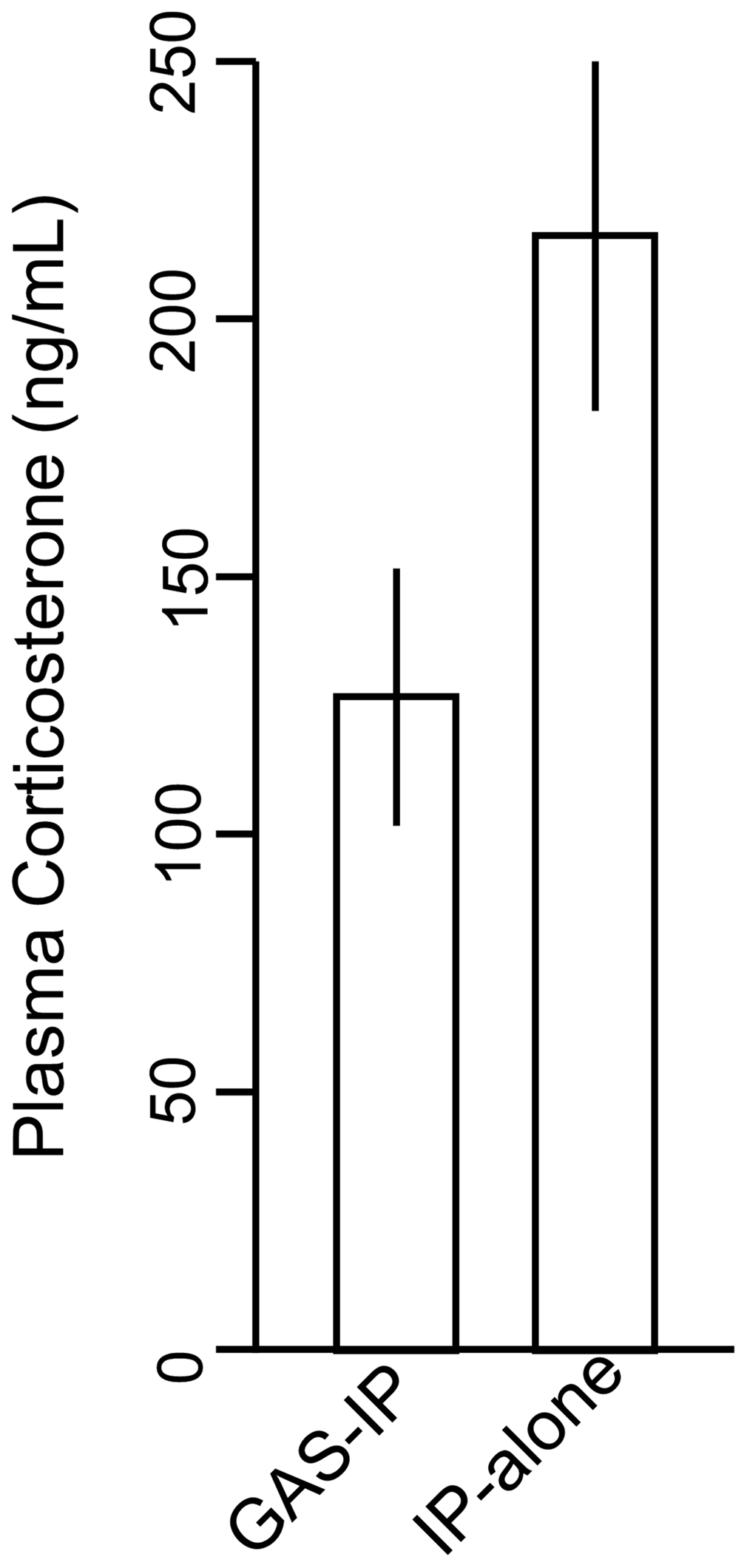
The effect of sevoflurane inhalation prior to intraperitoneal injection (GAS-IP) or intraperitoneal injection alone (IP-alone) on the stress response in rats, as reflected by plasma corticosterone concentrations (average ± SE).
There are, however, some limitations in interpreting the results. Rats show aversive behaviour to the smell of sevoflurane, which may have certain physiological impacts, thus, the advantage found in the current study should not be extrapolated to experienced experimenters. 5 It is yet to be determined whether the findings in this study could be applied to mice, since their small body size might generate less stress in experimenters. Also to be resolved is whether the stress-reducing effect of the preceding inhalational anaesthetic might be greater than stress levels when exposed to isoflurane rather than sevoflurane, or if female rat subjects were used instead of males.
Supplemental Material
sj-pdf-1-lan-10.1177_00236772241279680 - Supplemental material for Preceding sevoflurane inhalation in rats reduces the stress of intraperitoneal injection both in inexperienced experimenters and subject rats
Supplemental material, sj-pdf-1-lan-10.1177_00236772241279680 for Preceding sevoflurane inhalation in rats reduces the stress of intraperitoneal injection both in inexperienced experimenters and subject rats by Hidetoshi Ishibashi and Hideyuki Motohashi in Laboratory Animals
Supplemental Material
sj-xlsx-2-lan-10.1177_00236772241279680 - Supplemental material for Preceding sevoflurane inhalation in rats reduces the stress of intraperitoneal injection both in inexperienced experimenters and subject rats
Supplemental material, sj-xlsx-2-lan-10.1177_00236772241279680 for Preceding sevoflurane inhalation in rats reduces the stress of intraperitoneal injection both in inexperienced experimenters and subject rats by Hidetoshi Ishibashi and Hideyuki Motohashi in Laboratory Animals
Footnotes
Acknowledgments
The authors thank Ken Kojima for performing the plasma corticosterone concentration assays.
Data availability statement
The visual analogue scale questionnaire and all data used for the statistical analyses can be found in Supplemental materials.
Declaration of conflicting interests
The authors declare that they have no potential conflicts of interest with respect to the research, authorship, and publication of this article.
Funding
This work was supported by the Takeda Foundation and by JSPS KAKENHI (grant number JP23K08787).

Supplemental material
Supplemental material for this article is available online.
References
Supplementary Material
Please find the following supplemental material available below.
For Open Access articles published under a Creative Commons License, all supplemental material carries the same license as the article it is associated with.
For non-Open Access articles published, all supplemental material carries a non-exclusive license, and permission requests for re-use of supplemental material or any part of supplemental material shall be sent directly to the copyright owner as specified in the copyright notice associated with the article.
