



Abstract
The aim of this experimental, descriptive study was to evaluate feasibility, safety and side effects of alfaxalone and midazolam by intranasal instillation for anaesthesia induction in rabbits. We included 26, healthy, female New Zealand White Rabbits undergoing general anaesthesia in context of a study to test different coatings for stifle joint endoprosthesis. Midazolam (0.1 mg/kg) and alfaxalone 3 mg/kg (group 1) or 4 mg/kg (group 2) were mixed and administered intranasally. The number of sneezes, swallows and evasive attempts were recorded. Time to lateral recumbency, presence of salivation, nystagmus, induction and intubation qualities were scored. If intubation was not possible, a top-up of 1 mg/kg alfaxalone was administered intranasally. If still not sufficient, anaesthesia was induced by mask-insufflation of isoflurane. Data were analysed using IBM SPSS Statistics 30.0.0.0 and non-parametric data compared using either a Mann–Whitney test or a chi-square test. Overall, 10 animals assigned to group 1 and 16 animals to group 2 were included in the study. In 24/26 rabbits (92.3%) no significant complications were noted. One rabbit showed 20 s of apnoea after induction and one rabbit died during induction. Top-up dosages of alfaxalone were necessary in three cases and in two of these three, isoflurane administration was also required to complete anaesthetic induction. The median time to lateral recumbency was 32.5 s in group 1 and 15 s in group 2. By intranasal application of midazolam with alfaxalone at both dosages, the anaesthetic state was induced shortly after application.
Introduction
The anaesthesia related mortality rate of rabbits is reported to be between 1.39% 1 and 4.8% 2 and is hence significantly higher compared with cats (0.24% 1 ) or dogs (0.17% 1 ). 3
Rabbits are commonly used as laboratory animals or pets, both requiring safe anaesthetic protocols.
Intravenous4,5 and intramuscular6–9 administration of alfaxalone alone or in combination with different drugs to induce anaesthesia has been well studied in rabbits, but to the knowledge of the authors the intranasal instillation has not yet been published.
Intranasal administration of drugs appears feasible in rabbits, as it is a quick and easy procedure and because rabbits do not repel the intranasal instillation of drugs as much as other animals. It has already been reported that rabbits remain calm,10,11 while cats start salivating (unpublished data from PK and KKL) and dogs start sneezing. Therefore, the intranasal route of administration seems concomitant with a reduced stress level compared with conventional routes of administration.
In contrast, intravenous administration often results in cardiovascular depression, and during inhalation induction (mask-insufflation) rabbits often hold their breath.12–14
Safe intranasal administration of midazolam instead has already been published and was shown to be a stress-reducing way of sedation in rabbits. 10 Intranasally administered midazolam has furthermore been shown to result in a more rapid onset and shorter duration of sedation compared with intramuscular administration and to be less cardio-depressant. 15
Through the highly vascularized mucosa in the nasal cavity and hypothetically by bypassing the blood–brain barrier16,17 the onset of action of medications is expected to be faster compared with intramuscular injection, while being subject to less first pass metabolism compared with oral or rectal administration. 18 Furthermore, the total surface area of the nasal cavity of a rabbit is large (approximately 56.6–57.8cm2 per nostril 19 ), and therefore the available surface is rather large, allowing for a good drug absorption. Because of this good absorption and the published data on midazolam intranasally, we chose drug doses similar to those published for intramuscular injections.
Short acting medications are desirable as most of the anaesthetic related fatalities occur post-operatively 1 and quick recovery from anaesthesia is desired. Therefore alfaxalone, a non-accumulating drug with mild respiratory depressant effect and a fast onset of anaesthesia, and midazolam, a short acting and reversible 20 benzodiazepine, which causes only minimal respiratory or cardiovascular depression, are drugs of high interest for induction of anaesthesia in rabbits.
The authors hypothesized that the intranasal administration of alfaxalone with midazolam is a safe, quick and effective option to induce anaesthesia in rabbits, which would create good conditions for endotracheal intubation.
This study’s objectives were consequently to evaluate the feasibility, safety, time of onset, and side effects of midazolam in combination with two different doses of alfaxalone by intranasal instillation for anaesthesia induction and intubation in rabbits.
Material and methods
All animal experiments were carried out according to the Swiss laws of animal protection and welfare (TSchG 455) and approved by the local governmental veterinary authorities (approval number ZH273/14).
From a study including 35 rabbits to test different coatings for stifle joint endoprosthesis (EU-grant study, project number 310477), 26 animals were selected in dependence of the underling orthopaedic study and anaesthetized according to the protocol herein studied. These 26 healthy, female New Zealand White Rabbits had a mean age of 199.7 days (150–270 days) and a mean body weight of 3.55 kg (3.01–4.45 kg).
The animals arrived at least seven days prior to the planned anaesthesia and surgery to ensure an adequate acclimatization period (Charles River Laboratories, Research Models and Services Germany GmbH, Sulzfeld, Germany).
They were marked by a unique ear tattoo, which guaranteed their clear assignment throughout the study.
All rabbits were examined at the day of arrival, to ascertain their health and suitability for the study. Their body weight was recorded, and they were housed in groups, or if this was not possible owing to difficult social behaviour, into an individual box with visual and olfactory contact.
If any suspicion of a parasite infestation arose, a pooled faecal sample was collected over three days and examined.
Their health status was checked and recorded twice daily during their entire stay in our facility.
Only healthy and parasite-free animals were included in the study.
Within the 48 h before anaesthesia the body weight data were updated, to allow for a precise calculation of the drugs.
On the day of surgery, the animals were transported to the surgical facility where a pre-anaesthetic examination was performed, which included a thoraco-abdominal auscultation and evaluation of the vital parameters (heart rate, respiratory rate, rectal temperature), quality of the pulse, the hydration status and mucous membrane evaluations. An American Society of Anaesthesiologists (ASA) classification was performed. If no abnormalities were recorded (ASA 1), anaesthesia was induced using midazolam (Midazolam Sintetica 5mg/ml, Sintetica AG, Mendrisio, Switzerland) and alfaxalone (Alfaxan® 10mg/ml, Jurox (UK) Limited, Worcestershire, United Kingdom) in a mix-syringe applied intranasally, after a pre-oxygenation for 3–5 min with 2 l/min oxygen flow via a face mask. The volumes of instillation varied (no dilution of drugs) but the evaluator was blinded to them.
Animals were randomly assigned (using research randomizer.org) to one of two groups: group 1 received a dose of 3 mg/kg alfaxalone intranasally and group 2 received 4 mg/kg alfaxalone intranasally. In addition to alfaxalone, all rabbits received 0.1 mg/kg midazolam intranasally.
During intranasal drug instillation, the rabbits were positioned and gently held in sternal recumbency by a helping person, with the head dorsiflexed (Figure 1), while the drugs were slowly dripped into each nostril over 30 s/each.

Immobilization of the rabbit.
Both drugs were mixed undiluted in one syringe (administered volumes: 0.99–1.7 ml) and then slowly dripped into each nostril over 60 s in total (30 s per nostril) without introducing any syringe part into the nostril. The slow administration into both nostrils was chosen to prevent swallows of the instilled fluid in order to best utilize the mucosal surface for absorption.
The numbers of sneezes, swallows and evasive attempts during drug instillation of each rabbit were recorded.
The evaluator scored induction immediately at the end of intranasal drug administrations as follows:
5: Excellent (lateral recumbency, no reaction to stimulus (ear pinch));
4: Good (lateral recumbency but lifts head or limbs to stimulus);
3: Fair (sternal recumbency);
2: Moderate (incomplete, wobbling, considerable movement and/or excitement);
1: Poor (no anaesthesia, failure to achieve lateral recumbency).
The induction score was given after the first intranasal instillation (first dose of medication).
Endotracheal intubation was performed blindly with an acoustic guidance technique using a modified stethoscope attached to the endotracheal tube, as previously described by Sponheimer and Kronen. 21 Before intubation, 0.1 ml/kg of 1% lidocaine (Lidocaine 2% Streuli®, Streuli Pharma AG, Uznach, Switzerland + NaCl 0.9%, B Braun Medical AG, Sempach, Switzerland, diluted 1:1) was applied onto the larynx topically via the endotracheal tube to desensitize the larynx. Twenty seconds after application of the lidocaine, the endotracheal tube was then advanced into the trachea. The correct position of the placed endotracheal tube was assessed by auscultation and capnography.
If more than four cautious attempts were necessary to intubate the rabbits’ tracheas, a top-up of 1 mg/kg alfaxalone was administered intranasally. If that still was not sufficient, anaesthesia was induced by mask insufflation of isoflurane in oxygen prior to endotracheal intubation.
The anaesthetist scored the ease of intubation as follows:
5: Excellent (easy to intubate, first attempt);
4: Good (intubation at second attempt);
3: Fair (third or fourth attempt, or needs additional lidocaine 1% (0.5 ml));
2: Moderate (more than four attempts/difficult intubation);
1: Poor (failure to intubate, needs additional anaesthetic).
The anaesthetist intubating was always the same experienced person (PK).
Additionally, adverse reactions, nystagmus (scored as slow=1, intermittent=2, fast=3), salivation (scored as none, little or much) and time to lateral recumbency (in seconds) were recorded.
One catheter (BD VenflonTM Pro Safety 22G, Becton Dickinson Infusion Therapy AB, Helsinborg, Sweden) was inserted each into an auricular vein and the opposite side auricular artery, a blood sample was drawn, and blood chemistry and haematology were analysed. All rabbits received enrofloxacin (Baytril® 2.5%; 7.5 mg/kg, Provet AG, Lyssach, Switzerland), meloxicam (Metacam® 5 mg/ml; 1 mg/kg BW; Boehringer Ingelheim GmbH, Basel, Switzerland) and buprenorphine (Temgesic®, 0.3 mg/ml; 0,01 mg/kg BW; Essex Chemie AG, Luzern, Switzerland) intravenously as soon as the venous catheter was placed.
Anaesthesia was maintained by a balanced protocol using isoflurane–oxygen inhalation (Forene, Abbott AG, Baar, Switzerland) and ketamine administered intravenously in a constant rate infusion (Ketanarkon 100 ad. us. vet., 15–20 μg/kg per min, Streuli Pharma AG, Uznach, Switzerland) following a bolus at the start (Ketanarkon 100 ad. us. vet., 0.5–2 mg/kg BW Streuli Pharma AG, Uznach, Switzerland). Additionally, the animals received an intravenous infusion of Ringer-Lactate (5–10 ml/kg per h).
Arterial oxygen saturation values, end-tidal carbon dioxide values, echocardiogram, invasive (direct) arterial blood-pressure and temperature were monitored continuously and recorded every 10 min. These data were not part of the current study and are consequently not reported or analysed but are available from the authors.
The study’s humane endpoints were defined in the underlying orthopaedic study.
Statistical analysis
Data management and statistical analysis were performed using Microsoft Excel (Microsoft 365) and IBM SPSS Statistics 30.0.0.0.
The numbers of sneezes, swallows and evasive attempts during the intranasal administration, the time to lateral recumbency as well as the scores for salivation, nystagmus, induction and intubation after the intranasal instillation were analysed.
The induction score used for statistical evaluation was the one assigned after the first drug instillation, because in this study we had only three animals that did require additional drug administration, not warranting separate statistical evaluation. Instead, the intubation score used was the final intubation score (at successful completion of intubation).
Non-parametric data were compared using either a Mann–Whitney test for analysis of time to lateral recumbency as well as for scores for salivation, nystagmus, induction and intubation with the results presented as median with interquartile range (IQR). Pearson chi-square test was used to analyse the number of sneezes, swallows and evasive attempts with the results presented in the same manner. A value of p <0.05 was considered statistically significant.
Results
Overall, 26 healthy rabbits classified as ASA 1 were used for this study (group 1: n=10; group 2: n=16).
In 24/26 rabbits (92.3%) no complications occurred during induction of anaesthesia. In two rabbits of group 2 (7.7%), complications during induction were recorded: one rabbit (number 03) showed a short period (20 s) of apnoea after induction and returned to spontaneous breathing without further complications or interventions. Another rabbit (number 28) died during induction and therefore had to be excluded from statistical analysis except for overall mortality rate, mean age, and mean body weight. Further details are provided below.
The rest of the statistical analyses was performed with the remaining 25 rabbits.
A significant difference of time to lateral recumbency after completion of intranasal drug instillation was found (p=0.008). The median time to lateral recumbency in group 1 was 32.5 s (IQR 52 s), while in group 2 it was significantly lower, with 15 s (IQR 10 s).
No other significant differences were observed between the groups for any of the remaining parameters. Only slightly higher nystagmus-scores were found in group 1 compared with group 2 (p=0.071).
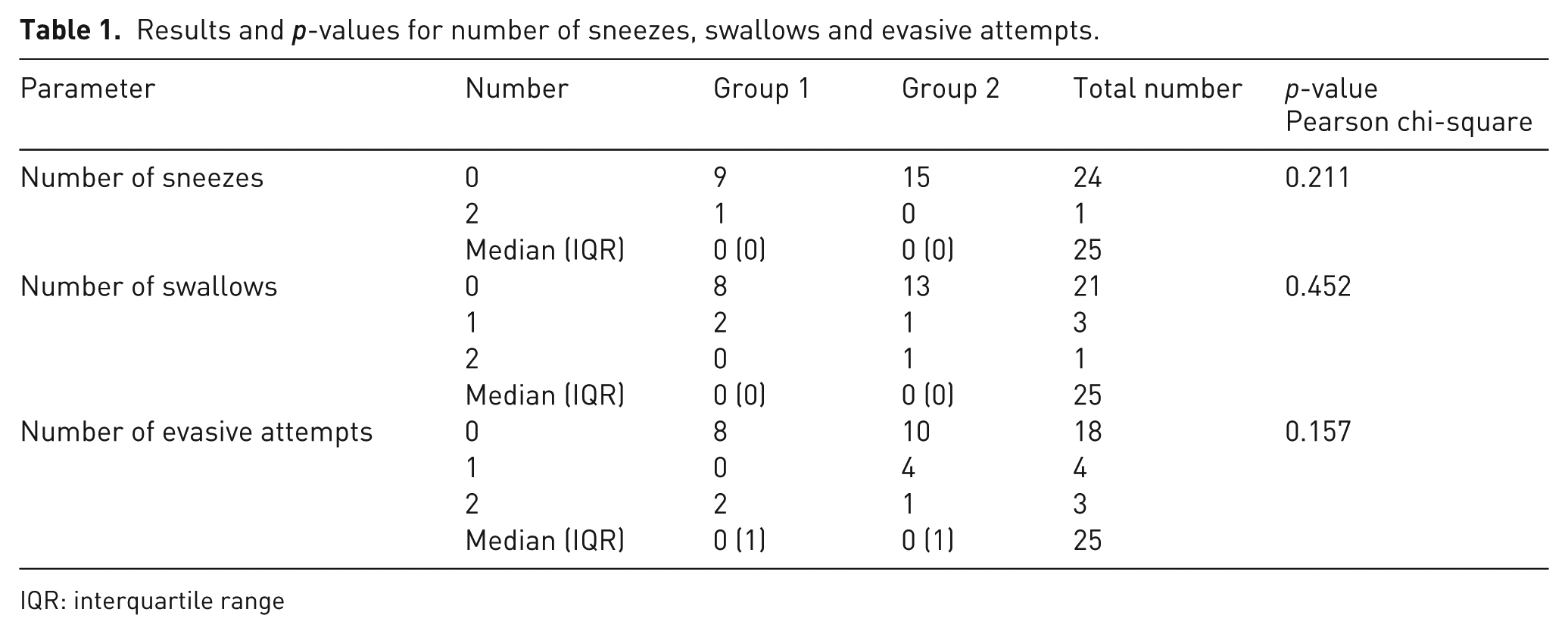
Results are presented in Table 1 for number of sneezes, swallows and evasive attempts analysed using Pearson chi-square test and in Table 2 for time to lateral recumbency, and scores for salivation, nystagmus, induction and intubation analysed using Mann–Whitney test.
Results and p-values for number of sneezes, swallows and evasive attempts.
IQR: interquartile range
Results and p-values for time to lateral recumbency, and scores for salivation, nystagmus, induction and intubation.

Statistical significance.
IQR: interquartile range.
It is important to note that even at higher induction scores – when handling and even painful stimulations (catheter placements) were possible – intubation was not always possible, and some rabbits reacted to this stimulation with swallowing and chewing.
In fact, three animals needed a top-up dose of alfaxalone and two of these required isoflurane as well. Therefore, these three animals received additional intubation scores after the top-up dose of alfaxalone or isoflurane.
Two of these three animals were in group 1 and one in group 2 and are described in more detail in the following.
Animal number 10 (group 1) was in lateral recumbency after 35 s with an initial induction score of 4. Nevertheless, during intubation, it showed two evasive attempts and swallowed once and could not be intubated, leading to an initial intubation score of 1.
Animal number 17 (group 2) was in lateral recumbency after 30 s with an initial induction score of 3. Although it showed neither evasive attempts nor swallows it could not be intubated (score 1).
Both rabbits were chewing on the endotracheal tube, which impeded a successful endotracheal intubation. In both cases the top-up alfaxalone was not sufficient and an isoflurane mask insufflation was necessary to enable endotracheal intubation. In both cases the initial induction and intubation scores remained unvaried after the top-up. Animal number 10 then received a final induction score of 4 and final intubation score of 2 and animal number 17 received a final induction score of 4 and final intubation score of 5 (after isoflurane mask induction).
Both animals showed evasive manoeuvres when being masked with isoflurane even after the previous drug administrations (alfaxalone with midazolam plus alfaxalone top-up dose). However, neither animal vocalized nor held its breath (Table 3).
Induction and intubation scores of animals 10, 13 and 17.
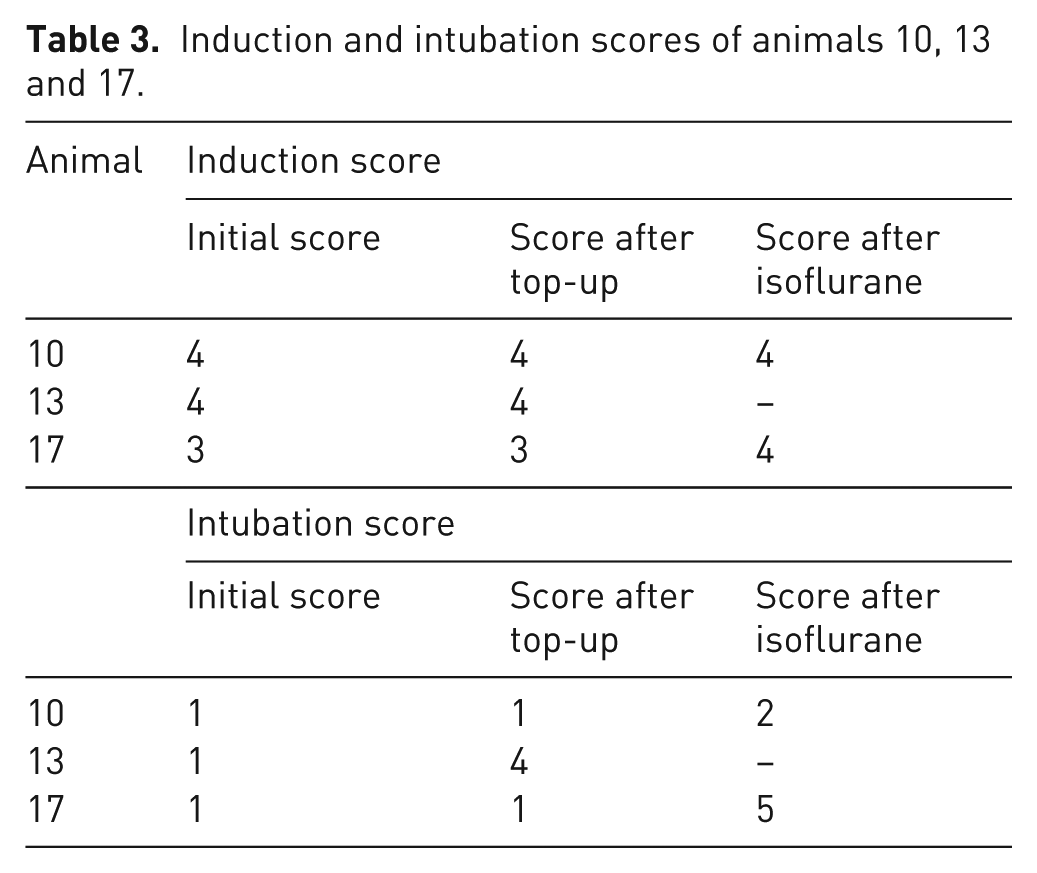
Animal 13 (group 1) sneezed twice during the initial intranasal drug instillation and was temporarily in lateral recumbency after 25 s. It showed intermittent nystagmus, but then returned to sternal recumbency and intubation was not possible. Therefore, a top-up dose was necessary. After the second intranasal drug instillation the animal was back to lateral recumbency after 15 s and had slow nystagmus. It received an induction score of 4, the intubation after the top-up was scored as good (4).
The animal that died (number 28) showed only intermittent nystagmus during induction and already 2 s after finishing the intranasal instillation it was in lateral recumbency. Before intubation could be attempted, apnoea and cardiac arrest occurred. Cardiopulmonary resuscitation was attempted, but a return of spontaneous circulation could not be achieved.
A post-mortem pathological evaluation revealed acute congestion and hyperaemia of larynx, lung, spleen, liver and kidney as well as severe diffuse oedema of the lung and mild multifocal myocardial necrosis and degeneration. In addition, a small erosion and ulceration of the epiglottic basis was seen.
Discussion
Rabbits react well to the intranasal instillation of drugs compared with cats and dogs.10,11 This was shown again in this study by the low incidence of sneezing, swallowing and evasive manoeuvres.
The drug instillation was easy to perform, and only gentle restraint was necessary using this two-person induction technique. The immobilisation of the patient was only necessary for about 1 min, which is considerably less compared with an intravenous application. In this study, sternal immobilization of the rabbits was chosen, as Weiland et al. 3 had shown a few fatal outcomes when rabbits had been anaesthetized by intranasal route in dorsal recumbency.
Overall, the intranasal administration can be considered convenient for both the rabbit and the anaesthetist.
Additionally, the authors observed that, if the thumb of the person restraining the animal during the intranasal instillation is positioned on the mandibula and the index finger on the rabbit’s nose, the rabbit presses its head into the hand and remains even calmer. This could potentially be explained by their normal hiding reflex as a prey animal, which might have been imitated (Figure 1).
The application of the drugs with a normal syringe (without catheter or another tip) was shown to be sufficient. The volume was easily instilled drop by drop directly into each nostril. A catheter tipped syringe as described by others 22 was not necessary; in contrast damage to the fragile mucosa was avoided by not introducing a foreign body and the whole nasal cavity surface was available for the absorption of the anaesthetics.
During mask insufflation no vocalization was noted, neither did the rabbits hold their breath, as previously described by Flecknell et al. 23 As in this study there were only two animals that required a mask induction, the authors cannot draw a direct conclusion. But if intranasal instillation of the drugs does not directly achieve a deep enough induction for endotracheal intubation, it can be speculated that then an induction with a mask is feasible with less stress compared with an induction solely by insufflation with isoflurane.
Alfaxalone was chosen as it is thought to produce reasonable muscle relaxation, a smooth induction of anaesthesia and good conditions for endotracheal intubation in the rabbit. 24 These expectations were fulfilled, as proven by the fast time to lateral recumbency (median: 32.5 s group 1; 15 s group 2) and the good intubation scores.
Multiple studies have shown a dose-dependent respiratory depression in rabbits,5–8 and when administered intravenously, apnoea is a frequent side effect of alfaxalone. 4 In this study, respiratory depression was noted after intranasal administration in two cases (animals 03 and 28).
The doses of 3 mg/kg and 4 mg/kg alfaxalone used in this study range between the published intramuscular (5 mg/kg,6 6 mg/kg,7 5–7 mg/kg,8 4–8 mg/kg9), and intravenous (2–3 mg/kg,5 1.25–1.45 mg/kg4) doses.
Nystagmus is an indicator of too light anaesthesia. Therefore, it is not surprising that there is slightly less nystagmus (p=0.071) in the 4 mg/kg alfaxalone group. Combined with the significantly lower times to lateral recumbency of group 2, a dose of 4 mg/kg alfaxalone intranasally might seem more reliable. Nevertheless, as we found no significant differences in induction and intubation scores between groups 1 and 2, we can conclude that both doses warrant further evaluations for intranasal induction of anaesthesia.
As expected, the short times to lateral recumbency (5–135 s) indicate a faster onset of the medications after intranasal instillation compared with an intramuscular injection (2.5 ± 1 min;7 2.3–3.1 min;9 300 ± 68 s15).
The induction and intubation scores suggest that alfaxalone at 3 mg/kg and 4 mg/kg in combination with midazolam administered intranasally create acceptable conditions for endotracheal intubation in most cases (23/26).
This is of high importance as the narrow anatomy of the oropharynx and the high susceptibility to laryngeal spasm of rabbits require sufficient anaesthetic depth for intubation.25–30
The authors can only speculate as to why the top-up doses of alfaxalone were ineffective and did not lead to a better intubation score in general.
Sneezes, swallows and evasive manoeuvres occurred in 2/3 cases in which an intranasal top-up dose was necessary. This could indicate that the drug was eliminated from the nose and not absorbed.
Maybe the top-up dose would have been more effective if administered earlier (as soon as sneezes/swallows were noted) and not only after intubation was rated as not feasible, as probably not enough of the medication was absorbed in the first place.
On the other hand, the top-up dose might not have been absorbed as well as the first dose as the circulation was already impaired due to the effects of the first dose and the stress of the intubation attempt.
As only 25% of the swallowing rabbits and 14.3% of the rabbits which tried to evade the instillation needed a top-up, it cannot be ascertained from our data if that is the real reason for the lack of response to the top-up dose.
The mortality rate in this study is 3.85% due to the death of one rabbit during induction of anaesthesia.
The post-mortem pathological findings are consistent with a hypoxic shock, probably due to respiratory and heart failure following the induction of anaesthesia. An acute laryngeal spasm cannot be ruled out. There was no indication for an experiment-specific adverse event and no pre-existing health problem had been diagnosed.
It must be concluded that this induction protocol is not safer compared with previously published protocols, as the mortality rate is comparable to others.
Limitations of this descriptive study were the low case numbers and the unbalanced distribution of the animals to each group. No sample size was calculated for the current study, because the number of animals was determined by the underlying orthopaedic study.
The cardiopulmonary effects of the drug combination were not evaluated in detail in the present study, which limits the comparison between different induction protocols.
The strain, age and sex of the animals was also determined by the respective orthopaedic study.
Only female rabbits were included in this study, thus sex-based differences in the pharmacokinetics, which might influence the determination of the dose,31,32 cannot be evaluated. Therefore, further studies that also involve male rabbits are warranted, especially as White et al. have shown significant differences between the sexes for plasma clearance, half-life and mean residence time of intravenous alfaxalone in rats. 33
Conclusion
This study indicated that after intranasal application of midazolam together with alfaxalone at both doses given, general anaesthesia could be effectively induced shortly after application in most rabbits (77%).
The combination may be a suitable, stress-reducing induction protocol to facilitate intubation. Further studies are needed to evaluate the doses given and the mortality rate in a larger number of animals and to assess the cardiopulmonary effects.
The study results show few differences between the 3 mg/kg and the 4 mg/kg dose. But with the 4 mg/kg dose, there was one rabbit with short apnoea and one death. A future study evaluating an administration of the alfaxalone–midazolam combination described to effect, rather than at fixed final dose, might be of interest.
Further studies regarding the haemoglobin oxygen saturation, cardiovascular and respiratory parameters (besides heart/pulse and respiratory rates) during induction and recovery period are warranted. In addition, the evaluation of the duration of the initial anaesthetic state would be desirable, as this becomes more important if the anaesthetist is not experienced with endotracheal intubation in rabbits.
Footnotes
Authors’ contributions
JH analysed and interpreted the patient data and is the primary author of the paper. PK and KKL performed the experiments and contributed to writing the manuscript. All authors read and approved the final manuscript.
Availability of data and materials
Data are available on file with the authors.
Consent for publication
Not applicable
Declaration of conflicting interests
The authors have no conflicts of interest to declare.
Ethics approval and consent to participate
All animal experiments were carried out according to the Swiss laws of animal protection and welfare (TSchG 455) and approved by the local governmental veterinary authorities (approval number ZH273/14).
Funding
The authors received no financial support for the research, authorship, and/or publication of this article.
