




Abstract
This article presents an experimental investigation of kinematics of verb sign production in American Sign Language (ASL) using motion capture data. The results confirm that event structure differences in the meaning of the verbs are reflected in the kinematic formation: for example, in the telic verbs (THROW, HIT), the end-point of the event is marked in the verb sign movement by significantly greater deceleration, as compared to atelic verbs (SWIM, TRAVEL). This end-point marker is highly robust regardless of position of the verb in the sentence (medial vs. final), although other prominent kinematic measures, including sign duration and peak speed of dominant hand motion within the sign, are affected by prosodic processes such as Phrase Final Lengthening. The study provides the first kinematic confirmation that event structure is expressed in movement profiles of ASL verbs, up to now only supported by apparent perceptual distinctions. The findings raise further questions about the psychology of event representation both in human languages and in the human mind.
1 Introduction
Human languages label observable events in a conceptually restricted manner, commonly described in linguistic literature as Aktionsart, or verbal event structure (Dowty, 1979; Pustejovsky, 1991; Vendler, 1967). The verbs which describe events as homogeneous, such that any part of the event can be described using the same verb as that describing the event itself (for example, swim, walk), are termed atelic. The verbs which describe events as heterogeneous phenomena that involve a change, resulting in a particular end-state for the affected argument 1 (such as fall, break), are termed telic.
Behavioral and neurophysiological studies of verbal event structure in spoken languages demonstrate that telic verbs, which license the affected (internal) argument, prime the Patient theta-role during online comprehension, facilitating processing of complex syntactic structures (Malaia, Wilbur, & Weber-Fox, 2009; O’Bryan, 2003; O’Bryan, Folli, Harley, & Bever, submitted). For example, the correct assignment of thematic roles in reduced relative clauses with atelic verbs (e.g., “The infant bathed by the mother cried loudly”) is more difficult compared to reduced relative clauses with telic verbs (e.g., “The infant changed by the mother cried loudly”). These psycholinguistic data confirm that telicity, a property of the verb reflecting its lexical semantic complexity, is also a key component in the interface linking syntactic structure and conceptual representation in human languages.
Recent research has also shown that event structure of signed verbs affects their morphosyntactic behavior in American Sign Language (ASL) (Brentari, 1998; Wilbur, 2005, 2008). Brentari (1998) observed that the morphological process ‘delayed completion’ could only apply to telic signs (related to the fact that telic verbs, but not atelics, have an event end-point which can be considered as the completion that the ‘delayed completion’ delays). In the process of trying to explain various gaps in the behavior of ASL verbs with respect to the different types of aspectual reduplication in the language (Klima & Bellugi, 1979; Wilbur, 2005, 2009b; Wilbur, Klima, & Bellugi, 1983), Wilbur (2003) made the linguistic observation that ASL lexical verbs could be analyzed as telic or atelic based on their form: telic verbs appeared to have a sharper ending movement to a stop, presumably reflecting the semantic end-state of the affected argument (Klima & Bellugi, 1979, referred to these as ‘end-marked’ but were unable to explain the presence or absence of this marking). These end-states were observed to be overtly marked in ASL by several mechanisms: (1) change of handshape aperture (open/closed or closed/open); (2) change of handshape orientation; and (3) abrupt stop at a location in space or contact with a body part. Within Brentari’s (1998) Prosodic Model for ASL, which distinguishes between static and dynamic segmental units in sign language, these mechanisms of end-state representation are realized as prosodic (dynamic) features and fall into a coherent phonological class, namely those which require movement in three dimensional planes rather than just two (the latter is referred to as ‘tracing’). 2
The observation that semantic verb classes are characterized by certain movement profiles was formulated as the Event Visibility Hypothesis (EVH) for sign languages: “In the predicate system, the semantics of the event structure is visible in the phonological form of the predicate sign” (Wilbur, 2008: 229). 3 For the purposes of this study, we focus on the presence or absence in lexical verbs of event end-states 4 and how that information is conveyed in the verb forms. Based on the EVH, apparent end-marking is a systematic reflection of the notion that telic events have end-states and that these events are physically marked in verb sign production. 5 We seek to determine which kinematic variables best account for the observed movement differences.
For this study, verb signs were chosen to represent telic and atelic events. Movements in the telic signs included handshape changes (e.g., THROW, EAT-UP), orientation changes (DIE, INSULT), position change (POSTPONE), movements to contact (STING, HIT, CATCH-UP, ARRIVE), or to a point in a perpendicular plane (LOOK-AT). Atelic signs included tracing (SEW-BY-MACHINE, TRAVEL, LIVE), and repetition (BOTHER). We could not include trilled movements or holds because of the measurement difficulties that they present.
Corroborative evidence for the EVH comes from recent research in psychology, which shows that ongoing segmentation of events is an automatic component of human visual perception (Baldwin, Baird, Saylor, & Clark, 2001; Speer, Zacks, & Reynolds, 2007; Zacks & Swallow, 2007), and that segmentation of activity into events is largely based on movement features, such as speed and acceleration (Zacks, Kumar, Abrams, & Mehta, 2009). Since the visual modality of signing matches the perceptual interface tied to event segmentation, it is possible that the sensory features utilized in event perception can be overtly represented in sign languages. 6
The present experiment was designed to investigate the hypothesis that American Sign Language utilizes motion profiles of predicate signs, including speed and acceleration patterns, to reflect telicity of the event denoted by the verb. The experiment reported here is the first empirical investigation of verb sign production in relation to event structure in ASL using motion capture data. Previous studies of sign production (Mauk, 2003; Mauk & Tyrone, 2007; Tyrone, Goldstein, & Mathur, 2007) have focused on a small number of signs and signers in order to permit analysis of within signer and across signer formational variation, or within sign and between sign variation, but not with respect to semantics, grammatical function, or other factors relevant to the present study. The present study differs by taking signs from two classes of verbs to provide stimulus diversity and by using a larger number of signers to increase the power of the analysis so that generalization beyond the individual signers and stimuli can be supported. 7
The experimental design was constructed to investigate which kinematic variables could best account for the apparent ‘sharper’ end of the dominant hand movement (‘end-marking’) in telic predicates, denoting reference to the event end-point. The kinematic variables used to test the hypothesis included: the peak speed in the sign, the following speed minimum, the overall slope of deceleration from peak speed to the following minimum, and the minimum acceleration (maximum deceleration). Additionally, since Phrase Final Lengthening is known to affect syllable duration both in speech (Grosjean & Deschamps, 1975; Pierrehumbert & Hirschberg, 1990) and in signing (Liddell & Johnson, 1989; Wilbur, 1999), we varied the position of signs within phrases during production (medial vs. final), and calculated the duration of each sign and the comparative placement of deceleration onset within each sign. This allowed us to investigate possible effects of the position of the sign within the sentence on the kinematic variables, and to identify the variables which could be robust indicators of event structure despite the effects of Phrase Final Lengthening. Details for calculating these variables are provided in the Materials and methods section; the variables are illustrated in Figure 1.

An example of kinematic variables in the ASL sign HIT. The variables are labeled on the displacement, velocity, and acceleration vectors for the predicate: (a) – sign duration; (b) – maximal velocity (MaxV) within the sign; (c) – minimum velocity following the peak velocity (MinV); (d) – percent of sign elapsed to peak velocity (% elapsed); (e) – minimal acceleration (MinA) following the peak velocity; (f) – overall slope of deceleration from peak velocity to the following minimum velocity (slope). The bars show the standard error.
2 Materials and methods
2.1 Materials
Various tests have been used in the literature to demonstrate that telicity is a relevant linguistic notion reflected in the grammatical system. The most widely used tests for spoken languages include the temporal adverbial modification test (Dowty, 1979; Verkuyl, 1972), the conjunction test (Verkuyl, 1972, 1993), and the imperfective paradox/progressive entailment test 8 (Dowty, 1979); the first two of these tests were used in the present study. Additionally, ‘almost’ modification has been used as a test in sign language research to identify telic predicates (Smith, 2007).
For the purposes of our study, a group of 50 ASL signs were discussed in an interview with an ASL linguist with a Master’s degree, who was also a native ASL signer. Linguistic judgments were elicited in the adverbial modification test, the conjunction test, the ‘almost’ modification test, and the STOP/FINISH combinability test. For the adverbial modification test, ASL telic predicate signs combined with signs meaning ‘IT-TOOK-AN-HOUR’, 9 and atelics combined with ‘FOR-AN-HOUR’. Additionally, if the predicate combined with the adverbial meaning ‘ALMOST’ (implemented as an adverbial, or as a modification of the formation of the sign’s movement) with the meaning of “one did not complete doing X”, we interpreted this as the presence of an end-point (which was not reached) in the event structure of the predicate. If the predicate combined with ‘almost’ with only the meaning “one did not start doing X”, the predicate was considered atelic; as expected, some of the telic predicates allowed both interpretations.
For the conjunction test, we tested the predicates’ meaning in the context sentence ‘she did V(erb) on Sunday and on Monday’. If the sentence was interpreted as denoting two discrete events, the predicate was considered telic; if the sentence referred to one long event, the predicate was considered atelic.
Finally, the predicates were examined for combinability with the signs FINISH and STOP. In cases where the predicate combined with FINISH with the ‘completive’ meaning (Fischer & Gough, 1999), it was interpreted as having an inherent end-point (i.e., telic); if the predicate did not combine with FINISH meaning ‘completed’, but only with FINISH meaning ‘already, in the past’, and/or instead could only be combined with STOP, it was considered an atelic predicate. Results of these linguistic tests were then combined in order to classify the predicate as either telic or atelic. When telicity interpretations differed between the four tests for one predicate, signaling the possibility of frame structure alternation (Levin, 1993), the predicate was eliminated from the final set of 40 stimuli (listed in Appendix I), which included 24 telic and 16 atelic signs.
2.2 Participants
Six (four male and two female; age: 21–45) subjects were recruited by advertisement. All participants were deaf right-handed native ASL signers, and had normal or corrected-to-normal vision. Written consent was obtained from all subjects before participation according to the established guidelines of the Purdue University Institutional Review Board.
2.3 Procedure
The 24 telic and 16 atelic signs were randomized, and elicited from the participants in the following linguistic conditions: in isolation, in the carrier phrase ‘SIGN X AGAIN’, sentence-medially ‘SHE X TODAY’, and in sentence-final position ‘TODAY SHE X’. The carrier phrase condition was designed in order to elicit the sign in citation form, whereas in the sentence condition we expected to see normal prosody, including coarticulation effects. The conditions were the same for all participants: after completing a practice trial, they saw the stimuli in the same pseudo-random order, 10 and signed to the camera while standing. One production per condition was collected for each signer (thus, we recorded 160 productions per signer for six signers). The signers wore a Gypsy 3.0 motion capture suit, 11 and the data about XYZ positions of all markers were collected at the rate of 60 fps for 5 participants, and 50 fps for one participant by 6 specialty cameras mounted in a circle on the ceiling. With these cameras, no markers are ever occluded from recording, eliminating the recurrent problem of missing data in standard two-camera motion recording setups. Thus, the study design derived analytical power from larger numbers of diverse stimuli (in our case, 40 different signs) recorded once per signer per condition across multiple signers. This allows us to report the kinematic differences across well-represented linguistically meaningful classes of signs (telic and atelic verbs), rather than at the level of individual signs.
A simultaneous video recording at 30 fps rate was made with an NTSC video camera on a tripod outside the motion capture recording field. The positional data from the marker on the right wrist, tracking the movement of the dominant signing hand, were used for the analysis. 12 Both the video and the 3-D positional data were imported into ELAN annotation software, 13 and aligned using the audio marker 14 and T-pose (the signer standing with hands extended to the sides at shoulder level) at the beginning and end of each recording. The video was annotated in ELAN by a native ASL signer, who marked the beginning and end of each target sign following procedures established by Green (1984), assuming the first frame of recognition of the sign-initial handshape as the beginning of each predicate, and either the point of contact, or maximal distance traveled by the hand, as the end of the sign. Thus, the onset and the ending of each sign were defined linguistically based solely on the video cues, without access to kinematic variables. The time points for the beginning and end of each sign were extracted from ELAN annotation of the video data, and processed in MATLAB 15 to extract speed and acceleration profiles for each predicate from the recorded kinematic files.
2.4 Data analysis
The predicates with maximal speed occurring on the last or next to last frame were discarded from analysis (4.1% of cases, including 14 telic and 26 atelic sign productions, of which 5 were phrase final, and 35 were in medial position; 16 these were the cases where contact occurred at the end of the sign, but both hands kept moving together briefly after contact; this situation resulted from using Green’s definition for determining the sign end, which perhaps cuts the end short). For the rest of the predicates, the following kinematic metrics were calculated:
a) the duration of the predicate in milliseconds (Duration);
b) peak instantaneous speed achieved within each predicate (MaxV);
c) the local minimum speed following the peak speed (MinV);
d) the percent of sign movement elapsed to the moment where peak speed occurred (% elapsed), which is also the point at which deceleration starts;
e) minimum instantaneous acceleration (i.e., maximum deceleration) within each predicate (MinA);
f) the slope of deceleration, calculated as the difference between MaxV and the following local minimum, divided by the number of milliseconds over which it occurred. The slope measured the overall steepness of the deceleration from MaxV to MinV, whereas MinA measured the minimum instantaneous negative acceleration (maximum deceleration).
An example of each variable for the ASL sign HIT is given in Figure 1: the variables are labeled on the displacement, speed, and acceleration profiles for the predicate.
3 Results
Based on the Event Visibility Hypothesis, we expected Predicate type (telic, atelic) to affect the kinematics of sign movement. Additionally, given previous findings of prosodic effects on kinematic variables described in the literature (Grosjean & Lane, 1977; Klima & Bellugi, 1979; Liddell, 1977; Padden, 1983; Wilbur, 2009a), we expected to see an effect of sign Position (medial, final) on the kinematic properties of the signs. According to our hypotheses, each of these main effects (factors), separately or together, could influence sign duration, peak speed within the sign, the point of its occurrence, peak deceleration following the peak speed, and the overall slope of deceleration. Thus, multivariate analysis of variance (MANOVA GLM) was conducted to determine the effect of each main independent factor (Predicate, Position) and their interaction (Predicate × Position) on each of the five dependent kinematic variables.
For this overall MANOVA model, Predicate type (Telic/Atelic) was a significant main effect: Wilks’ Lambda = .902, F(5, 912) = 19.85, p < .001, η2 p = .098; as was Position: Wilks’ Lambda = .949, F(5, 912) = 8.164, p < .001, η2 p = .051. The interaction of Predicate type and Position was not significant for the whole model: Wilks’ Lambda = .993, F(5, 912) = 1.315, p = .255, η2 p = .007. After providing results for the whole model, GLM also returns ANOVA results and post-hoc tests (Fisher’s Least Square LSD) for Predicate type and Position and their interaction, where appropriate, for each kinematic variable (five univariate ANOVAs), to which we now turn. First we report the main effects from the univariate analyses and their post-hoc differences, then we report the results by variable to see how each is affected by the main factors.
3.1 Main effects
3.1.1 Effects of Predicate type on kinematic variables
Predicate type (Telic/Atelic) significantly affected all five kinematic variables, as shown in Table 1.
Significant effects of Predicate type and Position on kinematic variables
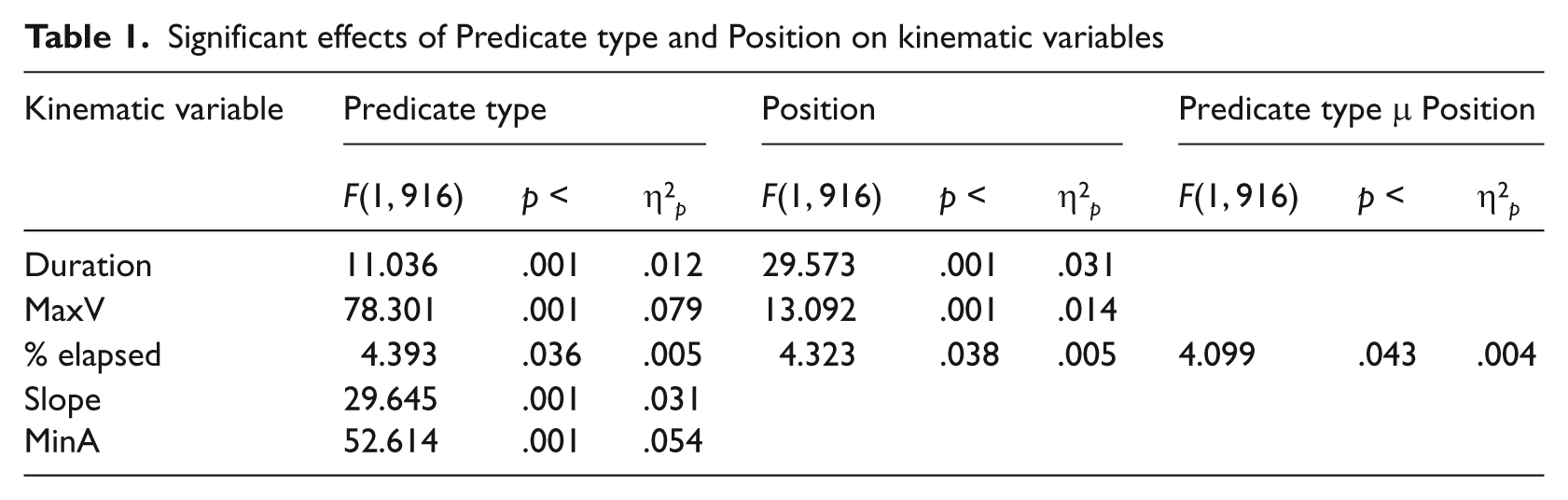
Post-hoc testing (Fisher’s Least Square Difference, LSD) showed that peak speed was significantly greater in telic signs than in atelics (p < .001, mean difference MD = .245, SE = .029). Similarly, telic signs showed significantly greater instantaneous deceleration (MinA) than atelics (p < .001, MD = 5.576, SE = .769). Additionally, sign duration was significantly shorter in telics than in atelics (p < .001, MD = −35.512, SE = 10.69), the slope was significantly steeper in telic signs (p < .001, MD = 0.003, SE = .001), and percent of sign elapsed to peak velocity was higher in telics than atelics (p < .036, MD = 3.297, SE = 1.573).
3.1.2 Effects of predicate Position on kinematic variables
Position in the phrase (Medial/Final) significantly affected sign duration, peak speed within each sign, and percent of sign elapsed to peak speed, as shown in Table 1. No other variable was significantly affected by Position. Post-hoc testing (LSD) showed that predicates in final position were significantly longer than those in medial position (p < .001, MD = 58.133, SE = 10.69), and the peak speed in them was significantly higher (p < .001, MD = .104, SE = .029). Also, peak speed (percent of sign elapsed to peak speed) was reached earlier in predicates in final position (p < .038, MD = -3.271, SE = 1.573).
3.1.3 Interaction effects of Predicate type and Position on kinematic variables
In the univariate analyses, only one variable was affected by the interaction of Position and Predicate Type, namely, percent of sign elapsed to peak speed (MaxV), F(1, 916) = 4.099, p < .043, η2 p = .004.
3.2 Individual kinematic variables
In this section we consider each variable individually.
3.2.1 Sign duration
Sign duration was affected by both Predicate type and Position. Figure 2 shows these effects, such that signs in phrase final position were longer than those in medial position, and that in final position, telics were significantly shorter than atelics (telics, medial M = 420 ms, final M = 468 ms; atelics, medial M = 445 ms, final M = 513 ms).
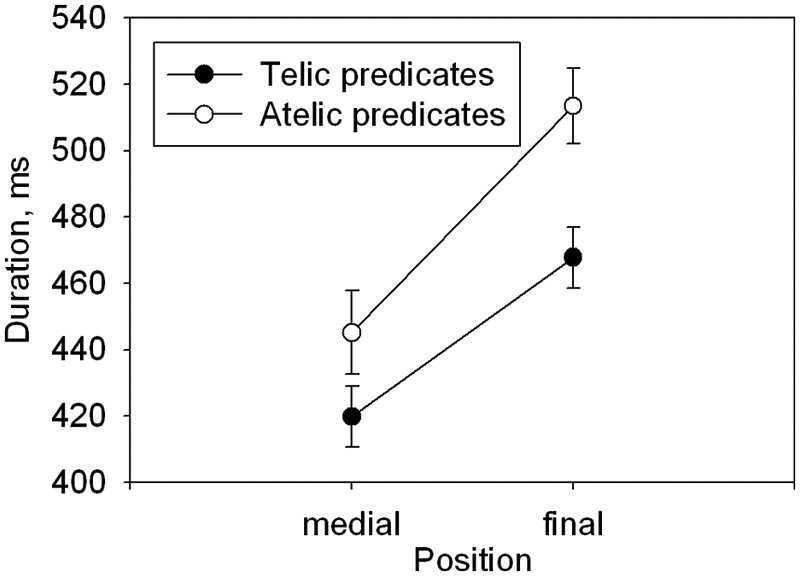
Predicate duration in telic and atelic predicates in phrase medial and phrase final position. The bars show the standard error.
3.2.2 Peak speed
Peak speed was also affected by both Predicate type and Position. Figure 3 shows these effects, such that signs in final position had significantly greater peak speed (1.04 m/s) than those in medial position (.94 m/s), and telic signs had greater peak speed than atelic signs regardless of Position (telics, medial M = 1.06 m/s, final M = 1.16 m/s; atelics, medial M = .81 m/s, final M = .92 m/s).
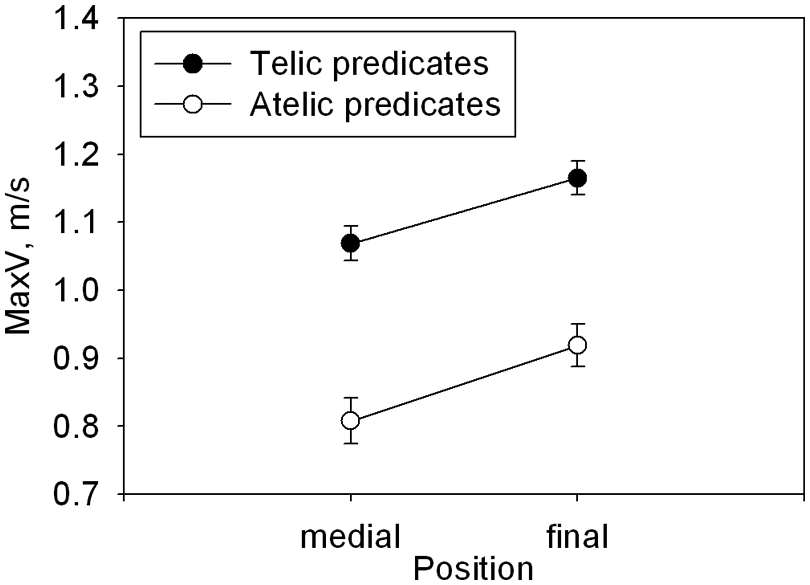
Peak velocity in telic and atelic predicates in medial and final position. The bars show the standard error.
3.2.3 Minimum instantaneous acceleration (deceleration)
Minimum instantaneous acceleration was affected only by Predicate type. The magnitude of instantaneous acceleration was greater in telic signs than in atelic ones (telics, medial M = −17.7 m/s2, final M = −18.5 m/s2; atelics, medial M = −12.4 m/s2, final M = −12.7 m/s2), as demonstrated in Figure 4.

Minimum instantaneous acceleration (i.e., maximum deceleration) in telic and atelic predicates in medial and final position. The bars show the standard error.
3.2.4 Elapsed percent of sign movement to time of peak speed
Elapsed percent of the sign movement to the moment of achieving peak speed was significantly affected by Position in atelic predicates only (yielding an interaction effect in the overall model). Peak speed was reached significantly earlier in atelic predicates in final position; Figure 5 illustrates this result, as well as lack of Position effect on telic predicates (telics, final M = 49.6%, medial M = 49.6%; atelics, final M = 43.1%, medial M = 49.5%) in medial position.
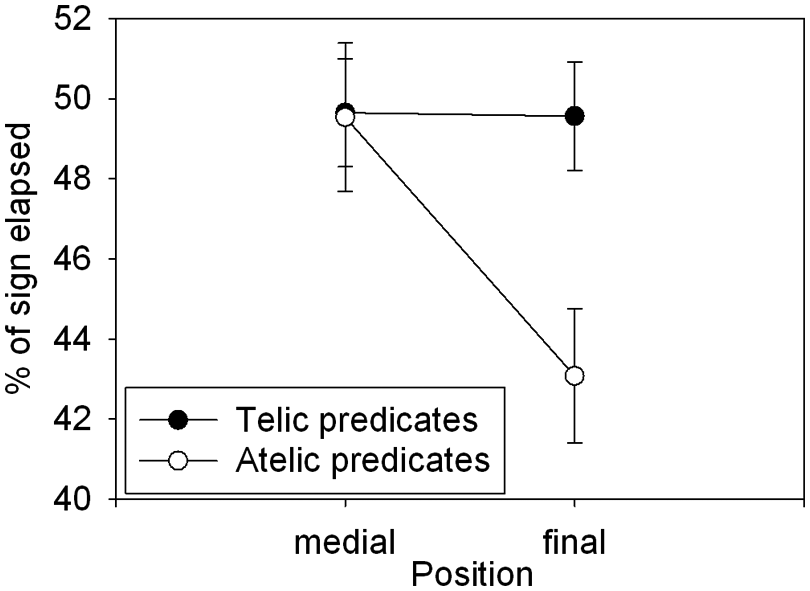
Percent of sign elapsed until peak velocity is reached in telic and atelic predicates in medial and final position. The bars show the standard error.
3.2.5 Deceleration slope
The overall slope of deceleration from the peak speed to the local minimum speed was affected only by the Predicate type. It was significantly steeper in telic signs, as compared to atelic ones (p < .001). Figure 6 shows this effect and the absence of a Position type effect (telics, medial slope −.010, final slope −.011; atelics, medial slope −.008, final slope −.007).

Gross slope of deceleration from peak velocity to the following minimum in telic and atelic predicates in medial and final position. The bars show the standard error.
3.3 Summary of findings
Predicate type had a significant effect on peak speed, instantaneous deceleration and the overall slope of deceleration within the sign, as well as sign duration, and percent of sign elapsed to peak speed. Phrase position affected sign duration, peak speed, and the point in the sign where peak speed was achieved. There was also a significant Predicate type × Position interaction effect on percent of sign elapsed to peak speed. This interaction was due to the fact that the Position effect was significant only in one predicate type: atelic.
4 Discussion
As demonstrated by statistical analysis, both Predicate type and Position show effects on the kinematic variables we investigated. Here, we further discuss these results in the context of:
4.1 Peak speed
The peak speed achieved within the sign was greater in phrase final position in both telic and atelic signs, and overall greater in telic signs as compared to atelic ones. Although peak speed was affected by both Predicate type and Position, the fact that it was significantly greater overall in telic predicates provides corroborative evidence for kinematic differentiation based on event structure of the predicate. This result agrees with the earlier findings (Wilbur, 1999), which demonstrated that individual linguistic variables, such as stress and position of the sign in the sentence, can independently affect peak speed within the sign.
4.2 Instantaneous deceleration
Telic predicates demonstrated larger absolute values of instantaneous deceleration compared to atelics in both medial and final position. Atelic predicates demonstrated an increase in the magnitude of instantaneous deceleration in the phrase final position, likely related to the increase in peak speed in this position. The fact that deceleration in telic and atelic verbs still differed significantly despite such position-related effects in atelic verbs can be taken as support for the EVH claim that the strong ‘end-marking’ of the end-point in event structure is kinematically manifested in telic sign production.
4.3 Sign duration and percent of sign elapsed to peak speed
The effect of Phrase Final Lengthening on duration of both types of predicates in Final position is consistent with earlier studies (Liddell, 1977; Wilbur, 1999), showing that sign duration is a reliable indicator of phrase boundary in ASL. The difference in duration of telic and atelic signs in phrase final position appears to result from the greater deceleration to an end-point in telic predicates marking the end-state, whereas atelic predicates are not bound by any such constraint. The lower value of ‘percent of sign elapsed to peak speed’ variable in final position in atelic signs demonstrates that Phrase Final Lengthening predominantly affects the part of the sign following the peak velocity. Telic signs, which are characterized by phonologically marked end-movement, maintain their velocity profile under the influence of Phrase Final Lengthening, with peak speed occurring roughly at the same point through the movement in the sign in both medial and final positions. Atelic signs, which do not have marked end-movements, show the effect of Phrase Final Lengthening in starting their deceleration earlier in the sign and then slowing down at a less rapid pace in the final position, as compared to the medial position.
4.4 Slope
In medial position, the slope between peak speed and the following local minimum speed was steeper overall in telic predicates. In phrase final position, the overall deceleration slope was steeper in telic predicates, and less steep in atelic predicates (mainly due to Phrase Final Lengthening, which most strongly affected the part of atelic signs following the peak speed).
5 Summary
Overall, the kinematic data thus demonstrate a production difference in telic and atelic signs reflecting the semantic distinction between telic and atelic events. ASL appears to map the linguistic distinctions between event types onto kinematic features – speed and deceleration rates – of individual lexical signs. Owing to Phrase Final Lengthening, kinematic differences in duration, speed, and deceleration slope between telic and atelic signs are somewhat mitigated in the phrase final position; however, the distinctive difference in instantaneous deceleration is maintained, constituting a resilient marker of end-point in the predicate’s event structure. This overt difference in the phonology of sign production provides empirical support for the event decomposition of predicates as proposed by the EVH.
The findings of the present experiment also raise further research questions regarding the relationships between sign languages in synchrony and diachrony. Other sign languages do exhibit event structure distinctions, some of which are linguistically manifested in different manners: for example, Austrian Sign Language also distinguishes predicate event types with distinctive non-manuals accompanying the signs (Schalber, 2004). Whereas our study has looked at lexical verb signs, there also exists a possibility that kinematic distinctions, such as those observed in the present study, can be morphologically productive, which would allow formation of telic and atelic predicates from the same sign root. An example of such a system can be found in spoken Slavic languages (e.g., Croatian, Russian), which contain distinct lexical entries for perfective (typically telic) vs. imperfective (typically atelic) verbs. This root is further modified by different affixes to render telic or atelic verb forms (Malaia, 2004). It is possible that sign languages in close contact with a spoken Slavic language family might utilize a similar mechanism of event type marking as a result of interaction in the education system. If so, kinematic distinctions like rapid deceleration following peak velocity would constitute a morphemic affix similar to those observed for various aspectual purposes, for example, in different types of reduplication 17 (Wilbur, 2005, 2009b) and be comparable to English aspectual coercion (Smith, 1991) or verb frame alternation (Levin, 1993).
The results of the experiment offer possible new variables for consideration in language acquisition research. It has been previously suggested, for example, that infants parse dynamic action by means of low-level visual cue detection, such as identification of continuity vs. change in overall body trajectory (Baldwin et al., 2001), and sentence-level pausing in sign language as early as 9 months (Brentari, Gonzalez, Seidl, & Wilbur, 2011). Further research might look at how early infants detect changes in deceleration in visual scenes, and whether this ability is affected by sign language experience.
6 Conclusions and future research
The motion capture analysis of ASL sign production demonstrated regular kinematic distinctions between telic and atelic predicates in ASL: both maximal speed and maximal deceleration of ASL predicates were significantly different in the two predicate types. While the difference in maximum speed between telic and atelic predicates was eliminated in phrase final position, the difference in maximal deceleration was robust to Phrase Final Lengthening. The motion capture evidence that event structure is reflected in the kinematic profile of predicate signs is a novel discovery, taking the first step in a new direction of kinematic analysis of signs, comparable to research on acoustic features that underlie meaning differences in speech (Breen, Fedorenko, Wagner, & Gibson, 2010).
The findings in the present study raise further questions about the psychology of event parsing and representation both in the human mind and in human languages. Further research would be necessary to determine how the perceptual cues provided by the kinematics of the predicate are interpreted by the recipient of signed discourse. Also of interest would be the investigation of the relationship between event parsing in perception and linguistic events, especially the sensory and conceptual features which might impact the correspondence between the two. The experiment also demonstrates that ASL utilizes physical properties of movement to represent event structure at the semantics-phonology interface, as evident from verb sign production.
Footnotes
Appendix I
The following predicates, which were identified as belonging to telic or atelic classes based on the results of all four linguistic tests, were selected for investigation: 18
Acknowledgements
We would like to thank our participants, and the Deaf communities of Purdue and Indianapolis for their support of ASL research. We also wish to thank Nicoletta Adamo-Villani for assistance with data recording, Robin Shay for help with participant recruitment and data annotation, and Lisa Goffman, Howie Zelaznik, and Martha Tyrone for comments on earlier versions of this manuscript. Recording was conducted at the Envision Center for Data Visualization at Purdue University. Portions of this study were presented at the Linguistic Society of America (Chicago, 2008) annual conference, and the Chicago Linguistic Society annual meeting (2008). This work was partially supported by NIH grant DC005241 and NSF 0345314 to Ronnie Wilbur.