



Abstract
According to the widely accepted Lexical Category Prominence Rule (LCPR), prominence assignment to triconstituent compounds depends on the branching direction. Left-branching compounds, that is, compounds with a left-hand complex constituent, are held to have highest prominence on the left-most constituent, whereas right-branching compounds have highest prominence on the second of the three constituents. The LCPR is, however, only poorly empirically supported. The present paper tests a new hypothesis concerning the prominence of triconstituent compounds and suggests a new methodology for the empirical investigation of compound prominence. According to this hypothesis, the prominence pattern of the embedded compound has a decisive influence on the prominence of the whole compound. Using a mixed-effects generalized additive model for the analysis of the pitch movements, it is shown that all triconstituent compounds have an accent on the first constituent irrespective of branching, and that the placement of a second, or even a third, accent is dependent on the prominence pattern of the embedded compound. The LCPR is wrong.
1 Introduction
Until recently, it was widely believed that phonological prominence assignment to triconstituent compounds, such as child care center or university textbook, depended on the branching direction. Left-branching compounds, that is, compounds with a left-hand complex constituent (e.g., child care), are held to have highest prominence on the left-most constituent, whereas right-branching compounds, such as university textbook, have highest prominence on the second of the three constituents. This idea was captured by Liberman and Prince (1977) in their ‘Lexical Category Prominence Rule’ (LCPR). Studies such as Berg (2009), Giegerich (2009) or Kösling and Plag (2009) have shown, however, that the branching direction is not a reliable predictor for noun–noun–noun (NNN) prominence placement, and that there exist compounds with all conceivable combinations of branching directions and prominence distributions. At present, it is unclear what exactly determines the prominence pattern of a given NNN compound.
The present paper has two major aims. Firstly, it develops and tests a new hypothesis concerning the prominence of triconstituent compounds and, secondly, it suggests a new methodology for the empirical investigation of compound prominence. According to the hypothesis we develop in the next section, the main problem of the LCPR lies in the assumption that NN compounds in English are left-prominent. According to recent studies, about one third of the compound tokens in natural speech are right-prominent (e.g., Bell & Plag, 2012; Kunter, 2011; Plag, 2010), which has important repercussions for the distribution of prominence in larger compounds. We hypothesize that the prominence pattern of the embedded compound has a decisive influence on the prominence of the compound: that element which is most prominent in the embedded compound will also be the most prominent element in the triconstituent compound.
Secondly, empirical investigations of compound prominence have been riddled with methodological problems. Pitch has been found to be a highly important cue to compound prominence (e.g., Farnetani, Torsello, & Cosi, 1988; Kunter & Plag, 2007; Kunter, 2011) and, consequently, the pertinent studies investigating the assignment of different prominence patterns often used pitch for their investigations. 1 However, the researchers used measures that all abstracted away from the actual pitch contours (such as mean pitch or minimum and maximum pitch), although the systematic variation of the contour is potentially highly informative for prominence perception. For instance, results in Kunter (2011) show that the slope of the pitch contour differs between the constituents of left- and right-prominent NN constructions. Yet, with the methodology employed in that analysis, it remained unclear in how far these findings reflect differences in the overall pitch contour of these constructions. We therefore propose a new method for modeling prominence in compounds that overcomes these problems by producing an abstraction of the pitch contour for the different compound types and makes use of the contour information: mixed-effects generalized additive models (GAMs) (e.g., Wood, 2006, 2011).
Using this new statistical technique for the analysis of the pitch movements, it is shown that all triconstituent compounds have an accent on the first constituent irrespective of branching, and that the placement of a second accent is determined by the prominence pattern of the embedded compound together with branching. The findings are compared to those reported by Kösling (2013) using a different methodology for the same data set. The present analysis yields compatible, yet more detailed results, which suggests that GAMs are a valid method of describing pitch contours in compounds.
The paper is structured as follows. In the next section we describe existing hypotheses on prominence assignment to NNN compounds and suggest an alternative. The third section will introduce the problems with modeling prominence in compounds on the basis of acoustic measurements. This is followed by a discussion of our methodology, and a presentation of the results. The last section concludes with a discussion of the results and an outlook of their implications.
1.1 Prominence in triconstituent compounds: hypotheses
It is generally assumed that prominence assignment to triconstituent compounds depends on the branching direction of the compound. Left-branching compounds have highest prominence on the left-most constituent, whereas right-branching compounds, that is, compounds with a right-hand complex constituent, have highest prominence on the second constituent of the whole compound. The LCPR proposed by Liberman and Prince (1977) has been evoked to account for this generalization. The LCPR labels metrical trees on the basis of strong–weak relations between two sister constituents. Hence, one constituent is always strong (S), that is, more prominent, in relation to its weaker sister constituent (W). In particular, the LCPR makes a prediction as to which constituent of a binary construction will be prosodically strong.
(1) LCPR
In a configuration [A B]: if C is a lexical category, B is strong if it branches. (Liberman & Prince, 1977, p. 257)
The predictions of the LCPR are illustrated in Figures 1 and 2. In addition to the labels ‘S’ and ‘W’ (strong and weak, respectively), the ‘N-level’ refers to the level of the embedded NN compound and ‘IC-level’ refers to the level between the complex and the single constituent, with ‘IC’ meaning ‘immediate constituent’. The tree in Figure 1 shows a left-branching compound (labeled ‘L’), while Figure 2 shows a right-branching compound (labeled ‘R’).
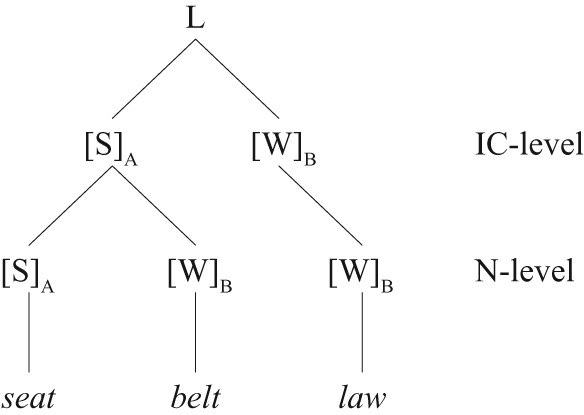
Metrical tree of a left-branching compound.
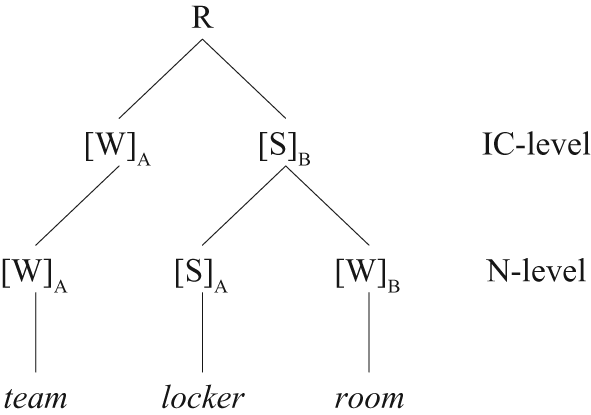
Metrical tree of a right-branching compound.
Sproat (1994) revises the LCPR in such a way that prominence assignment is seen as the result of deaccentuation: according to his np system, the second constituent of a compound retains its accent only if it is complex.
(2) np system
For each node C dominating [A B], if B is not complex, and if C is N0, then B is deaccented; else both A and B retain their accents. (Sproat, 1994, p. 84)
Yet, even Sproat’s revised version of the LCPR is only poorly empirically supported with respect to prominence assignment in complex compounds. In fact, available studies dealing with prominence assignment to NNN constructions (e.g., Berg, 2009; Giegerich, 2009; Kösling & Plag, 2009; Kvam, 1990) have shown that the LCPR fails to predict the correct prominence pattern for a considerable number of compounds.
For instance, Kvam (1990) investigated 40 NNN constructions in a production experiment. Even if his methodology remains somewhat unclear, Kvam found that the majority of the investigated compounds, namely 30 out of 40, were produced either exclusively or by the majority of the experimental subjects with prominence on constituent N2. Yet, Kvam points out that only 10 of these compounds were also clearly right-branching, that is, the group of compounds that should indeed have this stress pattern. Hence, only in 10 cases out of 40, stress assignment could be directly related to the branching direction of the compound.
Apart from Kvam’s study, additional evidence towards variation in the prominence assignment of NNN constructions is provided by Berg (2009). Taking an explorative approach by looking at a total of 642 NNN combinations taken from the British National Corpus (Berg, 2009, p. 87), Berg finds that 57.2 percent of the combinations are prominent on constituent N2, and 26.5 percent on N1. Thus, Berg’s findings go in the same direction as Kvam’s results, revealing a general tendency for triconstituent compounds to be in their majority most prominent on the second constituent, be they left- or right-branching. In addition to that, Berg also provides information about a number of right-branching compounds with prominence on constituent N1 and N3, as well as left-branching compounds with prominence on N3. Similar counter-examples are also provided in a more recent approach by Giegerich (2009). His study investigates the traditional English Compound Stress Rule, and, in contrast to Kvam and Berg, explicitly argues against the LCPR and its predictions.
Finally, a considerable number of counter-examples to the LCPR were also documented in a recent corpus study by Kösling and Plag (2009), who tested the predictions of the LCPR by analyzing about 500 compounds taken from the Boston University Radio Speech Corpus (Ostendorf, Price, & Shattuck-Hufnagel, 1996). Their analysis of the corpus data revealed a general trend for left-and right-branching compounds to behave as predicted by Liberman and Prince’s LCPR, that is, left-branching compounds tended to be prominent on constituent N1, and right-branching compounds on constituent N2. Crucially, however, their corpus data also revealed a significant proportion of compounds violating the rule, both at the level of the immediate constituents (IC-level) and at the level of the final nodes of the tree (N-level). Table 1 lists some of these N-level and IC-level violations. Note that some of the examples may appear to allow different branching interpretations than the one given in the table. Yet, the context in which the triconstituent compounds occurred in the corpus clearly shows that the given interpretation of the internal structure is the most plausible one.
Lexical Category Prominence Rule violations.
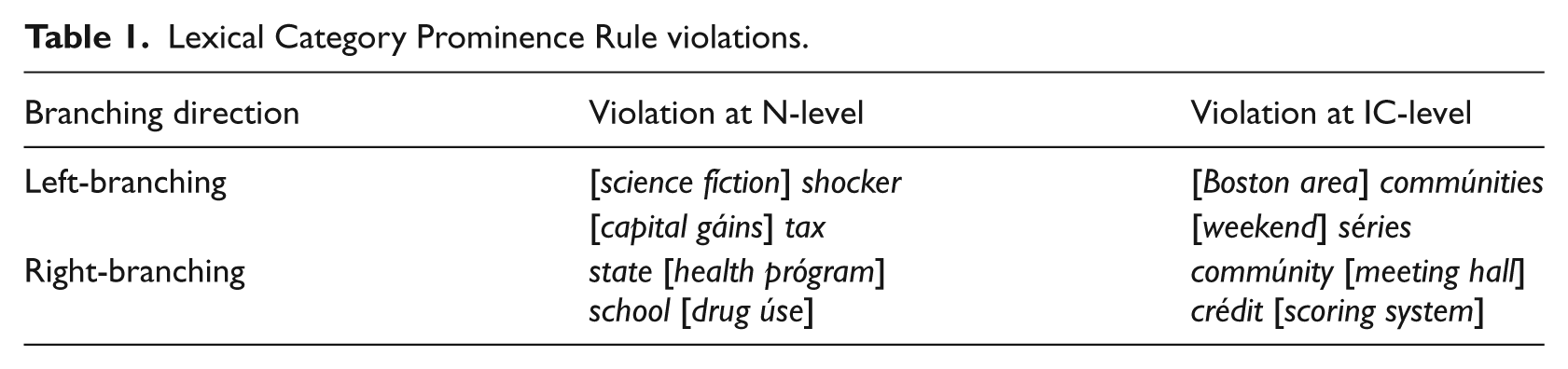
The examples listed in Table 1 raise the question of which factors are responsible for their aberrant prominence behavior. 2 Based on their data, Kösling and Plag (2009) argue that the violations at the N-level and the IC-level may both be explained by the presence of right-prominence in NN compounds. Previous studies have shown that there is a host of right-prominent NN constructions, and their frequency has been estimated to be roughly 30 percent of all NN constructions (cf. Bell & Plag, 2012; Kunter, 2011; Plag, 2010; Sproat, 1994).
Kösling and Plag (2009) propose that the violations at the N-level arise due to this presence of embedded right-prominent NN compounds: for example, science fiction shocker has prominence on the second constituent because the complex left constituent consists of the right-prominent science fiction; the same assumption is also put forward by Giegerich (2009). This prominence pattern is not predicted by the LCPR or the np system, because the existence of right-prominent compounds is not possible under the formulation of the LCPR: in Liberman and Prince’s (1977) approach, right-prominent NNs (apparently including science fiction) are simply assumed to be syntactic phrases, and the prominence pattern of phrases is assumed to follow a different prominence rule than the LCPR. The same problem is present in the np system, which also hinges on a clear distinction between compounds and phrases. For example, Sproat (1994) claims that there is a structural difference between Párk Street (which is considered a compound) and Madison Ávenue (which is considered not a compound but a phrase; Sproat, 1994, p. 83). His explanation of this difference appears to be based on the prominence pattern alone, thus leading to a circular argument: his np system will only yield right prominence for Madison Avenue if it is a phrase, but the claim that Madison Avenue has to be a phrase seems to be derived from the stress pattern alone. Indeed, it has been shown (e.g., in Bauer, 1998; Giegerich, 2009) that the distinction between compounds and phrases is very difficult to draw on formal grounds, and Park Street and Madison Avenue are a case in point.
If we apply the np system to triconstituent compounds, the patterns in Table 1 involving right-prominent NN compounds are unpredicted by the np system. For science fiction shocker, the algorithm would deaccentuate fiction (unless it is considered a phrase, but there is no independent evidence for this), and also deaccentuate shocker, because it is not complex, yielding scíence fiction shocker with prominence on the first constituent, not on the second as in the corpus data. Likewise, if we assume drug use to be a compound, use would be deaccentuated because it is not complex, so the resulting prominence pattern would be school drúg use, which conflicts with the attested school drug úse.
With reference to the IC-level violations, Kösling and Plag (2009) suggest that the same factors responsible for prominence variation in NN compounds are also responsible for prominence variation in NNN compounds. The literature on prominence variation in NN compounds usually discusses three groups of factors, namely structure, semantics and analogy. Experimental and corpus studies testing these factors (e.g., Arndt-Lappe, 2011; Kunter, 2011; Plag, 2006; Plag, Kunter, Lappe, & Braun, 2008) found that, in particular, semantics and analogy play a role, with structure being less significant (a more detailed account of these factors can be found in section 2.1 below).Hence, right-prominent NN compounds are responsible for many instances of aberrant prominence patterns at the IC-level, because the same mechanisms operating in biconstituent compounds, that is, at the N-level, may also operate at the IC-level of a given compound.
The present analysis remains agnostic about this ongoing debate on the factors affecting the prominence patterns of compounds at the IC-level, and concentrates on the N-level violations instead, for which we can formulate explicit predictions. We want to test Kösling and Plag’s (2009) and Giegerich’s (2009) hypothesis regarding the violations at the N-level with a new methodological instrument. We focus on the question as to whether the prominence pattern of the embedded NN compound affects prominence assignment in triconstituent compounds, as suggested by these authors. In particular, we want to test whether left-branching compounds with embedded right-prominent NN compounds are prominent on constituent N2, and whether right-branching compounds with embedded right-prominent NN compounds are prominent on constituent N3. These two cases would be unpredicted by the LCPR. Furthermore, we want to test whether compounds with embedded left-prominent NN compounds are prominent on constituent N1 (in the case of left-branching compounds), or on constituent N2 (in the case of right-branching compounds), as it is predicted by the LCPR. We may reformulate these assumptions as two related hypotheses, which, taken together, will be referred to as the Embedded Prominence Hypothesis (EPH, proposed by Kösling, 2011) for the rest of this paper.
(3) EPH
In left-branching and right-branching NNN compounds with embedded left-prominent NN compounds, the highest prominence is assigned to the left member of the complex constituent.
If the embedded NN compound is right-prominent, left-branching and right-branching compounds have highest prominence on the right member of the complex constituent.
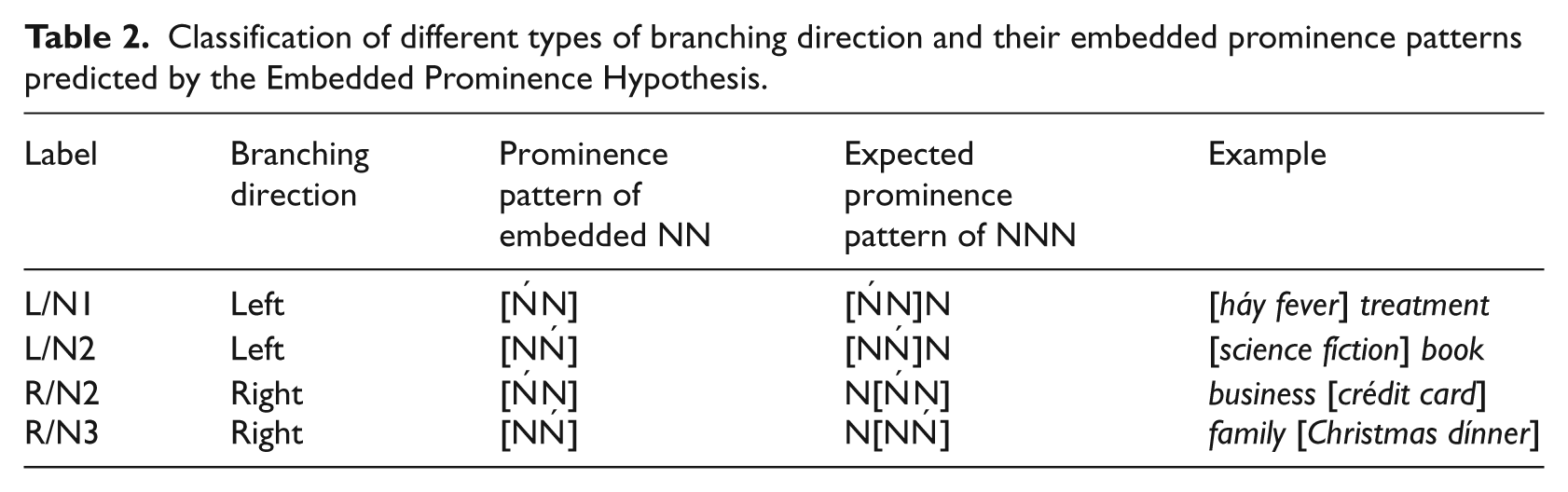
So, in effect, the EPH in (3) claims that in a triconstituent compound that has highest prominence on the complex constituent, the highest prominence falls on the constituent that is also prominent in the embedded compound. Accordingly, the hypothesis makes predictions for four different types of compounds: on the one hand, left-branching compounds with either an embedded left-prominent NN compound or an embedded right-prominent NN compound, and on the other hand, right-branching compounds with either an embedded left-prominent NN compound or an embedded right-prominent NN compound. These four types will be referred to as ‘L/N1’, ‘L/N2’, ‘R/N2’ and ‘R/N3’ in the remaining sections of this paper. The labels ‘L’ (left) and ‘R’ (right) indicate the branching direction of the NNN compound at the IC-level. The labels ‘N1’, ‘N2’ and ‘N3’ refer to the constituent in the compound that the EPH predicts to receive highest prominence in the compound. For example, right-branching compounds with a left-prominent complex constituent are expected to have highest prominence on the left-hand constituent of the embedded complex constituent, which is, as seen in Figure 2, constituent N2. This type of compound is therefore labeled ‘R/N2’. In contrast, ‘R/N3’ compounds are right-branching compounds with embedded right-prominent NNs, as the EPH predicts that the right-prominence is preserved under embedding, and highest prominence should therefore fall to constituent N3. Similarly, ‘L/N1’ and ‘L/N2’ compounds are left-branching compounds with left- and right-prominent complex constituents, respectively. Table 2 summarizes the four NNN compound types.
Classification of different types of branching direction and their embedded prominence patterns predicted by the Embedded Prominence Hypothesis.
In order to empirically test the EPH, one does not only need large amounts of pertinent compounds, but also a reliable method of determining the actual prominence pattern for each of these compounds. This is not a trivial task, and this paper will put forward a new methodology that is able to overcome certain shortcomings of previous approaches.
1.2 Pitch and prominence
The autosegmental-metrical framework of intonational phonology (for a summary, see, e.g., Ladd, 1996) proposes that prominence differences in multi-word constructions are linked to the presence of pitch accents on some of the words in such a construction. In principle, pitch accents are tonal targets that are aligned with stressed syllables and that shape the pitch contour of an intonational phrase. In English, these tonal targets can be either high (H*) or low (L*), or in the case of bitonal pitch accents, a combination of both (L*+H, L+H*). Perceptually, words that are accented are perceived as more prominent than unaccented words, and the last accent in a phrase (the nuclear accent) has highest prominence. In addition to pitch accents, tonal targets can also be aligned with the right edge of phrases. These phrase accents and boundary tones are not assumed to be prominence-lending, but provide acoustic cues to the phrasing of larger utterances, as well as the pragmatic coherence of the phrases (see Beckman & Edwards, 1994; Beckman & Pierrehumbert, 1986; Gussenhoven, 2004; Pierrehumbert, 1980, for detailed descriptions of the intonational system of English, and Hirschberg, 2004, for a summary of the link between intonation and pragmatic functions).
The autosegmental-metrical account assumes a particular relation between perceived prominence and notable changes in pitch height, and the temporal distribution of these changes (see Arvaniti, Ladd, & Mennen, 1998, and Dilley, Ladd, & Schepman, 2005, for discussions of the timing of pitch contours): listeners are attuned to the shape of the pitch contour, and perceive those elements as particularly prominent during which the pitch contour shows particular events. This link between pitch and prominence has been supported by the findings in studies such as Rietveld and Gussenhoven (1985) and Terken (1997): syllables received increasingly higher prominence ratings with increasing pitch excursion sizes. Rietveld and Gussenhoven (1985) have shown that for Dutch, a pitch excursion of 1.5 ST is a sufficient cue to prominence; Terken (1997) accordingly concludes that higher prominence ratings indeed appear to be proportional with the size of pitch excursions. It is noteworthy, though, that this proportional relation relates only to single pitch peaks, that is, to situations in which there is just a single pitch accent, but it does not account for the relative perceptual prominence in sequences of pitch accents.
Indeed, it has been shown (e.g., in Gussenhoven, Repp, Rietveld, Rump, & Terken, 1997; Gussenhoven & Rietveld, 1988; Ladd, Verhoeven, & Jacobs, 1994; Rietveld & Gussenhoven, 1985) that in a sequence of two pitch peaks, the second peak is perceived to be as prominent as the first peak even if the second pitch excursion is lower than the first one, which accounts for the claim that the nuclear accent in an intonational phrase is perceived as most prominent.
Thus, in sum, there is empirical support for the claim made in intonational phonology that accentuation plays a crucial role in determining the distribution of prominence in multi-word sequences in languages such as English or Dutch. By extension, this claim can be assumed to apply not only to phrases, but also to compounds. Gussenhoven (2004), for instance, proposes an Optimality Theory-based based description of accentuation in English that he assumes to apply to both phrases and compounds. However, until recently there was only weak empirical support for the assumption that prominence patterns in compounds can also be attributed to accentuation differences.
Farnetani et al. (1988) present an early investigation of the acoustic correlates that distinguish left-prominent and right-prominent NN compounds in English. The authors show that duration, intensity and maximum pitch show significant differences for the two prominence patterns. With respect to pitch, the difference between maximum pitch measurements in the first and second elements is found to be only small in right-prominent compounds, but large in left-prominent compounds. Farnetani et al. interpret this in terms of pitch accent distribution and conclude that in the former case both elements are accented, while in left-prominent compounds, only the first element carries an accent. Later, Kunter (2011) explicitly tests this interpretation in an analysis of pitch, intensity, duration and spectral balance in NN compounds. His analysis provides further robust support for the hypothesis that prominence patterns in NN compounds are distinguished by the presence or absence of a pitch accent on the second element, while the first element is always accented.
Turning to the four different types of triconstituent compounds described in Table 2, we would predict the following distribution of pitch accents. L/N1 compounds should have only one accent on the first constituent, while the other constituents should be unaccented. L/N2 should have an accent on N1 and on N2, because the complex constituent has the same distribution of accents as a right-prominent NN compound. The same pattern should be found in R/N2 compounds, but for slightly different reasons: the complex right constituent is a left-prominent NN compound, and therefore, N2 should be accented. At the same time, N1 should also be accented, because at the IC-level, R/N2 compounds are expected to be right-prominent, and in right-prominent compounds, the left constituent should be always accented. Finally, R/N3 compounds should have an accent on all three constituents: N2 and N3 together form a right-prominent NN compound (with accents on both constituents), and N1 should be accented in R/N3 compounds due to the same reasons as in R/N2 compounds.
In sum, previous studies have shown that there is indeed a relation between pitch and prominence in compounds, and that this relation can be described in terms of accentuation. As the relation between prominence and pitch can be quantified, it offers an opportunity to test statistically whether different types of compounds are produced with different prominence patterns. Using acoustic data obtained from speech corpora and production experiments, this methodology has been employed in recent studies of NN compounds (Farnetani et al., 1988; Plag, 2006; Plag et al., 2008; Štekauer, Zimmermann, & Gregová, 2007) and NNN compounds (Kösling, 2011; Kösling & Plag, 2009). However, the way that pitch is measured in all of these studies suffers from an identical weakness, namely that the researchers looked at rather crude abstractions of the pitch contour in the investigated compounds. For instance, Farnetani et al. (1988) measure the peak pitch in each compound constituent, Plag (2006) measures pitch at the mid-point of the syllables with primary stress, while Štekauer et al. (2007), Plag et al. (2008), Kösling and Plag (2009) and Kösling (2013) measure pitch averages in each constituent. Any information not captured by these measurements is ignored in the analysis, which is why these measurements run the risk of ignoring potentially systematic variation in the pitch contour that may provide perceptually important cues to prominence.
The movement direction of the pitch contour, that is, whether pitch is falling or rising, may be one of these cues. Terken and Hermes (2000), who have investigated how far pitch contributes to the perceived prominence of syllables, have found that a fall is perceived as more prominent than a rise of the same excursion size. Yet, all pitch measurements employed in the earlier literature on compound prominence are one-dimensional representations of the pitch contour in the sense that they describe only localized pitch events, and as such are incapable of registering any kind of pitch movement. 3 Furthermore, only parts of the pitch contour are considered in these studies, for instance the nucleus (Štekauer et al., 2007) or the rime (Plag et al., 2008) of the stressed syllables in each compound constituent. However, as Arvaniti et al. (1998) have shown, the tonal targets of bitonal pitch accents are not always aligned with the accented syllable itself. Thus, it might be possible that the second tonal target of L+H* accents does not fall within the measurement intervals used in the aforementioned studies. In such a case, the potentially prominence-lending high pitch of this accent type would be missed in the analysis.
These complications show that a methodology that considers the complete pitch contour in compounds may be more successful in detecting prominence differences than previous approaches, which were restricted to portions of the contour. Accordingly, the present paper presents a statistical model of the pitch contour in the four different types of English triconstituent compounds described in the previous section. In this context, we understand the intonation contour of a compound as the combination of the contours of the involved pitch accents (plus any boundary tones and phrase accents). For the task of modeling this pitch contour, we will use GAMs, a flexible and powerful statistical technique that is particularly suited for the problem at hand. This new method circumvents the limitations of previous studies and, at the same time, allows one to detect statistically significant differences between the contours that may be interpreted as different prominence patterns. The details of the statistical analyses will be explained below.
2 Methodology
2.1 Target compounds
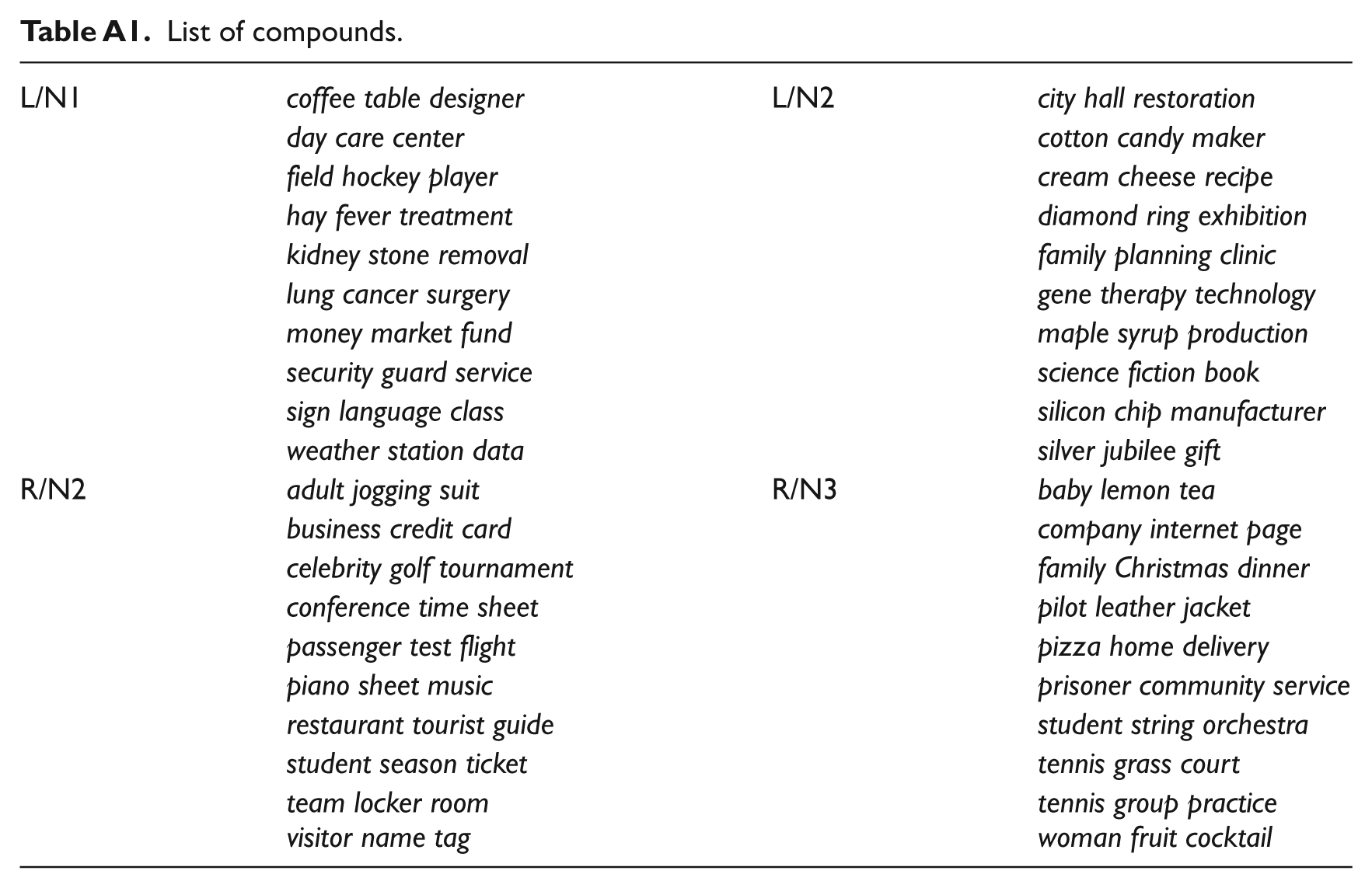
For the production experiment, a total number of 40 NNN compounds was devised, 10 of each type described in Table 2. Thus, in order to test whether left-branching compounds have highest prominence on constituent N1 and right-branching compounds on constituent N2 if the complex constituent is left-prominent, we constructed 10 compounds of the L/N1 type and 10 compounds of the R/N2 type. Furthermore, in order to test whether a right-prominent embedded NN compound causes left-branching compounds to have highest prominence on constituent N2 we constructed 10 compounds of the L/N2 type. Finally, in order to test whether a right-prominent embedded NN compound causes right-branching compounds to have highest prominence on constituent N3, we constructed 10 compounds of the R/N3 type. The appendix lists all 40 target compounds.
The prominence pattern of the embedded NN compounds was controlled by means of various American English dictionaries: Oxford Student’s Dictionary of American English (Hornby, 1983), Longman Dictionary of American English (Longman, 2002), Longman Advanced Dictionary of American English (Summers, 2000), Oxford Advanced Learner Dictionary CD (Hornby, 2000) and The Oxford Spanish-English dictionary (Carvajal & Horwood, 1996, as provided in Teschner & Whitley, 2004). Only those NN compounds whose prominence pattern was attested in at least one of these sources qualified as potential complex constituents for our triconstituent compounds. NN compounds that were attested in more than one source but with different prominence patterns were not considered as potential complex constituents either. Furthermore, compounds that have been reported in the literature to exhibit variable prominence patterns (e.g., íce cream versus ice créam, Bloomfield, 1933) were also not considered.
The left- and right-prominent two-word compounds were combined with another noun to form an NNN compound. If the third noun was attached to the right, this resulted in a left-branching NNN; if the third noun was attached to the left of the two-word compound, this resulted in a right-branching NNN. The choice of the third noun was constrained by several factors. Firstly, all resulting NNN compounds had to be unambiguously left-branching or unambiguously right-branching in order to exclude the possibility that potential prominence variation would be caused by structurally ambiguous compounds. The problem with structural ambiguous compounds, such as kitchen towel rack or police dog trainer, is that they are argued to be prominent either on constituent N1 or on constituent N2, depending on their interpretation (e.g., Visch, 1999; Warren, 1978). For example, the compound kitchen towel rack may be interpreted as either ‘a rack for kitchen towels’ (left-branching) or ‘a towel rack located in the kitchen’ (right-branching), and the compound police dog trainer may be interpreted as either ‘a trainer of police dogs’ or ‘a dog trainer working for the police’. In the case of a right-branching interpretation, the LCPR predicts the compound to be prominent on constituent N2, whereas a left-branching interpretation will lead to prominence on constituent N1. Given this variable prominence behavior of ambiguous compounds and given the fact that it is difficult to control which interpretation the speaker may choose, compounds were constructed in such a way that they left as little room as possible for different interpretations of their branching structure.
In order to test the role of the embedded compound’s prominence it is necessary to control for potentially intervening prominence relations at the IC-level. The study by Kösling and Plag (2009), for example, found left-branching compounds being prominent on constituent N3 and right-branching compounds prominent on constituent N1, which may be the result of prominence determinants working at the IC-level. For example, it has been claimed that semantic categories trigger the occurrence of right prominence in NN compounds (e.g., Bell, 2008; Fudge, 1984; Ladd, 1984; Liberman & Sproat, 1992; Olsen, 2000, 2001; Sproat, 1994). Examples of these semantic subgroups are, for instance, the group of copulative compounds (e.g., poet-translátor), compounds with temporal (summer níght) or locative modifiers (Boston márathon) or compounds with an ingredient and material as N1 (silk tíe, chocolate púdding) (cf. Kösling & Plag, 2009). Another such factor in compound prominence assignment is analogy (e.g., Arndt-Lappe, 2011; Liberman & Sproat, 1992; Plag, 2006, 2010; Schmerling, 1971; Spencer, 2003). Compounds that share the same left or right constituent tend to have the same prominence pattern. An example often mentioned in this context is that of street versus avenue compounds: while street compounds are generally left prominent (Óxford Street), avenue compounds (Madison Ávenue) are consistently right-prominent (e.g., Plag, 2003).
In order to ensure that the above-mentioned factors would not influence the present analysis, we avoided all semantic relations and categories at the IC-level of the compounds that have been found to trigger rightward prominence in NN compounds in earlier empirical studies (e.g., Kunter, 2011; Plag, Kunter, & Lappe, 2007; Plag et al., 2008). In addition to that, we also avoided lexical items as heads, which are generally mentioned in the literature to trigger rightward prominence in NN compounds (e.g., pie, avenue). By applying these different criteria, the role of the embedded NN compound on the prominence pattern of the entire compound could be tested without any of these factors potentially intervening at the IC-level of the compounds. Other factors, such as frequency or the degree of lexicalization, were not taken into consideration.
For the production experiment, the 40 target compounds were embedded in short declarative sentences that were adapted to be compatible with the semantics of the respective compounds. In order to avoid any potential effects that sentence position may have on the prominence pattern of compounds, all targets were placed in the object position of the sentence, followed by a two-word adverbial. The adverbial was added to keep both the nuclear accent of the sentence and the sentence-final boundary tones out of the target compound, as these tonal events may be expected to be assigned to an utterance due to intonational regularities that are outside of the scope of prominence assignment in compounds. Furthermore, we avoided potential environments in which contrastive meaning was evoked, such as He read about a coffee
(4) a. He started hay fever treatment last week.
b. He was sentenced to prisoner community service last month.
c. He sold a cotton candy maker last month.
2.2 Procedure
For the experiment, seven female and six male undergraduate and graduate students of the University of Toronto were recorded, aged between 18 and 27 years. All were monolingual native speakers of North American English. The majority grew up in the province of Ontario; three speakers originated from other Canadian provinces, and one speaker was originally from Massachusetts, and had been living in Toronto for two years at the time of the recordings. None of the participants, who were paid for their participation, reported any speaking or hearing disorder, and none of them was aware of the purpose of the experiment during the recordings.
Before each recording session, the participants were asked to read the instructions provided to them on a sheet of paper. In addition, the subjects were instructed to read aloud five training sentences that were used to adjust the loudness level of the recorder to the subjects’ individual voices and to give the subjects an opportunity to familiarize themselves with the test situation and the process of reading out loud. The training sentences differed from the target sentences of the experiment in that they contained no compounds.
In addition to the 40 target sentences containing the constructed compounds, the same number of filler sentences was added in order to distract the participants from the actual purpose of the experiment. The filler sentences differed from the target sentences in that they contained no triconstituent compound. Instead, the object slot was filled by a long noun phrase. To control for order effects, the total set of 80 sentences were pseudo-randomized to create three lists, each list with a different order of the 80 sentences. Pseudo-randomization was done on the basis of blocks of 10 sentences and systematically varying the order of these blocks. The sentences were presented to the participants on four separate sheets of papers.
The recordings were taken in a soundproof booth at the University of Toronto using a Marantz PMD660 portable solid state audio recorder at a sampling rate of 44.1 kHz. An external microphone was placed a distance of about 50 cm in front of the participants. Depending on the subjects’ reading speed, each recording took between 15 and 25 minutes. A researcher was present in the soundproof booth during each recording, and asked participants to repeat sentences during which mispronunciations, reading disfluencies or noisy interferences (such as rustling papers or loud chair movements) occurred.
2.3 Acoustic pitch measurements
Using the phonetic software Praat (Boersma & Weenink, 2012), the beginning and end of each clause in which a target compound was embedded were manually annotated, as were the beginning and end of the compound itself, and the two boundaries between the three constituents. The usual criteria for segmentation were applied (see, for instance, Ladefoged, 2003; Turk, Nakai, & Sugahara, 2006) to decide on the location of these boundaries.
For each sound file containing one target clause, the Praat auto-correlation algorithm (Boersma, 1993) was used to extract a pitch object. Pitch floor and pitch ceiling were set according to the sex of the speakers: for female speakers, the pitch range was 100–500 Hz, and for male speakers, it was 75–300 Hz. All other parameters of the pitch tracker were left at their default values.
Any gap in the contour of the resulting pitch object was filled by interpolating linearly between the closest available pitch measurements to the left and the right of the gap. This approach assumes that the pitch contour of an utterance is, in principle, uninterrupted, and that the overall shape of a pitch contour in an utterance is not affected by breaks introduced, for instance, by unvoiced speech segments. This assumption is in line with other representations of pitch contours, such as that in Hermes (2006), who argues that pitch contours are perceived as continuous, and that interruptions in the contour caused by unvoiced speech segments are not noticed by listeners as affecting the overall shape of the pitch contour.
By applying a smoother to the derived pitch contour, the transitions between interpolated and measured segments of the pitch contour receive a more natural shape, and localized misreadings of the pitch tracker algorithms are eradicated. In addition, the effect of microprosodic changes in the pitch contour, such as the lowered F0 that is frequently associated with voiced obstruents (see, for instance, Kingston & Diehl, 1994) is reduced, which is considered advantageous as the present study focuses on the macroscopic scale of the pitch contour that relates to prosodic prominence.
The effects of these modifications are shown in Figure 3. Figure 3(a) shows the unmodified pitch contour of the sentence She read about a gene therapy technology last night as produced by female speaker SP49. There are numerous gaps in the contour that can be associated with unvoiced segments; for instance, the two interruptions in therapy are linked to the voiceless segments /θ/ and /p/. In Figure 3(b), these interruptions are filled by interpolating between the surrounding portions of the pitch contour. Figure 3(c) shows the contour after application of Praat’s ‘Smooth’ function with a bandwidth of 10.0 Hz. The unnatural spikes that were created by the interpolation, for instance that in gene, are flattened. Likewise, small changes in the pitch contour, such as the tiny spikes in the middle portion of technology, which presumably are too small to be noticed by listeners and thus are probably not affecting the perception of the overall intonation contour, are removed.
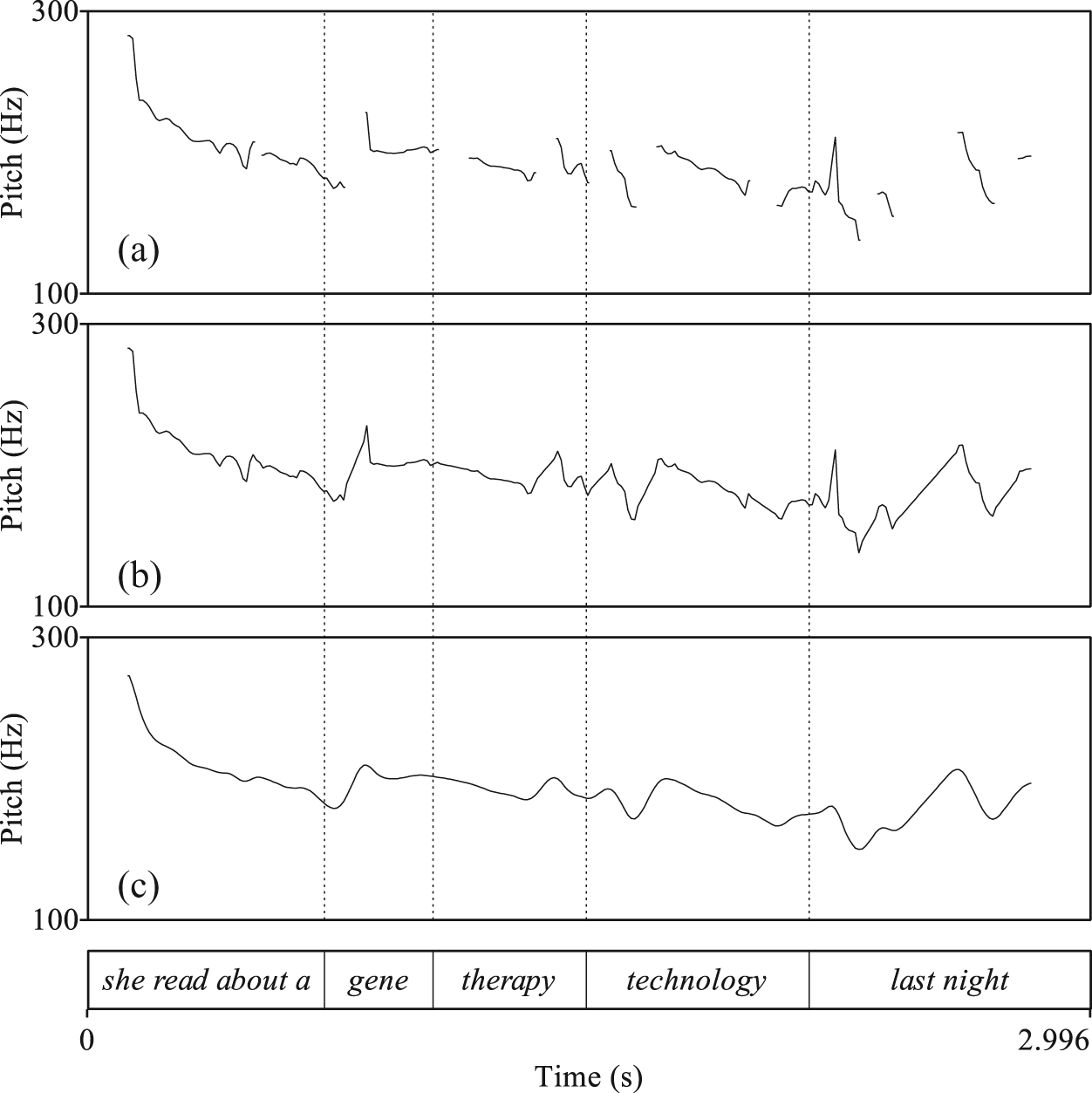
(a) Unmodified, (b) interpolated and (c) smoothed pitch contours.
Only the interval of the pitch contour associated with the target compound (indicated by the left-most and right-most dotted line around gene therapy technology in Figure 3) is considered for the present analysis. This target interval is split up into 100 parts of equal length, and the pitch is obtained from the smoothed contour. To account for the non-linear nature of the Hertz scale, all measurements are transformed to the linear semitone (ST) scale relative to 1 Hz. Every pitch measurement is stored together with the number of that part of the interval at which it was taken (ranging from 0 to 99). This number will be used as the time variable in the different smooth terms.
Very rarely, the automatic pitch tracker failed to obtain pitch measurements for parts of the compound, even after interpolation and smoothing. This could occur, for instance, if the end of the respective target sentence was produced with a creaky voice. Non-modal phonation has been shown to occur with very irregular F0 pulses (see, for instance, Blomgren, Chen, Ng, & Gilbert, 1998, for an analysis of the properties of non-modal phonation), which is why automatic pitch trackers frequently fail to detect a periodic signal. The interpolation process described above attempts to compensate for this failure by supplying linear approximations of the pitch contour during problematic parts of the recordings, but for 426 out of the 13 × 40 × 100 measurement points (0.8 percent), no pitch information could be obtained. Thus, the total number of observations was 51,574.
What is notable here is that an equal number of measurements is taken for each compound token, irrespective of any duration differences either between different compound types, or between tokens of the same compound type. For example, the compound type gene therapy technology shown in Figure 3 has, on average across all speakers in the experiment, a longer duration than the compound type day care center (the average durations are 1.413 and 0.784 s, respectively). Speaking rate differences between individuals may lead to duration differences between tokens of the same type: for instance, the duration of the token in Figure 3 is 1.434 s, but observed duration of this type ranged from 1.277 to 1.599 s.
The underlying assumption for using the same number of measurements for compounds of various lengths is that the pitch contour of different compound types is predominantly determined by their branching type. For instance, the LCPR will associate specific tonal events with specific constituents of the NNN compound, but this association is expected to be indifferent to the length of each constituent, or the time a speaker requires to produce the compound. Thus, by taking the same number of pitch measurements from each compound, irrespective of the absolute duration of the item, durational differences are normalized, resulting in a time-averaged series of 100 measurements from each item. 4 Yet, in order to relate the subsequently obtained model of the pitch contour to the linguistic structure of the compound types used as stimuli, each pitch measurement was stored together with information on whether the measurement was taken from the left, middle or right constituent of the compound.
2.4 Generalized additive models
GAMs (Wood, 2006, 2011) are an extension of the generalized linear model that provides flexible tools for modeling non-linearities. GAMs take the form

where y is the response variable, X β is a linear predictor and fi are smooth functions of the covariates xi. The central concept motivating
In what follows, we make use of the mgcv package (Wood, 2012) for R (R Development Core Team, 2011). For smooths of single predictors, we used restricted cubic splines, henceforth referred to in tables with the abbreviation s(). For smooths in more than one dimension, we made use of tensor products (abbreviated in tables to te()). Tensor product smooths estimate a wiggly surface (or hypersurface) from two (or more) basis functions. The smoothness of the basis functions (typically cubic splines) determines the amount of wiggliness of the regression surface. The mathematics of tensor products are complex; an informal way of describing a tensor given its marginal basis functions is that the tensor surface is constructed in such a way that in each dimension it is as faithful as possible to the shape of its marginal function in that dimension. Random-effect factors (such as subject and item) can be brought into the model as well, leading to a generalized additive mixed model. The problem of estimating the appropriate smoothing parameters can be solved in various ways: we have used the default, generalized cross-validation. Similar results were obtained with relativized maximum likelihood. Importantly, the optimal degree of smoothness is not determined by the user, but is estimated as part of the model fitting, along with the parametric coefficients and random intercepts for subject and item.
Significance of parametric terms is evaluated by means of the usual t-tests, and/or by means of analysis of deviance tests. Significance of non-parametric terms is evaluated by means of the Bayesian p-values recommended by Wood for smooths. The evaluation of significance for
Of central interest to the following analysis is how pitch develops over time for the four
Various other predictors were included as controls. Firstly, random intercepts were included for the random-effect predictors
Thirdly,
Fourthly, the length of a constituent (in phonemes) was included, to control for possible consequences of
Finally, the lemma frequency of each constituent was also included as a predictor, as frequency of occurrence has been found to have an influence on acoustic durations (Bell et al., 2003). We therefore sought to rule out the possibility that the effects of
3 Results
A first mixed-effects
A comparison of a sequence of generalized additive mixed models is summarized in Table 3. Each new row compares two nested models, where the second model has one predictor or interaction term more than the first, and evaluates whether there is a reduction in deviance, and if so, whether this reduction in deviance is significant given the number of parameters invested in obtaining this reduction. Significance is evaluated with the help of an F-test. The baseline model (not shown in the table), included an intercept (grand average) only. The first row, labeled ’speaker’, indicates that including random intercepts for speaker (for which the
Sequential model comparison.
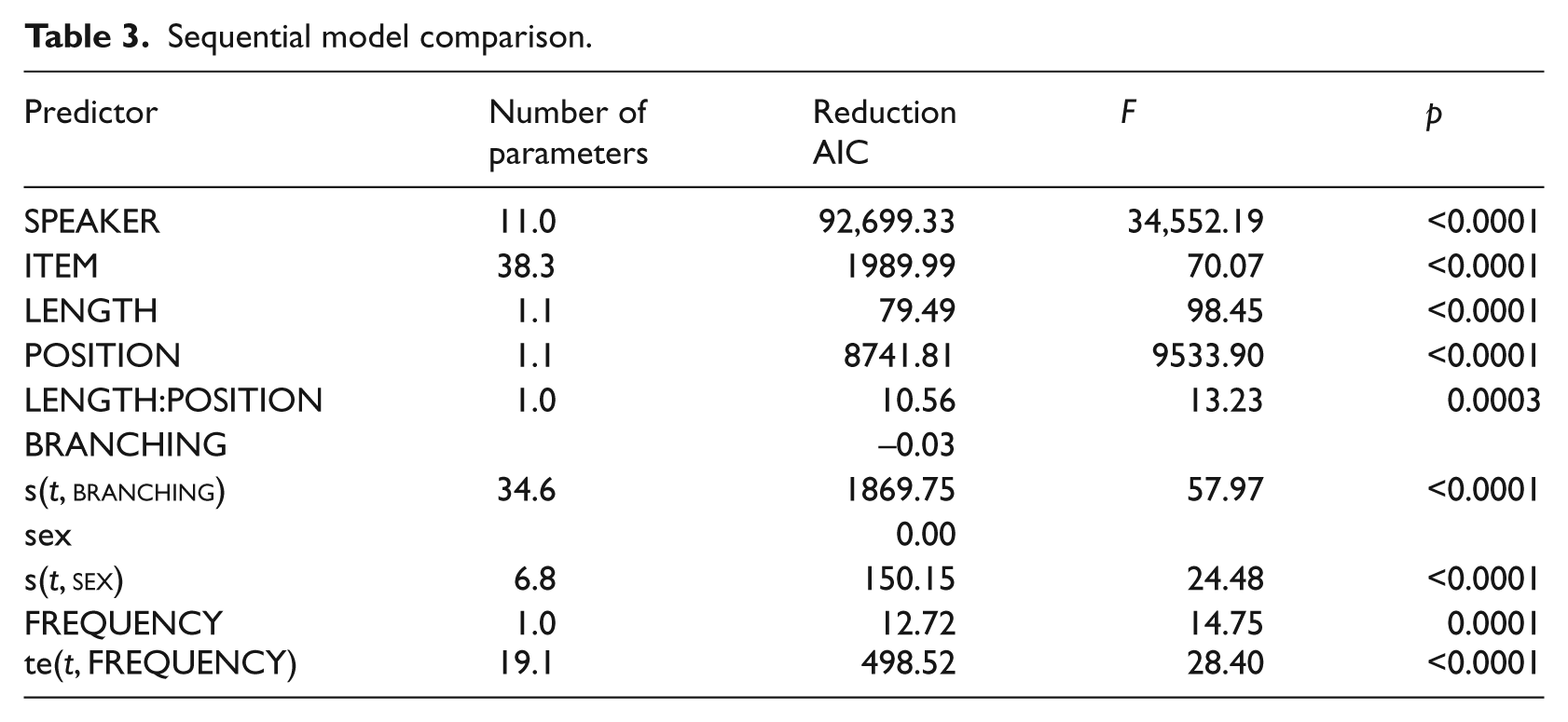
Table 4 presents the coefficients and associated statistics for the parametric submodel, as well as the F-tests for the smooth terms in the non-parametric submodel.
Summary of final mixed-effects general additive model (R2(adj) = 0.893, n = 47,574).
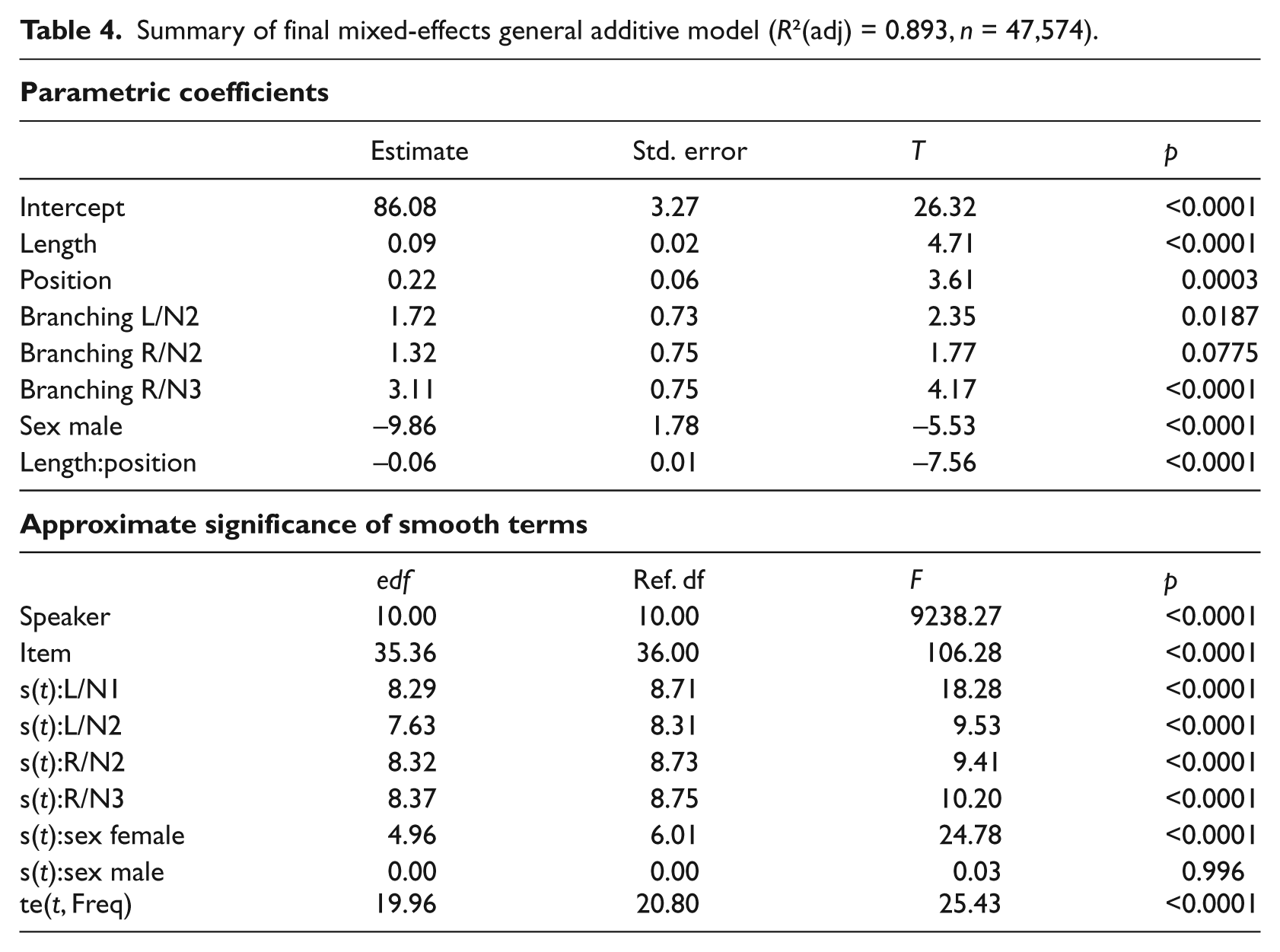
The R/N3 condition seems to have, on average, a pitch that is half a semitone higher than that of the L/N1 condition, which acts as the reference level in the model and is expressed in the intercept term. However, in the absence of a main effect of
Figure 4 illustrates the shapes of the pitch contours for each branching type that are captured by each of the four smooths. Each panel shows the smooth term for one of the four branching types. The horizontal axis is the normalized time scale; the vertical axis indicates pitch measurements in semitones relative to 1 Hz. The curve thus illustrates the estimated changes of the pitch contour in relation to the time dimension. Each curve presents the partial effect of the smooth, which is why each curve is centered on zero.
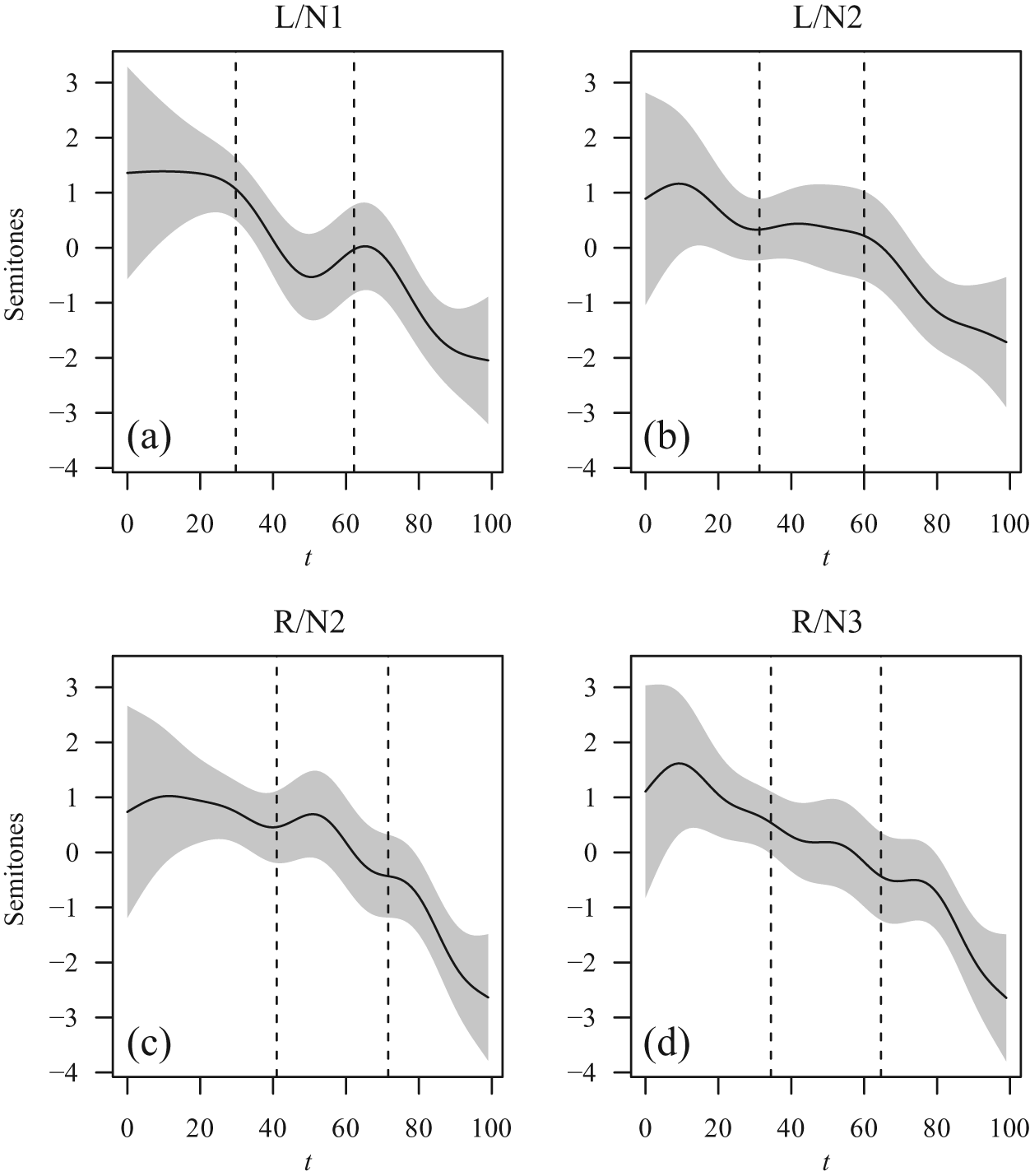
Estimated pitch contours by branching type (t is the index on the normalized time scale).
In order to be able to relate the shape of the estimated pitch contours to the linguistic components of the target compounds, average constituent boundaries are displayed by the dashed vertical lines. Due to different lengths of the constituents that were used in the construction of the target compounds, these boundaries are not the same for all four types. For example, the second constituents of L/N2 compounds (indicated by the interval between the two dotted lines in Figure 4(b)) are, on average, clearly shorter than the first constituents of R/N2 compounds (Figure 4(c)). While the average constituent boundaries do not, of course, correspond to the actual boundaries of any specific compound, they are nevertheless useful in identifying the alignment of the pitch contour with the three constituents of the different compound types, as they reflect the average point of time at which the pitch contour moves from one constituent to the next.
Across all four panels, the expected pitch declination is clearly visible. In every smooth, pitch starts high and shows a general downward trend toward the end of the compound. The high start is an indication of the presence of a pitch accent. For L/N1 and R/N2 compounds, there is a nearly linear decline in pitch up to the beginning of the second constituent. For L/N2 and R/N3 compounds, the pitch function is non-linear, with an initial nearly steady state followed by a steep decline that levels off before the second constituent. This suggests that the high tone in the first constituent of L/N2 and R/N3 compounds occurs later in the first constituents.
The contour for L/N1 compounds (Figure 4(a)) drops further by a semitone during the second constituent. This implies that for the vast majority of L/N1 compounds, there is no second accent with a high tone on N2. However, the contour shows a small rise by about 0.25 ST at the boundary between N2 and N3. This secondary peak appears to be too small to be interpreted as a further high tone (recall that pitch excursions of 1.5 ST and more have been found by Rietveld and Gussenhoven, 1985, as a sufficient cue to prominence; the peak here is clearly smaller), but as it seems to be aligned with the right edge of the complex constituent, we may interpret this as a phrase accent that speakers use to indicate the internal structure of this type of triconstituent compounds.
There is no similarly steep drop of the pitch contour during the second constituent in L/N2 and R/N2 compounds (Figures 4(b) and (c), respectively). Instead, there is a clear rise in the contour of N2, which suggests that there is a high target for these compound types. In other words, L/N2 and R/N2 compounds are accented both on N1 and on N2.
There are further differences between the pitch contour of L/N2 and R/N2 with respect to the boundary between second and third constituents, and within the third constituent. In L/N2 compounds, the pitch appears to spread out longer toward the boundary than in R/N2 compounds, and drops steeply at the beginning of the third constituent. In R/N2, the pitch drop occurs earlier, before the constituent boundary. This may be an indication that L/N2 compounds, just as L/N1 compounds, have a phrase accent at the boundary between N2 and N3, which prevents an immediate drop of the pitch contour after the pitch peak in N2. 9
The remaining compound type R/N3 (Figure 4(d)) reveals a similar hint of a pitch target on the third constituent, which is located further toward the end of the word. In fact, the pitch function for these compounds is suggestive of three falls, one in each constituent, followed by a plateau. This would suggest three accents, with clearly decreasing peak heights. Apparently, speakers prefer downstepped pitch accents on N2 and N3 in this type of compound. Using conventional notations, the accentuation pattern of R/N3 compounds thus may be described as H* !H* !H*. The finding that there is a pitch accent on every constituent is to be expected if we assume that right-prominent NN compounds also have pitch accents on both constituents (see, for example, Kunter, 2011, ch. 5, for evidence and detailed discussion).
Thus, in sum, the smooths produced by the mixed-effects GAM for the four different compound types reveal obvious differences of the pitch contour, and by extension, for the prominence patterns of these types. L/N1 compounds tend to have a single pitch accent on N1, which may be expected to be the most prominent constituent of the overall compound. In perhaps L/N2 and clearly in R/N2 compounds, there is also a pitch accent on the first constituent, but compounds of these types tend to have another pitch accent on the second constituent, as predicted by the EPH. Finally, R/N3 compounds frequently have accents on the third constituent (in addition to any preceding pitch accent).
The reliability and accuracy of these pitch contours for the four types of compounds depend in part on how well other factors have been controlled for. A first question that should be addressed is whether these contours are due to a conflation of different patterns for females and males. A model incorporating a main effect of
A second control variable is
Our third control variable, the frequency of occurrence of a word, also emerged as significant. As a simple main effect, it emerged with a significantly negative slope, indicating that higher-frequency words had a lower pitch. Further inspection with a tensor product suggests that this effect of frequency is restricted mainly to the first constituent. Just as higher-frequency words tend to have shorter acoustic durations, due to their relatively high degree of informational redundancy (Bell et al., 2003; Gahl & Garnsey, 2004), higher-frequency words appear to have somewhat attenuated initial pitch targets. This finding fits well with the smooth signal redundancy hypothesis (Aylett & Turk, 2004). Crucial for the present study is that frequency of occurrence, which was not controlled for beforehand in the selection of materials, is under statistical control through a tensor product in our GAM.
Finally, there is a potential confound in our data, namely the position of the lexically stressed syllable in a given constituent. For example, if a constituent has two syllables and is stressed on the first syllable, we expect an earlier pitch peak than if we had a disyllabic constituent that is stressed on the second syllable. These differences in the temporal location of the main stressed syllable of a constituent were not controlled for in the present analysis, since we are using data that were collected with a different methodology in mind, in which differences in the temporal location of lexical stresses within constituents would not have mattered due to the principled insensitivity of the measurements concerning this variable. Furthermore, the distribution of lexical stresses is actually quite uniform across the test items. For the first constituent, we have mostly disyllabic words with initial stress. There is only one polysyllabic word that is not stressed initially (security). Similarly, there is only one polysyllabic second constituent that is not stressed on the first syllable from the left (community). For the first two constituents we can safely assume that the pitch contour is only very weakly affected by the variability of lexical stress placement. Only in the third constituent do we find more variability. Eight out of 40 constituents are not stressed on the initial syllable (e.g., designer, removal, delivery). This means that the contours for the third constituent may be interpreted in such a way that for about three quarters of the items the peaks are actually slightly more to the left, and that for the minor of eight items the peaks are actually later than it appears in the plots. With regard to the decisive question whether the contours give evidence for the presence of a pitch accent, these complications do not seem to play a decisive role, and with only so few constituents that did not carry their lexical stress on the initial syllable, there appears to be little need for including further statistical controls to counter this potentially confounding influence of stress position.
4 Discussion and conclusion
The shape of the pitch contours and the corresponding statistical models invite an interpretation according to which branching direction is not the sole determinant of NNN prominence. To the contrary, the analysis of the pitch contours of the pertinent compounds in the experiment has shown that the prominence pattern of the embedded compound has to be taken into account. Left-branching compounds with a left-prominent embedded compound behave in accordance with the LCPR, and so do right-branching compounds with a left-prominent embedded compound. However, if the embedded compound is right-prominent, the predictions of the LCPR fail. The LCPR predicts the same prominence pattern as before, but the empirical facts run counter to that expectation. Left-branching compounds with an embedded right-prominent compound have an accent on N2, and right-branching compounds with a right-prominent embedded compound have an accent on N3. It was also shown that all triconstituent compounds have an accent on the first constituent. Overall, the predictions of the EPH turned out to be in accordance with the statistical analysis of the pitch contours. The pitch contours strongly suggest that those constituents which were predicted to be accented do indeed appear to receive a pitch accent.
Based on these findings, an accent-based classification of the different compound types is given in Table 5.
Typology of prominence.
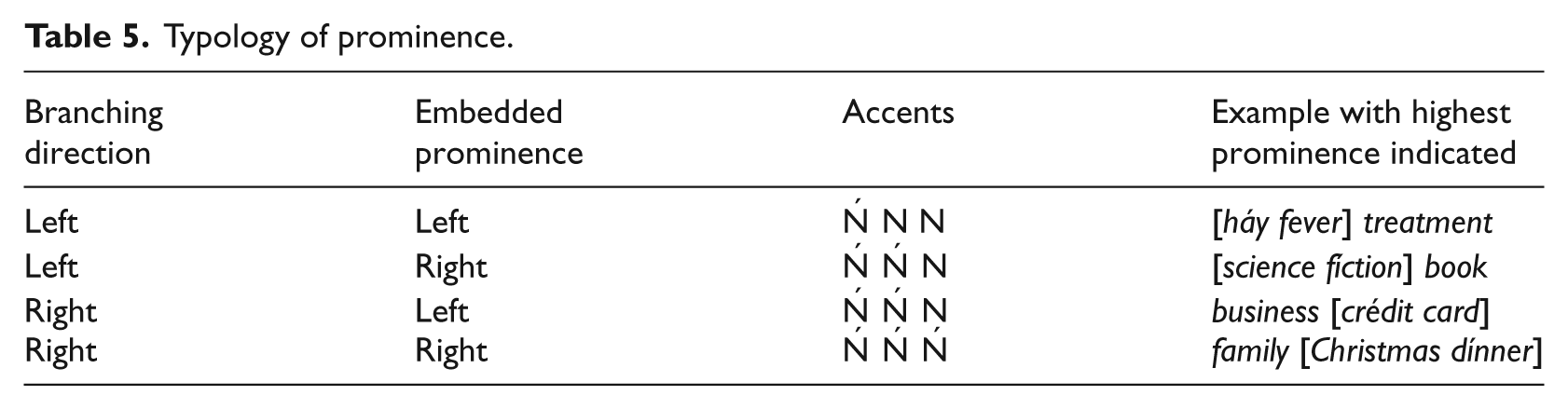
Our findings are in line with other empirical studies that have found problems with the predictions of the LCPR. Giegerich (2009) gives a number of examples that show effects in accordance with the EPH; while the extent of the phenomenon remains open, he concludes that the LCPR is wrong. Similarly, Kösling and Plag (2009) find violations of the LCPR in their speech corpus data that suggest an effect of embedded prominence, and these authors state that these patterns merit ‘further empirical testing with more carefully controlled data’ (p. 229). The present study provides such data and strong empirical support for the idea that embedded prominence, and not branching, determines the prominence of triconstituent noun compounds. The present paper has also shown that mixed-effects GAMs can be fruitfully employed to model prominence in triconstituent compounds. Very similar results, yet with a lower level of descriptive detail, have been found by Kösling (2013), who analyzed the same data set using a different methodology that has been established in many previous studies (e.g., Kösling & Plag, 2009; Kunter, 2011; Plag, 2006; Plag et al., 2008). Furthermore, Kunter and Plag (2007) have shown that this methodology is capable of approximating the perception of prominence patterns in compounds to a large degree. The compatibility of both approaches shows that the models used in the present paper provide a valid way of describing pitch contours, and the pitch contours as predicted by the model lend themselves to straightforward interpretations in terms of autosegmental-metrical phonology, as the theoretically predicted pitch accents can indeed be traced in the contours. Future research that links these types of models to perception of prominence by speakers will show the validity of these conclusions.
A natural extension of the present research program would deal with the question of what happens at the IC-level. Recall that in the present experiment, with left-branching compounds, IC-level prominence was carefully controlled for, and only IC-left-prominent NNNs were produced by the participants. Given that rightward prominence can also occur at the IC-level (contrary to the assumptions of the LCPR), we would expect that this could also lead to prominence patterns that are not in accordance with the branching direction-based predictions of the LCPR. Preliminary acoustic evidence presented by Kösling and Plag (2009), as well as Giegerich’s (2009) small selection of pertinent words, point in this direction, but a systematic study is called for that investigates these patterns in more detail. A reliable method for such an investigation is now available.
The usefulness of the type of statistical models employed in this study, however, goes beyond the analysis of compounds. GAMs are an accessible way of representing pitch contours in clearly defined data sets, and they allow a principled, statistical comparison between the different contours, which makes them a very suitable tool for the empirical investigation of intonation patterns in larger utterances. One case in point may be the link between intonation contours and the pragmatic meaning of utterances. Hirschberg (2004) associates declarative sentences and wh-questions in standard American English with an H* L-L% sequence, and yes–no questions with L* H-H%. These mappings of intonation patterns on specific sentence types appear to be mostly uncontroversial. However, Hirschberg notes that there may be more links between specific pitch contours and certain pragmatic meanings of the utterance, but she considers these links to be ‘both more controversial and more elusive’ (Hirschberg, 2004, p. 533). For instance, it has been proposed that downstepped contours such as H* !H* !H* L-L% are frequently used in sentences that introduce a new topic in a didactic context, but to our knowledge, this proposal has never been investigated. The models described in this article might be employed to examine empirically whether such an effect of context is indeed traceable in different intonational contours.
Footnotes
Appendix
List of compounds.
| L/N1 | coffee table designer | L/N2 | city hall restoration |
| day care center | cotton candy maker | ||
| field hockey player | cream cheese recipe | ||
| hay fever treatment | diamond ring exhibition | ||
| kidney stone removal | family planning clinic | ||
| lung cancer surgery | gene therapy technology | ||
| money market fund | maple syrup production | ||
| security guard service | science fiction book | ||
| sign language class | silicon chip manufacturer | ||
| weather station data | silver jubilee gift | ||
| R/N2 | adult jogging suit | R/N3 | baby lemon tea |
| business credit card | company internet page | ||
| celebrity golf tournament | family Christmas dinner | ||
| conference time sheet | pilot leather jacket | ||
| passenger test flight | pizza home delivery | ||
| piano sheet music | prisoner community service | ||
| restaurant tourist guide | student string orchestra | ||
| student season ticket | tennis grass court | ||
| team locker room | tennis group practice | ||
| visitor name tag | woman fruit cocktail |
Funding
This work was supported by a research grant awarded to the final author by the Deutsche Forschungsgemeinschaft (grant PL151/5-3), which we gratefully acknowledge.