



Abstract
The current study examined whether fine-grained phonetic detail (voice onset time (VOT)) of one segment (/p/ or /k/) generalizes to a different segment (/t/) within the same natural class. Two primes were constructed to exploit the natural variation of VOT: a velar stop followed by a high vowel (keen) resulting in a naturally long VOT and a labial stop followed by a low vowel (pan) resulting in a naturally shorter VOT. Two experiments were conducted, one in which the speakers produced both the prime and the target, and a second in which the speakers heard the primes and then produced the targets. In Experiment 1, VOTs for initial /t/ were shorter following pan than following keen. In Experiment 2 where participants heard the primes, priming was found only when the primes had unexpected relative VOT values (short for keen and long for pan). These results provide evidence for cross-segmental generalization of phonetic detail and also suggest that natural, within-category variability is encoded during language processing.
1 Introduction
A fundamental question about the structure and organization of the language processing system is what information is encoded. While abundant research has found evidence for the role of acoustic-phonetic detail in perception (e.g., Andruski, Blumstein, & Burton, 1994; Davis, Marslen-Wilson, & Gaskell, 2002; McMurray, Tanenhaus, & Aslin, 2006; Miller, 2001), there is less evidence for the role of acoustic-phonetic detail during language production. Here, we use the gradient nature of voice onset time (VOT) within the category of voiceless stops to examine how acoustic-phonetic detail affects language production. If fine-grained phonetic detail of one segment affects the production of a non-identical segment within the same category, it would suggest that the fine-phonetic detail is encoded and also that there must be a subphonemic level of representation that allows these details to generalize to other segments within a natural class.
1.1 Gradient changes in production
Two main lines of research have shown evidence for gradient changes in language production. Traditional shadowing tasks, where participants repeat auditorily presented words, provide evidence for a type of identity priming. Many studies using a shadowing paradigm have found that speakers’ productions are modified based on fine-grained phonetic details of auditory stimuli (Babel, 2012; Goldinger, 1997, 1998; Miller, Sanchez, & Rosenblum, 2010; Namy, Nygaard, & Sauerteig, 2002; Nielsen, 2011; Sanchez, Miller, & Rosenblum, 2010; Shockley, Sabadini, & Fowler, 2004). Both acoustic measures and perceptual evaluations reveal that shadowed productions are more similar to the auditory stimulus than baseline productions. Those studies that include acoustic analyses have found that both linguistically-relevant aspects of the speech such as vowel formants (Babel, 2012) or VOT (Nielsen, 2011; Shockley et al., 2004), and also non-linguistically contrastive aspects such as fundamental frequency (Goldinger, 1997), are modified in shadowing tasks. That speakers adapt their productions to be more similar to the speech they hear clearly shows that these speakers retain highly detailed, gradient information about the auditory stimulus and that this detail alters production.
Traditional shadowing studies have been used to argue for exemplar models with no abstract representations where listeners store words as non-decomposed wholes (e.g., Goldinger, 1998) and thus encode and store only fine-grained phonetic detail. Because nearly all shadowing studies have had speakers produce the exact same word that they hear, it is possible that fine-grained phonetic detail from the sensory trace results in gradient modifications to the output, where no other, sublexical levels of information (e.g., segmental, featural) are needed.
A second line of research that has shown gradient changes in production does not rely on segmental or lexical identity, but instead has examined the impact of conflicting phonological features or conflicting articulatory commands. Yuen, Davis, Brysbaert, and Rastle (2010) examined the precise location of the constriction of voiceless velar stops in two conditions: after hearing a prime with a velar stop or after hearing a prime with an alveolar stop. Electropalatographic analyses revealed that /k/ was articulated more anteriorly when speakers heard a prime that began with /t/, an anterior stop, than when they heard a prime with an initial posterior stop /k/. Importantly, /t/ and /k/ differ in the features or articulatory commands that relate to their place of articulation. Thus, hearing a sound with a conflicting place of articulation caused a gradient change in the precise location of constriction for the target segment.
Further evidence that conflicting phonological features play a role in language production comes from a tongue twister paradigm (Goldrick & Blumstein, 2006). Participants were asked to rapidly read sequences of words in which the initial segment differed by only one phonological feature (e.g., geff, keff differ in [±voice]). To evaluate the influence of conflicting features, VOT (the primary acoustic correlate of the voicing contrast in stressed syllable-initial position) was compared in correct productions (e.g., geff produced for target geff) and incorrect productions (e.g., geff produced for target keff) to see if there was a residual effect of the target word’s conflicting feature. Error productions of geff had longer VOT than correct productions of geff, indicating that the voicelessness of the intended target pulled the VOT of the actual production in the direction of voicelessness.
The studies where conflicting phonological features or articulatory commands result in fine-grained changes in production can be used as evidence for coarse-grained phonological features. These gradient changes that are found in the output are interpreted as resulting from the simultaneous or residual activation of the opposing, incongruent features (e.g., [+voice] and [-voice]) or articulatory commands. In the tongue twister paradigm, for example, the gradient change within the voiced stop /g/ is interpreted as residual, trace activation of [-voice] (or the laryngeal commands) because the intended target keff has a voiceless stop (Goldrick & Blumstein, 2006). Within this model of cascading activation from the nonword target, this residual activation is not strong enough to change the output stop completely to the voiceless category; instead, the residual activation during the actual (error) production of the [+voice] geff results in a slightly longer VOT (more towards the voiceless end of the continuum) than when geff is correctly produced for target geff. In the latter case where geff is produced for target geff, only [+voice] is activated and the VOT is thus very short.
Yuen et al. (2010) use their data of gradient place of articulation changes as evidence that the motor system is activated during speech perception. In their study, listeners heard a word with the conflicting, incongruent place of articulation (hearing [t] while producing [k]). When a conflicting motor command was activated from perception (e.g., [t]) than was supposed to be used during production (e.g., [k]), the resulting [k] exhibited an articulation that was more intermediate than if the auditory stimulus did not involve a conflicting motor command. Thus, in both Goldrick and Blumstein (2006) and Yuen et al. (2010), gradience in production emerges from the system directly as a result of activation of a conflicting, incongruent articulatory command. As such, gradience itself need not be directly encoded.
In contrast to the two previously mentioned lines of research (shadowing studies and conflicting feature studies), a recent study has examined the effect of fine-grained phonetic detail in production using a third type of experimental manipulation. Rather than examining opposing features or identity between heard and produced segments, Nielsen (2011) examined the effects of gradience within a natural class along a shared, rather than conflicting, dimension. Nielsen (2011) had participants listen to /p/-initial words with artificially lengthened VOTs. Following the listening phase, participants produced additional /p/-initial words but also produced /k/-initial words. Critically, both /p/ and /k/ are voiceless stops and the acoustic-phonetic information that was measured related to this shared feature. That is, the study manipulated the acoustic-phonetic parameter (VOT) that correlates with this phonological feature. The results revealed that gradient, within category changes to VOT during the listening phase (e.g,. lengthened VOT for /p/) resulted in lengthened VOTs in /k/-initial words. What is critical about the design of Nielsen’s study is that she did not examine a dimension on which /p/ and /k/ differ, but rather she examined a dimension that is shared. Less surprising is that the lengthened /p/-initial words heard during the listening phase also caused longer VOTs for novel /p/-initial words.
Nielsen (2011) argues that the results of her study provide evidence that both gradient information (e.g., duration of VOT) and also more coarse-grained sublexical information (e.g, [-voice]) must be encoded in the language production system. She argues that these levels of information must be encoded precisely because gradience of one segment resulted in gradience of another segment along the same phonological/phonetic dimension. Subphonemic information (features or articulatory commands) must be encoded because lengthened VOT of /p/ generalizes to a different segment within the natural class of voiceless stops, specifically /k/. Thus, even though listeners heard no /k/ exemplars in the experiment, they do hear exemplars of other voiceless stops. Because of this cross-segmental generalization of VOT, Nielsen argues that there must be a level of representation where /k/ and /p/ are grouped, and where the phonetic details of exemplars of one member of the group (here /p/) can affect the phonetic detail of another member of the group. Other researchers have similarly argued for multiple levels of representation in exemplar models (Pierrehumbert, 2001; Walsh, Möbius, Wade, & Schütze, 2010). The current study expands on Nielsen’s findings by using the natural, systematic variation of VOT to explore the effects of cross-segmental priming of phonetic detail.
1.2 The current study
Following Nielsen (2011), we examine the effect of VOT of one segment (/k/ or /p/) on the production of a different segment (/t/) to test whether fine-grained phonetic detail of one segment generalizes to the production of a different segment from the same phonological category. Positive evidence for such an effect would provide supporting evidence for Nielsen’s (2011) conclusions that fine-grained phonetic detail is relevant during language production and also that there must be a level of subphonemic representation where these fine-grained phonetic details affect the production of different members of the same natural class.
Like many other studies examining the effects of gradience during language processing, Nielsen (2011) used synthetically modified VOT. VOT for /p/-initial words was modified by a minimum of 40 ms which resulted in an average of 5 ms of lengthening of /k/-initial words. In the current experiments, we instead exploit the natural variation of VOT that results from different phonetic environments.
The current experiments use VOT to test the role of acoustic-phonetic detail during speech production because of its relevance for the voicing contrast in English stops in word-initial position, because its measurement is relatively straightforward, and because there is well-understood variation of VOT within the category of voiceless stops. In particular, when in the onset of a stressed syllable, VOT is longer for posterior stops (k > t > p) (Byrd, 1993; Crystal & House, 1988; Klatt, 1975; Lisker & Abramson, 1967; Nearey & Rochet, 1994; Port & Rotunno, 1979; Smit & Bernthal, 1983) and also longer before high vowels than before low vowels (Klatt, 1975; Nearey & Rochet, 1994; Yavaş, 2009). Thus, within the category of voiceless stops, there is systematic variation of the primary acoustic correlate of voicelessness.
Using the extremes of these two parameters, two primes were created: A short VOT prime with a labial stop in the context of a low vowel (pan /pæn/) and a long VOT prime with a velar stop in the context of a high vowel (keen /kin/). These two primes allow us to test whether predictable, naturally-conditioned variation of VOT is sufficient to prime fine-grained, but systematic phonetic variation of a different segment from the same phonological category. If consistent differences in VOT for the target /t/-initial words are found for these two experimental conditions, it would provide supporting evidence for Nielsen’s (2011) argument that in addition to episodic traces of particular segments, there must also be a subphonemic level of representation that allows phonetic detail to affect different segments within a natural class. In particular, we hypothesize that VOT for /t/ will be shorter following the short VOT prime pan than when following the long VOT prime keen (Experiment 1). Because shadowing tasks and Yuen et al. (2010) have found that phonetic detail of auditory stimuli affects production and because an important issue in language processing is whether the perception and production systems are connected, a second set of experiments were conducted where primes were presented auditorily rather than being produced by the participants.
2 Experiment 1: Production priming
2.1 Methods
2.1.1 Participants
Twenty-six native speakers of American English participated in Experiment 1. One speaker was eliminated due to previous speech therapy as a child, and two additional speakers were eliminated for making too many errors on the target words (e.g., yawning, repeating the wrong word). These two speakers produced four or more errors with at least two on the same trial type. The remaining 23 speakers had two or fewer error productions and none were on the same target word. This resulted in 1222 words where the initial VOT was measured. All speakers were between the ages of 18–25 and reported no history of speech or hearing impairments. Speakers were paid US$20 for their participation.
2.1.2 Stimulus materials and recording
Six target words, each beginning with a voiceless alveolar stop followed by one of six vowels (3 levels of height x 2 levels of backness: [tin], [tεn], [tæn], [tɑm], [toʊn], [tun]), were produced after a short VOT prime (pan), a long VOT prime (keen), and in a neutral prime containing only nasal consonants (main [meɪn]). Twenty-four additional prime-target filler pairs which did not contain any stops were also included. Speakers produced three blocks of the full set of 42 prime-target pairs (12 experimental, six neutral control, 24 filler). Each block was pseudo-randomized to avoid having long and short priming conditions for the same word on consecutive trials. Four filler pairs appeared at the beginning and end of each randomization.
Recordings were made in a sound-attenuated IAC booth in the Department of Communicative Sciences and Disorders at New York University. Speech samples were recorded using a SHURE 10A head-mounted dynamic cardiod microphone with a frequency response from 50 to 15,000 Hz. Utterances were recorded onto a Fostex FR-2LE recorder at 44.1 KHz as .wav files and transferred to a PC for acoustic analysis with Praat (Boersma & Weenink, 2008).
2.1.3 Procedure
Participants sat in a sound-attenuated booth, with a laptop PC running Windows XP and EPrime 2.0 sitting outside the booth but visible through a large window. For each trial, a fixation point appeared for 750 ms, followed by a blank screen for 500 ms, the prime in capital letters for 1000 ms, a blank screen for 100 ms, and the target in capital letters for 1000 ms. Participants were instructed to read the words aloud as they appeared on the screen, but were not otherwise instructed about the speed of their response.
2.2 Acoustic analysis
VOT durations were measured by a trained research assistant who was naïve to the hypotheses. Measurements were based on the waveform and confirmed visually with a spectrogram. VOT was measured from the beginning of the release burst to the onset of the first glottal pulse.
Five of the 23 participants’ VOTs (21.7%) were remeasured by a second trained research assistant for the purposes of establishing inter-rater reliability. Two-way mixed, consistency, single measure intraclass correlation coefficients (ICC) (McGraw & Wong, 1996) were calculated for this subset of the data to establish the degree to which coders provided consistency of their VOT measures. The resulting ICC was in the excellent range (ICC = .986, 95% confidence interval = .982-.989) (Cicchetti, 1994).
2.3 Results
Visual inspection of quantile-quantile (Q-Q) plots and of histograms for the distribution of target VOTs in the three priming conditions (following pan, keen, and main) suggested a normal distribution. Results from the Kolmogorov-Smirnov test for normality confirmed that these target VOT distributions did not deviate significantly from a normal distribution (D = .057, .053, and .066 respectively, all p > .05).
A linear mixed-effects model (Baayen, 2008; Baayen, Davidson, & Bates, 2008; Jaeger, 2008) was fit to the data using the lmer() function (Bates, Maechler, Bolker, & Walker, 2010) in R (http://www.r-project.org/). The model included a fixed effect for Prime (keen, pan, main) and random effects for participants and for items (teen, ten, tan, Tom, tone, tune). Significance was assessed using the Markov Chain Monte Carlo (MCMC) procedure (Baayen, 2008). The analysis revealed that VOT following the pan was significantly shorter than when following keen (estimate = −2.01, SE = .88, t = −2.266, p = .023) or than when following main (estimate = −2.18, SE = .88, t = −2.46, p = .014), but there was no difference between keen and main (estimate = .17, SE = .88, t = .19, p = .84). Thus, compared to the control, VOT was shortened following pan, but unchanged following keen, as seen in Figure 1. The mean decrease of VOT was 2 ms in the pan-condition. This type of small, but consistent difference in VOT has been found for words with and without minimal pair neighbours (3-5 ms) (Baese-Berk & Goldrick, 2009), in tongue twister errors (4-8 ms) (Goldrick & Blumstein, 2006), and in the cross-phoneme priming (5 ms) of Nielsen (2011). Thus, data from Experiment 1 show that the natural, but predictable variation in VOT generalizes to the VOT of a different, but phonologically-related segment.
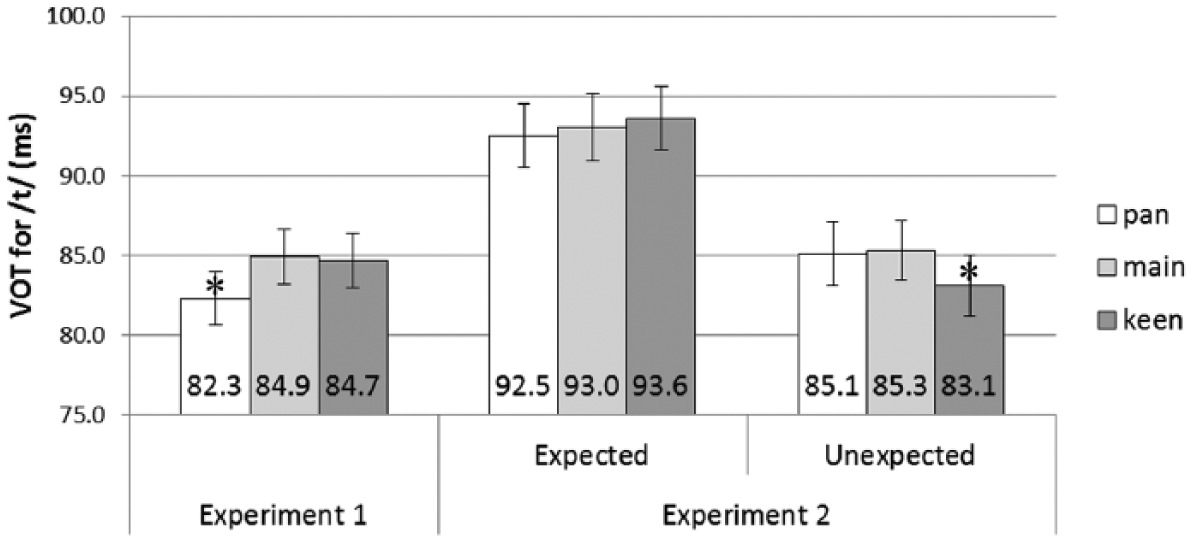
Mean VOT for t-initial words following pan (white bars), main (light grey bars), and keen (dark grey bars) for Experiments 1 and 2.
3 Experiment 2: Perception priming
Given that traditional shadowing studies have found that fine-grained phonetic detail from perception affects production, we conducted a second set of experiments where two groups of participants heard the primes, rather than produced the primes. In Experiment 2, different participants were assigned to one of two different conditions. In the Expected condition, primes had the expected relative VOT values (shorter for pan and longer for keen), while in the Unexpected condition, these relative values were reversed (shorter for keen and longer for pan).
If, as suggested by Yuen et al. (2010), the motor system is automatically and sufficiently activated during perception, then we expect to find that VOTs will be shorter following the auditory prime pan than when following the auditory prime keen in the Expected condition because the auditory primes have a shorter VOT in pan than in keen. This would indicate that the perception and production systems are sufficiently linked because they allow generalization of phonetic detail from one segment to another segment.
The Unexpected condition represents an interesting test of whether the specific auditory signal is what affects priming or instead whether activation of a lexical item and stored knowledge of the production of a lexical item affects priming. Specifically, if phonetic details from perception directly affect detailed phonetic priming, then we expect VOT to be shorter following keen than when following pan in the Unexpected condition because the auditory stimuli in this condition have shorter VOTs in keen than in pan. In contrast, if the auditory percept activates a stored motor plan or other stored exemplars of the lexical item, then it would activate a motor plan with shorter VOT in pan than in keen because this is the normal, expected difference in VOT. If the latter case is true, then the Unexpected condition should result in a shorter VOT following pan than when following keen even though this is not the pattern that is presented in the auditory stimuli.
3.1 Methods
3.1.1 Participants
Two different groups of participants completed Experiment 2. All participants were required to meet the following criteria: native speaker of American English, ages 18–25, and no history of speech or hearing impairments. Twenty-five participants completed Experiment 2-Expected. One was eliminated for producing too many errors (n=6) and one participant was eliminated due to a recording malfunction, leaving 23 participants for analysis. This resulted in 1229 words where the initial VOT was measured. Twenty-five participants completed Experiment 2-Unexpected. One was eliminated for producing too many errors (n=7), leaving 24 participants for analysis. This resulted in 1272 words where the initial VOT was measured. All participants were paid US$20 for their participation.
3.1.2 Stimulus materials
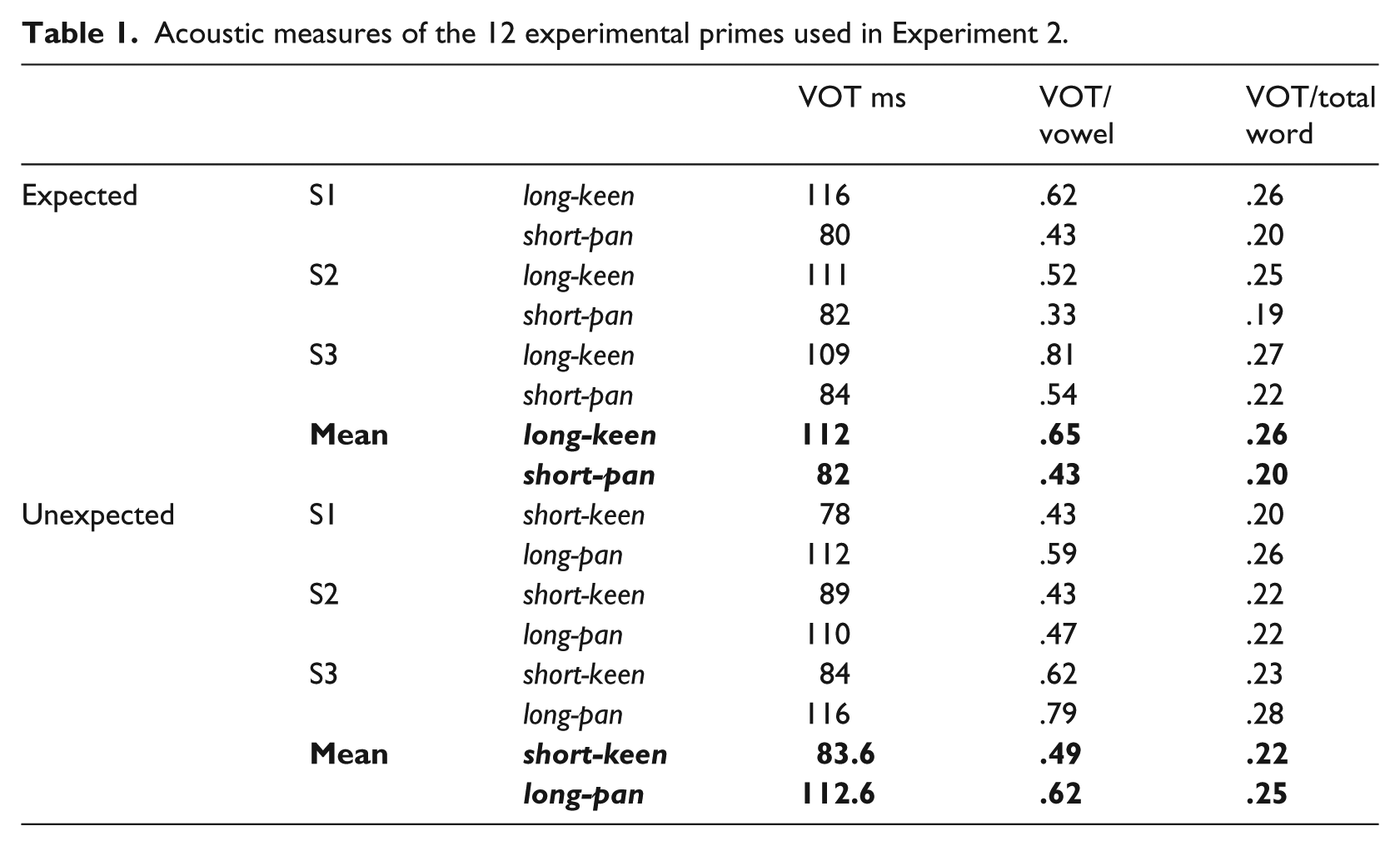
Auditory primes were selected from the productions of three female speakers who completed a pilot study similar to Experiment 1, but where the words were presented on index cards. Auditory experimental primes were selected to either have a long VOT in keen (long-keen) and a short VOT in pan (short-pan) in the Expected condition or a short VOT for keen (short-keen) and a long VOT for pan (long-pan) for the Unexpected condition. These particular speakers and tokens were selected because they produced matched sets of keen and pan such that the short versions were approximately 82 ms and the long versions were approximately 112 ms. Table 1 provides acoustic measures for the 12 experimental primes. In addition, one production of main and of four filler primes were selected for each of these three speakers.
Acoustic measures of the 12 experimental primes used in Experiment 2.
Three target speakers were selected so that the participants in Experiment 2 would hear a variety of productions of the same word, but with a consistent VOT. The goal was to incorporate some variability within the primes, as high variability training has been found to result in the best generalization (Clopper & Pisoni, 2004; Houston, 1999; Lively, Logan, & Pisoni, 1993; Logan, Lively, & Pisoni, 1991; Richtsmeier, Gerken, Goffman, & Hogan, 2009; Rost & McMurray, 2009; Singh, 2008).
3.1.3 Procedure
Participants sat in a quiet testing room in front of a desktop PC running Windows XP and EPrime 2.0 and completed three blocks of self-paced trials. For each trial, a prime was played binaurally over Sennheiser HD-280 circumaural headphones. When the sound file ended, a fixation point appeared for 250 ms after which the target appeared on the screen in capital letters for 750 ms, as shown in Figure 2. After the target word was produced, participants saw the question ‘What word did you hear?’ on the computer screen, referring to the prime. Speakers were presented with this question to ensure that they were actually attending to the prime. Pilot testing indicated that without this prompt, speakers were likely to report that they had no idea what word was heard. The first and last four trials of each block contained only filler prime-target pairs. Two experimental targets (teen, ten, tan, Tom, tone, tune) were paired with each of the three speakers (S1, S2, S3). Across the three blocks, all speakers served as the priming voice for each of the target words.

3.1.1.1 Trial procedure for Experiment 2.
Participants’ responses were recorded with a Shure SM58 dynamic cardiod table top microphone with a frequency response from 50 to 15,000 Hz. The microphone was placed to the side of the speaker approximately 12 inches away. Utterances were recorded onto a Marantz PMD670 solid state recorder at 44.1 KHz as .wav files analyzed in Praat.
3.2 Acoustic analysis
VOT measurements were taken in the same manner as in Experiment 1. For Experiment 2-Expected, five of the 23 participants’ VOTs (21.7%) and for Experiment 2-Unexpected five of the 24 participants’ VOTs (20.8%) were remeasured by a second trained research assistant to establish inter-rater reliability. Using these two partial datasets, two-way mixed, consistency, single measure ICCs (McGraw & Wong, 1996) were calculated. The resulting ICCs were in the good–excellent range (2-Expected: ICC = .936, 95% CI = .919-.949; 2-Unexpected: ICC = .886, 95% CI = .857-.909) (Cicchetti, 1994).
3.3 Results
Visual inspection of Q-Q plots and of histograms for the distribution of target VOTs in the three priming conditions (following pan, keen, and main) for both the Expected and Unexpected conditions suggested a normal distribution. Results from the Kolmogorov-Smirnov test for normality confirmed that these target VOT distributions did not deviate significantly from a normal distribution (Expected: D = .040, .036, and .043 respectively, all p > .05; Unexpected: D = .045, .047, and .059 respectively, all p > .05).
An omnibus linear mixed-effects model was fit to the data from Experiment 2. Condition (Expected and Unexpected), Prime (keen, pan, main), and their interaction were treated as fixed effects, with random intercepts by participant and target word (item). Statistical significance of the main effects and interaction was assessed using likelihood ratio tests (Baayen, 2008, p. 276) to evaluate the change in goodness-of-fit when terms are added to a linear model.
Using the model comparisons, we observed a significant Condition x Prime crossover interaction, χ2(1) = 6.54, p = .038. This interaction indicates that the duration of VOT was differently affected by the two primes depending on whether participants heard the Expected or Unexpected VOT values. To explore this interaction, two separate linear mixed effects models were fit to the Expected and Unexpected data, with only Prime (pan, keen, main) as a fixed effect, and with random intercepts by participant and target word. As in Experiment 1, significance was assessed using the MCMC procedure (Baayen, 2008). These MCMC analyses revealed no significant effect for Prime in the Expected condition (keen:pan comparison, p = .21; keen:main comparison, p = .46; pan:main comparison, p = .61), but did reveal a significant effect in the Unexpected condition, with VOT values being shorter following the short prime keen than when following the long prime pan (estimate = 1.80, SE = .91, t = 1.98, p = .048) and when following the neutral prime main (estimate = 2.20, SE = .91, t = 2.42, p = .015), as shown in Figure 1. There was no significant difference in VOT between pan and main (p = .65)
4 Discussion
Experiment 1 revealed that fine-grained phonetic detail (duration of VOT) during the production of one segment changes fine-grained phonetic detail in the production of a different segment but along the same acoustic dimension. Thus, phonetic detail is generalized to other segments that are in the same natural class. In Experiment 2, which examined whether this also applies from perception to production, there was a significant effect of the prime condition in the Unexpected version, but not in the Expected version.
Three main findings emerge from the current experiments. First, the results from Experiment 1 provide converging evidence that fine-grained acoustic detail of a prime can affect the fine-grained acoustic detail of a phonologically related, but non-identical, segment within the natural class. The results of Experiment 1 also extend Nielsen’s findings by providing evidence that the generalization of fine-phonetic detail is not limited to artificially-modified acoustic information, but also arises due to natural variation of phonetic detail. In Experiment 1, the two experimental primes were naturally produced with an average VOT difference of 30 ms between the short prime pan and the long prime keen. This naturally produced difference in VOT resulted in a VOT difference on the target segments on the similar order of magnitude as those found in other studies. Both Nielsen’s data and the data from Experiment 1 show that fine-grained phonetic changes go in the expected direction to more closely match the primed/exposed VOTs. Following exposure to lengthened VOTs, Nielsen’s speakers produced longer VOTs. Similarly, in the two relevant priming conditions of Experiment 1 where participants actually produced a VOT on the prime, the resulting target VOTs were shorter after having produced a short VOT than after having produced a longer VOT. In fact, this type of VOT change—becoming more similar to the prime VOT—was also found in Experiment 2-Unexpected, where target VOTs were shorter after hearing a shorter VOT and longer after hearing a longer VOT. (See below for additional discussion of the results of Experiment 2.)
That fine-grained phonetic detail of one segment generalizes to another segment within the same natural class suggests that there must be some type of subsegmental information that is shared across the different segments. Nielsen argues that one possible theory that can account for this cross-segmental generalization of phonetic detail is an exemplar theory, albeit with some modifications to the traditional versions. Traditional exemplar theories in which stimuli are encoded as non-decomposed wholes and where only a level of lexical representation exists cannot account for the generalization data reported by Nielsen (2011) and found in the current set of experiments. In these restricted exemplar theories, an exemplar of keen can only affect the production of keen. Because non-identical segments are involved in the experiments here—where phonetic information about /k/ and /p/ influences the production of /t/—VOT changes of /t/ cannot be attributed to an episodic trace because there is no trace for /t/. As Nielsen notes, a shared level of subphonemic representation for the natural class of voiceless stops allows exemplars of different segments within this class to affect each other. Incorporating this level of shared representation among the class of voiceless stops creates an exemplar cloud of voiceless stops, which allows exemplars from that cloud to affect the production of other sounds from that same exemplar cloud. Thus, producing (or perceiving) a voiceless stop with a short versus long VOT could pull the VOT of another voiceless stop in the same direction. This is analogous to how the results of traditional shadowing studies are explained, where phonetic details of the heard target word remain activated and result in a production that is more similar to the auditory stimulus. The only difference between the explanation for the shadowing data and for the cross-segmental generalization data is that rather than requiring identity between the two lexical items, there is identity on a subsegmental level for sounds that are in the natural class of voiceless stops. Other researchers have similarly argued for multiple levels of representation in exemplar models (Pierrehumbert, 2001; Walsh et al., 2010).
An alternative way to account for the generalization of phonetic detail from one segment to another is through a psycholinguistic theory of language production that allows for gradient activation, as is discussed in Goldrick and Blumstein (2006) for the tongue twister data. In such a theory, the feature or articulatory commands related to voicelessness are more or less activated based on the duration of VOT of the prime. For example, after producing the short prime pan, the voiceless node would be less activated than after producing the long prime keen. This relative difference in activation would affect the production of other voiceless sounds that share the voicelessness node, thus resulting in shorter or longer VOT depending on whether the node was more or less activated by any member of the same natural class that shared the node.
Although these two theories account for the data in different ways, the unifying factor is that for non-identical segments to affect each other, it is necessary that there be some link between non-identical segments. This shared link, whether a subsegmental level of representation in an exemplar model or with a subsegmental node, allows cross-segmental generalization of phonetic detail.
The second major finding to emerge from the current set of experiments is that priming of fine-grained phonetic detail is stronger within a modality (production-to-production) than across modalities (perception-to-production). While there was an effect of the experimental primes in Experiment 1, where speakers produced both the prime and target, there was not a significant difference in VOT for the targets in the analogous perception-to-production task (namely Experiment 2-Expected). In contrast, Nielsen (2011) did find an effect of fine-phonetic detail from perception affecting fine-phonetic detail in production. Thus, the current study partially replicates the cross-segmental priming of fine phonetic detail from perception to production that was found in Nielsen (2011). The difference between Nielsen’s finding of cross-segmental perception-to-production priming and ours may arise from a few possible sources. As mentioned above, the VOT differences in the exposed auditory stimuli were greater in Nielsen than were the VOTs of the prime stimuli in the current experiment. Nielsen’s VOTs were modified by at least 40 ms, whereas the VOT differences in the primes in Experiment 2 differed by only 30 ms (see Table 1). Thus, the lack of a significant effect of priming in Experiment 2-Expected may simply relate to the less extreme differences in VOT between the two conditions in the current study. A larger difference in VOT of the primes may be needed to generate a change in production.
Alternatively and more interestingly, the lack of generalization of phonetic detail in Experiment 2-Expected may instead result from perceptual compensation of the listeners. It is well-established that listeners make perceptual accommodations based on stored knowledge of—and experience with—the phonetics of a language. Relevant for the current study is that listeners compensate for place of articulation when locating the phoneme boundary between voiced and voiceless stops, with increasingly shifted boundaries towards longer VOT for more posterior place of articulation (Lisker & Abramson, 1970; Miller, 1977; Nearey & Rochet, 1994) and also for longer VOT for the high vowel context (Nearey & Rochet, 1994). Thus, the exact same duration of VOT for a labial versus a velar stop could be perceived as being in different voicing categories or as better (more canonical) or worse examples of the category. For example, based on Lisker and Abramson’s (1970) stimuli, a VOT of 50–60 ms is well within the voiceless category for a bilabial stop, but much closer to the voiced/voiceless boundary for the velar stop. Because the default VOT is expected to be shorter for pan than for keen, their different VOT values may be perceived as more similar than their absolute values would suggest. If the listeners do compensate here, then the lack of a significant effect in Experiment 2-Expected is easily explained; listeners perceive the amount of VOT as the same (or more similar) which results in nonsignificant VOT differences for the target VOTs. Perceptual compensation is not relevant for Nielsen’s study because listeners only heard lengthened versions of a single voiceless stop /p/, thus there was no comparison or compensation that could be made with another segment with a different place of articulation within the experimental task. Support for the possible role of perceptual compensation also comes from Gussenhoven (2007) who found perceptual compensation related to the predictable relationship between vowel height and vowel length.
The possible contribution of perceptual compensation is bolstered by the results of Experiment 2-Unexpected. In the Unexpected condition, perceptual compensation would augment the absolute difference in VOT of the two primes rather than reduce it, as was suggested for the Expected condition. Specifically, perceptual compensation would serve to make the short VOT of keen seem even shorter because it would be towards the shorter end of the /k/ distribution, whereas the long VOT in pan would seem even longer because it would be on the longer end of the /p/ distribution. In addition to perceptual compensation, the stronger effect in the Unexpected condition may also be due to the unusual, or ‘surprising’ nature of the stimuli (longer VOT for pan than for keen). Similar types of surprising or unexpected aspects of stimuli have been shown to magnify effects in other behavioral tasks (Fine & Jaeger, 2013; Jaeger & Snider, 2008).
If perceptual compensation underlies the null effect in Experiment 2-Expected (and the significant effect in Experiment 2-Unexpected), then additional considerations must be made for both exemplar theories and psycholinguistic theories. 1 If an exemplar theory included a subsegmental level of information that resulted in an exemplar cloud of voiceless stops, then we would expect faithful encoding of the duration of VOT. Similarly, if degree of activation were purely linked to duration of VOT in a psycholinguistic theory of spoken language processing, then we would also expect exact encoding of duration of VOT. Thus, both theories would predict a significant effect of prime in Experiment 2-Expected. The null effect for this version thus suggests that the encoding of VOT at this subsegmental level may be modulated by phonetic context (e.g., place of articulation and vowel height). We leave it to future studies to explore the possible role of perceptual compensation in cross-segmental generalization of phonetic detail and its implications for theories of speech perception and production.
The third major finding to emerge from the current set of experiments is that in contrast to the nonsignificant result in the Expected condition of Experiment 2, there was a significant effect of prime VOT in the Unexpected condition of Experiment 2. Specifically, VOT of the target words was shorter following an auditory prime with an acoustically short VOT (in this condition, keen) than when following an auditory prime with an acoustically long VOT (in this condition, pan). The Unexpected condition was included to test whether phonetic details of the particular auditory stimuli were relevant for cross-segmental priming or whether the lexical item itself and the concomitant knowledge of VOT distributions, rather than the specific phonetic details of the auditory stimuli, would influence cross-segmental generalization of VOT. The results of the Unexpected condition clearly show that the auditory details, and not stored knowledge of the normal VOT production for these lexical items, are what matters. This finding supports Yuen et al.’s (2010) conclusion that motor plans are automatically activated during perception. The results of the current study suggest that the particular details of the motor plan, in this case a short VOT in keen and a long VOT in pan, are activated during the auditory primes and ultimately result in a difference in the target VOT.
Taken together, the results of the two experiments here provide clear supporting evidence for Nielsen’s previously collected data that fine-phonetic detail of one segment can generalize to another segment within the same natural class, resulting in phonetic details of a target that are more similar to that of the priming stimulus. Importantly, the current study shows that this generalization occurs as the result of natural variation of VOT, making it a result that is more likely to occur in everyday language situations. Furthermore, our results show that event-specific acoustic information is what is relevant. In Experiment 2-Unexpected, the specific details of the auditory primes resulted in modifications to VOT of the target words, rather than stored knowledge of VOT distributions for the two different lexical items. Taken together, the findings of the current study provide converging evidence that speech production is sensitive to fine-grained phonetic detail, indicating that any theory of language production must include a level of subsegmental information that allows for this type of cross-segmental generalization of phonetic detail.
Footnotes
Acknowledgements
We thank Jennifer Bruno, Emma Mack, Rolliene Mallari, Jennifer Melgarejo, Rebecca Piper, and Ashley Quinto for help with data collection and analysis. Portions of this work were presented at the 159th Meeting of the Acoustical Society of America in 2010.
Funding
This research received no specific grant from any funding agency in the public, commercial, or not-for-profit sectors.