



Abstract
The use of emotion in language is a key element of human interactions and a rich area for cognitive research. The present study examined reactions to words of five types: positive emotion (e.g., happiness), negative emotion (e.g., hatred), positive emotion-laden (e.g., blessing), negative emotion-laden (e.g., prison), and neutral (e.g., chance). Words and nonwords were intermixed in a lexical decision task using hemifield presentation. Results revealed a general left hemisphere advantage. Overall, reaction times for positive words were faster than for negative or neutral words and this effect varied by hemifield of presentation. These results support a valence hypothesis of specialized processing in the left hemisphere of the brain for positive emotions and the right hemisphere for negative emotions.
1 Representation of emotion in the brain
Emotions are an indelible part of the human experience. Both positive and negative emotions can influence our actions and attitudes in profound ways that are relevant to goals such as survival and well-being (Tooby & Cosmides, 2008). Communication about one’s emotional experiences through language is a fundamental skill in facilitating social relationships. Researchers in the fields of cognitive psychology and psycholinguistics have studied ways in which the emotional characteristics of language can impact comprehension, attention, and memory. These studies generally have sought to show differences in processing between emotional words and neutral words.
Facial expressions are produced asymmetrically on the face, with the left side of the face showing greater expression of emotion (the muscles on the lower portion of the face are contralaterally controlled; Davidson, Shackman, & Maxwell, 2004; Sackheim, Gur, & Saucy, 1978). This evidence led to investigations of possible lateralization of emotion in the brain. Two main theories have evolved from this research: the valence hypothesis and the right hemisphere hypothesis. The valence hypothesis supposes that negative emotion processing is specialized to the right hemisphere, whereas positive emotion processing is specialized to the left hemisphere. A significant number of studies have demonstrated empirical results consistent with the valence hypothesis (see e.g., Alfano & Cimino, 2008; Davidson, Ekman, Saron, Senulis, & Friesen, 1990; Holtgraves & Felton, 2011; Wager, Phan, Liberzon, & Taylor, 2003). The right hemisphere hypothesis claims that both positive and negative emotion processing is specialized to the right hemisphere (Borod, 1992). A large number of studies have found evidence consistent with this hypothesis as well (see, e.g., Ahern et al., 1991; Bourne & Vladeanu, 2011; Grzybowski, Wyczesany, & Kaiser, 2014; Levine, Banich, & Koch-Weser, 1988; Watling & Bourne, 2013). A final group of studies has not found support for specialization of either hemisphere for emotion processing of non-linguistic stimuli and instead showed bilateral effects with roughly equal processing facilitation for both the left and the right hemisphere (Fusar-Poli et al., 2009).
Results from studies of emotion lateralization have sometimes found sex to be an important factor (Bauer & Altarriba, 2008; Bourne, 2005, 2008; Rahman & Anchassi, 2012; Schneider et al., 2011; Wager et al., 2003; Watling & Bourne, 2013), whereas others found no sex differences in lateralization effects (Holtgraves & Felton, 2011; Sommer, Aleman, Somers, Boks, & Kahn, 2008). Nearly all studies that have found a relative difference in lateralization or emotion lateralization within one sex, but not the other, found stronger effects for males. This was supported by Bourne and Maxwell (2010), who used measures of psychological masculinity (i.e., the degree to which one identifies with statements typical of masculine behaviors) and femininity (i.e., the degree to which one identifies with statements typical of feminine behaviors). They found that even when biological sex was taken into account, psychological masculinity was predictive of greater lateralization (no effect was seen for psychological femininity).
Table 1 summarizes findings of studies investigating emotion lateralization using single word stimuli, as does the present experiment. Mixed results across studies have been obtained (see Table 1). Although all of these studies have found left hemisphere activation consistent with advantages for language processing (supported elsewhere, such as Knecht et al., 2000), the effects based on valence are more ambiguous. Some find stronger right hemisphere (RH) activation for positive words (Kuchinke et al., 2005) and some find stronger left hemisphere (LH) activation for negative words (Inaba, Kamishima, & Ohira, 2007). A consistent pattern has not emerged at this point; however, some (Canli, Desmond, Zhao, Glover, & Gabrieli, 1998; Wager et al., 2003) have suggested that failures to find expected patterns of emotional processing based on valence may have occurred because authors failed to match their stimuli for their arousal or emotional intensity. The present study matched positive and negative stimuli on arousal level due to concern for this variable.
Summary table of recent research on lateralization of emotion effects using single word stimuli.
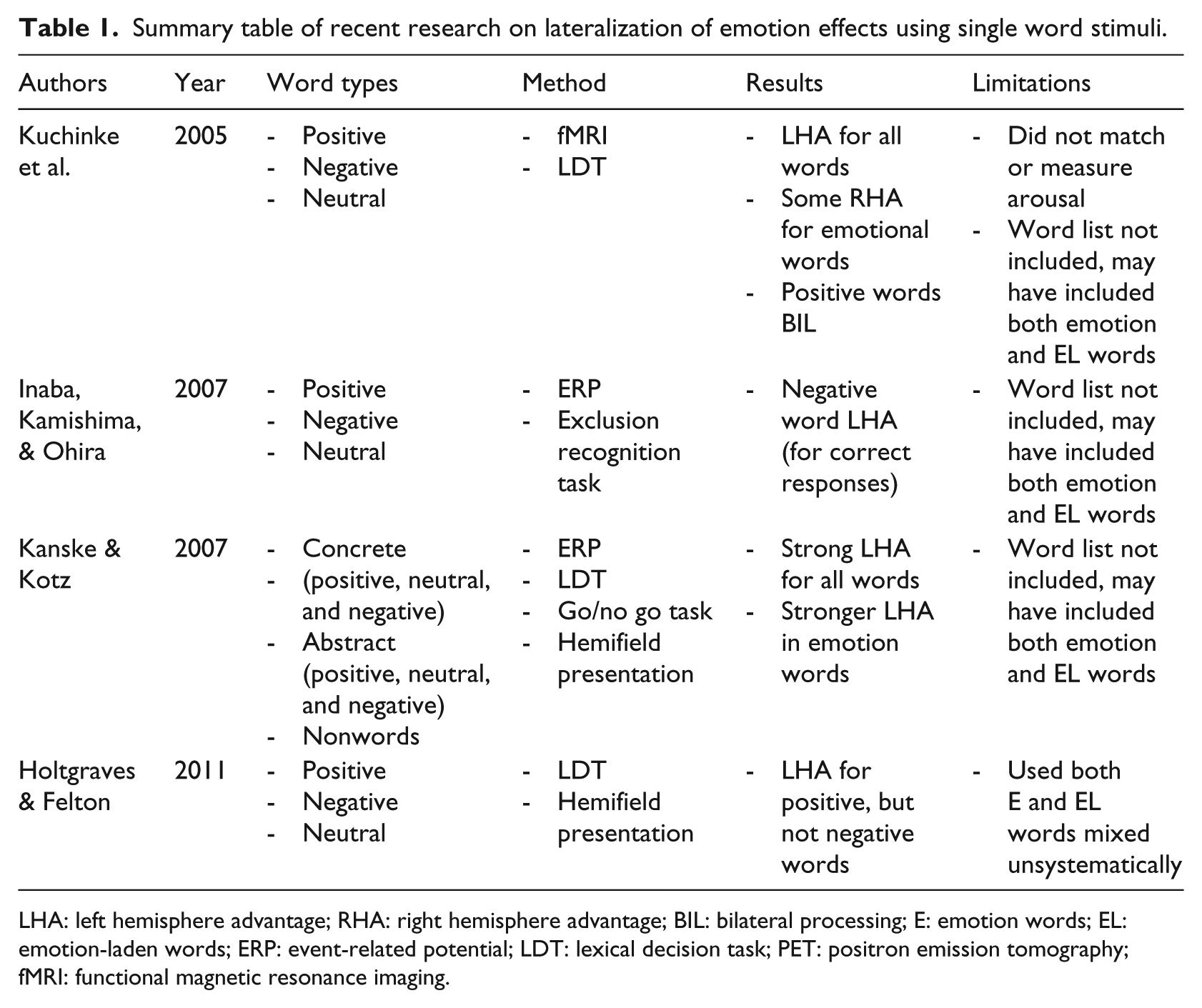
LHA: left hemisphere advantage; RHA: right hemisphere advantage; BIL: bilateral processing; E: emotion words; EL: emotion-laden words; ERP: event-related potential; LDT: lexical decision task; PET: positron emission tomography; fMRI: functional magnetic resonance imaging.
1.1 Emotion and emotion-laden words
Previous research has examined emotion representation across brain hemispheres, but has unsystematically intermixed emotion (describing an emotional state, e.g., love) and emotion-laden words (simply evoking an emotion, e.g., cancer), despite the fact that processing differences across these word types have been empirically documented. Altarriba and colleagues have found important empirical differences between emotion and emotion-laden words in several experimental paradigms such as the Affective Simon Task (Altarriba & Basnight-Brown, 2011) and repetition blindness paradigm (Knickerbocker & Altarriba, 2013).
Altarriba and Basnight-Brown (2011) used an Affective Simon Task (De Houwer, 2003) in which monolingual and bilingual participants either categorized words by color (blue or green) or valence (positive or negative). In this paradigm, if valence is quickly processed, participants will automatically assess the valence of the stimuli, even when it is irrelevant to the decision at hand, as in the case of color decisions (see Figure 1 for samples). The Simon effect refers to results in which responses that are congruent between both categories are facilitated relative to those that prompt incongruent responses, despite the task irrelevance of the categorizations based on the other dimension. In Altarriba and Basnight-Brown (2011), the valence of the word was not relevant to making a categorization based on color. If, however, congruent responses are faster than incongruent responses, the valence task is affecting color performance even though it is uncorrelated with color categorization. Word stimuli included either emotion words or emotion-laden words, manipulated between-subjects.
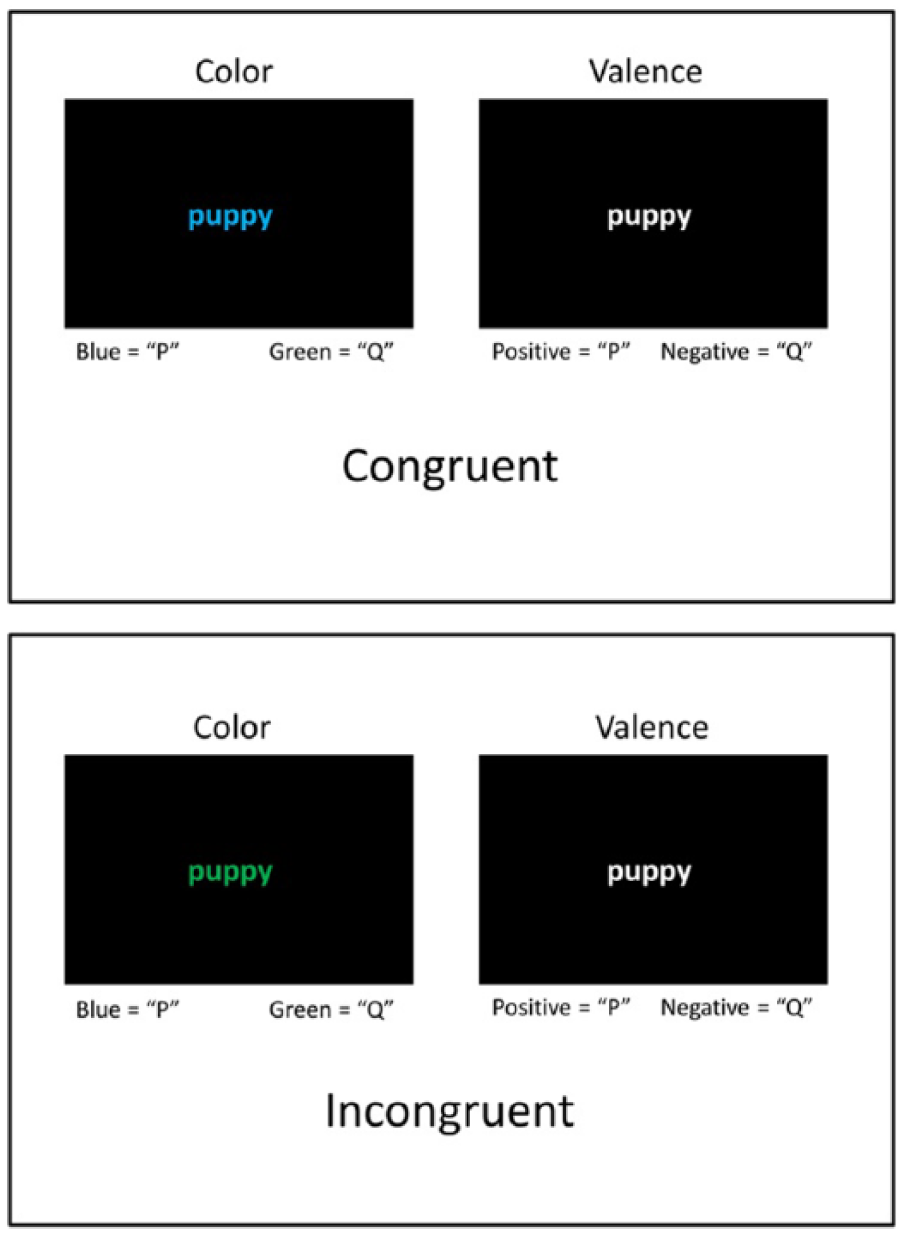
In these example displays, similar to those used in Altarriba and Basnight-Brown (2011), the response keys are congruent for the top samples when participants respond based on color or valence (both the blue ink color and positive valence correspond to a response of “P”). However, in the lower samples, the key press for the correct response based on color, green (“Q”), is incongruent with the key press for the correct response based on valence, positive (“P”).
Results from Altarriba and Basnight-Brown (2011) showed differential patterns for emotion words and emotion-laden words based on valence. Participants were faster to respond to trials in which the responses were congruent for both color and valence responses for both emotion words and emotion-laden words with negative valence. However, for positive valence, participants were only facilitated to respond on congruent trials of emotion-laden (not emotion) words. This study provides important empirical evidence of differences between emotion and emotion-laden word processing.
Knickerbocker and Altarriba (2013) examined the emotion and emotion-laden word classes with a different experimental paradigm, repetition blindness (RB). Repetition blindness refers to the finding that when participants view a series of rapidly presented items that contains a repeated item, participants report seeing only one instance of the repeated item (Kanwisher, 1987). For example, if the series, “treat, paper, table, regret, chance, hate, regret, pillow” was briefly presented one word at a time (using rapid serial visual presentation; RSVP), participants are likely to report “regret” just once, despite it having been presented twice. Knickerbocker and Altarriba (2013) employed neutral words, and emotion and emotion-laden negatively valenced words in this paradigm. The words were either repeated in close proximity in the same trial or no repetitions occurred in the trial. All emotional stimuli together produced more repetition blindness than neutral words; however, this effect was driven by emotion (not emotion-laden) words. Participants showed significantly larger repetition blindness for emotion than for emotion-laden words. Once again, empirical results support a clear difference between emotion and emotion-laden words.
These differences may occur based on the number and strength of semantic associates to words of each type (Knickerbocker & Altarriba, 2013), with emotion words having more direct associations to emotion information, and emotion-laden words having a greater number of semantic associates (including fewer emotional connotations in many cases). However, much of the previous literature and ongoing work continues to unsystematically intermix the two classes.
1.2 Primary reference study
Kanske and Kotz (Experiment 1, 2007) conducted a lexical decision task using several word types varying in concreteness and emotional valence. Of the 120 concrete words, 30 were positive (e.g., flower), 30 were negative (e.g., enemy), and 60 were neutral (e.g., cabin). The 120 abstract words also included 30 positive (e.g., delight), 30 negative (e.g., violence), and 60 neutral words (e.g., optics). All emotion words were rated as higher in arousal than the neutral words, but arousal did not significantly differ between positive and negative words. These words were presented in a hemifield presentation along with 240 pseudowords that were created by changing one letter from the target words. A continuously presented fixation cross appeared at the center of the display. After 1000 ms, each word appeared for 200 ms at 1° of visual angle to the left or right of fixation. Immediately after the participant’s response, a black fixation cross was presented for 1200 ms, followed by a 700 ms red fixation cross indicating that the next trial was about to begin. Participants responded with one of two keys indicating “word” and “nonword.” Participants were 30 native German speakers and all words were German words (the examples given above are translations).
Results from Kanske and Kotz (2007) showed that concrete words were processed faster than abstract words and that, on average, words were processed faster when presented in the right hemifield (initial input to left hemisphere). Additionally, positive words were responded to faster than negative or neutral words, though negative words were responded to faster than neutral words. The interaction between emotionality and concreteness was also significant, such that the difference between negative and positive words was only significant for concrete, not abstract, words.
Some limitations of Kanske and Kotz’s (2007) research lie in the division of word types. Although due consideration was given to the reality that emotional words can vary in concreteness, and the concrete words used included emotion-laden words (e.g., enemy, flower), the abstract emotional words included both emotion (e.g., delight) and emotion-laden (e.g., violence) words. Consideration of emotional word categories based solely on concreteness does not give a complete picture of the ways in which emotional word stimuli can vary, given the previous evidence presented supporting differences between emotion and emotion-laden word types (Altarriba & Basnight-Brown, 2011; Knickerbocker & Altarriba, 2013). Therefore, it is critically important to systematically differentiate emotion and emotion-laden words in such investigations. It is also unusual that the pseudowords or nonwords from this study were created from the actual word stimuli used within the experiment. The authors of the present study avoided this issue by creating nonwords from matched stimuli not used within the experiment.
1.3 Current study
The present study sought to find support for one of the previously described opposing theories of emotion specialization, while also investigating whether specialization to a particular brain hemisphere depends on whether stimuli are emotion words or emotion-laden words. The present study compared five word types: positive emotion, negative emotion, positive emotion-laden, negative emotion-laden, and neutral, within a lexical decision task. These word types have not previously been compared in the same lateralization study. The stimuli have been carefully normed to provide much-needed control of emotion versus emotion-laden stimuli.
It was predicted that in the lexical decision task, emotion words would be responded to faster on average than neutral words (Kanske & Kotz, 2007; Kousta, Vinson, & Vigliocco, 2009). Results pertaining to lateralization of emotion may be consistent with either the valence hypothesis (negative emotion processing is specialized to the right hemisphere and positive emotion processing is specialized to the left hemisphere; e.g., Alfano & Cimino, 2008) or the right hemisphere hypothesis (both positive and negative emotion processing is specialized to the right hemisphere; e.g., Watling & Bourne, 2013). If a difference in lateralization was found based on sex, males were predicted to show greater hemispheric specialization than females.
2 Method
2.1 Participants
One hundred and thirty-two participants initially completed the experiment; however, based on screening using the Beck Depression Inventory (BDI; Beck, Steer, & Brown, 1996) and the state portion of the State-Trait Anxiety Inventory (STAI; Spielberger, 1983), all data were removed from 32 participants with high scores (BDI > 13 or STAI > 43) prior to analysis. This was done out of concern for negative response bias from participants with non-typical emotional profiles (Trippe, Hewig, Heydel, Hecht, & Miltner, 2007), as is consistent with comparable previous work (Sutton & Altarriba, 2011). Any participants who reported being left-handed or ambidextrous were also eliminated (n = 15) as left-handed individuals often have differing patterns of hemispheric brain lateralization in general and for language specifically (Szaflarski et al., 2012) and there was not a sufficiently large sample size of left-handed individuals to compare right- and left-handed participants with acceptable statistical reliability. The final sample consisted of 85 undergraduate students (41 females and 44 males; mean age = 19.4 years) at the University at Albany, State University of New York. All participants were monolingual native speakers of English. Participants reported their current feelings of alertness (M = 4.8, range 3–7 on a Likert scale of not alert 1 to 7 extremely alert). Participants received partial course credit as compensation for their participation.
2.2 Materials
2.2.1 Target words
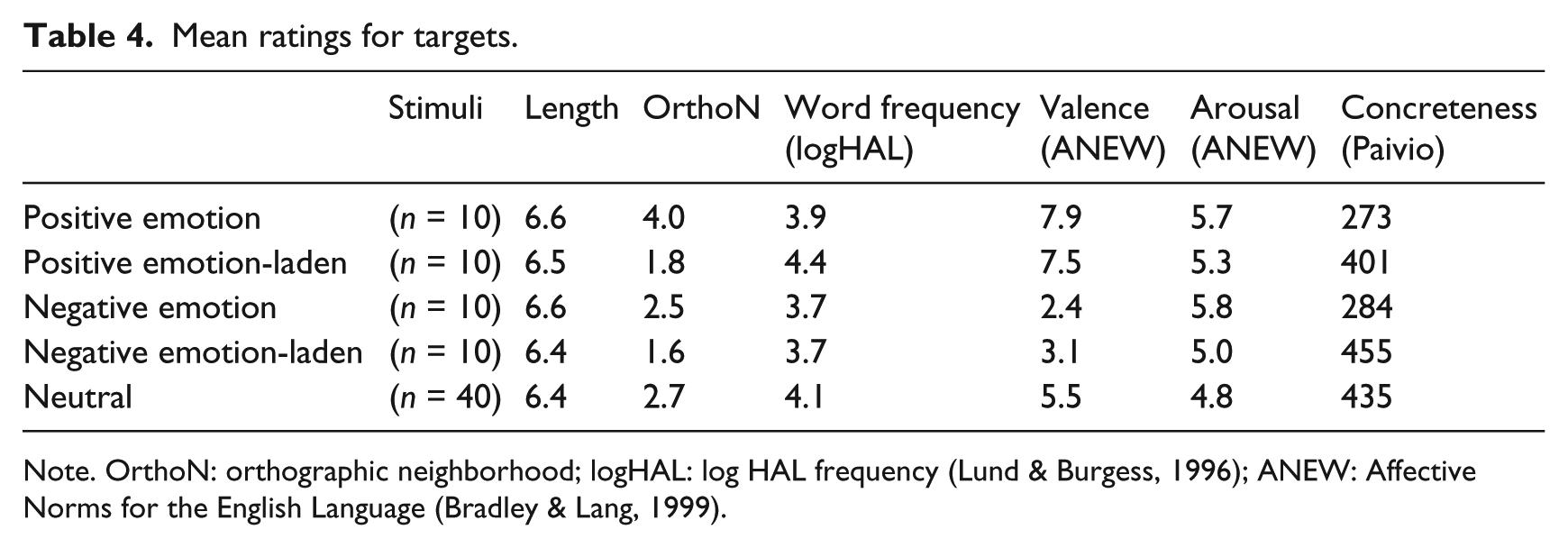
The 80 target words were chosen based on data from relevant word norms (Balota et al., 2007; Bradley & Lang, 1999; Clark & Paivio, 2004; Lund & Burgess, 1996; Martin et al., in progress). Five categories of words were created: 10 positive emotion words, 10 negative emotion words (20 emotion words in total), 10 positive emotion-laden words, 10 negative emotion-laden words (20 emotion-laden words in total), and 40 neutral words (see Appendix 1 for a full list of words). These words were then evaluated for their valence and arousal using Bradley and Lang’s (1999) Affective Norms for English Words, concreteness using Clark and Paivio (2004), frequency using Lund and Burgess (1996), and orthographic neighborhood using Balota et al. (2007). The categories were equated on length, word frequency, orthographic neighborhood, and previously obtained mean reaction time for lexical decision. The positive emotion and emotion-laden words were of high valence, negative emotion and emotion-laden words of low valence, and neutral words of moderate valence. All emotion words described an emotion (e.g., sadness), whereas all emotion-laden words were associated with or evoked an emotion, but did not label the emotion itself (e.g., weapon). (See Appendix 2 for mean values of word characteristics.)
All words used were English nouns in order to hold word class constant in this experiment. Nouns were chosen based on prevalence in the word norms used and also to increase similarity between the word categories. For example, many emotion-laden words are things (nouns) that have been colored by emotional experience (e.g., coffin) that is associated with such feelings as grief and sadness through experience. Emotions can be discussed using adjectives to describe the way we feel (e.g., sad) or by naming the emotional state itself (e.g., sadness). The noun form of the emotional state was chosen to be more comparable to the emotion-laden words in terms of word class.
2.2.2 Nonwords
All nonwords (e.g., blit) were taken from the English Lexicon Project (Balota et al., 2007) and matched to target words as closely as possible for length, orthographic neighborhood, and lexical decision reaction time. Initial letters and suffixes were matched when possible. All nonwords were easily pronounceable, had moderate to large orthographic neighborhoods, and were created from nouns; none were created from words appearing elsewhere in the experiment. (See Appendix 1.)
2.2.3 Beck Depression Inventory (BDI)
The Beck Depression Inventory (Beck et al., 1996) was administered to assess participants’ emotional states in the two weeks prior to test administration to gain a measure of depression.
2.2.4 State-Trait Anxiety Inventory (STAI)
The State portion of the State-Trait Anxiety Inventory (Spielberger, 1983) was given to assess participants’ current mood and feelings of anxiety.
2.2.5 Additional questions
Participants answered a number of demographic questions including their age, sex, handedness, current alertness, etc.
2.3 Procedure
Participants completed the informed consent process, and then the BDI and STAI inventories (described above) to measure their emotional states, which were presented in a random order to each participant. The participants then performed the main task, a lateralized lexical decision task. They were seated in front of a computer (the screen was positioned at a distance of 19 inches) and asked to place their chin onto a chin rest to keep their head still. The experimenter made sure that the participant was comfortable before proceeding. Participants decided whether the strings of letters were real words or not, as quickly and as accurately as possible. All of the words and nonwords were presented one at a time either to the right or to the left of the fixation cross in white, size 20 pt Arial font on a black computer screen. The words appeared between 3″ and 6″ from fixation, depending on the length of the word. The center of each word appeared at a standard point, approximately 4.5″ from fixation, either on the left or the right. The appropriate key assigned for word and nonword responses, “C” or “M,” counterbalanced across participants, was indicated on the bottom of the computer screen to alleviate working memory load. See Figure 2 for example screens. The word was continuously presented until participant response. Neutral, emotion, and emotion-laden words were presented in a random order interspersed with nonwords within each block. Participants completed 10 practice trials followed by 320 test trials that consisted of the 80 target words and 80 nonwords each presented once in each hemisphere (these were proportionally divided into four blocks and randomized within each block). Participants were allowed up to 2 minutes rest after every 80 trials. Finally, participants answered a short list of additional questions that included handedness, age, and sex. The entire experiment took approximately 35 minutes to complete.
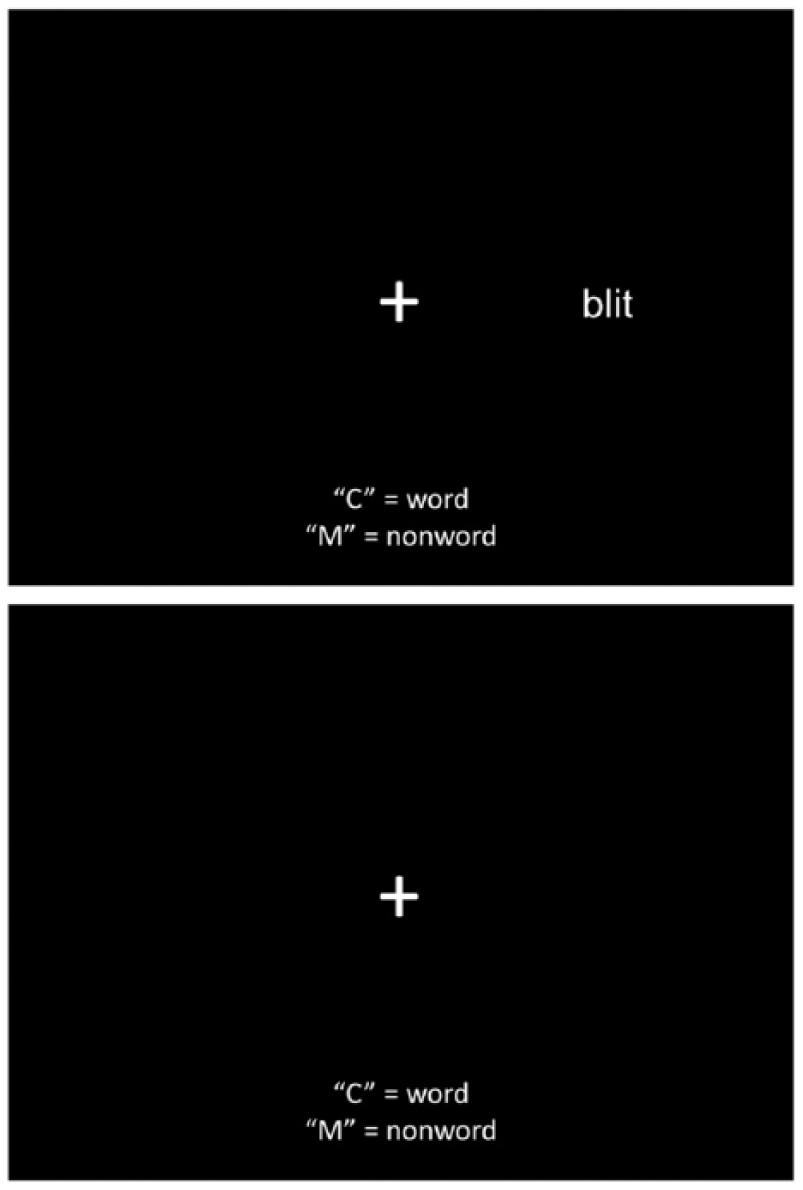
Example displays from the present experiment. In this example, the correct answer is “Nonword,” so the participant should press the “M” key.
3 Results
Data from all participants who met typical emotional criteria outlined above were examined for outliers. All trials with reaction times less than 200 ms were removed. A Winsorizing procedure (see Erceg-Hurn & Mirosevich, 2008) was used to replace trials with reaction time with a z-score greater than 2.5 with the value at z = 2.5 (1638 ms for left hemifield and 1829 ms for right hemifield). See Table 2 for descriptive statistics for final data of reaction times.
Descriptive statistics for lexical decision reaction times (ms), separated by sex, word type, and hemifield.
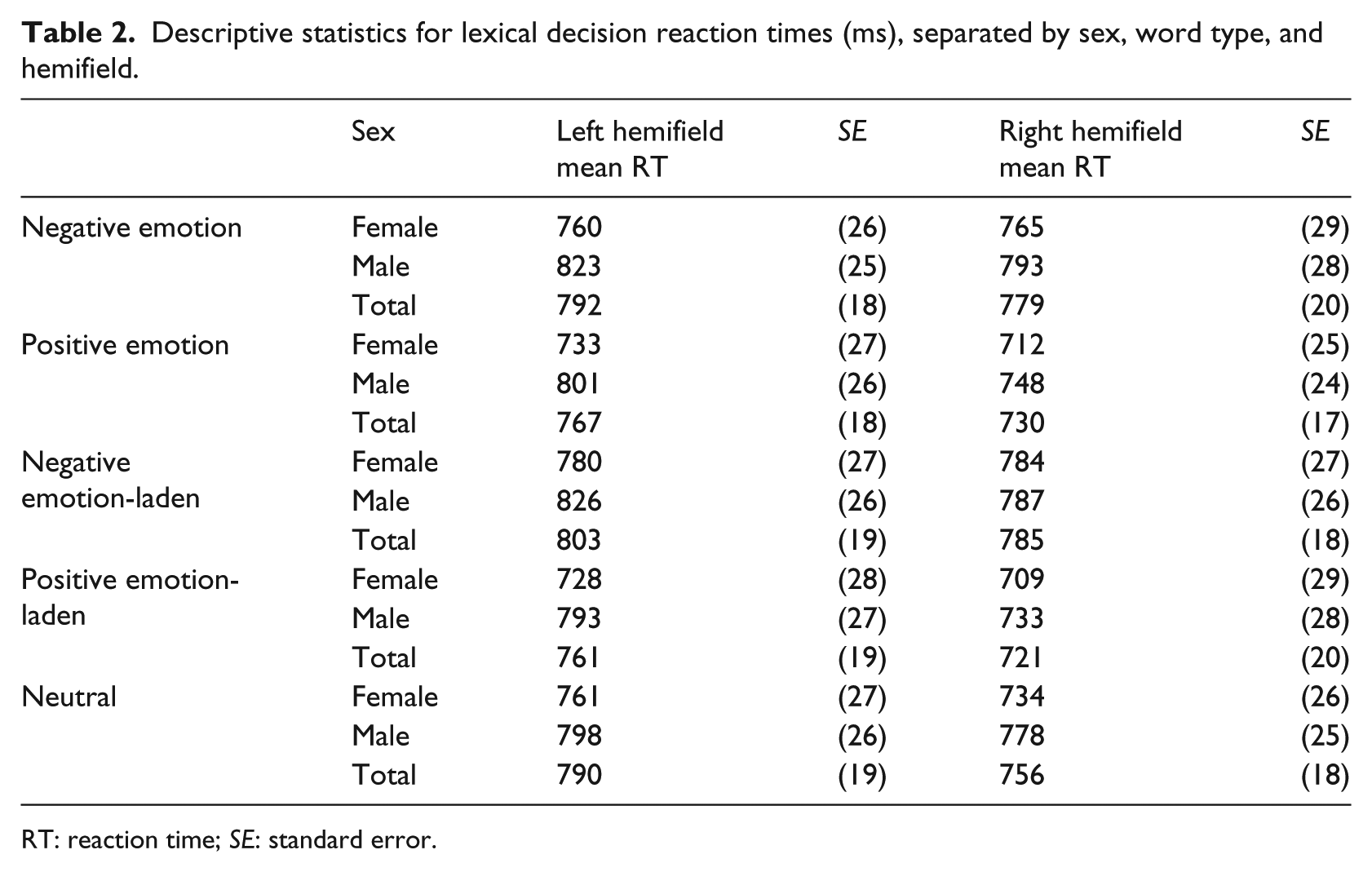
RT: reaction time; SE: standard error.
3.1 Reaction times
3.1.1 ANOVA of all words
A 5 × 2 × 2 mixed-factor analysis of variance (ANOVA) was conducted using word type (positive emotion, positive emotion-laden, negative emotion, negative emotion-laden, and neutral) and hemifield (left and right) as within-subjects independent variables, sex (male and female) as a between-subjects independent variable, and lexical decision time as the dependent variable. A main effect of word type on lexical decision reaction time, F(4, 332) = 27.14, p < .001, η2p = .25, and a main effect of hemifield, F(1, 83) = 24.73, p < .001, η2p = .23, were observed. A main effect of sex was not obtained.
There was a significant two-way interaction between sex of participant and hemifield, F(1, 83) = 8.14, p < .01, η2p = .09, in which males showed greater lateralization than females in their responses to all words. Males were significantly faster to respond to words appearing in the right hemifield (see Figure 3). There was no significant two-way interaction between word type and hemifield or word type and sex. The three-way interaction between word type, hemifield, and sex was also not significant.
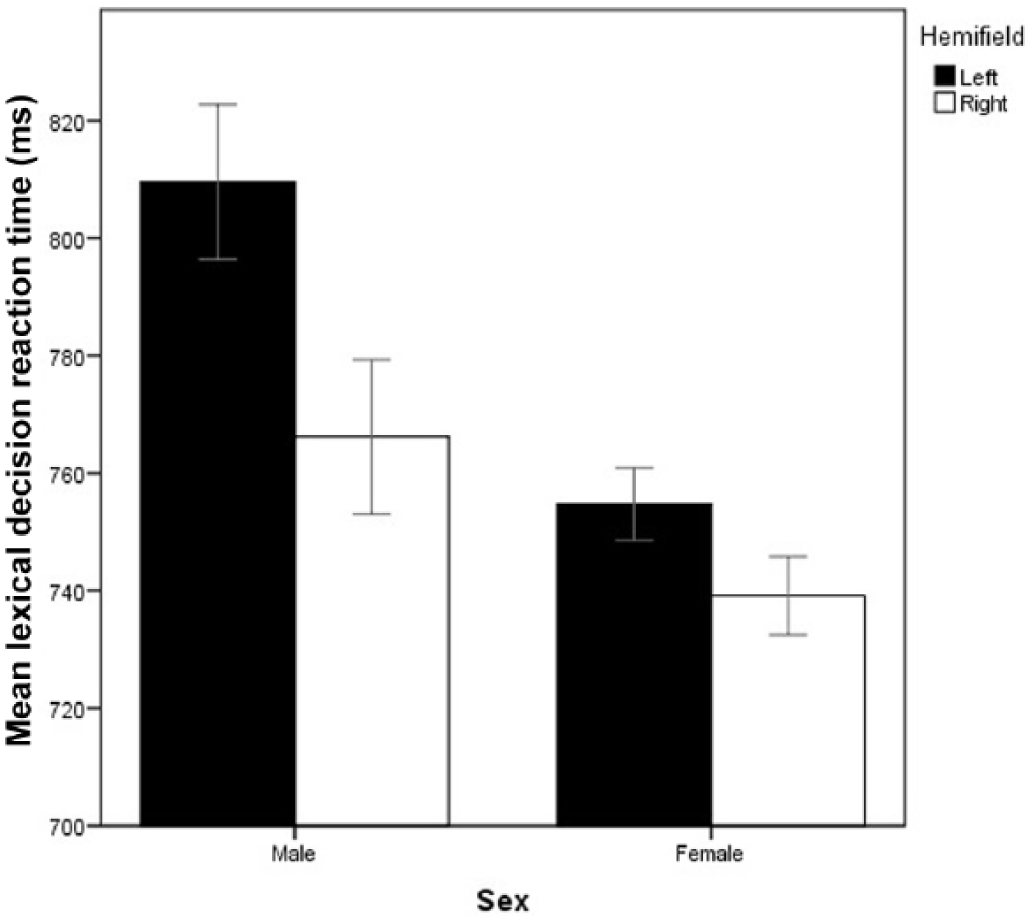
Mean lexical decision reaction times (ms) for each hemifield of presentation in males and females. Error bars represent ±1 SE.
Pairwise comparisons using a Bonferroni correction (all reported significant p < .01) and estimated marginal means supported a pattern of results based on differences between positively and negatively valenced words. Negative emotion words (estimated marginal mean, EMM = 785 ms) were responded to slower than positive emotion-laden words (741 ms) and positive emotion words (749 ms). Negative emotion-laden words (794 ms) were slower than positive emotion words (749 ms) and positive emotion-laden words (741 ms). There was no significant difference between negative emotion (785 ms) and negative emotion-laden words (794 ms), p > .05, or between positive emotion (749 ms) and positive emotion-laden words (741 ms), p > .05. Pairwise comparisons between neutral words and all other word types yielded three significant differences. Neutral words (773 ms) were significantly slower than positive emotion words (749 ms) and positive emotion-laden words (741 ms), and significantly faster than negative emotion-laden words (794 ms). All other pairs did not significantly differ (see Figure 4).
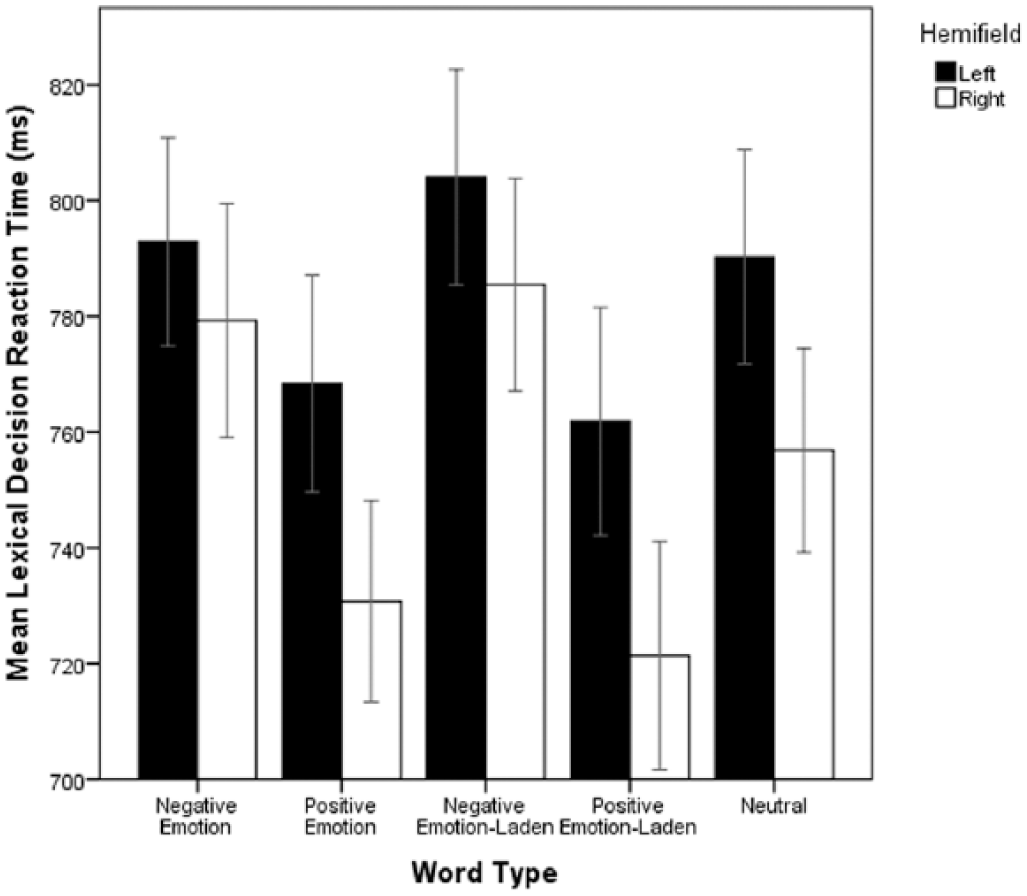
Mean lexical decision reaction times (ms) for each word type for each hemifield of presentation. Error bars represent ±1 SE.
3.1.2 Analysis of variance collapsing across emotion and emotion-laden word types
Given the lack of difference between emotion and emotion-laden word types in the previous analyses, a final analysis of variance (ANOVA) on reaction times was performed using only three word types: positive, negative, and neutral words. This was carried out with a 3 × 2 × 2 mixed-factor ANOVA using valence (positive, negative, and neutral) and hemifield (left and right) as within-subjects independent variables, sex (male and female) as a between-subjects independent variable, and lexical decision time as the dependent variable. A main effect of valence on lexical decision reaction time, F(2, 166) = 55.59, p < .001, η2p = .40, and a main effect of hemifield, F(1, 83) = 29.10, p < .001, η2p = .26, were observed. A main effect of sex was not obtained.
There was a significant two-way interaction between participant sex and hemifield, F(1, 83) = 7.27, p < .01, η2p = .08, in which males showed greater lateralization than females in their responses to all words. Males were significantly faster to respond to words appearing in the right hemifield. There was also a significant two-way interaction between valence and hemifield, F(2, 166) = 3.80, p < .05, η2p = .04, but not between word type and sex. The three-way interaction between valence, hemifield, and sex was not significant.
Pairwise comparisons for significant main effects showed that positive words (EMM = 745 ms) were reacted to faster than neutral words (773 ms), which were in turn reacted to more quickly than negative words (790 ms). All words presented in the right hemifield (755 ms) were responded to more quickly than words presented in the left hemifield (784 ms). Males showed greater lateralization than females in their responses to all words. Males were significantly faster to respond to words appearing in the right hemifield (770 ms) than the left (813 ms). Females showed a much smaller difference in reaction time for words appearing in the right hemifield (739 ms) than the left (754 ms).
3.2 Error rates
A mixed-factor ANOVA was conducted using all five word types and hemifield as within-subjects independent variables, sex as a between-subjects independent variable, and error rate as the dependent variable. See Table 3 for descriptive statistics of error data. A main effect of sex was obtained, F(1, 83) = 9.57, p < .01, η2p = .10. Pairwise comparisons using a Bonferroni correction showed that males (EMM = .31) had a significantly higher proportion of errors than females (.09). There were no significant main effects of word type on error rate or hemifield. None of the two-way interactions, nor the three-way interaction, approached significance (all p > .05). No other significant pairwise differences were observed.
Descriptive statistics of lexical decision error rate proportions, separated by sex, word type, and hemifield.
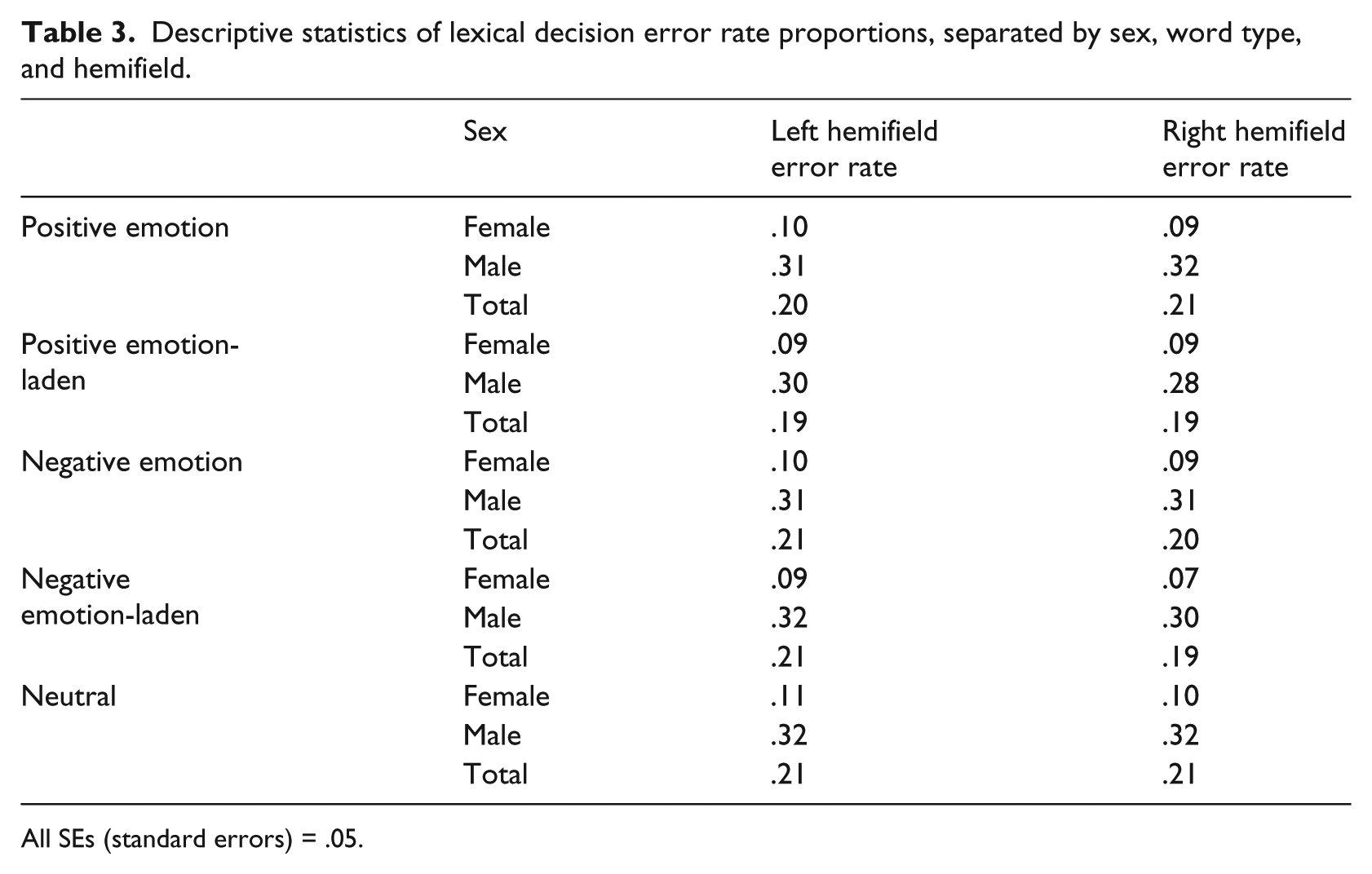
All SEs (standard errors) = .05.
4 Discussion and conclusions
The present study examined the effects the emotional valence of words using a lateralized lexical decision task. Results revealed a left hemisphere advantage for all of these word types, consistent with previously supported left hemisphere dominance for language (e.g., Knecht et al., 2000). When collapsed across emotion and emotion-laden word types, an interaction between valence and hemifield was revealed. Positive words were reacted to more quickly when presented in the right hemifield (more direct access to the left hemisphere of the brain) than the left hemifield (more direct access to the right hemisphere of the brain). Negative words did not show a significant difference in reaction times across the left and right hemispheres.
These results provide moderate support for the valence hypothesis as presentation of words in the right hemifield only showed a relative advantage for positive words. This advantage was in the same direction as a general left hemisphere advantage for language. For negative words, however, the lack of a difference between presentation to the left and right hemifields may indicate a specialized processing of negative emotions, particularly in the right hemisphere of the brain that is in the opposite direction to the left hemisphere specialization for language. Because the processing of negative words elicits activation of both hemispheres, the net result could be predicted to be null, as was found in this experiment. On the other hand, processing of positive words elicits activation of primarily one hemisphere, demonstrated by additive effects of both positive valence and language specialization for the left hemisphere.
Interestingly, no difference was found between emotion and emotion-laden words within the present study, indicating that although this distinction is important in several paradigms, it does not appear to play a role in hemispheric specialization as examined in the current work. However, differences between positively and negatively valenced words could only be seen when collapsed across emotion and emotion-laden word types. It is possible that although differences have been shown between emotion and emotion-laden words in other tasks such as the Affective Simon Task (Altarriba & Basnight-Brown, 2011) and masked priming paradigm (Kazanas & Altarriba, 2016), there may be an effect of blocked presentation of emotion and emotion-laden trials as compared to intermixed trials. The aforementioned past works used blocked presentation whereas the present study presented all word types in a randomized, intermixed fashion. Although this factor has not been specifically compared for emotion and emotion-laden words, there is some evidence from the emotional Stroop paradigm that negative words can have persistent effects on later trials (McKenna & Sharma, 1995). It is possible that emotion or emotion-laden words have a long enough time course of activation so as to affect subsequent trials of the other word type. Future research should seek to systematically vary this procedural element in a trial-by-trial fashion to ascertain its effects on word processing.
Finally, an interaction between hemifield and sex was found that supported greater lateralization in males than in females (who showed a more distributed, bilateral pattern of reaction times across hemifields). Greater lateralization in males than females has previously been found in some studies (e.g., Bourne & Maxwell, 2010; Clements et al., 2006), but not all (Holtgraves & Felton, 2011; Knecht et al., 2000; Sommer et al., 2008). However, as the two-way interaction between sex and word type, as well as the three-way interaction between sex, hemifield, and word type, were not significant, all discussion of valence and word type effects should not be interpreted as varying by the participant’s sex. It is likely that this effect is based on a more general effect of lateralization of language and visual processing in males (Toga & Thompson, 2003) rather than specifically emotion word processing. Previous studies that focused on lateralization in emotion perception used facial expression stimuli (e.g., Bourne & Maxwell, 2010), rather than words as in the present study, and may reflect processing specific to emotion in facial expressions. Future research should examine the specific question of emotion word processing in males and females to differentiate the roles of language and emotion in such patterns.
A main effect of word type was found and pairwise comparisons supported that it was likely driven by a difference in reaction time between words of positive and negative valence. Positive words were responded to more quickly than negative words. The processing advantage for positive words here is inconsistent with previous memory-focused studies that have generally found emotion effects in memory to be driven by negative stimuli (McKenna & Sharma, 1995; Sutton & Altarriba, 2011). However, this reaction time advantage for positive words is similar to previous results from studies using speeded tasks similar to the present lexical decision task (Briesemeister, Kuchinke, & Jacobs, 2011; Estes & Adelman, 2008; Hofmann, Kuchinke, Tamm, Võ, & Jacobs, 2009; Kissler & Koessler, 2011; Kousta et al., 2009; Kuchinke, Võ, Hofmann, & Jacobs, 2007). It is also consistent with the approach–avoidance model of emotion (Davidson et al., 1990; Eder & Rothermund, 2008), which sorts emotions into those that provoke responses approaching the relevant stimuli (e.g., reaching for the stimuli), or avoiding it (e.g., retreating from the stimuli). In the present study, an avoidance response to the negative stimuli likely caused a slow-down in the final response time in the lexical decision task.
The lack of differences between emotion and emotion-laden word types was somewhat surprising in comparison to Kanske and Kotz (2007), who found differences in lateralization between their abstract and concrete emotion word categories. The emotion and emotion-laden words used in this study did differ in their mean concreteness ratings due to inherent differences between these word types (emotion words can only be abstract, whereas emotion-laden words can refer to either abstract or concrete concepts with emotional connotations). However, despite the difference in mean concreteness ratings, the emotion-laden words included both abstract and concrete words. It may be that for this particular task, the difference between abstract and concrete words is more relevant than the difference between emotion and emotion-laden words. Further work should endeavor to tease apart these effects more directly.
In summary, the present study’s results replicate previous findings of advantages for positive emotion words in speeded tasks, and found evidence of greater language lateralization in males. The interaction between word type and hemifield supported the valence hypothesis of emotion word representation in the brain. The emotional valence of words is clearly important to word processing in a lexical decision task, especially when comparing positive words to the other word types. This effect also appears to systematically vary by hemifield of presentation.
This study contributes to the field of emotion research in building evidence that emotion words are indeed processed differently from neutral words. Future work should continue to more closely define sub-regions of the brain’s hemispheres and their role in specific emotional processes, following the lead of those such as Phan, Wager, Taylor, and Liberzon (2002). Other work should delve further into questions raised by the subtle differences in results based on speeded lexical decision performance. Such investigations would aid in charting the time course of complex, but significant, emotion and emotion-laden word differences and the influence of task. This body of work should also be extended beyond monolingual speakers into the large global population of bilinguals (Jończyk, 2015). It was theoretically important to determine that emotion and emotion-laden words did not differ within a lateralized lexical decision task. This also increases confidence in previous studies that unsystematically mixed the two, as the present results suggest that this variable is unrelated to emotion lateralization.
Footnotes
Appendix 1
Appendix 2
Mean ratings for targets.
| Stimuli | Length | OrthoN | Word frequency (logHAL) | Valence (ANEW) | Arousal (ANEW) | Concreteness (Paivio) | |
|---|---|---|---|---|---|---|---|
| Positive emotion | (n = 10) | 6.6 | 4.0 | 3.9 | 7.9 | 5.7 | 273 |
| Positive emotion-laden | (n = 10) | 6.5 | 1.8 | 4.4 | 7.5 | 5.3 | 401 |
| Negative emotion | (n = 10) | 6.6 | 2.5 | 3.7 | 2.4 | 5.8 | 284 |
| Negative emotion-laden | (n = 10) | 6.4 | 1.6 | 3.7 | 3.1 | 5.0 | 455 |
| Neutral | (n = 40) | 6.4 | 2.7 | 4.1 | 5.5 | 4.8 | 435 |
Note. OrthoN: orthographic neighborhood; logHAL: log HAL frequency (Lund & Burgess, 1996); ANEW: Affective Norms for the English Language (Bradley & Lang, 1999).
Acknowledgements
The authors would like to thank James Neely for his comments and insight on earlier versions of this manuscript and Jenna Capuano, Michael McManus, and Danielle Roth for their assistance with data collection.
Funding
This research received no specific grant from any funding agency in the public, commercial, or not-for-profit sectors.