




Abstract
Purpose:
Metaphor is a specific type of figurative language that is used in various important fields such as in the work with children in clinical or teaching contexts. The aim of the study was to investigate the developmental course, developmental steps, and possible cognitive predictors regarding metaphor processing in childhood and early adolescence.
Method:
One hundred sixty-four typically developing children (7-year-olds, 9-year-olds) and early adolescents (11-year-olds) were tested for metaphor identification, comprehension, comprehension quality, and preference by the Metaphoric Triads Task as well as for analogical reasoning, information processing speed, cognitive flexibility under time pressure, and cognitive flexibility without time pressure.
Results:
Metaphor identification and comprehension consecutively increased with age. Eleven-year-olds showed significantly higher metaphor comprehension quality and preference scores than seven- and nine-year-olds, whilst these younger age groups did not differ. Age, cognitive flexibility under time pressure, information processing speed, analogical reasoning, and cognitive flexibility without time pressure significantly predicted metaphor comprehension.
Conclusions:
Metaphorical language ability shows an ongoing development and seemingly changes qualitatively at the beginning of early adolescence. These results can possibly be explained by a greater synaptic reorganization in early adolescents. Furthermore, cognitive flexibility under time pressure and information processing speed possibly facilitate the ability to adapt metaphor processing strategies in a flexible, quick, and appropriate way.
Keywords
1 Introduction
1.1 Metaphor: Definitions, models, and everyday use
Metaphor is a specific type of figurative language (Gibbs & Colston, 2012). Metaphoric words or phrases are used to describe something as they are applied to objects or actions to which they are not literally applicable so as to show that two things have the same qualities and to make descriptions more powerful (Oxford Advanced Learner’s Dictionary, 2010; Oxford Dictionary of English, 2003). Metaphor is derived from the Greek metaphora and metapherein, which means to transfer (Oxford Dictionary of English, 2003), thus it is indicated that some sort of information transfer takes place. In the metaphor “School is a jail,” “school” is termed the topic of the metaphor and “jail” the vehicle of the metaphor (e.g., Glucksberg, 2001). The properties of “jail” (or being in “jail”) and “school” (or being in “school”) are processed and new, or already known similarities such as “obligatory for certain people,” “execution of sentence,” “existence of (restricting) rules,” “bound to a certain place,” “occasional excursions,” “loss of freedom,” “hierarchical structure,” etc. are recognized, whilst unrelated properties are inhibited (e.g., Glucksberg, 2001). These common properties provide the ground of the metaphor, which is based on transfers of properties between the vehicle and the topic (Glucksberg, 2001).
Research on metaphor processing indicates that such information transfer processes are based on metaphorical mappings that can be accomplished either by comparison or categorization processes (Gentner & Bowdle, 2008; Glucksberg, 2001). According to Gentner’s Structure-Mapping Theory (Gentner & Bowdle, 2008), which claims that metaphors are processed like comparisons, first of all, the topic’s and vehicle’s properties are symmetrically aligned, followed by a directional projection of further inferences from vehicle to topic, as described in the Structure-Mapping Engine Model (SME). Other approaches claim that metaphor processing relies on categorization processes or so-called class inclusion processes (Glucksberg, 2001). According to this class inclusion approach (Glucksberg, 2001), the metaphor topic provides dimensions for attribution and the vehicle provides properties that can be attributed to the topic. Within this framework, the metaphor topic can be seen as a member of different ad hoc categories involving multiple hierarchical levels of possible attribution. These two approaches (comparison and categorization) can be combined within the Career of Metaphor Theory (Gentner & Bowdle, 2008) that states that the processing depends on the type of the metaphor. Conventional metaphors are processed either by comparison or categorization processes whereas novel metaphors are usually processed by comparisons. According to the Quality of Metaphor Theory, comparison and categorization can be seen as complementary processes and most often the processing strategy is chosen unconsciously (Glucksberg & Haught, 2006).
Metaphors are present in everyday life’s communication and thought, and are regarded as part of a larger system of human cognition and communication (Gibbs & Colston, 2012). Metaphors are used in various fields such as journalism (Kimmel, 2010), narratives (Spranzi, 2004), prevention of illnesses (Fromme, Marlatt, Baer, & Kivlahan, 1994), diagnosis of diseases such as epilepsy (Plug, Sharrack, & Reuber, 2009) or dementia (Rapp & Wild, 2011), therapy (Blenkiron, 2005) and recovery (Matheson, 2007), description of and communication about illnesses (Casarett et al., 2010; Springer, 2015), development of coping strategies (Wright-St. Clair, 2003), but also teaching (Garner, 2005) and learning (Little, 2014), communicating scientific theories (Kendall-Taylor, Erard, & Haydon, 2013), enhancing problem solving ability (Grossman & Wiseman, 1993) and creative thought (Khatena & Khatena, 1990) as well as in expressive–affective contexts (Gentner & Bowdle, 2001).
1.2 Metaphor processing: Development and gender differences
Over the last decades, children’s metaphorical language abilities have increasingly gained scientific interest, considering that metaphors are used to facilitate children’s acquisition of new knowledge (Williams, 1988) as a tool is clinical settings (Kallady, 2015), and especially in explaining illnesses to children (Whaley, 1994).
As very young children (two to three years) already identify and understand some aspects of metaphors (Gibbs & Colston, 2012) in terms of being able to produce action-based metaphors (Winner, 1988), such early metaphors gradually become more linguistically articulated (Melogno, Pinto, & Levi, 2012). The development of metaphor comprehension—in the light of the previously mentioned theories—seems to start at approximately age five or six as children typically understand perceptually grounded metaphors (Gentner, 1988; Siltanen, 1987) and show some ability to verbally reason about metaphorical mappings (Gibbs & Colston, 2012). Metaphor comprehension ability seems to increase consecutively (Johnson & Pascual-Leone, 1989; Pouscoulous, 2014; Siltanen 1987) as it depends on chronological (see e.g., Johnson, 1991; Van Herwegen, Dimitriou, & Rundblad, 2013; Waggoner, Messe, & Palermo, 1985) as well as mental age (Godbee & Porter, 2013; Van Herwegen et al., 2013). At the age of five or six, children begin to understand easy metaphors as they increasingly construct disjunctive categories based on perceptual grounds (Siltanen, 1986, 1987) and seemingly begin to process metaphors literally (Asch & Nerlove, 1960). At the age of eight, children are usually able to construct disjunctive and conjunctive categories built on multiple perceptual grounds (Siltanen, 1987) as well as to interpret metaphors based on immediate physical resemblance (Johnson & Pascual-Leone, 1989). By the time children reach the age of 10 and therefore early adolescence (see Steinberg, 2016), they are typically able to link the topic’s and vehicle’s terms on the basis of psychological grounds (Winner, Rosenstiel, & Gardner, 1976) and to apply the vehicle’s properties to the semantics of the topic (Johnson & Pascual-Leone, 1989). Whilst between ages 9 and 11 children increasingly comprehend moderately difficult metaphors as they begin to additionally build relational categories based on perceptual and conceptual grounds (Siltanen, 1987), it can be hypothesized that approximately at age 11 or 12, early adolescents reach a qualitatively new level in metaphor processing. Supporting this assumption, it was shown that early adolescents are typically able to explain the link between the topic’s and vehicle’s properties of certain metaphor types (Asch & Nerlove, 1960), to reliably understand metaphors which require precise, higher level conceptualization (Johnson & Pascual-Leone, 1989) and to understand difficult metaphors as they process the previously mentioned metaphor aspects in a combined fashion and with decreasing effort (Siltanen, 1987).
Research regarding gender differences with respect to metaphor comprehension yields inconsistent results as one study showed that boys between ages three and six are superior to girls regarding common metaphors (Lutzer, 1991), whilst other studies showed no gender differences between ages 7 and 10 (Kogan & Chadrow, 1986).
Whilst metaphor comprehension seems to develop consecutively with age, children’s preference for metaphors does not seem to follow the same course. Whilst children between ages three and four seemingly prefer metaphorical utterances, instructions, and exercises to literal counterparts (Gardner, Kircher, Winner, & Perkins, 1975; Heffner, Greco, & Eifert, 2003), children between ages seven and eight seem to prefer literal utterances to metaphorical ones (Gardner et al., 1975; Silberstein, 1980; Silberstein, Gardner, Phelps, & Winner, 1982). Between ages 10 and 20, the preference for literal utterances consecutively decreases—except for a temporary increase between ages 13 and 15—and gives away to a constant preference for metaphors (Silberstein, 1980; Silberstein et al., 1982).
Whilst age effects on metaphor preference had already been shown, research regarding gender differences is scarce. In this context, it was shown that adult females and males do not differ with respect to the number and type of metaphors used to describe depression (Charteris-Black, 2012) whilst for children between ages 9 and 10 a gender effect was shown as girls use more metaphors than boys when describing school courses (Guven, 2008).
1.3 Analogical reasoning in children: Development and similarities with metaphor processing
Gentner and Bowdle (2008, p.110) state that “most of the metaphors studied in the psychological literature are analogies,” although not all metaphors are analogies (Gentner, 1982). Analogical reasoning is defined as the “ability to perceive and use relational similarity between two situations of events” as processing analogies require the identification of a common relational system between two entities and its aspects as well as to generate further inferences based on these similarities (Gentner & Smith, 2012, p. 130). Similar to metaphors, typical analogies use a familiar domain (vehicle) “as a model by which one can comprehend and draw new inferences about a less familiar domain” (topic); see Gentner and Smith (2012, p. 130). The process of drawing inferences is demonstrated by an example by Sterman and colleagues (as cited in Gentner & Smith, 2012, p.130) that explains the balance of CO2 in the atmosphere. Understanding this process is facilitated as CO2 emissions and removal are compared to water flowing into and out of a bathtub.
In this way, analogies and metaphors can be used to derive new abstractions based on relational comparisons as both are theoretically combined within the previously mentioned SME framework (Gentner & Bowdle, 2008). The relationship between metaphor and analogy processing is shown by behavioral studies involving typically developing children (Nippold & Sullivan, 1987) and children with disorders such as learning disabilities (Mashal & Kasirer, 2012a, 2012b) as well as by functional magnetic resonance imaging (fMRI) studies, which show overlapping activation of brain regions during the execution of metaphor comprehension and analogical reasoning tasks (Prat, Mason, & Just, 2012).
Although 13-month-olds already show transfers of analogous solutions (Chen, Sanchez, & Campbell, 1997), studies showed that analogical reasoning based on pairs of relations drastically improves between ages three and six as about one-third of the three-year-olds and nearly 90% of the six-year-olds are able to solve such tasks (Goswami, 1998). The consecutive increase in analogical reasoning ability throughout childhood and adolescence can at least be partially explained by a shift from primarily processing perceptual information to the processing of relational information (Gentner & Ratterman, 1991) as well as by an increasing ability to ignore irrelevant perceptual distractors (Richland, Morrison, & Holyoak, 2006). Furthermore, it was shown that six-year-olds show activation in the same brain regions as adults during the execution of analogical reasoning tasks (Wendelken, O’Hare, Whitaker, Ferrer, & Bunge, 2011). Whilst these studies suggested a consecutive increase across age groups, other studies showed that reasoning ability also tends to vary greatly within age groups as well (Stevenson, 2012; Stevenson, Hickendorff, Resing, Heiser, & de Boeck, 2013).
1.4 Cognitive flexibility, information processing speed, and metaphor processing in children
Cognitive flexibility can be defined as the ability to change perspectives or approaches to a problem and to flexibly adjust to new rules, demands or priorities as it requires to think “outside the box,” to see things from different perspectives and to flexibly adapt to changed circumstances as quickly as possible (see Diamond, 2013).
In their descriptive study, Fine and Lockwood (1986) indicated that people who frequently and effectively use metaphorical language exhibit a more flexible cognitive style than people who use metaphors less frequently. In this study, participants saw drawings depicting ambiguous situations and had to make up stories for the situations (used as a metaphorical language measure) as well as inkblots, which they had to describe (Rorschach inkblot: descriptions by the participants were analyzed according to fixed guidelines (Klopfer, Ainsworth, Klopfer, & Holt, 1954), task used as a cognitive style measure)). Although research on the relationship between metaphor processing and cognitive flexibility is scarce, it has been shown that in adults cognitive flexibility is partially predictive of verbal metaphor comprehension (Kasirer & Mashal, 2014). With respect to the relationship between metaphor comprehension and cognitive flexibility in children, inconsistent results can be found. Declercq, Baltazart, and Didon (2010), for example, stated that the development of metaphor comprehension in children might at least be partially explained by gains in cognitive flexibility. This result is supported by findings of positive correlations between metaphor comprehension and cognitive flexibility (Landa & Goldberg, 2005; Mashal & Kasirer, 2011). Other studies did not find such clear relationships between these two abilities (Mashal & Kasirer, 2012a, 2012b), leaving uncertainties concerning the predictive qualities of cognitive flexibility with respect to metaphor comprehension.
Whilst inconsistent results can be found with respect to the role of cognitive flexibility, it was shown that metaphor processing is influenced by attentional processes and attentional constraints, respectively (see e.g., Coney & Lange, 2006). These studies focused on constructs such as mental capacity (see e.g., Johnson & Pascual-Leone, 1989) or attentional control (see e.g., Coney & Lange, 2006), whereas studies that focus on speed of information processing, another important aspect of attention, are scarce. Whilst previous studies investigated the relationship between information processing speed and intelligence (for a review see Sheppard & Vernon, 2008), the current study investigates its predictive value with respect to metaphor processing.
1.5 Rationale of the study
Despite a long-lasting research history with respect to figurative language abilities in children, certain aspects of metaphor processing still need to be investigated more thoroughly, or remain uninvestigated to date. In former studies, a consecutive age-related increase in metaphor comprehension was shown with age being the most important predictor. Based on the results of previous studies, it can be hypothesized that children at approximately age 11 or 12 reach a qualitatively new level of metaphor processing. In order to confirm this developmental course as well as the hypothesis regarding such a developmental step, we chose to systematically investigate metaphor comprehension in 7-, 9-, and 11-year-olds. These age groups were chosen in accordance with former studies (Waggoner et al., 1985) in order to increase the comparability of results. Furthermore, these narrow age groups were chosen as they mostly represent the lower boundaries of previously investigated broader age groups (e.g., Johnson & Pascual-Leone, 1989; Siltanen, 1987). In this context, age spans of up to three years per age group (e.g., Siltanen, 1987) seem rather big considering that a great number of changes take place in this part of life. Moreover, these age groups were chosen so as to compare two age groups at the end of childhood and one at the beginning of early adolescence (see Steinberg, 2016). In order to allow for more extensive analyses of metaphorical language abilities and differences in this age span, two additional variables—metaphor identification and comprehension quality—were introduced and investigated (for a description see the Method section). Whilst a lot of studies regarding age differences can be found, results regarding gender differences are inconsistent, therefore in this study possible gender effects and age–gender interaction effects were also investigated. Furthermore, whilst studies on metaphor preference involved children between the ages three and four (e.g., Heffner et al., 2003), as well as individuals between ages 7 and 8, and 10 and 20 (e.g., Silberstein et al., 1982), in this study we hope to confirm the developmental pattern of metaphor preference as well as to complement it by filling the obvious age gap. With respect to metaphor preference, gender effects and age–gender interaction effects will be investigated, considering the dearth of studies dealing with this issue. We think that such extensive analyses have important implications for the practical use of metaphors, as the results potentially allow for a more adequate application of metaphors in the work with children.
The authors of the current study hold the view that structure mapping can be seen as the basis of metaphor processing and that comparison and categorization processes depend among others on the number of the topic’s and vehicle’s properties and the way in which they are aligned. In this way, conventionality and novelty of a metaphor are possibly terms along a continuum as, in our view, it is hard to define how many properties need to be processed simultaneously in order to represent a comparison process and how many need to be grouped so as to build ad hoc categories in terms of a categorization process. In this context, the aim of this study was not to find such a theoretical cut-off point but rather to investigate more real-life-like aspects of metaphor encounter.
In everyday language, it is often difficult or simply not possible to know which linguistic contents will be uttered. Furthermore, with respect to figurative language, in our opinion, perception of conventionality or novelty of a metaphor strongly depends on the individual. Thus, in this study, the Metaphoric Triads Task (MTT; Kogan & Chadrow, 1986) was chosen because it does not claim to measure either conventional or novel metaphors. As Kogan, Connor, Gross, and Fava (1980) postulate in their description of the MTT: “Metaphor clearly entails a special kind of similarity, one that overrides conventional category boundaries and brings together objects or events that normally belong to different domains” (p. 1). The authors of the current study hold the view that this definition of metaphor is valid for conventional as well as novel metaphors; in this way, in the view of the authors, the use of the MTT allows for statements about a more naturalistic, “unprepared” processing of metaphors as well as its predictors considering the role of age. In order to allow for such statements, the whole MTT including its different metaphor types was used, whilst it has to be noted that investigating the role of the different metaphor types was not an aim of the current study as extensive analyses regarding this topic will be reported elsewhere (Deckert, Schmoeger, & Willinger, 2017, under review). Nevertheless, descriptive data regarding the metaphor types will be reported so as to provide a more comprehensive picture.
A nonverbal analogical reasoning task was chosen so as to allow for statements about nonverbal predictors of metaphor comprehension (like e.g., in Johnson & Pascual-Leone, 1989) and to allow for a better comparison of the predictors, as both cognitive flexibility tasks are not strongly dependent on language proficiency. Whilst the relationship between analogical reasoning and metaphor comprehension has been studied extensively, to date, research on the relationship between cognitive flexibility and metaphor comprehension is scarce as results are inconsistent and studies mainly investigate children older than 11 years. In the light of the Quality of Metaphor Model (Glucksberg & Haught, 2006) and the hypothesis that, besides sufficient techniques, metaphor processing also requires the ability to choose and adapt adequate processing strategies in a flexible and quick (and often unconscious) way, it can be hypothesized that cognitive flexibility is an important predictor of metaphor processing. Furthermore, we hypothesize that information processing speed also significantly predicts metaphor processing as studies hinted that increased processing speed potentially facilitates the acquisition of new information (see e.g., Weiss, Saklofske, & Prifitera, 2003), which could also account for the novel aspects of the metaphors used in this study.
1.6 Research questions
H1: There will be a significant difference between age groups (7-, 9-, and 11-year-olds) and gender groups (male, female) with respect to metaphor identification, comprehension, and comprehension quality.
H2: There will be a significant difference between age groups (7-, 9-, and 11-year-olds) and gender groups (male, female) with respect to metaphor preference.
H3: There will be a significant multivariate difference between metaphor comprehension groups (children with higher or lower comprehension abilities) with respect to age, analogical reasoning, information processing speed, and cognitive flexibility (under time pressure and without time pressure).
2 Method
2.1 Subjects
A sample of 164 typically developing children and early adolescents (56% female, 44% male) was divided into three age groups: 7-year-olds (M = 7.5, SD = 0.4 years; N = 44), 9-year-olds (M = 9.6, SD = 0.5 years; N = 41), and 11-year-olds (M = 11.6, SD = 0.4 years; N = 79). All participants were enrolled in public schools, were native German speakers and showed a typical language development. The eldest age group was composed of early adolescents of two different school types that are typical for the Austrian school system. 1 Thirty-seven early adolescents (47% of this age group) belonged to the lower education type and 42 early adolescents (53% of this age group) belonged to the higher education type. This was done so as to keep up the heterogeneity within the age groups as seven- and nine-year-olds in Austria visit only one school type (special schools excepted) irrespective of their academic abilities. After receiving permission from the responsible subsection of the Austrian Federal Ministry of Education as well as by the respective headmasters, letters of agreement signed by parents and participants were obtained. Prior to participation, a written informed consent form was signed by every participant and his/her legal guardian. The study protocol was approved by the ethics committee of the Medical University of Vienna and has been carried out in accordance with the code of ethics of the World Medical Association (Declaration of Helsinki) for experiments involving humans.
2.2 Materials
2.2.1 Metaphor identification, comprehension, comprehension quality, and preference
Identification and comprehension of metaphors as well as comprehension quality and preference for metaphors were assessed using a German version (Schaunig, 2002; Schmoeger, 2004) of the verbal form of the MTT (Kogan & Chadrow, 1986). Each of the 24 items of the MTT consists of word triads (e.g., “grandfather - rocking chair - ancient tree”) offering three pairing possibilities. One of these pairings represents a metaphoric relation whilst the other two represent non-metaphoric relations (functional, categorical, locational, or other).
Before conducting the MTT, participants were not told that this task involves metaphors, and the concept of metaphor was not first explained. Participants were asked to select the best possible pairing and afterwards form any other meaningful pairings. For each pair the children selected they were asked to explain the basis for the pairing. Additionally, the children were instructed that whenever they did not know a word, they were very welcome to ask the researcher. Whenever a child asked for a word, the researcher explained it and made sure that the child understood the word. In this study, the metaphoric pair was of importance and therefore scored. The respective item was scored with two points if the metaphoric pair was selected and correctly explained (2-point-answer), one point if the metaphoric pair was selected but accompanied by a less than fully adequate explanation (1-point-answer) and zero points if the metaphoric pair was not selected, or selected and explained incorrectly (0-point-answer).
First, a metaphor identification score (a new variable introduced by the authors of the current study) was calculated by counting the number of metaphoric pair selections (counting the number of 2-point- and 1-point-answers), measuring whether a metaphor was identified or not.
Second, a metaphor comprehension score was calculated by summing the scores received for each answer (2 points, 1 point, or 0 points), measuring to what extent the metaphor was understood and verbally explained. In this way, identification and correct explication of the metaphors contribute to higher comprehension scores.
In the next step, metaphor comprehension quality scores (new variables introduced by the authors of the current study) were calculated by counting the number of 2-point- as well as 1-point-answers separately so as to depict a detailed profile of comprehension quality.
Furthermore, in accordance with Kogan and Chadrow (1986), metaphor preference was operationalized by an identification of the metaphoric pair in the first step followed by a correct or less than fully adequate explanation (2-point or 1-point-answer). The authors assumed that real preference for metaphorical utterances is based on understanding the metaphoric content.
Moreover, in accordance with Kogan and Chadrow (1986), the items were divided into two sets, the less difficult set I (MTT-I) and the more difficult set II (MTT-II) yielding scores for set I and II as well as a total score (sum of both sets - MTT-total). Due to the increasing difficulty levels of MTT-II, in this study the seven-year-olds had to finish only MTT-I in order to avoid overstrain. The previously mentioned scores were calculated for MTT-I, MTT-II, and MTT-total separately. MTT-I contains four configurational metaphors, five conceptual metaphors, and three physiognomic ones; MTT-II contains three configurational metaphors, seven conceptual metaphors, and two physiognomic ones. Configurational metaphors require the identification of a perceptual similarity between the two relevant items (e.g., “dancing ballerina - spinning top”), physiognomic metaphors require the identification of an affective association (e.g., “angry man - thunderstorm”) whilst conceptual ones are constructed by detecting an abstract cross-categorical similarity (e.g., “grandfather - ancient tree”). Reliability analyses of the German version of the verbal form of the MTT (Kogan & Chadrow, 1986) yielded a Cronbach’s alpha of 0.84 (MTT-I), 0.83 (MTT-II), and 0.90 (MTT-total), respectively. Interrater agreement ranged between 88.4% and 98.1% (percentage correspondence). All coefficients of the German version yielded acceptable values and were comparable to results of previous reliability analyses (Schaunig, 2002; Schmoeger, 2004) as well as to the values of the original MTT (Kogan & Chadrow, 1986).
2.2.2 Analogical reasoning
Analogical reasoning ability was assessed using the Raven’s Standard Progressive Matrices (SPM; Heller, Kratzmeier, & Lengfelder, 1998). The SPM consists of 60 items, each containing a figure with a missing piece. In order to complete the figures, one piece out of six or eight alternative pieces had to be chosen. In accordance with the test manual, an analogical reasoning score was calculated.
2.2.3 Cognitive flexibility—no time pressure
Cognitive flexibility without time pressure was assessed using the Wisconsin Card Sorting Test (WCST) 64 Card Version (Kongs, Thompson, Iverson, & Heaton, 2000). This task includes four stimulus cards and 64 response cards showing figures that differ with respect to the “categories” color, number, and shape. The children were asked to consecutively assign the response cards to one of the stimulus cards. They were not told anything about the rules according to which the cards should be assigned, but received verbal feedback on whether the choice was correct or false. In this study, three scores were picked out, each one representing one factor of the factor structure of the WCST (Kongs et al., 2000): (a) perseverative errors (WCST-PE), measuring the repeated usage of the same wrong category to assign the response card incorrectly (scoring defined by fixed criteria), (b) nonperserverative errors (WCST-NPE), defined as incorrect matches of the response card–errors that do not fulfill the criteria of repeated use of perseverative errors, and (c) failure to maintain set (WCST-FMS), defined as the number of times a respondent completes five or more consecutive correct matches and then makes an error. All variables were calculated in accordance with the test manual.
2.2.4 Information processing speed and cognitive flexibility—time pressure
Information processing speed as well as cognitive flexibility under time pressure was assessed using the children’s version of the Trail Making Test (TMT; Reitan, 1971). Part A (TMT-A) measured information processing speed as the children had to connect 15 consecutive numbers in an ascending order as quickly as possible by drawing a line on a page. Part B (TMT-B) measured cognitive flexibility under time pressure, as they had to draw a line alternating between numbers and letters in an ascending order, also as quickly as possible. The time required to complete each task was measured.
2.3 Statistics
2.3.1 Analyses regarding research questions H1 and H2
In order to compare all three age groups withrespect to metaphor identification, comprehension, comprehension quality as well as preference, analyses of variance (ANOVA), and multivariate analyses of variance (MANOVA) with age group (3) x gender (2) as independent variables and metaphor identification, comprehension, 2-point-answers, 1-point-answers, and preference in MTT-I as dependent variables were conducted. Additionally, Bonferroni post hoc comparisons were conducted. In order to compare the 9-year-olds and 11-year-olds with respect to MTT-II and MTT-total scores, ANOVA and MANOVA with age group (2) x gender (2) as independent variables and metaphor identification, comprehension, 2-point-answers, 1-point-answers as well as preference as dependent variables were conducted.
2.3.2 Analyses regarding research question H3
In order to investigate the multivariate differences between children with higher and lower metaphor comprehension abilities, two groups were formed on the basis of the MTT-I comprehension score. Participants who were among the best 25% of the sample were assigned to the higher metaphor comprehension group (metaphor-high) and participants who were among the worst 25% of the sample were assigned to the lower metaphor comprehension group (metaphor-low). The multivariate differences between the metaphor-high and metaphor-low group were analyzed for significance using discriminant analysis including the variables age, analogical reasoning (SPM), cognitive flexibility without time pressure measures: WCST-PE, WCST-NPE, WCST-FMS, information processing speed (TMT-A), and cognitive flexibility under time pressure (TMT-B). All statistical analyses involving scores from the analogical reasoning and cognitive flexibility tasks were performed with standardized scores in order to eliminate the age-effect on these variables. The raw scores of the analogical reasoning task were converted into standardized, school-dependent norm scores due to the fact that the age group of 11-year-olds was composed of children of two different school types. There was no standardized score provided for the WCST-FMS score, therefore the effect of age was eliminated by regression analysis and using the residuals. The cut-off level for statistical significance was set at p < .05. Data handling and analyses were carried out using SPSS for Windows, Version 20.
2.4 Procedure
Tasks were performed in the following order: SPM (analogical reasoning), MTT (metaphor task), TMT-A (information processing speed), TMT-B (cognitive flexibility under time pressure), and WCST (cognitive flexibility without time pressure). All participants were tested in a single-subject setting and all tasks were performed consecutively. Between each task the participants had a break of approximately 2 min. If a participant showed any signs of fatigue, they were asked to take a longer break (approximately 5 min).
3 Results
3.1 First research question (H1)
3.1.1 Metaphor identification
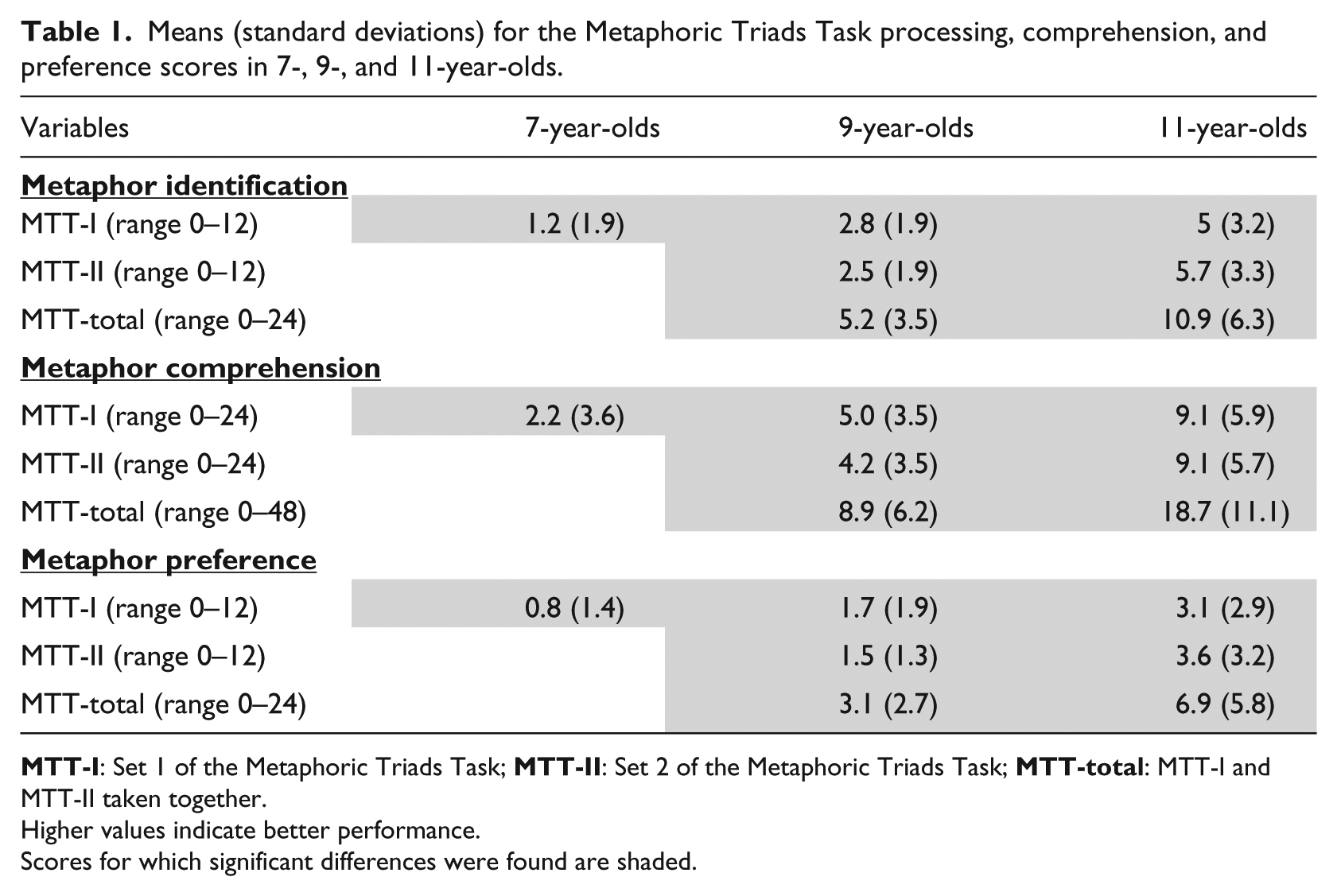
Comparisons showed significant differences between the three age groups with respect to MTT-I identification score, F(2, 158) = 29.950, ηp2 = .27, p ≤ .0001, as well as significant differences between 9-year-olds and 11-year-olds with respect to MTT-II identification score, F(1, 99) = 23.656, ηp2 = .19, p ≤ .0001, and the MTT-total identification score, F(1, 99) = 22.695, ηp2 = .18, p ≤ .0001. Post hoc comparisons with respect to MTT-I showed that 7-year-olds exhibited significantly lower results than 9-year-olds (p = .022) and 11-year-olds (p ≤ .0001) whilst 9-year-olds exhibited significantly lower results than 11-year-olds (p ≤ .0001). With respect to MTT-II and MTT-total identification scores 11-year-olds showed higher scores than 9-year-olds. Means and standard deviations are shown in Table 1. With respect to metaphor identification scores (MTT-I, MTT-II, MTT-total) no significant gender effects and no significant interactions between age and gender were shown for all age and gender groups.
Means (standard deviations) for the Metaphoric Triads Task processing, comprehension, and preference scores in 7-, 9-, and 11-year-olds.
Higher values indicate better performance.
Scores for which significant differences were found are shaded.
3.1.2 Metaphor comprehension
Comparisons showed significant differences between the three age groups with respect to MTT-I comprehension score, F(2, 158) = 29.3, ηp2 = .27, p ≤ .0001, as well as significant differences between 9-year-olds and 11-year-olds with respect to MTT-II comprehension score, F(1, 99) = 20.275, ηp2 = .17, p ≤ .0001, and the MTT-total comprehension score, F(1, 99) = 20.96, ηp2 = .17, p ≤ .0001. Post hoc comparisons with respect to MTT-I showed that 7-year-olds exhibited significantly lower results than 9-year-olds (p = .032) and 11-year-olds (p ≤ .0001), whilst 9-year-olds exhibited significantly lower results than 11-year-olds (p ≤ .0001). With respect to MTT-II and MTT-total comprehension scores, 11-year-olds showed higher scores than 9-year-olds. Means and standard deviations are shown in Table 1. With respect to metaphor comprehension scores (MTT-I, MTT-II, MTT-total) no significant gender effects and no significant interactions between age and gender were shown for all age and gender groups.
3.1.3 Metaphor comprehension quality
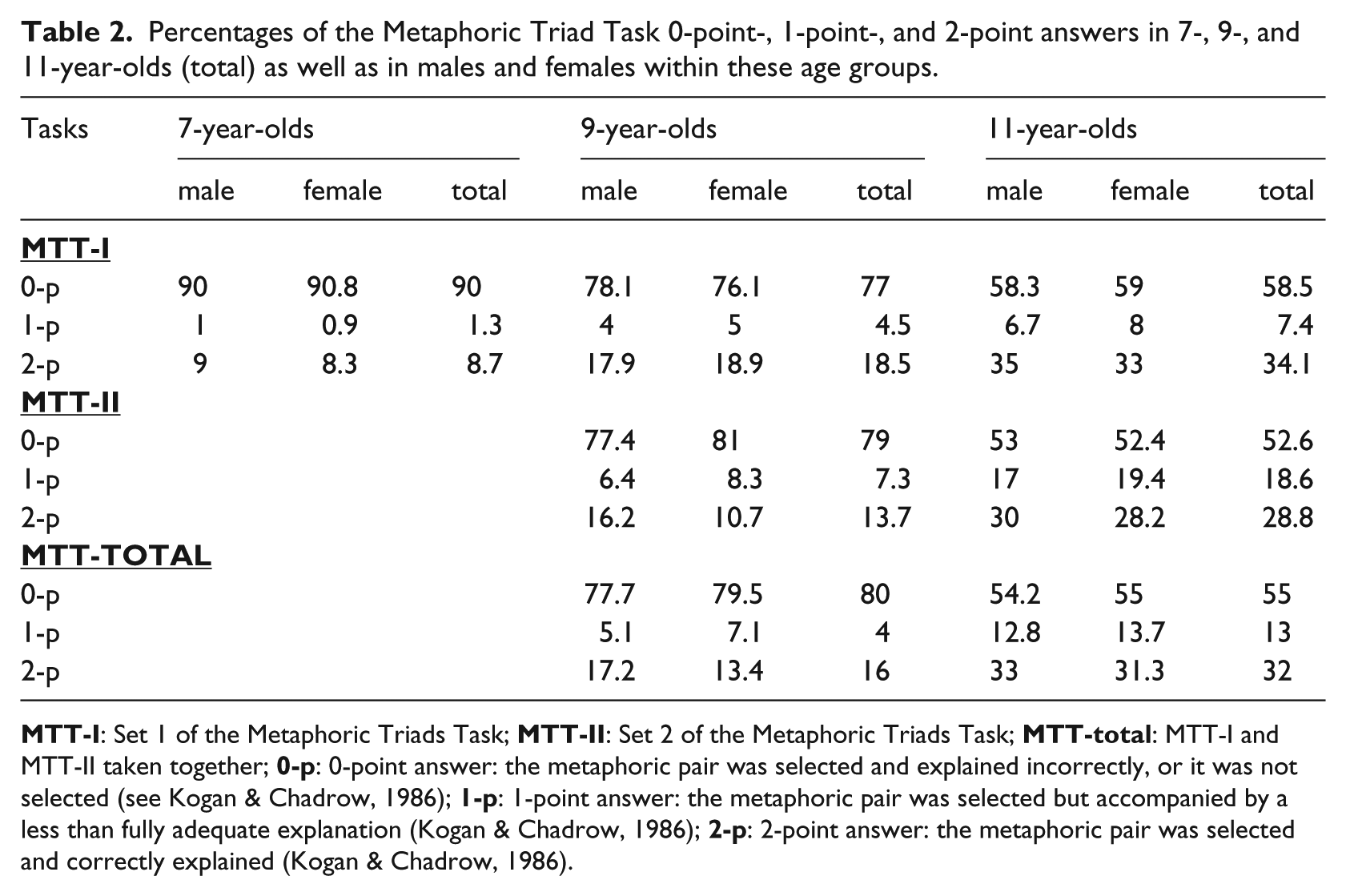
Comparisons showed significant differences between the three age groups with respect to the number of MTT-I 2-point answers, F(2, 158) = 27.097, ηp2 = .25, p ≤ .0001, and MTT-I 1-point answers, F(2, 158) = 10.592, ηp2 = .12, p ≤ .0001; significant differences between 9-year-olds and 11-year-olds with respect to the number of MTT-II 2-point-answers, F(1, 99) = 13.920, ηp2 = .12, p ≤ .0001, and MTT-II 1-point-answers, F(1, 99) = 18.385, ηp2 = .16, p ≤ .0001, as well as significant differences between 9-year-olds and 11-year-olds with respect to the number of MTT-total 2-point-answers, F(1, 99) = 17.992, ηp2 = .15, p ≤ .0001, and MTT-total 1-point-answers, F(1, 99) = 18.455, ηp2 = .16, p ≤ .0001. Post hoc comparisons with respect to the number of MTT-I 2-point-answers showed no differences between 7-year-olds and 9-year-olds (p = .056) whilst both groups exhibited significantly lower results than 11-year-olds (p ≤ .0001 and p ≤ .0001, respectively). Post hoc comparisons with respect to the number of MTT-I 1-point-answers showed that 7-year-olds did not differ from 9-year-olds (p = .105) but exhibited significantly lower results than 11-year-olds (p ≤ .0001), whilst 9-year-olds and 11-year-olds did not differ (p = .114). With respect to the number of 2-point- and 1-point-answers in MTT-II and MTT-total, 11-year-olds constantly showed higher scores than 9-year-olds. With respect to metaphor comprehension quality scores (MTT-I, MTT-II, MTT-total) no significant gender effects and no significant interactions between age and gender were found for all age and gender groups. Details are shown in Table 2.
Percentages of the Metaphoric Triad Task 0-point-, 1-point-, and 2-point answers in 7-, 9-, and 11-year-olds (total) as well as in males and females within these age groups.
3.2 Second research question (H2)
3.2.1 Metaphor preference
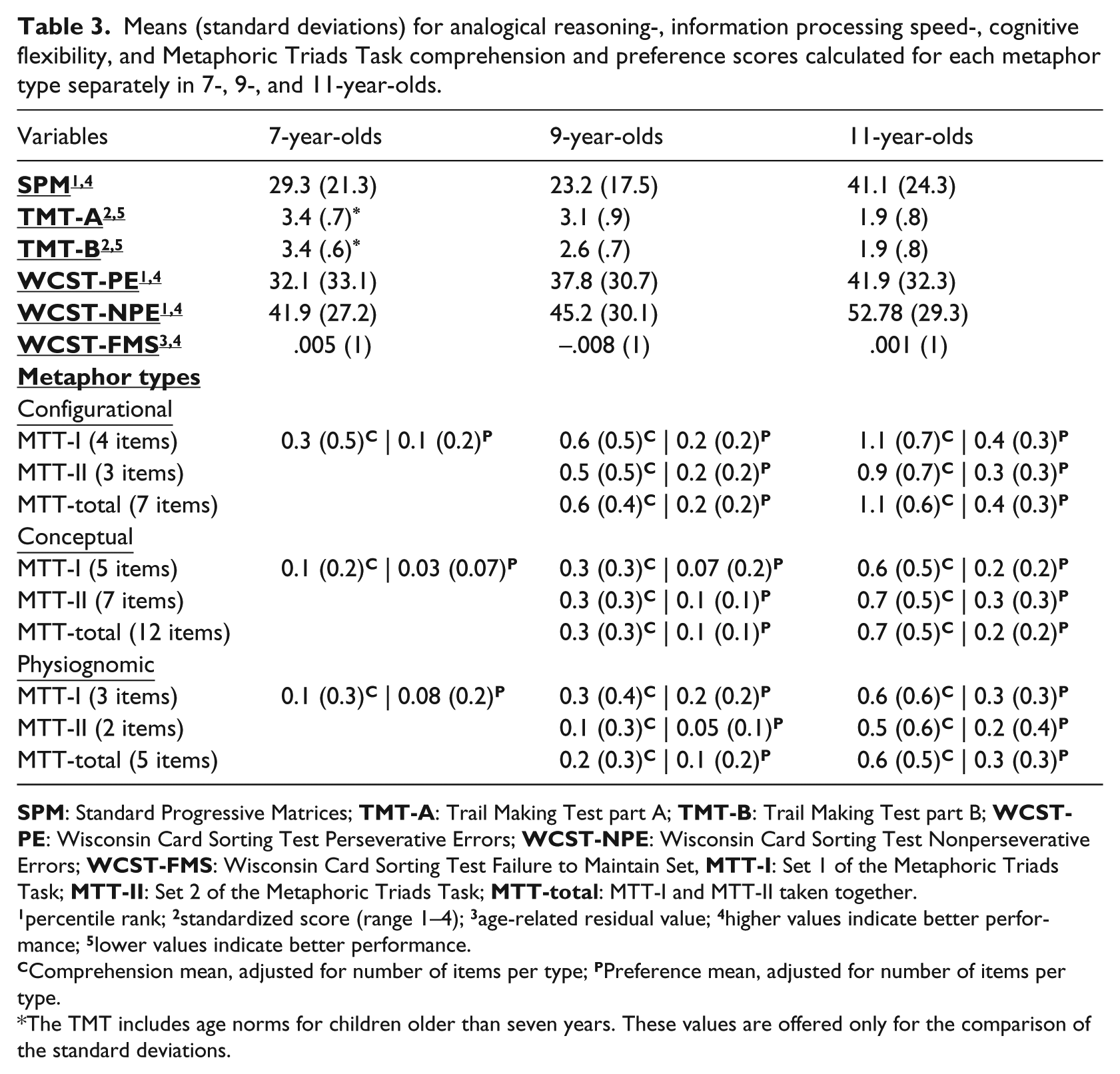
Comparisons showed significant differences between the three age groups with respect to MTT-I preference score, F(2, 158) = 15.128, ηp2 = .16, p ≤ .0001, as well as differences between 9- and 11-year-olds with respect to MTT-II preference score, F(1, 99) = 12.122, ηp2 = .11, p = .001, and the MTT-total preference score, F(1, 99) = 12.523, ηp2 = .11, p = .001. Post hoc comparisons with respect to MTT-I showed no differences between 7-year-olds and 9-year-olds (p = .304) whilst both 7-year-olds (p ≤ .0001) and 9-year-olds (p = .004) exhibited significantly lower results than 11-year-olds. Regarding MTT-II and MTT-total preference scores 11-year-olds showed higher scores than 9-year-olds. With respect to metaphor preference scores (MTT-I, MTT-II, MTT-total) no significant gender effects and no significant interactions between age and gender were found for all age and gender groups. Means and standard deviations are shown in Table 1. Descriptive statistics with respect to the age groups regarding the cognitive variables and the MTT scores for each metaphor type separately are presented in Table 3.
Means (standard deviations) for analogical reasoning-, information processing speed-, cognitive flexibility, and Metaphoric Triads Task comprehension and preference scores calculated for each metaphor type separately in 7-, 9-, and 11-year-olds.
percentile rank;
Comprehension mean, adjusted for number of items per type;
The TMT includes age norms for children older than seven years. These values are offered only for the comparison of the standard deviations.
3.3 Third research question (H3)
3.3.1 Comparison between metaphor-high and metaphor-low groups
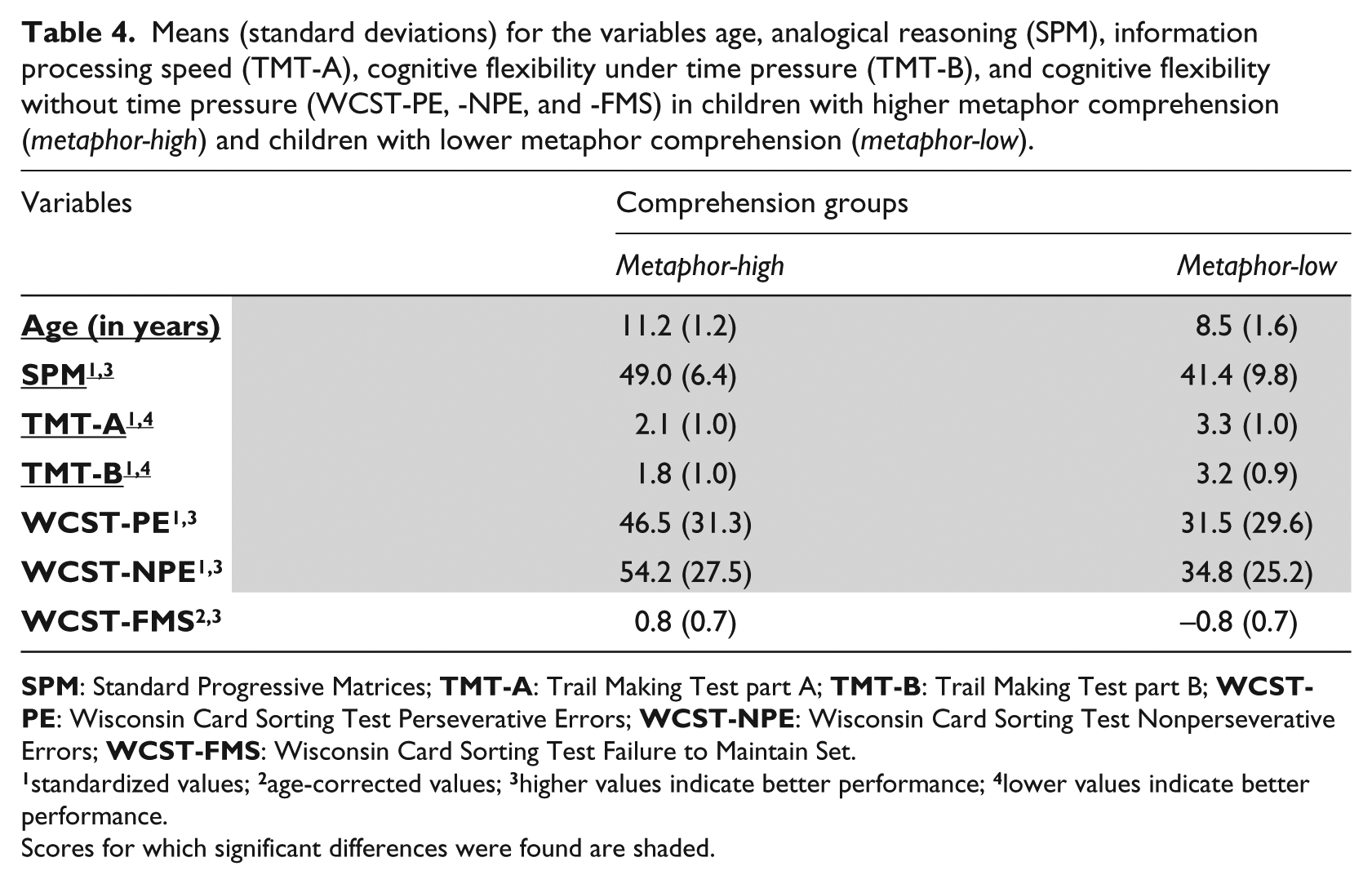
Comparisons between the metaphor-high and the metaphor-low groups with respect to MTT-I showed significant differences between the two groups, canonical correlation = .8, Wilks Lambda = .4, χ2(7, N = 164) = 59.2, p ≤ .0001. Eighty-six percent of the metaphor-low group and 89% of the metaphor-high group were classified correctly, yielding an overall correct classification of 88% by age, cognitive flexibility scores, information processing speed, and analogical reasoning. The highest correlations between the discriminant variables and the standardized canonical discriminant function showed high values with respect to age, r(162) = .8, cognitive flexibility under time pressure, TMT-B: r(162) = -.6, and information processing speed, TMT-A: r(162) = -.5; modest values with respect to analogical reasoning, r(162) = .4, and cognitive flexibility without time pressure: WCST-NPE, r(162) = .3; and low values with respect to WCST-PE, r(162) = .2, and WCST-FMS, r(162) = .1. Analyzing the univariate differences, significant differences between the metaphor-high and metaphor-low group were shown with respect to age: Wilks Lambda = .5, F(1, 71) = 62.7, p ≤ .0001; cognitive flexibility under time pressure: TMT-B, Wilks Lambda = .6, F(1, 71) = 39.4, p ≤ .0001; information processing speed: TMT-A, Wilks Lambda = .7, F(1, 71) = 26.2, p ≤ .0001; analogical reasoning: Wilks Lambda = .8, F(1, 71) = 15.6, p ≤ .0001; cognitive flexibility without time pressure: WCST-NPE, Wilks Lambda = .9, F(1, 71) = 9.9, p = .002; and WCST-PE: Wilks Lambda = .9, F(1, 71) = 4.5, p = .038. No univariate differences were found regarding WCST-FMS: Wilks Lambda = .9, F(1, 71) = .5, p = .472. Details are shown in Table 4.
Means (standard deviations) for the variables age, analogical reasoning (SPM), information processing speed (TMT-A), cognitive flexibility under time pressure (TMT-B), and cognitive flexibility without time pressure (WCST-PE, -NPE, and -FMS) in children with higher metaphor comprehension (metaphor-high) and children with lower metaphor comprehension (metaphor-low).
standardized values;
Scores for which significant differences were found are shaded.
4 Discussion
The current multivariate study was conducted in order to systematically investigate metaphor identification, comprehension, comprehension quality, and preference in children and early adolescents as well as to look for possible developmental steps and gender effects. Furthermore, predictors of metaphor comprehension were investigated. Metaphor identification and comprehension consecutively increased with age. Eleven-year-olds showed significantly higher metaphor comprehension quality and preference scores than seven-year-olds and nine-year-olds whilst the younger age groups did not differ. Age was the most important predictor of metaphor comprehension whilst cognitive flexibility under time pressure, information processing speed, and analogical reasoning were the most important cognitive predictors.
Metaphor identification—which the authors of the current study interpret as the ability to detect metaphoric contents by a successful differentiation between metaphor-relevant and non-relevant stimuli—and metaphor comprehension—the ability to comprehend and verbally explain metaphors—were shown to consecutively increase with age. These results are in line with studies that show an ongoing development with respect to metaphor processing within this age span (see e.g., Johnson & Pascual-Leone, 1989; Siltanen, 1987; Waggoner et al., 1985). Furthermore, an expected age-related developmental shift regarding metaphor comprehension depending on the metaphor type can be seen (see Table 3, but also Gentner, 1988; Siltanen, 1986, 1987; Winner et al., 1976). In this study, it was shown that 7- and 9-year-olds did not differ with respect to comprehension quality, whilst both groups showed significantly less correct or less than fully adequate explanations than 11-year-olds. These results support the assumption that at approximately age 11, children reach a qualitatively new level in metaphor processing (see e.g., Asch & Nerlove, 1960; Johnson & Pascual-Leone, 1989; Siltanen 1987). In this context, multivariate analyses involving multiple cognitive tasks showed that age was the most important predictor of metaphor comprehension. Especially between ages 9 and 11 there seems to be a developmental step with respect to metaphor processing. In early adolescence (starting at approximately age 10) fundamental changes such as biological, cognitive, or emotional changes take place (Steinberg, 2016). In this context, it was shown that an adolescent’s brain differs from a child’s brain with respect to morphology, structure, structural and functional connectivity, neurotransmission as well as gray and white matter density (for a review see Steinberg, 2010). With respect to the age groups chosen in this study, prefrontal gray matter density shows a peak around age 11 (Blakemore, 2008), whilst results of other studies lead to the hypothesis that a greater synaptic reorganization takes place between ages 9 and 11 than between 7 and 9 (Brain Development Cooperative Group, 2012). As Blakemore (2008) suggests that such a synaptic reorganization starts early in the prefrontal cortex (PFC) and given the age-related shift in MTT performance, it can be hypothesized that the MTT is sensitive to synaptic changes in the PFC. Furthermore, individual differences in brain structure and function were shown to be linked to differences in experience (see Steinberg, 2010). Social and interpersonal changes take place in early adolescence as adolescents form more complex peer relationships (Steinberg, 2016). As social contexts are supposed to support language acquisition by providing opportunities for communicative experience (Hoff, 2006), it can be argued that increases in metaphor competence could also be explained by increased usage of metaphors in communication with peers.
In the current study, cognitive flexibility under time pressure and information processing speed were found to be the most meaningful cognitive predictors of metaphor comprehension, confirming our hypotheses. In everyday language, say in the course of a conversation, it is often difficult or simply not possible to know which linguistic content one will hear from his/her dialogue partner. It can be hypothesized that in such a case it is necessary to analyze the same words or phrases repeatedly by using different and/or already applied but modified mental operations. As the processing of metaphors depends on a number of factors such as conventionality, difficulty, or context (see e.g., Goldstein, Arzouan, & Faust, 2012; Siltanen, 1987), it is certainly necessary to adapt the processing strategy (unconsciously) to get the meaning. The results of the current study suggest that this adaption is facilitated by cognitive flexibility in the form of set-shifting. This is supported by studies that show a relationship between cognitive flexibility and metaphor comprehension in adults (Kasirer & Mashal, 2014) and reviews that state that similar processes underlie cognitive flexibility in children as well as adults and indicate quantitative as well as qualitative changes throughout childhood (Cragg & Chevalier, 2012). In this context, imaging studies showed that show that neural flexibility in the form of dynamically updating functional connectivity patterns within and between higher-order association cortices changes during maturation and normal aging (Yin et al., 2016). Considering the theory that comparison and categorization are complementary strategies with respect to the processing of conventional and novel aspects of metaphors (Gentner & Bowdle, 2008; Glucksberg & Haught, 2006), it can be assumed that cognitive flexibility facilitates the shifting between and the adaption of such or similar metaphor processing strategies (maybe even in a not conscious way) as well as the execution of currently applied strategies. This result potentially supports the notion of the authors that the MTT contains conventional as well as novel metaphors (see the rationale section). In the MTT item “dancing ballerina - girl playing - spinning top” for example, metaphor comprehension requires a change of perspectives as one has to push the properties of literal pairs into the background (e.g., “the ballerina and the girl are both female,” “both can dance,” or “the ballerina has a spinning top”) so as to analyze the metaphorical meaning (e.g., “the ballerina and the spinning top can both spin,” “both can rotate around its own axis”) whilst the processing strategy depends on the conventionality of the metaphor. At this point it must be noted that in this study, conventionality/novelty of the metaphors was not controlled and it can just be assumed that regarding the present sample the MTT contained conventional as well as novel metaphors. Therefore, the interpretations in this discussion have to be treated with caution, whereas future studies should control this aspect so as to allow for more precise analyses and interpretations.
In everyday language, it is often necessary to process speech quickly. So as to keep an adequate stream of speech, it can be assumed that in the course of a conversation the understanding of linguistic contents takes place within critical time windows. Regarding metaphors this assumption is supported by the results of the current study as cognitive flexibility under time pressure and information processing speed are the most meaningful cognitive predictors, despite the fact that in this study, metaphor processing was assessed without time pressure. This indicates that these abilities facilitate the execution and adaption of metaphor processing strategies in a flexible and quick way. The current results suggest that increased processing speed indicates an increased metaphor competence as it potentially facilitates a successful shifting process. In this context, with respect to intelligence, it was shown that under certain conditions task complexity leads to an increased relationship between intelligence and processing speed (Sheppard & Vernon, 2008). Furthermore, it can be assumed that processing speed facilitates the processing of novel aspects of metaphors, as strength in processing speed potentially facilitates the acquisition of new information (Weiss et al., 2003). In addition, it was shown that processing speed consecutively increases throughout childhood (see e.g., Kail, 1991) and that it is predictive of different cognitive abilities in children (Kail, 2000).
Analogical reasoning was also shown to be a meaningful predictor of metaphor comprehension. In this context, it can be assumed that processing metaphors, similar to processing analogies, requires to identify and complement relational systems between the components of a metaphor. In the case of the word triads used in the MTT, one has to alternately compare the properties of two words whilst keeping the other word combinations in mind so as to find the metaphoric pair. Analogical reasoning and metaphor processing are theoretically combined within structure-mapping frameworks (Gentner & Bowdle, 2008). This close relationship is supported not only by behavioral studies (e.g., Nippold & Sullivan, 1987) but also by fMRI studies that show overlapping brain activation with respect to both abilities, indicating shared underlying neural processes (Prat et al., 2012). Additionally, it was shown that children at age six already show activation in the same brain regions as adults during the execution of analogical reasoning tasks (Wendelken et al., 2011). Therefore, this increase in metaphor comprehension could at least be partially explained by increases in neural efficiency in terms of increasing functional connectivity within and between the respective brain regions (e.g., Yin et al., 2016).
Furthermore, cognitive flexibility without time pressure had the lowest predictive value for metaphor comprehension. This possibly indicates that at this age span abilities such as acquiring and maintaining a concept, set-shifting, or perseverative behavior without a speed component do not influence metaphor comprehension in such a meaningful way like cognitive flexibility under time pressure. In this way, understanding the creative use of language (by other people) possibly requires a quick, flexible shift of thinking, rather than the flexible adaption of changing demands of a language task itself (see Diamond, 2013).
In metaphor research, a number of cognitive abilities were already shown to be significant predictors of metaphor comprehension. For instance, it was shown that metaphor processing requires increased attentional resources (Coney & Lange, 2006; Inhoff, Lima, & Carroll, 1984). Furthermore, mental capacity—defined as the simultaneous activation of task-relevant schemes that are not adequately activated by situational inputs (see Johnson & Pascual-Leone, 1989)—was shown to account for a great deal of variance in the development of metaphor comprehension (Johnson & Pascual-Leone, 1989). Another predictor that is related to but not identical to mental capacity (see Johnson, 1991) is working memory. The relationship between metaphor processing and working memory was shown in behavioral (Blasko, 1999; Godbee & Porter, 2013) as well as in fMRI studies (Prat et al., 2012), which showed that during metaphor comprehension brain areas are activated that are typically associated with working memory. These results support the Predication Model (see Chiappe & Chiappe, 2007; Kintsch, 2000, 2001) that states that people with limited working memory capacity are less likely to generate adequate interpretations of metaphors because they have difficulties suppressing irrelevant properties that cannot be attributed. Furthermore, metaphor comprehension could potentially be explained by verbal abilities and/or verbal intelligence (see e.g., Stites & Ozcaliskan, 2013). It was shown that certain domains of verbal intelligence such as vocabulary (Deckert et al., 2017, under review; Nippold & Sullivan, 1987; Prat et al., 2012), comprehension of word meaning (Schaunig, Willinger, & Formann, 2004), or verbal reasoning/abstraction (Deckert et al., 2017, under review) influence metaphor comprehension. These findings support the assumption that children’s abilities to identify relational systems between two entities and to form further inferences become gradually and increasingly based on linguistic grounds as metaphor processing gradually becomes more linguistically articulated (Melogno et al., 2012). Nevertheless, it was also shown that age itself has more predictive value than language proficiency (Johnson, 1991). Further important factors that were not investigated in this study are domain-specific knowledge and general cognitive capacity (see Johnson, 1991; Johnson & Pascual-Leone, 1989). These cognitive aspects were not explicitly controlled in this study, therefore age and reached school grade must be seen as representative of the developmental level in both (for a similar approach see Johnson, 1991).
With respect to metaphor preference, it was shown that preference for metaphorical stimuli significantly increased between ages 9 and 11 whilst no difference between 7- and 9-year-olds was found, which confirms the assumed developmental pattern and adds new data. One explanation could be that children between ages seven and nine do prefer metaphorical relations but first want to show that they detect and understand other relations as school increasingly teaches them to analyze information critically and in a multidimensional way. Another hypothesis would be that children in this age span truly do not prefer metaphors because different quantitative and qualitative levels of metaphor comprehension show differential effects on children’s cognitive stimulation when facing metaphorical language. In this context, fMRI studies showed that metaphor processing correlates with increases in brain regions that are associated with emotional salience (Citron, Güsten, Michaelis, & Goldberg, 2016). It can be hypothesized that children in this age group show a temporarily decreasing stimulation by metaphorical contents. This decline could depend on the difficulty of the metaphor—easy metaphors could lead to weak positive stimulation whilst difficult ones could rather lead to frustration—as well as the possibility that metaphor processing is not sufficiently facilitated by context factors, as Siltanen (1987) showed that children between ages six and eight did not, or just slightly, benefited from context cues, independent of the difficulty of the metaphor. In this context, it can be argued that early adolescents experience greater cognitive stimulation because they have acquired the means to understand more challenging metaphors. Furthermore, it can be argued that metaphor preference is potentially predicted by verbal intelligence. This assumption would be supported by studies that showed that the ability to verbally reason about social situations, common concepts, or general knowledge issues seemingly predicts metaphor preference in children (Deckert et al., 2017, under review).
In this study, no gender effects were found. With respect to metaphor comprehension, Lutzer (1991) found that boys between ages three and six outperformed girls, and hypothesized that male preschoolers possibly show greater awareness for metaphorical task demands, or show greater risk-taking and exploration behavior. This possibly facilitates the decision to stay away from “literal rules” and therefore leads to the choice of metaphorical alternatives. In our study, such a gender effect was not found, possibly due to a decreasing difference between boys and girls with respect to these behaviors or maybe (additionally) due to a compensating effect of earlier maturation in girls (see e.g., Berk, 2005; Steinberg, Vandell, & Bornstein, 2010) involving faster developing verbal abilities in girls in general. With respect to metaphor preference, no gender differences were found. In this context, it can be hypothesized that both females and males are equally confronted with metaphorical contents during education or that metaphorical stimuli cause similar patterns of cognitive stimulation for both females and males.
Limitations
This study confirms developmental courses, supports hypotheses about developmental steps, and adds new knowledge to metaphor research in children and early adolescents. A number of explanations with respect to these developmental changes are offered. Most of these explanations are theoretical and raise research questions for further studies. In our view, future studies should investigate metaphor processing as well as its predictors using a variety of neuroscientific/imaging methods whilst comparing the results with data about general brain development. Whilst the importance of cognitive flexibility as a predictor of metaphor comprehension was shown and the importance of analogical reasoning was confirmed, it has to be noted that a number of established predictors of metaphor processing were not investigated. Future studies should include these predictors as well as those which were investigated in this study, so as to confirm previous results and refine existing theories of metaphor processing. Furthermore, it was shown that cognitive flexibility without time pressure, measured by the WCST, had the lowest predictive value for metaphor comprehension. Due to methodological issues, this result has to be interpreted with caution as the WCST most likely cannot be seen as a “pure” measure of cognitive flexibility. Rather, it measures a number of cognitive abilities that are subsumed under the umbrella term of cognitive flexibility, such as generating hypotheses, acquiring and maintaining a concept, set-shifting, inhibition, or feedback-learning (see Kongs et al., 2000). Furthermore, in this study three scores were chosen to represent the major factors of the WCST, therefore it cannot be ruled out that other scores could have significantly predicted metaphor comprehension. In addition, it must be noted that in this study, conventionality of the metaphors was not controlled. Therefore, the results and interpretations have to be treated with caution, whereas future studies should control this aspect so as to allow for more detailed results.
Footnotes
Acknowledgements
The authors would like to thank the editor and the reviewers for their very helpful comments.
Funding
This research received no specific grant from any funding agency in the public, commercial, or not-for-profit sectors.