




Abstract
Past research on Singapore English (SgE) has shown that there are specific segmental and prosodic patterns that are unique to the three major ethnic groups, Chinese, Malay, and Indian in Singapore. These features have been highlighted as the “stereotypical” ethnic markers of SgE speakers, assuming substrate influence from the speakers’ “ethnic” languages (Mandarin, Malay, and Tamil). However, recent research suggests that Singaporeans are becoming increasingly English dominant and has challenged the position of the ethnic languages as true “mother tongues” of Singaporeans. Hence, this study seeks to question if such “stereotypical” ethnic features exist, and if so, the extent to which a less dominant ethnic language would affect the phonology of speakers’ English. This study looks specifically at the production of consonants /f/, /θ/, /t/, /v/, and /w/ as salient segmental features in SgE. Participants’ phonetic behavior of /θ/, which was produced similarly across the three ethnic groups, disputed substrate influence. Tamil speakers were the most disparate, particularly with the /v/-/w/ contrast production. However, these deviations were often sporadic phonetic changes, which scarcely reflect robust speech patterns in the community. As a result, consonantal production in SgE is found to be largely independent of substrate influence and relatively uniform across the three ethnicities. The homogeneity observed in this study sheds light on bilinguals’ acquisition of sounds, and it also provides phonological evidence toward the understanding of the evolutionary process of postcolonial Englishes.
1 “Ethnic” sounds in Singapore English (SgE)
This study investigates how bilingual Singaporeans produce consonantal contrasts, focusing on, in particular, how the ethnicity of the speakers affects the production of these sounds. Research over the past two decades on SgE 1 has shown that there are specific segmental and prosodic patterns that are unique to the three major ethnic groups, namely the Chinese, Malays, and Indians, in Singapore (e.g., Lim, 1996, 2000; Tan, 2001, 2002, 2010). 74.3% of Singapore’s population are labeled “Chinese,” 13.4% “Malay,” and 9% “Indian” (Singapore Department of Statistics, 2018), and all are expected to speak their designated “mother tongue” language of Mandarin, Malay, and Tamil, respectively, as well as SgE. In the descriptive studies focusing on segmental features of SgE, researchers tend to show how there are sounds that are characteristic of each ethnic group. Early studies such as Tay (1982), for example, point out that features such as the absence of a /v/-/w/ distinction is characteristic of the speakers of the Indian ethnic group and the absence of a /r/-/l/ distinction as a feature of the Chinese speakers of SgE. In a more recent work, Hashim and Brown (2000) show that the tendency to merge /e/ and /æ/ in SgE is stronger for the Malay speakers of SgE as compared to the Indian speakers. While there has not been any attempt to show a systematic “transference” of these phonetic features from the speakers’ first language to English, these features have been pointed out to be the “stereotypical” ethnic markers of SgE speakers, assuming therefore an influence from the speaker’s “ethnic” language. In the area of prosody, which tends to present more conclusive research showing ethnic differentiation in SgE, there is also an underlying assumption, whether implicitly or explicitly articulated, that all ethnic-specific prosodic features can be traced back to the speakers’ ethnic language. Past research in this area tends to attribute the differences to substratal influences, and sounds from the speakers’ “first” or “native” language is assumed to have made an imprint on the speakers’ English. For instance, Tan (2010), looking at ethnic differences in the intonation of SgE, finds that each ethnic variety has its own unique global curve and tonal patterning, and proceeds to show how each intonational feature is directly correlated with the intonational patterns of the other languages, specifically Mandarin, Malay, and Tamil, that these speakers also speak. Tan’s (2002) acoustic and perceptual analyses of stress also show how Singaporean speakers of the three ethnic groups produce and perceive stress differently, positing as well the influence from the ethnic languages of Mandarin, Malay, and Tamil.
2 Substratal influence, really?
The idea that there is linguistic influence or transfer from the “ethnic” languages to English has its roots in the substrate theory or substrate hypothesis (see Mufwene, 1990, for its different iterations and a historical overview). The substrate hypothesis is used predominantly in the field of creolistics and contact linguistics to explain the emergence of new linguistic features found in the superstrate language. The superstrate language is one that typically has political or economic dominance, and when in contact with substrate languages spoken by local communities, adopts features from the substrate. Earlier versions of the substrate theory rely heavily on the idea of interference (e.g., Weinreich, 1953; Thomason & Kaufman, 1988) to explain how substrate language speakers show linguistic deviation as they learn the superstrate imperfectly. Recent scholarship however has moved away from the idea of imperfect learning, but instead sees substrate influence as defining and marking traits of a socioethnic variety (Wolfram, 2013; Wolfram, Childs, & Torbet, 2000). Scholars working on SgE (and Singlish) have found the substrate theory very applicable to the contact situation in Singapore, and have applied this to explain non-English syntactic and lexical features found in SgE and Singlish (e.g., Ansaldo, 2009; Bao, 2005, 2010; Bao & Wee, 1998, 1999; Platt & Weber, 1980). And not unsurprisingly, as mentioned earlier, it has also been the dominant approach to explaining “ethnic” features in the phonology of SgE (e.g., Lim, 1996, 2000; Tan, 2001, 2002, 2010).
While it is completely logical to attribute ethnic differentiation in SgE to substrate influences, this necessarily assumes the relationship between English and the supposedly substrate or ethnic languages along two dimensions, namely, use, and acquisition. In terms of use, one would expect that the speakers are equally proficient in English and the substrate “ethnic” language, or if not, more proficient in the substrate languages, than in English. Research on the Singapore sociolinguistic situation over the last decade is however painting a predominantly English picture. English in Singapore serves the function of being the official language, language of administration, and the medium of education. English is also the lingua franca, serving as the link language of communication for Singaporeans of different ethnic groups. The use of English is so widespread that, according to the Singapore Census of Population (2010), 32.3% of the population claimed English as their dominant home language, an increase from 23% in 2000, 18.8% in 1990, and 11.6% in 1980. This suggests an increasing trend of English replacing the other languages in the home domain—a point also made by a few others (e.g., Lim, 2009; Pakir, 2000; Wee, 2002, 2013). Tan (2014), in particular, with empirical data collected from over 400 participants, argues that English has in fact penetrated the psyche of the everyday Singaporean to the point that it can be considered to be not only the mother tongue for Singaporeans, but also possibly the only language many claim to be proficient in. The penetration of English even goes into the construction of ethnicity. Wong and Tan (2017) show how the Singaporean Chinese community uses English as a tool to imagine and construct their Chinese ethnicity, tearing down the essentialistic link between Chinese language, culture, identity, and ethnicity. Given the dominance of English in a typical Singaporean’s linguistic repertoire and that the ethnic languages are often acquired alongside English, would it still be appropriate to assume substratal influences on English? Hence, this paper investigates the extent to which a less-used, and therefore less dominant ethnic language, affects the phonology of a speaker’s English.
In order for the ethnic language to have a transference effect on English in bilinguals, one would have to assume that the ethnic languages are acquired before English; or at the very least, at the same time as English is being acquired by the bilingual speaker. Early studies on cross-linguistic transfer relied on the assumption that the language acquired within the critical age window (Lenneberg, 1967) is invariable and that subsequent learning of languages would not cause any restructuring of the phonetic categories already in place in the first acquired language (L1). Because of this, the malleability of speech contrasts was more often investigated in the direction of how the L1 will affect the subsequently acquired language (L2) (Kartushina, Frauenfelder, & Golestani, 2016). Following this line of research, Baker and Trofimovich (2005) show that late Korean–English bilinguals’ newly formed L2 phonetic categories have a strong influence from L1, demonstrating a unidirectional influence from the L1 on the L2 (Baker & Trofimovich, 2005). These lend weight to the intuition that the more dominant language in a speaker’s linguistic repertoire will influence the production of sounds in the L2, which is acquired later. This also complements the substrate theory as mentioned earlier, as the substrate languages are supposedly present in the linguistic ecology prior to the acquisition of the superstrate. In Singapore’s case, based on past research, the “substrate” languages of Mandarin, Malay, and Tamil, are therefore responsible for influencing the production of “ethnic” sounds in the Chinese, Malay, and Indian varieties of SgE. However, one can only call these three languages the substrate languages if they were already in the linguistic repertoire of Singaporeans before the acquisition of English. Historical records show a slightly different situation. According to the census data of 1957, a total of 33 languages of different language families were reportedly spoken in Singapore (Bokhorst-Heng, 1998, p. 288). They comprised Indic languages such as Hindi, Urdu, Punjabi, and Sindhi; Dravidian languages such Tamil, Telugu, Malayalam, and Kannada; and Austronesian languages such as Malay, Boyanese, Bugis, and Javanese. And just within the Chinese community, which made up 75.4% of the population then, more than 13 Chinese languages were spoken (ibid.), and they included Min languages such as Hokkien, Teochew, Hainanese, and Foo Chow, Gan languages such as Hakka; and Yue languages such as Cantonese. According to the 1960 census, only 0.1% of the population then deemed Mandarin as their mother tongue, and 11.5% for Malay, and 5.2% for Tamil (ibid.). Suffice it to say, there were many languages in the substratum, though Mandarin and Tamil certainly did not feature strongly in the overall linguistic ecology in the 1960s.
The reason why Mandarin, Malay, and Tamil, took the spotlight later as “substrate” languages is entirely due to Singapore’s language policies. It has been mandatory, since Singapore’s Independence in 1965, that all Singaporeans be assigned an official ethnic group. The three main ones are “Chinese,” “Malay,” and “Indian.” The ethnic classifications of “Chinese,” “Malay,” and “Indian” also have direct relevance to the languages one is expected to speak and acquire, as the official languages of Mandarin, Malay, and Tamil are assigned to the ethnic groups “Chinese,” “Malay,” and “Indian” correspondingly as “mother tongue” languages. Therefore, if one is ethnically classified as “Chinese,” then one’s “mother tongue” is deemed to be Mandarin, that of a “Malay,” Malay and that of a Tamil-speaking Indian, “Tamil.” Alternatively, non-Tamil Indians are allowed to take other Indian languages, while children outside the three groups can choose any one of the three language as their “mother tongue” language (Gupta & Siew, 1995). The term “mother tongue” in the Singaporean context therefore does not reflect the linguistic reality (see Tan (2014) for the idea of “mother tongue” in Singapore), but suffice it to say, it is not implausible to have instances of a Singaporean child who does not learn or speak their designated “mother tongue” at home. In 1987, English became the language of instruction across the national school system (Vaish & Tan, 2008), and since then, all school-going children must have at least 10 years of formal education in both English and their respective assigned “mother tongue” language. In other words, all Singaporeans who have gone through the Singapore education system would have what Pakir would call “English-knowing bilingualism” (Pakir, 1991, p. 111). There is no doubt that this bilingual education system and Singapore’s bilingual policy has created ethnic differentiation in the phonology of SgE, since, clearly, as past research has shown, there are prosodic and segmental features that are different across the speakers of the three ethnic groups. However, to think about these as a transference effect may not be entirely accurate, given the current sociolinguistic context.
To what extent, then, does the phonology of these three groups of “English-knowing” bilinguals differ? Can one confidently say that the consonants produced by SgE speakers are a result of their other “mother tongue” language? Are there markers of ethnic differences beyond the ones studied in past research? What this paper aims to do, therefore, is to look into the production of consonants by the bilingual speakers of the three main ethnic groups, without first assuming substrate influence. This paper focuses on six pairs of consonants that are characteristic features of SgE, but are not all typically linked to ethnic differentiation, the aim of which is to look at the effect of sound production in English-dominant bilinguals who can be said to have acquired both English and their “ethnic” language at the same time.
3 Present study
We investigate, in this study, the production of English consonants in SgE across three groups of bilinguals, namely the English–Mandarin, English–Malay, and English–Tamil speakers. As mentioned earlier, Singaporeans undergo intensive exposure to their assigned “ethnic” language for at least ten years of their childhood through mandatory instruction in schools. Their assumed early exposure to English and to their other designated “ethnic” language through interactions with family, social groups, language community, media, or other forms of social interactions, makes the majority of the population early bilinguals.
We focus on consonants as a number of them are salient features of SgE. These consonants are /f/, /θ/, /t/, /v/, and /w/. One of the most distinctive features of SgE is the production of the dental fricative /θ/. According to Deterding (2007), when found in a word-final position, it can be potentially produced as [f] or [t], while in a word-initial position, as [t] or [th]. This explains the choice of the first three consonants in this study. In addition, we also look at /v/ and /w/, for as mentioned earlier, the Tamil-speaking Singaporean community has been observed, albeit anecdotally, to articulate /v/ and /w/ interchangeably (Tay, 1982). Studying /v/ and /w/ as we are doing here would be one of the first of such empirical studies. Furthermore, the Indian community has by far demonstrated the greatest shift towards English away from Tamil (Rajan, 2018; Saravanan, 1994), allowing us to further investigate how a less used language can affect the phonetic system of the dominant language.
3.1 Participants
A total of 75 participants, consisting of 25 Mandarin–English bilinguals, 25 Malay–English bilinguals, and 25 Tamil–English bilinguals, participated in this study. The participants’ ages ranged from 18 to 33 years and all of them were born and raised in Singapore. A majority of the participants were undergraduates from the authors’ university, while the other participants were recruited via word-of-mouth or the participants’ own social networks from other local universities.
Prior to data collection, all participants first provided informed consent, and were also asked to fill out a basic demographic questionnaire and a questionnaire specifically targeting their language use known as the Bilingual Language Profile (BLP) (Birdsong, Gertken, & Amengual, 2012). The BLP assesses an individual’s language dominance on the areas of their spoken languages, frequency and context of language use, language proficiency across various domains, and language attitudes. A combined dominance score is then computed based on the individuals’ self-reported answers.
The BLP is useful in objectively quantifying a bilingual’s dominance in the languages he/she speaks. An overall score is computed based on answers given to several questions in the questionnaire. Overall scores can range anywhere in the negative to positive range. Scores in the negative range indicate dominance towards the officially designated “mother tongue” language (Mandarin, Malay or Tamil), and the more negative the score, the greater the dominance in the officially designated language. Scores in the positive range indicate dominance towards English and the higher the score, the greater the dominance in English. Scores close to zero are indicative of balanced dominance in either language. Table 1 shows the means and standard deviations of the participants’ BLP scores.
Mean Bilingual Language Profile (BLP) scores and demographic information by ethnic group.

Note: standard deviations are in parentheses.
A one-way analysis of variance (ANOVA) revealed that the three groups differ on their BLP scores significantly, F(2, 72) = 4.05, p = 0.02. Post hoc Bonferroni analyses showed that the Mandarin-speaking participants had marginally higher BLP scores than the Malay (p = 0.07) and significantly higher scores than the Tamil (p = 0.04) speakers, but that there were no statistically significant differences between the scores of the Malay- and Tamil-speaking participants (p = 1). The scores for all groups are in the positive range, indicating that the participants are mostly English-dominant. The Mandarin speakers have the highest scores, indicating a higher dominance in English.
3.2 Stimuli and procedure
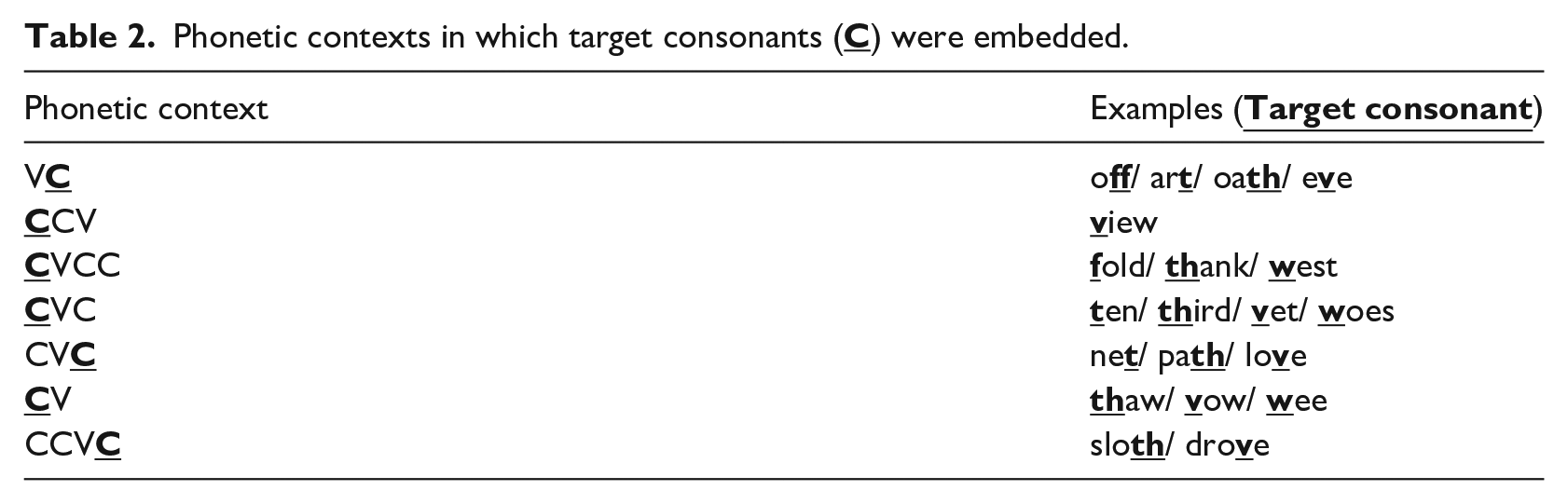
A total of 81 target words were selected for the participants to read. Target words with /v/, /w/, /f/, /θ/ and /t/, were embedded in sentence medial position. Target words were monosyllabic, and target consonants (
Phonetic contexts in which target consonants (
Recording was done using a Shure SM81 small-diaphragm condenser microphone attached to a recording device, in a sound attenuated booth. Participants were told that they would be presented with some sentences which would be shown to them one at a time on a computer screen. The participants were asked to read them out as casually as possible. The presentation started out with two filler sentences followed by a random presentation of the 81 target sentences and fifteen filler sentences, and ended with another two filler sentences. Presentation of the stimuli was conducted via the program E-Prime v2.0 software (Psychology Software Tools) as the program allowed for random presentation of the sentences. All participants were asked to read the sentences at their own pace.
The production data were first analyzed auditorily by the three authors of this paper, who are all SgE speakers, and who also are Tamil–English, Malay–English, and Mandarin–English bilinguals themselves. The target consonants were then also evaluated using Praat (Boersma & Weenink, 2018) by looking at the spectral energies of the fricatives. And for the stop /t/, we adopted a cut-off voice onset time (VOT) length of 30 milliseconds to determine if the stop was aspirated ([th]) or unaspirated ([t]), a method used by past studies (e.g., Lisker & Abramson, 1964; Yamaguchi & Pétursson, 2012) which have yielded consistent results.
4 Results
Each target word embedded in a sentence was first classified, according to whether the target speech sound was produced and if not produced, what the phonetic change was in the production. We focus, in particular, on the following productions:
1) The realizations of /v/
2) The realizations of /w/
3) The realizations of /θ/
4) The realizations of /t/.
We observe seven systematic trends, and will discuss them in the following section. The trends are:
1) /v/→[w]
2) /w/→[v]
3) /θ/→[t] (in word-initial position)
4) /θ/→[t] (in word-final position)
5) /θ/→[f] (in word-final position)
6) /θ/→[th] (in word-initial position)
7) /t/→[t] (in word-initial position).
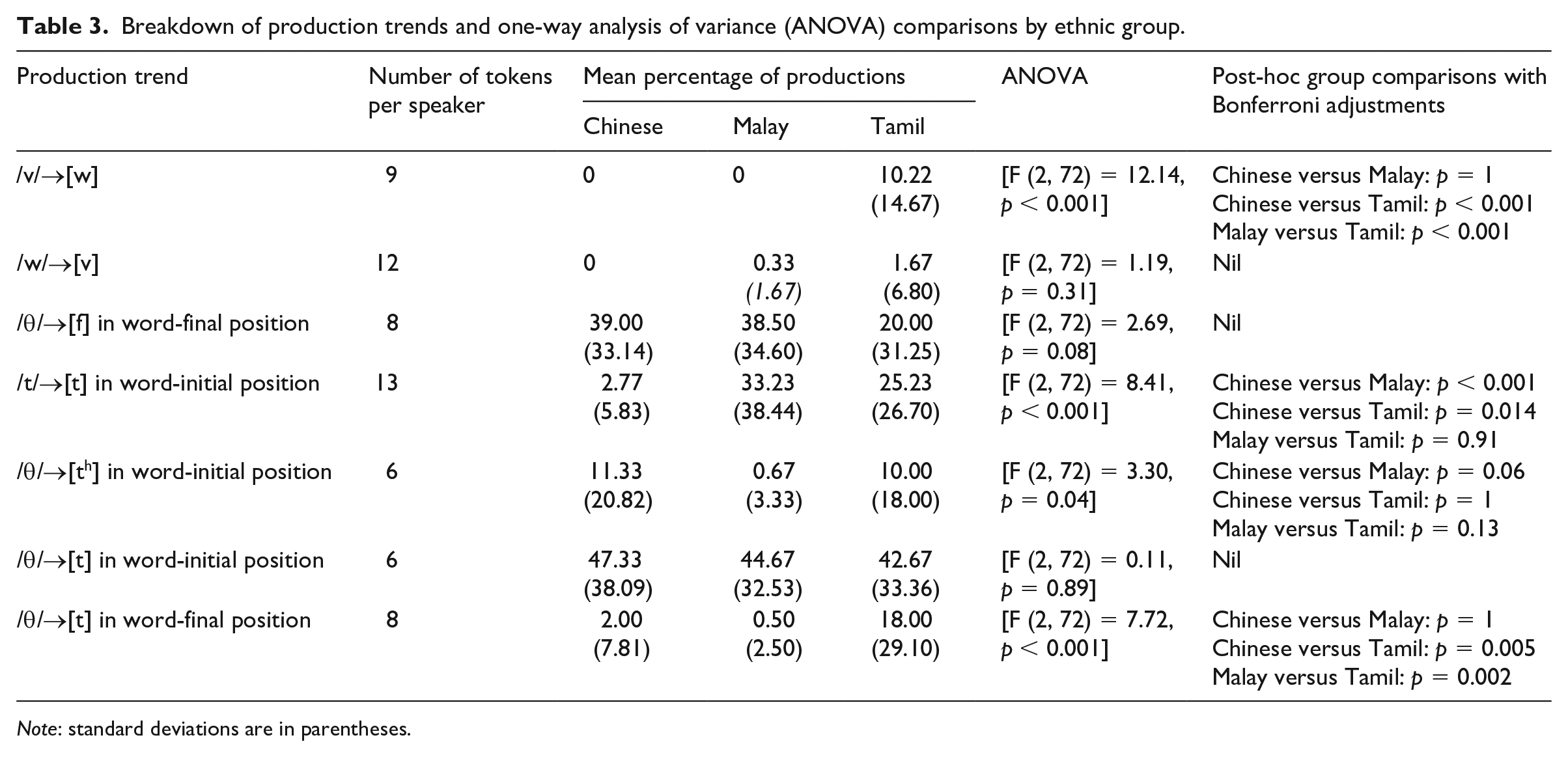
We conducted one-way ANOVAs comparing the ethnic groups on each of the production trends listed above. The analyses are presented in Table 3 and graphically illustrated in Figure 1.
Breakdown of production trends and one-way analysis of variance (ANOVA) comparisons by ethnic group.
Note: standard deviations are in parentheses.

Summary of production trends observed across ethnic groups.
The analyses in Table 3 show that the percentage of productions involving phonetic changes from /v/→[w], /t/→[t] in word-initial position, /θ/→[th] in word-initial position, and /θ/→[t] in word-final position emerge significantly different across ethnic groups. Post-hoc analyses reported in Table 3 show that the Tamil speakers distinctly produce more /v/→[w] phonetic changes as compared to the Chinese and Malay speakers. For the /w/→[v] phonetic change, the Tamil speakers have the highest number of productions, though these productions are not significant across ethnic groups. It is thus possible to deduce that the direction of phonetic change, if any, is almost always /v/→[w] but not /w/→[v].
For /θ/ occurring in word-final position, participants either show a /θ/→[t] or /θ/→[f] phonetic realization. The results in Table 3 and Figure 1 clearly show that the majority of Chinese and Malay bilinguals exhibit a change in sound production from /θ/→[f] when /θ/ occurs in word-final position, while only a small percentage of productions from these participant groups change from /θ/→[t]. There seems to be a divide in the speech sounds chosen to substitute word-final /θ/ within the Tamil group. The Tamil group is standing apart by demonstrating a two-way substitution in either /θ/→[f] or /θ/→[t].
The results also show that the majority of the participants from all three groups exhibit a tendency to produce [t] when /θ/ occurs in a word-initial position. A minority of participants produce [th] in place of /θ/ in word-initial positions. It is evident from the data that the majority of Singaporeans produce [t] in place of /θ/ in word-initial positions. It is possible to conclude that the /θ/→[th] phonetic change is not a salient marker of ethnic differences in SgE.
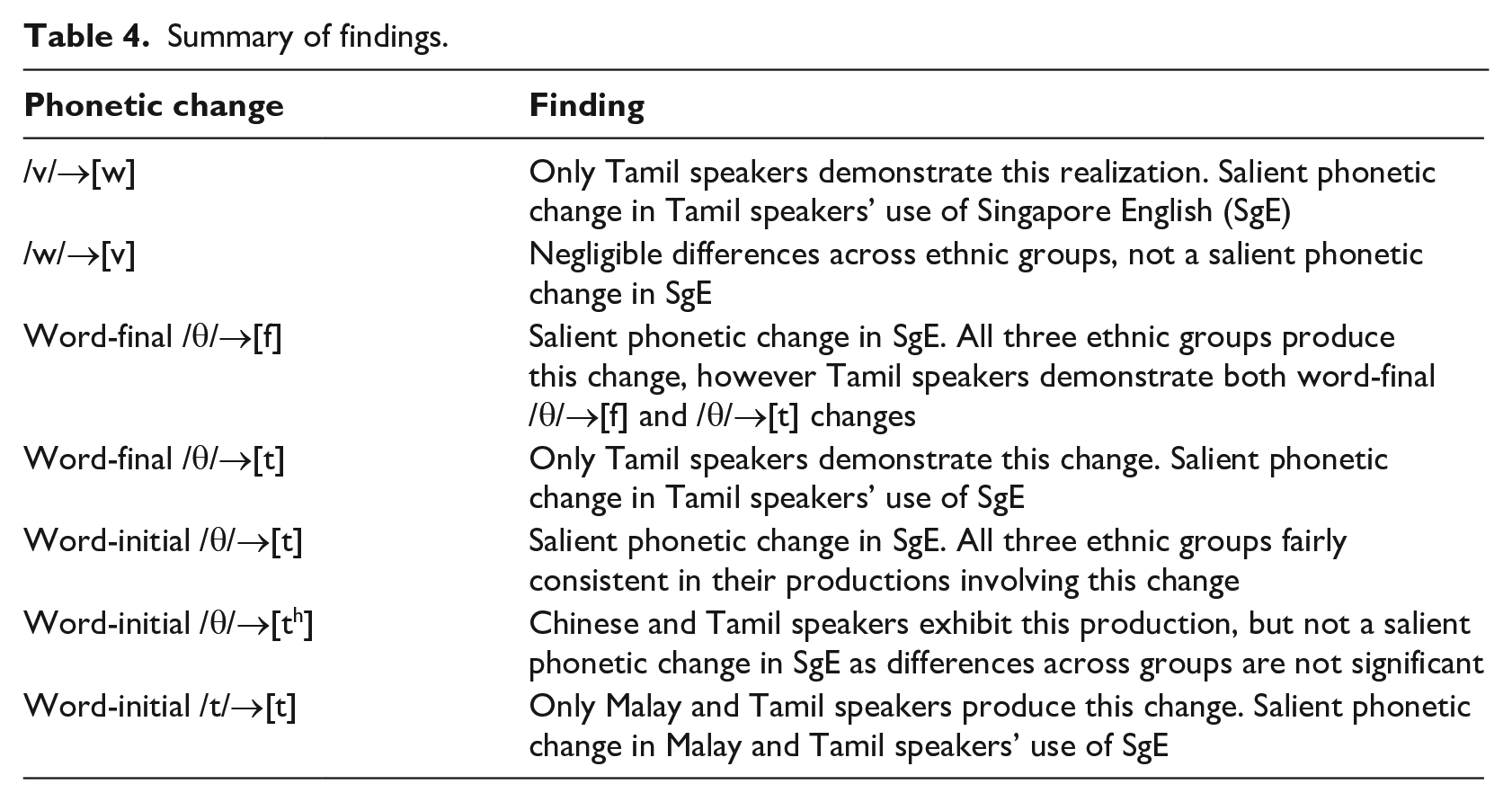
Lastly, results reported in Table 3 show that Malay and Tamil speakers show a greater tendency to produce the /t/→[t] change when /t/ occurs in word-initial position as compared to Chinese speakers. The results are suggestive of the [th]→[t] phonetic change in word-initial position as being a distinct marker of ethnic differences in the production of SgE consonants. Table 4, summarizes the findings from this study.
Summary of findings.
Our results above corroborate with findings in previous studies on the phonology of SgE, for example, the /θ/→[t] change in word-initial position (Platt & Weber, 1980) and /θ/→[f] in word-final position (Deterding, 2007; Moorthy & Deterding, 2000). In addition, our findings do show some differences across ethnic groups. While the majority of Chinese and Malay bilinguals exhibit a consistent change in sound production for /θ/→[f] in word-final position, the Tamil speakers show a two-way substitution in either /θ/→[f] or /θ/→[t]. Furthermore, our results for the /v/→[w] phonetic change show that the Tamil speakers are the least likely to produce the acoustic differences between /v/ and /w/, which lends weight to previous research suggesting that the /v/→[w] phonetic change is a characteristic of the Tamil-speaking community (Deterding, 2007; Lim, 2004). The results show that while there are in general similarities across the different groups of speakers, the Tamil speakers differ most significantly. The Chinese and Malay speakers seem to exhibit similar phonetic trends in their speech, suggesting the near-homogenization of the selected speech contrasts in this study among the two groups, while the Tamil speakers differ significantly from the Chinese and Malay speakers. Can we then posit these outcomes as influence from the “mother tongue” languages? We focus in particular on word-initial /θ/→[t] and word-final /θ/→[f] phonetic changes for all three groups, and the /v/→[w] phonetic change for the Tamil speakers.
4.1 Ethnic influence to explain the substitution of dental fricatives?
Dental fricatives are considered rare, occurring only in about 7% of the world’s languages (Maddieson, 1984). Their relative rarity therefore contributes to the overall difficulty for non-native speakers to produce and perceive them. Data on first language acquisition show that children acquire stops before fricatives, suggesting that fricatives are universally more difficult to acquire (Locke, 1983). There is ample evidence from numerous language studies showing that the English /θ/ poses pronunciation problems for non-native English speakers (e.g., Brannen, 2002; Hanulíková & Weber, 2012; Lombardi, 2003; Wester, Gilbers, & Lowie, 2007). Dutch speakers, for instance, realize /θɪŋk/ as [sɪŋk] (Wester et al., 2007), showing that speakers of English from other communities show differential substitution of /θ/. These factors make /θ/ significantly more marked than other consonants in a typical language phonemic inventory. Here, we present evidence showing that speakers of SgE also experience difficulties with /θ/.
While previous studies have agreed on the /θ/→[t] and /θ/→[th] phonetic changes in word-initial position in SgE, less is known about why these substitutions occur in SgE. With reference to the /θ/→[t] phonetic change in word-initial position, we propose that ethnic influence is an unlikely reason because all three groups of speakers exhibit the same behavior, and there is no evidence that the sound substitution is specifically linked to the other three “mother tongue” languages. There is also emerging evidence showing that languages are capable of developing language structures free of influence from other languages in the ambient environment (Sandler, Meir, Padden, & Aronoff, 2005). Sandler et al.’s (2005) linguistic report shows that within the space of one generation from its conception, the language has developed a systematic structure that is unlike any of the other languages in close proximity to this language. Though this study was investigating the word order patterns in the language, it is relevant to the present study as we are also finding regularities in SgE that are independent of the “mother tongue” languages spoken in the environment. This is also in line with evidence showing that English varieties such as Malaysian English (ME) are capable of creating new subvariants of phonemic units. For example, Yamaguchi and Pétursson (2012) found that the alveolar stop ([t]) used to replace /θ/ or /ð/ in word-initial position in ME did not resemble the VOT values of the original ME [t] (e.g., in
On the other hand, the /θ/→[th] and /t/→[t] phonetic changes could be ethnically motivated to some extent. Evidence shows that aspiration is phonemic in Mandarin Chinese, as well as in other related Chinese languages in the substrate (Chen, 1976). It is noteworthy that in Malay (Shahidi & Rahim, 2011), and in Tamil (Keane, 2004), all voiceless stops remain unaspirated. Chen (1976) notes that word-initial /θ/ could be realized as [t] or [th], hinting that the aspirated form could be reflective of substrate influence from Chinese languages, and the unaspirated form from Malay. Bao (2003) initially makes the proposition that /θ/ could be realized as [t] in word-initial position, but later posits that many people now realize /θ/ as [th] in word-initial position. While Chen (1976) attempts an explanation with regards to substrate influence, both studies do not make comparisons of productions based on ethnic divisions, but rather attempt to account for these phonetic trends in SgE at the aggregate level. The results from the present study are largely in alignment with Chen’s (1976) explication of substrate influence, as we present evidence showing that Chinese speakers have a higher tendency to maintain the aspiration when required (i.e., not producing the /t/→[t] phonetic change unlike Malay and Tamil speakers), and producing the /θ/→[th] phonetic change with the highest frequency, though the latter is not statistically different from the other ethnic groups.
Lastly, the preference for the /θ/→[t] phonetic change in word-initial position and the /θ/→[f] phonetic change in word-final position across our speakers could be accounted for by evidence showing that phonetic substitutions may differ based on the position that the phoneme occurs in. Dutch speakers for instance, show differential substitution of /θ/, by producing stops in the onset and fricatives in the coda (James, 1984), a phenomenon related to Dutch acquisition patterns observed in children (Lombardi, 2003). Based on the above, Clements (1990) identifies that in Dutch, the preference is for fricatives to occur syllable-finally, while plosives are preferred over fricatives to occur syllable-initially. The consonantal production patterns of the majority of participants in our study are also largely in accordance with the Dutch L2 substitution patterns of the English dental fricatives (i.e., there is a preference for a plosive ([t]) substitution when /θ/ occurs in syllable-initial position, while there is a preference for a fricative ([f]) substitution when /θ/ occurs in syllable-final position). Again, we cannot assume the notion of transfer from the ethnic languages, as all ethnic groups exhibit the same behavior in substituting /θ/ with [f] in word-final position to some extent, though Tamil speakers also demonstrate a /θ/→[t] phonetic change in word-final position.
At present, it is not definitively known what could be driving Tamil speakers to perform both /θ/→[t] and /θ/→[f] phonetic substitutions in word-final positions. We speculate that the /θ/→[t] phonetic change in word-final position could be a residual of phonetic trends that have been in the speech of previous generation Tamil–English bilinguals, which are likely to have been passed down to the current generation of Tamil speakers in this study. The previous generation Tamil speakers could have resorted to using /t/ instead of /f/ to replace /θ/ in word-final position as /f/ is not a native speech sound to the Tamil phonemic inventory and is considered part of loanwords borrowed from other languages (Keane, 2004). Our current data suggest that speech production trends replacing /θ/ in word-final position among Tamil speakers could be in the process of homogenization across younger generations. The word-final /θ/→[f] substitution observed by some of the Tamil speakers in this study may be an indication that Tamil speakers are gradually moving towards using the /θ/→[f] substitution in word-final position to assimilate with the majority speech patterns in the Singaporean community. The above explanation however warrants further research through comparisons of phonetic substitutions of /θ/ across generations to determine its applicability to the current data.
4.2 A resistant “ethnic” feature? The /v/-/w/ contrast in Tamil speakers
There seem to be good reasons to believe the claims made by previous studies stating that Tamil-speaking Singaporeans encounter difficulties with distinguishing between /v/ and /w/, given that the Tamil speakers in our study do show more difficulty in distinguishing these two sounds as compared to the Malay and Chinese participants. Might this be a particularly “resistant” ethnic feature of the Tamil speakers? How then, can one explain this ethnic differentiation in SgE phonology if not for substratal influence?
Recent studies in language acquisition may be able to shed some light on why the “ethnic” differences in SgE persist. Studies have shown that what was previously thought of as “established” categories of speech continue to remain malleable and that cross-language phonetic interference between a bilingual’s languages is often bidirectional in nature (Barlow, Branson, & Nip, 2013; Flege, 2007; Kartushina et al., 2016). In fact, there is evidence to show that any amount of language transfer and exposure would influence the way we acquire speech sounds in our dominant language. For instance, Chang (2012) investigated if native English speakers’ production of English (L1) exhibited any cross-linguistic influence from Korean (L2) in very early stages of Korean language learning. It was found that indeed, there was phonetic influence from Korean when learners’ English productions were assessed. Furthermore, the phonetic influence was found to have permeated through segmental, subsegmental, and global levels of language production (Chang, 2012). Baker and Trofimovich (2005) note how early Korean–English bilinguals were able to produce distinct acoustic realizations of Korean and English vowels when the speech sounds did not overlap in terms of acoustic properties, but produced acoustic realizations that were merged from Korean and English when the speech sounds across the two languages were similar, suggesting a bidirectional influence from L1 to L2 and vice versa. While there has been little else telling us how the phonological systems of a bilingual speaker influence each other, what the above studies seem to suggest is that any amount of language exposure will affect the way speakers produce speech sounds in any language within their linguistic repertoire. And this might be the reason why the /v/-/w/ contrast seems to be a peculiar one that stands out to mark the Tamil speakers.
We hypothesize that the presence of the labiodental approximant /ʋ/ in Tamil (Keane, 2004) could be interfering with the acute productions of the /v/-/w/ contrast in our pool of Tamil speakers. Iverson, Ekanayake, Hamann, Sennema, & Evans (2008) compared the performance of L1 Sinhala, German, and Dutch speakers whose L2 was English on their evaluations of English /v/-/w/ distinctions. Similar to Tamil, Sinhala has a single phone /ʋ/ in its phonemic inventory. German has a single phone /v/ in its phonemic inventory and Dutch has two related phones in its phonemic inventory, /v/ and /ʋ/. The Sinhala speakers, despite having the earliest exposure to English in childhood at a mean age of 5 years and having the most experience with English throughout adolescence and adulthood, performed the worst, at chance level on their perceptions and productions of /v/ and /w/. Dutch speakers performed the best, being able to clearly discriminate and produce English /v/ and /w/, and German speakers performed better than the Sinhala speakers on both the identification and production of English /v/ and /w/ but not as well as the L1 Dutch speakers. According to Iverson et al. (2008), the Dutch speakers had the greatest success on the discrimination and production of the English /v/ and /w/ consonants as they were using their L1 phonetic categories to perceive and categorize English /v/ and /w/. As they had distinct categories for Dutch /v/ and /ʋ/, it was possible for them to map the English /v/ onto the Dutch /v/ and the English /w/ onto the Dutch /ʋ/ phonetic categories, thus sharpening the distinctions between English /v/ and /w/. Some sources also claim that /ʋ/ being a voiced labiodental approximant, is acoustically more similar to /w/ than /v/ (Molden & Klein, 2013). This could have facilitated the mapping of /w/ onto the Dutch /ʋ/. Meanwhile, German and Sinhala speakers only have one phonetic category in place in their native languages, /v/ and /ʋ/, respectively. The German /v/ is closer in acoustic space to the English /v/ and could be easily assimilated into the German /v/ phonetic category, and they are able to acquire a new phonetic category for /w/. For the Sinhala speakers however, the English /v/ and /w/ are not good fits to the Sinhala /ʋ/ phonetic category, additionally sharing some acoustic properties that may be overlapping with either of these categories. This could be contributing to the difficulties that the Sinhala speakers encountered when discriminating /v/ and /w/. And this same phenomenon could well be happening to the Tamil speakers we are describing in this paper, which explains why Tamil speakers in our study are more likely to exhibit the /v/→[w] productions as compared to speakers from the other two ethnic groups. It is also noteworthy that /w/ and /v/ both exist in Malay, albeit /v/ being treated as a loan phoneme from Arabic/English (Clynes & Deterding, 2011), and there are both /v/ and /w/ in Mandarin Chinese (Chen & Gussenhoven, 2015). It is possible to hypothesize from these other language groups why the Tamil-speaking community might be poorer at discrimination of these phonemes relative to the Mandarin-speaking and Malay-speaking communities whose other language does not have the /ʋ/ consonant. The above studies and the current findings appear to suggest that the presence of the labiodental approximant /ʋ/ in one’s phonemic inventory interferes with the proper perception and articulation of /v/. This may or may not indicate substrate influence, however, and what might be a more accurate account could be that competing phonemes in the shared acoustic space of a speaker could interfere with the phonetic boundaries of each of these speech sounds.
The current data also support speculations that speech production and perception could be influenced by listening to speech features. Diehl and Kluender (1989) and Massaro (1987) provide evidence showing that hearing others speak creates lasting acoustic impressions of how speech is perceived and produced. Iverson et al. (2008) note how Sinhala speakers in their study had the earliest exposure to English, yet presented the most difficulties when asked to differentiate between /v/ and /w/. They proposed that this could be due to the Sinhala speakers being taught a variety of English that does not distinguish between /v/ and /w/, thus propelling them to lose perceptual sensitivity to distinguish between the two phonemes at an early age. In a similar vein, our sample of Tamil speakers could have been exposed to a variety of SgE spoken by their parents and grandparents, while our sample were growing up, that did not make a contrast between /v/ and /w/, which could have driven them to be less sensitive to the perceptual differences between /v/ and /w/, a possible explanation for the /v/-/w/ production patterns we have uncovered in this study.
Interestingly, evidence suggests that not all speech contrasts are acquired at the same pace and with the same amount of effort. Burnham (1986) posits that speech sounds occur on a fragile to robust continuum. Speech sounds that have high (low) acoustic salience and high (low) frequency of occurrence across the world’s languages are considered robust (fragile) speech sounds. An individual’s perception of fragile speech sounds develops early in life, typically within the first year of birth, while the perception of robust contrasts continues and remains highly malleable until about 5–6 years of age. In this regard, voiced fricatives such as /v/ are also deemed to be relatively unusual in the world’s languages, and are known to be surprisingly difficult to produce (Johnson, 2012, p. 156). High volume velocity is required to produce turbulent noise associated with fricatives and the vibrating vocal cords because voicing impedes the flow of air through the vocal tract (Johnson, 2012, p. 156). It is possible that the universal difficulty of voiced fricatives makes them more resilient to language change and adhering to community norms, though language change concerning these “universally difficult” speech sounds is possible with time. We say this as the data reported here could be suggestive of Tamil speakers’ speech production patterns moving towards a state of homogenization, as this can be seen from approximately half of the articulations experiencing word-final /θ/→ [f] phonetic substitutions and the low percentage of /v/→[w] phonetic substitutions.
It is also noteworthy that the /v/→[w] phonetic substitutions are not rampant and only constitute 10.22% of the 225 possible productions across Tamil speakers in this study. What this could mean is that though the /v/→[w] substitution is unique to the Tamil speakers in our sample, the phonetic change might be moving towards homogenization just like the other phonetic changes observed in this study. What we could be observing might be sporadic instances of participants’ pronouncing /v/ as [w] without a systematic pattern. Sporadic sound changes refer to sound changes that do not have a regular pattern, do not occur across all speakers, and do not happen across all contexts (Lehmann, 1992). They often tend to be spontaneous and are not driven by language factors. Yamaguchi and Pétursson (2012) identify the word-initial /θ/→[t] phonetic change in ME to be sporadic, as they note that all their participants also retained the dental fricatives /θ/ and /ð/ in their phonemic inventory. In a similar vein, almost all our participants retained /θ/ in their phonemic inventory, as not all instances of /θ/ were being replaced consistently, and not all Tamil speakers in our study demonstrated the /v/→[w] phonetic change and were still able to articulate /v/ as intended. We therefore can say that Tamil speakers exhibit the tendency to produce /v/ as [w] more frequently than Mandarin–Chinese or Malay speakers but cannot conclude that they produce the /v/→[w] substitution all the time.
5 Conclusion
This paper adds to the research on (the lack of) substratal influences on the production of SgE consonants. As mentioned in the introduction to this paper, most previous research has assumed transfer effects or substratal influences from Mandarin, Malay, and Tamil. Contrary to this, we find here that there is large-scale homogenization across the three ethnic groups in their productions of SgE consonants. While we acknowledge that Tamil speakers diverge from the Mandarin and Malay speakers in their productions of the /v/-/w/ contrast and display a two-way substitution of word-final /θ/, we also note that the relative low frequencies of occurrences of the mentioned changes point to sporadic sound changes and can conclude that Tamil speakers’ speech production patterns are moving in alignment with the majority population. Future research could extend the current methodology to speakers of diverse age groups, to ascertain how SgE has evolved across generations of Singaporeans. This could provide us with diachronic data, additionally elucidating the language processes that have taken place across generations to better explain the association between language and ethnicity. It is also noteworthy that the participants in our study are university students, reflecting a certain socioeconomic status and class. There is evidence showing that speech production patterns in SgE differ according to the speakers’ educational level and socioeconomic status as in the case of the postvocalic-r and intrusive-r (Tan, 2012). Future research might consider including speakers from various socioeconomic groups or speakers varying in education levels to gain a comprehensive picture of speech production in SgE.
Schneider (2007) made the assertion that SgE is one of the most advanced postcolonial Englishes as it has entered the “endonormative stabilization” phase, the fourth of five phases in the evolution of postcolonial Englishes. This phase, in particular, is marked by the general homogeneity of linguistic features. Schneider’s claim was however questioned as past research on SgE has shown evidence to the contrary, given the differentiation of linguistic features, particularly across ethnic lines. Did SgE skip the homogenization process and move straight into Phase Five (which is marked by differentiation)? Or might it be that Schneider’s dynamic model could not be applied to SgE? Given the results in this paper, we can see, and also expect homogenization to be true to the phonology of SgE in general. This is perhaps the missing link that Schneider needed to make his claim work.
Supplemental Material
supplemental_material – Supplemental material for The Homogenization of Ethnic Differences in Singapore English? A Consonantal Production Study
Supplemental material, supplemental_material for The Homogenization of Ethnic Differences in Singapore English? A Consonantal Production Study by Kastoori Kalaivanan, Firqin Sumartono and Ying-Ying Tan in Language and Speech
Footnotes
Funding
The author(s) disclosed receipt of the following financial support for the research, authorship, and/ or publication of this article: This research is supported by the Ministry of Education, Singapore, under its Academic Research Fund Tier 2 (MOE2015-T2-1-120).

Supplemental material
Supplemental material for this article is available online.
Notes
References
Supplementary Material
Please find the following supplemental material available below.
For Open Access articles published under a Creative Commons License, all supplemental material carries the same license as the article it is associated with.
For non-Open Access articles published, all supplemental material carries a non-exclusive license, and permission requests for re-use of supplemental material or any part of supplemental material shall be sent directly to the copyright owner as specified in the copyright notice associated with the article.
