




Abstract
This is a short report of an experiment conducted to investigate the effects of phonology-to-orthography (P-O) consistency, lexical frequency, imageability, and the number of strokes on writing-to-dictation in Chinese. Thirty-two undergraduates were tested using a writing-to-dictation task consisting of 60 Chinese characters without homophones (i.e., P-O consistent) and 60 Chinese characters with at least two homophones (i.e., P-O inconsistent), the responses of which were recorded on an Android tablet. Linear mixed-effect modelling was used to investigate the significance of the different effects on three measures—accuracy, response time (RT), and total writing time. The results indicated that imageability was significant in predicting accuracy and RT; P-O consistency was significant in predicting RT and total writing time; the number of strokes was significant in predicting accuracy and total writing time; and the lexical frequency effect was significant in predicting all three measures. In general, the results supported the dual-route account of writing-to-dictation in Chinese and confirmed that both the lexical-semantic and lexical non-semantic pathways are needed to explain writing-to-dictation in Chinese. The significance of the different effects observed in the three measures also indicated the need to include different measures when studying writing-to-dictation to better understand the time course of the writing process.
1 Introduction
Writing is an important means of communication in which the ideas of a person are represented in textual formats so they can be conveyed to a potentially unlimited number of communicative partners beyond time and space. Given its unique role in communication, research on the process of generating orthographic codes and/or phonological codes from ideas has received much attention. In this study, the process involved in writing-to-dictation was investigated.
The dual-route account of writing (Ellis & Young, 1988) has been widely applied to explain how writing-to-dictation is achieved (e.g., Bonin et al., 2001; Delattre et al., 2006; Rapp et al., 2002; Tainturier & Rapp, 2001). According to this account, the writing process involves the operation of two parallel routes: (1) the lexical route; and (2) the non-lexical route. The lexical route retrieves the spelling of known lexical items stored in one’s orthographic lexicon directly, while the non-lexical route assembles the spelling of the target word by making use of phoneme-to-grapheme correspondence rules.
Supporting evidence for the dual-route account has come from patients with neurogenic dysgraphia who demonstrated exceptional problems in spelling invented non-words (Shallice, 1981) and those who demonstrated exceptional problems in spelling real words (Hatfield & Patterson, 1983). Moreover, studies conducted on normal individuals have also supported the dual-route account. By varying the probability of phoneme-to-grapheme mapping and the frequency of the stimuli, Delattre et al. (2006) reported that during a writing-to-dictation task the participants made more word errors when the phoneme-to-grapheme mapping was inconsistent compared with when the mapping was consistent. When word frequency was further manipulated, Delattre et al. (2006) observed a significant interaction effect between word frequency and sound-to-spelling consistency, and a greater consistency effect was associated more with low-frequency words than with high-frequency words; in addition, the sound-to-spelling consistency effect was significant, not only when error rates were compared but also in latency comparison. Delattre et al. (2006) also reported that the participants’ response times and overall writing durations involving words with low sound-to-spelling consistency were longer than those with high sound-to-spelling consistency, and this consistency effect was larger for low-frequency words than for high-frequency words. Overall, Delattre et al.’s (2006) findings, together with those from other studies that reported similar interaction effects between sound-to-spelling consistency and lexical frequency regarding writing-to-dictation performances (e.g., Bonin et al., 2015; Bonin et al., 2001), have provided solid evidence to support the dual-route account of writing-to-dictation.
Although the dual-route account has been extensively applied to explain writing-to-dictation in alphabetic languages, the direct application of this account in non-alphabetic deep orthographies like Chinese has been found to be problematic, if not impossible. In the case of non-alphabetic deep orthographies, there are two possible problems with the direct application of the dual-route account. First, the opaque relation between phonology and orthography may not favor the non-lexical route, which operates based on the mapping consistency from phonological units to orthographic units (P-O) (Han et al., 2012). Second, in certain deep orthographies, whether there is a non-lexical route in writing is controversial. For example, Weekes et al. (2006) argued that there is no non-lexical route in the processing of Chinese, since no non-lexical responses in Chinese character writing can be accepted as correct. To gain a better understanding of the reasons behind this suggestion by Weekes et al. (2006), a brief review of Chinese script is essential.
Chinese is a morphosyllabic language in which each basic orthographic unit, or character, is mapped onto one syllable and one morpheme (Hoosain, 1992). For example, the character 女 corresponds to the syllable [neoi5] 1 and the morpheme <female>. The mapping between syllables and characters in Chinese is usually considered opaque because there is a high degree of homophony in Chinese. On average, each syllable maps to 15 homophonic heterographic characters in Chinese (Standards Press of China, 1994).
One major group of Chinese characters, called phonetic compounds, contains radicals that give clues to a character’s sound and meaning. For example, the character 姨 [ji4] <aunt> contains the semantic radical 女 <female-related>, which gives a clue to its meaning, and the phonetic radical 夷 [ji4] <uncivilized>, which gives a clue to its phonology. The role of phonetic radicals in the process of reading phonetic compounds has been widely reported (e.g., Feldman & Siok, 1997; Lau et al., 2015; Perfetti & Tan, 1998; Zhou & Marslen-Wilson, 1999). In general, the more consistent the orthography-to-phonology mapping is between phonetic radicals and syllables, the faster and more accurately the phonetic compounds can be read.
According to Weekes et al. (2006), although it is possible to create pseudo-characters in Chinese by combining semantic and phonetic radicals, in naming these pseudo-characters, only existing syllables can be generated as responses, as sub-syllabic units cannot be represented by characters or sub-character units. Similarly, in writing a character that represents a pseudo-syllable, it is unlikely that any real character or pseudo-character will be identified as an acceptable response. Hence, Weekes et al. (2006) contended that the non-lexical route in reading and writing Chinese is impossible.
Instead, Weekes et al. (2006) proposed a unique dual-route mechanism for writing-to-dictation in Chinese: the lexical-semantic pathway for Chinese character writing via the semantic system and the lexical non-semantic pathway that bypasses the semantic system. To facilitate the explanation of these two pathways, examples are given in Figure 1 for illustration. In example (a), upon auditory presentation, the syllable [lyun6] in the phonological domain is identified and consequently accesses the corresponding orthographic unit 亂 in the orthographic output lexicon either via the semantic system (i.e., lexical-semantic pathway) or bypassing it (i.e., lexical non-semantic pathway). Because there are no homophones for the character 亂, both pathways converge at the same orthographic unit. In the case that a syllable is shared by different characters, however, the lexical-semantic pathway plays a critical role in the identification of target orthographic units. As illustrated in example (b), because the syllable [faat3] is associated with three different orthographic forms, 發 <develop>, 髮 <hair>, and 法 <law>, the lexical-semantic pathway is needed if a particular target character is specified, as in the requirements of a writing-to-dictation task.

(a) Writing-to-dictation processes of characters without homophones; (b) Writing-to-dictation processes of characters with homophones.
It is important to note that these two routes proposed for Chinese character writing are different from the dual (lexical and non-lexical) route account proposed for writing in alphabetic languages (e.g., Bonin et al., 2001; Tainturier & Rapp, 2001). As discussed above, according to Weekes et al. (2006), the non-lexical route in reading and writing Chinese is impossible; therefore, they proposed using both lexical-semantic and lexical non-semantic processing. Although this distinction has helped to clarify that both the lexical-semantic and lexical non-semantic pathways are lexical routes, the necessity of using two lexical routes has been questioned. Specifically, given the high degree of homophony in Chinese, the lexical-semantic route is exceptionally important in accurately identifying target characters in writing. Under such a condition, is the lexical non-semantic pathway necessary?
Empirical evidence supporting the existence of the lexical non-semantic pathway in Chinese writing was presented in a study by Han et al. (2012), who proposed that the lexical non-semantic pathway in writing-to-dictation in Chinese operates partly based on P-O mapping consistency. Using a writing-to-dictation task in a large-scale study, Han et al. (2012) studied the effect of P-O consistency on Chinese character writing. Characters without homophones (i.e., P-O consistent) and characters with homophones (i.e., P-O inconsistent) were used as stimuli in the study. Instead of measuring the accuracy of the written characters, which represented a set of target morphemes, however, Han et al. (2012) obtained the “generation probability” of a set of target syllables. For example, instead of specifying a specific morpheme represented by a target syllable, such as [faat3] <develop> in Figure 1, and asking the participants to write the character that represents the target syllable (i.e., 發 in this example), the ratio of the number of participants who wrote 發 as the response to the number of participants who wrote 髮 and 法 as the response upon presentation of the target syllable [faat3] was measured. Han et al. (2012) reported that the generation probability of different characters was significantly predicted by P-O consistency and lexical frequency. Although the study confirmed the effect of P-O consistency on Chinese character writing, the scoring method, which emphasized the phonological part and ignored the semantic part, may not have completely reflected how P-O consistency affected writing-to-dictation in Chinese. It is also possible that the significant P-O consistency effect reported in that study was the result of a task requirement that caused the participants to rely on phonological cues in writing. Hence, the question of whether there is lexical non-semantic processing when writing Chinese characters, which requires verification from evidence that demonstrates a significant P-O consistency effect in addition to the lexical-semantic pathway to explain writing-to-dictation in Chinese, remains unanswered.
Therefore, the aim of the current study was to investigate this P-O consistency effect on writing-to-dictation in Chinese using a more conventional writing-to-dictation task. To avoid confusion due to the homophonous issue, disyllabic word contexts of the target stimuli were given in the instructions. A factorial design that manipulated both the character frequency and P-O consistency of the stimuli, measured in terms of the number of homophones, was used. It was expected that if Chinese character writing was affected by P-O consistency as reported in other studies (e.g., Delattre et al., 2006; Peereman et al., 1998), a significant P-O consistency effect would be seen among the low-frequency stimuli. Three different measures were used in the current study, including accuracy, response time (RT), and total writing time. Given the opaque nature of Chinese, in which each syllable maps onto multiple orthographic forms, it was expected that relying on P-O consistency to retrieve the orthographic forms directly from the syllables would be very difficult. Therefore, it was expected that the P-O consistency effect on writing-to-dictation in Chinese would be relatively less robust than that in alphabetic languages. In addition to P-O consistency, the effects of the imageability ratings and the number of strokes of the stimuli in the writing-to-dictation task were also included in the data analysis, as previous studies have reported that they were significant in predicting writing-to-dictation measures (e.g., Caramazza et al., 1986; Coslett, 1991).
2 Method
2.1 Participants
Thirty-two undergraduate students (gender-balanced; mean age = 22.42 years old, SD = 2.21, range = 19 to 26 years old) were recruited for the experiment. None of the participants were studying in the linguistics or psychology departments. All participants reported that they were native Chinese speakers without a history of learning or intellectual disabilities.
2.2 Stimuli
Sixty Chinese characters with no homophones (i.e., P-O consistent) and another 60 Chinese characters with at least two homophones (i.e., P-O inconsistent) were selected. The two sets of characters were compared for character frequency, number of strokes, number of words the target characters generated, and imageability ratings by another group of 20 undergraduate students (Lau et al., 2019). In addition, as the target characters were embedded in disyllabic words in the aural presentation, it was possible that the frequency and the number of homophones of the non-target characters in the disyllabic words would affect the recognition of the disyllabic words. Therefore, they were also included in the data analysis. 2 Table 1 summarizes the information on the stimuli in the two categories.
Means and standard deviations of different psycholinguistic variables of the target and non-target characters of the two categories of stimuli.
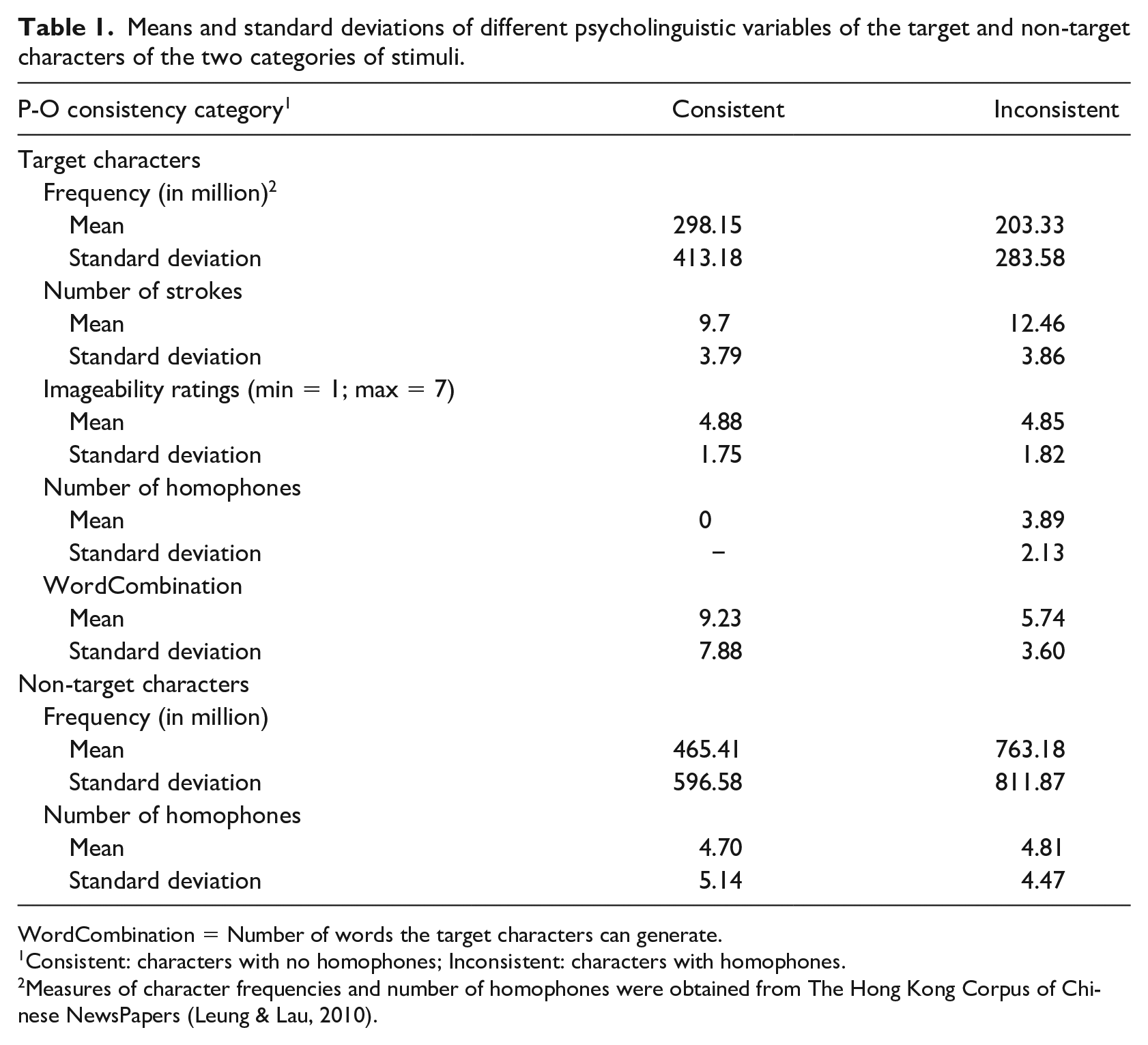
WordCombination = Number of words the target characters can generate.
Consistent: characters with no homophones; Inconsistent: characters with homophones.
Measures of character frequencies and number of homophones were obtained from The Hong Kong Corpus of Chinese NewsPapers (Leung & Lau, 2010).
2.3 Equipment
Data collection was conducted using a 7-inch tablet (quad-core with 2.20GHz processing speed, resolution of 1820x1200, and refresh rate of 60Hz) running Android 4.1.1 with handwriting software installed. The participants were required to perform a writing-to-dictation task on the tablet using a wireless stylus pen.
2.4 Procedures
A writing-to-dictation task was conducted. Each participant was assessed individually in a quiet room. They were instructed to perform each trial as accurately and as quickly as possible. Prior to the test, two practice trials using very high-frequency characters were given to ensure that the participants understood the instructions. In each of the randomly ordered target trials, the disyllabic word context of the target character was given to avoid confusion (e.g., “「背包」嘅「背」字” [the ‘back’ in ‘backpack’]). No feedback on accuracy was given.
2.5 Measures
For each trial, accuracy data were obtained and latency data, including RT (measured as the time difference between the onset of the target syllable in the recorded instructions and the first contact of the stylus on the tablet screen made by the subjects) and total writing time (measured as the time difference between the onset of the first stroke and the offset of the last stroke made by each subject), were recorded using the tablet.
3 Results
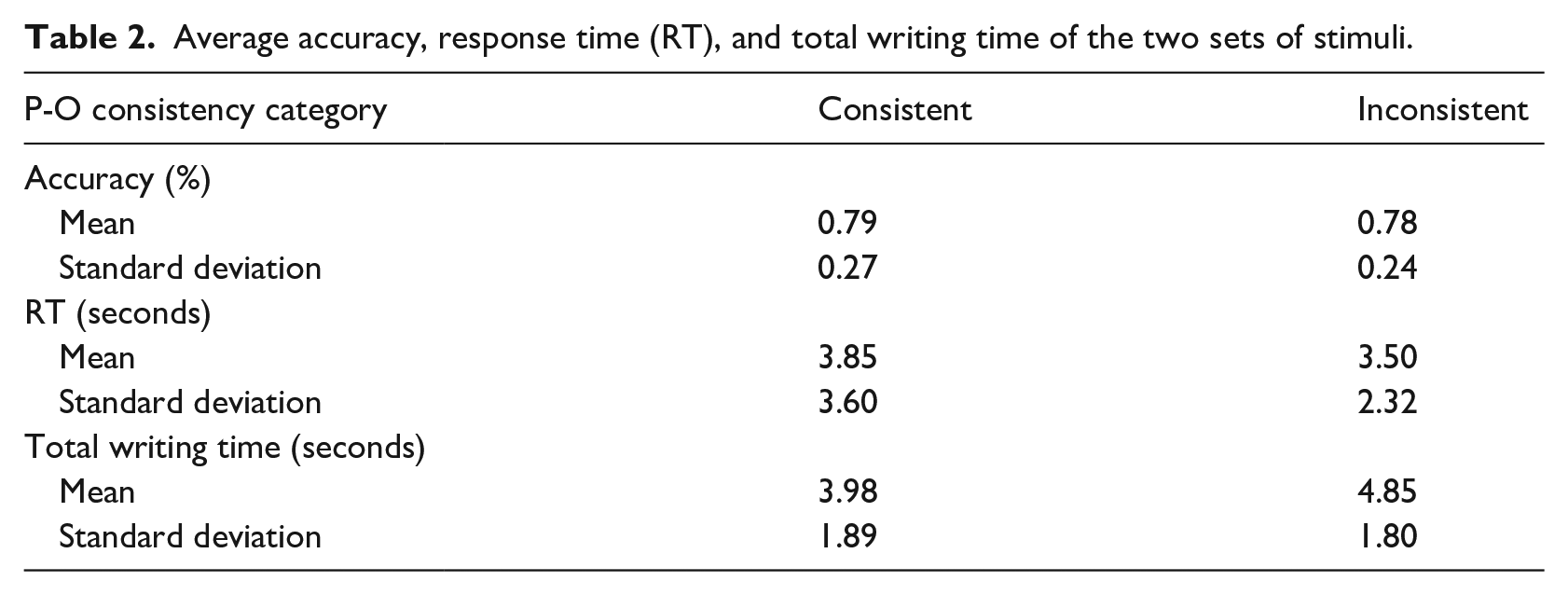
The average accuracy, RT, and total writing time of the two sets of stimuli are summarized in Table 2.
Average accuracy, response time (RT), and total writing time of the two sets of stimuli.
Linear mixed-effect models with maximal model structure (Barr et al., 2013) were computed using the lme4 package (version 1.1-18.1; Bates et al., 2015) in R (version 3.5.1; R Core Team, 2018) for each of the measures (i.e., accuracy, RT, and total writing time). Character frequency (logFrequency), number of homophones (logHomophones), number of strokes (strokeNumber), number of words generated (logWordComb), and imageability of the target characters, as well as character frequency (logNonTargetFrequency) and number of homophones (logNonTargetHomophones) of the non-target characters in the disyllabic words, were entered as fixed factors. By-subject and by-item random intercepts and random slopes were included for each fixed main effect and interaction, based on a recommendation by Barr et al. (2013). Fixed effects were centered around their mean to minimize collinearity. Character frequency, number of homophones, and number of words generated were log-transformed to correct for skewness. Significance was determined using the cut-off point of t > 2. The effect size (measured as d) of each significant effect identified was calculated based on a formula recommended by Westfall et al. (2014). The results of the statistical models for the measures of accuracy, RT, and total writing time are summarized in Tables 3, 4, and 5, respectively.
Results of the model examining the predictors of accuracy. * indicates p < .05.
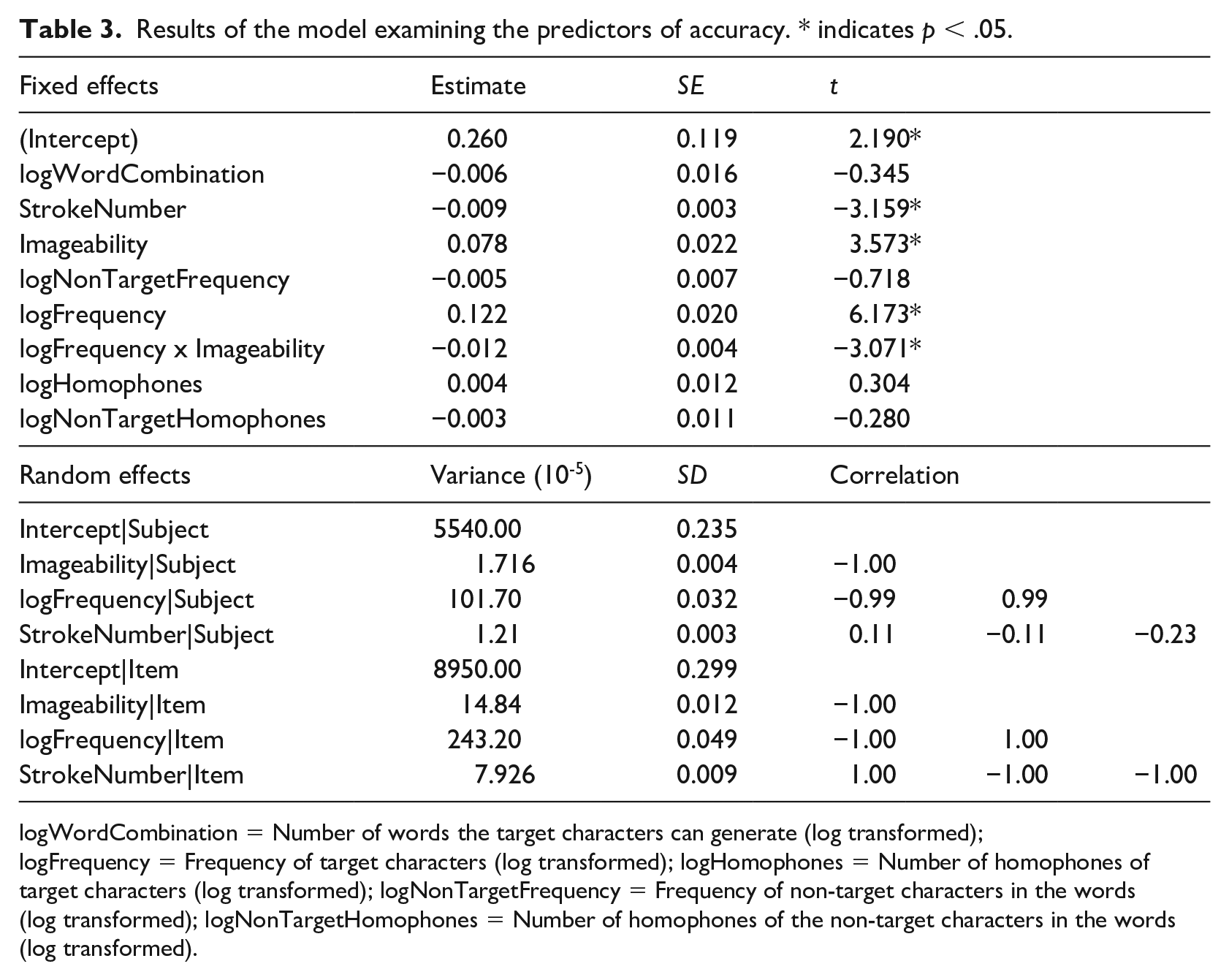
logWordCombination = Number of words the target characters can generate (log transformed); logFrequency = Frequency of target characters (log transformed); logHomophones = Number of homophones of target characters (log transformed); logNonTargetFrequency = Frequency of non-target characters in the words (log transformed); logNonTargetHomophones = Number of homophones of the non-target characters in the words (log transformed).
Results of the model examining the predictors of RT. * indicates p < .05.

logWordCombination = Number of words the target characters can generate (log transformed); logFrequency = Frequency of target characters (log transformed); logHomophones = Number of homophones of target characters (log transformed); logNonTargetFrequency = Frequency of non-target characters in the words (log transformed); logNonTargetHomophones = Number of homophones of the non-target characters in the words (log transformed).
Results of the model examining the predictors of total writing time. * indicates p < .05.
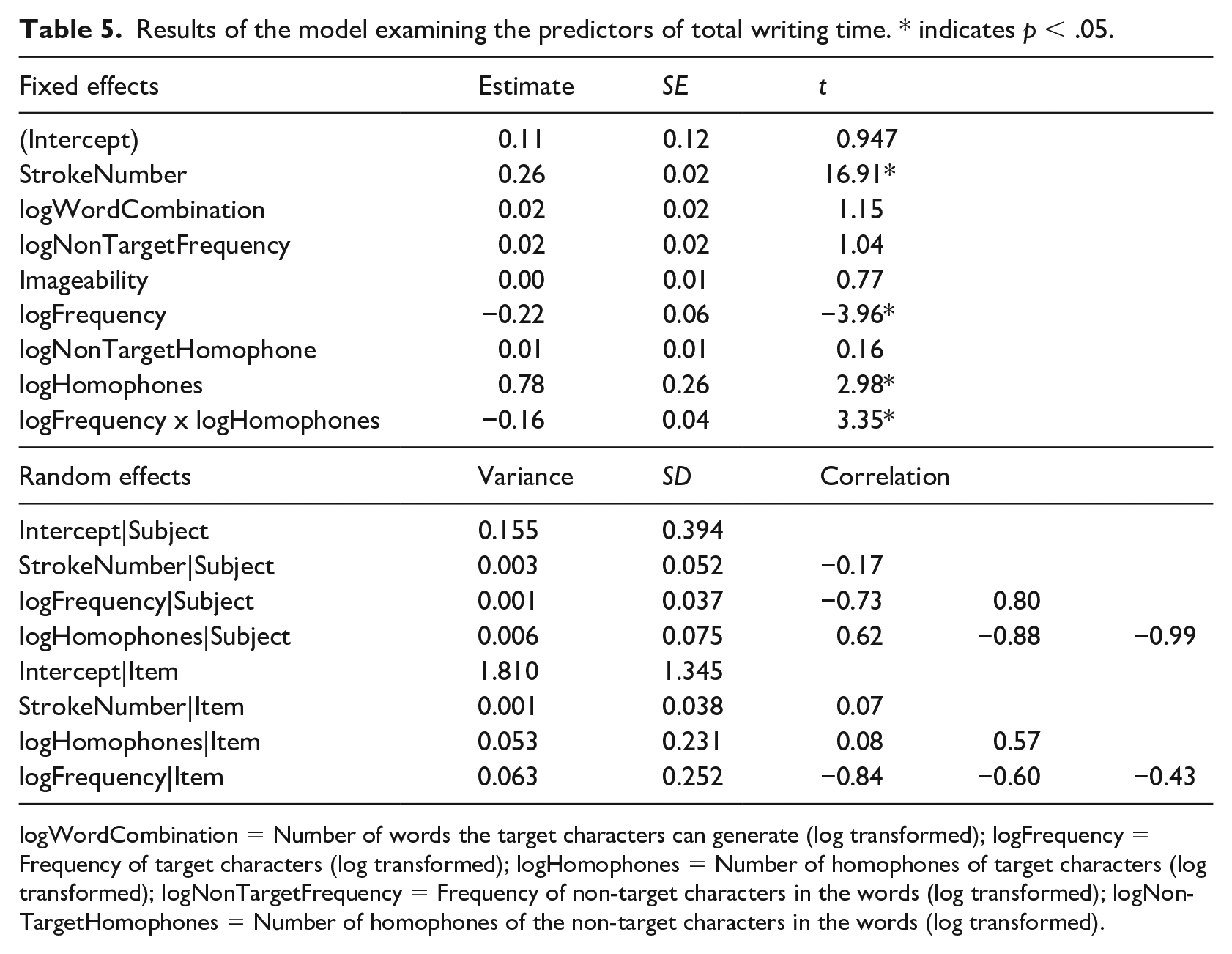
logWordCombination = Number of words the target characters can generate (log transformed); logFrequency = Frequency of target characters (log transformed); logHomophones = Number of homophones of target characters (log transformed); logNonTargetFrequency = Frequency of non-target characters in the words (log transformed); logNonTargetHomophones = Number of homophones of the non-target characters in the words (log transformed).
3.1 Accuracy
The results showed that accuracy in the writing-to-dictation task decreased in strokeNumber (−0.073 ± 0.027, d = 0.12) and increased in logFrequency (0.158 ± 0.029, d = 0.26). Accuracy also increased in imageability (0.132 ± 0.035, average count, d = 0.21), but in the low-frequency condition only (interaction of logFrequency/imageability: −0.020 ± 0.006, d = 0.03). Finally, the prediction of accuracy was not significant in logHomophones, logWordComb, logNonTargetFrequency, and logNonTargetHomophones (p > 0.1).
3.2 Response Time
Only accurate trials were included in the analysis. About 4.2% of the RT data were excluded from the analysis because they were longer than 3 SD of the mean. The results showed that the RTs in the writing-to-dictation task decreased in imageability (0.029 ± 0.011, d = 0.04) and logFrequency (0.120 ± 0.015, d = 0.16). The RTs also increased in logHomophones (0.066 ± 0.028, d = 0.09). Finally, the prediction of RTs was not significant in logWordComb, logNonTargetFrequency, and logNonTargetHomophones (p > 0.05).
3.3 Total Writing Time
Only accurate trials were included in the analysis. About 4.0% of the total writing time data were excluded from the analysis because they were longer than 3 SD of the mean. The results showed that total writing times increased in strokeNumber (0.646 ± 0.039, d = 1.55) and decreased in logFrequency (0.056 ± 0.015, d = 0.15). Total writing times also increased in logHomophones (0.220 ± 0.077, average count, d = 0.39), but in the low-frequency condition only (interaction of logFrequency/logHomophones: −0.049 ± 0.014, d = 0.13). Finally, imageability, logWordComb, logNonTargetFrequency, and logNonTargetHomophones did not significantly predict the total writing times (p > 0.05).
4 Discussion
The aim of the current study was to investigate the effect of P-O consistency on writing-to-dictation in Chinese. Three different measures, including accuracy, RT, and total writing time, were used in the writing-to-dictation task. The results showed that the roles of different psycholinguistic factors in predicting the three measures in the writing-to-dictation task varied.
4.1 Accuracy
The results showed that accuracy in the Chinese writing-to-dictation task was predicted by the number of strokes, character frequency, and imageability. Referring to Figure 1, each trial of the writing-to-dictation task started with an auditory recognition of the target syllable in the phonological lexicon. There were two possible routes by which to identify orthographic representation in the orthographic lexicon, the lexical-semantic route and the direct lexical route (Weekes et al., 2006). Finally, the identified orthographic representation was transmitted to the peripheral process of writing. In explaining how different factors can predict accuracy in writing-to-dictation in Chinese, it is important to note that accuracy is modulated by both central processing and the peripheral process of writing. The significant effect of character frequency observed in the writing-to-dictation task was attributed to both the identification of target orthographic representations in central processing and the execution of a motor plan to write the target character.
For the significant interaction effect between lexical frequency and imageability, although lexical frequency was the major factor that affected accuracy in the writing-to-dictation task, low-frequency characters benefited when imageability was high.
The significant effect of the number of strokes observed should be explained with caution. There are two possible reasons for the number of strokes affecting accuracy in the writing-to-dictation task. The first is that characters with more strokes are more vulnerable to execution errors such as stroke omission. This is related to the orthographic output buffer (Caramazza et al., 1987; Han et al., 2007) involved in writing. The orthographic output buffer temporarily stores the orthographic unit’s output from the orthographic lexicon while the unit is pending motor execution via handwriting (Caramazza et al., 1987). Therefore, the more strokes in a character, the heavier the cognitive demand in temporarily storing the orthographic unit pending motor execution. As a result, there is a greater chance of committing execution errors when writing characters with more strokes.
The second reason is that characters with fewer strokes are usually introduced in earlier grades in school (Shu et al., 2003); hence, the stroke effect observed may have only reflected the age of acquisition effect (Liu et al., 2007). Future studies investigating the effect of age of acquisition on writing-to-dictation in Chinese are needed to confirm this hypothesis.
The insignificant effect of the number of homophones observed in predicting accuracy in the writing-to-dictation task indicated that unlike alphabetic languages (Delattre et al., 2006), accuracy in writing-to-dictation in Chinese is not affected by P-O consistency. Despite P-O consistency being part of central processing, its role in predicting accuracy in the writing-to-dictation task was minimal. One possible reason is that the homophonous nature of the Chinese writing system discourages users from relying heavily on the phonology-to-orthography conversion approach in writing. Otherwise, many errors with substitutions of homophones would be committed in daily writing, which would cause much confusion in communication.
4.2 Response Time
The results showed that lexical frequency, imageability, and P-O consistency significantly predicted the RTs in the writing-to-dictation task. This was consistent with the predictions in Figure 1, that writing-to-dictation in Chinese is modulated by both lexical-semantic and direct lexical pathways. It is important to note that unlike the findings in Han et al. (2012), the interaction effect between lexical frequency and P-O consistency was not significant in predicting the RTs in the writing-to-dictation task in the current study. This suggests that P-O consistency equally affected both high- and low-frequency Chinese characters. One major difference between the current study and the study by Han et al. (2012) was the task’s requirements. In Han et al.’s (2012) study, the participants were instructed to write “the first syllable that came to mind upon hearing a syllable” (p. 522). This task requirement resulted in a significant interaction effect between lexical frequency and P-O consistency. When presented with syllables with many homophones (i.e., P-O inconsistent), given that many possible orthographic forms are associated with syllables, the “first syllable that came up” was probably driven by lexical frequency; hence, the lexical frequency effect was more robust. On the other hand, when presented with syllables with fewer (or no) homophones (i.e., P-O consistent), the frequency effect may not have been apparent because there were not many “choices” activated in the lexicon in this case.
In the current study, however, since a word’s context was provided to specify the target morphemes in each trial, only one unique orthographic entry fulfilled the requirement. Hence, the ease of identifying the target orthographic entry should have been primarily determined by lexical frequency. The number of homophones (distractors) associated with the targets only slightly affected the RTs in the writing-to-dictation task equally across different lexical frequencies. Similarly, the imageability of the characters also had an effect on the RTs. Unlike the results for the accuracy measure, the interaction effect between lexical frequency and imageability did not significantly predict RTs. This, again, suggests that the RTs for the writing-to-dictation of Chinese characters were primarily determined by lexical frequency. Imageability also had an effect on the RTs equally across different lexical frequencies. This suggests that in the case of low-frequency characters, high imageability and high P-O consistency may have contributed slightly to facilitating the retrieval of the target orthographic representations.
4.3 Total Writing Time
The results showed that the total writing times were predicted by lexical frequency, number of strokes, and P-O consistency. The effect of the number of strokes was within expectations, as the more strokes in a character, the longer it took to write it. In addition, the results also showed that after controlling for the number of strokes, the total writing times were modulated by lexical frequency, P-O consistency, and their interaction.
The longer total writing times associated with low-frequency P-O inconsistent characters was attributed to competition between homophones in the orthographic lexicon. Longer writing times required comparing P-O inconsistent characters with P-O consistent characters, which was consistent with previous findings (Bonin et al., 2015; Delattre et al., 2006). Therefore, the results of the current study support the “cascaded” architecture of lexical processing (Qu & Damian, 2015; Roux & Bonin, 2012). The significant P-O consistency effect and interaction effect between frequency and P-O consistency observed in the total writing times in the current study echoed the claim that the conflicts that occur in the central processing of spelling inconsistent words cascade and carry over to lengthen the writing time spent on the peripheral process of handwriting execution (Delattre et al., 2006). In fact, evidence of cascaded processing in handwriting has been reported in many other studies (e.g., Qu & Damian, 2015; Roux & Bonin, 2012; Roux et al., 2013). Future studies with other measures for the Chinese character handwriting process, such as the comparison of interstroke intervals at radical boundaries (e.g., Lau, 2020; Lau et al., 2016) between P-O consistent and inconsistent characters, are suggested to further investigate to what extent the competition between neighbors affects the handwriting process.
The number of words that the target characters generated was not significant in predicting any of the dependent variables. One possible reason is that the selected word contexts were amongst the most representative in the family of words that contained the target characters. As indicated earlier, instead of random selection, the dissyllabic words were carefully selected to avoid any ambiguity due to the homophonous nature of Chinese. This probably minimized the potential competition effects generated from other family members. Future studies using stimuli with a mixture of different levels of representativeness in corresponding families will be needed to warrant this.
4.4 Dual-route Account of Writing-to-Dictation in Chinese
The major purpose of investigating the effect of P-O consistency on writing-to-dictation in Chinese was to verify whether the lexical non-semantic pathway is necessary in explaining writing-to-dictation in Chinese. The significant P-O consistency effect observed, therefore, suggests that the answer is affirmative. Overall, the results of the current study generally support the dual-route account of writing-to-dictation in Chinese proposed by Weekes et al. (2006) and depicted in Figure 1.
In the current study, the lexical-semantic route, as reflected in the significant imageability effect observed, was necessary for the identification of the target orthographic entry associated with the target morpheme, while the direct lexical non-semantic route, as reflected in the significant P-O consistency effect observed, allowed for the bypassing of the semantic system, but only for high-frequency orthographic entries. Once the target morpheme was confirmed, the ease of retrieval of the orthographic entry was primarily determined based on lexical frequency. Imageability and number of homophones had an effect on the ease of retrieval at different processing levels. Next, the identified orthographic entries in the lexicon were temporarily stored in the orthographic output buffer pending the motor execution of handwriting (Han et al., 2007). Finally, any conflicts that occurred in central processing cascaded and carried over to lengthen the writing time spent on the peripheral process of handwriting execution.
The findings of the current study also highlight that given the entire writing-to-dictation process, which involved several steps, the use of different measures, including accuracy, RT, and total writing time, interstroke intervals and writing velocity (e.g. Lau, 2019; Roux et al., 2013) are needed to indicate how different steps in the entire process work and interact in the entire time course of writing-to-dictation.
5 Limitations and Future Studies
One major limitation of the current study concerns the sample size of the study. As observed, the effect size of some of the significant effects reported was relatively small. The small effect size may possibly be related to the cascaded nature of information flow in the writing process. This cascaded nature suggests that some of the competition that occurred at the central processing stage remained unsolved at the onset of the handwriting process, and hence some of the effects, including semantic, orthographic, and phonological, on certain stimuli may not have been reflected in the RTs of writing the Chinese characters. Similarly, the extent to which different factors affected the total writing times should also have been affected accordingly. Having an insufficient number of stimuli, therefore, was not ideal as reflected in the small effect size. It is recommended that future studies use much larger scales to warrant the findings of the current study.
6 Conclusion
The current study examined the P-O consistency effect on the writing-to-dictation in Chinese using the measures of accuracy, RT, and total writing time. The results indicated that a significant P-O consistency effect was observed in the RTs and total writing times but was absent in the accuracy measure. In general, the results support the lexical-sematic and lexical non-semantic pathways account proposed by Weekes et al. (2006). The results echoed a previous finding that the lexical-semantic pathway plays a major role in writing-to-dictation in Chinese (Han et al., 2012). Moreover, the results in the current study also echoed the important role of the orthographic output buffer in Chinese writing (Han et al., 2007). Finally, since the results also replicated previous reports (e.g., Qu & Damian, 2015; Roux & Bonin, 2012) of the finding that any conflicts that occur in central processing cascade and carry over to lengthen the writing time spent on the peripheral process of handwriting execution, the current study highlighted the necessity of using different measures, including accuracy, RT, and handwriting data, in studies on writing-to-dictation.
