



Abstract
This exploratory study investigates the acoustic correlates of the Korean three-way laryngeal stop distinction in Gyeongsang long-term (LT) transplants who were born in the Gyeongsang region but moved to Seoul to pursue higher education. Acoustic data were collected from eight LT transplants, five short-term (ST) transplants, and 11 Seoul speakers to examine whether exposure to Seoul Korean (SK) affects Gyeongsang speakers’ cue-weighting in distinguishing stops in production. LT transplants produced stimuli in both Gyeongsang and Seoul dialects. A cue-weighting model based on the acoustic data reveals that voice onset time (VOT) is less important to distinguish lenis from aspirated stops for Seoul speakers and for LT transplants’ SK, as compared to ST transplants and LT transplants’ Gyeongsang Korean (GK). In addition, fundamental frequency (F0) is more important for the lenis–aspirated distinction for Seoul speakers and LT transplants’ SK, as compared to ST and LT transplants’ GK, showing that LT transplants rely less on VOT and more on F0 to distinguish lenis from aspirated stops compared to ST transplants. LT transplants’ SK reveals that they rely more on VOT and less on F0 compared to SK speakers. The cue-weighting model of the LT transplants provide empirical evidence that a series of sound changes in GK is due to inter-dialect contact.
Keywords
1 Introduction
Much research has focused on the question of how languages or dialects change when they come in contact with other languages or dialects. In addressing this question, a fundamental concern in second-language acquisition is the interaction between the first (L1) and second languages (L2) of an L2 learner. One of the theoretical models addressing the interaction between L1 and L2 is the Speech Learning Model (SLM; Flege, 1995, 2003; SLM-r; Flege & Bohn, 2020), examining both speech perception and production. The SLM provides a theoretical motivation for the effect of L1 on L2 acquisition when learning L2, as well as for L2 effects on the L1. An important underlying mechanism of the SLM is category assimilation. Category assimilation is a component of “equivalence classification,” which may arise when speakers fail to form a new category for an L2 speech sound. This occurs when the phonetic realization of L1 and L2 speech sounds is different but can be grouped into one category (e.g., English /u/ vs. French /u/; English /t/ vs. French /t/; Flege, 1987). As a result, the modified category incorporates aspects of the original L1 category as well as the similar L2 category, and the acoustic properties of the two sounds may influence each other. In other words, L2 phones can be pronounced similarly to L1 phones due to the influence of the L1, and L1 phones can also be produced more like their L2 counterparts due to the influence of the L2.
The way L1 affects L2 acquisition has been well-documented (e.g., Best, 1995; Best et al., 1988; Bradlow et al., 1997; Flege, 1987, 1991; Flege & Hillenbrand, 1984; Flege & Port, 1981; Fox, et al., 1995; Nittrouer & Burton, 2005). Flege (1987), for example, showed that native English speakers living in Paris produced French /u/ with a significantly higher second formant (F2) frequency than French monolinguals. Similarly, native French speakers living in Chicago produced English /u/ with a significantly lower F2 than English monolingual speakers. These results suggest that phonetic details of the L1 affect speech production in the L2, even in bilingual speakers. Examining these phonetic details within the same language, Escudero and Boersma (2004), for instance, demonstrated that, while native Scottish English listeners depended more on spectral cues, native Southern British English listeners depended more on temporal cues to distinguish tense from lax vowels (/i/ vs. /ɪ/). The cue-weighting patterns of L1 also affect the perception of L2. A well-known example is Japanese listeners’ perception of English /l/ and /ɹ/ in syllable-initial position (e.g., Iverson et al., 2003; Miyawaki et al., 1975; Yamada & Tohkura, 1990), with native English listeners found to rely more on third formant onset (in perception as well as in production; see Lotto et al., 2004), whereas Japanese listeners focused more on F2 onset (Iverson et al., 2003; Yamada & Tohkura, 1990). Japanese listeners’ greater reliance on F2 was attributed to its importance for distinguishing /ɾ/ and /w/ in Japanese (Lotto et al., 2004). Thus, Japanese listeners’ difficulty processing the English liquid contrast arose from their cue-weighting transfer from the L1 to the L2.
In terms of the effect of L2 on L1, prior studies have focused on phonetic drift found in the production of L2 learners and bilingual speakers (e.g., Chang, 2012: English L2 learners of Korean; Dmitrieva, 2019: Russian–English bilinguals; Dmitrieva et al., 2020: English L2 learners of Russian; Flege, 1987: late French–English bilinguals; Guion, 2003: Quichua–Spanish bilinguals; Harada, 2003: early Japanese–English bilinguals; Kang & Guion, 2006: late Korean–English bilinguals; Lang & Davidson, 2019: English–French bilinguals; Lord, 2008: late English–Spanish bilinguals; Major, 1992: English–Portuguese bilinguals). Flege (1987), for instance, showed that the voice onset time (VOT) of English /t/ spoken by English–French bilingual speakers was significantly shorter than that spoken by English monolinguals. Likewise, the VOT of French /t/ spoken by French–English bilingual speakers was significantly longer than that produced by French monolinguals. These results suggest that acquiring the L2 phone affects the phonetic details of the production of the L1 phone. A similar L2-on-L1 effect was documented by Dmitrieva et al. (2010), which focused on the acoustic correlates of Russian final devoicing. Native Russian speakers with long-term (LT) exposure to and extensive knowledge about English showed a larger difference in vowel duration and voicing into closure between underlying voiced and voiceless final obstruents in Russian as compared to monolingual Russian speakers. This difference in production was attributed to speakers’ phonological knowledge about English, which does not have final devoicing. L2 experience has also been shown to affect cue-weighting patterns in bilinguals’ L1. For example, in her study of stop voicing in word-final position, Dmitrieva (2019) found that Russian–English bilinguals’ perception of incompletely neutralized final voicing in Russian relied more on vowel duration and less on glottal pulsing compared to Russian monolinguals.
The L2 effects on the L1 appear not only in bilingual or advanced L2 learners but also in novice L2 learners. For example, Chang (2012) showed that the VOT of the English aspirated stop produced by novice English L2 learners of Korean was lengthened to a level similar to that of Korean aspirated stops after five weeks of intensive Korean training in South Korea. Most recently, Dmitrieva et al. (2020) showed that these L2-on-L1 effects can be observed even in L1-immersed classroom learners. The effect of L2 on L1 might also lead to phonetic differences between dialects. Caramazza and Yeni-Komshian (1974), for example, revealed that the VOT of French voiced stops produced by Canadian French monolinguals was more English-like (short lag) as compared to that produced by European French monolinguals. The authors ascribed this difference to language contact: unlike European French, Canadian French has been influenced by constant contact with English.
In line with the L1-on-L2 effects and L2-on-L1 effects described within the framework of SLM, the present study investigates whether an effect of native dialect (D1) on the second dialect (D2) and an effect of D2 on D1 emerges when different dialects come into contact. This study examines whether LT transplants’ speech production shows phonetic drift and whether the directionality of such drift is consistent with the ongoing sound changes in the monodialectal speech community. As a test case, we investigate the ongoing sound changes in Gyeongsang Korean (GK), which is a tonal dialect of Korean. 1 Thus, the primary goal of the present study is to examine whether the current sound changes in GK are contact-induced changes. This question will be addressed by investigating the production of GK speakers living in Seoul.
1.1 Diachronic changes in GK
Korean has a typologically rare three-way stop contrast among voiceless stops (the so-called fortis, lenis, and aspirated stops), with VOT, fundamental frequency (F0) at vowel onset, closure duration, and H1–H2 in the following vowel playing a role in distinguishing the three-way contrast. In word-initial position in isolation, previous research has found that the fortis stop has a short VOT and high F0, the lenis stop has an intermediate VOT and low F0, and the aspirated stop has a long VOT and high F0 (e.g., Kim et al., 2002; Lisker & Abramson, 1964). In word-medial position, the fortis stop has the longest closure duration, the aspirated stop has an intermediate closure duration, and the lenis stop has the shortest closure duration due to the lenis stop being voiced intervocalically (e.g., Lisker & Abramson, 1964). More recent studies have found that, in word-initial position, the VOTs of the lenis and aspirated stops have gradually merged over time, whereas the VOT of tense stops has not changed. The VOT of lenis stops has increased, and that of aspirated stops has decreased. In some speakers, the VOTs of the lenis and aspirated stops show complete overlap (e.g., Kang, 2014; Silva, 2006). As a result, speakers become more likely to depend on the F0 difference of the following vowel when they distinguish lenis from aspirated stops (e.g., Kang, 2014; Kang & Guion, 2008; Silva, 2006).
These acoustic characteristics, however, are limited to Seoul Korean (SK), which is a non-tonal dialect of Korean spoken in the midwestern region of the Korean peninsula. On the other hand, GK, spoken in the southeastern region, is a tonal dialect and is known to have nominal lexical pitch accents. For instance, GK shows three lexical pitch accent contrasts—high–high (HH), high–low (HL), and low–high (LH)—when the word is disyllabic (Kim & Jun, 2009; Lee, 2008; Lee & Davis, 2009; Lee & Jongman, 2012, 2015; Lee et al., 2016). The three pitch accent contrasts are distinguished by the location of the F0 peak. HH words form a peak plateau across the syllables, HL words have a peak in the first syllable, and LH words have a peak in the second syllable. 2
The GK speakers show a different production and perception pattern of the three-way laryngeal distinction compared to SK speakers. Lee and Jongman (2012), for example, compared the production of the three stops of GK speakers and SK speakers and showed that the presence of lexical pitch accent affects the three-way laryngeal distinction and the way in which multiple acoustic cues signal stop contrasts in the two dialects having different prosodic structures. Specifically, F0 is significantly different across the three Korean stops for SK speakers, whereas F0 is not a reliable acoustic cue to the three-way laryngeal distinction for GK speakers due to the presence of lexical pitch accent. While F0 is not sufficiently reliable, VOT clearly distinguishes the three stops for GK speakers. By contrast, for SK speakers, VOT by itself does not play a dominant role in distinguishing the three stops and should be combined with F0 to distinguish them appropriately. Thus, these results indicate that the presence of lexical pitch accent affects the dialectal variation in distinguishing laryngeal contrasts.
The interdialectal difference in speech production is found in speech perception as well. Lee et al. (2013) demonstrated that SK listeners use F0 as the primary cue and VOT as a secondary cue to perceive the lenis and aspirated stops, whereas GK listeners mainly use VOT, and F0 secondarily. Lee et al. (2013) argued that the presence of lexical pitch accents in GK may make F0 differences a less reliable cue to the laryngeal distinction than in SK and that an ongoing change in the stops (i.e., VOT merger of lenis and aspirated stops) in SK made VOT differences less salient than in GK. Although both older generation and younger generation GK speakers have the four underlying classes of nominal lexical pitch accents, the accent classes are maintained with less distinctive acoustic properties for the younger generation compared to their elders (Lee et al., 2016). Specifically, the nominal pitch accents of younger GK speakers have fewer spectral and temporal F0 differences across contrastive accents, which results in a final rising accent pattern similar to SK (Lee & Jongman, 2015).
These diachronic changes in the GK pitch accent may affect the cue-weighting of VOT and F0 in younger-generation GK speakers. Lee and Jongman (2019) showed that younger GK speakers’ use of F0 was reduced for the pitch accent contrast but increased for the laryngeal contrast. More specifically, younger GK speakers’ use of the F0 cue for the contrastive stop triplet was less affected by the lexical accent classes, suggesting that F0 as a cue to the laryngeal contrast is more robust for the younger than for the older speakers. Given that the existence of lexical tone makes F0 a less reliable cue to the segmental distinction, the authors proposed that the reduced tonal property for younger GK speakers could make F0 more available as a cue to the stop contrasts.
These diachronic changes in GK have been mostly attributed to language contact (Lee & Jongman, 2019; Lee et al., 2016). The most influential factor proposed is GK speakers’ increasing contact with SK speakers: younger GK speakers who have been more under the influence of SK than older speakers might develop a cue-weighting strategy similar to that of younger SK speakers who weight F0 more than conservative speakers (Lee & Jongman, 2019; Lee et al., 2016). Short-term (ST) exposure to non-native acoustic cues and contact with different languages can induce a change in cue-weighting patterns (e.g., Escudero & Boersma, 2004; Nielsen, 2011; Nittrouer & Burton, 2005; Pearce, 2009). Thus, younger GK speakers who have been exposed to SK since an early age may be more likely to change their cue-weighting strategy to be similar to that of SK. However, there is no clear evidence that this series of changes in GK is indeed due to language contact with SK. These changes could simply be internal changes occurring within the GK speech community.
1.2 The present study
The present study explores how younger GK speakers who have lived in Seoul for many years and have GK as D1 and SK as D2 (hereafter, GK LT transplants), produce the three-way laryngeal stop contrast. Specifically, we examine whether the VOT and F0 cues to the three-way laryngeal contrast are weighted differently between GK ST transplants and GK LT transplants’ D1 (i.e., D2–D1 effect). We also examine the production of SK speakers and LT transplants’ D2, which allows us to examine any D1–D2 effect and directly compare cue-weighting strategies across the different groups of speakers.
With respect to GK ST transplants and SK speakers, we expect to replicate the findings of Lee and Jongman (2012, 2019). GK ST transplants would clearly distinguish the three-way stop distinction with VOT alone, and F0 would not serve as a sufficiently reliable acoustic cue. For SK speakers, VOT alone would not play a significant role, and it would need to be combined with F0 to distinguish the stops, especially lenis from aspirated stops.
For GK LT transplants, we predict that their production of GK would be different from GK ST transplants in that the GK LT transplants’ GK would show a reduced reliance on F0 to distinguish GK lexical pitch accent contrast but an increased reliance on F0 to distinguish the laryngeal contrast, resulting in cue-weighting similar to younger SK speakers. It is also predicted that the GK LT transplants’ production of SK would be different from SK speakers. Due to the effect of D1 on D2, GK LT transplants would rely more on VOT compared to SK speakers to distinguish the laryngeal contrast. Empirical support for these predictions would suggest that there are D1–D2 and D2–D1 effects that affect speakers’ cue-weighting in segmental production. A difference in the production of the LT transplants by dialect as compared to the ST transplants would imply that the speech pattern may change due to dialectal contact.
2 Experiment
2.1 Participants
The participants were divided into three groups: 11 SK speakers; five GK ST transplants; and eight GK LT transplants. Given intrinsic differences between female and male speakers in terms of F0, this study recruited female speakers only. All participants were recruited at Seoul National University. The descriptive statistics of the participants are shown in Table 1. The SK group included only speakers who were born and grew up in Seoul with parents who spoke only SK. All speakers in the GK group were born and grew up in the Southern Gyeongsang region with parents who spoke only GK. The GK ST transplants moved to Seoul to pursue higher education but were educated in Seoul for less than three years. The first author verified that none of the GK ST transplants were able to fluently and naturally speak SK at the time of the experiment. 3 The GK LT transplants moved to Seoul to pursue higher education and were educated in Seoul for at least five to 10 years. None of the participants had a history of speech or hearing disorders.
Descriptive statistics of the participants.

Note: values are means (standard deviations/range).
2.2 Speech materials
The speech materials were disyllabic words and are shown in Table 2. All target stops were followed by the vowel /a/, except /khoil/ “coil.” The stimuli consisted of three triplets of the word-initial stops, which differed by pitch accent in GK (HH vs. LH vs. HL). HH words were monosyllabic nouns followed by the nominative case marker /-i/, except /k’aki/ “peeling” which consists of the verb root /k’a-/ and the derivational morpheme /-ki/.
Stimuli for the acoustic study.

Note: we use the ejective symbol /’/ to transcribe tense stops since there is no official International Phonetic Alphabet symbol. The unshaded stimuli were adapted from Lee and Jongman (2012).
2.3 Procedure
The stimuli were recorded in the Phonetics Laboratory at Seoul National University, using a microphone (Shure BETA 87A) and a digital recorder (Zoom H4n Pro) at a sampling rate of 22,050 Hz. The participants were asked to produce each word in isolation, which was presented in the Korean alphabet. A triggering context was given for each word to help speakers produce the words more naturally and distinguish them from homonyms. For instance, a triggering context for the target word “bread,”(빵이 /p’aŋ-i/ in Korean), was “This bakery’s _____ is delicious”. The target words occurred in the same prosodic position, and the accent patterns of the target words were not modified by their position in the context sentences. The participants saw the context sentences but were instructed to only produce the target words. All words and triggering sentences were presented three times in random order.
In contrast to the SK speakers and GK ST transplants, GK LT transplants required a specific task to tap into their use of each dialect, because they had to produce the words in both dialects: D1 (i.e., GK); and D2 (i.e., SK). To reduce any interference between the two dialects, the two recordings were separated by one week. The LT transplants recorded their D2 in their first participation. They were asked to read aloud one paragraph of a newspaper article in SK before they recorded the stimuli. The purpose of the read-aloud task was to help participants get into SK speech mode. One week after the SK recording, participants returned to the laboratory to record their D1. In their second participation, the participants were asked to read a script in GK (including GK-style vocabulary and ending markers) before they recorded the stimuli. All participants were compensated for their participation.
2.4 Measurements
The VOT of the stops and F0 at the onset of the following vowels were measured using the software package Praat (Boersma & Weenink, 2018). VOT was defined as the interval between the release of the burst and the onset of voicing. F0 at the onset of the following vowel was measured by taking an F0 value at 20 milliseconds (ms) after the voicing onset using the “To Pitch. . .” function in Praat with a pitch range of 100–500 Hz. The starting point of the vowel was determined based on the onset of voicing, as indicated in the waveform and spectrogram.
2.5 Data analysis
The measured values were fitted into linear mixed-effects models using the lmer function of the lme4 package (Bates et al., 2013) of the statistics software R and R studio (R Core Team, 2019). We first focused on the D2–D1 effect by examining if GK ST transplants produced the accent words differently from LT transplants. For this purpose, F0 values were estimated, including two variables
Next, we focused on the D1–D2 effect. Since SK speakers and GK LT transplants’ SK should not show a different role of F0 as a function of pitch accent, the second part only examined the role of F0 and VOT as a function of laryngeal contrast between the two groups. Again, two mixed-effects models were constructed, one with F0 as the dependent variable, and the other with VOT as the dependent variable. For each model, the fixed effects were
For each model, we applied Helmert contrasts coding for factors with more than two levels (i.e.,
3 Results
3.1 The effect of D2 on D1
3.1.1 Lexical pitch difference
Figure 1 illustrates the mean F0 (Hz) of the first syllable of the target words for the GK ST and LT transplants’ GK as a function of pitch accent. For the GK ST transplants, the mean F0 of LH words (219 Hz) was the lowest, and that of HH (248 Hz) was slightly lower than that of HL words (250 Hz). The LT transplants’ GK showed the same pattern. The mean F0 of LH words (219 Hz) was the lowest, followed by HH (234 Hz), and HL words (236 Hz).

FO (Hz) distribution for GK ST and LT transplants’ GK as a function of pitch accent.
Table 3 summarizes the parameter estimate (β) for each of the fixed effects as well as the interaction terms. The mixed-effect model with the GK ST transplants’ F0 in LH words as baseline revealed a significant main effect for accent
Summary of fixed-effect coefficients in the mixed-effects regression model of F0 with GK ST transplants’ F0 of LH words as the baseline.

3.1.2 F0
Figure 2 illustrates the mean F0 (Hz) of the first syllable of the target words for the GK ST and LT transplants’ GK as a function of pitch accent and laryngeal type. For the both groups, aspirated stops have the highest F0 across pitch accents, except HL words produced by the LT transplants. Lenis stops have the lowest F0 values across pitch accents, except LH words spoken by the ST transplants.

FO (Hz) distribution for GK ST and LT transplants’ GK as a function of pitch accent and laryngeal type.
Table 4 summarizes the parameter estimate (β) for each of the fixed effects as well as the interaction terms. The mixed-effect model with the GK ST transplants’ F0 of fortis stops of LH words as the baseline revealed significant two-way interactions of
Summary of fixed-effect coefficients in the mixed-effects regression model of F0 with GK ST transplants’ F0 of fortis stops (for.) of LH words as the baseline.

The GK LT transplants produced lenis and aspirated stops with a larger F0 difference than the ST transplants, and the LT transplants’ use of the F0 cue for the contrastive stop pair was less affected by the lexical accent classes, as evidenced by the significant three-way interaction. These results suggest that F0 as a cue to the laryngeal contrast is more robust for the LT transplants than for the ST transplants.
3.1.3 VOT
Mean VOT values for GK LT and LT transplants’ GK as a function of pitch accent and laryngeal type are provided in Figure 3. Across the speaker groups and pitch accents, the shortest VOT was found in fortis stops (ST group: 13 ms; LT group: 14 ms), which is followed by lenis (ST group: 61 ms; LT group: 59 ms) and aspirated stops (ST group: 85 ms; LT group: 77 ms).

VOT (ms) distribution for GK ST and LT transplants’ GK as a function of pitch accent and laryngeal type.
Table 5 summarizes the parameter estimate (β) for each of the fixed effects as well as the interaction terms in the best model. The final model included the two fixed factors,
Summary of fixed-effect coefficients in the mixed-effects regression model of the VOT with GK ST transplants’ VOT of fortis stops as baseline.

The results of the mixed-effect model of VOT with GK ST transplants’ VOT of fortis stops as baseline showed a significant effect of
3.2 Discussion
To investigate whether knowledge about D2 has an influence on D1, we compared the production of GK ST transplants to that of LT transplants’ GK. The results of F0 as a cue to accent contrast showed that ST and LT transplants differ in their use of F0 to distinguish lexical pitch accent words, as evidenced by the significant interaction of
The results of the ST transplants’ F0 as a function of laryngeal contrast are consistent with the results of Lee and Jongman (2012). As a function of pitch pattern, the present study found that F0 is significantly lower in LH than HL and HH words for the ST transplants, which is also consistent with the results of Lee and Jongman (2012, 2019). For the interaction of
The results for VOT showed that both ST and LT groups produce distinctive VOTs to make the three-way laryngeal distinction for GK. With respect to the VOT difference between lenis and aspirated stops, the ST transplants showed a larger difference compared to the LT transplants’ GK. We did not find a significant effect of accent class, meaning that VOT as a function of laryngeal type is not modulated by pitch accent class. The results of the ST transplants are consistent with previous findings on the clear VOT difference in the production of younger GK speakers (Lee & Jongman, 2012, 2019). The novel finding of the present study is that the LT transplants produce stops in a different way from the ST transplants. Although LT transplants’ GK is clearly distinguished by VOT alone, the VOT difference between lenis and aspirated stops is smaller than that of the ST transplants.
Combining the results of F0 with those of VOT, we found that the GK LT transplants relied more on F0 and less on VOT than the GK ST transplants to distinguish the three-way laryngeal contrast, providing supporting evidence for the D2–D1 effect. For the GK LT transplants, we expected that their production of D1 (i.e., GK) would be different from the ST transplants due to their exposure to and knowledge about D2 (i.e., SK). More specifically, we predicted that the LT transplants would show a reduced reliance on F0 to distinguish the GK pitch accent contrast but an increased reliance on F0 and reduced use of VOT to distinguish the laryngeal contrast, resulting in a cue-weighting pattern similar to that of SK speakers. Our results substantiated these predictions.
3.3 The effect of D1 on D2
3.3.1 F0
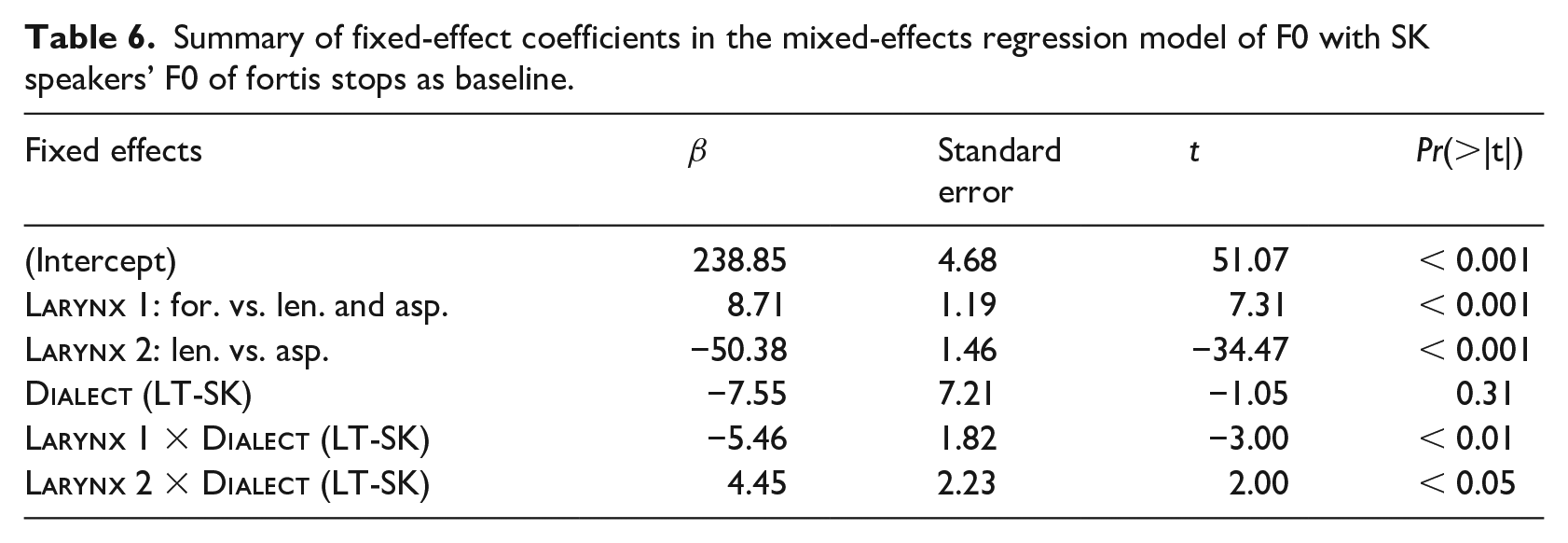
Figure 4 illustrates the mean F0 (Hz) of the first syllable of the target words for SK speakers and GK LT transplants’ SK as a function of laryngeal type. Across the groups, aspirated stops have the highest mean F0 values (SK speakers: 261 Hz; GK LT transplants: 253 Hz). Fortis stops have an intermediate mean F0 (SK speakers: 244 Hz; GK LT transplants: 234 Hz), and lenis stops have the lowest mean F0 (SK speakers: 211 Hz; GK LT transplants: 207 Hz) for both groups.

FO (Hz) distribution for SK speakers and GK LT’ SK as a function of laryngeal type.
The initial regression models evaluated the effect of the fixed factors
Summary of fixed-effect coefficients in the mixed-effects regression model of F0 with SK speakers’ F0 of fortis stops as baseline.
3.3.2 VOT
Figure 5 illustrates the mean VOT (ms) of the target words for SK speakers and GK LT transplants’ SK as a function of laryngeal category. For SK speakers, the mean VOT values of lenis (81 ms) and aspirated stops (81 ms) were the same. In contrast, for LT transplants’ SK, lenis stops (68 ms) have a shorter mean VOT than aspirated stops (76 ms). Across the groups, fortis stops have the shortest VOT values (SK speakers: 14 ms; GK LT transplants: 15 ms).

VOT (ms) distribution for SK speakers and GK LT transplants’ SK as a function of laryngeal type.
Similar to the F0 model, the initial regression models evaluated the effect of the fixed factors
Summary of fixed-effect coefficients in the mixed-effects regression model of the VOT with SK speakers’ VOT of fortis stops (for.) as baseline.

3.4 Discussion
With respect to F0 as a cue to laryngeal contrast, the results of SK speakers are consistent with prior findings in that aspirated stops have the highest F0, and lenis stops have the lowest F0 (e.g., Kang 2014; Kang & Guion, 2006; Silva 2006), regardless of the pitch accent patterns (e.g., Lee & Jongman, 2012, 2019). Importantly, this study found that there was a significant two-way interaction of
In terms of the results of VOT, SK speakers did not show a significant VOT difference between lenis and aspirated stops. This result of the SK speakers is consistent with previous findings on the VOT merger in the production of younger SK speakers (e.g., Kang, 2014; Kang & Guion, 2006; Lee & Jongman, 2012, 2018; Silva, 2006). The novel finding of the present study is that GK LT transplants produce SK stops in a different way from SK speakers. SK speakers produce less distinctive VOTs to make the three-way laryngeal contrast compared to GK LT transplants’ SK, as evidenced by the significant interaction of
Comparison between SK speakers and GK LT transplants’ SK suggests that LT transplants’ SK relied less on F0 and more on VOT than SK speakers to distinguish the three-way laryngeal contrast. This confirms that LT transplants’ SK showed the effect of D1 on D2. For the LT transplants’ SK, F0 is a less robust cue to laryngeal contrast, whereas VOT is more robust compared to SK speakers. The cue-weighting strategy found in LT transplants’ SK is similar to what we observed in the ST transplants. In other words, the cue-weighting pattern of the D1 still remains when the LT transplants produce the D2.
4 Cue-weighting of acoustic parameters: Mixed-effects logistic regression model
In order to examine how the weighting of VOT and F0 in signaling the three-way stop distinction changes depending on dialect group, mixed-effects logistic regression models were constructed. The models allow us to quantify the contribution of each acoustic parameter and focus on different cue-weightings when each speaker produces lenis and aspirated stops. To remove the magnitude differences among measurement units (i.e., ms and Hz), the two acoustic parameters were standardized using the z-score transformation (e.g., Kang, 2014; Kong et al., 2011). The dependent variable of the model was
The results of each model are summarized in Table 8. The model of GK ST transplants show main effects of VOT and F0, indicating that LT transplants use both acoustic parameters to distinguish lenis stops from aspirated stops. Within the model, the absolute values of the coefficient are higher for VOT than for F0, suggesting that the VOT parameter is more influential than the F0 parameter for GK LT transplants. The model of SK speakers shows no significant main effects of VOT. These results are consistent with previous findings and results of the present study, showing that the VOT parameter does not play a significant role in the lenis–aspirated distinction for SK speakers. The model of the GK LT transplants’ GK shows that there are main effects of VOT and F0, which means that LT transplants use both acoustic parameters to distinguish lenis and aspirated stops when speaking GK. The model of GK LT transplants’ SK shows the same pattern as SK speakers. That is, for LT transplants, the VOT parameter does not play a significant role in the lenis–aspirated distinction when they speak SK. The difference between the coefficients of VOT and F0 is bigger in the model of the GK LT transplants’ SK than that of the GK LT transplants’ GK. These results suggest that the VOT parameter plays a more significant role in GK LT transplants’ GK compared to GK LT transplants’ SK. To ensure that the different cue-weightings within the GK LT group are meaningful, we built the mixed-effects regression models of F0 and VOT with GK LT transplants’ SK and GK. The summary of each model is provided in the Appendix. The results showed a significant three-way interaction of
Output of the mixed-effects logistic regression model that predicts aspirated stops in contrast to lenis stops in the production of each dialectal group.

The probability of aspirated stops with respect to the VOT and F0 parameters estimated by the mixed-effects models of logistic regression is graphically represented in Figures 6 and 7, respectively. The inverse logit curves are drawn based on the output of the mixed-effects logistics regressions provided in Table 8. In terms of the VOT parameter, as shown in Figure 6, the steepest slope is observed in GK ST transplants, which is followed by LT transplants’ GK and LT transplants’ SK. This indicates that the VOT parameter is the most influential parameter for GK ST transplants compared to the other groups. As shown in Figure 7, the steepest slope of the F0 parameter is found in SK speakers, which is followed by LT transplants’ SK, indicating that the F0 parameter plays the most influential role in SK when distinguishing lenis from aspirated stops in production.

Probability of aspirated stops with respect to voice onset time parameter estimated by the mixed-effects models of logistic regression.

Probability of aspirated stops with respect to fundamental frequency parameter estimated by the mixed-effects models of logistic regression.
5 General discussion
This study examined Korean laryngeal stops produced by Seoul Korean monodialectal speakers, Gyeongsang Korean short-term transplants, and Gyeongsang long-term transplants to investigate whether GK LT transplants’ use of acoustic cues to laryngeal contrast shows any effect of the D2 on the D1, and vice versa. The present study suggests that acoustic characteristics shown by the GK LT transplants are different from other groups. We also document the different cue-weighting strategies across different groups by evaluating speakers’ reliance on VOT and F0 to distinguish lenis from aspirated stops. While the current results fit in well with our predictions based on previous studies from our laboratory and others, we must stress the exploratory nature of our study given the relatively small sample size.
When comparing across different groups, the VOT results showed that the difference between lenis and aspirated stops was greatest in GK ST transplants, followed by GK LT transplants’ GK and GK LT transplants’ SK. SK speakers did not show a significant VOT difference between lenis and aspirated stops. In terms of the F0 difference between lenis and aspirated stops, GK ST transplants and LT transplants’ GK showed a smaller difference compared to SK speakers and LT transplants’ SK. The results of the cue-weighting model showed that both VOT and F0 play significant roles in the aspirated–lenis stop distinction for ST transplants and LT transplants’ GK and SK, whereas the VOT parameter does not play an essential role for SK speakers. Importantly, the absolute values of the coefficient of each parameter suggest that the cue-weighting of LT transplants’ GK is different from that of ST transplants. Although both parameters are significant, LT transplants place more weight on F0 than VOT, whereas ST transplants place more weight on VOT than F0. The difference between ST and LT transplants’ GK in cue-weighting strategies shows the same pattern as the difference between younger and older GK speakers. The results of age-related variation in GK and SK discussed in Lee and Jongman (2019) suggest that the most innovative cue-weighting pattern is found in younger SK speakers who primarily rely on F0, an intermediate pattern in older SK speakers and younger GK speakers who use both F0 and VOT, while the most conservative pattern is found in older GK speakers who mainly rely on VOT.
In the present study, as in Lee and Jongman (2019), both F0 and VOT play an important role in distinguishing the three laryngeal stop types in younger GK ST transplants. However, since LT transplants’ GK places more weight on F0 than the ST transplants, the GK of the LT transplants (who are more exposed to SK) shows a more innovative cue-weighting. This pattern is consistent with the direction of change seen between younger GK speakers and older GK speakers. It is clear that LT transplants’ SK exhibits a more innovative pattern than LT transplants’ GK and a more conservative pattern relative to younger SK speakers. As the degree of exposure to SK increases, the cue-weighting pattern of the GK speakers changes to an extent similar to that of younger SK speakers. Thus, these results provide supporting evidence to previous studies suggesting that a series of changes in GK is caused by inter-dialect contact.
Furthermore, there is empirical evidence from surveys conducted by the National Institute of Korean Language (2010, 2015) to support the notion that there is an increase in GK speakers’ degree of exposure to and familiarity with SK. These surveys investigate 5000 Korean speakers’ thoughts on the overall use of Korean, including the use of dialects, based on equal samples across age groups (from the 20s to 70s) and sex, and proportional to dialect region.
According to the results from 2010 to 2015, the overall proportion of Korean speakers’ usage of SK increased by approximately 16% while the proportion of GK usage decreased by approximately 5%. This trend of decline was consistent across all age groups. Interestingly, the number of GK speakers who could speak SK had increased by approximately 17% in five years. In contrast, 45.8% of SK speakers answered that they felt uncomfortable when they speak with GK speakers in 2010, but this percentage had increased to 70% in 2015. To summarize, the results of the surveys conducted by the National Institute of Korean Language provide empirical evidence that the ongoing changes in GK are most likely due to the influence of SK. This contact-induced change makes speakers become more familiar with speaking SK, and at the same time, they become less familiar with speaking GK.
The diachronic changes in the GK speech community are also related to a sociolinguistic factor, specifically language attitude. For example, Kang and Kim (2015) conducted a survey to examine GK speakers’ thoughts on their own dialect and SK. The participants were 488 GK speakers with equal proportions of each age group (from the 20s to 50s) who had lived in the Gyeongsang region. In their study, 75% of GK speakers answered that they have a positive attitude or feeling about SK. The positive comments included keywords such as affable, soft, classy, smart, and polite. Interestingly, 66% of GK speakers responded that their own dialect brings negative feelings such as angry, aggressive, boorish, brisk, and ignorant. In other words, the negative attitude towards GK and positive attitude towards SK within the GK speech community could be an additional factor in the ongoing changes in GK.
From a theoretical perspective, this study revealed that the acoustic details and cue-weighting pattern of GK LT transplants’ GK are different from those of GK ST transplants due to the D2–D1 effect, and those of LT transplants’ SK are distinctive from SK speakers due to the D1–D2 effect. The results are thus consistent with the general ideas of the SLM (Flege, 1995, 2003; Flege & Bohn, 2020). In line with the L1-on-L2 effects and L2-on-L1 effects described in the framework of the SLM, the present study established that such effects also emerge when different dialects come into contact. The results of GK LT transplants showed that the phonetic norms of GK and SK to distinguish laryngeal contrast mutually influenced one another. This suggests that the LT transplants’ phonetic representation for the acoustic cues to laryngeal contrast was restructured and modified as the result of exposure to phonologically equivalent but acoustically different phones in D1 and D2. The SLM, however, only partially accounts for the present findings, since the SLM does not provide an explanation for cross-language or cross-dialect developments that occur at a suprasegmental level, and it does not describe how each acoustic cue contributes to segmental or suprasegmental contrast. As Chang (2012) has pointed out, a complete model of cross-linguistic phonetic influence should account for the acquisition of a non-segmental level as well.
Several open questions for future research remain. First, the current results should be replicated with a larger sample size. Second, it would be interesting to study whether language attitude indeed affects cue-weighting strategies of the LT transplants. This could be done by testing the production of SK speakers who have been exposed to GK. If the language attitude of individual SK LT transplants has an influence on how they produce D2, then the degree of the D2–D1 effect would be weaker relative to the degree observed in GK LT transplants. A third question is related to the age of acquisition effect. Since the SLM assumes that the formation of new phonetic norms is increasingly blocked by the mechanism of equivalence classification as a speaker matures, the age of acquisition is considered a crucial factor in learning outcomes. If the age of acquisition effect also matters in the acquisition of a different dialect as well as a different language, then early GK transplants should exhibit both reduced D2–D1 and D1–D2 effects.
6 Conclusion
The present study explored whether inter-dialect contact affects ongoing sound changes in the GK speech community. To address this question, we compared the production of the three-way laryngeal stop distinction in Korean among GK ST transplants, GK LT transplants, and SK speakers. This study elucidated the cue-weighting pattern for each of the dialect groups. Quantifying the reliance on VOT and F0 across different dialect groups showed that the cue-weighting of GK LT transplants differed from ST transplants and SK speakers. The data show that the direction of change seen by younger GK monodialectal speakers is consistent with the change seen by GK LT transplants’ GK. Furthermore, these series of sound changes in GK are most likely due to contact with SK.
In addition, GK LT transplants’ SK was different from that of the monodialectal speakers of SK, as the phonetic norms of GK remained when the LT transplants produce their second dialect. The current D2–D1 and D1–D2 effects are in line with the principles of the SML and extend the scope of the model by presenting evidence that interference effects apply not only when learning different languages but also when learning different dialects of the same language.
Footnotes
Appendix
Summary of fixed-effect coefficients in the mixed-effects regression model of F0 and VOT with F0 and VOT of fortis stops of LH words in GK LT transplants’ SK as baseline.

| F0 | VOT | |||||
|---|---|---|---|---|---|---|
| Fixed effects | β | Standard error (SE) | t | β | SE | t |
| (Intercept) | 231.40 | 6.55 |
|
52.34 | 2.25 |
|
| 3.45 | 1.62 |
|
−55.31 | 2.96 |
|
|
| −45.49 | 2.01 |
|
−7.25 | 3.68 | −1.97 | |
| −2.05 | 1.89 | −1.09 | −2.03 | 3.09 | −0.66 | |
| 1.99 | 2.11 | 0.94 | 6.97 | 3.58 | 1.95 | |
| −1.43 | 1.08 | −1.33 | −3.24 | 0.79 |
|
|
| 3.09 | 3.44 | 0.90 | 1.04 | 6.29 | 0.17 | |
| 2.77 | 4.26 | 0.65 | 9.94 | 7.80 | 1.27 | |
| 0.69 | 3.97 | 0.18 | −11.23 | 7.26 | −1.55 | |
| −2.12 | 4.92 | −0.43 | −0.54 | 9.01 | −0.06 | |
| 0.84 | 2.21 | 0.38 | 2.84 | 1.61 | 1.76 | |
| 18.38 | 2.74 |
|
−11.42 | 2.00 |
|
|
| −11.45 | 2.29 |
|
6.59 | 1.67 |
|
|
| −3.50 | 2.65 | −1.32 | 5.80 | 1.93 |
|
|
| −8.12 | 4.69 | −1.73 | −8.64 | 3.42 |
|
|
| −12.25 | 5.81 |
|
8.75 | 4.25 |
|
|
| −12.55 | 5.41 |
|
−8.50 | 3.95 |
|
|
| −24.06 | 6.71 |
|
8.77 | 4.90 | 1.79 | |
Note:
Acknowledgements
We thank two anonymous reviewers as well as Dr. Annie Tremblay, Dr. Jie Zhang, Dr. Joan Sereno, and the student members of LING 850 at the University of Kansas for their insightful comments and feedback on this work. Any misunderstandings are of course our own.
Funding
The authors received no financial support for the research, authorship, and/or publication of this article.
