



Abstract
The paper introduces the Special Issue on Language Contact and Speaker Accommodation, which originates from the conference Phonetics and Phonology in Europe (PaPE) held at the University of Lecce, Italy, in 2019. It discusses the topics of language contact and speaker accommodation, summarizing the contributions included in the Special Issue, and arguing explicitly in favour of a unitary view of how both temporary and stable changes happen in (part of) the linguistic systems. Accommodation is seen as the same gradual and non-homogeneous process at play in different contact settings. In the introductory sections, a discussion is offered on various situations in which linguistic systems are in contact and on the main factors that may be at play; the following sections offer an overview of the papers included in the Special Issue, which focus on accommodation in L2 and heritage speakers as well as on the time dimension of dialect or language societal contact. Finally, accommodation is discussed as the same process that is at work in any interaction, that may modify temporarily or long-term the system of L2 learners and bilinguals (e.g., immigrants), that usually affects in the long-term the heritage speakers’ system, and that only in the long term can lead to language changes involving entire communities.
Keywords
1 Introduction
Accommodation is a ubiquitous phenomenon observed in human communication, both in face-to-face and text-based online communication, as well as in human-computer interaction. It refers to how people adjust their speech to better align with their interlocutors, and it has been shown to affect all levels of linguistic structure.
Two major theoretical frameworks address accommodation: the Communication Accommodation Theory (CAT) and the Interactive Alignment Model (IAM). CAT evolved from the Speech Accommodation Theory, which started as a socio-psychological model of speech style modification (e.g., Giles, 1973; Giles & Powesland, 1975) and later became an interdisciplinary model of processes active in communicative interaction, integrating notions from sociolinguistics, communication, and social psychology (Bradac et al., 1989). The Speech Accommodation Theory initially focused on how language features and behaviour co-vary with the speaker’s social needs or the listener’s social evaluation. For instance, speakers may modify their linguistic features to create solidarity with or dissociate from their interlocutor/group (Giles et al., 1991). This attention eventually led to the development of the CAT, which takes into account multilingual accommodation as well (Sachdev et al., 2013) and, over time, has undergone several refinements (e.g., Giles et al., 2007; Giles, 2016). In Giles’ theory, accommodation may correspond to a reduction of differences or even the adoption of features from the interlocutor dialect. However, accommodation taking place in interactions among individuals is often a matter of intergroup interactions, where ethnicity, gender, age, and membership play a role (Giles et al., 2010), in line with Tajfel’s work on intergroup relations (Tajfel, 1978; Tajfel & Turner, 1986; see discussion in Sachdev et al., 2013).
The central behavioural tenets of CAT are convergence and divergence. Sociolinguistic convergence refers to the different strategies that aim to reduce the differences between speech styles, not only based on the formality–informality context (Labov, 1966) but also on the interlocutor’s styles (Giles, 1973). Convergence may involve a wide range of linguistic (e.g., allophonic variants), paralinguistic (e.g., pauses and utterance length), and nonverbal features (e.g., smile and gaze), and it reflects the speaker’s motivation to gain social approval and to increase communication effectiveness. On the other hand, divergence refers to the strategies that help dissociate from the (group of the) interlocutor based on factors like age, gender, accent, social class, power structures, or political views, and may be achieved by incrementing the differences or just avoiding convergence.
Research on phonetic convergence has shown that speakers converge acoustically on a wide range of prosodic and segmental features, including articulation rate (e.g., Schweitzer & Lewandowski, 2013), long-term average spectra (e.g., Gregory, 1983, 1986), Voice Onset Time (e.g., Sancier & Fowler, 1997; Shockley et al., 2004), vowel formant values (e.g., Babel, 2012; Schweitzer & Lewandowski, 2013), consonants and clicks (e.g., Gold et al., 2013), voice quality (e.g., Levitan & Hirschberg, 2011), fundamental frequency (e.g., Gregory & Webster, 1996) as well as global measurements of spectral properties, such as amplitude envelope signals (Lewandowski, 2012).
Speakers converge phonetically not only in conversational settings and in interactive tasks, but also in non-interactive tasks when exposed, for example, to instances of single words (Goldinger, 1998). The second highly influential model of speech accommodation, the IAM proposed by Pickering and Garrod (2004, 2013, 2021), can account also for the manifestation of phonetic convergence in these contexts. Pickering and Garrod (2004) posited that during an interaction, automatic priming between the representations shared by the dialogic partners leads to their alignment on all levels of linguistic structure. At the core of the model, as proposed in their 2013 paper, is the idea of a complete integration between comprehension and production processes such that comprehension relies on the same processes as production.By building on research in action and action perception, Pickering and Garrod proposed that, during an interaction, listeners change their productions in response to their perception of the interlocutor’s speech. The listener’s comprehension of a speaker’s utterance occurs through a complex system of predictive simulations (by making use of prior knowledge or covert imitation) that can become an overt imitation of the dialogic partner in the listener’s subsequent productions. The model shares with the Motor Theory (Liberman & Mattingly, 1985) and the Direct Realist Theory of speech perception (Fowler, 1986, 2014) the idea that the speech perception process recruits the speech production process via a direct link between perception and production. IAM explicitly claims that the motor commands activated during language comprehension through the perception-production link lead to imitation, resulting straightforwardly in convergent productions.
Crucially, in this model, convergence is set up as an unconscious automatic process, with very little space left for the speakers’ social goals. Thus, IAM cannot account for the variations in the degree of convergence related to social factors such as ethnicity, gender, social role, language variety, etc. (Ross et al., 2021), nor for the high individual variability in convergence. It has been shown that talkers do not converge in the same way on all segmental or prosodic features (e.g., Levitan & Hirschberg, 2011; Pardo, Jordan et al., 2013), that they may at the same time converge on some features and fail to converge on others (Ostrand & Chodroff, 2021; Pardo, Cajori Jay, et al., 2013) or that the same speaker can show a variable convergence across words (Pardo et al., 2017). Nor can IAM account for differences in convergence due to the language spoken by the same talker as L1 or L2 (Bruggeman and Cutler, 2020). On the other hand, a social model such as CAT cannot account for why convergence occurs also when talkers are explicitly instructed to avoid imitation or in non-interactive settings (e.g., Wagner et al., 2021). To overcome the limitations of a purely social (CAT) and a fully automatic (IAM) account, in more recent years a hybrid model has been proposed, in which convergence is seen as an unconscious process based on the strong link between perception and production, but modulated by social factors as well as by linguistic ones (word frequency and word length) and by the phonetic distance between the interlocutors (Babel, 2012; Pardo, 2012; Pardo et al., 2017).
2. Accommodation within speakers
Independently of considerations on its nature as social or automatic, accommodation has been shown to occur regardless of the linguistic code adopted in the interaction. For instance, accommodation can happen between native speakers of the same language, between a native speaker and a fluent bilingual 1 , or even a beginner L2 learner, as well as between speakers of different languages who use a third language as a lingua franca. In bilinguals accommodation has also been viewed as a balance between convergence to facilitate communication and divergence to maintain group identity (Cargile & Giles, 1996). 2
However, besides the interactional setting, we can think of accommodation as occurring also within individual speakers, when “two languages get in contact through foreign language acquisition or bilingual education” (Delais-Roussarie et al., 2015, p. 1). In line with this observation, any bilingual or multilingual speaker with two or more languages in her/his repertoire, experiences a contact between different language systems, independently of the degree of separation that may be postulated among them (or part of them). Languages acquired either through foreign language acquisition or a bilingual education received in a majority language setting, as well as languages acquired in a minority setting as in the case of heritage speakers 3 , may be seen as corresponding to separated systems that may be variably activated (e.g., Grosjean, 2004) or as systems that somehow share the same “space” (e.g., Flege and Bohn (2021) as for phonetics). Thus, a certain degree of accommodation may happen in such crowded situations, as multiple systems coexist and may influence each other and, as shown for heritage speakers (Celata, 2019, p. 224), changes potentially occur “as a function of time development and the degree of bilingualism”. Thus, bilingual or multilingual speakers, first and later generations of heritage speakers and L2 learners may be seen as experiencing a similar type of contact, that of speakers that variably know and variably use two or more languages, in which accommodation may lead to different outputs.
L2 learners and heritage speakers in particular share the contact between two systems: L1 is the dominant and majority language for second-language learners, while for heritage speakers L1 is the weaker and minority language (Montrul, 2016). The dominance pattern of the languages in contact determines the strength of reciprocal influence. In L2 learners, L1 is easily transferred in L2 at least in the initial stages of acquisition, while L2-induced L1 attrition is of less impact (Best & Tyler, 2007; Chang, 2012; Flege & Bohn, 2021). On the other hand, L1 attrition (i.e., “long-term changes in the native language pronunciation of an individual as a result of the acquisition of a new dialect or language acquired post-adolescence”; de Leeuw et al., 2021, p. 205) is often observed in heritage speakers who, differently from adult L2 learners, are exposed to both the heritage language and the majority language at birth or later in childhood.
For both types of speakers, though, the role of quality and quantity of input, the type (natural acquisition vs. formal teaching) and the duration of exposure, as well as the role of family, social and political environment play a fundamental role in determining the command of the two languages. L2 learners can vary significantly in the level of ultimate attainment in L2, ranging from a limited competence to a near-native one. Heritage speakers have an initial advantage over L2 learners that makes them more native-like (due to the age of acquisition and learning experience) but may, over time, undergo a language shift and become dominant in the majority language to the detriment of the heritage language. The factors listed above concur in determining whether they can remain balanced in the two languages, have fluent control of the heritage one, or lose the language altogether across generations (Montrul & Polinsky, 2019). When heritage speakers experience no continuous and abundant input in the heritage language, incomplete acquisition and attrition may coexist and also regard different linguistic aspects (Montrul, 2013). The heritage language may become an incompletely acquired secondary language, with linguistic characteristics which are typical of a second language acquired after puberty.
Thus, accommodation may occur in interactions between speakers, irrespective of the linguistic code they use, but it may also happen within the speaker, as a result of the contact of two languages within the speakers’ knowledge.
3 Accommodation and language change
Accommodation taking place in pro-social interactions may easily correspond to temporary adjustments between individuals. However, accommodation may also play a role in societal long-term changes, even in a group’s long-term shift, as suggested by Trudgill in his seminal study on dialects in contact (Trudgill, 1986). Various models have been proposed regarding the consequences of long-term contact between dialects and languages, and discussing them is out of the scope of this paper (for an overview, see Hinskens et al., 2005). However, according to Trudgill, mutually intelligible (at least to some degree) varieties of language that are in contact with each other socially may become changed linguistically “as a result of also being in contact psychologically in the competence of individual speakers” (p.1). By taking into account accommodation between regionally (non-socially) different languages and focusing on phonetic and phonological differences, he observes that accommodation between accents may occur both in the short and long term. In the short term, speakers modify linguistic variables that represent markers within the community, which may involve not only the adoption of new variants but also changes in the frequency of usage of variants. In the long term, accommodation results in changes in pronunciation with the adoption of new features and occurs beyond the community. According to Trudgill, the geographical diffusion of linguistic forms takes place when face-to-face interactions between speakers from different areas happen sufficiently frequently for accommodation to become permanent, and on a sufficiently large scale for a considerable number of speakers to be involved. Nowadays, restricting the discussion to face-to-face interactions is obviously too limited, but the process taking place may be considered to be the same. As Trudgill observes, when accommodation between dialects in contact has not gone to completion, for example in the adoption of the other speakers’ variant in some words but not in others, the process of partial accommodation can lead to mixed dialects. 4 These, in the long run, may give rise to whole new interdialectal varieties up to the formation of new dialects in which processes such as levelling, simplification, and reallocation play a significant role.
Overall Trudgill’s (1986) work points to a set of questions that are still driving the interest of most scholars, and are addressed in the papers of this Special Issue: “How speakers accommodate, the extent to which they accommodate, and why some situations and some individuals produce more—or different types of—accommodation than others” (p.3). The main factors he discusses are linked to the saliency of linguistic features that are modified in accent convergence. These are the degree of phonetic differences and the different incidence of shared phonemes. The role of awareness for typical and stigmatised forms is also deeply discussed (aspects that are revealed in imitation tasks), and personality traits are also given importance, as “accommodation may in time become permanent, particularly if attitudinal factors are favourable” (Trudgill, 1986, p. 39).
4 The Special Issue
This Special Issue originates from the conference Phonetics and Phonology in Europe (PaPE) held at the University of Lecce in 2019, where part of the presentations explored the topics of language contact and speaker accommodation. The papers included in the Special Issue represent part of (but are not limited to) the conference presentations. Language contact was discussed from different perspectives and in different situations, such as the language contact experienced within speakers and across communities, both in production and perception, by focusing attention on issues concerning both segments and prosody. Linguistic accommodation was considered as occurring in L1 and L2, in controlled and more ecological settings. The papers in this Special Issue have been selected to contribute to the view that linguistic accommodation is the same process that is at work in any interaction, that may modify (short or long-term) the system of L2 learners, that usually affects in the long-term the heritage speakers’ phonetic and phonological knowledge, and that only in the long term can lead to language changes involving entire communities.
Changes at the community level are rather uncontroversially linked to long-term accommodation, in line with Trudgill (1986), Kerswill (2002), Pardo (2016), Trudgill (2008), and in line with Niedzielski and Giles’ proposal of accommodation theory as “one of the major frameworks to which researchers in language change should turn” (Niedzielski & Giles, 1996, p. 338) — what has also been called the original change-by accommodation model (Auer et al., 2005). Regardless of expectations related to the original change-by-accommodation model, such as the relevance of frequency of (direct) interaction or the need to observe the co-occurrence of interpersonal accommodation and community-level change (see discussion in Auer et al., 2005), we keep the idea of (long-term) accommodation as potentially leading to language change; further, we propose that the same mechanism is at work also in when changes regard heritage speakers, bilingualism due to language contact or an L2 language learning process. In all these cases, time is one of the main factors involved in the change of linguistic systems.
However, various models have been proposed that focus also on other factors affecting accommodation, such as the need for identification with a model group, that would explain the observed tendency to converge to a possible model of its components (see the identity-projection model in Auer et al., 2005, along the lines of La Page’s model of verbal “acts of identity” in Le Page & Tabouret-Keller, 1985). Indeed, many are the factors affecting accommodation and its impact. They range from personality traits to linguistic aspects (such as the type of segment or the type of speech act involved), from the quantity of input (such as the amount of exposure to innovative features) to its quality, from the strength of the languages involved (minority vs. majority language, primary vs. secondary languages) to the type and degree of connection among speakers (e.g., Edwards’ [2010] typological framework of language contact settings). Most important, many of these factors may be relevant also in the case linguistic systems are in contact within the individual.
In the next sections, we first summarise the papers in the Special Issue and then discuss the proposal sketched above, regarding a unitary view of short-term accommodation and language change as different stages of the same process applied in different contact settings. Accommodation and change are discussed in the literature with regard to various parts of in the linguistic system. 5 However, our focus is the phonetic and phonological level, though other levels of the grammar are necessarily referred to as relevant to the discussion.
4.1 Accommodation in L2 and heritage speakers
The first five papers focus on accommodation in L2 and heritage speakers, a relatively understudied aspect of linguistic accommodation that has been vastly investigated in dialogic situations between partners sharing the same language variety. As discussed by Grace Wenling
Cao recognises the need to distinguish between accommodation to similar or new categories and attempts to answer the question of whether patterns of L2 accommodation can be predicted by the L2 category formation hypothesis of the revised Speech Learning Model (Flege & Bohn, 2021). A strictly related question addressed in the paper refers to the role of cross-L2 dialect (dis)similarity in L2 accommodation, specifically whether a larger cross-L2 dialect phonetic dissimilarity would predict a stronger degree of L2 accommodation. The paper tested bilingual Hong Kong English (HKE) speakers’ short-term accommodation towards Received Pronunciation (RP) and General American English (GenAmE). Hong Kong speakers have difficulty acquiring English fricatives /z/ and /th/, which are not present in the phonological system of their native Cantonese. Such phonological difference allows testing the patterns of L2 accommodation to a new category. On the other hand, the role of phonetic (dis)similarity in L2 accommodation is assessed by analysing the patterns of accommodation in the vowels of the THOUGHT and PATH sets, which are phonetically similar in Hong Kong English and RP but different in Hong Kong English and GenAmE. By taking into account both the direction and the distance of shifting, Cao shows that for both investigated vowels, HKE speakers converged to RP and GenAmE interlocutors similarly, not supporting the hypothesis that HKE speakers would converge more towards the language variety that is globally more different from the native one (GenAmE). However, when looking at the local phonetic dissimilarity, HKE speakers accommodate more towards the interlocutor the larger the phonetic distance between their vowels. Results on the accommodation for English fricatives show that the patterns of accommodation crucially depend on whether the bilingual HKE speakers had already formed the relative L2 categories or not, a result which is unexpected based on the revised Speech Learning Model. Results only partially confirm the role of phonetic dissimilarity in convergence and fail to support the prediction that only fully or partially formed L2 categories can induce convergence. To explain L2 accommodation, Cao proposes a new exemplar model that integrates L2 learning models and exemplar-based theories and takes into account the important role of speech perception and attention weight adjustment.
One aspect of L2 accommodation that emerged in the study by Cao and was also observed in other studies (e.g., Pardo et al., 2017) is the high individual variability of the phenomenon. The paper Phonetic Accommodation on the Segmental and the Suprasegmental Level of Speech in Native–Non-Native Collaborative Tasks by Christiane
The problem of individual variability is tested in both the L1 and L2 of the same speaker in the paper The language-specificity of phonetic adaptation to talkers by Anne
The way the sound systems accommodate each other within an individual is discussed with reference to the variable susceptibility of different segments to phonetic convergence by Khia
Accommodation in heritage speakers is explicitly addressed in the paper by Chiara
In the present paper, Celata and Nagy go further in investigating whether lexical frequency has a role in shaping cross-generational changes. They hypothesise that the two types of aspiration could differ at the lexical level: English-like aspiration, showing a more predictable influence of language-internal and language-external variables, may also be subject to typical frequency effects, with a direct correlation between lexical frequency and rate of aspiration. Calabrian-like aspiration would not be as much due to the progressively more limited speakers’ exposure to the heritage language and its indexical value. Results show that both types of aspiration changed across generations in terms of their lexical distribution but in different ways. The diffusion of a majority language’s phonetic feature into a heritage language is substantially frequency-driven, with a consistent increase across generations in the number of distinct lemmas that are the targets of the phonetic change, while the maintenance or loss of the sociophonetically relevant stop aspiration in the speech of heritage speakers is not: it shows a wider and more even distribution across lemmas and its decrease across generations is not influenced by lexical frequency. The paper thus shows that the consequences of long-lasting internal contact depend on the type of the phonetic variable in contact. Contact-induced phonetic changes that do not affect socio-indexical variables are similar to lexically-gradual sound changes, while those changes that do affect socio-indexical variables do not depend on a process of progressive lexicalisation due to entrenchment into a small set of high-frequency words.
4.2 Accommodation in long-lasting community contact
The other four papers focus on the time dimension of dialect or language contact and show the effects of long-lasting contact on a linguistic code resulting either in sound changes in progress, in mixed languages or the stable integration of segmental or prosodic features in the linguistic system.
In their paper, entitled Fast-Speech-Induced Hypoarticulation Does Not Considerably Affect the Diachronic Reversal of Complementary Length in Central Bavarian, Markus
As discussed by Sky
Turning to contributions addressing prosodic issues, the paper Echoes of Past Contact: Venetian Influence on Cretan Greek Intonation by Mary
The contribution by Andrea
5 Many contact situations, one process
The papers outlined in the previous sections deeply discuss both short-term and long-term contact situations, where the contact may be experienced within the speaker or may involve entire communities. Data regard both production and perception, the focus may be the segmental or the prosodic level, and several factors are brought into play as relevant to the discussion. Nevertheless, despite differences in topics and methods, these contributions allow us to identify what is in common, that is, the accommodation process.
As outlined in the introductory sections, accommodation can be considered to be at play in any interaction in human communication. Accordingly, the reference to the accommodation process is not new in the literature on language change and bilingual communities in long-term contact. In that litterature, though, systems of different languages/dialects may be described as converging even when the general process of accommodation is not explicitly brought into play. Similarly, linguistic systems are described as accommodating within the individual speaker, as in L2 learning and in bilingualism in general. However, in the discussion on systems accommodating within the individual speakers, a link with language change at the community level may well be out of scope and, therefore, it is not discussed. We aim to fill the gap by explicitly proposing a unitary view of how both temporary and stable changes happen in (part of) linguistic systems through the same gradual and non-homogeneous process at play in different contact situations.
We want to make explicit that contact situations differ, but the underlying process, that is accommodation, is the same. Figure 1 may help disentangle this issue, representing the various settings in which accommodation may take place and the main factors that may play a role in differentiating its impact on the linguistic systems. Accommodation does not take place homogeneously, and it may involve various parts of the linguistic system; however, in what follows, we focus on phonetics and phonology, whereas other levels are recalled only for interface phenomena.
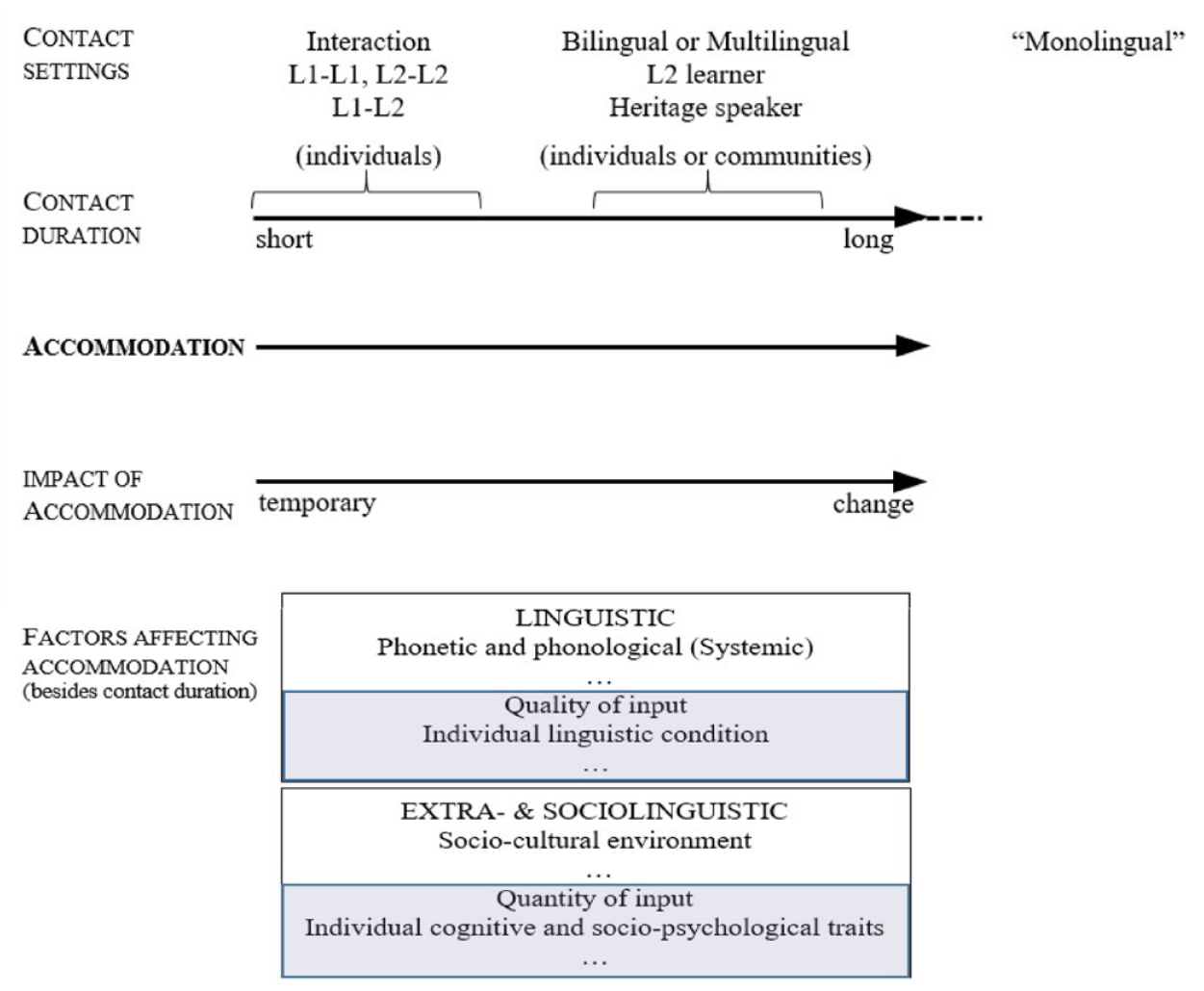
Accommodation as the same process involved when languages are in contact within the individual and when they are in the communities, with short-term and long-term effects.
Various situations have to be considered in thinking of accommodation (see top level in Figure 1, “Contact settings”). The accommodation process may be observed and investigated when it happens between individuals involved in interactions among “monolinguals”
6
, or among L2 speakers, as well as in interactions involving mothertongues and L2 talkers. Furthermore, accommodation may be at play when contact of linguistic systems is observed within L2 learners, bilingual or multilingual individuals in general, including heritage speakers (in the Special Issue, see papers by
The duration of the contact (second level in Figure 1 “Contact duration”) may clearly vary along a continuum, though the various contact situations may be somehow placed in distinct positions along such a continuum. For instance, a contact of short duration is observed in any interaction, while longer duration regards other situations, from those experienced by some L2 learners and heritage speakers for most of their lives, to settings regarding communities in contact for centuries, some of which may even keep some ties after the contact ceases.
Accommodation (third level in Figure 1 “Accommodation”) is the gradual process at play in the various contact situations and is often distinguished in short- and long-term accommodation. The former is seen as taking place in short, temporary contact, which may become long-term depending on the contact duration, also with differences in the way it affects speakers. In this regard, the impact of accommodation may range from temporary to long-term “as soon as it permanently affects the accommodating speakers” (Auer & Hinskens, 2005: 335). The process may be described as taking place for different amounts of time (depending on the duration of the contact—second level in Figure 1 “Contact duration”), and its impact may be differentiated in terms of the temporary or permanent effect on the speaker(s) (fourth level in Figure 1, “Impact of accommodation”). Thus, at one hand of the continuum, for instance, in impromptu (L1-L1, L2-L2, L1-L2) interactions and in some L2 learning contexts, such as (short) training set-ups, a phonetic, temporary change is indeed often documented (see
Noticeably, considering accommodation as the same gradual and non-homogeneous process at play in different contact situations, including within individuals, still allow to refer to convergence and divergence phenomena. Within this perspective, processes such as convergence or divergence may still be measured in terms of similarities or differences developing between linguistic systems. Crucially, such processes involve parts of the systems, to the extent that some segments can be affected more than others (see discussion in §5.1, the overview of the Special Issue in §4, and discussion in the papers included, e.g., the paper by Khia Johnson and Molly Babel). The involvement of parts of the systems implies that, for instance in heritage speakers or bilinguals in general, there is no need for entire systems to converge, becaming identical, or diverge, showing no traces of similarity due to contact. It rather accounts for the observation of convergence or divergence phenomena that, in various contact settings, may be variably characterized as for their scope, quantity, and persistence.
5.1 Factors affecting the impact of accommodation
Within this perspective, time is crucial in various respects. First of all, it is crucial because accommodation is a (gradual) process that exists only in time and, thus, time is preliminary to the observation of the process itself, its impact and other factors affecting it. Second, time differentiates the duration of accommodation (to start with the distinction between short-term and long-term), and, together with other factors, its effects and their persistence.
However, several factors may play a relevant role in promoting, or restraining, the accommodation process and its output (bottom level in Figure 1, where dots indicate that the lists are not intended to be exhaustive). As Figure 1 suggests, the main relevant factors, besides time, range from linguistic to extra-linguistic 9 and sociolinguistic ones; they further range from factors that seem to be more specific for situations involving individuals and groups of bilinguals (L2 learners, L2 speaking immigrants and heritage speakers; see the grey background cells in the bottom table) to factors that are expected to be at play also when entire communities undergo a language change (white background in the bottom table).
Linguistic factors that may be at play in all contact situations considered here (white background in the table) include systemic factors, such as phonetic and phonological aspects (e.g., from the type of segment to its phonological role in the system and the maintenance of phonological contrast; see, a.o., the contributions of
One of the linguistic factors that seem to be more specific to contexts involving individuals or groups of L2 learners, heritage speakers, and other bilinguals such as L2-speaking immigrants (grey background in the table) is the quality of input. The input’s quality varies if the speaker is exposed to the mother tongue or L2 speech (see discussion in, e.g., Cao’s paper in this Special Issue) and, in the case of heritage communities (Celata & Nagy’s paper), the input quality differs if heritage speakers are exposed to the majority language orthe heritage speakers’ speech. Another linguistic factor is the individual linguistic condition, meaning the number of languages that individuals know and their proficiency level (see, e.g.,
In all contact situations considered here, accommodation may be also affected by extra- and sociolinguistic factors, such as the socio-cultural environment (white background cells in the table). Both a language change and the output of, for example, an L2 learning process are indeed possibly affected by partially intertwining factors, such as those related to characteristics of the family environment (to begin with the attitude of the whole family towards the use of different languages), the social class, the instruction level, the social network, and by dominance relations (in this Special Issue, see the paper by Pešková) and social distance between communities and speakers (as for the role of the specific social net the individual belongs to, see Allard & Landry, 1994).
Other factors at play may be gender and age, including the age of L2 learning. For instance, even in the case specific units are found to be particularly susceptible to accommodation and change, differences are often reported to depend on specific groups involved in the contact, such as groups sharing the same age or gender (Simonet, 2011; Romera & Elordieta, 2013), as well as groups sharing the length of residence in an L2-speaking country.
More specific to contexts involving individuals or groups of L2 learners and heritage speakers, and other bilinguals such as L2 speaking immigrants (grey background cells in the table) is the quantity of input, that is the amount of exposure to linguistic stimuli. 10 The quantity of input may differ in learning settings (immersion in L2 speaking community vs. formal setting within a society where L2 is not the primary language; as for the possible impact of formal instruction, see Butler, 2013); it may change in heritage speaker settings (where exposure to heritage-speaker L1 language may be highly variable, see Schmid & Köpke, 2019), as well as in bilingual L2 speaking immigrants (as the amount of L2 input depends on the amount of interaction with the local mother tongue-primary language speakers). On the other hand, in the case of language change, the quantity of input may probably be included under the duration of contact.
Finally, individual cognitive and socio-psychological traits affecting accommodation may be considered, such as the need for social approval, the attitude towards integration (e.g., the need for inclusion vs. the need to maintain or match group identity), the learning attitude, the attention capability, the empathy or, to make a final example, the autistic traits.
11
Hypothetically, the lack of homogeneity in the results of investigations on various contact situations may be ascribed to differences in the perception of linguistic and social identity (see Trudgill’s salient features; in this Special Issue, see
The overview given in the paper is ambitious, and various topics have been mentioned by referring to relevant studies. Of course, the references included do not aim at being exhaustive. Rather they are meant to offer examples, to start with contributions to the Special Issue, supporting the view of both temporary and long-term changes in various types of contact situations as due to the same process, that is accommodation. The different aspects related to the numerous issues discussed in this paper may be deeply understood thanks to references found in the works mentioned in the paper.
6 Concluding remarks
The paper introduces the Special Issue on Language Contact and Speaker Accommodation, and argues explicitly in favour of a unitary view of how both temporary and stable changes happen in (part of) the linguistic systems. The proposal is that the same gradual and non-homogeneous process, i.e., accommodation, is at play in different contact settings.
Trudgill (1986) already proposed that accommodation favours language change. However, in the literature on language change and bilingual communities in long-term contact, linguistic systems may be described as converging with no explicit reference to the general process of accommodation. On the other hand, linguistic systems are described as accommodating in interactions, within the individual bilingual speaker or in groups of bilinguals (such as in L2 learning, immigration settings, and also when the focus is on heritage speakers). In these cases, though, a link with language change at the societal level is usually out of scope and is not discussed.
We aimed to fill the gap by making it explicit that contact settings differ, but the underlying process in place in all of them is accommodation. Accommodation is the same process that is at work in any interaction, that may modify temporarily or long-term the system of L2 learners and bilinguals (e.g., immigrants), that usually affects in the long-term the heritage speakers’ system, and that can lead to language changes involving entire communities only in the long term.
In our view, the papers in the Special Issue clearly show it. The first five papers focus on accommodation in L2 and heritage speakers, while the other four papers focus on the time dimension of dialect or language societal contact. They offer a deep discussion on various settings in which linguistic systems are in contact, with special attention to the impact that contact has on phonetic and phonological aspects, and to a number of the various factors that may be at play. Overall, they are discussed as supporting the view of accommodation as the same process at work in different contact situations, that may lead to both temporary and stable changes.
