



Abstract
Diabetic foot is a complex and challenging pathological state, characterized by high complexity of management, morbidity and mortality. The elderly present peculiar problems which interfere on one hand with the patient's compliance and on the other with their diagnostic-therapeutic management. Difficult clinical management may result in medico-legal problems, with criminal and civil consequences. In this context, the authors present a review of the literature, analysing aspects concerning the diagnosis and treatment of diabetic foot in the elderly which may turn out to be a source of professional responsibility. Analysis of these aspects provides an opportunity to discuss elements important not only for clinicians and medical workers but also experts (judges, lawyers, medico-legal experts) who must evaluate hypotheses of professional responsibility concerning diabetic foot in the elderly.
Introduction
Worldwide, 346 million people have diabetes. 1 The World Health Organization (WHO) predicts that deaths from diabetes will double between 2005 and 2030. 1 In 2010, 3 million people in Italy, or 4.9% of the population, had diabetes. 2 The prevalence of this disease is estimated to involve 19.5% in people aged 75 years and over. As the incidence of diabetes increases in Italy and in general in Western countries, so will the number of people who suffer from its complications. 2 Among these complications, diabetic foot is a complex disorder causing many diagnostic and therapeutic difficulties, 3 with related morbidity and mortality. 3 It is defined by WHO as the foot of a diabetic patient which potentially risks pathological consequences, including infection, ulceration, and/or destruction of deep tissues, associated with neurologic abnormalities, various degrees of peripheral vascular disease, and/or metabolic complications of diabetes in the lower limb. 1 As foot disorders are the leading cause of hospitalization for patients with diabetes mellitus, 4 prevention of these complications is important for patient health and also for cost management. 4
Factors interfering with management of diseases in elderly.
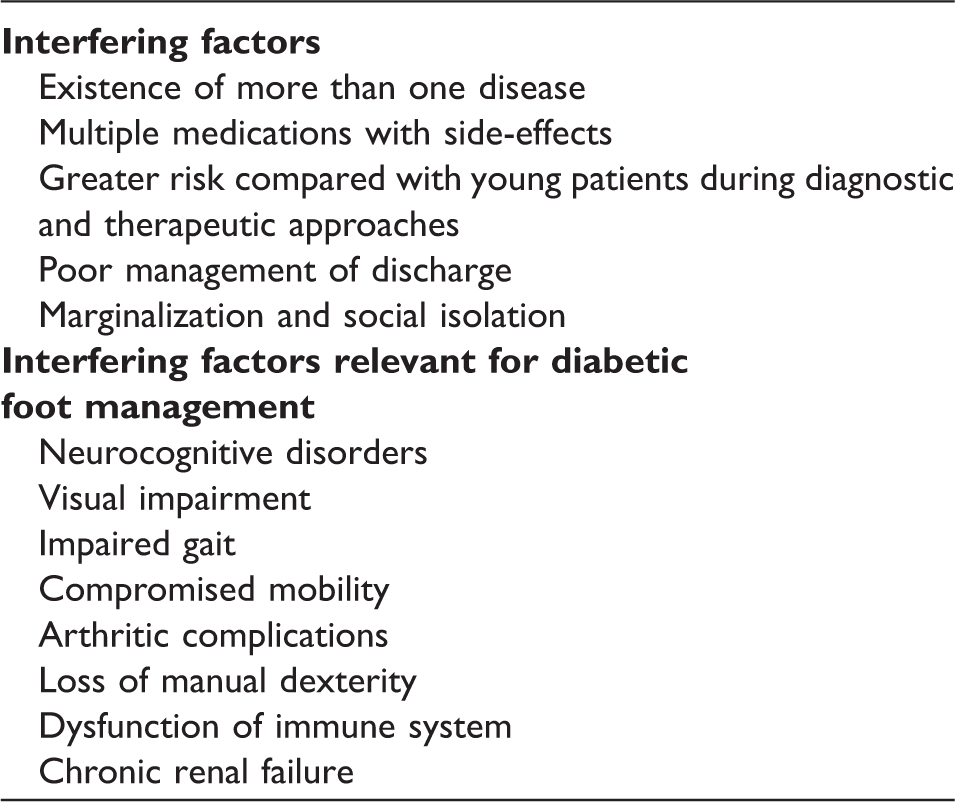
Patient compliance plays a role of paramount importance in the management of diabetic foot. As compliance is based on clinical communications between physicians and patients, 11 any neuropsychiatric disorder affecting the ability to understand the information provided may affect patient collaboration and, consequently, management of the disorder. Diabetes is associated with lower levels of cognitive functions, 12 with a prevalence of neuropsychiatric disorders (e.g., Alzheimer disease, Parkinson disease, etc.) which is higher among elderly patients when compared with the general population. Visual impairment, impaired gait 13 and mobility, 14 arthritic complications, and the loss of manual dexterity 12 negatively influence disease management and hinder the prevention of complications. In particular, visual impairment may influence the capacity to detect initial signs of ulceration; impaired gait and mobility may cause abnormal load pressure on some foot areas, favouring ulceration; loss of manual dexterity may lead to insufficient foot hygiene and inadequate ulcer care. The progressive physiological dysfunction of the immune system related to senescence 12 gives rise to an increased risk of infection and decreased capacity to recover.
Difficulties in the clinical management of diabetic foot may result in medico-legal consequences when patients or, more frequently, their relatives, believe they have suffered damage. As the prevalence of diabetes increases and the number of claims of malpractice increases 15 for medical procedures involving also the elderly, we believed it would be interesting to review those diagnostic and therapeutic situations in the treatment of diabetic foot of the elderly which are most often related to cases of professional liability. We considered analysis of these aspects to be important not only for clinicians and medical workers but also for experts (judges, lawyers, medico-legal experts) who must correctly evaluate hypotheses of professional responsibility.16,17 A systematic review of the clinical management of diabetes is beyond the scope of this paper and we refer to the many international guidelines18–22 for an overall discussion of this topic.
Discussion
Professional liability in Italy is based on the demonstrated occurrence of an error committed by a medical worker, causally related to damage to a patient23,24 (passing from a healthy condition to a disease, to death, or suffering the aggravation of an already diagnosed disease). Professional liability may be disciplinary, civil, or criminal (e.g., manslaughter). In the field of professional liability, independently of the context (civil, criminal, etc.), the conduct of the medical worker is evaluated by medical experts skilled in that particular art, who must evaluate whether the error exists according to guidelines, consensus conference, literature, and, also, their experience and expertise. An error committed by a medical worker may be due to negligence, imprudence, or incompetence. Negligence is the lack of care in working, imprudence is acting without due caution, and incompetence is due to the lack of technical ability. Professional responsibility may involve a single medical worker (physician, nurse, social worker) but is more frequently multidisciplinary, involving several general practitioners and specialists of the diabetic foot care team. Independently of the clinician involved and the demonstration of professional liability, a claim for malpractice may arise from a diagnostic and/or therapeutic procedure which is considered to be inadequate or wrong by family members or patients’ lawyers. Examples are: the underestimation of the clinical condition of an elderly patient which may favour diagnostic and/or therapeutic errors (Figure 1); incorrect information to patients, leading to possible interference with diagnosis/therapy, or the expectations of patients or their relatives, which may also lead to claims of malpractice (Figure 1).
How malpractice claims may arise.
The various diagnostic (a), therapeutic (b), and information (c) steps, which may be related to claims of malpractice in elderly diabetic patients, are described below.
(a) Diagnostic phase
After gathering the medical history of the patient, a physical examination should be performed, to establish the state of the diabetic foot and the treatment plan, to determine any risk to the patient, and to make a prognosis. Evaluation frequency is closely related to the patient’s risk profile during the first diagnostic process. The risk profile is related to the different weights given to the various risk factors for diabetic foot, including peripheral neuropathy, arterial insufficiency, deformity, or prior history of ulceration or amputation. Diagnostic assessment is based on neurological, vascular, musculoskeletal, and specific ulcer evaluation. 14
Neurological evaluation
Professional liability may derive from a neurological evaluation which is not carried out, or is inaccurate. The degree of autonomic neuropathy present can influence deterioration in the diabetic foot. The evolution of diabetic peripheral neuropathy is related to poor glycemic control, 25 duration of the disease, 26 potentially modifiable cardiovascular risk factors 27 (hypertension, hyperlipidemia, obesity, and smoking).
An incorrect classification of autonomic neuropathy may lead to incorrect treatment, consequent worsening of the disease, and therefore damage. Incorrect classification may lead to inadequate cooperation by a patient who has not been properly informed in detail.
Neurological evaluation should be documented when the patient is examined and should include deep tendon reflexes, perception of temperature, the Babinski sign (used to test the plantar reflex and to indicate any metabolic or structural abnormalities in the corticospinal system), perception of vibration, and light pressure. 28 Assessment of the vibration perception threshold with a biothesiometer is useful in predicting which patients are at high risk of future ulceration. 29
Vascular evaluation
Evaluation of vascular status is another important diagnostic step, since it yields information on expectations of treatment, potential for wound closure, and prognosis of the treatment itself. 5 Without an adequate blood supply, healing will never be achieved. 30 Correct assessment of the vascular picture allows correct evaluation of prognosis and thus proper information to patients and relatives. The expectations of patients and family members arise from the information they are given, and this detailed information should be consistent with the clinical picture. Inadequate vascular assessment will lead to incorrect information to patients and family members.
Correct vascular assessment includes palpation of pulses, subpapillary venous plexus filling time, venous filling time assessment, documentation of color changes, presence of edema, temperature gradients, and changes consistent with ischemia. 4 If the physical examination indicates ischemia, wave form analysis, ankle-brachial indices, toe pressure, and transcutaneous oxygen tension should all be performed. 14 In particular, an ankle-brachial index of less than 0.7, toe blood pressure of less than 40 mmHg, or transcutaneous oxygen tension levels of less than 30 mmHg are all indications of arterial perfusion associated with impaired wound healing, and they require an additional vascular consultation. 4 Doppler segmental arterial pressure should be performed to determine lower extremity perfusion and represents a non-invasive arterial study. 4
Arteriography with clearly visualized distal run-off is the appropriate assessment for potential revascularization.4,31 Distal arterial perfusion can also be performed by magnetic resonance angiography or CT angiogram. 4
Musculo-skeletal evaluation
Another key element in diagnostic evaluation of diabetic foot is musculo-skeletal assessment, including technologies to identify bone and joint deformities that may result in focal points of increased pressure, in turn giving rise to an increased risk of ulceration. 14 Orthopedic deformities, limited joint mobility, and gait evaluation should be documented. In the case of musculo-skeletal deformities, examining the patient’s footwear is essential. The type of footwear must be checked and the possible presence of foreign bodies sought. 32 In most cases, a properly fitting shoe will be sufficient to reduce the risk of foot problems in the elderly population.12,32 In patients with disturbed biomechanic pressures and deteriorated circulation, techniques to decrease plantar peak pressure will be necessary.32,33
Ulcer evaluation
Prevention of diabetic foot and lower extremity amputation begins with primary prevention of diabetes, 9 consisting of detailed information regarding a healthy lifestyle, foot care education, and routine foot care. Specific risk factors for ulceration are peripheral neuropathy, vascular disease, limited joint mobility, foot deformities, abnormal foot pressure, history of ulceration or amputation, and impaired visual acuity. 4
If an ulcer develops, it should carefully be examined. Specific assessment of any ulcer – in terms of shape, state, and any signs of infection – must be implemented and accurately documented: 34 in particular, the location, size (length, width, depth), and color of the wound; the presence of exudate, odour, pain, signs of healing or necrosis, and the aspect of wound edges. 35
In the case of a claim for malpractice, the lack of accurate documentation of medical and surgical evaluations and interventions may make it impossible to demonstrate that a specific assessment was, or was not, performed.
As regards frequency of assessment, weekly evaluation may reveal infection of a wound. In the context of infectious processes, the development of osteomyelitis can be assessed by radiography or, preferably, by magnetic resonance imaging (MRI). 36 The ulcer evaluation process concludes with wound staging (analysis of the wound and nearby tissues, to establish any worsening or improvements), according to European 37 or American 38 staging systems.
The steps described above may present specific difficulties in the elderly, a fact which should be taken into account by healthcare providers. Awareness compromised by cognitive deficits may render patients incapable of alerting clinicians in case of complications: this is especially true in case of marginalization and social isolation. If cognitive impairment is involved, healthcare providers should inform other clinicians; hospitalization in facilities with inadequate monitoring may lead to worsening of the disorder, and this possibility should also be considered.
(b) Therapeutic phase
In accordance with the clinical diagnosis, various kinds of treatment can be undertaken in the prevention and management of conditions affecting the diabetic foot. The non-execution or improper execution of treatments given in accordance with the basic framework may be interpreted as errors in the physician's conduct. The four main therapeutic contexts considered as sources of professional responsibility are treatment of foot ulceration, treatment of infectious processes, debridement, and reduction of load pressure on the foot.
Treatment of ulcer
If pressure ulcers develop, they should be cleaned with a non-toxic solution. 39 Cleaning clears the base of the ulcer of debris and bacteria – factors which may delay ulcer healing. 20 Physicians or nurses should use cleansers that do not disrupt or cause trauma to the ulcer. 39 Normal saline (0.9%) is usually recommended, because it is not toxic to healthy tissue. 39 Many wound care products are available as alternatives to normal sterile saline and are grouped into categories such as: transparent films, hydrogels, foams, hydrocolloids, calcium alginates, gauze pads, collagen dressings, antimicrobial dressings, antiseptics, topical antibiotics, enzymes, growth factors, and skin substitutes. 4 Semi-occlusive (transparent film) and occlusive dressings (hydrocolloids, hydrogels, etc.) are dressing types that facilitate autolytic debridement, creating an environment for the body’s enzyme actions. Proteolytic enzymes (e.g., collagenase) represent enzymatic debridement used to remove necrotic tissue. Foam dressings are useful in highly exudative wounds and have different degrees of flexibility and density. Alginate dressing are also useful for such wounds. Skin substitutes have been developed to decrease the time required for wound healing. 40
The choice of dressing depends on factors such as size, depth, location, and type of wound surface which, again, should be documented. Every choice should be motivated and related to the diagnostic picture. 39
Treatment of infections
Infections can threaten both life and limb. 4 Diabetic ulcers in the diabetic foot are at high risk of infection, secondary to progressive immune dysfunction. 41 Clinical signs that the pressure ulcer may be infected include malodorous, purulent exudate; excessive draining; bleeding in the ulcer; and pain. 4 Treatment requires incision and drainage, with administration of broad-spectrum antibiotics without waiting for culture or biopsy results. 14 The choice of antimicrobials should include those active against Gram-positive and Gram-negative organisms and provide aerobic and anaerobic coverage. 14 The condition of the wound and the patient’s medical status and history determine the choice of oral versus intravenous antibiotics and/or the need for hospitalization. 14 Drug–drug interactions should be carefully considered; renal function evaluation should be performed, considering that in the elderly decreased muscle mass can determine normal creatinine serum levels even in case of significant renal dysfunction; evaluation of glomerular filtration rate and of albuminuria/proteinuria should also be performed. 19 Surgical intervention, bone debridement, extended antibiotic therapy, and hospitalization may be necessary managing infections. 14 In these situations, clinicians should carefully evaluate the patient’s condition, taking into account the risks and benefits of hospitalization and/or of aggressive intervention for an elderly patient. 14
Surgical debridement
Surgical debridement is one of the most important aspects in the treatment of diabetic foot, and its proper performance in the light of the patient's general condition is of great importance in prognosis. In elderly patients, proper assessment of the risk/benefit ratio of debridement is required. In particular, in their case, the risks of surgery, additional risks arising from prolonged hospitalization, with possible functional decline, prolonged immobility, decubitus pressure ulcers, and hospital-acquired infections must all be considered. 13 Again, treatment choices must be tailored to the patient’s physical and cognitive status, 19 which may influence compliance.
Reduction of load pressure
Pressure reduction is another key aspect in treating diabetic foot. Also in this context, patient compliance, which depends on the provision of accurate and detailed information, is essential if damage is to be limited. When elderly patients have problems in carrying out daily activities, other health professionals (social workers, nurses, etc.) should also be involved in patient monitoring, focusing especially on frequent clinical assessment or social evaluation. Techniques to reduce load should be decided upon, according to the patient’s physical characteristics and ability to comply with treatment. However, it is essential that patients should always be informed about the need for properly fitting shoes. 42
(c) Patient information and compliance
The lack of the collection of a valid informed consent form represents incorrect conduct on the part of the physician, independently of the diagnostic and therapeutic results.
Diagnostic and therapeutic procedures must be accompanied by an information process which is necessarily based on a relationship involving both physician and patient. The patient must have the capacity to provide valid consent to treatment. The lack of proper information or of truly informed consent shows incorrect conduct which may be punished. Such conduct may also result in poor compliance by patients and/or false expectations on their part or, more frequently, on the part of their relatives. Both consequences may result in malpractice claims.
The provision of timely and accurate information is essential in preventing diabetic foot, ulcers, and risk factors for amputation.
In the elderly, any cognitive impairment, which should be clearly documented during examination, may influence the information process and should be taken into account by physicians, who should then review specific forms of treatment and involve other healthcare providers. Whenever a neuropsychiatric disorder is suspected, such as cognitive dysfunction or depression, brief screening tools should be used. The clock drawing test, 43 Mini-mental state examination,44,45 or similar tests should be performed, to explore cognitive dysfunction; the Geriatric Depression scale 46 or similar tests to screen for depression should also be administered.
In the case of neuropsychiatric disorders, a responsible attitude on the part of relatives and, again, a multidisciplinary team approach to patient management may contribute to reducing complications and improving quality of life.
Conclusions
Diabetic foot in the elderly may be competently managed only by means of a multidisciplinary team approach, addressing not only pathologic comorbidities but also social, physical, and/or financial problems. Collaboration, a responsible attitude, and close interaction with social workers, home healthcare agencies, primary care providers, podiatrists, nurses, dieticians, and diabetes nurse educators are all often necessary. The responsibility for successful treatment belongs not only to the clinician but also to the patient. Patient compliance is of paramount importance in the prevention and treatment of diabetic complications. The challenges of treating elderly diabetic patients may result not only in unsuccessful treatment but also in medico-legal consequences (civil or criminal). Diagnostic or therapeutic errors by clinicians may be the result of incorrect information from the patient or underestimation of the factors that complicate the management of diabetes in the elderly (cognitive impairment, visual deficits, inability to manage activities of daily living, immobility, etc.).
Footnotes
Funding
This research received no specific grant from any funding agency in the public, commercial, or not-for-profit sectors.
Declaration of conflicting interests
None declared.