



Abstract
Stature estimation is one of the essential early steps during forensic investigation of human skeletal remains. The aim of the present study was to obtain a linear regression formula for estimating stature from sternal length of a central Indian population. The study includes 92 male cadavers brought for medico-legal autopsies. The linear regression equations were derived from manubrium, mesosternum and the total sternal length. The regression model provided a 95% confidence interval of ±14.8 cm and a correlation coefficient of 0.55. Compared with other studies, regression formulae based on the length of the sternum provided considerably larger standard errors than that based on long bone lengths. The study indicates that sternal length in relation with body stature shows a moderate positive correlation and relatively low reliability in estimating stature, and has limited forensic value.
Introduction
Establishment of the identity of skeletal remains carries remarkable forensic importance. 1 Stature offers one of the important aspects of an individual’s identification, and its determination is one of the significant initial steps during forensic analysis of the skeletal remains. 2 Various means of anthropometric measurements of the skeleton are used in determining stature.2–14 Such determination is built on the relations between skeletal component and stature. 15 It is a generally accepted fact that stature has a direct relation to the length of various bones.16,17 Different linear regression equations are derived to estimate stature from bone length.
The long bones are widely used for accurate stature estimation. However, in certain scenarios such as mass disasters or crime involving dismemberment of the victim, the long bones may not be available or complete. In such cases, the medico-legal professional requires an alternative solution for stature estimation.18,19 Stature estimation from sternal measurements has received recent attention.20–23 The sternum may be useful in stature estimation because it is easily removed and dissected from the rib cage or torso. Very few studies has been done for stature estimation from the sternal bone.20–23 Most of these studies have focused on stature estimation from dry and macerated sternums. However, when a quick estimate is required and maceration cannot be carried out, fresh sternal length can be used for stature estimation. 23 The goal of present study was to find an association between the size of sternum and stature, which could be useful in stature estimation of mutilated human remains.
Materials and methods
Setting and population
The present study was conducted in the Department of Forensic Medicine, Government Medical College, Nagpur, Central India. Cadaver and sternum length was obtained from 92 male cases. The age of the individuals was retrieved from the inquest documents of the police and confirmed from the lawful heirs of the deceased. Decomposed, charred, mutilated bodies and bodies having physical anomalies were excluded from the study.
Methodology
The cadaveric length was measured in the supine position between the vertex of the head and the heel with a steel measuring tape to the nearest 0.1 cm.20,24 To this, a correction factor of 2.5 cm was applied as described by Trotter and Gleser as a measure of living standing height. 24 The body was kept in a supine position on a flat, hard-surfaced autopsy table with the knee and hip joint extended, and the neck and feet in a neutral position.
The sternum was removed as a single piece via an incision at the sternoclavicular joints and at the junctions of all seven rib costal cartilages. After removal, the sternum was cleaned thoroughly by manually stripping the soft tissue as much as possible and was allowed to air dry. No further maceration was performed. The sternum was measured by taking midline measurements with a vernier caliper according to the methods adopted by Ashley. 25
The main concern with this measurement was to ensure that the end points of the caliper were touching the bone itself, without interference from any soft tissue, by removing as much soft tissue as possible and exposing the bony surface (Figure 1). The sternum was subsequently replaced after the necessary measurements and was not preserved beyond autopsy.
(a) Sternum: A, incisura jugularis (jugular notch); B, manubrium; C, manubrio-mesosternal joint (angle of Louis); D, mesosternum; E, xiphisternal joint; F, xiphisternum. The red colour marked the points of measurement. (b) Sternal measurements by vernier caliper.
Length of the manubrium
This is a straight measurement on the anterior surface of sternum from the centre of the suprasternal notch or incisura jugularis (jugular notch) to the centre of the manubrio-mesosternal junction (angle of Louis) in midsagittal plane.
Length of the mesosternum
This is the straight measurement from the manubriomesosternal junction (angle of Louis) to the xiphisternal junction in the midsagittal plane. In fresh sterna, there is always a concern about identifying the point for taking the measurement, especially the xiphisternal joint. This is done by marking the lower end of the two lateral articular demi-facets for the seventh costal cartilage along the lateral borders of the mesosternum to distinguish the mesosternum from the xiphoid process.
Total sternal length
This is a straight measurement on the anterior surface of the sternum from the centre of the suprasternal notch or incisura jugularis (jugular notch) to the centre of the xiphisternal junction in the midsagittal plane. The xiphoid process was not taken into consideration in the metric study because of the extreme variability of its length. 20
Data analysis
The data were analysed using SPSS for Windows v17.026 to derive a linear regression equation for stature estimation from the manubrium, the mesosternum and the total sternal length of a male. For regression analysis, the dependent variable was taken as the body length (stature), while the independent variable was different sternal lengths (manubrium, mesosternum and total sternal length). The standard error of estimate and 95% confidence intervals for regression were computed. Here, we wanted to evaluate if the cadaver length was incorporated in the 95% confidence interval of estimated stature rather than comparing the cadaver length and point stature estimate.
Inter-observer error was estimated to test the reliability of the data by measuring the sternum by two different researchers. Intra-observer error was not assessed, as the sternum was not preserved after autopsy. Inter-observer error was estimated by calculating the intra-class correlation coefficient.
Results
Age and sex distribution of cases.

Descriptive statistical data of sternal length in relation to body stature in males.

A simple regression formula was obtained to estimate the stature from the length of the sternum (Table 3 and Figures 2–4). There was a moderately positive correlation between total sternal length and cadaveric length (R = 0.55). A better correlation was seen between total sternal length and cadaveric length than with manubrium or mesosternal length and cadaveric length. Similarly, a better correlation was observed between manubrium length and cadaveric length than the mesosternum length and cadaveric length. The standard error of estimate in the study was 7.4 cm for total sternal length, 7.9 cm for the manubrium and 8.5 cm for the mesosternum (Table 3). The intra-class correlation coefficient (ICC = 0.992, [95% CI 0.950–0.999]) shows a good correlation between the measurements of the two researchers.
Correlation of the manubrium with cadaveric length. Correlation of the mesosternum with cadaveric length. Correlation of total sternal length with cadaveric length. Mechanism of death distribution. Where Y is stature (cadaveric length), and X is sternum length.


Discussion
Stature estimation from various bones, especially the long bones, have been done by different researchers.27–37 Nothing had been published about sternum length since Dwight et al., a span of almost one century. 38 Stature estimation from sternal measurements has received recent attention. Most studies have dealt with stature estimation from a dry sternum.20–22 Recently, Marinho et al. 23 studied fresh sterna for stature estimation to ascertain its applicability in forensic practice.
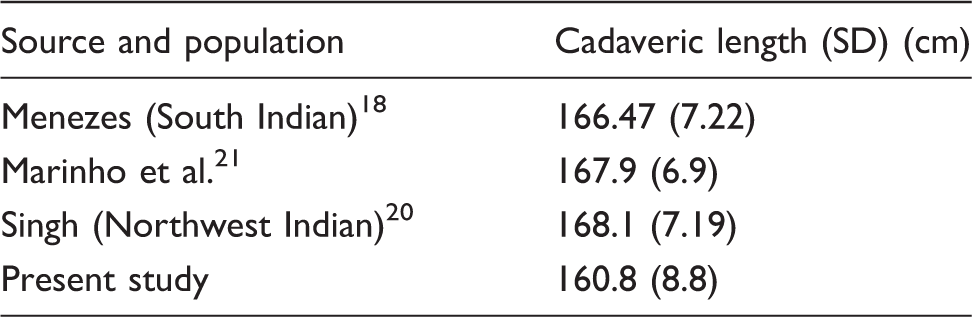
Cadaveric length (cm) in different sternum studies.
Correlation coefficients by different investigators.

Only Peiru et al. 21 and Singh et al. 22 studied the manubrium and the mesosternal part of the sternum for stature estimation. In our study, the correlation coefficient for the manubrium and mesosternal length with the cadaveric length was weaker than that in Peiru et al. 21 While Singh et al. 22 showed a weaker correlation of cadaveric length with the manubrium and mesosternal length, Peiru et al. 21 showed a better correlation coefficient. Both Peiru et al. 21 and Menezes et al. 20 had taken very small samples for their study, which might be one of the reasons for such a high correlation coefficient (Table 5).
The standard error of estimate in the present study for the total sternum length was 7.4 cm. The standard error of estimate was comparatively higher than all the other studies. The manubrium and mesosternal length also showed a higher standard error of estimate. Though Menezes et al. 20 showed the smallest standard error of estimate, the confidence interval obtained was still large, and the correlation coefficient was always <0.7. Therefore, these studies indicate that with the same stature, individuals vary considerably with regard to their sternum length. Thus, sternal length is comparatively correlated less with stature and thus is reliable for stature estimation in the central Indian population.
A question may be raised about whether results obtained by using a fresh sternum for estimating stature may be biased. However, this is unlikely, as any error tends to be systematic. This has been clearly described by Marinho et al. 23 However, the formula obtained in the study is more applicable to the fresh sternum and cannot be applied to dry macerated sternum. 23 Several studies have demonstrated that different stature estimation methods are not universally applicable, and a model developed from a specific population may not give reliable estimates when applied to another population group. 23 Body proportions may vary among individuals from developed countries and developing countries. 42 This occurs mostly from differences in proportion between stature and the bone size that results from differences in environmental conditions during growth. 42
Estimation of stature is an important aspect in identifying skeletal remains or mutilated bodies. Sternum length can be used as an alternative method when a quick estimate is required and when maceration cannot be carried out, as it is easily removed and dissected from either a relatively fresh or a badly decomposed body. In the present study, the sternum length has a comparatively weaker correlation coefficient with stature and higher standard error of estimate in regression analysis. Our study concludes that the sternum may be of some importance for stature estimation only when long bones are not available. However, the study does not provide support for the use of sternal length as a reliable estimator of stature in mutilated human skeletal remains, either skeletonised or fleshed. Thus, a medico-legal professional must exercise caution if estimating stature from a fresh cadaveric sternum.
Footnotes
Acknowledgements
We wish to thank Drs VN Ambade, SG Dhawne and SK Meshram for their invaluable guidance. We also wish to thank to Drs JL Borkar, HV Pathak and AY Deshmukh for their support and encouragement to carry out this work.
Conflict of interests
All authors declare that they have no conflict of interest.
Funding
This research received no specific grant from any funding agency in the public, commercial or not-for-profit sectors.