



Abstract
Here, we report an incest paternity case involving three biological brothers as alleged fathers (AFs), their biological sister and her child that was investigated using the Investigator ESSplex Plus, AmpFLSTR Identifiler Plus/Investigator IDplex Plus and PowerPlex 16 kits. Initial duo paternity investigations using 15-loci autosomal short tandem repeat (STR) analyses failed to exclude any of the AFs. Despite the fact that one of the brothers, AF1, had a mismatch with the child at a single locus (D2S1338), the possibility of a single-step mutation could not be ruled out. When the number of autosomal STR loci analysed was increased to 22 without the inclusion of the mother, AF2 and AF3 still could not be excluded, since both of them again had no mismatches with the child. A breakthrough was possible only upon inclusion of the mother so that trio paternity investigations were carried out. This time AF1 and AF2 could be excluded at two loci (D2S1338 and D1S1656) and six loci (vWa, D1S1656, D12S391, FGA, PENTA E and PENTA D), respectively, and AF3 was then the only brother who could not be excluded from paternity. Subsequent statistical analyses suggested that AF3 could be the biological father of the child with a combined paternity index >100 billion and a probability of paternity >99.99999999%. These findings consolidate the fact that complex paternity cases such as those involving incest could benefit more from the inclusion of the mother than simply increasing the number of STR loci analysed.
Introduction
Comparisons of the number of short tandem repeats (STRs) have been used for a long time in paternity tests. Although commercial kits include multiple STRs that provide very high discrimination power, in some situations they may still be insufficient, such as in ‘deficient cases’ where only the mother or the father is available for testing. In such cases, routine analyses of 15 autosomal STR loci (or even 22 loci as in our case) may not be sufficient for obtaining the necessary data in order to exclude any mother or father candidate. 1 Further complications arise when the alleged father (AF) and/or mother are close relatives such as in the case of brother–sister incest. Commercial kits may be insufficient for these cases because common allelic traits are more frequently observed among close relatives compared with any other subjects.2–4 The number of studied STR loci might be increased, or other discriminative markers, for instance, single nucleotide polymorphisms (SNPs), might be used in order to overcome these problems.5,6
Incest is commonly known as sexual relations between first-degree relatives such as father–daughter, mother–son or brother–sister.7–10 The case presented here involves a potential brother–sister incest where a 19-year-old girl gave birth to her daughter after being repeatedly raped by her brothers. In order to detect the biological father, the three brothers and the baby were studied first. None of the three AFs could be conclusively excluded with the three different kits used until the mother was also included, which then enabled the inclusion of the true biological father.
Materials and methods
Blood samples from the 16-, 17- and 21-year-old brothers (AFs and also the biological brothers to the mother), 19-year-old mother and 2-month-old baby were analysed at the Department of Biology – Ministry of Justice Council of Forensic Medicine. All samples were collected, along with informed consent, and in accordance with the Institutional Ethics Committee’s approval. DNA from the samples was isolated by BioRobot Universal System (Qiagen), which uses the column filtration technique. DNA quantification was carried out with the human DNA-specific Quantifiler Duo DNA Quantification Kit (Applied Biosystems) using the 7500 Real-Time PCR System (Applied Biosystems). STR amplifications were carried out using the AmpFLSTR Identifiler Plus (Applied Biosystems)/Investigator IDplex Plus (Qiagen), Investigator ESSplex Plus (Qiagen) and PowerPlex 16 (Promega) kits. Capillary gel electrophoresis was conducted with the ABI 3130 Genetic Analyser, and the resultant data were analysed with the GeneMapper v3.5 software (both Applied Biosystems). Finally, statistical analyses were performed using in-house compiled software.
Results and discussion
15 to 22-loci autosomal short tandem repeat (STR) results for the three alleged fathers (AFs), the mother and the child. AFs are also biological brothers to each other and to the mother.
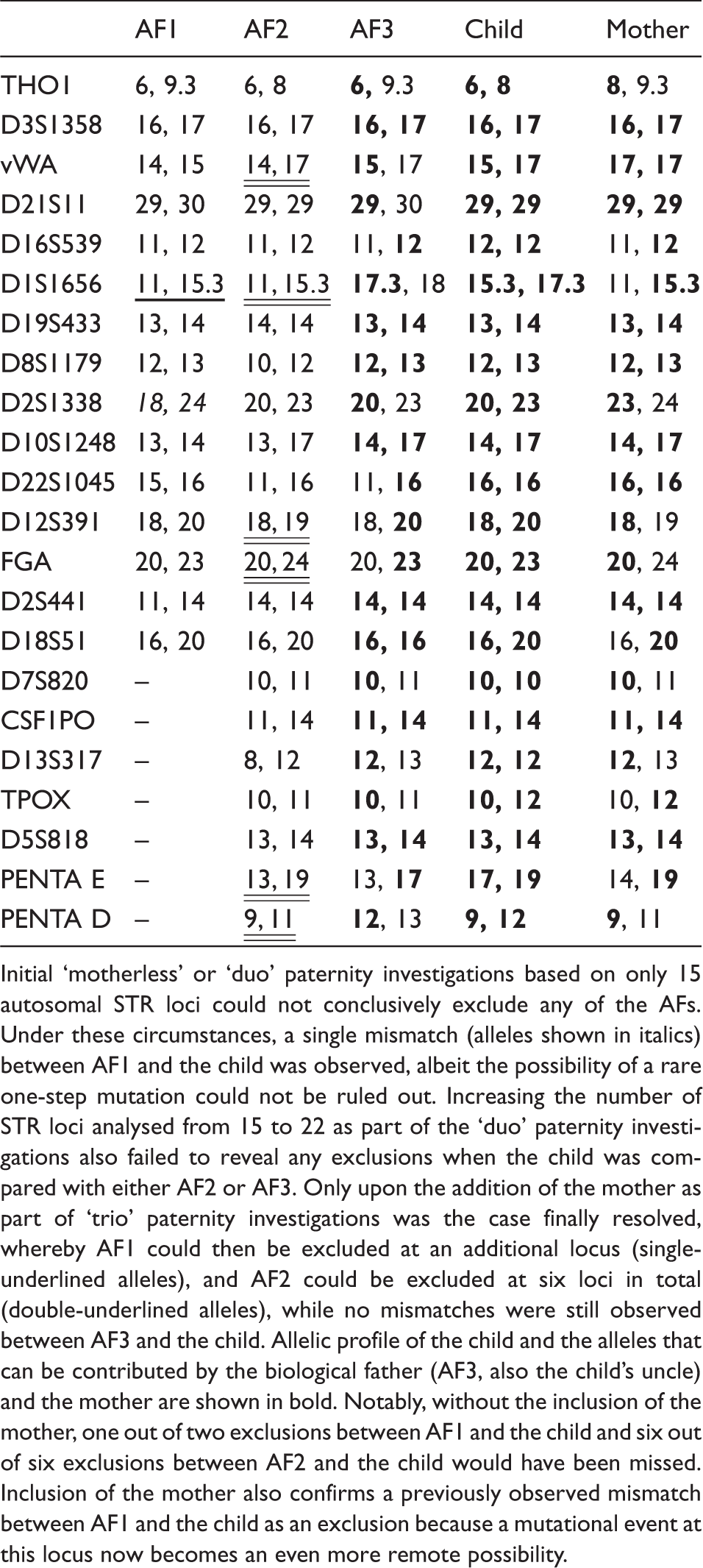
Initial ‘motherless’ or ‘duo’ paternity investigations based on only 15 autosomal STR loci could not conclusively exclude any of the AFs. Under these circumstances, a single mismatch (alleles shown in italics) between AF1 and the child was observed, albeit the possibility of a rare one-step mutation could not be ruled out. Increasing the number of STR loci analysed from 15 to 22 as part of the ‘duo’ paternity investigations also failed to reveal any exclusions when the child was compared with either AF2 or AF3. Only upon the addition of the mother as part of ‘trio’ paternity investigations was the case finally resolved, whereby AF1 could then be excluded at an additional locus (single-underlined alleles), and AF2 could be excluded at six loci in total (double-underlined alleles), while no mismatches were still observed between AF3 and the child. Allelic profile of the child and the alleles that can be contributed by the biological father (AF3, also the child’s uncle) and the mother are shown in bold. Notably, without the inclusion of the mother, one out of two exclusions between AF1 and the child and six out of six exclusions between AF2 and the child would have been missed. Inclusion of the mother also confirms a previously observed mismatch between AF1 and the child as an exclusion because a mutational event at this locus now becomes an even more remote possibility.
A number of similar cases have been previously reported in the literature. In a study in 2011, where just the child and the AF samples were used, Borsting et al. could not exclude the paternity of the AF after the analysis of 15 STR loci. However, following new SNP analyses carried out for the same samples, the previously included AF could then be excluded based on the new results. 11 In our case, the paternity investigation could be resolved conclusively without resorting to SNP analysis, but by including the mother sample instead. Without the inclusion of the mother, that is, when the case was treated as duo investigations, we would not have been able to reject the paternity of the two AFs despite using three different kits or 22 autosomal STR loci in total. In another study in which the mother was also not included, Gonzalez-Andrade et al. analysed 19 autosomal STR loci in the two AFs and the child samples. Both AFs could not be excluded. 12 The authors performed Y-chromosomal STR (Y-STR) analysis and solved the problem. In our case, because all three AFs were brothers and hence had the same Y-STR profiles and because the child was female, Y-STR analysis would not help to solve the problem. In 2006, Wurmb-Schwark et al. tested the probability of obtaining false-positive paternity test results in duo paternity tests when a genetic relationship existed between the AFs. 4 One hundred and sixty-four subjects were studied with the AmpFLSTR Identifiler Plus kit. Ninety-three children were crossed with their uncles to test for a possible father–child relationship. Five out of the 125 crosses gave no incompatibility in allele transition between the uncle and the child. Wurmb-Schwark et al. suggested involving the mother in paternity tests in cases where father candidates are blood relatives and if the required study should be supported by additional markers. 4
In the case presented herein, false-positive (false inclusion) results were obtained when only the biologically related AFs and the child were examined (duo case). If the candidates in a kinship DNA analysis are close blood relatives, because the frequency of sharing similar alleles between two such close relatives is high, the evaluation of these kinds of cases would require extra caution. Our results clearly demonstrate that inclusion of the mother greatly simplified the incest paternity investigation at hand by allowing the case to be resolved conclusively and without the need to use any additional autosomal STR loci and/or different marker systems. Thus, in order to avoid false positive results in incest cases and to help simplify analyses therein, we underscore the fact that the AF(s), mother and child (trio case) should be included in such studies. Of course, if need be, the number of the polymorphic autosomal STR loci could be increased, and different markers could also be used.
Footnotes
Acknowledgement
We gratefully acknowledge all our colleagues at the Council of Forensic Medicine for their constant support.
Declaration of conflicting interest
The authors declare that they do not have any conflict of interest.
Funding
This research received no specific grant from any funding agency in the public, commercial, or not-for-profit sectors.