



Abstract
Tyre imprints on the skin are usually considered to be the result of being run over by a motor vehicle. This article reports a traffic accident in which tyre marks on the victim’s skin were caused by a collision rather than by being run over. The mechanism of the injury in this case is analysed and discussed. A 23-year-old male drove a motorcycle while under the influence of alcohol and collided with a sign pillar on the side of the road. Both the victim and the motorcycle careened into the bottom of a tractor-trailer. No witnesses or surveillance videos could confirm the process of the accident. Because tyre imprints were found on the victim’s skin, traffic police believed that he had been run over during the accident. However, forensic autopsy and analysis of the accident process revealed that the true cause of the imprints was a collision between the victim’s body and a tyre.
Introduction
A contusion occurs when a blunt impact tears vessels, resulting in the escape of blood into the extravascular space. Intradermal hematomas are especially informative, as they often reflect the surface configuration of the impacting object. The skin squeezed into the grooves will show intradermal bleeding, whereas the areas exposed to the elevated parts remain pale.1 Virtually all geometrically formed objects can leave a recognisable mark on the skin. Occasionally, a patterned contusion which reproduces the surface features or configuration indicative of the injuring objects will be so distinctive as to allow little room for interpretation. For example, patterned injuries of this type are seen in tyre tread marks if an individual is run over by a wheel or in bruises from vertical stamping with the ribbed sole of a shoe.2 If a patterned injury corresponding to a tyre tread mark is visible, then at least one instance of the victim being run over may be concluded.3 However, similar wound appearances may originate from different causes, which may share the same mechanism of injury. Here, we report a case in which tyre imprints on the skin of the victim were caused by a collision rather than by being run over.
Police investigation
The victim was a 23-year-old male who drove a two-wheeled motorcycle after drinking alcohol. After a collision with a roadside sign pillar, the victim and his motorcycle fell to the ground and careened into the bottom of a tractor-trailer waiting for a green light at the crossroads. The victim was sent to hospital and died 1 hour and 20 minutes later, despite attempts to resuscitate him. Although the process of the accident was recorded by a camera on the left side of the vehicle, the situation on the right side of the vehicle could not be definitively established.
Scene of the accident
The day after the accident, the scene and the vehicles suspected to be involved were examined. The tractor’s outline was 6115 mm × 2495 mm × 3560 mm, its curb weight was 7280 kg and its total weight was 18,000 kg. The trailer’s outline was 16385 mm × 2480 mm × 1670 mm, its curb weight was 7500 kg and its total weight was 37,980 kg. The asphalt road had three main lanes, with two auxiliary roads on the right. A cement fence and a sign pillar were at the junction of the left auxiliary road and the right lane. A tyre mark (2.5–3.0 cm in width) was found on the sign pillar (15–30 cm off the ground; Figure 1). Strip-like scratches were found on the ground from the base of the sign pillar to behind the guide arrow painted on the right lane (Figure 2). A bloodstain (proved to be from the victim by DNA test) was found on the ground on the left side of the right rear wheel of the tractor (Figure 3).
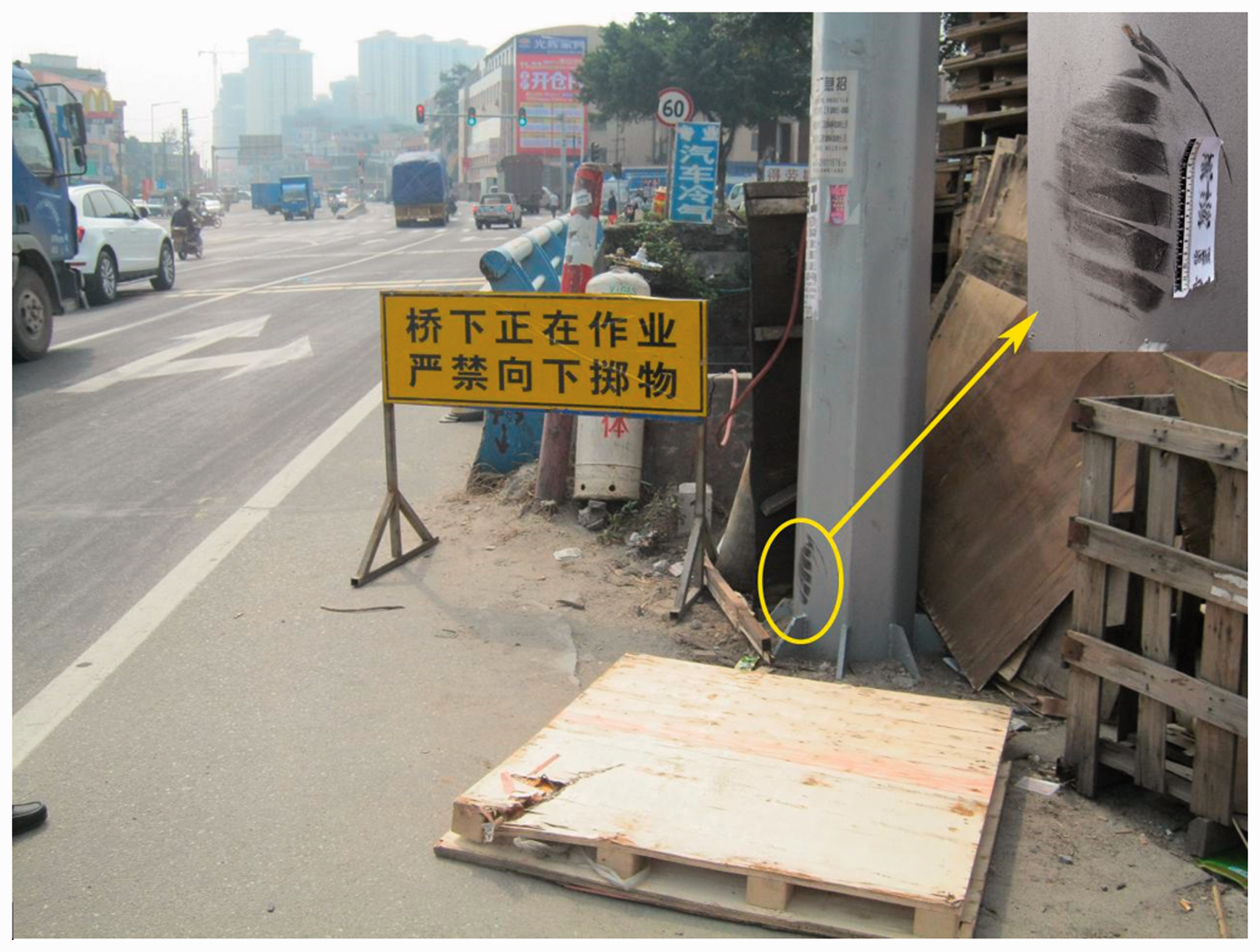
Tyre marks of the front wheel of the motorcycle on the pillar (the next day).

Scratches formed by friction between the motorcycle and the ground showed the trajectory of motion of the motorcycle after the collision with the pillar (intraday).
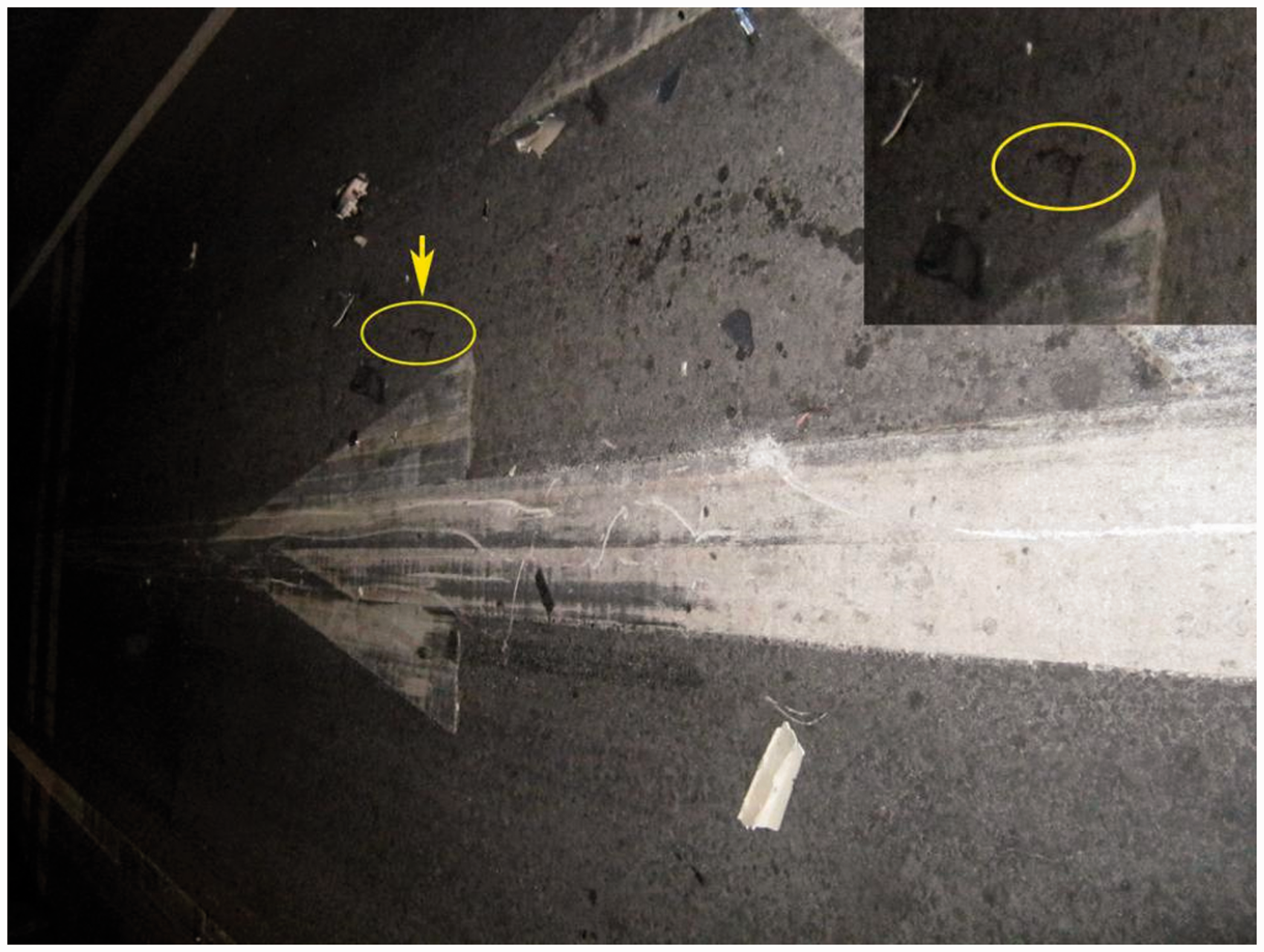
A bloodstain from the victim found on the ground that indicated his final location (intraday).
The tractor and the motorcycle were examined by traffic police and technical experts. The victim’s clothes were examined for accident-related damage and traces. A tyre imprint corresponding to the grooves of the right rear lateral tyre of the tractor was seen on the left part (chest) of the jacket worn by the victim.
Autopsy findings
After all external findings were recorded and photographs were obtained, the body was subjected to a complete forensic autopsy. In brief, this autopsy produced the following findings. The body length was 164 cm. A small amount of blood was found in the mouth and nose. There were multiple abrasions of the skin without obvious open injuries. The left clavicle was fractured (lateral 1/3), and wavy red linear contusions were seen on the left thoracic wall (Figure 4). No evident collapse of the left chest wall was observed. Serial rib fractures (ribs 1–12, left), mediastinal haemorrhage, pleural haemorrhage (1300 mL, including a 310 g blood clot) and multiple ruptures in the left lung were detected. There were no positive findings for the head, right chest or abdomen. No fractures were found in the limbs or pelvis (Figure 5). Because no obvious open injuries were found in the autopsy, we concluded that the bloodstain on the ground was from the oral cavity and/or nasal cavity. A cardiac blood poison assessment was negative, and the victim’s blood alcohol content was 120 mg/100 mL.

The skin of the left chest showed wavy red lines. The width of these lines and the distance between them corresponded to the grooves of the tyre on the trailer’s right rear lateral wheel.
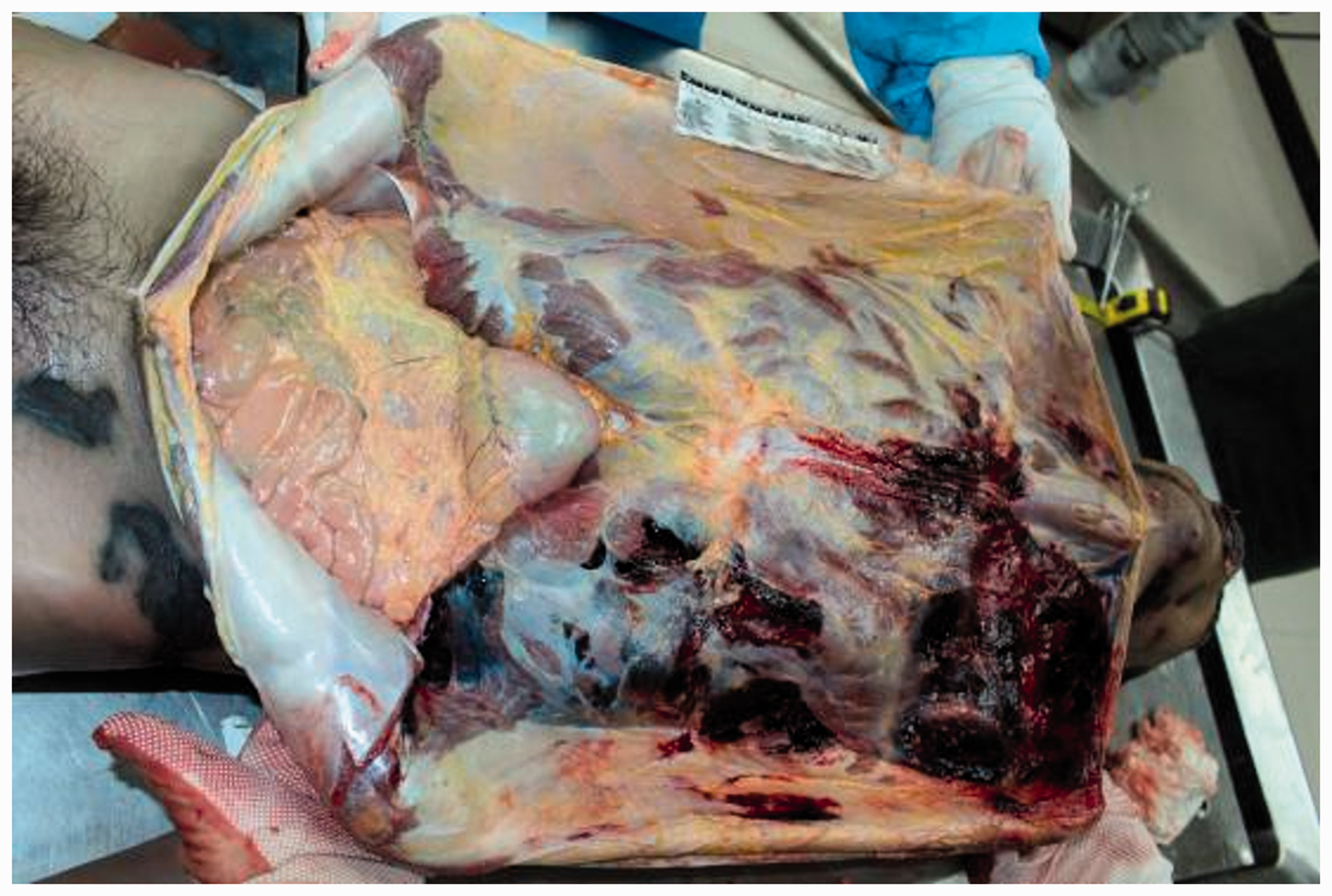
Injuries to the thorax and abdomen.
We compared the patterned injury on the left chest with the tyre pattern,4 finding that they were consistent with concave pattern of the right rear wheels (Figure 4)
Reconstruction of the scene
A video recorded by a surveillance camera installed on a pole opposite the accident site was examined.
At 01:22:46, the tractor-trailer stopped. At 01:22:49, the motorcycle reached the accident site. At 01:22:52–54, a collision between the victim’s body and the pillar occurred. Subsequently, the motorcycle and its driver lay between the rear wheel of the tractor and the front wheel of the trailer. The tail light of the motorcycle was parallel to the front wheel of the trailer. At 01:22:55–23:00, the tractor started moving forward, hauling the motorcycle away from its prior location (as evidenced by the motorcycle’s tail light). The victim changed position relative to his location in the frame at 01:22:52 and then stopped on the road after rolling.
Based on traces (the bloodstain, scratches and other evidence) from the scene and information from the surveillance video (Figure 6), three-dimensional scanning of the main objects at the scene and the vehicles suspected to be involved was performed to reconstruct the accident by utilising a method for object location in images based on 2D/3D registration.5 The final positions of the tractor, trailer and pillar were reconstructed as follows. The pillar was at the right rear of the right rear wheels of the tractor and the right front of the right wheels of the trailer. The motion trails of the victim and the motorcycle after the collision with the pillar are depicted in Figure 7. In addition, based on data from the surveillance video, we estimated that the victim’s body collided with the tyre at a speed of 40–50 km/h.

A screenshot from the surveillance video. 1. The tractor-trailer. 2. The victim on his motorcycle.
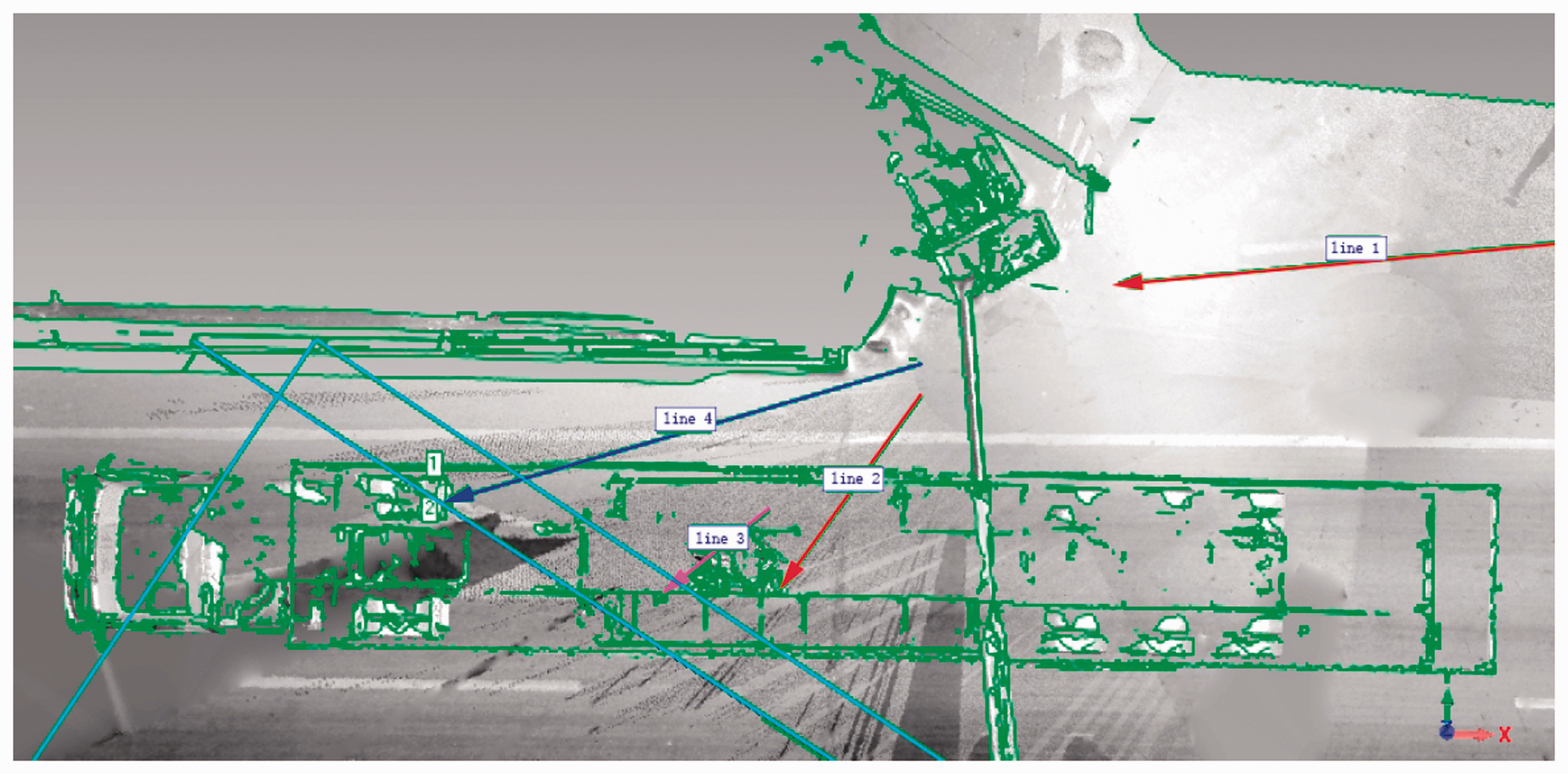
Scene reconstruction. Line 1: The motorcycle’s track before its collision with the pillar. Line 2: The motorcycle’s running track after collision with the pillar. Line 3: The final location of the motorcycle was estimated to be no further than this line. Line 4: The victim’s track after his motorcycle’s collision with the pillar. 1. The lateral edge of the tractor’s right rear wheels. 2. The medial edge of the tractor’s right rear wheels.
Discussion and conclusion
The process of the accident was reconstructed based on the examination of traces combined with the analysis of the video data present. The victim was speeding while driving a two-wheeled motorcycle under the influence of alcohol. After colliding with the roadside sign pillar, he fell to the ground, careened with his motorcycle into the bottom of a stationary tractor-trailer from the right side, collided with the wheel of the tractor and stopped at its left side. When the tractor moved forward, there was no further contact between the victim and the tractor-trailer. According to the autopsy findings and the traces at the scene, we therefore ruled out the possibility that the injuries were caused by the initial impact with the roadside pillar. Multiple abrasions on surface of the body could be explained by scraping on the ground after the victim fell off his motorcycle.
Although tyre imprints were consistent with the patterns of the right rear lateral tyre of the tractor, which may seem to indicate being run over, in the autopsy, there was no obvious collapse at the left chest wall where tyre imprints were observed, and there were only rib fractures and local laceration of the left lung. Less positive findings were detected in the head, right chest or abdomen. Lacerations of the lung could result when a severe compressive or crushing force was applied to the chest so that the pulmonary tissue bursts or tears. Another possible mechanism is inward displacement of a fractured rib which impales the lung.2 However, the curb weight of the tractor was 7280 kg, and its total mass was 18,000 kg, which would have been sufficient to collapse a human’s chest wall. Thus, we excluded that the victim was run over by the right rear wheel.
Blunt force trauma is characterised by the body colliding with an object or surface. This may involve an object being brought into contact with the body, as in a blow or a push, or the converse in the case of a fall, whereby the body moves towards the object. Traffic accidents often produce a combination of these two movements.6 When the collision occurred, the victim was travelling at a speed of approximately 40–50 km/h according to the reconstruction of the scene. At this speed, the collision resulted in a blunt force to the chest, leading to rib fractures and local lacerations of the lung. This was accompanied by the shearing force from the edges of the concave of tyre tread, creating a consistent imprint on the skin.1 Although rare, contusions may be produced post-mortem if a severe blow is delivered to a body within a few hours after death. They are most commonly seen in the skin and/or soft tissue overlying bone or bony prominences.7
Generally, tyre imprints on the skin would indicate that the victim had been run over. However, based on the above evidence, we argue that the formation of the tyre imprints in this case was via a collision rather than being run over. A high-speed collision followed by a blunt force between the victim’s body and a tyre could produce concave tyre imprints, the mechanism of which could be similar to being run over by a vehicle.
Footnotes
Declaration of conflicting interests
The authors declare that they have no conflict of interest.
Funding
The authors disclosed receipt of the following financial support for the research, authorship, and/or publication of this article: This work was supported by the National Natural Science Fund of China (No. 81772021) to Dong-Ri Li.