



Abstract
Traumatic dissection of the carotid arteries is a rare cause of delayed death due to hanging. We report a case of delayed death two and a half months following attempted suicide by hanging where the patient was able to talk after being released from neck compression. The cause of death was aspiration pneumonia due to cerebral infarction secondary to traumatic dissection of the left common carotid artery due to attempted suicide by hanging. Carotid artery injuries should be examined in patients who were able to talk after an unsuccessful suicide attempt by hanging but who later died.
Introduction
Death due to hanging usually occurs immediately after neck compression and is caused by brain ischemia due to obstruction of the cervical arteries and/or respiratory insufficiency due to airway obstruction. 1 Delayed deaths due to hypoxic brain injury may occur in patients who survived after an unsuccessful suicide attempt by hanging. Traumatic injury of the carotid arteries is a rare cause of delayed death due to hanging.2,3 We report a case of a man in his 70s who died of cerebral infarction due to traumatic dissection of the carotid artery two and a half months after attempted suicide by hanging.
Case report
A man in his 70s attempted suicide by hanging himself on the first floor with a hard electric cord 5 mm wide fixed to a pole in the hallway on the second floor of his house. His wife witnessed the attempt and rescued him from the hanging loop. After termination of neck compression, he was able to talk to his wife. However, after approximately five hours, he gradually lost consciousness and was brought to hospital. Upon admission, the patient exhibited moderate disturbance of consciousness, a Glasgow coma scale score of 11 (E4V2M5) and right incomplete hemiparesis. Magnetic resonance imaging on the second hospital day showed infarction of the left parietal region of the cerebrum. Magnetic resonance angiography (MRA) showed complete occlusion of the left common carotid artery. The patient was diagnosed with cerebral infarction due to traumatic carotid arterial injury. Repeated MRA on the seventh hospital day showed recanalisation of the left common carotid artery. Subsequent MRA was not performed in hospital. He developed aspiration pneumonia and died two and a half months after the suicide attempt. The patient had no medical history.
External examinations showed a faint residual ligature mark 5 mm wide on the front and left side of the neck. There was no ligature mark on the right side of the neck. Subcutaneous and intramuscular haemorrhages in the neck were not observed. Examinations of formalin-fixed brain sections showed an infarct on the left frontal-parietal-occipital region of the cerebrum in the left middle cerebral artery (Figure 1). Macro- and histological examinations of the left common carotid artery showed intimal tear, dissection of the medial layer, organised thrombus in the true lumen, fresh blood in the false lumen and calcified atheroma plaque (Figure 2). The age of the cerebral infarct and organised thrombus was consistent with the survival period. No abnormalities were observed in the right common carotid artery except for a calcified atheroma plaque. Histological examinations of the organs revealed acute pneumonia in the lungs. The cause of death was confirmed as aspiration pneumonia due to cerebral infarction secondary to traumatic dissection of the left common carotid artery resulting from attempted suicide by hanging. The manner of death was suicide.
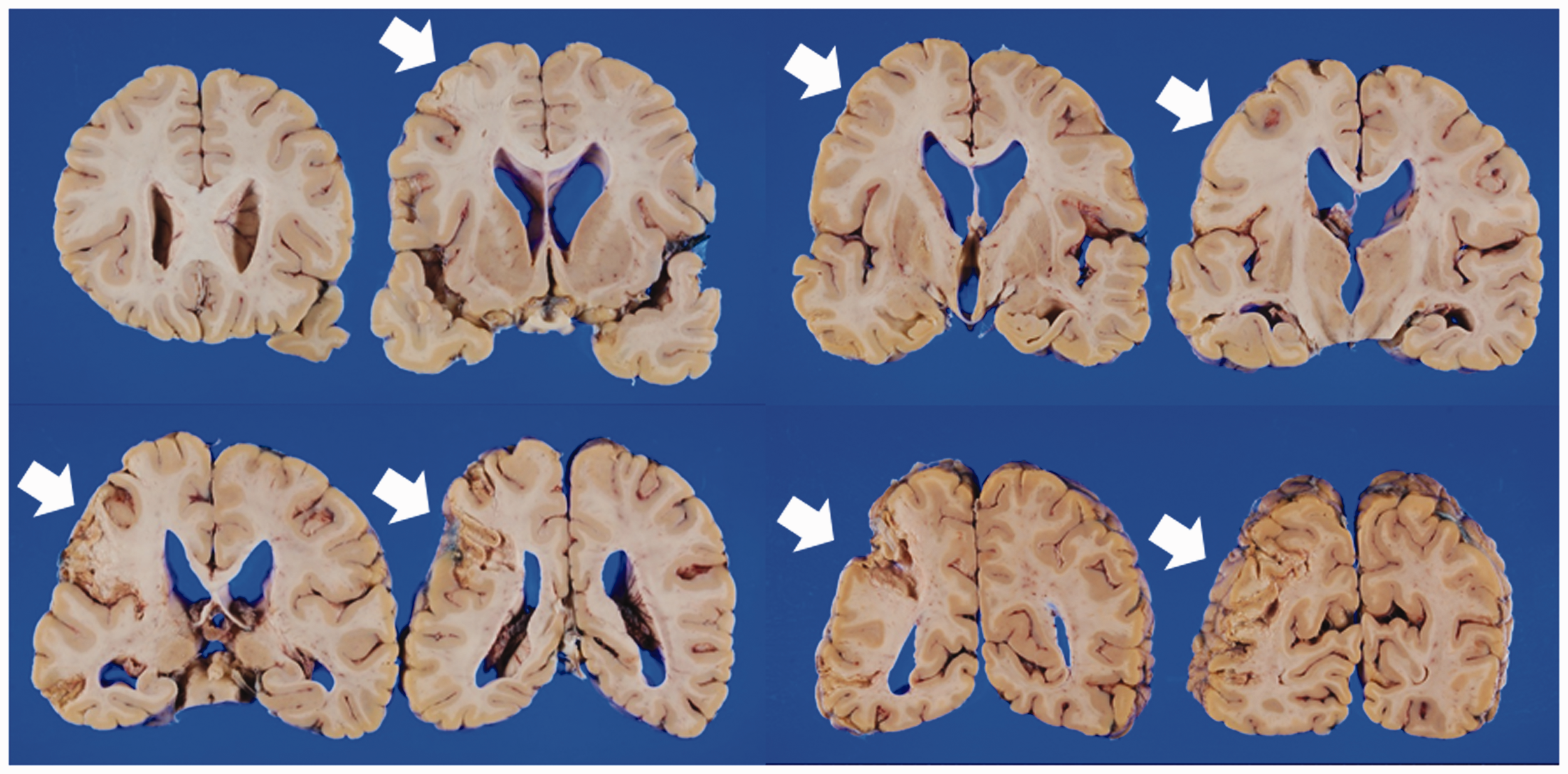
Coronal sections of the cerebrum showing an infarct on the left frontal-parietal-occipital region in the left middle cerebral artery (arrows).

Horizontal sections of the left carotid artery showing median dissection. (a) Macroscopic photographs after formalin fixation. 1–11:, common carotid artery; 12 and 13: internal and external carotid arteries. (b) Histological analysis photograph. Numbers 1–12 correspond to those in (a). HE. Bar=1.0 cm. (c) Number 11. True lumen with organised thrombus (●), false lumen (*), calcified atheroma plaque (arrowhead) and intimal tear (arrow). Elastica van Gieson. Bar = 1.0 cm.
Discussion
This report shows a rare case of delayed death from cerebral infarction due to traumatic dissection of the carotid artery two and half months after attempted suicide by hanging. In this patient, the ligature mark was observed on the front and left side but not on the right side of the neck. Therefore, the hanging loop was asymmetrically wrapped around the neck and compressed the left side of the neck with the victim’s weight and injured the left common carotid artery. The recirculation of the left common carotid artery on MRA on the seventh hospital day was a result of recanalisation of blood flow through the false lumen of the dissected left common carotid artery, although entry and re-entry sites on the intima were not identified post-mortem after two and half months of survival.
Hausmann and Betz reported a case of a 58-year-old man who died of cerebral infarction following traumatic thrombosis of the subtotally ruptured carotid artery four days after attempted suicide by hanging using a thin cord for a ligature. 2 In their case, the patient called for medical help and was neurologically intact after the unsuccessful suicide attempt by hanging. However, his condition suddenly deteriorated, and the patient died. Blanco Pampin et al. reported an autopsy case of a 33-year-old man who died of cerebral infarction following a traumatic dissection of the common carotid artery four days after a suicide attempt by hanging. 3 In their case, the patient called for an ambulance but deteriorated approximately six hours later. In the present case, the patient was also able to talk for approximately five hours after the unsuccessful suicide attempt. In contrast, patients of delayed death due to hypoxic brain injury are usually unconscious continuously after attempting suicide by hanging. Therefore, traumatic injury of the carotid arteries should be suspected in cases where patients are able to talk after attempting suicide by hanging but then deteriorate and subsequently die. Forensic pathologists should examine the carotid arteries during the autopsy in the cases of unexpected death in patients who were able to talk after an unsuccessful suicide attempt by hanging but who died later. Clinicians must be aware of this rare but disabling vascular complication for early diagnosis and treatment of dissection.
An intimal tear of the common carotid artery is a morphological finding of neck compression. 4 Damage on the intima induces intramural hematoma that reduces the luminal blood flow. 5 Traumatic dissection of the common carotid artery is caused by neck compression, including manual strangulation and blunt-force impact. Le Blanc-Louvry et al. observed a calcified atheroma plaque in the dissected bilateral common carotid artery in an autopsy case of manual strangulation and suggested that atheroma facilitates dissection formation. 5 In this case, a hard electric cord 5 mm wide was used as a ligature in hanging. Intimal tear and calcified atheroma plaque were observed in the common carotid artery. Therefore, focal compression by a hard thin cord, intimal tear and atheroma of the common carotid artery may be factors for the formation of dissection in the common carotid artery.
In conclusion, the present case showed that traumatic dissection of the common carotid artery is a cause of delayed death after hanging. We recommend that forensic pathologists review the clinical course and carefully examine the common carotid arteries in the autopsy of patients died after attempted hanging.
Footnotes
Declaration of conflicting interests
The authors declared no potential conflicts of interest with respect to the research, authorship and/or publication of this article.
Funding
The authors received no financial support for the research, authorship and/or publication of this article.