



Abstract
Introduction
Generally, contemporary minds feel a sense of shock, dismay, and barbarity on listening to the narrations and cases of parents who kill their children. The homicide of a child by a parent is an unusual but overwhelmingly distressing incident. The homicide of own children signifies betrayal of a conjecture of love and some supreme form of hatred and renunciation of a socially held conception that parents are the embodiment of love, affection, safety, and security. Such cases are extensively covered; however, the source available for reporting is media and law. 1 However, in many such cases, there is a need to find the baseline links which may be connected to the circumstances of the perpetrator at the time of the act or the conditions of their lives under which they are required to raise their children. For instance, parents often kill their child(ren) when they are short of finances to up bring a child or the child is illegitimate or mental health of the parent is not well.
Filicide is an act of killing a child up to the age of 18 years committed by his or her parent(s) or parental figure(s), including guardians and stepparents. 2 A child's age range extends from birth to adulthood. Neonaticide, infanticide, and filicide are all included. Infanticide refers to the killing of a child under the age of one year, whereas neonaticide refers to the killing of a child within the first 24 h following birth.2–4 The prevalence of killing by parents is highest during the first year of life. 3 Most of the neonaticide are by mothers who are usually young, unmarried, and have unwanted pregnancies with almost no prenatal care. 5
More than 95,000 children between the age range of 0–4 are killed each year globally. 6 The incidence rate of infanticide in developed countries such as the United Kingdom, Scotland, United States of America, and Canada ranges between 2.4 and 8.0 per 100,000 births, while the incidence rate for neonaticide ranges from 0.07 to 8.5 per 100,000 births.7–10 However, the prevalence of filicide is underreported, particularly in the case of infanticide and neonaticide. Because newborn and baby bodies are readily disposed off and hidden, police records are frequently not made, and the cause of death is frequently camouflaged and misreported and labelled as sudden infant death syndrome. Due to this the law, courts cases do not prosecute though there may be evidence available via medical reports.11–14 Maternal filicide is linked with individual vulnerability and stress. Filicidal women are often observed as suffering from psychotic depression. 15 Research also indicates that criminally insane mothers have an imbalance of stress-related hormones. Filicidal women in comparison to matched psychiatric but non-filicidal women had higher cortisol and adrenocorticotropic hormone levels which confirms the level of stress higher in filicidal women. 16 Other contributing factors include depression, history of suicidality or previous mental health issues, social isolation, past experiences of abuse, history of substance abuse or alcoholism, and abandonment by their mothers.9,17 However, maternal filicide cannot be limited to only mental health problems or environmental issues. There may be certain flaws in a mother's ability to act in the position of mother to their children, or a lack of parenting skills. 18 Thus, there is always a need to assess the motives or factors that contribute to killing the child.
Global data on filicide are not well-established; however, one study reports that the United States has the utmost rates of child murders, to be precise age it is 8.0 per 100,000 for infants, 2.5 per 100,000 for preschool-age children, and 1.5 per 100,000 for school-age children. 12 Scrutinizing the statistics for prevalence or incidence is challenging, as filicide, neonaticide, or infanticide are crime that are either not recorded or if recorded, it is recorded with other crimes or attributed to other natural deaths. In most of the countries across the globe, there are no government agencies delegated to track child killings specifically cot deaths, and even when attempts are made to do it, it is mostly part of cumulative data encompassing other types of death. 19
Most of the studies have been conducted in industrialized countries and underdeveloped countries despite having higher reposts of filicide have fewer research data and findings available. Thus, the noticeable absence of data and research aspired to conduct the present study. The main purpose of the article is to address the empirical lacuna in South Asia and to expand the literature in order to broaden the understanding of filicide. The following questions are addressed: What are the characteristics of perpetrators, risk factors, and forms of filicide in South Asia? What is the psychiatric view of filicide from the standpoint of filicide perpetrators? Are there any laws that restrict filicide?
Materials and methods
Search strategy
The search was done in PubMed, PubMed Central, Scopus, and Google Scholar. Articles published from 2000 to 2020 were identified. Hand searching of the articles and journals was also carried out for the present review. The time frame of 20 years was kept as a control to see the recent trend. We didn't consider it as a systematic review due to a low number of papers. We searched in PubMed, PubMed Central, Scopus, and Google Scholar. We didn't use MeSH terms.
Search terms
The search terms included ‘filicide’, ‘neonaticide’, ‘infanticide’, and also ‘child homicide’ by parents, ‘child fatal maltreatments’ and ‘South-Asia’. Individual country names i.e., Afghanistan, Bangladesh, Bhutan, India, the Maldives, Nepal, Pakistan, and Sri Lanka were also used with each search term to broaden the access to material.
Inclusion criteria
Research papers eligible for inclusion were original articles, quantitative studies, and case studies available in full-length articles form. Papers publicized only in the English language were included. The papers that explicitly mentioned that the child was killed by parent in the eight South Asian countries, namely Afghanistan, Bangladesh, Bhutan, India, the Maldives, Nepal, Pakistan, and Sri Lanka, were included in this study. The time period for published research articles was from 2000 to 2020.
Exclusion criteria
Articles based on the review, letter to the editor, commentaries and opinions, editorials, systematic reviews or meta-analyses, and qualitative studies were excluded. Research papers based on reported cases living outside the native country and data based on newspaper reports were excluded. We excluded the qualitative studies as we intended to express results quatitatively in regards to the outcome variables.
Outcome variables
The selected research articles were examined, and the data were extracted and entered in an excel-sheet designed for this study. It included information regarding, age of child, gender, form of filicide, filicide perpetrator, motive for killing/risk factors, method of death, and psychiatric and legal aspects. Extraction of the data was independently carried out by the authors. The data in the excel-sheet were further verified by two authors for accuracy and refinement. Firstly, a screening on titles and abstracts was carried out. Then full-length articles were read. This was done by two independent authors, and data entry was made in the extraction file. Inter-rater reliability was not carried out statistically. However, a general evaluation was made to tally the results.
Quality assessment
The methodological quality of the selected articles for the systematic review was conducted utilizing Quality Assessment Tool which evaluates five facets: study plan, comparison groups, characteristics of the samples, sample size, and data collection tools. All facets are individually rated on a continuum level of 0–3, a higher score designates a greater quality.
Permission
The present study included data from previously published researches in which informed consent was taken by the primary research investigators. No human participants were involved in this study. Therefore, no formal ethical clearance was sought for conducting the review.
Results
Distribution of the articles
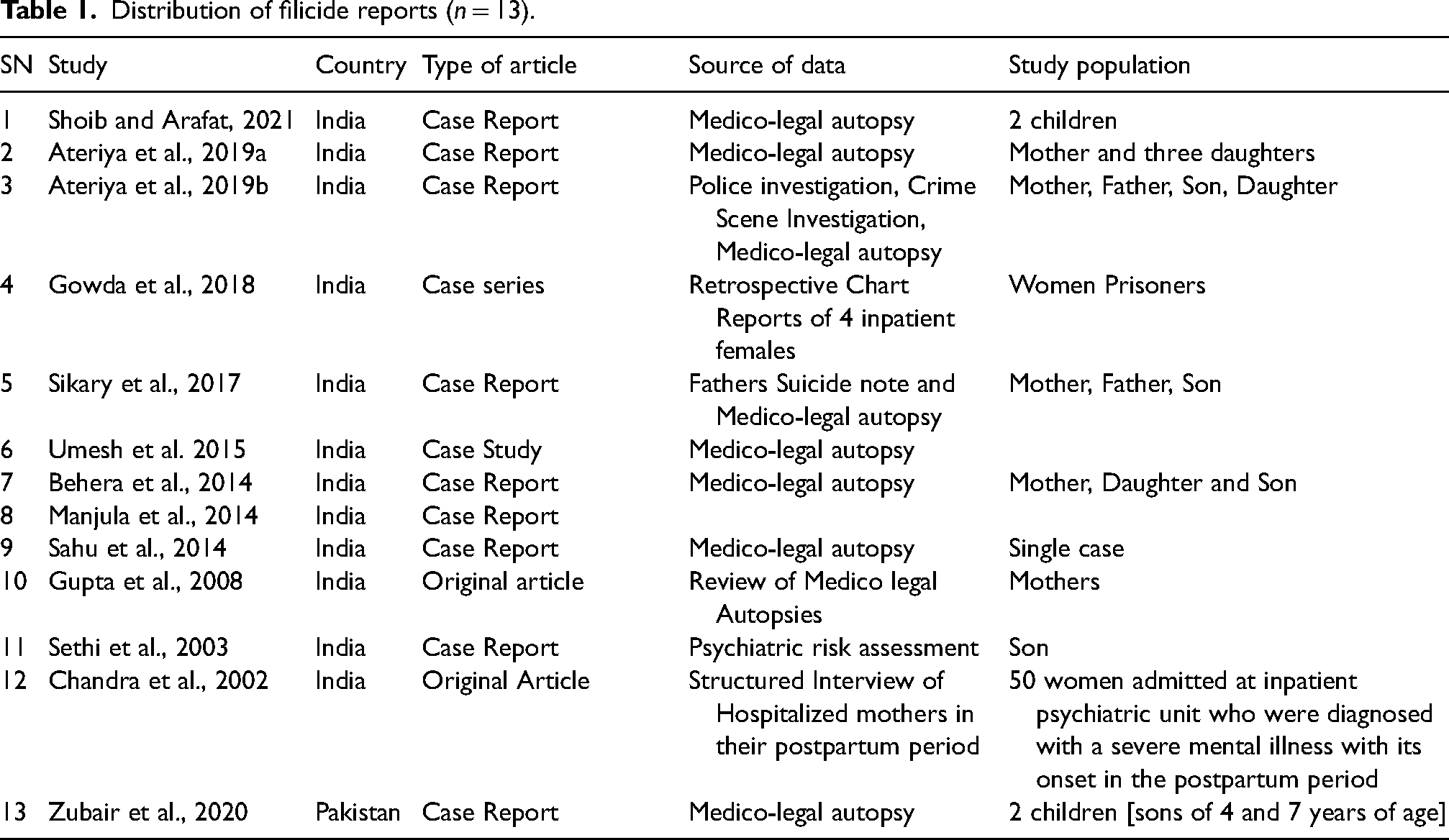
A total of 13 reports of filicide were found in the eight South Asian countries. Out of 13, there were only two research reports and the others were case reports and case series (Table 1). There were 12 reports from India and 1 from Pakistan. No report was identified from Afghanistan, Bangladesh, Bhutan, the Maldives, Nepal, and Sri Lanka. The medico-legal autopsy was done in 11, in the remaining two it was not available.
Distribution of filicide reports (n = 13).
Clinical characteristics of perpetrators, risk factors, and forms of filicide
Out of the 13 reports of filicide, 11 reports indicated that the mothers were the perpetrators, and in one case, the father was the perpetrator and in the remaining two cases the perpetrator was both father and mother (Table 2). Most cases of filicide belong to a lower socio-economic status and in most cases parents were unemployed. One case had a farmer and the other had a nursing professional. It was the female child in most of the reports who was killed by parent, predominantly under the age of six years. Twelve cases of filicide were reported in India and one case was reported in Pakistan.
Flicide variable.

Flicide variables
The most common method of filicide was by administering poisonous substances (five cases), burning (four cases), hanging (three cases), slaughterings (two cases), and drowning (two cases). Stress, depression, frustration, family pressure, marital disharmony, poverty, and lower socio-economic status were the major contributory factors to suicide in the majority of reports (Table 2). The most common method for disposal of the dead body of child was by putting in gunny bag (a sack made of a coarse heavy fabric (such as burlap) or by drowning.
Mental health aspect aspect
Depression was present in 7 cases of filicide, and schizophrenia was present in 1 case (Table 3). Unwanted children and severe marital discords and spouse revenge were other causes of filicide. There was no history of substance abuse in all cases of filicide studied except one case reported history of nicotine abuse. Most cases of filicide attempted suicide after the filicide incident. In most cases, the perpetrator of filicide was arrested for committing the crime (Table 3).
Mental health and legal aspects.

Legal aspects
All articles suggested Family Planning, Children's Rights Protection, Counseling, Conflict Management, need for Forensic Experts and Early identification of mental illness and risk assessment is required. Most cases of filicide attempted suicide after the filicide incident. In most cases, the perpetrator of filicide was arrested for committing the crime (Table 3).
Discussion
Filicide has remained a mysterious problem in forensic psychiatry due to the complicated medico-legal elements involved. 20 Additionally, a fundamental hindrance with scientifically studying filicide in almost any culture, society, or country is the lack of literature. Female feticide, neonaticide, infanticide, and filicide are extreme practices of gender discrimination that happen quite systematically and a threat prevails to eliminate females in the societies where they are practiced. Unfortunately, there are no specific or reliable facts and figures available on it. The review revealed an extreme dearth of research reports on filicide in the eight South Asian countries as papers were only identified from India 12 and Pakistan. 1 No report was identified from Afghanistan, Bangladesh, Bhutan, the Maldives, Nepal, and Sri Lanka.
Main findings of the study
Notwithstanding the prevalent nature of the issue, there is a dearth of systematic literature on filicide in South Asia. The perpetrator in most cases was the mother and suicide following filicide was a common occurrence. No particular gender predilection for the child victim was noted. Interestingly, the use of violent methods such as strangulation, drowning, hanging, and slaughtering was preferred over relatively sedate methods such as poisoning. Socio-economic and interpersonal factors such as marital and financial strife, infidelity, and discord with in-laws took precedence over mental illness as possible risk factors for the crime. Criminal or legal proceedings were initiated against the perpetrators in about half of the cases.
Characteristics of perpetrators, risk factors, and forms of filicide
Among the 13 reports of filicide, in 11 cases mother was the perpetrator, and in one case, the father was the perpetrator, and remaining two cases the perpetrator was both father and mother. Regardless of the findings that fathers commit filicide as frequently as or maybe more frequently than women, paternal filicide has not received much attention.1–22 Fathers are usually committers of fatal abuse–related filicide, which is typically an outcome of battering and usually, there is no psychotic illness or no history of suicidal attempt. 23 Paternal filicide committers often have a personal history of abuse in childhood, predominantly in cases of infanticides.
Filicide variable
Most cases of filicide were female and were under six years of age as per review. More boys than girls are murdered by their parents in Western countries, but more girls than boys are murdered by their parents in South Asia24–26 and China. The foremost reason for the occurrence of infanticide in the People's Republic of China is the ‘one-child policy’. 27 It is speculated that more than 40 million girls and women are ‘missing in China, Yangtze River was a well-known site for infanticide of a girl child till the government of China made the access difficult for people to go there. 28 To comprehend filicide in many Southeast Asian cultures, one must first analyze the deeply ingrained phenomena of son-preference. There is plentiful evidence available for son or gender preference in South Asia. One more thing to be noted here is that it is different from neonaticide in the west, their neonaticide exists due to unwanted pregnancies and being unmarried; however, in South Asian countries like India, these mothers are mostly married, they do not conceal their pregnancies, their families aware of their pregnancies, and in many cases, the family members are supportive or even coercive in deciding for killing the unwanted daughter.
In majority of cases, the mother was the perpetrator and in one case- the father was the perpetrator and remaining two cases the perpetrator was both father and mother. It has been reported that generally, fathers kill older children. They are rarely indulged in neonaticides.2,29,30 Around 90% of the perpetrators of filicide are biological parents and 10% are stepparents. Stepparents are more on the verge of killing children in comparison to biological parents which is up to 100 times higher. 31 Most of the neonaticide are by mothers who are usually young, unmarried, and have unwanted pregnancies with almost no prenatal care. 5 The filicide committed by mothers is higher than fathers, 3 mothers are more expected to kill girl child and fathers are expected to kill boy child, 32 predominantly, the boys over the age of 15 years, 33 and fathers are also likely to kill their adult children. 34
Mental health aspect
Seven cases of filicide indicated depression in parent, and one case indicated the presence of schizophrenia. The parent kills the child responding to psychosis and there is no other rational motive. A study reported that around 26% of mothers who committed infanticide had psychosis. 35 A study on paternal filicide indicated that most of the fathers had mental illness and almost one-third of them had psychosis. 36 Unwanted children and severe marital discords and spouse revenge were other causes of filicide. A child is considered as a hindrance, particularly when the child is unwanted or unplanned due to gender, financial constraints or burden to carry especially in India; therefore, the parent kills him/her. The motive may be to get some benefit from the death of the child, for instance, inheritance of money, unwanted pregnancy, denial or concealment of pregnancy, maintenance of intimate relationship or marrying a partner who does not want children, fear of abandonment, or punishment by family.37,38
Financial problems, low socio-economic status, unemployment, lack of education, marital discord and fear of separation, desire to control child behavior, lack of parenting skills, jealousy from a child, and a sense of inadequacy are also significant contributors to paternal filicide. The parent inadvertently kills the child as an upshot of abuse or neglect. There may be punishment to discipline the child, hitting child due to uncontrollable anger outburst, lack of supervision, and neglect to the nutritive or health care needs of child which result in death. 39 The parent commits filicide for taking revenge on the spouse, sometimes due to perceived infidelity or abandonment. 37
Legal challenges
There are complex legal challenges associated with filicide and were almost observed in all the cases of filicides reported. Most cases of filicide attempted suicide after the filicide incident. In most cases, the perpetrator of filicide was arrested for committing the crime. There was a lack of proper fitness evaluation to stand trial in most cases. Further, there is no scale for assessing fitness to stand trial in almost all countries, particularly in India. 40 Family Planning, Children right Protection, Counseling, Conflict Management, need for the Forensic Experts and Early identification of mental illness and risk assessment is required.
Implications of study findings
Filicide is a global issue prevalent across cultures and settings. Nonetheless, systematic investigation of issues related to filicide is scarce and challenging owing to its deep links with societal perceptions and beliefs surrounding such practices. Prior studies and reviews on the practise of filicide have found that sociocultural and interpersonal factors play a major role in the practise of filicide, both among those with and without mental illness; major risk factors documented include marital discord, financial stress, and domestic violence.41–43
Other explanations that have been offered in India is the practice of the dowry system: a gendered, culturally deep-rooted practice, involving giving away of gifts in cash or kind to the bride by her own family. 42 This practice seeks to provide the bride with personal wealth which is intricately linked to her status in her in-law's house. However, this also implies a depletion in family wealth and, consequently, girl children are viewed as a liability right from their birth. This may explain the finding of financial strife as a precipitating factor for filicide noted in the present study.
Similar to our findings, other investigators have noted the use of violent methods in filicide, regardless of perpetrator characteristics. Common methods in filicide literature include drowning, suffocation, and strangulation in maternal filicide, while paternal filicide involved the use of more active methods such as shooting, stabbing, and shaking. 27
Although the reasons for these sex differences are unclear, it may stem from the societal need for males to be more successful in their attempts at homicide; indeed, it has been shown that fathers are more likely to engage in fatal filicides. 44 In this regard, parallels can be drawn between the less pronounced gender differences in suicides compared to attempted suicide in South Asia.
In most cases, the perpetrator of the crime was the mother. Prior literature has thrown up conflicting findings, while some studies showed that mothers more commonly commit filicide, 36 others have shown that paternal filicide is as common, if not more, than maternal filicide. 36 In a review of cross-cultural patterns in maternal filicide, the authors observed that the crime is usually committed by mothers who are unable to fulfil their parental obligations due to ongoing circumstances and societal diktats and hail from impoverished backgrounds with poor educational attainment. 42 As a corollary, filicide prevention efforts need to focus on societal norms that regulate marriage and gendered parenting practices to curb negative consequences on children.
Various types of mental illnesses were noted among perpetrators, including mood disorders and psychotic disorders. Prior studies have shown that about 40% of perpetrators had some form of recorded mental illness.2,36 However, the most common mental health problems identified were mood disorders and personality disorders. The rates of psychosis were lower (15%) though these were still higher than homicide perpetrators in the general population; however, qualitative studies have shown that most filicidal mothers had psychosis at the time of the act. 45
These findings have significant implications for intervention, prevention, and research. Firstly, mental health practitioners should routinely enquire about violent thoughts towards children among parents with mental illness. Next, if there is an affirmation of such violent thoughts, its characteristics in terms of frequency, intensity, and specificity (method/time/place) need to be explored similar to a suicide risk assessment schema. 46 Indeed, the authors have noted that about 41% of mothers with postpartum depression endorsed having violent thoughts towards their child. 47 More pertinently, psychiatrists were found to underestimate the extent of such thoughts among depressed mothers. 48
Current challenges and future directions
Filicide is a complicated topic in forensic psychiatry because of the medico-legal issues involved. There are myriad psychiatric conditions associated with it. Depression and psychosis are commonly associated with filicide. Filicide has transpired all through the past, and there are complex clinical, legal, and social aspects associated with filicide. Furthermore, only a few studies have been conducted in South Asia countries despite having reports of filicide. Thus, there is a need for further studies and researches on filicide that will provide an in-depth understanding of its psychopathology.
Strength and limitations
This is the first such kind of review assessing filicide research in South Asia. We only searched the readily available articles in online for last 20 years (2000–2020) that may exclude papers published in printed only journals and published before 2000. Our search wasn't systematic which may drop some papers albeit, the search was viogourous covering major databases. Articles were identified from two countries only (India and Pakistan) that restricts the regional generalization. The majority of the articles (n = 11) were case reports and case series that challenges the methodological aspects of the studies.
Another limitation is that a very small number of cases, and case reports are available in the literature. Thus, there may be issues about the representativeness of the cases of filicide in this area of the world. However, due to lack of data availability, it is imperative to make utilization of this case and make analysis. Due to lack of papers, the authors did not plan a systematic review. Therefore, a Prisma diagram was not prepared for the present study.
Conclusions
There is a dearth of filicide research in South Asia as evident by no study was identified from six out of the eight countries. Mothers are the main perpetrators, and female child(ren) are the prime victim. Depression is the primary psychiatric morbidity associated with filicide in the region. Finally, because filicide is a rare event, even among those with mental illness or other risk factors, more research is needed to uncover proximal warning signs that may indicate a near-term risk of filicide or filicide suicide.
Footnotes
Declaration of conflicting interests
The authors declared no potential conflicts of interest with respect to the research, authorship, and/or publication of this article.
Funding
The authors received no financial support for the research, authorship, and/or publication of this article.
