



Abstract
After Japan's post-war reconstruction, in the early 1950s, cases of double suicide, in which two people (particularly young lovers) leave a suicide note and die together, were a relatively frequent occurrence. During the three-year period between 1954 and 1956, 5466 suicides were recorded in the special wards of Tokyo, including 79 cases of double suicides, accounting for 158 deaths. In these double suicide cases (2.89% of all deaths by suicide), the evidence revealed that 65.8% involved lovers and 29.1% involved married couples. By contrast, contemporary data indicate a large drop in suicide pacts between lovers to 15.9% and an increase between spouses to 48.8%. Conceivably, the relatively high double-suicide rate after post-war reconstruction reflected difficulties for the younger generation in reconciling ‘marriage based primarily on love’ and the traditional family system, specifically marriage problems and stress caused by rapidly changing post-war values. One notable difference between victims of double suicide in 1954–1956 and the contemporary period is the younger average age of the former. Another important shift was found in the most common causes of death among victims of double suicide: in 1954–1956 these were poisoning by cyanide or hypnotic drugs, compared to carbon monoxide poisoning and hanging in modern times. We discuss similarities and differences concerning double suicides in relation to social and economic conditions in Japan in the 1950s and today.
Introduction
Double suicide is the term used to describe two or more people voluntarily ending their lives together at one time, usually in the same place; it is also known as a suicide pact. Although rare in most Western countries, 1 it accounts for 0.56–2.25% of all suicides in countries for which data are readily available, and possibly as high as 4% in Japan. 2 When the overall incidence of suicides in Japan peaked in 1958, immediately after the post-World War II reconstruction period, double suicides by young people were especially frequent. Ohara reported on double suicides and homicide–suicides recorded throughout Japan during 1954. 3
After the post-World War II reconstruction period, love-pact suicides, in which two lovers end their own lives together, and homicide–suicides, which in many cases involve a parent murdering their children and then killing himself or herself, were especially frequent. Based on data presented by Ohara, 3 the incidence of double suicides for the period was calculated as 3.01% of all suicide cases, higher than the global estimate given by Le Bihan and Bénézech. 2 In Japan, the term Shinjū designates the suicide or commissioned murder of romantic partners who voluntarily end their lives together by mutual consent. It is conceivable that the double suicide rate reported by Ohara is inaccurate due to the possible inclusion of commissioned murders and homicide–suicides in the ‘Shinjū’ cases. Here, we revisit the double suicide phenomenon after the post-World War II reconstruction period in Japan, when suicides in general increased, and examine the relationships between the partners and the methods used to cause death. With reference to more recent literature on suicide in Japan, we then explore similarities and differences in double suicides between the two eras.
Material and methods
The Tokyo Medical Examiner's Office (TMEO) holds records for examined and autopsied medico-legal cases in the 23 wards of Tokyo (‘special wards’), Japan. The TMEO handled cases in which it was concluded that two people consensually completed suicide together during the three-year period between January 1954 and December 1956, that is, shortly after post-World War II reconstruction. Every death was investigated by police officers and the coroner, and an autopsy was carried out by the medical examiner from the TMEO to determine the cause and the manner of death.
For this study, after extracting double suicide cases from the protocol records, we investigated the relationships between the two people, their age, sex, cause of death, presence or absence of a suicide note and place of death. Cases in which double suicide was attempted but one person survived were excluded. The study was conducted with the consent of the Medical Ethics Committee of the TMEO.
Results
During the three years of 1954–1956, 79 cases of double suicide (158 victims) were extracted from autopsy records and post-mortem reports of the TMEO. The mean annual incidence was 26.3, with 30 cases (60 deaths), 24 cases (48 deaths) and 25 cases (50 deaths) in 1954, 1955, and 1956, respectively. Thus, 1954 had the highest number of cases.
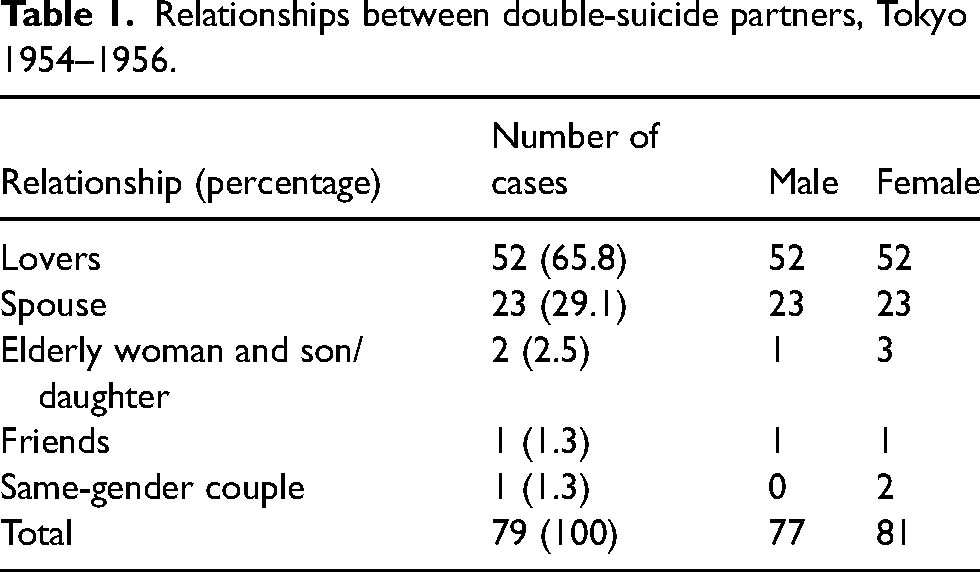
The total number of suicide victims in the special wards of Tokyo during the same period was 5466, giving a double suicide rate of 2.89%. For these latter cases, the following information was retrieved concerning the victims’ relationships with their respective (suicide) partners, as presented in Table 1. Almost two-thirds of cases involved lovers, and almost 30% involved married couples. The four remaining cases involved elderly women and an adult offspring (two cases), and two involved friends (1 heterosexual and 1 same-gender pairs).
Relationships between double-suicide partners, Tokyo 1954–1956.
The overall average age of double-suicide victims was 30.0 ± 12.9 years (Figure 1). The average ages of double-suicides involving lovers, spouses, and an elderly woman and her son/daughter were 30.7 ± 7.2 years, 41.4 ± 16.2 years, and 61 ± 4.2 years, respectively; in the latter cases, the age of the son/daughter was 39 ± 5.7 years. Overall, double suicides involved 77 men and 81 women, giving a male: female ratio of 1:1.

Age-ranges of double-suicide victims as a percentage of all incidences.
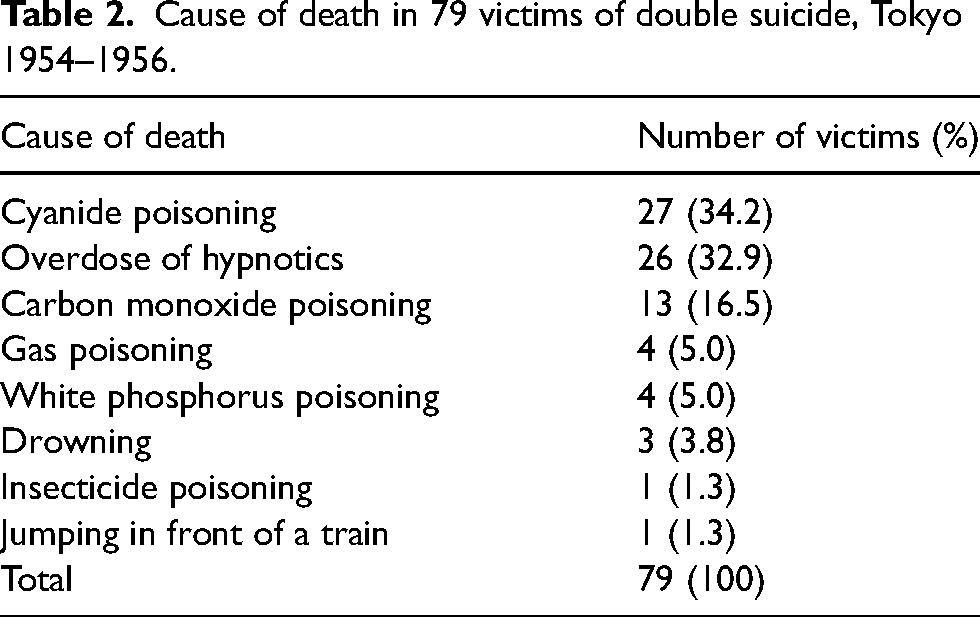
The respective causes of death for the double-suicide victims are presented in Table 2. Together, cyanide poisoning and sedative-hypnotic drug overdose accounted for more than two-thirds of all deaths; both methods were more than six times more frequent than any other method, which included other types of poisoning, drowning, and being hit by a train. A suicide note was found in 52 cases (65.8%); no suicide note was found in 15 cases, and the existence of a suicide note was unknown in 13 cases.
Cause of death in 79 victims of double suicide, Tokyo 1954–1956.
The motives for suicide, as indicated suicide notes were: illness-induced distress in at least one partner (12 cases, 15.2%), financial distress (10 cases, 12.6%), extramarital affair or relationship-related difficulties (19 cases, 24.1%), and unknown in 38 cases (48.1%). Place of occurrence of double suicides was an inn or hotel (38 cases, 48.1%), home (31 cases, 39.2%), river or sea (5 cases, 6.3%), company, dormitory or office (3 cases, 3.8%), and a railroad track in 1 case (1.3%).
Discussion
According to Cohen et al. 4 in double suicide or a suicide pact, two people end their own lives consensually, at the same time and place. In the past, double-suicide tended to be more common in Asia than in the West, but today this difference is much less apparent. The literature shows that in several countries for which data are readily available, most cases involve married couples, usually socially isolated, with one or both suffering from a severe physical or mental illness (see Table 3).5–8 Furthermore, suicide is more common among people older than 50 years of age than in younger people, with men and women the victims in almost equal proportions9–11 It is known that cultural differences exist in motives for double suicide. In several Western countries, for example, spousal financial problems are reported to be a factor in double suicide, but in Eastern societies problems with romantic relationships are a more prominent factor.1,9
Suicide and double-suicide data from various studies.
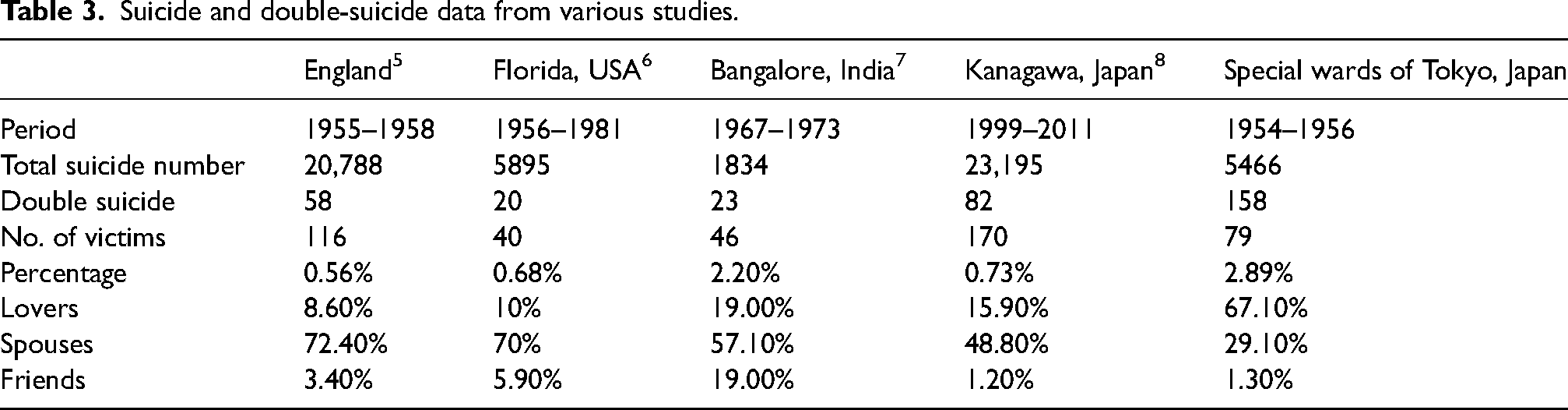
During the period 1954–1957 the TMEO handled 79 cases of double suicide (158 victims), a rate of 2.89% of all suicides, almost identical to that found in Ohara's study of records for 1954. Satoh and Osawa 8 reported a more recent third peak of double suicides in Japan with the highest increase in all suicides occurring between 1999 and 2011, which we refer to as the contemporary period. The same authors found that 48.8% of contemporary double suicides involved spouses, and 15.9% lovers. These figures contrast sharply with those for the period 1954–1957, when less than 30% of double suicides involved married couples and almost two-thirds involved lovers. In Japan, before World War II, when civil law from the Meiji period was still in force, there was relatively little individual freedom surrounding marriage, as the focus was on unity between two communities – houses and homes – rather than individual romantic feelings. 12 After the war, the Constitution of Japan was enacted in 1946, abolishing the family system dating from the Meiji era, and resulted in greater emphasis on ‘marriages based primarily on love’. 13 The increase in double suicides among young people occurred during the transition period between love-based marriage and the traditional system. Indeed, the Military Occupation's encouragement of rapid changes in post-war values, including the liberalisation of religion and the abolition of the family system, caused various psychological reactions among many Japanese people. 14 ‘Shinjū’ originally referred to a couple in love who killed themselves together as an expression of their mutual will. The term is also known as ‘emotional death’. Many Ningyo Joruri (puppet drama) productions from the Edo period include themes of Shinjyū. One of the best-known is Sonezaki-shinjū by Chikamatsu Monzaemon. The story is about two young lovers who are not allowed to marry because of differences in status, etc. A link has been proposed between the popularity of the story at the time and an increase in attempted double suicides by lovers. 15
The double suicide rate during the post-war recovery period was 3.7 times higher than the contemporary rate. How might this be explained?
The period 1954–1957 saw the start of the first peak in the post-World War II increase in suicides in Japan; the peak lasted from 1953 until 1960, when reconstruction was in full swing. 16 At that time suicides in Japan tended to be biphasic, occurring especially among young adults in their 20s and the elderly. 17 However, whereas the youth peak started to diminish in the 1960s, suicides among middle-aged and older people began to increase. 18
Suicides in Japan reportedly tend to increase as economic conditions worsen. 19 After independence was regained in 1952, Japan moved towards economic recovery and a free economy, related to the special procurement boom caused by the Korean War. Eventually, a foreign currency crisis occurred, and unemployment increased. This combination of social and economic conditions might be linked to the peak increase in suicides between 1953 and 1960. However, the increase in suicide among young people in their 20s appears difficult to explain solely by worsening economic conditions at that time. 18
In the period 1954–1957, in more than half (65.8%) of 52 cases of double suicide by lovers and 23 by couples a suicide note was found. In contemporary Japan, by contrast, the corresponding percentage of double suicides in which a suicide note is found has dropped to 40.2%. The greater relative frequency in the earlier sample may be attributable to the greater incidence of lovers jointly ending their lives then. According to Lang et al., persons leaving suicide notes before killing themselves were more often female, less often married, more often in a financial or partnership crisis, and more likely to suffer from a serious medical illness. 20
Suicide mortality was especially high in young persons in the mid-1950s in Japan. In particular, self-poisoning by solid or liquid substances increased suddenly in young men and women aged 15–24 years. 18 Hypnotics (mainly bromwarelyl urea and barbiturates) were used frequently to treat youth suicidality, which peaked in 1958. The hypnotics were readily available at pharmacies 21 ; however, their availability and use decreased after the national health insurance law of 1956 came into effect. The incidence of suicide by bromwarelyl urea overdose declined after the drug was no longer marketed in Japan because of its many side effects, including frequent fatal overdose and chronic bromine poisoning. 22
In more than two-thirds of our surveyed cases, the most common causes of death were cyanide poisoning (27 cases, 34.2%), and poisoning by large doses of hypnotics (26 cases, 32.9%). In contemporary double-suicide cases, carbon monoxide poisoning was the most common method, occurring in nearly half of the cases, followed by hanging, (about a quarter of cases), with drug-induced poisoning accounting for less than 10%. 8
Our survey covered the number of double suicides in only a limited area, namely: the special wards of Tokyo. According to the Statistics Division of the Bureau of General Affairs, the special wards of Tokyo have a total population of 9.65 million, 23 which is greater than the population of Kanagawa prefecture, the second most populous prefecture in Japan. The double-suicide rate during the post-war reconstruction period was 2.89%, which is much higher than that reported nationwide. If the incidence of double suicides in Japan indeed continues to be higher than in other developed countries (but see Table 3 to put this claim into context), then we should further examine what combinations of social and economic factors might contribute to this situation.
Footnotes
Declaration of conflicting interests
The authors declared no potential conflicts of interest with respect to the research, authorship, and/or publication of this article.
Funding
The authors received no financial support for the research, authorship, and/or publication of this article.
