



Abstract
Pesticides are used to kill, repel or control any animal or plant species which are considered pests, but have also been associated with intentional and unintentional human fatalities. A rapid increase in pesticide suicides was observed during ‘The Green Revolution’ after pesticides were introduced into low- and middle-income rural households without appropriate guidelines for safe use and storage. While national pesticide bans have contributed to a significant decrease in pesticide-related suicides, such cases still comprise a large proportion of all suicides around the world. The aim of the current study was to provide a profile of pesticide suicides in a high-income country as a point of comparison against studies from low- and middle-income countries. Statistical analyses were performed using R (version 4.2.3). Over the 20-year study period, there were a low, yet consistent number of pesticide suicides which were most common among males over the age of 40. Paraquat and methomyl pesticides collectively contributed to almost half (48.8%) of all fatalities. Consistent with the literature, such cases often occurred with little premeditation in response to an acute emotional crisis. While interpretation of autopsy findings was mostly limited, there were some pesticides that demonstrated findings consisted with previously reported characteristics (e.g., gastroesophageal erosions with paraquat). Given the high proportion of cases where paraquat and methomyl pesticides were implicated, it may be appropriate to review the availability and accessibility of such compounds to reduce the occurrence of pesticide suicides in South Australia and potentially the wider Australian population.
Introduction
Pesticides (i.e., insecticides, rodenticides, molluscicides and herbicides) are materials which are used to kill, repel or control any animal or plant species which are considered pests. Pesticides are also highly hazardous chemicals which have been associated with fatalities. Agricultural advancements in the mid-90s, referred to as ‘The Green Revolution’, brought new high-yield crops in conjunction with highly hazardous pesticides which were introduced into rural households, often in low- and middle-income countries. 1 However, a lack of awareness and guidelines for safe use and storage saw a rapid increase in pesticide-related deaths, which were both unintentional and intentional.1–6 While intervention measures such as national pesticide bans have contributed to a significant decrease in pesticide-related suicides, such cases still comprise a large proportion of all suicides around the world. Mew et al. (2017) found that between 2010 and 2014, pesticide self-poisonings accounted for approximately 13.7% of global suicides each year. 7 However, this study also highlighted significant geographic variations reflecting agricultural farming involvement or socioeconomic status, with a higher prevalence in countries with high rates of agricultural farming and those of low- and middle-income. For example, in countries such as Sri Lanka and Bangladesh where the sale and use of industrial pesticides is widespread, rates of pesticide self-poisonings are high. Therefore, successful intervention measures have focussed on limiting access to pesticides through national bans of highly hazardous materials. These interventions have been shown to be extremely successful in reducing rates of pesticide self-poisoning in countries such as Bangladesh, Sri Lanka and South Korea.8–10 However, for high-income countries such as the United Kingdom, South Korea and Australia, pesticide self-poisonings are comparatively less common and are more often related to the use of widely available, household products rather than industrial-grade pesticides.
The following study was, therefore, undertaken to analyse the incidence and profile of pesticide self-poisonings in a high-income country to compare with the reported features from low- and middle-income countries with high levels of agricultural activity.
Materials and methods
The database of the Toxicology Group at Forensic Science SA was searched for all post-mortem pesticide detections over a 20-year period from January 2000 to December 2019. Toxicology reports were then cross-referenced against autopsy reports to identify cases where death was attributed to pesticide ingestion. Collected variables included age, sex, medical history, scene findings, location of death, cause of death, manner of death, autopsy and toxicology findings. All cases were subject to full coronial and police investigations with complete autopsies.
Age was separated into the following categories: infant (0–12 months), toddler (1–3 years), child (4–14 years), young person (15–24 years), adult (25–64 years) and elderly (65+ years). Seasons in Australia are summer (December–February), autumn (March–May), winter (June–August) and spring (September–November). Pesticides were separated into the following categories: organophosphates, carbamates, organochlorines, herbicides and rodenticides.
Statistical analyses were performed using R (version 4.2.3). A Poisson regression was used to characterise trends in the observations. A Chi-squared test for given probabilities determined the significance of proportions for the following variables: age category, sex, season and pesticide type. A Welsh two-sample t-test determined the significance of mean age between males and females. Ethics approval for the data used in this study was granted by the University of Adelaide Human Research Ethics Committee (H-2020-033).
Results
Overview
During the 20-year study period (2000–2019), 41 cases of fatal pesticide ingestion occurred in South Australia (SA). There was no significant trend in the number of cases over time (i.e., there was a consistent number of cases across the time series, p = 0.09) as shown in Figure 1 (see Appendix A, Table A.1). The largest number of cases occurred in spring (n = 13), followed by summer (n = 11), winter (n = 9) and autumn (n = 8). However, there were no statistically significant trends observed in the seasonality of cases (p = 0.696, see Appendix A, Table A.2). Following police, coronial and pathological investigations, it was determined that all cases involved the intentional ingestion of a pesticide(s). No cases of unintentional pesticide exposure were identified.
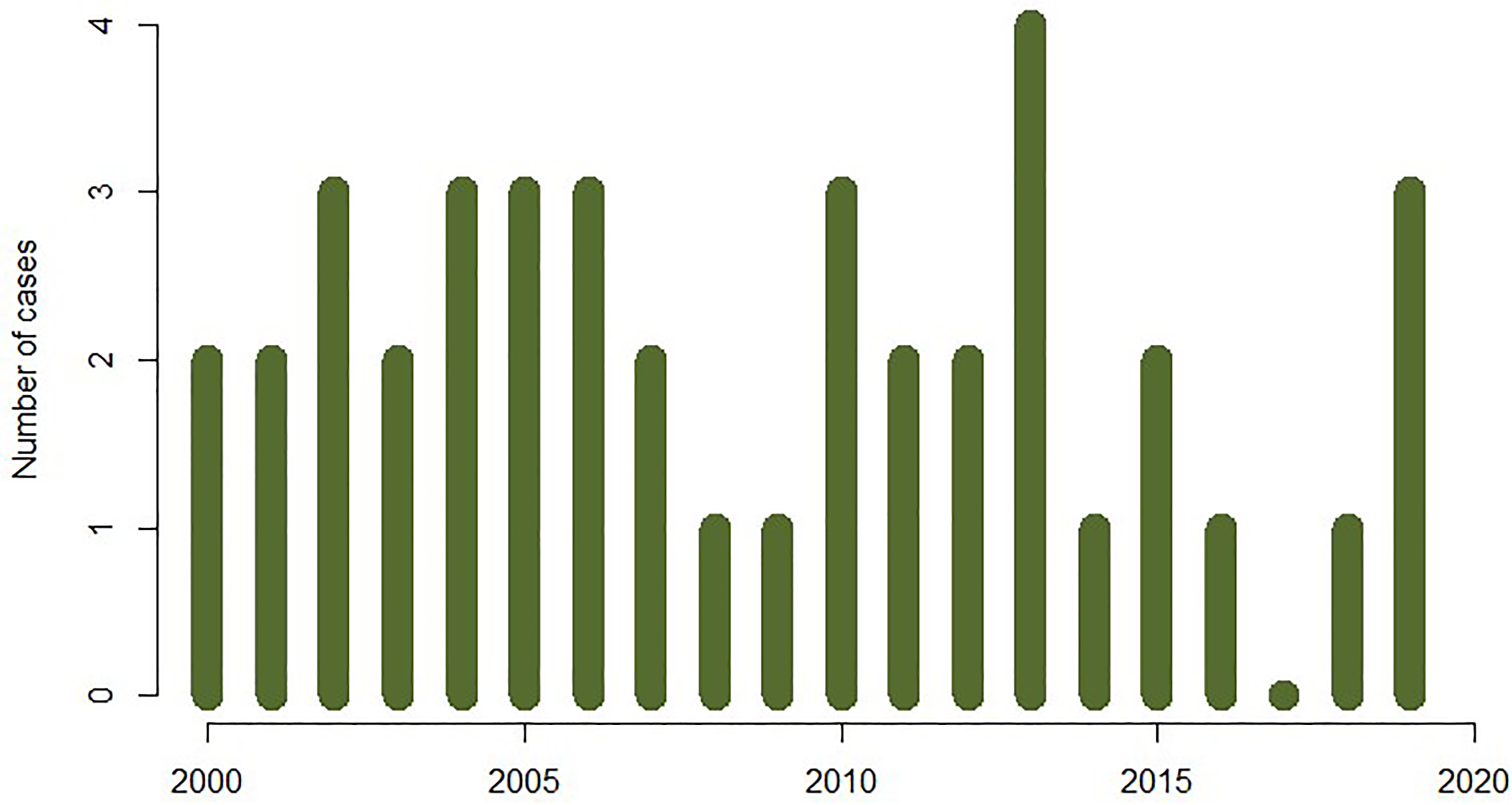
Number of fatal pesticide ingestions in SA between 2000 and 2019.
Of the 41 cases identified, 39 were attributed to pesticide toxicity in isolation, and two cases were attributed to the combined toxic effect of a pesticide in conjunction with another substance (citalopram and methylated spirits, respectively). When divided by pesticide category, herbicides were most frequently implicated (n = 15), followed by carbamates (n = 11), organophosphates (n = 9), rodenticides (n = 6) and organochlorines (n = 1). A summary of the toxicology findings for all cases is presented in Table 1. Note: the values above do not total 41 as one case involved the ingestion of two pesticide products from different pesticide categories.
Pesticide toxicology findings for cases of fatal pesticide ingestion in SA between 2000 and 2019.
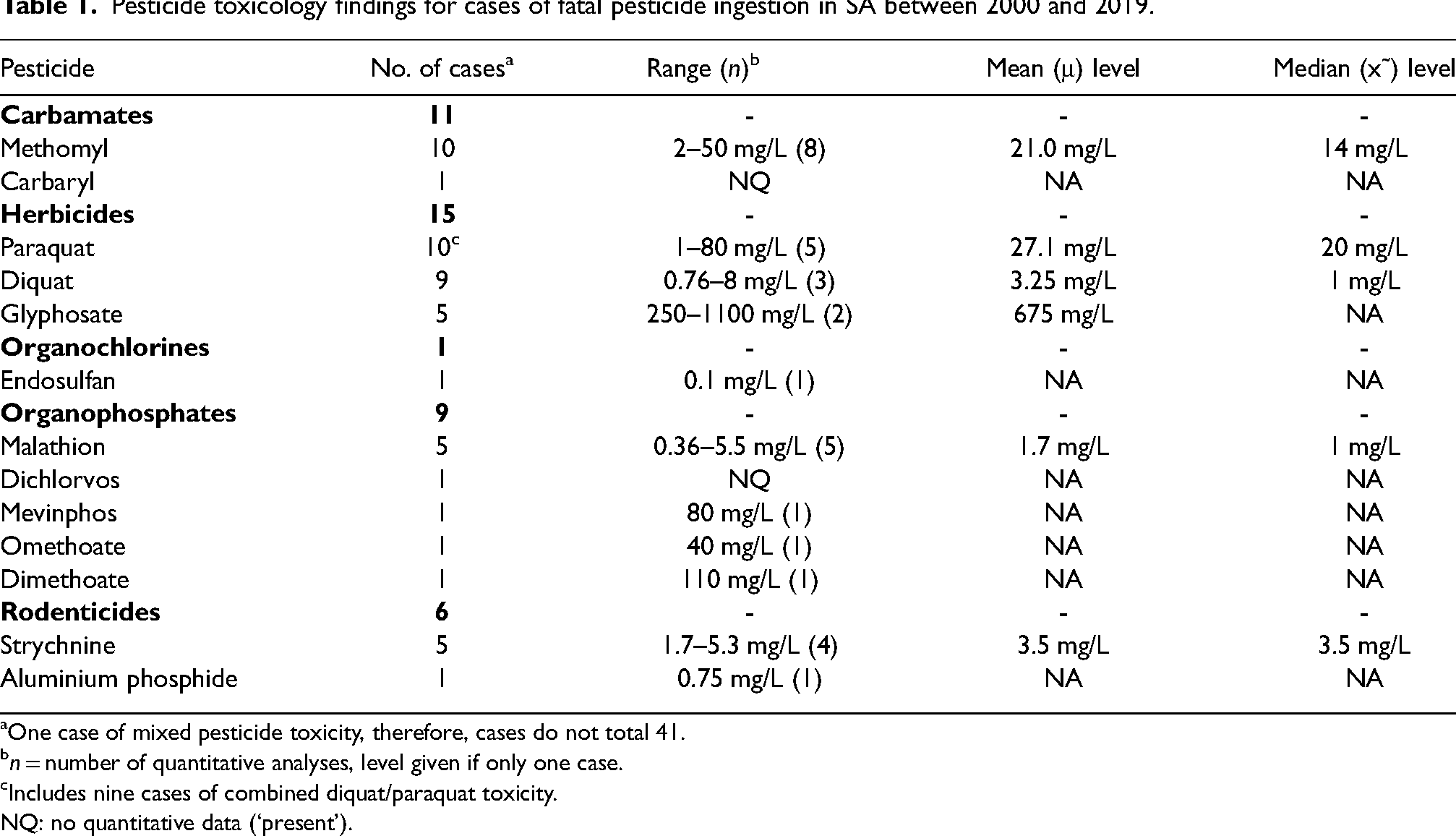
One case of mixed pesticide toxicity, therefore, cases do not total 41.
n = number of quantitative analyses, level given if only one case.
Includes nine cases of combined diquat/paraquat toxicity.
NQ: no quantitative data (‘present’).
Demographic characteristics
The decedents included 10 females (mean 71, SD 10.37) and 31 males (mean 60, SD 18.04) with an age range of 18–90 years (mean 63 years). No cases were identified in the infant, toddler and child age categories. The number of cases was highest amongst the elderly (n = 21) and adult (n = 19) age categories, with only one young person identified. There was a much greater proportion of males (76%) compared to females (
Decedent histories
More than half (54%, n = 22) of decedents had a history of mental illness, including anxiety/depression (n = 19), schizophrenia (n = 3), dementia (n = 2) and alcoholism (n = 1). Additionally, seven decedents had experienced a domestic dispute or argument shortly prior to death (17%), three of whom also had a history of mental illness. Three decedents had a history of exceedingly poor health at the time of their death. Four decedents made contact with a family member after ingesting pesticide to inform them of their actions. Only one decedent had direct access to industrial-grade pesticides through employment as a fruit grower. No information was provided regarding the decedents’ histories and circumstances in six cases.
Location
The location of pesticide ingestion was most often the home address of the decedent (n = 27, 66%). Seven additional cases occurred in a public area/building and the location of the incident was not documented in the remaining seven cases. Of the decedents who ingested the pesticide(s) at their home address, 16 decedents (59%) died at the same location and the remaining 11 decedents (41%) were transported to hospital where they died. Six of the decedents who ingested pesticides in a public area/building died at the same location, and the remaining decedent died in hospital. Of the seven cases where the location of the incident was not documented, four decedents died in hospital. Overall, 61% (n = 25) of decedents died at the same location as where they ingested the pesticide and 39% (n = 16) died in hospital.
Scene findings
Unfortunately, scene findings were not available in 16 cases, most often in cases in the earlier part of the study or where death had occurred in hospital. For the remaining 25 cases where scene findings were documented, a suicide note was only found in six cases (24%). However, there were an additional four cases where the decedent informed a family member of their actions prior to death either in person or via telephone. The presence of drinking utensils used to ingest the pesticide product was noted in eight cases (e.g., water bottle, cup).
Pesticide-specific findings
Herbicides
Herbicides collectively contributed to the largest number of deaths overall (n = 15, 37%). The proportion of suicides attributed to the use of herbicides was statistically significant (
The ten paraquat (and diquat) cases showed pulmonary oedema and congestion at autopsy, with early acute bronchopneumonia in four cases and intra-alveolar haemorrhage in five cases. Gastrointestinal erosions were observed inconsistently between cases, with definitive evidence of oropharyngeal/oesophageal ulcerations seen in five cases and gastrointestinal ulcerations in two cases. The trachea and bronchi were noted to show acute inflammatory changes with or without erythema in the remaining cases. Renal and hepatic necrosis was seen in four cases, with three additional cases only showing organ congestion. The remaining cases showed organs of normal appearance. Cerebral congestion and swelling were observed in two cases, with areas of acute haemorrhage observed in one.
The four cases of glyphosate toxicity where an autopsy was performed showed pulmonary oedema and congestion, with evidence of focal bronchopneumonia in one case. Oesophageal or gastrointestinal erosions were only observed in two cases, noted as erythematous corrosive gastritis and erosive epiglottitis, respectively. An additional case showed green discolouration of the oesophageal mucosa and evidence of corrosive gastritis in the stomach. Renal and hepatic necrosis were present in one case, with the remaining cases demonstrating generalised organ congestion without necrosis. Two cases had cerebral congestion and swelling, one of which also showed microscopic acute haemorrhages on histology of the brainstem with loss of Purkinje cells in the cerebellum. A summary of post-mortem findings for all cases is presented in Table 2.
Case details for cases of fatal pesticide ingestion in SA between 2000 and 2019.

^Only substances implicated in the cause of death are listed.
*Level detected likely to be significantly lower than the perimortem concentration due to post-mortem degradation
# Mixed-substance toxicity (includes one case of mixed-pesticide toxicity)
NQ: no quantitative data (‘present’).
Carbamates
Ingestion of carbamate pesticides was consistent across the study period (n = 11, 27%), with 1–4 deaths every five years. The majority of carbamate cases involved a product containing methomyl (n = 10, 91%), with only one case involving a carbaryl-containing product which occurred at the beginning of the study period. Cases due to carbamate toxicity exhibited a wide variety of non-specific pathological findings. The methomyl cases consistently showed pulmonary oedema with or without early acute bronchopneumonia and intra-alveolar haemorrhage. Gastrointestinal erosions were not frequently seen, only observed in two out of ten cases. Instead, findings were more representative of terminal multi-organ failure. The autopsy findings for the single case of carbaryl poisoning are summarised in Table 2.
Organophosphates
Ingestion of organophosphate pesticides was also consistent across the study period (n = 9, 22%) with 1–4 deaths every five years. These cases most often involved a product containing malathion (n = 5, 63%), with the three remaining cases involving dimethoate, omethoate and mevinphos, respectively. There was one additional case involving the ingestion of both dichlorvos and methomyl and is subsequently listed twice in Table 2 for both carbamate and organophosphate-related cases (Case 4). Malathion use was also consistent over the study period, with the latter three cases involving dimethoate, omethoate and mevinphos occurring in the middle point of the study period.
The four cases of malathion ingestion where autopsy results were available demonstrated somewhat inconsistent findings. Pulmonary oedema and congestion were present with aspiration of gastric contents in two cases. The liver showed early necrosis in one case, but this case was also associated with a high (but not lethal) paracetamol level. The autopsy findings for the single cases involving ingestion of dichlorvos, mevinphos, omethoate and dimethoate are summarised in Table 2.
Rodenticides
Use of rodenticides was confined to the earlier years of the study period, with no cases after 2011. Five of the six rodenticide cases involved the ingestion of strychnine, and the remaining case involved the inhalation of phosphine gas through the use of aluminium phosphide.
The four cases of strychnine ingestion where autopsy results were available demonstrated generalised pulmonary congestion and oedema, with patchy changes associated with adult respiratory distress syndrome in one case. Histology showed focal areas of collapse and haemorrhage in the lungs with red blood cells in the alveolar spaces. No notable brain changes were observed except for extensive hypoxic change in one case. The autopsy findings for the single case involving inhalation of aluminium phosphide are summarised in Table 2.
Organochlorines
Cases involving organochlorines were the least frequently observed (n = 1). The single organochlorine case utilised a product containing endosulfan and the autopsy findings were non-specific.
Biochemistry findings
Submission of blood samples for biochemical cholinesterase analyses was only undertaken for five cases; two involving malathion, two involving methomyl and one involving dimethoate. While malathion and dimethoate are organophosphate pesticides and methomyl a carbamate derivative, both classes of compounds elicit their toxicity through inhibition of cholinesterase. Unfortunately, the results of one case involving malathion were unavailable. The mean values for red blood cell and plasma cholinesterase levels for the remaining four cases were 5.75 U/g Hb (range 3–8 U/g Hb) and 0.67 kU/L (range 0.03–1.66 kU/L), respectively.
Discussion
It has been estimated that pesticide self-poisonings account for up to 20% of all suicides globally. 7 In Western Pacific low- and middle-income countries, cases comprise up to 48.3% of all suicides, 7 a situation likely driven by poverty and availability. It is noted, however, that suicide methods vary markedly among communities with caustic agents being favoured over pesticides in countries such as Surinam. 11 However, in Australia, intentional pesticide self-poisoning only accounted for 0.2–0.5% of all suicides between 2012 and 2021. 12 The comparatively high proportion of pesticide suicides in low- and middle-income countries is largely attributed to widespread engagement in agricultural activities and the ready availability of highly hazardous pesticides. Over the last 20 years, national bans of these agents have resulted in significant reductions in pesticide suicides in several countries,6,8–10,13,14 particularly in China which previously contributed to more than half of the world's pesticide suicides. 15
While pesticide suicides are not nearly as prevalent in Australia (and SA specifically) compared to other countries and communities, it is important to recognise that while low in number, they have continued to occur over time. 16 The prevalence and lethality of pesticide ingestion in countries such as China is attributed to a lack of appropriate training and tailored treatment protocols. 17 The absence of fatal unintentional pesticide ingestion cases within the current study highlights the effectiveness of stringent pesticide storage guidelines and public awareness of pesticide toxicity in reducing cases of fatal inadvertent exposure.
The demographic profile of pesticide suicides in the current study differed greatly from countries such as Sri Lanka, where most cases involve young males.18,19 A more recent analysis showed that globally, pesticide poisonings were more prevalent among young females. 20 However, a high number of countries with known high rates of pesticide suicide were not included in this study as they had not provided data to the World Health Organisation. 20 While the majority of decedents in the current study were also male (76%), more than half of the cohort were elderly (51%). Overall, 90% (n = 37) of decedents were over the age of 40 years.
There are some similarities in the circumstances surrounding the ingestion of pesticides between countries. Studies have shown that those who commit suicide by ingesting pesticides often make the decision to utilise the method at short notice without significant premeditation in response to an acute emotional crisis.17,21–23 A study of individuals who intentionally ingested pesticides in Sri Lanka highlighted that very few patients purchased pesticides prior to the suicide attempt, 22 demonstrating the impulsive nature of the act in most cases. This scenario was observed in seven cases in the current study, where the decedent ingested a pesticide product shortly after an argument or dispute with a partner or family member. The choice of pesticide ingestion rather than another method of suicide was largely attributed to easy availability, utilising substances that were already in the home, perhaps in the absence of a feasible or tolerable alternative. 22 Certainly, the availability and accessibility of a method of suicide has been shown to be a determinant of the profile of suicide methods in different communities, particularly those involving non-pharmaceutical substances.24,25
Historical studies of acute pesticide exposures show that the most frequently implicated compounds were organophosphates and organochlorines in Sri Lanka and Malaysia and bipyridyls in Thailand.2,26 In the current study, the most frequently implicated category of pesticide was herbicides (n = 15), specifically products containing paraquat (± diquat) which contributed to 67% of herbicide cases and to 24% of all cases overall (n = 10). The second most frequently implicated pesticide category was carbamates, where methomyl-containing products contributed to 91% of the carbamate pesticide cases and to 24% of all cases (n = 10). Collectively, paraquat- and methomyl-containing compounds contributed to almost half (48.8%) of all pesticide-related deaths in SA over the 20-year study period.
Most cases of pesticide ingestion in the current study occurred at the home address of the decedent (66%), with only a few cases ingesting the pesticide elsewhere (17%). The majority of decedents died at the same location as where the incident occurred (61%) which is reflective of the acute nature of pesticide toxicity when ingested. In 2010, the compounds responsible for the largest proportion of hospital admissions and deaths (94% and 98% respectively) in Sri Lanka were organophosphates, paraquat, MCPA, propanil and glyphosate. 18 Those with the highest case fatality were paraquat, dimethoate and fenthion, with fatality rates of 42%, 20.6% and 14.8%, respectively. 18 The case fatality rate of aluminium phosphide has also been documented in cases from India. 27 While it appears that the toxicity and lethality of paraquat is well documented in the literature, cases involving fatal ingestion of methomyl-containing compounds have not been widely reported until now. In the current study, several decedents notified a relative of their actions immediately following the incident, further emphasising the importance of rapid medical attention in cases of suspected pesticide ingestion to the survival of patients. The details surrounding the incident, particularly the type and dose of pesticide ingested is integral to ensuring treatment protocols are effective.
Safety data for pesticide products provide detailed information regarding the dose-dependent clinical symptoms, and by extension, an indication of the post-mortem findings that may be observed at autopsy. For example, paraquat causes severe cellular toxicity and has been associated with oropharyngeal burns and multi-organ failure comprising renal and hepatic necrosis, myocarditis and pulmonary haemorrhage with high doses. 28 These findings were observed in most paraquat cases in the current study, where oropharyngeal burns were also observed to varying degrees in addition to variable progressions of multi-organ failure. However, post-mortem findings for other pesticide products were largely inconsistent, where their interpretation was further complicated by the ingestion of other substances, prolonged survival period, medical intervention and limited information on the circumstances of the incident (e.g., dose, timing etc).
Several pesticides highlighted in the current study have been banned in many countries. However, some are still used in Australia including paraquat, chlorpyrifos, dimethoate, malathion and dichlorvos. 29 Given that paraquat contributed to 24% of all cases of the current study, it may be pertinent to reconsider the availability and accessibility of these compounds to the general public in an effort to reduce the incidence of fatal pesticide suicides. However, in countries such as Australia where pesticide suicides are rare, it may be difficult to determine the effect of prevention measures, if implemented.
Supplemental Material
sj-docx-1-msl-10.1177_00258024231197914 - Supplemental material for Features of fatal pesticide ingestion in South Australia
Supplemental material, sj-docx-1-msl-10.1177_00258024231197914 for Features of fatal pesticide ingestion in South Australia by Lilli Stephenson, Corinna Van Den Heuvel, Melissa Humphries, Christine Nash and Roger W. Byard in Medicine, Science and the Law
Footnotes
Declaration of conflicting interests
The authors declared no potential conflicts of interest with respect to the research, authorship, and/or publication of this article.
Funding
The authors received no financial support for the research, authorship, and/or publication of this article.

Supplemental material
Supplemental material for this article is available online.
References
Supplementary Material
Please find the following supplemental material available below.
For Open Access articles published under a Creative Commons License, all supplemental material carries the same license as the article it is associated with.
For non-Open Access articles published, all supplemental material carries a non-exclusive license, and permission requests for re-use of supplemental material or any part of supplemental material shall be sent directly to the copyright owner as specified in the copyright notice associated with the article.
