



Abstract
This study investigates the legal challenges posed by telesurgery, an emergent healthcare modality facilitated by advancements in 5G and Artificial Intelligence. It highlights the urgent need for a comprehensive legal framework reconciling the complexities of healthcare delivery and technology integration. The paper examines the Chinese adjudication of negligence and the evidentiary hurdles in telesurgery, interrogating the application of the ‘reasonable doctor’ standard, the intricate causation-negligence nexus and the distribution of evidentiary burdens. The analysis contends that current statutes require revision to apportion telesurgery-induced damages fairly. Further, it proposes the formation of multidisciplinary committees to oversee medical technology, calls for systemic reforms, more reasonable liability differentiation and fortifying medical insurance frameworks.
Keywords
Introduction
Telesurgery, characterised by the integrating of 5G and Artificial Intelligence (AI), heralds a new synergy of medicine and information technology. This fusion facilitates physicians to surmount geographical limitations, fusing communication technologies with cloud computing, big data and augmented reality, thereby enabling procedures remotely. 1 The advent of 5G technology significantly augments the capabilities of AI-assisted telesurgery, offering solutions to geographical disparities, optimising resource allocation and enhancing the efficiency of healthcare services. 2 Notably, during the COVID-19 pandemic, telesurgery has been pivotal in reducing the risks of cross-infection. 3
Tracing its origins from NASA's space exploration efforts to current applications in China, telesurgery now stands at the forefront of healthcare innovation. A testament to this progress is China's successful execution of complex surgeries over vast distances using 5G technology, demonstrating its transformative impact on global healthcare. 4 Given the promising stage of telemedicine cases within the Chinese legal discourse, examining telesurgery's tortious complexities gains emphasis through international precedents. For instance, the American case of Auris Health Inc. vs. Intuitive Surgical Operations Inc. involved a judicial assessment of telesurgery, reflecting widespread skepticism about its acceptance. 5 This case, along with the proliferation of telesurgery practices globally, accentuates the critical need for rigorous academic analysis of tort law in the context of telesurgery.
Driven by the rapid advancements in medical technology and the broadening reach of remote surgical procedures,6,7 this paper addresses the legal challenges of telesurgery in China, exploring the intricacies of medical malpractice, product liability and care standards within this domain. It analyses causation, fault and proof burden in telesurgery-related litigations and proposes a legal framework that prioritises patient safety in the wake of rapid technological advancements in remote surgery.
Current legal landscape for telesurgery in China
Within telesurgery's domain, liability attribution has grown increasingly intricate. This complexity arises from the geographical disjunction inherent in delivering medical services by incorporating AI and ICT. In the Chinese legal framework governing medical malpractice, key legislative texts include the Chinese Civil Code (hereinafter ‘Civil Code’), the Interpretation of the Supreme People's Court on Several Issues Concerning the Application of Law in the Trial of Cases Involving Medical Malpractice Liabilities (hereinafter ‘Supreme People's Court Interpretation’) and the Product Quality Law. This framework facilitates a systematic classification of medical torts, crucial for delineating the responsibilities in a telesurgery-related tort case. These torts fall into three categories: ‘medical performance damage’, ‘medical ethical damage’, and ‘medical product damage’. 8
For precision, the first category addresses instances where medical staff commit torts, yet the liability is ascribed to the medical institutions. As stipulated in Civil Code Article 1218, which delineates the responsibilities of medical staff, the institutions bear vicarious liability for any medical negligence during diagnosis or treatment, which aligns with the U.S. precedent set by Darling v. Charleston Community Memorial Hospital, 9 , 13 which introduced the concept of direct institutional liability, providing a pertinent benchmark for assessing Chinese legal positions on telesurgery.
The second category encompasses ‘medical ethical damage’, which includes violations such as inadequate patient communication or consent. As regulated by Civil Code Articles 1219, 1222, 1225 and 1226, this assumes a ‘rebuttable presumption’ of the medical staff's fault, compelling institutions to prove their diligence in patient interactions and privacy maintenance.
The third category, ‘medical product damage’, imposes strict liability on manufacturers and marketing authorisation holders, as delineated in Civil Code Article 1223 and Product Quality Law Article 13, 10 which encompasses an obligation for the product's marketing authorisation holder, manufacturer or providing institution to compensate or for a medical institution to seek compensation. This liability extends to medical institutions and the creators and sellers of the products in question. The principle applied in medical product damage litigation is one of strict or no-fault liability, holding manufacturers, authorisation holders and providers responsible irrespective of fault.
Allocation of negligence liability in telesurgery
As the World Health Organization emphasises, advancements in medical technology are critical for healthcare safety and accountability. It underscores the need for legal experts to actively engage with the distribution of responsibilities in this evolving field. 11 This section addresses three key liability concerns: defining the ‘reasonable doctor’ standard, analysing causation and negligence in telesurgery and assessing evidentiary challenges and proof burdens.
Definition and application of the ‘reasonable doctor’ standard
In the context of telesurgery in China, the standard of care is basically the ‘current appropriate medical level’, which combines the ‘reasonable doctor’ standards and the ‘locality rule’.12–14 In China, a doctor accused of negligence must provide the same care and diligence as a competent practitioner in similar circumstances. Nevertheless, ‘the current appropriate medical level’ emphasises the foreseeability component, which concentrates on the overall nature of the event or harm rather than its specific kind or mode of occurrence.
The Supreme People's Court Interpretations further refines this standard, advocating for a holistic consideration of factors in considering the ‘current appropriate medical level’, including ‘the degree of emergency of a patient's disease severity’, ‘individual differences of patients’, ‘local medical level’ and ‘the qualifications of a medical institution and its medical staff’. 15 The Zong vs Town Health Center case exemplifies the ‘current appropriate medical level’ standard, where the court acknowledged the defendant met medical duties and thus absolved them of liability. 16
Telesurgery, which integrates sophisticated technologies and remote modalities, necessitates an expanded interpretation of the conventional ‘reasonable doctor’ standard. It introduces specific responsibilities tailored to the nuances of telesurgical procedures, which, in turn, demand a nuanced approach to the attribution of liability – especially as remote medical institutions take the helm of operations, potentially diminishing the role of local facilities. 17 This shift in healthcare delivery mandates an informed reassessment of how responsibility is allocated in the event of telesurgical errors, 18 which may involve assigning joint responsibility across institutions as delineated by law.
To embody a ‘reasonable doctor’ in telesurgery deviates markedly from conventional medical standards, as it incorporates advanced technology and the nuances of remote operation, presenting distinct challenges and demanding particular skills. It requires a comprehensive assessment against the enhanced ‘reasonable doctor’ standard, tailored to telesurgery's intricacies. Surgeons must maintain the utmost standard of care, necessitating specialised training and collaboration with equally skilled peers and keeping up-to-date with developments in AI and ICT. 18 The complex nature of telesurgery also introduces specific liabilities, drawing from the U.S. tort law's ‘Learned Intermediary’ doctrine, 19 which transfers the onus of understanding product warnings from manufacturers to physicians. Physicians are expected to possess the expertise, training and discernment needed to align medical products with the unique health profiles of patients and to oversee the results vigilantly. Cases such as Lei v. Nanjing Children's Hospital, 20 and Du Jinshan and Du Wei v. Affiliated Hospital of Jiangnan University, 21 further underscore the need for doctors to communicate technological constraints transparently. In telesurgery, a ‘reasonable doctor’ must ensure informed consent and engage in vigilant remote collaboration and proactive issue mitigation, like addressing 5G disruptions. It highlights the necessity for foresight in technological risks and swift response systems to uphold patient safety.
Analysis of causation and negligence in telesurgery
The adjudication of causality in cases of medical infringement is notably intricate, necessitating profound medical acumen that often surpasses the direct evaluative capacity of the judiciary. The United States precedent of the ‘two schools of thought’ principle, 22 and the United Kingdom's BOLAM test 12 serve to circumscribe judicial intrusion into medical matters, thus venerating professional medical judgment. The medical appraisal emerges as an essential determinant in linking alleged medical negligence to resultant patient harm within the Chinese legal system. The Supreme People's Court Interpretations underscore the necessity for expert testimony from specialised medical appraisals to resolve technological intricacies preemptively. 15
There has been an observable trend within the judiciary to excessively prioritise adherence to expert testimony from specialised medical appraisals, which tends to merge medical errors with the causation of harm.23,24 This has ignited considerable discussion across scholarly and applied domains,25,26 arguing high reliance on expert testimony from specialised medical appraisals may risk sidelining the core legal principles of causality. It may stray from the original legislative objectives outlined in the case of Bolitho, 27 which correctly pointed out that the judiciary's reliance on expert testimony for causation analysis must ensure that the medical opinions accepted by the courts are ‘responsible, reasonable or respectable’, and that the experts have considered the comparative risks and benefits to reach a defensible conclusion, thereby preserving the court's decisive authority in establishing medical fault.
Another critical issue involved in causation is the application of Proportional causation, as introduced in Article 1168 of the Chinese Civil Code, 28 and inspired by European tort law's concept of ‘causal proportional liability’,29,30 offers a method to allocate liability proportionate to the likelihood of having caused harm. This doctrine is instrumental in scenarios where causation is unclear, and a precise delineation of each contributing factor's impact on the damages is unfeasible. The principle's application aims to ensure equitable compensation, especially when standard methods of establishing causality are inadequate.
However, the efficacy of specialised appraisals in identifying causation is often hampered by the complex interplay of factors that contribute to medical harm, such as the multifactorial nature of damages, the possibility of record concealment by medical institutions and the challenges inherent in post-mortem analysis or ambiguous clinical presentations. These factors necessitate the development of a more sophisticated framework to guide the application of proportional causation in medical–legal contexts.
Considering the complex elements of a telesurgery case, this paper proposes the establishment of an interdisciplinary body to conduct specialised appraisals in cases involving complex medical technologies, such as telesurgery. This body would assess liability and ensure safety oversight and risk management, bolstered by neutral scientific expertise. 5 The need for such a body is underscored by the difficulties in confidently establishing causation and the reliance on current scientific and technological capabilities to identify causal relationships. Establishing such an interdisciplinary body is posited as a critical step towards addressing the complexities of telesurgery malpractice cases, ensuring that causation is shown with a greater degree of certainty and that liability is allocated in a manner that is both just and reflective of the intricate nature of these cases. 5
Moreover, the paper acknowledges that litigation is not the only, nor necessarily the most effective, means of addressing telesurgery malpractice. Alternative Dispute Resolution, especially mediation, offers a collaborative alternative, with a particular emphasis in China on retired judges facilitating non-adversarial resolution, fostering social harmony. It suggests a broader scope for resolving disputes in the context of telesurgery-related malpractice beyond conventional litigation. 31
Evidentiary challenges and the burden of proof in telesurgery
One of the significant challenges in medical damage liability is the allocation of the burden of proof. Under the traditional medical legal framework, medical damage liability is vicarious, that is, the medical institution is liable for the damages that may be caused to the patient by the medical staff in the course of treatment. The critical issue for Chinese courts in AI-assisted telemedicine is who bears the burden of proving fault. Article 1218 of the Civil Code stipulates that if a patient suffers damage during medical treatment and the patient can establish that the medical institution or the medical staff is at fault, the medical institution is liable for compensation. Article 4 of the Supreme People's Court Interpretations also points out that the patient must provide evidence of medical treatment and injuries in tort liability claims for medical damage. Suppose it is not possible to provide proof of fault and causality between the medical institution and its medical staff. In that case, the patient may apply for a medical damage appraisal by the law. If the medical appraisal concludes that the causal relationship is not clear, the patient will suffer from the result of losing the lawsuit. 28 These legal frameworks show that China has traditionally placed a significant evidentiary burden on patients, a burden that is exacerbated by the complexities of telesurgery, where causation and responsibility may be more challenging to ascertain. 15
However, the specificity of telesurgery exacerbates the patient's disadvantage in the burden of proof in the context of physical isolation and technological intervention between the doctor and the patient. 7 While patients face many insurmountable obstacles to confirmation in traditional surgery, telesurgery is even more complex. Beijing Jishuitan Hospital's remote orthopaedic surgical robot system (Figure 1) 2 depicts a standard 5G-facilitated telesurgical mechanical system, wherein, should malpractice occur, the spectrum of potentially liable parties might encompass the operating surgeon, the robotics manufacturer, software or AI architects, as well as the administrators of the 5G medical network and data storage systems, given their integral roles in the operational processes and decisions.
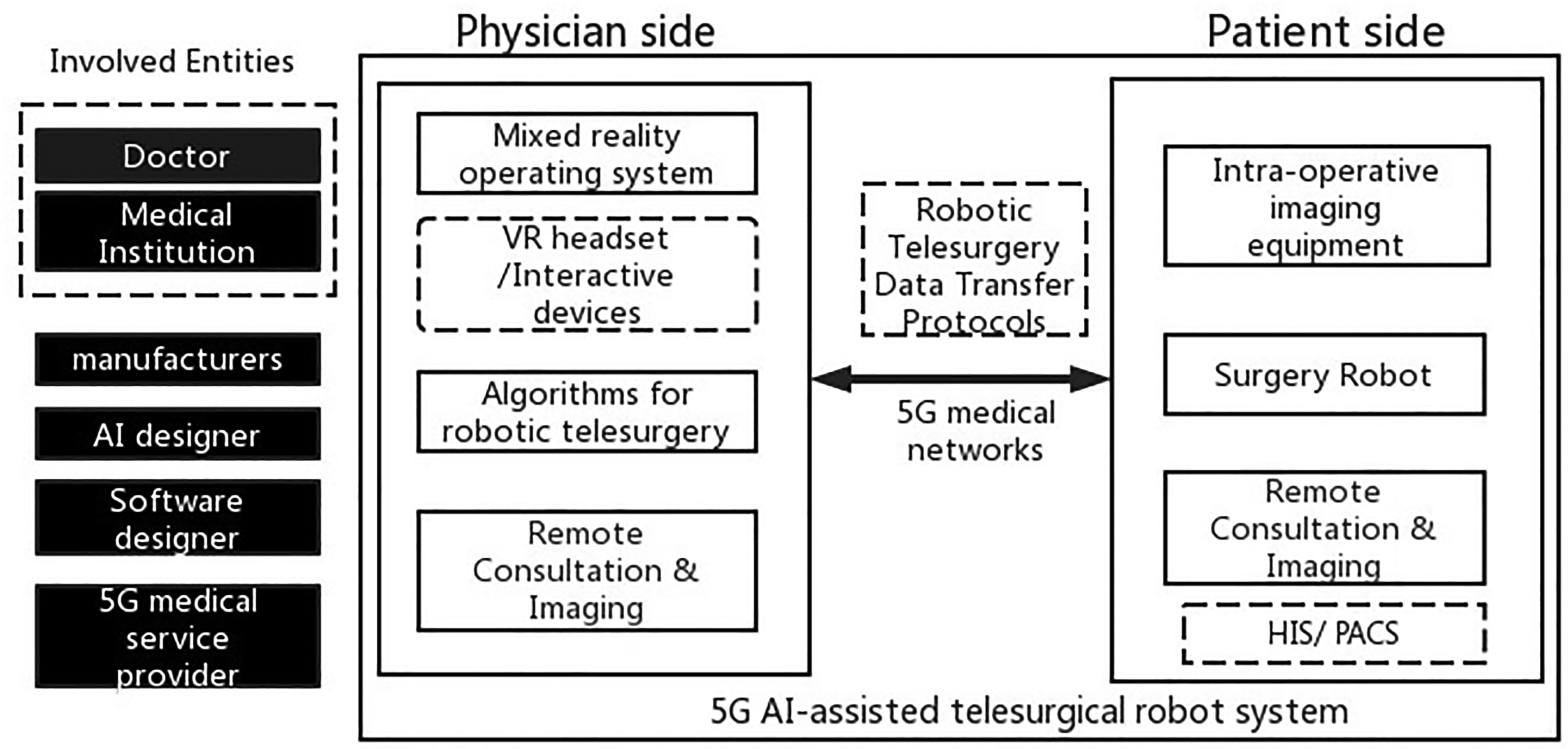
Diagram of a 5G Artificial Intelligence (AI)-assisted telesurgical system.
The intricate nature of telesurgery necessitates that plaintiffs demonstrate a breach in the standard of care and navigate the technical nuances that may have contributed to the alleged malpractice. Furthermore, the diversity of actors involved in care delivery complicates the attribution of fault in telesurgery-related incidents. It extends beyond the operating surgeon to include the equipment's designers, the software developers and the network infrastructure providers. Each actor's role must be meticulously examined to ascertain their contribution to the incident, if any, thereby creating an evidentiary mosaic that the plaintiff must construct to substantiate their claim. Therefore, the burden of proof becomes a significant hurdle, mainly when technical expertise and proprietary algorithms are beyond the typical purview of medical knowledge. 17 This demands an enhanced evidentiary framework that can accommodate the complexities of modern telesurgery practices. 25
In this regard, the Chinese legal system's current approach necessitates a shift towards a more balanced distribution of the evidentiary burden.32,33 This could involve the introduction of a ‘rebuttable presumption’ in favour of the patient, particularly in scenarios where the telesurgery system's complexity inherently obscures the cause of harm. 34 Such a presumption would mandate the medical institution to provide evidence to the contrary, effectively inverting the traditional burden of proof and facilitating a fairer litigation process. Where the defect of any telesurgery product causes any harm to a patient, if the patient requires compensation from the medical institution, the medical institution that has paid the compensation shall be entitled to be reimbursed by the liable product marketing authorisation holder, manufacturer or institution providing the product. 28
Ultimately, the legal discourse on telesurgery must evolve to reflect the realities of contemporary medical practice, ensuring that the burden of proof does not become an insurmountable barrier to justice. This evolution will likely require legislative intervention, judicial willingness to engage with technical evidence and the development of a cadre of experts capable of elucidating the confluence of medical and technological factors in telesurgery. 5
Liability for telesurgery-related products
In the Chinese legal milieu, there is a growing discourse on the status and liability of autonomous surgical robots. These entities, capable of independent operation and exhibiting human-like traits, have sparked debate over their legal classification.17,25 Although some international jurisdictions have recognised a form of robot citizenship’, 35 Chinese legal consensus opts for a nuanced approach, viewing these robots as more than mere tools, given their unpredictable and non-transparent decision-making processes.36,37 These robots cannot be designated civil subjects within the legal framework. 17
Artificial Intelligence algorithms and 5G networks, integral to the operation of telesurgery, raise the question of their status as ‘medical products’. This classification is critical when addressing the legal challenges presented by telesurgery, mainly when technical malfunctions occur, as evidenced by Trump v. Intuitive Surgical, Inc., 38 where the company conceded the potential for micro-cracks in da Vinci systems, highlighting the complexity of medical malpractice and its myriad contributing factors, from operational mistakes to device malfunctions and beyond. This issue is illustrated in the Chen Ningqing vs Zhejiang Provincial People's Hospital case, 39 where a patient experienced severe complications following a da Vinci Surgical Robot-assisted laparoscopic right nephrectomy. The patient suffered significant haematuria and subsequent infection, attributed to a blood vessel rupture caused by a suture needle during surgery. The court held the hospital accountable for 30% of the damages. Given the high precision associated with the da Vinci surgical robot, the suturing mishap could be viewed as a defect, thereby invoking product liability considerations.
Determining telesurgery-related products constitutes the foundational basis for assigning corresponding liabilities in telesurgery. While not explicitly defining intangible entities as products, the Chinese legal system's stance on product liability invokes responsibility when damage occurs during the market circulation phase. It raises the question of how telesurgery's advanced technologies fit into the product liability framework, especially considering the no-fault liability principle that places responsibility on manufacturers and vendors when defects are identified.
Interrogating product liability allocations and corresponding legal obligations is crucial, particularly within the complex domain of medical tort litigation. As stated in Article 2 of the Product Quality Law, 10 a product is defined as ‘any entity manufactured and processed for marketing purposes’. Analogous to the classification of tangible goods, AI algorithms and software, in conjunction with 5G medical networks, can be classified as ‘medical products’. Consequently, any damage caused by products in circulation invokes responsibility, providing it occurs during the product's sales phase.
The existence of a product defect is a prerequisite for telesurgery products to cause harm. Applying product liability rules is only possible when a defect in telesurgery products results in human damage. The product liability system is grounded in a no-fault liability principle, requiring designers, manufacturers and vendors to accept compensation responsibility, assuming product defects are identified. Applying this principle safeguards victims’ rights and serves as a deterrent, compelling telesurgery product designers, manufacturers and vendors to undertake due diligence, thereby preventing potential product defects. 34
In Chinese judicial practice, legal precedents increasingly view software and algorithms as commodities, recognising their potential as marketable entities that meet consumer demands.The classification of software is analogous to the categorisation of tangible goods, as illustrated in the Guizhou Aerospace vs Jiangxi Qingyuan Hanben Biotechnology case. 41 This perspective aligns with the Court of Justice of the European Union's stance on medical software classification, where the court prioritises the intent of the software developers over the software's direct interaction with the human body. 30 Significantly, specific hardware and software items in China's medical industry are explicitly classified as medical device products per Chinese regulations. 42 Therefore, when adjudicating telesurgery infringement cases involving medical robots and 5G medical networks, it is essential for judges to acknowledge the product liability of these advanced technologies. Consequently, this study proposes that product liability is a potent instrument in civil law, effectively managing technological risks and offering compensation for the resulting harm.
However, the legal complexities of product liability in telesurgery malpractice are multifaceted, especially when incidents implicate potential equipment defects. The paper notes a pronounced focus on medical performance damage within medical liability disputes between 2020 and 2022, a predominant focus on medical performance damage is indicated, with claims numbering 18,527 in 2020, diminishing to 14,298 in 2021, and further to 6526 in 2022. In stark contrast, lawsuits for medical ethical and medical product damage remain markedly lower, with the former presenting 58 cases in 2020, decreasing to 46 in 2021 and 21 in 2022. The latter commences at 77 points in 2020, slightly rising to 79 in 2021 and then falling to 17 in 2022. 40 Such comparative data elucidates, to an extent, the adversities patients encounter in pursuing liability claims for medical product torts and the judicial system's difficulty in resolving disputes effectively. Given that medical product liability is predicated on no-fault, enhancing the tangibility and accessibility of this responsibility would undoubtedly facilitate more excellent relief for patients. The pivotal inquiry here is the evidentiary mechanism to substantiate product defects. According to Article 46 of the Product Quality Law, 10 defects are defined as irrational dangers inherent in products that threaten personal safety property or products that fail to meet the relevant national or industry standards. However, the challenge arises when products harbour unreasonable risks that are not readily discernible. Compliance with national and industry standards implies a presumption of non-defectiveness, disregarding the nuances of individual cases and the spectrum of defects across various stages and types. 25
It is crucial to consider the complex interplay between technology and clinical practice in telesurgery to ensure care and liability standards correspond with the complexities and risks associated with telesurgical devices. Artificial Intelligence algorithms’ complex ‘black-box’ nature presents challenges in detecting and legally demonstrating medical product defects. This complexity is magnified by the dynamic interaction of external factors like the complexities of 5G connectivity and force majeure considerations, encapsulated in the AI Act of the European Union, 43 , 44 which classifies nearly all AI medical devices as high risk. However, this legal categorisation necessitates a revised approach to ascertain liability. A meticulous classification of product defects is vital to improving product liability evaluation in telesurgery. This paper proposes the segregation of product defects into four unique categories: design, manufacturing, warning and monitoring defects, 25 taking into account the specific circumstances and the diverse range of defects that can arise at varying stages of a product's life cycle. Generally, design defects are the purview of developers, who must balance safety and performance, subject to comprehensive testing under the ‘risk-utility’ standard to establish the risk and defect standard. 19 Manufacturing defects are the responsibility of the producers, who must ensure that products align with approved design specifications and are evaluated based on their adherence to the intended design. Manufacturers and sellers are accountable for warning defects and must provide clear and updated warnings. Monitoring defects demands ongoing vigilance from designers, manufacturers and sellers, requiring swift responses to product concerns assessed on a case-by-case basis. 45 This paper suggests future studies shall focus on a systematic method for classifying telesurgery defects into these categories for risk assessment. It delineates the party responsible for each type of defect while providing specific standards for their evaluation.
Conclusion and recommendations for legislative and institutional reforms
To effectively navigate the complexities introduced by 5G and AI-involved telesurgery, it is paramount that a dynamic and responsive legal framework is established. Such a framework should be capable of assimilating sophisticated technical evidence and expert testimony, which are integral to adjudicating causality and liability accurately. Legislative and judicial bodies must evolve their processes to align with the multifaceted nature of telesurgery, ensuring that the principles of justice are upheld equitably.
In telesurgery, where harm is attributable to product defects – whether in algorithms, software or 5G medical networks – stringent liability should be imposed on the responsible entities. Given the technical complexity inherent in these technologies, it is prudent to shift the evidentiary burden towards healthcare providers, given that patients typically lack the resources to contest medical or technological failings. Distinguishing between causative and at-fault elements within legal proceedings is critical. A discerning appreciation for the direct correlation between medical interventions and subsequent harm is crucial. The doctrine of proportional causation holds particular significance in scenarios where various factors contribute to the patient's injury. However, its application must be judiciously constrained. An elaborate evaluation of multiple elements – ranging from the level of negligence and the sophistication of the medical product to the gravity of harm sustained – is indispensable for justly assigning liability.
Beyond economic damages, the indirect psychological trauma experienced by patients and their families due to medical malpractice demands attention. Traditional compensatory schemes may fall short in addressing such non-material injuries, 17 which often elude precise quantification. Consequently, establishing a comprehensive, interdisciplinary professional appraisal agency is advocated. This agency would act as a nexus for medical experts, technologists and ethicists, enabling a collective evaluation of medical incidents. The pivotal role of this agency lies in its ability to validate the determinations of medical accidents and to navigate the ethical application of burgeoning medical technologies.
In sum, this paper urges systematic reforms, including developing such appraisal agencies, refining liability delineations and enhancing medical product risk management mechanisms. Shanghai's initiative to include AI-assisted treatments within medical insurance schemes exemplifies a progressive measure to ensure comprehensive coverage for beneficiaries. 2 It is crucial that a synergistic approach is adopted, engaging healthcare providers, technology developers and telecommunications entities to bolster safeguards and provide support for individuals impacted by telesurgery-related incidents.
Nonetheless, this study acknowledges its limitations, mainly focusing on the Chinese context and the rapid evolution of AI and 5G technologies. These constraints highlight the necessity for ongoing research that encompasses a global perspective and is attuned to the continuous legal challenges posed by technological advancements.
Footnotes
Acknowledgements
This work was funded by Zhejiang Provincial Science and Technology Program General Soft Science Research Project (Grant no.:2023C35074).
The authors would like to acknowledge Mr Zhou Mingxing for his assistance in facilitating the submission of our paper. While he is not named as an author, as the leader of a medical device company, he offered significant insights into the telesurgery tort issues within the medical artificial intelligence industry. All authors have granted authorization for the manuscript to be submitted through Mr Zhou Mingxing and have consented to any statements or declarations made.
Declaration of conflicting interests
The authors declared no potential conflicts of interest with respect to the research, authorship, and/or publication of this article.
Funding
The authors disclosed receipt of the following financial support for the research, authorship, and/or publication of this article: This work was supported by the Zhejiang Provincial Science and Technology Program General Soft Science Research Project, (grant number (Grant no.:2023C35074)).