



Abstract

Independent Monitoring Boards (IMBs) play an important role in England in ensuring prisoners are treated fairly and humanely. They have produced a significant new report in which they consider the mental health care provided to segregated prisoners. The report follows “repeated failings that IMBs have raised over recent years regarding the poor outcomes for men with mental health needs, who are being held in Care and Separation Units (CSUs)”. As well as making key future recommendations, the report provides a comprehensive overview of challenges and issues arising. 1 This editorial reviews the content of the IMB report and considers what is now needed to ensure meaningful change in this area.
Segregation (also known as solitary confinement) involves isolating prisoners from the general prison population. Various reasons exist for doing this, including as part of disciplinary measures or to ensure the prisoner's safety. However, it is known that segregation, particularly when prolonged, can adversely affect an individual's mental health. Where underlying mental health conditions already exist, these can be exacerbated, and where none exist, new conditions, such as depression or post-traumatic stress disorder, may develop. In addition to causing psychological harm, limited evidence exists of a wider effect on institutional violence or a subsequent impact on reoffending behaviour. 2
For several years, IMBs have been raising concerns about the conditions in which segregated prisoners are held. These concerns have included the use of overly restrictive measures and the lack of close supervision, especially in cases where prisoners are vulnerable. Often, insufficient suitable constant watch cells are available, meaning prisoners must be supervised from outside their cell door. Additionally, the use of anti-ligature clothing and other restrictive measures, while intended to prevent serious self-harm, can have a profoundly negative effect on an individual's mental health and well-being. According to the IMBs, up to 15% of men in CSUs are managed under Assessment, Care in Custody and Teamwork (ACCT) documents, indicating that they present a serious risk of self-harm or suicide.
Numerous challenges arise in attempting to provide appropriate mental health care for segregated prisoners. These include difficulties in ensuring a return to their ordinary location (e.g., where prisoners are struggling to cope or refusing to return, perhaps due to concerns for their safety), lack of capacity within existing mental health services (including specialist support), and delays to adequate assessment or the provision of appropriate psychiatric or psychological treatment. However, CSU environments are not designed for these purposes, and prison staff training in mental health care is often minimal. Clinicians able to identify and treat mental disorders are not consistently available, often providing visiting services in which a major activity is simply to declare the individual “fit” to remain in segregated conditions. However, this alone is potentially problematic, as these individuals are not fit to be held in segregation in many instances but remain there due to an absence of suitable alternatives, including timely hospital placement.
Long waits for admission to secure psychiatric beds and delays to referral and assessment are well-described in the literature; they are an unfortunate yet persistent part of this landscape.3–6 In their report, the IMBs indicate that prisoners frequently wait for hospital beds for over 100 days, while some wait for over 200 days, and the wait exceeded 500 days in one case. Meanwhile, “‘baton passing’ between external mental health and learning disability providers” often occurs, as these turf wars seek to establish the required level of security, who is responsible (and therefore who must pay), and what level of priority should be attached to the admission.
These delays in the process of prison-to-hospital transfer are profoundly inappropriate, and they are substantially at odds with international law requiring urgent access to healthcare services (including psychiatric services) when required. 7 Urgent access is often particularly required in cases involving acute mental health disturbance due to the loss of insight often associated with acute psychiatric illness and the resulting refusal to take medication that can restore mental equilibrium. Meanwhile, these issues can present significant challenges to prison healthcare and operational staff, not least because the latter seldom have advanced training and lack specialist skills in managing acute or acute-on-chronic mental disorders.
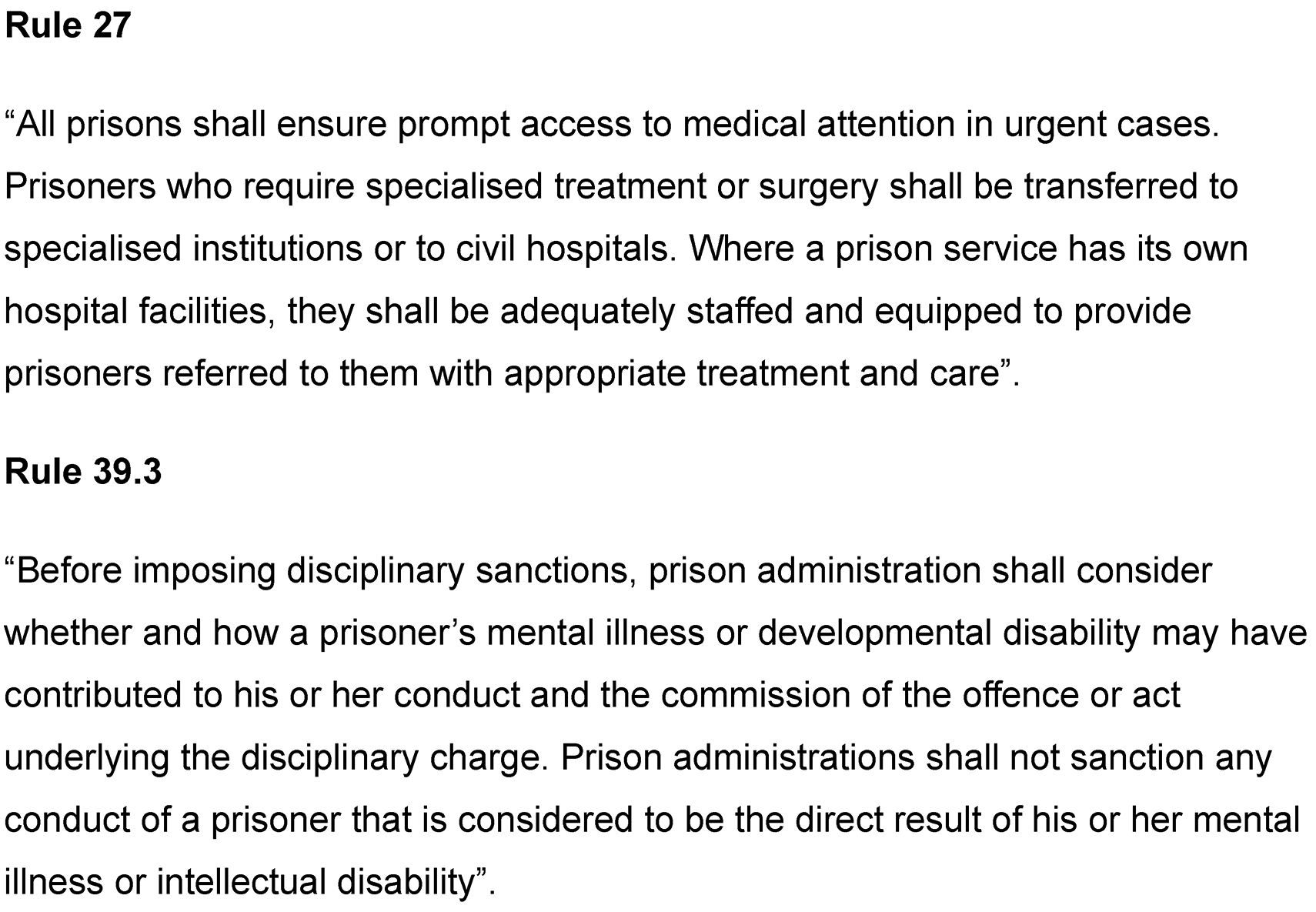
Mandela Rules (UNODC,2015).
The IMBs continue to make recommendations – including increasing the resources available for mental health support, streamlining referral and assessment processes, and expanding access to specialist facilities within the prison system. They also state that the mental health needs of prisoners serving indeterminate sentences (Imprisonment for Public Protection, or IPP prisoners) require a particular focus.
The situation is serious and persistent, yet the role of healthcare services in solving it remains unclear. Providing additional mental health care within CSUs is unlikely to be beneficial because these environments are unsuitable for treatment. Thus, the focus should instead be on alternatives to segregation, including diverting people to specialist units provided within the prison system or to hospital care. This will probably require implementing many more specialist units within the prison estate, with appropriate training for health and prison staff and the expedition of mental health assessments. The current secure hospital assessment and referral system should be overhauled: rather than functioning inappropriately as a “gate-keeping” system, with the main emphasis on applying multiple hurdles and criteria, limiting the number and speed of hospital admissions, it should function as a “gate-entry” system. The referral system should be simplified and shortened (the current system requires prison psychiatrists to obtain large amounts of information before a referral is accepted, often meaning they must cancel clinical work elsewhere to enable this). This could mean simply accepting a referral letter and trusting the assessment made by the team in prison rather than seeking to duplicate it and inevitably introduce delays.
Before embarking on the changes required in this area, relevant international learning should be considered. In Ontario, Canada, for example, similar concerns have been described, 8 and recommendations for improvement have included developing useful alternatives to segregation, adjusting staffing models and quantities, training staff, including external and independent reviews of segregation decisions, ensuring prisoners and their legal representatives can properly challenge these decisions, collecting and regularly analysing human rights data, and ensuring experts and stakeholders can comment on any proposed systems changes. 9
Some of these changes should be considered and a significant national research programme implemented. This should focus on understanding routes into CSUs, reviewing the roles and functions of existing prison healthcare units, understanding the prevalence of mental health disorders among people detained in CSUs, and considering how best to implement alternatives to CSUs. Additionally, regularly overseeing this group and publishing information on their characteristics, detention duration, and the nature of their underlying mental health conditions and vulnerabilities could form a useful mechanism for publicly monitoring their human rights, ensuring greater compliance with relevant international obligations.
In conclusion, the current situation in many CSUs is untenable, and likely at odds with obligations under international law. Yet, despite the many underlying structural problems, there is reason to believe that practical steps can be taken that will produce change. What is now required is the will to move forward with these changes, use research models to understand what can work best, then implement them in an organised and strategic manner.