



Abstract
Selfies are self-surveillance images or videos captured by individuals using digital cameras that, in the attempt to obtain content, may lead to selfie-related injuries or deaths. Criminal selfies refer to offenders who take selfies with their victim(s) during crimes. Globally, both phenomena are underestimated due to deficient official data and the social nature of these incidents. This pioneering media-based retrospective study on selfie-related trauma aims to offset the literature deficit on this topic in Egypt, as an Arabic-speaking country, and extend the global understanding beyond the Western context. We utilised the Egyptian newspaper articles published between January 2014 and May 2023. We identified 25 reports of selfie-related accidents that resulted in 29 casualties with an 82.8% fatality rate. Male victims outnumbered female victims and the mean age was 21.8 years, with most victims aged in their twenties. Regarding the causes of selfie-related deaths, drowning in the Nile ranked first (43.4%) followed by falling from a height (26%). Unless suicide was suspected (n = 1), the remaining cases were considered accidental. We also found four reported criminal selfies that were associated with intimate partner violence. Three of these offenders were male, of which two had a history of drug addiction. In contrast to selfie cases, only one offender belonged to the second decade age group. Overall, selfie-related deaths were infrequent, with an average of three incidents per year. In conclusion, audio-visual communication has altered the modus operandi of crimes, so the digital media analysis should supplement the criminological and medicolegal processes.
Introduction
A selfie refers to the process of taking a self-portrait photo using a camera and sharing it via social media.1,2 The definition currently includes a variety of self-surveillance images, including still-images, video-recordings, and live-streaming videos.3,4 Photography-sharing and video live-streaming have become global phenomena due to enhanced audience participation and the unlimited distribution of digital content. 1 Such social acts have emerged due to the desire to capture ephemeral renditions of risky situations at various locations, including railways, bridges, and in the vicinity of wild animals. 5 The motivations behind these acts range from self-promotion to criminal intent. Various psychiatric and personality disorders have been identified in selfie authors, such as Dark Triad (DT) traits. DT traits describe three interrelated malevolent personality constructs, narcissism, psychopathy, and Machiavellianism, that are linked to selfie authors due to their frequent posing for and posting of selfies. 6
Through this novel world reality, there has been a digital revolution in terms of the impact of selfies on the criminological and medicolegal processes. 7 From 2008 to 2021, 433 selfie-related traumas with or without fatalities were reported globally, 5 in which India ranked first followed by the United States and Russia.5,8 Meanwhile, criminal selfies refer to offenders who take photos or record videos while committing crimes. 9 Several types of crimes can be captured, such as torture, sexual assault, suicide, and mass shootings. 3
Specifically, Egypt has been disregarded by the international research due to the exclusion of non-English data from the analysis, and because Egyptian news is mostly written in Arabic.5,10–12 Therefore, we conducted a media-based review of the reported selfie-related victims who had been either injured or died after using a smartphone to take a selfie. The main objective was to analyse the demographic profiles of the victims and the causes of death. In addition, we analysed reported cases of criminal selfies to understand the patterns linked to this phenomenon. Accordingly, we conducted a comprehensive overview of the criminological aspects and medicolegal consequences related to selfie-taking as a sociocultural behaviour. To the best of our knowledge, this is the first study to document selfie-related deaths and criminal selfies in Egypt. As these phenomena spread worldwide, it is important to describe the demographic characteristics of the selfie authors in Egypt to facilitate comparisons with other countries.
Materials and methods
We searched Egyptian news media websites using Google. We collected data from articles available on free online daily newspapers published from January 2014 to May 2023. The search terms were categorised into the Arabic terms for selfie phenomenon, selfie madness, selfie deaths, selfie video-recording, and live-streaming.
We only included cases of injuries and fatalities that occurred after individuals or offenders used smartphones to capture photos or videos. The included cases were differentiated from those captured using CCTV security cameras or bystanders’ smartphones. We also excluded healthcare and rescue professionals’ selfies with patients or victims of man-made disasters in the background. The eligible news articles were then identified and analysed. Duplicates were identified based on the dates and locations of the events as well as the victims’ age and sex. When duplicates were identified, we used the articles that provided the most data and discarded the remaining articles. Cumulative data were extracted from the articles, including the event type, year and month, location, dynamics, victims’ demographic data, and cause of death. We then conducted a narrative synthesis of the key published scientific articles5,10,11 on the topic. We presented the descriptive statistics as frequency and percentage values in tables and bar charts. Ethical approval for the research protocol was granted by the ethics committee of the Alexandria Faculty of Medicine (IRB NO. 00012098 - FWA NO. 0018699).
Results
We comprehensively analysed the injuries and fatalities reported while using smartphones to capture still-image selfies posted on social media. Between January 2015 and May 2023, 25 selfie-related accidents and four criminal selfies were reported. No selfie-related incidents were reported during 2014.
Selfie-related accidents cases
Among the selfie cases, 62.1% (n = 18) of the authors were males and 37.9% (n = 11) were females. The age range was 12–49 years. According to the selfie type, 21 cases were individual (mono) selfies and four cases involved two people (group selfies). Selfie-stick usage was not reported in any of the cases. Regarding the cause of death, drowning ranked first (43.4%) followed by a fall from a height (26%). One case reported injuries caused by an unlicensed handgun; one case reported envenomation from capturing a selfie with a cobra, resulting in immediate death; and one case reported the death of two individuals in a road traffic accident due to a negligent driver in the car next to them taking a selfie. One case of suicide was identified; the other cases were deemed accidental.
Regarding the age group distribution (Figure 1), the victims of more than 50% of the cases were aged in their twenties and were female. No female victims were aged in their forties, while one victim (>40 years) died in a vehicle accident. The most vulnerable victims were those aged in their twenties (Table 1), with the proportion of deaths accounting for 82.6%; this figure exceeds the ∼5% statistic reported in a global study. 5

Age group distribution in Egypt according to the frequency of selfie-related injuries and fatalities (in percentages). The second decade is the most vulnerable age groups, corresponding to the millennials.
Cross-cultural comparison of selfie-related deaths and injuries. Percentages were used for pattern comparison between Egypt and the worldwide data due to differences in the time periods of the studies.
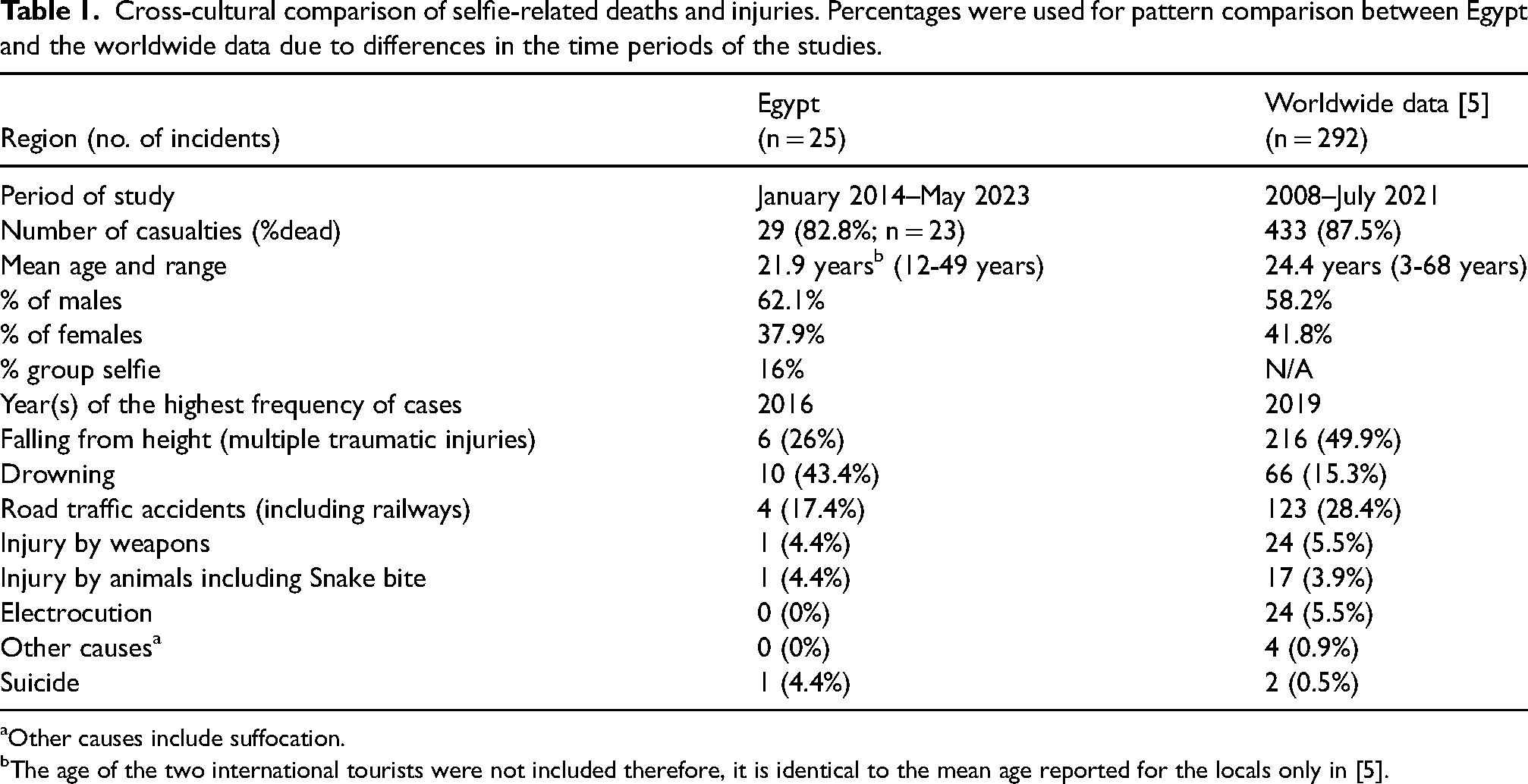
Other causes include suffocation.
The age of the two international tourists were not included therefore, it is identical to the mean age reported for the locals only in [5].
Criminal selfie cases
During the search period, all cases (n = 4) involved single offenders who worked alone. Three offenders were male, one was female, and one offender was aged below 20 years; in one case, the male offender's age was not provided in the media report. One case involved an offender live-streaming with a dead body, which was posted on TikTok. All cases presented extreme intimate partner violence or sexual violence. In the three male cases, their motives were to capture extraordinary events, whereas humiliation was the motive for the single female offender. She had been a victim of long-standing intimate partner violence and had taken a selfie with her tongue protruding out of her mouth while her injured husband bled out on the floor.
Discussion
Using Egyptian newspaper articles published from January 2014 to May 2023, we identified 29 casualties from 25 cases and four criminal selfie cases that gained media attention. We did not find any incidents reported during 2014. The selfie-related injuries and deaths peaked in 2016 (20% of incidents; n = 5). This finding coincides with a national contest on Facebook called ‘SelfieNation 2016’ 13 and the worldwide increase in the number of selfie deaths from 2014 to 2017 due to increased smartphone usage, enhanced features, and selfie sticks. 8 We found that the number of cases decreased thereafter: three cases were reported annually from 2017 to 2020 and two cases were reported annually from the years 2021 to 2023. Remarkably, only two tourists (8%) were victims of fatal selfie incidents in Egypt; this result is lower than the previously reported rate (10%–37.2%) of selfie-related casualties among international travellers.5,14 A comparison of our results with the worldwide data 5 from 2008 to 2023 provided no evidence of increasing prevalence of selfie incidents in Egypt. Specifically, the prevalence of fatalities in Egypt was lower than that reported in Turkey 11 and Italy. 10 Moreover, we estimated that there were, on average, less than three incidents annually (Supplementary Material Figure S1). The number of selfie-related injuries and deaths was generally very low in relation to the number of smartphone users (>4.5 billion globally).14,15
The mean age of the Egyptian casualties was 21.8 years, and their ages ranged from 12 to 49 years, with the majority of victims aged in their twenties. The victims were mostly aged <25 years, which is comparable to the global range of 3–68 years. 5 Compared to females, the proportion of male fatalities was 62.1%, which was slightly higher than the reported percentage of global deaths (58.2%). 5 This result was surprising as females take more selfies than males because of their desire to appear more appealing to others on social media.5,16 Moreover, a recent Egyptian study 16 showed that 49.5% of university students displayed signs of borderline ‘selfitis’, with higher rates among females. Nevertheless, accidents happen when risk-taking behaviour is associated with neurocognitive impairment due to a lack of situational awareness, imbalance, and temporary distraction which seems to be more frequent in males.12,17 Finally, the influence of age is a more significant predictor of selfie-taking, posting, and editing behaviours among females than males. 18 This can explain the differences that we found in the age distribution and frequency of cases among the male and female victims (Figure 1).
We found that most of the deaths were from drowning (43.4%); this finding is similar to that reported in Italy (41.7%). 10 However, the main cause of death was falling from a height in Turkey and a global study (48% 11 and 49.9%, 5 respectively). Meanwhile, although vehicle/pedestrian accidents are also considered common causes of death worldwide,5,19 only two incidents were recorded in Egypt. Selfie-related injuries and fatalities are more frequent in natural environments, particularly near water bodies 10 ; in Egypt, most of the related incidents were due to falling from a height (i.e. a bridge) into water. We also found other infrequent incidents to include one case of injury caused by an unlicensed handgun and one case of death due to a selfie with a cobra snake. Causes of death vary worldwide and often reflect the diversity of geographic regions, cultural or social beliefs, and legislation.8,12 For example, India has more railway-related selfie deaths due to ‘the belief that posing on or next to train tracks with one's best friend is regarded as romantic and a sign of never-ending friendship’.8,12,14 In the United States and Russia, firearm injuries largely contribute to death due to the flexibility of gun laws in both countries. Moreover, in the Middle East (Lebanon), more unusual deaths occur due to unexploded grenades, corresponding to the country's political turmoil. 20 Even rarer incidents include solitary cases of injury due to lightning strikes or wild animal attacks, such as being dragged by a walrus. 14
Medicolegally, a selfie-related injury or death is defined as ‘an accidental trauma and death that is precipitated by the process of self-photography and occurs just before, during, or after the process, typically by a smartphone’. 10 However, determining the manner of a selfie-related death, in terms of accidental or suicidal, is challenging. For example, in the cases of falling from a height and road traffic accidents, polytraumatic injuries may occur upon impact. Conversely, gunshots and snakebites result in a single fatal wound. Hence, injury patterns are non-informative. Additional information can be gathered from the digital evidence at the scene of death. For example, we found one reported case (Case #10: Supplementary Material Table S1) in which the victim took a selfie prior to committing suicide by drowning in the Nile. A digital analysis of the victim's smartphone revealed a selfie and e-suicide note on his Facebook profile.
The intertwined relationship between suicide and selfies stems from posting on social media as a form of self-expression and seeking dangerous settings to gain attention on social media. Given that the majority of cases involved young adult males, who are characterised by risk-taking behaviour and impulsivity, suicide may be more associated with this group.15,21 Hashem et al. 16 reveal that the selfie phenomenon is associated with depression, anxiety, obsessive-compulsive disorder, eating disorders, and other personality and psychiatric disorders. Moreover, Flaherty and Caumes 22 point out that tourists’ unsafe behaviour when taking or posting photographs at or close to cliff edges, as well as their possible suicidal antecedents, may be attributable as the causes of fall incidents at these sites. 22 However, there is insufficient data supporting these incidents, resulting in difficulties in deriving conclusive results. 22
In such cases of unusual deaths due to the selfie phenomenon, forensic practitioners should identify cases linked directly to smartphone usage by considering the dynamics of the events, determining the cause of death based on autopsy reports, and establishing the potential roles of drugs or alcohol. 15 Digital evidence obtained from the examination of smartphones and social media profiles, as well as witnesses interrogation, may aid in determining whether a death was accidental or otherwise. Currently, the analysis of social media images, videos, and text posts plays a central role in crime scene investigations worldwide. 23 A ‘social mobile autopsy’ refers to the examination of previous posts about suicidal plans and attempts, so as to discern the manner of death.23,24 In this case, selfies constitute the first documentation of an incident, describe the motives for and circumstances of the creation of photos, and reveal the roles that individuals play in possible offences. 25 Furthermore, the use of social media applications can assist in the identification process of missing and unrecognisable individuals in cases of complete decomposition or animal predation. A search for ante-mortem data uploaded to social media accounts can also be a source of adjunct data for comparisons with post-mortem data. 26
In criminal proceedings, the contextual factors of selfies should also be considered in cases involving the deaths of individuals caused by the dangerous behaviours of those nearby. Therefore, the responsibility of the offenders’ actions and the roles of drugs or alcohol in initiating such behaviours should be evaluated. 27 Currently, the provision of penal laws lacks homogeneous definitions worldwide. Nevertheless, the Indian government has produced a declaration of 16 ‘no selfie zones’ throughout the country through different means of signage, legislation, and enforcement.14,27,28 Other countries have applied penalties ranging from fines to evictions. 29
Criminal selfies involve the use of cameras as part of an offence, and such digital evidence is a key factor in approximately 90% of criminal cases. 30 Criminal selfies reveal the relationships between offenders and their desire for visibility. Therefore, this behaviour is not a simple extension of the established risk-taking behaviour that is pertinent to capturing ordinary selfies. 7 As such, diverse factors must be considered regarding the motivation underlying the production of a criminal selfie. For example, offenders who take photos with the deceased may want to document their crime as part of a ‘snapshot culture of extraordinary moments’’ or to send a message,3,9 brag about their crime, humiliate the victim, 9 blackmail the parents, or make a sale on an open market. 31 The circulation of such images is termed a ‘performance crime’. 32 This antisocial behaviour may inadvertently facilitate an offender's own arrest and conviction, even after a long period, as we found in Case #1 (Table 2).
The time, location, offender versus victim demographic characteristics, and reconstruction of the offending situations in criminal selfie incidents.

A Norwegian study 9 identified 51 cases of criminal selfies by searching for higher court decisions and found that most offenders were male and acted alone (35/51), which concurs with our results. In the legal system, the act of explicitly recording an image may lead courts to increase a sentence or present the image as evidence in the court documents without any further comment. 9 With that said, smartphones serve as valuable sources of digital evidence for the investigation and prosecution of premeditated crimes and felony convictions. The additional psychological and physical harm following the recording and posting of criminal images should be considered in the legislation and sentencing guidelines for crimes involving the use of cameras. While the key difference lies in whether the images are intended for private consumption or public distribution, the act of dissemination is inevitable in some cases.3,9
A limitation of our study is that we only reviewed news media reports. The media-based research is increasingly being used as an information source for selfie-related trauma because such cases are only reported in the media for the sake of audience engagement.8,10,12 Moreover, selfie-related deaths are underreported internationally because the act of taking a selfie itself is not reported as the official cause of death. For example, deaths after posing for selfies on highways are reported as deaths due to road traffic accidents. 8 Therefore, due to the lack of official statistical data and the nature of the incidents being addressed as a social issue in the worldwide media, the analysis of more newspaper articles from the Middle East may supplement the official data about cases not reflected in public statistics. 33
Conclusion
To the best of our knowledge, our study is the first to document the injuries and fatalities associated with selfie-related incidents and criminal selfies reported in the media in Egypt. By analysing the data collected from the Egyptian media over a 9-year period, our results are parallel to the global results due to the globalisation of selfie-taking behaviour in the smartphone era and the widespread use of social media platforms. The main differences concern the reported causes of death, which reflect Egypt's geography and national laws and regulations. Moreover, determining the manner of selfie-related deaths, in terms of accidental or suicidal, may not readily discernible in some cases unless digital evidence analysis is performed. Technologically advanced audio-visual communication has altered the modus operandi of investigating crimes. Therefore, the future studies should analyse social media websites during medicolegal investigations of selfie-related deaths. Moreover, the evaluation of digital evidence from smartphones should be mandatory for extracting valuable data, mitigating its impact on criminological and medicolegal processes, and pursuing control policies and prevention strategies.
Supplemental Material
sj-docx-1-msl-10.1177_00258024241257100 - Supplemental material for Selfie accidents and crimes in Egypt: A comprehensive discussion of the medico-legal implications
Supplemental material, sj-docx-1-msl-10.1177_00258024241257100 for Selfie accidents and crimes in Egypt: A comprehensive discussion of the medico-legal implications by MennattAllah Hassan Attia and Nancy M Zaghloul in Medicine, Science and the Law
Supplemental Material
sj-docx-2-msl-10.1177_00258024241257100 - Supplemental material for Selfie accidents and crimes in Egypt: A comprehensive discussion of the medico-legal implications
Supplemental material, sj-docx-2-msl-10.1177_00258024241257100 for Selfie accidents and crimes in Egypt: A comprehensive discussion of the medico-legal implications by MennattAllah Hassan Attia and Nancy M Zaghloul in Medicine, Science and the Law
Footnotes

Declaration of conflicting interests
The author(s) declared no potential conflicts of interest with respect to the research, authorship, and/or publication of this article.
Funding
The author(s) received no financial support for the research, authorship, and/or publication of this article.
Supplemental material
Supplemental material for this article is available online.
References
Supplementary Material
Please find the following supplemental material available below.
For Open Access articles published under a Creative Commons License, all supplemental material carries the same license as the article it is associated with.
For non-Open Access articles published, all supplemental material carries a non-exclusive license, and permission requests for re-use of supplemental material or any part of supplemental material shall be sent directly to the copyright owner as specified in the copyright notice associated with the article.
