



Abstract
The methods employed to detect latent fingerprints during crime scene investigations are continually refined and enhanced. The implementation of dusting techniques on surfaces that are unfeasible for laboratory transport often yields a lower percentage of identifiable fingerprints. This issue is predominantly due to the inherent properties of these surfaces and their respective levels of contamination. Furthermore, the application of laboratory procedures, typically designated for the cyanoacrylate fuming method, is of paramount importance for efficient fingerprint development in field conditions. In this study, five donors (three males and two females) deposited natural fingerprints on readily available materials in day-to-day life, such as microscope slides, both rough and smooth mica, and galvanized sheet metal. The analysis of fingerprints was conducted at seven distinct time intervals: 1 day, 1 week, 1 month, 3 months, 6 months, 9 months, and 12 months. Each of the 280 fingerprints used was divided into two equal parts, resulting in a total of 560 fingerprint segments for examination. The findings of the current study showed that 52.9% of fingerprints suitable for identification were developed with the dusting method, 89.3% with the cyanoacrylate fuming method, and 95% especially with the cyanoacrylate spraying method. These results underscore the potential significance of the cyanoacrylate spraying method as an essential scientific technique in the resolution of criminal cases.
Keywords
Introduction
Fingerprints remain one of the oldest and most reliable forms of forensic evidence, linking crime scenes to perpetrators. This is based on the assumption that each individual has a unique set of patterns on their fingertips. 1 The three glands in the body fluid secretion that form the fingerprint are eccrine, apocrine, and sebaceous glands. 2 Only a few micrograms of material from the body's natural secretions are transferred to the surface it comes into contact to form the fingerprint. 3 However, it is worth noting that incomplete or insufficiently detailed fingerprints may be found at crime scenes. Three types of fingerprints can be encountered: patent marks (oily, painted, bloody, etc.), embossed fingerprints (paste, soap, wax, etc.), and invisible fingerprints (latent). Latent fingerprints are among the most frequently detected types of evidence found on the surfaces of objects at crime scenes. Various methods, including optical, physical, and chemical processes, are employed in fingerprint analysis to visualize latent prints. Optical techniques, such as multispectral imaging, IR (infrared) reflection, fluorescence examination, and the use of specialized light sources and filters, are commonly applied. Physical methods, including powder application, depend on the surface type and color, while chemical processes vary based on the surface's structure. For porous surfaces such as raw wood and paper, iodine vapors, ninhidrin, 1,2-indandione, DFO (1,8-diazafluoren-9-one), thermaNin, 5-MTN (5-methylthioninhydrin), and other reagents are used. Nonporous surfaces, such as metal, glass, plastic, and nylon, are treated with cyanoacrylate, sudan black, crystal violet, sticky side, amido black, hungarian red, and small particle reagent chemicals. Each method demonstrates varying effectiveness depending on the surface and environmental conditions, making the careful selection of the appropriate technique crucial for obtaining accurate results in forensic analysis.1,2
Latent fingerprints represent a popular research topic, as they pose a significant challenge due to their invisibility to the naked eye. Several factors, including the surface's condition and structure (rough vs. smooth, absorbent vs. nonabsorbent, etc.), the presence of any residue affecting the fingerprint (oil, blood, etc.), environmental factors (wetting, drying, etc.), and the fingerprint's age (length of time it has been on the surface), are critical in selecting an appropriate fingerprint development (FPD) method. 4 Traditional FPD techniques, such as cyanoacrylate, ninhydrin, and fingerprint powders, are commonly used. Dusting, a simple technique for latent fingerprints, allows the powder to adhere to the fingerprint's different aqueous and oily components, making it visible. However, dusting has its advantages and disadvantages. While the dusting method reveals the print immediately, the deforming effect of the brush and powder application on the fingerprint is high. 5 Generally, dusting is only routinely applied for surfaces that cannot be transported from the crime scene to the laboratory. In cases where the surfaces are contaminated with different substances (oil, blood, water), this method is insensitive or has limited sensitivity, highlighting the need for the practical application of laboratory methods at the crime scene.6,7
The utilization of cyanoacrylate is another effective FPD method due to its superior adhesive properties. When exposed to the right temperature, cyanoacrylate quickly polymerizes, securely bonding and rendering the fingerprint residue visible on the surface. However, the efficiency of this method relies on certain conditions such as atmospheric pressure, room temperature, relative humidity, and the age of the fingerprint. 1 The impact of relative humidity level on the quality of developing prints and microstructure of poly cyanoacrylate in papillary lines was confirmed through the cyanoacrylate fuming method. It should be noted that relative humidity changes can affect the eccrine gland's components in evaluating FPD levels. Therefore, it is essential to maintain optimal conditions for accurate results.8,9 The cyanoacrylate fuming method is a common approach for developing latent fingerprints. This method involves placing the fingerprints in a development chamber and exposing them to cyanoacrylate fumes for about 10–20 min. However, this method is not suitable for porous surfaces. Another disadvantage is that prolonged exposure to cyanoacrylate vapors without safety precautions (masks, etc.) can lead to health problems.8
Identification of fingerprints from porous and nonporous surfaces is not always feasible due to partial or complete damage of latent fingerprints. Moreover, the identification process becomes more challenging with time as the components of the fingerprint fluid deteriorate. Therefore, there is an ongoing effort to develop an efficient and less time-consuming method to identify latent fingerprints from various surfaces found at both forensic laboratories and crime scenes. 5
The objective of the current research is to identify fingerprints left on various surfaces such as microscope slides, rough and smooth mica, and galvanized sheet metal for a duration of 12 months at different intervals. The study utilized the dusting method, the cyanoacrylate fuming method, and a newly developed cyanoacrylate spray method. Notably, there are no existing studies on the cyanoacrylate spraying technique. Therefore, the aim of this new method was to increase the number of identifiable fingerprints by using solutions that react with fingerprint residue and spraying them onto target surfaces, both in forensic laboratories and at crime scenes, without the need for a separate cabin.
Materials and methods
Reagent and chemicals
Cyanoacrylate spraying method: 20 drops of ethyl cyanoacrylate (Evobond 502 Super Glue, Taiwan) was dissolved in 60 mL hyfet (3 M Novec HFE7100, USA) and 40 mL petroleum ether (Meck, Germany) to prepare a 100-mL working solution.
Creating natural latent fingerprints
The study utilized natural fingerprints from five donors: three men and two women aged between 25 and 50 years. In order to create natural fingerprints, hands were washed with soap and water half an hour before the fingerprint samples were left on the surfaces to ensure the removal of any foreign matter residues from the fingers of the donors. Also, donors were ensured not to contact any surface while waiting. For each age/method group, three depletion series were deposited by each donor. The contact time of the donors onto the target surfaces for each fingerprint was limited to 10 s. The most efficiently developed fingerprints were included in the study. The fingerprints were taken from easily accessible surfaces in daily life, including microscope slides for glass, galvanized sheet metal for metal, and mica for rough and smooth plastic surfaces. The samples that were prepared were stored in room conditions with a temperature of 20–22°C and relative humidity of 65%, also ensuring that they were not affected by environmental factors such as light and heat. The experiment was conducted over seven different trials and repeated at intervals of 1 day, 1 week, 1 month, 3 months, 6 months, 9 months, and 12 months. Care was taken to ensure the accuracy and precision of the data collected.
The study conducted an experiment to compare the effectiveness of the cyanoacrylate spraying method against dusting and cyanoacrylate fuming methods in developing fingerprints on different surfaces. To maintain consistency, the samples were divided into two parts, and each trial involved 5 volunteers, 4 surfaces, and 40 fingerprints. In total, 80 fingerprint fragments were used for each experiment. The cyanoacrylate spray method was applied to half of the fingerprint sample, while the other half was subjected to dusting and cyanoacrylate fuming methods separately. Cyanoacrylate fuming and dusting methods were applied to 140 fingerprint fragments, while the cyanoacrylate spray method was applied to 280 fragments.
Methods used for FPD
The dusting method, cyanoacrylate fuming method, and cyanoacrylate spraying method were applied to the prepared target surfaces (metal, glass, and mica). Cyanoacrylate fuming method: nonporous surfaces (metal, glass, etc.) were placed in a FPD cabinet (Sirchie, USA) so that they do not touch each other. In the application, liquid ethyl cyanoacrylate (Evobond 502 Super Glue, Taiwan) was placed in a container and placed on the heating tray (approximately 40 drops or 1 gram for a 0.5 m³ cabinet). The temperature of the heating tray in the application booth was set to 120°C. The humidity level in the chamber was maintained at 80% for FPD. In addition, the samples were kept in the ambient cyanoacrylate fuming for 10–20 min to develop the prints.
During the fuming process in the chamber, a polymerization (chain) reaction occurred between water-soluble molecules, mainly amino acids, in the fingerprint liquid and the cyanoacrylate fuming. The chain reaction selective polymerization on the fingerprint ridges, making the fingerprint visible. It was observed that the fingerprints developed in white color. Following the development of the fingerprints, the cyanoacrylate vapour, classified as an irritant and potentially sensitizing rather than strictly toxic, was evacuated from the cabin, and the environment was thoroughly ventilated.
In case of poor development of fingerprints, the surfaces were again treated with cyanoacrylate fuming. The developed prints were left to be fixed on the surface for 12 hours.
Dusting method: Black or white powder (Sırchıe, USA) applied on nonporous surfaces (metal, glass, etc.) was moved over the surfaces with a standard-size fiberglass brush (Sırchıe, USA) with a plastic handle, and care was taken not to create physical friction between the fiberglass filaments of the brush and the applied surface. Once the development of prints was observed, the excess dust on the surfaces was removed with a fiberglass brush, and the fingerprints were photographed.
The specified ratios for the cyanoacrylate spray method were prepared and applied with safety precautions, including wearing a mask, through spraying. This reagent was sprayed from a 15–20 cm distance to completely cover the target surfaces using a chemical-resistant liquid spray pump nozzle with a maximum speed of 1.3 mL/sec (Divortex, Turkey) and left to dry under room conditions. Finally, photographs were taken of the visible fingerprints.
Fingerprint analysis
Each fingerprint fragment was reassembled using a different FPD method. The Nikon D7200 Camera and Sigma 105 mm f 2.8 EX DG OS HSM Macro Lens were used for the highest resolution photographs of a complete fingerprint, fixed on a photographic bench parallel to the fingerprint. Image sharpening software (Adobe Photoshop CS6) was applied to analyze whether the image was suitable for identification. The scoring system provided by the Home Office Centre for Applied Science and Technology 10 in Table S1 was utilized to identify fingerprints.
In order to accurately determine the level of identification of developed fingerprints, the study searched for a minimum of 12 fingerprint characteristics that would classify a fingerprint as “identifiable.” This classification is indicated by scores of 3 or 4 on the quantitative fingerprint rating scale, as shown in Table S1. The identification of the identifiable fingerprint was carried out in accordance with the International Association for Identification, standardization II committee report. 11 Two fingerprint experts identified and graded the fingerprints developed in the study. Next, the percentage and frequency of developable fingerprints were calculated for all donors, and data were generated considering the variables in the data analysis.
Statistical analysis
The study compared FPD methods based on fingerprint scores, using statistical analysis in IBM SPSS Statistics version 27. Categorical variables were expressed as percentages, and differences in scores were evaluated using Crosstab (chi-square) to determine statistical significance levels. The methods’ effectiveness was analyzed based on surface types and time. Statistical significance was determined as p < 0.05.
Results
Fingerprint evaluation
In the study, 560 fingerprint fragments were deposited on target surfaces and divided into two equal groups. The cyanoacrylate spraying method successfully developed identifiable fingerprints (Scores 3–4) in 95% (n = 266) of the 280 fingerprint fragments. The dusting method was successful in 52.9% (n = 74) of the fragments, while the cyanoacrylate fuming method was effective in 89.3% (n = 125) of the 140 fingerprint fragments.
Followingly, the fingerprints suitable for identification were compared at the determined periods using the cyanoacrylate spraying method, cyanoacrylate fuming method, and dusting method applied to all surfaces in the study, as shown in Figure 1.
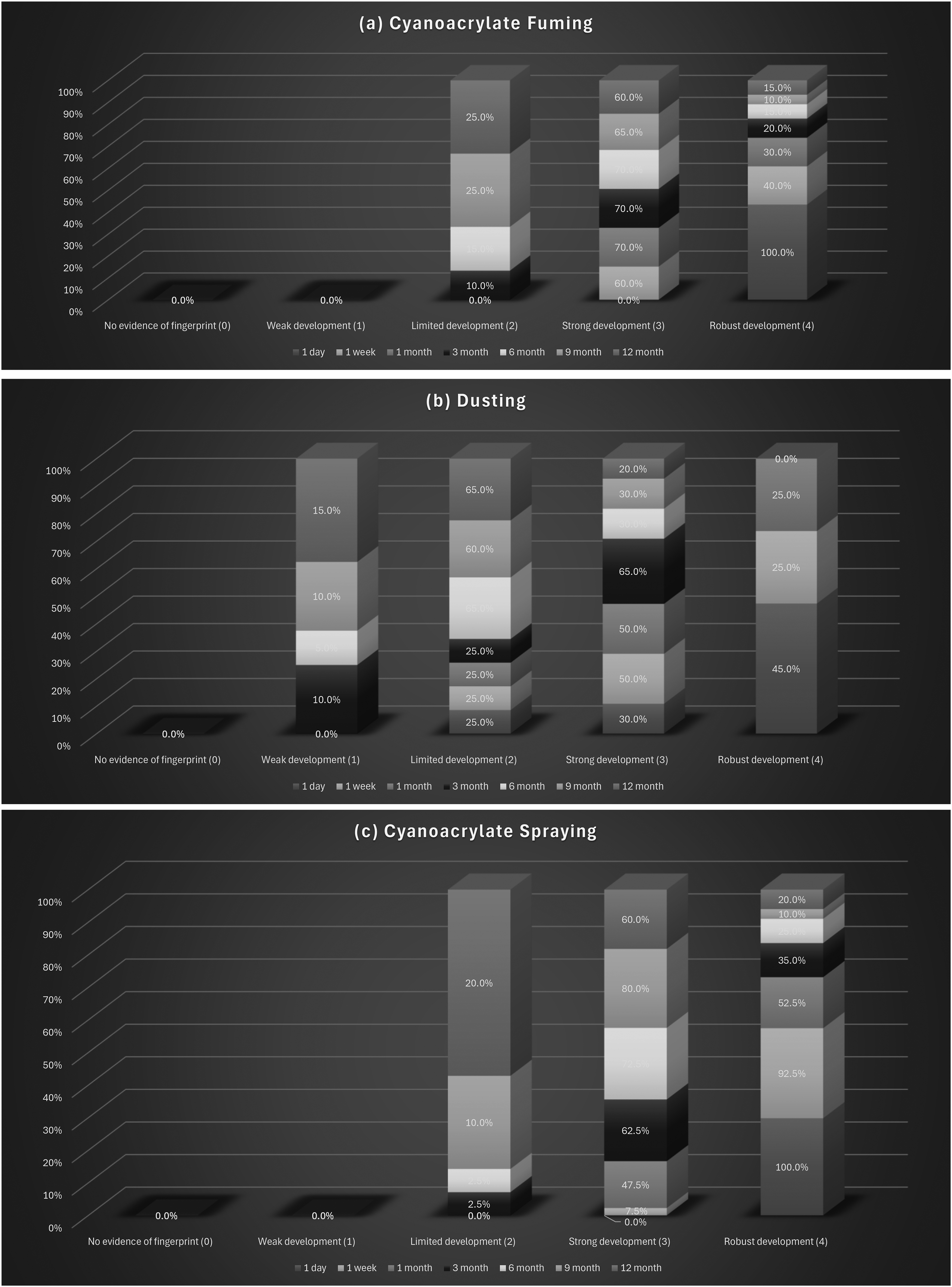
Time-dependent stack plots of fingerprint development scores for cyanoacrylate fuming (a), dusting (b), and cyanoacrylate spraying (c) methods.
According to the results analyzed using the frequency test, the cyanoacrylate spraying method provided the best result among the other methods. For instance, the number of identifiable prints (with scores 3 and 4) developed by the dusting method was lower than the other development methods, indicating that this method observed the worst results.
When the development levels of the two different fingerprint fragments treated with the cyanoacrylate spraying method were statistically evaluated, no the significant difference was observed (p = 1.000, chi-square test).
The relationship between the effectiveness of FPD techniques regarding surface types is given in Table 1 with Crosstab test results.
Crosstab test data comparing fingerprint development techniques and surface types.
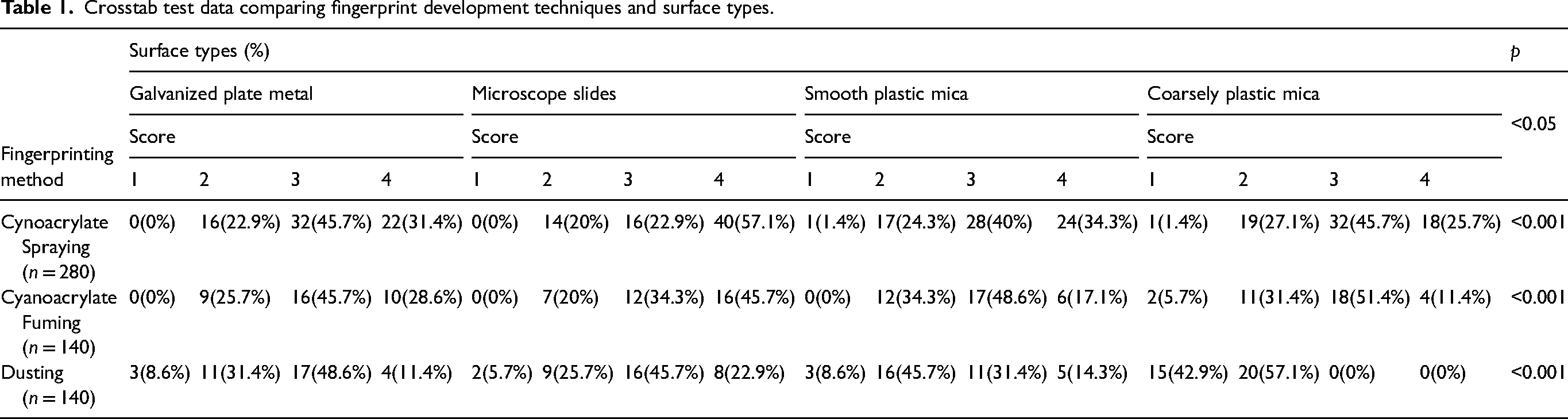
Fingerprints developed on the target surfaces by the dusting method, cyanoacrylate fuming method, and cyanoacrylate spraying method showed significant differences in terms of identifiable FPD (p < 0.001). No FPD was achieved on the rough plastic surface (0%) compared to the other surfaces with the dusting method. Moreover, each of the other surface types had a different level of development.
With the FPD methods used in the study, it was observed that the number of identifiable fingerprints (with scores 3–4) obtained from glass surfaces was higher than the number of identifiable fingerprints obtained from galvanized sheet metal parts and porous and nonporous mica surfaces. The cyanoacrylate spraying method achieved 80% success in terms of fingerprints suitable for identification on glass surfaces, while the cyanoacrylate fuming method achieved 80% success, and the dusting method achieved 68,6% success in considering identification on glass surfaces.
In addition, the development of fingerprints over different surface types with the cyanoacrylate fuming method in a single cabinet negatively affected the development of some fingerprints on the surfaces, as shown in Figure S1.
Cyanoacrylate spraying has led to the development of identifiable fingerprints with a high-contrast difference compared to other development methods (Figures 2 and 3).
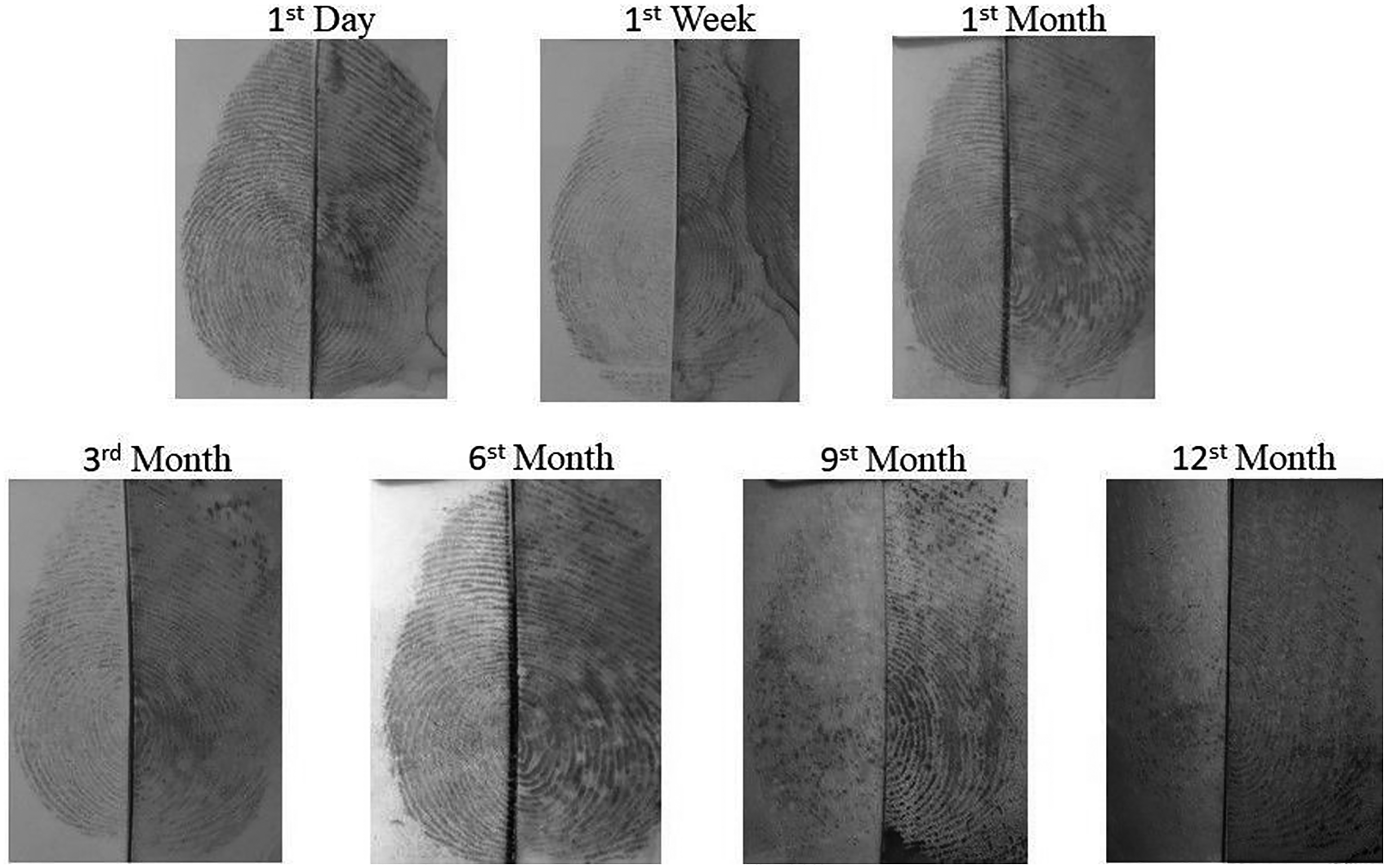
Comparison of the level of fingerprint development of the dusting method (left part of the fingerprint) and cyanoacrylate spraying method (right part of the fingerprint) on glass surfaces in all periods.
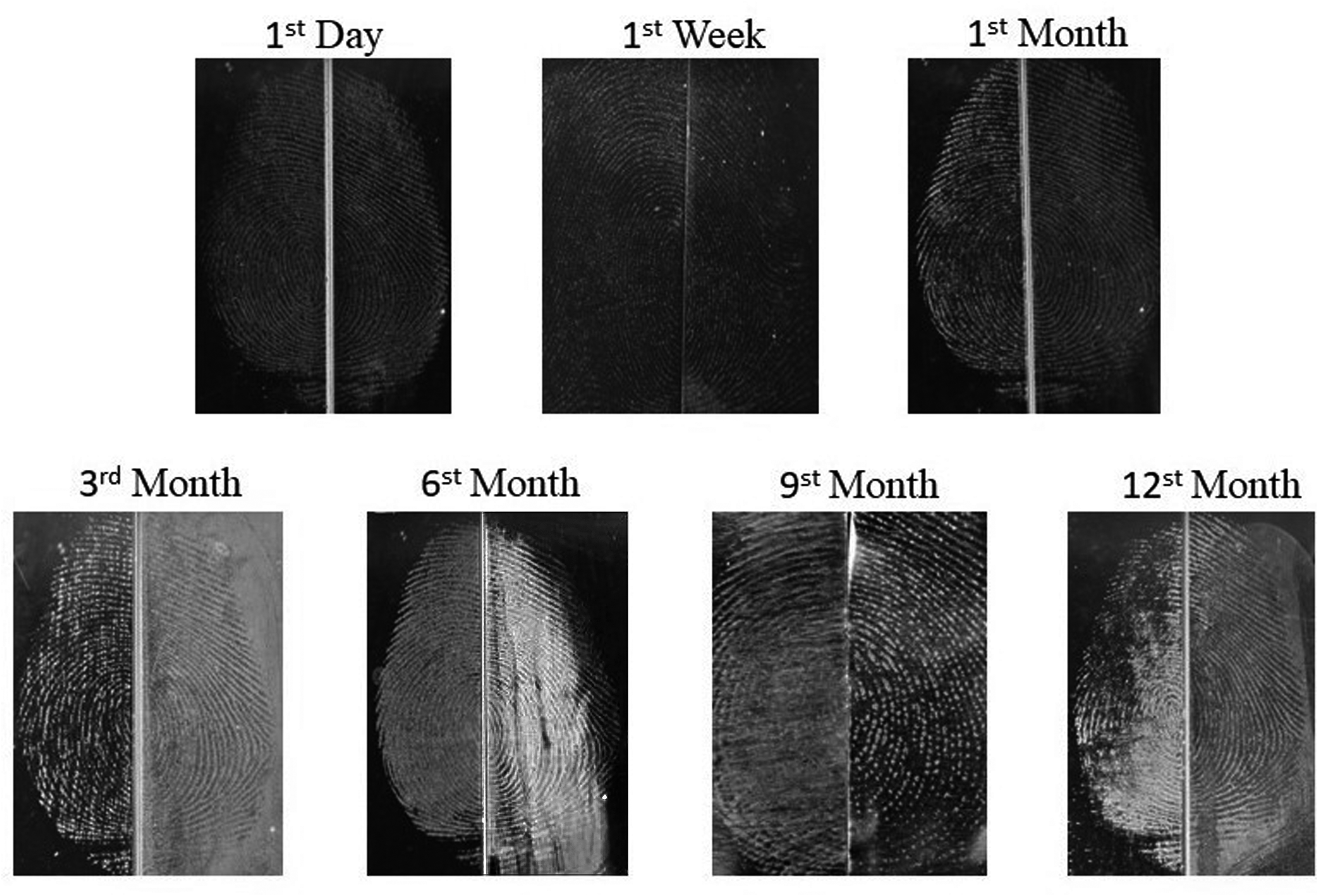
Comparison of the fingerprint development level of the cyanoacrylate fuming method (left part of the fingerprint) and cyanoacrylate spraying method (right part of the fingerprint) on glass surfaces in all periods.
Statistically, significant differences (p < 0.05) were observed in the development of identifiable fingerprints obtained with all development methods used in the study over time (Table 2).
Change in the number of fingerprints suitable for identification over time (scores 3–4).

The change in the number of fingerprints suitable for identification according to different time periods showed a significant decrease with the dusting method compared to the cyanoacrylate fuming and spraying methods.
Discussion
This study focuses on enhancing the FPD capacity through analyzing the effectiveness of different FPD methods on nonporous surfaces over time. The cyanoacrylate spraying method was evaluated to be an efficient approach for the practical application of the cyanoacrylate method in both forensic laboratories and field conditions.
In cyanoacrylate's molecular structure, the cyano group (CN) and ester group (COOR) are connected to the same carbon atom with electron attraction. Ethyl cyanoacrylate, which is used in FPD, is known to scatter light more efficiently and thus create visible fingerprints with high contrast difference.8,12 Due to these properties, molecules that react with electron-rich chemicals form chain (polymerization) reactions that form very long-chain structures with moisture in the environment within a few seconds. 13 The chain reaction that occurs with cyanoacrylate fuming and spraying methods makes fingerprints visible. The resulting fingerprints develop visibly and in white color. 14 The print development process of the cyanoacrylate fuming method, which is carried out in the cabinets of FPD laboratories, takes approximately 10–60 min, depending on the age of the fingerprint. In addition, control samples showing similar characteristics to the materials are also left in the cabin, and trace development can be monitored through the specially designed transparent glass part of the cabin. However, FPD is provided for a limited number of evidence that is transported to the laboratory. 7 Compared to the fuming method, the cyanoacrylate spraying technique offers a quicker and simpler way of developing fingerprints on evidence without requiring transportation to a lab. Additionally, the issues related to varying levels of FPD on different surface types are resolved through the use of cyanoacrylate spray. However, the flammability of the chemicals involved in the cyanoacrylate spraying technique and the toxic effects of the minimized chemicals released into the environment during its application necessitates the use of protective equipment (such as masks and gloves), which serve as limiting factors.
The cyanoacrylate spray method consists of a homogeneous mixture of hyfets and petroleum ether. Hyfet, chemically known as methoxy-nonafluorobutane (C4F9OCH3), is clear and colorless.15,16 In the prepared working solution, hyfet prevents the cyanoacrylate adhesive from being absorbed by the surface by providing a high boiling point and low surface tension. It slows down the freezing process and increases the adhesion strength. It was observed that using less than 60 mL of hyfet causes the cyanoacrylate to freeze quickly, however, when used in extensive amounts, it causes the solution to become less effective. Petroleum ether is also a colorless, volatile, easily flammable liquid. 17 To achieve the desired dilution of cyanoacrylate, petroleum ether was utilized in the experiment. However, it was discovered that exceeding the 40-mL limit of petroleum ether resulted in poor adherence of cyanoacrylate to the surface while using less than 40 mL caused the cyanoacrylate to solidify quickly. In addition to all these advantages, the producing company (3 M, USA) announced that the production of hyfet (hydro-fluoro-ether Novec 7100) will be discontinued since it is a per- and polyfluoroalkyl substance and a regular transition will be facilitated for customers. 18 Therefore, environmentally friendly solutions such as methylamine 14 for the pretreatment of aged latent fingerprints are suggested for future studies.
Fingerprints left on surfaces were divided into two parts. Although the fingerprint secretions of all people differ in content and quantity, the secretions of the same people show instantaneous differences considering the components and factors affecting FPD.1,10 This is an essential parameter in terms of keeping all conditions the same and excluding many uncontrollable variables (fingerprint content and quantity, pressure, etc.) from the comparison to determine the effect levels of FPD methods and make accurate comparisons. Applying the cyanoacrylate spraying method to different fingerprints divided into two parts shows no difference in FPD (p < 0.05). This proves the reproducibility of the cyanoacrylate spraying method under different conditions (surface, donor, etc.).
The fingerprint composition transferred to the target surface changes over time, likely altering the effectiveness of cyanoacrylate treatments. 10 Therefore, seven different aging times were determined to evaluate the FPD capacity of each surface.
The adhesion of the different chemical compounds that make up fingerprints to the surface can be affected by the nature of the surface on which they are deposited. 10 During the study, the more successful identification of fingerprints on glass surfaces, compared to other materials, can be attributed to the unique properties of glass. Its smooth, nonporous structure minimizes the absorption or dispersion of fingerprint residues, thereby preserving the clarity of ridge details. Additionally, glass surfaces facilitate the rapid evaporation of water vapor, which enhances the transfer efficiency of fingerprint residues, including sweat and epithelial cells. This concentrated deposition of fingerprint fluids on the surface improves the visibility of the prints, as supported by the findings of Pesaresi and colleagues. 19 Even if the fingerprints observed on other types of surfaces (metal, rough vs smooth plastic, etc.) are the same as the ones observed on glass surfaces, the exposure time to cyanoacrylate fuming required for print development varies. Variations in fingerprint secretions can be observed on different surfaces due to factors such as time elapsed, finger pressure during print development, and diverse surface contamination. 13 Furthermore, cyanoacrylate tends to polymerize faster on certain types of surfaces, which may result in a more robust background development. 12 For this reason, developing fingerprints from different types of surfaces with the cyanoacrylate fuming method in a single cabinet negatively affects the development of some fingerprints on surfaces.
Water-soluble molecules (lactic acid, ammonia, acetic acid, amines, alcohols, amino acids, alkanes, proteins, etc.) in the structure of the fingerprint are the key components of the polymerization reaction that takes place in the cyanoacrylate method.20,21 However, these molecules are ineffective without the appropriate humidity level in the environment, and the development of identifiable fingerprints becomes increasingly difficult as they age.7,8 In the current study, it was observed that the cyanoacrylate spraying method, which utilizes hyfet, petroleum ether, and ethyl cyanoacrylate, creates a homogeneous solution that activates the initiator components of the polymerization reaction, resulting in high-contrast, identifiable fingerprints.
Conclusion
Crime scene investigators focus on fingerprint research in areas where the suspect may have interacted. With the methods used to develop latent fingerprints on evidence that cannot be transported to the laboratory, contamination and physical friction adversely affect the development of prints, even if the evidence is somehow transported to the laboratory. As a result, to address the challenges faced, the techniques employed must be enhanced. The current study produced a cyanoacrylate spraying technique that resulted in fingerprints that can be identified with a 95% success rate on all intended surfaces. Particularly, fingerprints were observed to have been detected with 80% success on glass surfaces. The cyanoacrylate spraying technique is an efficient, cost-effective, and viable method widely employed in both forensic laboratories and crime scenes. This process involves the application of a cyanoacrylate solution to surfaces, where it polymerizes upon contact with latent fingerprints. Within 5–10 s, the solution dries, causing the latent fingerprints to become immediately visible due to the polymerization reaction. The resulting marks can subsequently be enhanced through additional procedures, increasing their clarity for identification purposes. This technique has several advantages over the cyanoacrylate vapor method, including the reduction of harmful gas emissions into the environment. Additionally, this technique is known for its promptness, and effectiveness in developing latent fingerprints.
Supplemental Material
sj-docx-1-msl-10.1177_00258024251332536 - Supplemental material for An innovative approach to latent fingerprint development at crime scenes: The cyanoacrylate spraying methodology
Supplemental material, sj-docx-1-msl-10.1177_00258024251332536 for An innovative approach to latent fingerprint development at crime scenes: The cyanoacrylate spraying methodology by Yakup Gulekci in Medicine, Science and the Law
Footnotes
Compliance with ethical standards
Written informed consent was obtained from all participants. This research was approved by the Ethics Committee of Kütahya Health Sciences University with the Ethical Approval code of 2023/04-29.
Declaration of conflicting interests
The author declared the following potential conflicts of interest with respect to the research, authorship, and/or publication of this article: Cyanoacrylate spraying method applied in the study; The national patent registration was made with the file number TR 2018 12245 B based on the Turkish Patent and Trademark Office letter dated 27.02.2023 and numbered E-39616753-110-230154901.
Funding
The author received no financial support for the research, authorship, and/or publication of this article.

Supplemental material
Supplemental material for this article is available online.
References
Supplementary Material
Please find the following supplemental material available below.
For Open Access articles published under a Creative Commons License, all supplemental material carries the same license as the article it is associated with.
For non-Open Access articles published, all supplemental material carries a non-exclusive license, and permission requests for re-use of supplemental material or any part of supplemental material shall be sent directly to the copyright owner as specified in the copyright notice associated with the article.
