




Abstract
Highlights
Using CiteSpace software to visually analyze literature from 2014 to 2023, the study reveals the evolution and changes in research hotspots related to postmortem interval estimation, particularly the applications of forensic entomology, forensic microbiomics, and artificial intelligence.
The study conducted a bibliometric analysis of 1778 relevant papers worldwide, predicting that approximately 150 new articles will be published by 2024, indicating steady growth in this field over the past decade. Also, forensic entomology and proteomics are current research hotspots, accounting for a significant proportion.
Future research trends are likely to focus on the integration of multiomics approaches with artificial intelligence, aiming to build more accurate models for postmortem interval estimation, enhancing precision in forensic science.
Emerging technologies such as proteomics, microbiomics, and genomics bring new hope to postmortem interval estimation, providing more scientific and precise methods, especially when traditional techniques face challenges.
Introduction
Postmortem interval (PMI) refers to the interval that has passed after an individual's death, specifically the duration between the discovery and examination of a deceased body and the actual occurrence of death. 1 In forensic practice, especially when it involves a homicide case, the ability to quickly determine the PMI becomes crucial for solving the case. However, estimating PMI is challenging and complex, as homicide cases may involve a lack of evidence or potential body tampering, which can hinder the investigation and allow the perpetrator to evade justice. 2
Besides the testimonies of eyewitnesses and non-scientific criminalistic or scene markers, scientific biomedical techniques are the main sources of time since death estimation. 3 Conventional methodologies for estimating the PMI predominantly rely on observing early cadaveric phenomena, primarily morphological evidence, including corpse temperature analysis, evaluation of cadaveric ecchymoses, and examination of cadaveric rigidity. 4 This approach remains one of the most prevalent in forensic practice. Concurrently, the advent of forensic entomology and postmortem microbiomics has significantly propelled the field of postmortem interval estimation. Furthermore, novel technological approaches such as gene sequencing, 5 vibrational spectroscopy, 6 and artificial intelligence 7 have been applied to this field, bringing fresh hope to the study of postmortem interval estimation.
In summary, the research landscape for postmortem interval estimation is expansive, and the volume of publications remains steady, rendering bibliometric analysis indispensable for identifying research foci and forecasting future developmental trajectories in this field. Accordingly, the present study utilizes CiteSpace software to conduct a visual bibliometric analysis of pertinent literature in the domain of postmortem interval estimation sourced from the Web of Science Core Collection. The objective is to visually delineate the current research hotspots and elucidate the evolutionary logic underlying these trends, ultimately predicting future developments and providing a foundation for prospective investigations in this field. Meanwhile, this study identifies key research topics and trends to provide valuable insights and guidance for scholars and forensic professionals in the field.
Materials and methods
Data source
Using the Web of Science Core Collection as the data source, a literature search was conducted with the following topic search formula: ((postmortem interval OR post-mortem interval OR PMI OR postmortem period OR time of death OR time since death OR death time OR death period OR moment of death OR post-mortem interval) AND (forensic OR legal)). Inclusion criteria: articles that matched the search formula and were publicly available. Exclusion criteria: (1) articles unrelated to the topic; (2) reviews, news reports, conference abstracts, calls for papers, and similar content. Additionally, following the preliminary search results, one author will independently perform manual screening. In cases of uncertainty, the second author will assist in determining whether to exclude it. To ensure the accuracy and reliability of the included data, we adhere to a detailed protocol outlined in Supplemental Figure 1. If both authors have doubts about specific data, it will be excluded to maintain the professionalism and stability of the results. The literature search was conducted in two stages. To obtain an overall picture of the publication volume in the field of postmortem interval estimation, the first search covered the entire Web of Science Core Collection from its inception until December 31, 2023. The annual publication volume and citation data were then calculated, and trends were analyzed. Based on these annual publication volumes, a second search was performed for the period during which the publication volume exceeded 100 articles per year and remained stable, specifically from January 1, 2014, to December 31, 2023.
Visualization analysis items
For the first set of retrieved literature, the annual publication volume and citation counts were calculated, and the trends were analyzed. For the second set of retrieved literature, the total number of publications was determined, and the annual publication growth rate was calculated. Microsoft Office Excel 2021 (Microsoft Corporation, USA) was used to create combination charts, and a trend line was used to predict the number of publications in this field for 2024. The annual publication growth rate was calculated using the following formula: Annual publication growth rate = (publication volume in the current year − publication volume in the previous year)/publication volume in the previous year * 100%.
For the second set of retrieved literature, the following metrics were analyzed: (1) source journal analysis: the number of journals contributing to the publications was analyzed. Additionally, the top 10 journals by publication volume were examined for their research focus, country of publication, impact factor, citation score, and classification within the Chinese Academy of Sciences (CAS). (2) Citation analysis: the keywords of the cited references were clustered using the log-likelihood ratio (LLR) algorithm, and a timeline graph was generated to visually display past and current research hotspots. The top five cited references were analyzed based on citation frequency, betweenness centrality, and sigma value, and their conclusions were summarized to highlight the main directions of research in postmortem interval estimation. In the clustering analysis, clusters were ranked by size, with the largest cluster labeled as #0, followed by #1, and so on. (3) Keyword analysis: a keyword clustering analysis was performed, and a timeline graph was generated. Additionally, the burst detection algorithm was used to generate a list of burst keywords (hereafter referred to as “burst terms”), and the top 10 burst terms by intensity were displayed. Burst intensity reflects the frequency change of a burst term over a period of time, with higher intensity indicating more attention. By analyzing high-intensity burst terms, future research hotspots in the field can be predicted.
Data processing
Count data is expressed as frequency (percentage). CiteSpace 6.2.R4 software was used to perform co-occurrence network and burst analysis on the 1265 articles retrieved in the second search, focusing on journals, countries, cited references, and keywords. The parameter settings were as follows: time slice was set to 1 year, the scaling factor (k value) was manually adjusted to 9, and the network link strength was calculated using the cosine algorithm. All other options were kept at their default settings. The node types selected for the analysis were journals, countries, cited references, and keywords. CiteSpace uses the Latent Semantic Indexing (LSI) algorithm to extract cluster labels. The software provides two metrics [Modularity Value (Q-value)] and [Mean Silhouette Value (S-value)] to assess the clarity and effectiveness of the visualized clusters. A Q-value greater than 0.3 indicates a significant clustering structure, while an S-value greater than 0.7 suggests that the clustering is highly convincing. An S-value above 0.5 generally indicates that the clustering is reasonable. These metrics help ensure that the visualized network and clusters effectively represent the underlying research patterns.
Results
Analysis of annual publication volume
Based on the searching formula, 8621 articles were obtained during the pre-detection phase. To ensure the accuracy and professionalism of the results, the formal retrieval process was divided into two stages. Following manual screening (Figure S1), the final results reveal that the overall development of this field can also be categorized into two distinct stages: (1) 1998–2013, during this period, the annual number of publications remained below 100, and the publications were not continuous year by year. (2) 2014–2023, from 2014 onward, the annual publication volume and the number of citations generally showed an upward trend, with slight fluctuations, but the volume remained consistently high overall (see Figure 1).

The annual number of publications and citations of literature related to inferring postmortem interval research in the core collection of the Web of Science database from 1998 to 2023.
For the second stage, which was limited to the period from January 1, 2014, to December 31, 2023, a total of 1265 articles were retrieved. The average annual growth rate of publications during this period was 6.84%, with a peak growth rate of 35.61% observed in 2023. Based on the trend line for this period (y = 99.872x, R2 = 0.5659; where e is the natural logarithm, x represents the year, and R² indicates the goodness of fit, with values closer to 1 representing a better fit), it is predicted that the number of publications in this field will reach 150 in 2024 (see Figure 2).
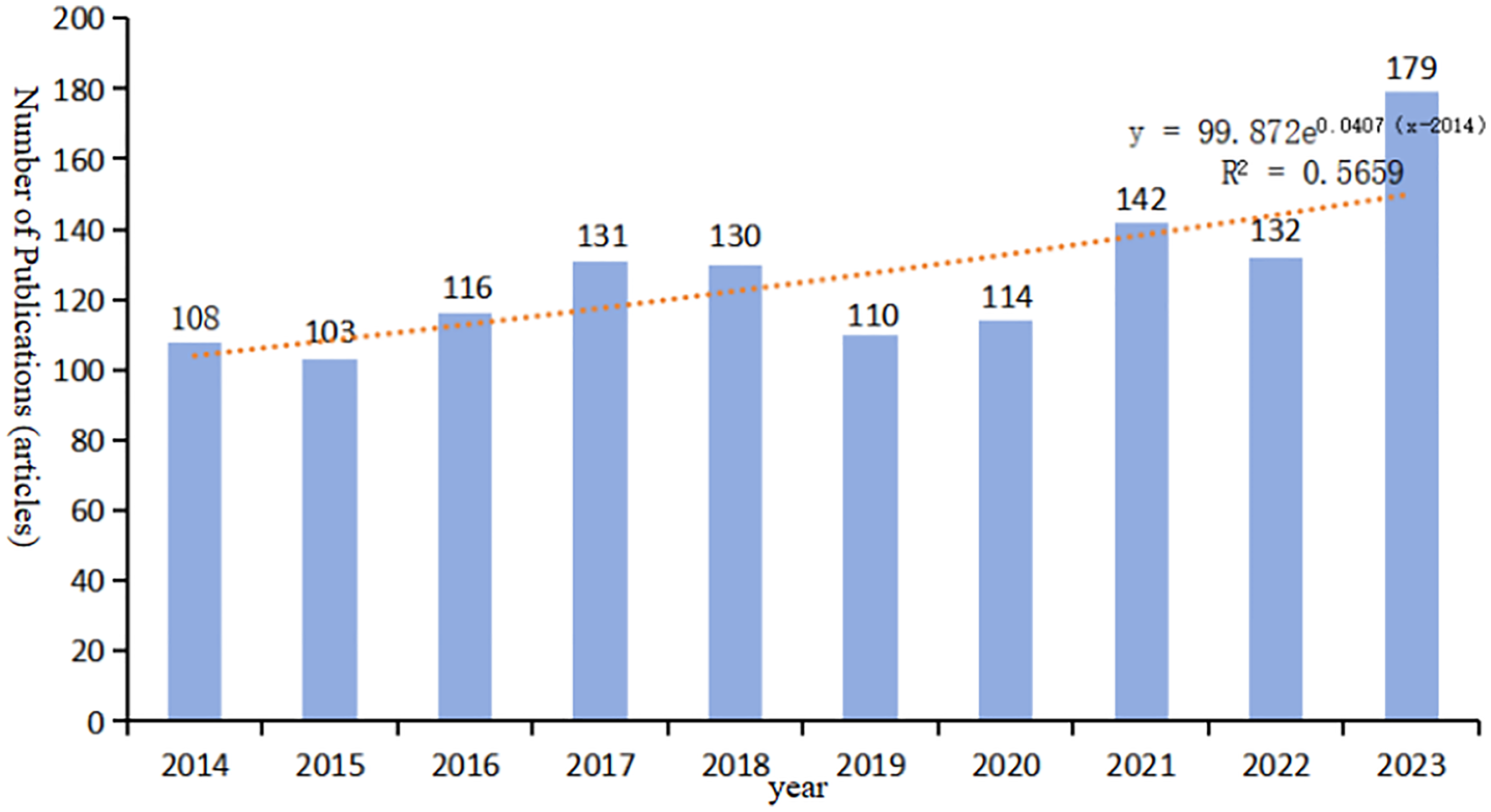
The annual number of publications and trend line of literature related to inferring postmortem interval research in the core collection of the Web of Science database from 2014 to 2023.
Analysis of source journals of papers
The second literature stage identified publications in 225 different journals. A total of 748 relevant papers were published in the top 10 journals, accounting for 59.13% (748/1265) of the total. These journals primarily focus on research areas such as forensic science, entomology, and pathology, with the majority of publications originating from countries like the United States and the United Kingdom. According to the Chinese Academy of Sciences journal classification standards, one of these journals falls into the second quartile (Q2). See Supplemental Table 1 for details.
Analysis of countries (regions) and institutions from the second literature search
A collaboration network map of countries (regions) and institutions was generated based on the results of the second literature search. As shown in Figure 3, the co-occurrence network of countries (regions) has a density of 0.097, consisting of 71 nodes and 24 edges. The largest node is the USA, with 214 publications, accounting for 16.92% of the total literature, ranking first, followed by the People's Republic of China and Italy. At the same time, the USA has the highest betweenness centrality, with a score of 0.50. Other countries (regions) with a betweenness centrality greater than 0.1 include the United Kingdom (0.31), Italy (0.21), Spain (0.16), Switzerland (0.12), and Finland (0.11).
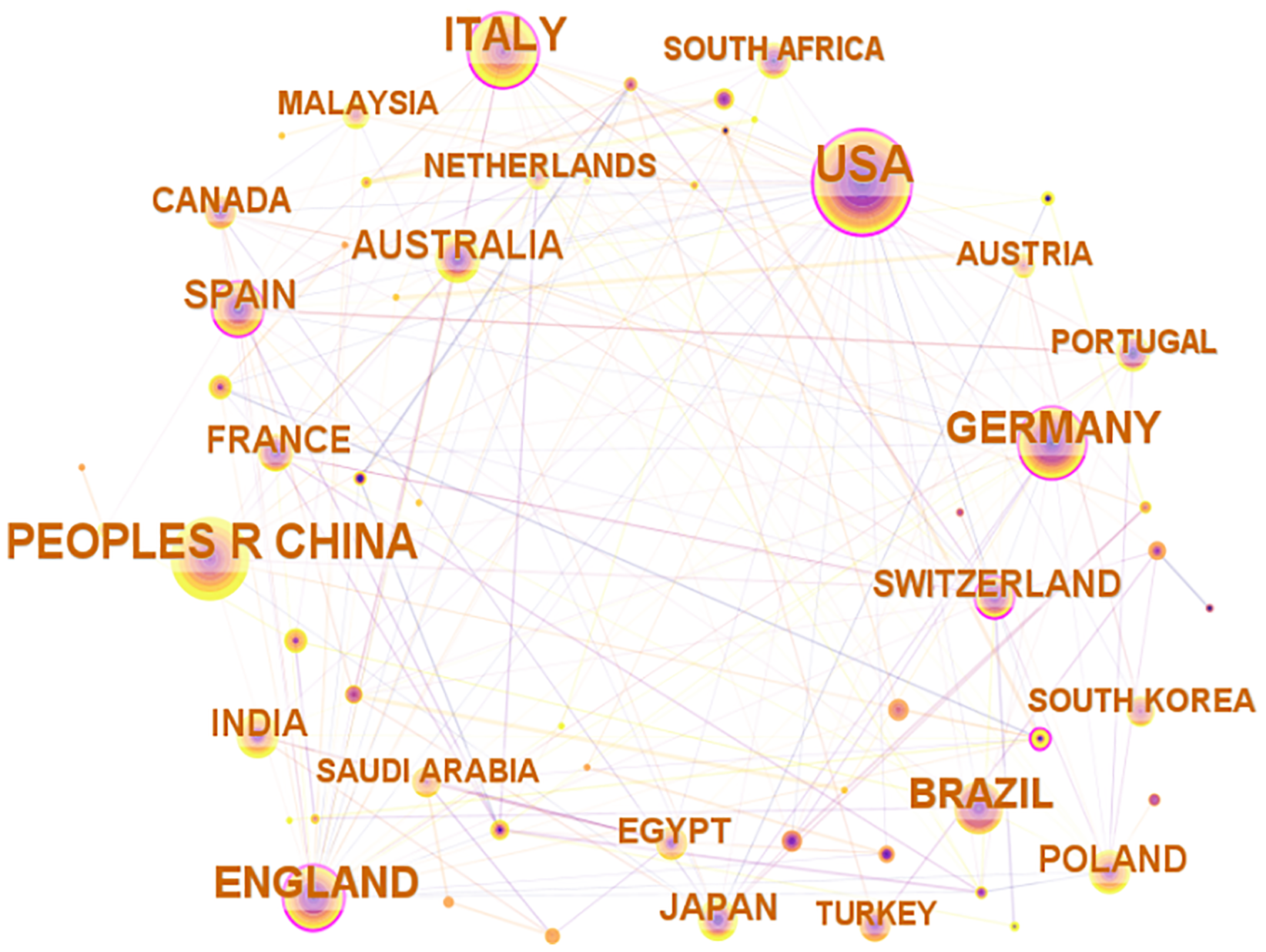
Country (region) collaborative networks for the research field of postmortem interval. The size of the nodes represents the number of publications from each country (region), with larger nodes indicating higher publication counts. The color of the circle within the nodes represents the publication years of the articles. The lines between the nodes indicate collaboration relationships, with the thickness of the lines reflecting the strength of the collaboration, and the color corresponding to the first time the nodes co-occurred.
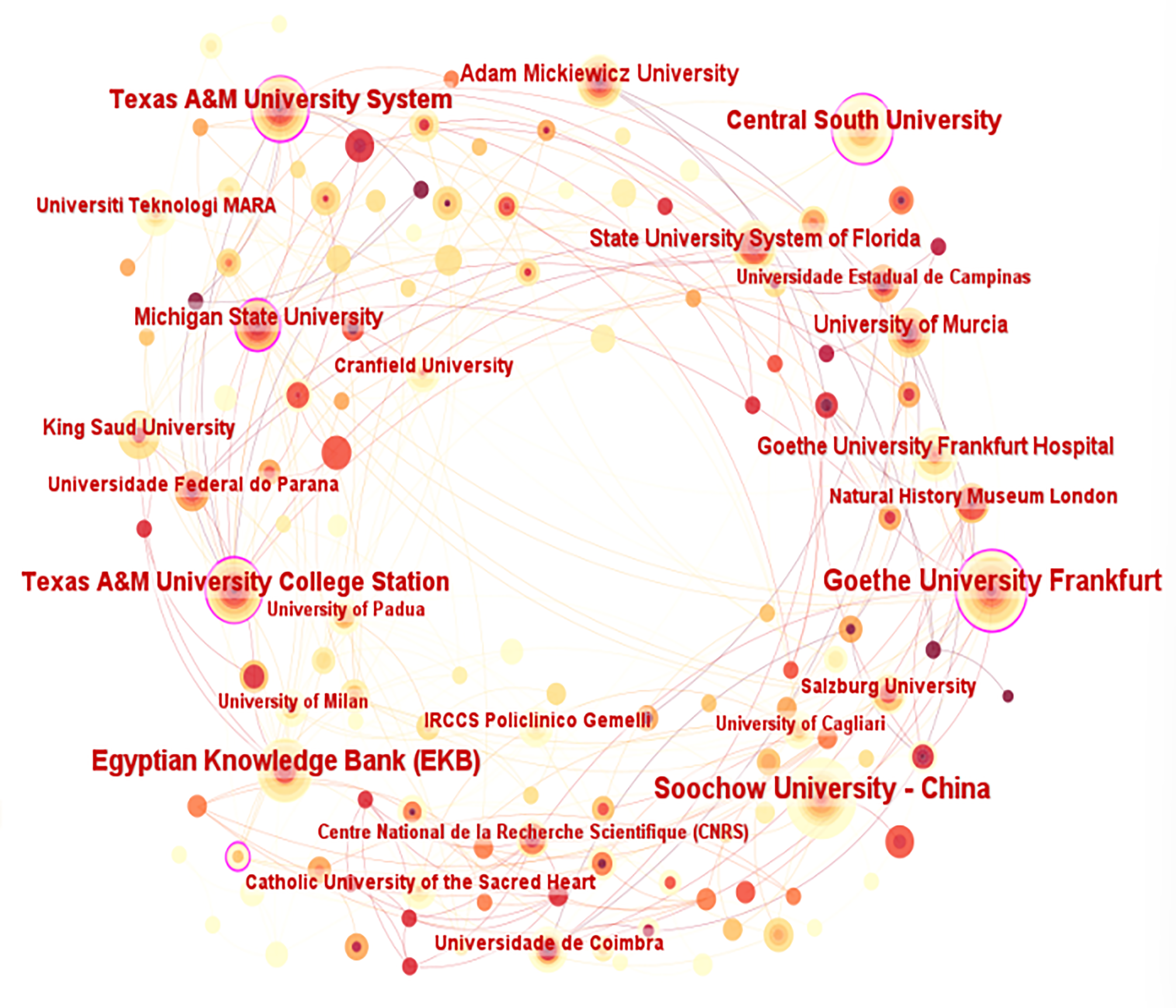
Institutions collaborative networks for the research field of postmortem interval. The size of the nodes represents the publication volume of each institution, with larger nodes indicating a higher number of publications. The color of the circle within the nodes reflects the publication year of the articles. The lines between the nodes represent collaboration relationships, with the thickness of the lines indicating the strength of the collaboration, and the color corresponding to the first time the nodes co-occurred.
A total of 211 institutions are engaged in research related to the estimation of postmortem interval, but only seven institutions have published more than 20 papers (Figure 4). Among the top five institutions by publication volume, Soochow University ranks first with 45 papers, followed by Goethe University Frankfurt (42 papers), Egyptian Knowledge Bank (31 papers), Central South University (29 papers), and Texas A&M University (27 papers).
Citation analysis
Cluster analysis revealed that the keywords of the cited references formed 295 nodes and 7 major clusters (Q = 0.69, S = 0.91), as shown in Figure 5(a). The timeline chart indicates that the primary clusters from 2009 to 2015 were #0 Forensic Entomology, #3 Postmortem Microbiome, and #6 Cytochrome Oxidase, while the primary clusters from 2016 to 2023 were #1 Decomposition, #2 Putrefaction, #4 Artificial Intelligence, and #5 Forensic Identification, as shown in Figure 5(b). Among these, the clusters #0 Forensic Entomology, #3 Postmortem Microbiome, #4 Artificial Intelligence, and #6 Cytochrome oxidase from the citation network of the second literature search showed the closest co-occurrence relationships, as seen in Figure 5(c).
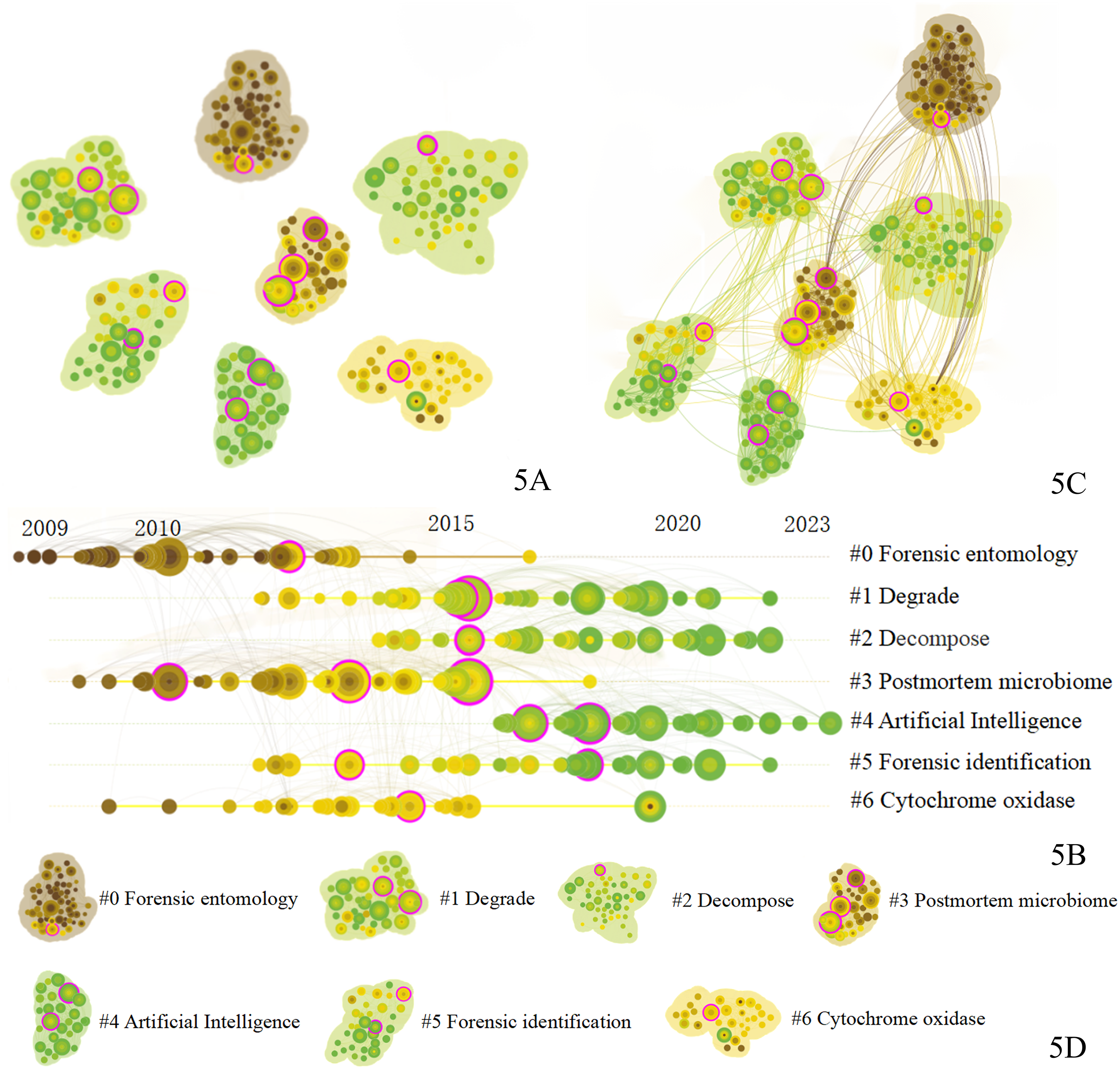
Keyword cluster analysis of cited literature of literature related to postmortem interval research in the core collection of the Web of Science database from 2014 to 2023. The nodes represent the keywords of the cited references, with larger nodes indicating a higher co-citation frequency. In (b) and (c), the lines between nodes represent co-occurrence relationships. In (b), the cluster numbers reflect the cluster size, with larger numbers indicating smaller clusters.
An analysis of the top five cited references based on citation count, betweenness centrality, and Sigma value indicates that key research areas include the estimation of postmortem interval through forensic entomology, the use of postmortem microbiomes and microbial communities in time of death estimation, and emerging gene-level technologies for estimating postmortem interval. See Supplemental Table 2 for details.
Keyword analysis of the second literature search
A comprehensive analysis was conducted on the keywords from the second literature search, and the keyword co-occurrence knowledge map is shown in Figure 6(a). The map consists of 287 nodes and 2052 lines. Among them, “death” has the highest betweenness centrality at 0.12, ranking first, followed by “forensic entomology” at 0.11. “identification,” “degradation,” and “age” all rank third with a centrality of 0.09, suggesting that forensic entomology is an important research direction in estimating the time of death.
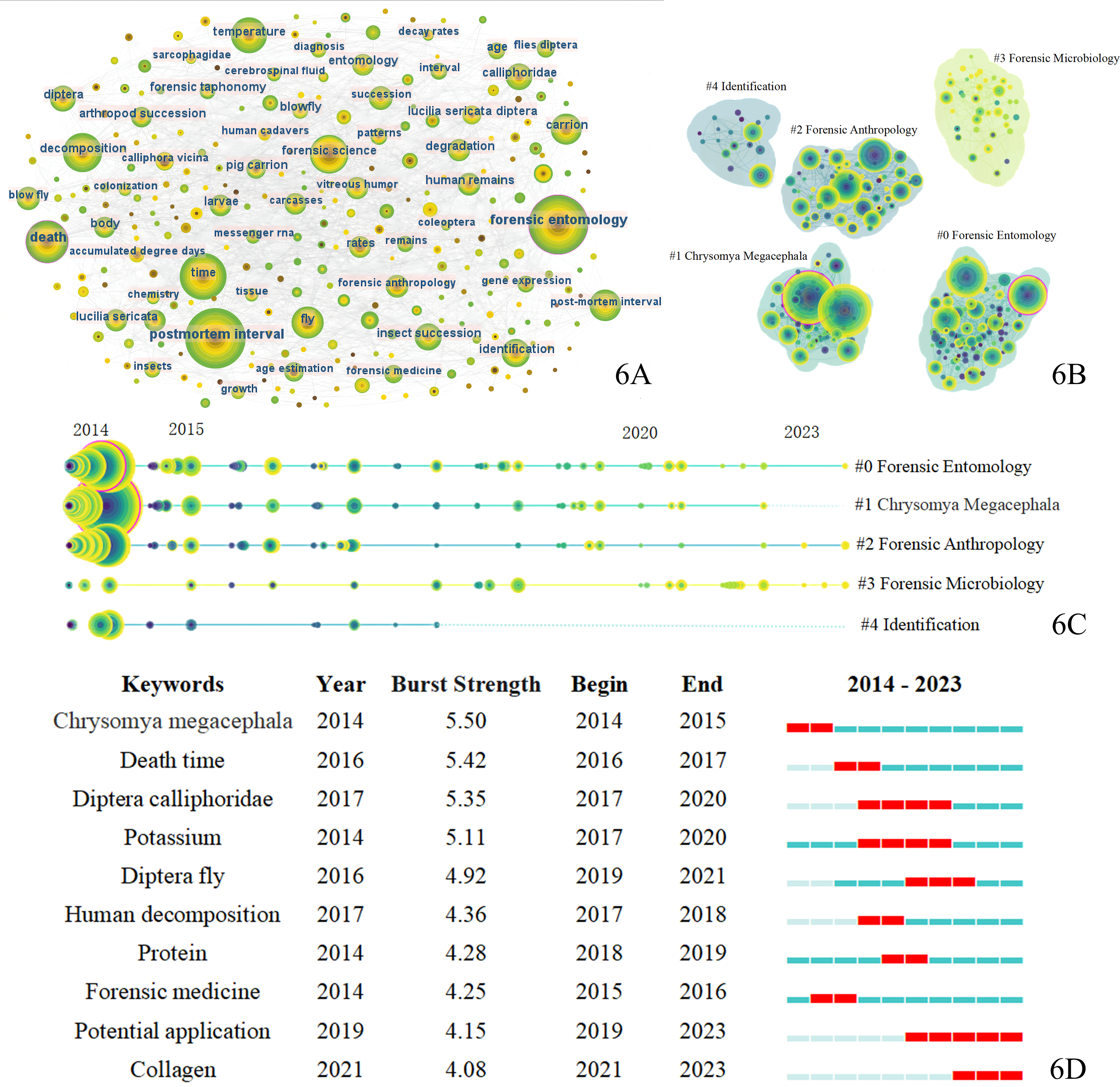
Keyword co-occurrence cluster analysis of literature related to postmortem interval research in the core collection of the Web of Science database from 2014 to 2023. (a) Keyword co-occurrence network. (b) Keyword co-occurrence analysis cluster network. (c) Timeline of the top five clusters in keyword co-occurrence analysis. (d) Top 10 burst keywords by burst intensity. In (a)–(c), the nodes represent keywords, with larger nodes indicating a higher frequency of keyword occurrence. In (b) and (c), the closer the node color is to yellow, the closer the occurrence of the keyword is to 2023; the closer it is to dark blue, the closer the occurrence is to 2014. The cluster numbers in (b) and (c) reflect cluster sizes, with larger numbers indicating smaller clusters. In (c), the position of the node corresponds to the first occurrence of the keyword. In (d), bright blue represents keywords with low burst intensity, while light blue represents keywords that have not appeared. In (b)–(d), red represents keywords with high burst intensity.
The interactions between keywords were analyzed using LSI to extract clustering labels, resulting in a clustering modularity value of Q = 0.40 and an average silhouette value of S = 0.73, indicating that the clustering structure is significant and the results are convincing. Five main clusters were formed: #0 Forensic Entomology, #1 Chrysomya Megacephala, #2 Forensic Anthropology, #3 Forensic Microbiology, and #4 Identification, as shown in Figure 6(b).
The timeline shows that the second literature search was primarily focused on Cluster #3 Forensic Microbiology and #4 Identification from 2016 to 2023, while it was primarily focused on Cluster #0 Forensic Entomology, #1 Chrysomya Megacephala, and #2 Forensic Anthropology before 2015, as shown in Figure 6(c).
Burst word analysis identified 38 burst terms, with the top 10 burst terms being Chrysomya megacephala, death time, diptera calliphoridae, potassium, diptera flies, human decomposition, protein, forensic science, potential applications, and collagen, each with different starting and ending timeframes. In the early to mid-period (2014–2020), forensic entomology remained a research hotspot in this field. Since 2020, the exploration of potential applications for time of death estimation began, with continuous advancements in biochemical indicators in this area. Among the high-intensity burst terms, “Diptera calliphoridae” and “Diptera fly” belong to Cluster #0 Forensic Entomology, while “Potassium,” “Protein,” and “Collagen” belong to Cluster #4 Identification, as shown in Figure 6(d).
Discussion
Bibliometric analysis is a type of study that statistically analyzes scientific articles to describe citation relationships across publications and research trends in a certain field, being valuable for statistically evaluating researcher contributions across countries. 8 In the present study, we performed bibliometric analysis to understand worldwide trends in postmortem interval research, focusing on specific topics within the discipline across a nearly 10-year period. To the best of our knowledge, this is a study to perform bibliometric analysis on the global scientific body of research on postmortem interval via the Web of Science Core Collection databases.
The number of scientific publications is an intuitive indicator that could reflect the development of the discipline based on bibliometrics. 9 The substantial variation in the number of articles published annually may signal a significant turning point in this field. This study focuses on analyzing the relevant literature from the past decade, as the number of publications surpassed 100 in 2014 and has exhibited a consistent upward trend each year since. This suggests that the field of PMI estimation is experiencing a period of rapid development and growing interest. Inevitably, certain omissions may occur during the research process, such as limitations in retrieval strategies, including the selection of article types and languages. However, we have made every effort to ensure a strong correlation between the retrieved literature and the study's objectives by carefully refining the inclusion criteria. Articles with uncertainties were excluded to uphold the rigor of the study. These measures have minimized potential biases, ensuring that the final results remain robust and exhibit trends consistent with those reported by most researchers. 10 Furthermore, several key hotspots identified in the final analysis align closely with the findings of other scholars.11–13
Journal and subject category are the basic units in bibliometric analysis. 14 As per the top 10 journals list, Forensic Science International, International Journal of Legal Medicine and Journal of Forensic Sciences made the most contributions to scientific research, and the number of published articles has exceeded 100. Citations are an intuitive but imperfect indicator of the author's impact in a specific field of research. 14 However, based on a multi-angle analysis of the cited literature, we found that the article Microbial community assembly and metabolic function during mammalian corpse decomposition published in Science, ranks in the top two positions in three key metrics: highly cited references, high betweenness centrality, and high sigma values. Additionally, Methods for determining time of death published in Forensic Science, Medicine and Pathology, ranks in the top three for highly cited references and high sigma values. These results further confirm the quality and impact of publications in this field. As for research hotspots and trends, a more detailed explanation is provided in the following text.
Current research status and hotspot analysis of postmortem interval estimation
Prior to 2020, high-frequency keywords pertaining to postmortem interval estimation were predominantly concentrated around 2018 within cluster #1 Calliphora. Before 2020, cited literature primarily centered on investigations in forensic entomology and postmortem microbiomes, indicating that the application of forensic entomology in postmortem interval estimation constituted a research hotspot during this period.
In 1855, Bergeret established the initial connection between entomological observations and postmortem interval (PMI) estimation. Forensic entomology primarily serves to estimate the PMI in cases of suspicious deaths. According to the highly cited literature mentioned above, forensic entomology can also assist in uncovering the cause of death and, in certain cases, may contribute to identifying the victim. 15 This is particularly beneficial in addressing the demands of criminal investigations. Forensic entomologists have endeavored to utilize the development or succession patterns of necrophagous insects to estimate PMI. 16 During the early decomposition process, the PMI estimation using entomology depends on the time required for insect species present at the death scene to reach specific developmental stages. 17 In this study, the high-frequency burst keyword “Calliphora” represents a common necrophagous fly, and accurately determining the developmental stages of pupae has significant reference value for PMI estimation. Typically, observations of pupal structures and morphological changes provide effective estimates, 17 but temperature and humidity are crucial factors affecting larval development, body decomposition, and degradation. 18 In practical forensic scenarios, technical methods like micro-computed tomography (micro-CT), 19 vibrational spectroscopy, and gene expression analysis can significantly reduce the interference of environmental factors.
Furthermore, several high-betweenness centrality keywords in this study (e.g., “degradation” and “period”) are also associated with forensic entomology, providing further validation. However, in forensic work, extreme conditions of the body (such as severe decomposition or skeletonization) may render insect evidence other than pupal cases unsuitable for PMI estimation. 20 With advances in technology and science, new alternative methods have emerged. For instance, estimating the time of death using volatile organic compounds released by pupae may further improve accuracy. 17
Chrysomya megacephala belongs to the genus Chrysomya in the family Calliphoridae, order Diptera. Diptera are among the earliest insects to participate in the decomposition of animal remains, 21 making them an important parameter in forensic science. Dipteran insects involved in the decomposition of animal carcasses are diverse, with flies being considered the most active insects. 22 Therefore, these findings align with the high-intensity burst keywords in this study (e.g., Diptera Calliphoridae, Diptera flies), and the keyword clustering map also reflects the presence of forensic microbiology and postmortem microbiomes.
In this study, the keyword clustering timeline of the cited references shows that the early high-intensity keywords mainly focused on forensic entomology and postmortem microbiomes. Researchers have investigated the influence of microbe-insect interactions on PMI estimation. CROOKS et al. 23 studied the effects of Escherichia coli and Staphylococcus aureus on the colonization and growth of Lucilia sericata, Calliphora vicina, and Calliphora vomitoria to better understand microbe-insect interactions and improve the estimation of the minimum PMI. Weatherbee et al. 24 characterized the microbiomes associated with the surface of pig carcasses, the necrophagous dipteran larvae in the environment, and the dipteran larvae colonizing the pig carcasses using 16S amplicon sequencing. They observed alterations in the relative abundance of various fly species within the community, and the presence of specific Calliphoridae species within the community was potentially correlated with temporal changes in the microbial community, suggesting substantial interactions among the environment, microorganisms, and insect larvae. Thus, early studies in both entomology and microbiology exhibited high citation intensity.
Analyzing the highly cited, high betweenness centrality, and high sigma references in Supplemental Table 2 reveals that using microbial community succession data for PMI estimation is a valuable investigative tool in forensic practice. Since mammalian corpses and microbes are crucial to nutrient cycling in the environment, and the microorganisms driving decomposition across different hosts and environments are somewhat similar, the decomposition process of mammalian remains may involve a predictable microbial sequence, 25 providing an ecological basis for using microbial communities to estimate PMI. The high-throughput metagenomic sequencing method, frequently mentioned in Supplemental Table 2, is also closely related to microbial communities. The concept of metagenomics was first proposed by Handelsman al. 26 in their study of soil microbes, overcoming the limitations of traditional research, which could not culture and sequence multiple microorganisms on a large scale. Researchers have used high-throughput sequencing to analyze marker genes (16S rRNA,27–30 18S rRNA,31,32 or ITS33,34) for each microbial group and employed these marker genes as predictive features to learn the relationship between the microbial community structure and decomposition time points, ultimately establishing PMI estimation models.
Figure 6(d) of this study demonstrates that protein emerged as a high-frequency burst term during 2018–2019, while collagen became a high-frequency burst term during 2021–2023, suggesting that proteomics represents one of the recent research hotspots. In comparison to entomology and microbiology, proteins exhibit greater persistence in damaged or decomposed bodies, yielding more reliable information for forensic investigations.
In fact, over the years, several studies have combined histological and ultrastructural analyses 35 and immunohistochemistry36–38 to determine morphological parameters in human tissues, thereby identifying the expression and specific localization of protein markers related to PMI. Collagen is a protein widely present in the extracellular matrix of various connective tissues, with type I collagen accounting for about 90% of the total collagen in humans, making it a potentially ideal parameter for estimating PMI. 39 Additionally, compared to other functional or structural proteins, collagen has become a research hotspot due to its lower time-dependent degradation. 39 For example, the rate of pathological degradation of macromolecules in the extracellular matrix (ECM) of hyaline cartilage could be verified by assessing the intensity of collagen and proteoglycan (PG) staining, thereby determining the PMI. 40 In the presented in vitro pilot study, this methodology was used for the first time to determine PMI.
Proteins undergo systematic degradation at regular intervals after the death of an animal. Researchers have observed the degradation patterns of specific proteins, such as protein phosphatase 2A, desmin, and troponin, in standardized animal models using sodium dodecyl sulfate-polyacrylamide gel electrophoresis (SDS-PAGE) and Western blot analysis,41,42 which can be used to estimate the PMI. Although proteomes may undergo many postmortem modifications, each protein has inherent stability and tends to maintain its native structure. 43 This time-dependence is also observed in skeletal muscle, for example, in proteins such as α-tubulin, α-actin, vinculin, sarcoplasmic/endoplasmic reticulum Ca 2+ ATPase (SERCA1), and glyceraldehyde-3-phosphate dehydrogenase (GAPDH), as well as their associated low-molecular-weight proteolytic fragments, which may appear or disappear within specific postmortem intervals. 44 It is also noteworthy that collagen's role has been observed to decline over time in various studies involving bone, gingival, and kidney tissues, even when different methods are used. 43 Therefore, according to different legal cases, how to quickly select suitable tissue for collagen detection is a key issue that we should pay attention to.
In today's research context that combines multi-omics approaches, proteomic research techniques have matured, becoming more precise. Protein chips 45 represent a novel type of biochip. Their principle entails immobilizing known protein products labeled with specific fluorescence onto a chemically treated solid-phase carrier. This allows for the capture of the target protein that specifically binds to the known protein. Subsequently, washing, purification, and measurement of the fluorescence intensity of each spot on the chip are performed. Finally, computer analysis is employed to identify the different proteins. The spectral peaks and peak contents of protein chips for different postmortem intervals show differences, with varying trends and degrees, 46 thereby providing evidence for estimating the time of death. Additionally, protein chip technology is widely used in areas such as gene expression screening, antigen-antibody detection, biochemical reaction detection, drug screening, and disease diagnosis.47,48
Proteomics technology enables precise quantification of proteins at different postmortem time points, exploring their changes to estimate the time of death. This approach also investigates protein–protein interactions, as well as DNA–protein and RNA–protein interactions, to elucidate the mechanisms of unexplained deaths. 49 DNA and RNA, which are also biological macromolecules, are hotspots of research in the field of time of death estimation and have matured significantly. Techniques such as single-cell gel electrophoresis (SCGE), 50 flow cytometry (FCM), 51 and real-time quantitative PCR (qPCR) 52 can be used to observe the degradation of DNA or RNA, calculate the ratio to intact cells, or establish models using computer analysis to estimate PMI values.
Compared to the relatively stable DNA molecules in vivo, studies using only one type of RNA for PMI estimation are relatively rare. Most studies conduct multi-indicator analyses by combining miRNA, lncRNA, circRNA, mRNA, and other types of RNA.53–55 Among the various RNA types, mRNAs have received the most extensive research attention.56–58 The degradation times of a specific mRNA are influenced by several factors, such as the environmental characteristics where the sample is stored, the intrinsic tissue characteristics, et al. Currently, the heart, brain, and striated skeletal muscle appear to be the most suitable for carrying out these analyses, thus mRNA degradation on different matrices and at different temperatures should be evaluated simultaneously. 12 MiRNAs have characteristics such as being more stable compared to longer RNAs such as mRNA. 59 Some researchers 13 using RT-qPCR technology have found that miRNA exhibits different expression levels. Alshehhi S et al. found that miR-205 showed stable expression levels for 360 days after death and became one of the specific markers in saliva. 60 Meanwhile, Odriozola et al. reported insignificant levels in miRNA expression (miR-541, miR-484, miR-34c, mir-142-5p, miR-20a, miR-888, and miR-671-3p) after death between who dies at night and during the day in vitreous humor samples. 61 Therefore, we need to select appropriate miRNA targets according to the specific organization, so as to estimate PMI effectively and quickly, and at the same time, not hinder the progress of the case. The technique for RNA-based PMI determination is known as real-time PCR; however, due to the experimental conditions and cellular environment from which the RNA was isolated, variations may occur in the expression of genes. 62 Moreover, the stability of DNA and RNA varies across different tissues, and they are influenced by various factors such as environmental conditions and the pre-death state. However, with the advancement of multi-omics, the accuracy of estimation has continuously improved, which is expected to further advance the development of this field.
Future hotspot prediction in the field of postmortem interval estimation
Figure 6(c) of this study indicates that while the burst intensity of forensic microbiology is relatively low, it remains evenly distributed throughout the research period. In contrast, Figure 6(d) reveals that terms associated with forensic entomology have consistently exhibited high burst intensities across different years, with proteomics also demonstrating high burst intensity during the mid to later stages. Although there are many methods for PMI estimation, none of them are perfect for practical cases, as they are greatly influenced by the surrounding environment, involve a high degree of subjectivity, present difficulties in quantifying some observed objects, and have poor repeatability. 63 Therefore, a multi-omics combined analytical approach is essential, as a single-disciplinary method is insufficient to comprehensively analyze the dynamic and complex field of time of death estimation. In the current era of big data, and with the development of artificial intelligence, combining genomics, transcriptomics, proteomics, and more, and establishing new algorithm models through machine learning, deep learning, and reinforcement learning, 64 will inevitably advance progress in this field. The field of biochemical technologies has begun to identify biomarkers in various biological fluids, such as blood and urine, for the estimation of PMI. 65 These biochemical markers analyzed by artificial intelligence can provide information on the time of death. 66 In the field of microbiology, quality control for raw microbiome data is paramount for subsequent analysis. AI techniques, such as deep learning, facilitate the automatic detection and correction of sequencing errors, as well as the removal of low-quality data; machine learning models can forecast the functional potential of microbial communities, suggesting possible impacts on hosts and environments. 67
The burgeoning volume of data and computational complexity inherent in multiomics integration can be effectively addressed through the application of artificial intelligence techniques. Consequently, it is anticipated that future research endeavors will likely involve the utilization of AI to integrate data from forensic entomology, forensic microbiology, and other disciplines, in conjunction with genomics, transcriptomics, and proteomics, to establish and consolidate data models for PMI estimation. This approach has the potential to further enhance the accuracy of PMI estimation. However, researchers must recognize that PMI estimation constitutes a critical task in forensic pathology, necessitating meticulous attention to practical applicability and adaptability to diverse local forensic conditions. By simplifying complex processes and prioritizing practical considerations (including uneven regional development and experimental funding et al.), the precision of PMI estimation is expected to be significantly improved. Concurrently, there remain unexplored and underutilized aspects within classical disciplines such as forensic entomology and forensic microbiology. Therefore, traditional methods warrant further in-depth investigation. By exploring novel perspectives and identifying suitable avenues for secondary innovation within this field, it is also possible to stimulate continued advancement. In the discussion, representative fields from the network map were selected for analysis. Although there are inevitable shortcomings, this represents only a preliminary achievement. We continue to closely monitor developments in the field of postmortem interval estimation and look forward to advanced breakthroughs that integrate multiplies and modern technologies.
Supplemental Material
sj-jpg-2-msl-10.1177_00258024251348722 - Supplemental material for Visual analysis of hotspots and evolutionary trends in the field of postmortem interval estimation
Supplemental material, sj-jpg-2-msl-10.1177_00258024251348722 for Visual analysis of hotspots and evolutionary trends in the field of postmortem interval estimation by Chengqiang Du and Yehui Lv in Medicine, Science and the Law
Supplemental Material
sj-docx-3-msl-10.1177_00258024251348722 - Supplemental material for Visual analysis of hotspots and evolutionary trends in the field of postmortem interval estimation
Supplemental material, sj-docx-3-msl-10.1177_00258024251348722 for Visual analysis of hotspots and evolutionary trends in the field of postmortem interval estimation by Chengqiang Du and Yehui Lv in Medicine, Science and the Law
Supplemental Material
sj-docx-4-msl-10.1177_00258024251348722 - Supplemental material for Visual analysis of hotspots and evolutionary trends in the field of postmortem interval estimation
Supplemental material, sj-docx-4-msl-10.1177_00258024251348722 for Visual analysis of hotspots and evolutionary trends in the field of postmortem interval estimation by Chengqiang Du and Yehui Lv in Medicine, Science and the Law
Footnotes
Authors’ contributions
Chengqiang Du and Yehui Lv were involved in the study design. Chengqiang Du mainly collected the statistical analyses. Chengqiang Du wrote the first draft of the manuscript. Yehui Lv guided the writing and revised the manuscript. All authors read and approved the final manuscript.
Compliance with ethical standards
This article does not contain any studies with human participants or animals.
Declaration of conflicting interests
The authors declared no potential conflicts of interest with respect to the research, authorship, and/or publication of this article.
Funding
This work was supported by research scholarships from the International Committee of the Red Cross, Shanghai Sailing Plan [21YF1418800] and construction project of high-level local universities, Shanghai University of Medicine and Health Sciences [E1-2601-23-201006].

Supplemental material
Supplemental material for this article is available online.
References
Supplementary Material
Please find the following supplemental material available below.
For Open Access articles published under a Creative Commons License, all supplemental material carries the same license as the article it is associated with.
For non-Open Access articles published, all supplemental material carries a non-exclusive license, and permission requests for re-use of supplemental material or any part of supplemental material shall be sent directly to the copyright owner as specified in the copyright notice associated with the article.

