



Abstract
The recent introduction in Italy of unsupervised conjugal visits for prisoners is part of a broader trend that has been well-established across numerous European countries. This provision is grounded in the respect for constitutional rights and the principles set out by the European Court of Human Rights (ECHR), which underscores the centrality of private and family life even for incarcerated individuals. This development raises significant bioethical and medico-legal challenges, which have yet to be fully explored, particularly regarding conception during conjugal visits. The present article critically analyses the bioethical implications related to the right to parenthood in prison, state responsibility towards the unborn child, reproductive health challenges, and related medico-legal issues. It highlights a legislative gap that urgently requires attention and proposes operational strategies for addressing these challenges.
Background
The debate on the fundamental rights of persons deprived of liberty, particularly those concerning affective and sexual spheres, has recently experienced significant development within Italian and international legal landscapes. In Italy, this process reached a turning point with Constitutional Court ruling no. 10/2024, 1 the preeminent constitutional guarantor body. This ruling declared unconstitutional Article 18 of the Prison Administration Act, 2 insofar as it did not provide the possibility for inmates to have unsupervised intimate visits with their spouse, civil union partner, or stable cohabitant. The decision is based on indispensable constitutional principles safeguarding the inviolable rights of the person, as summarized in the following table (Table 1).
Italian constitutional principles safeguarding the inviolable rights of the person.
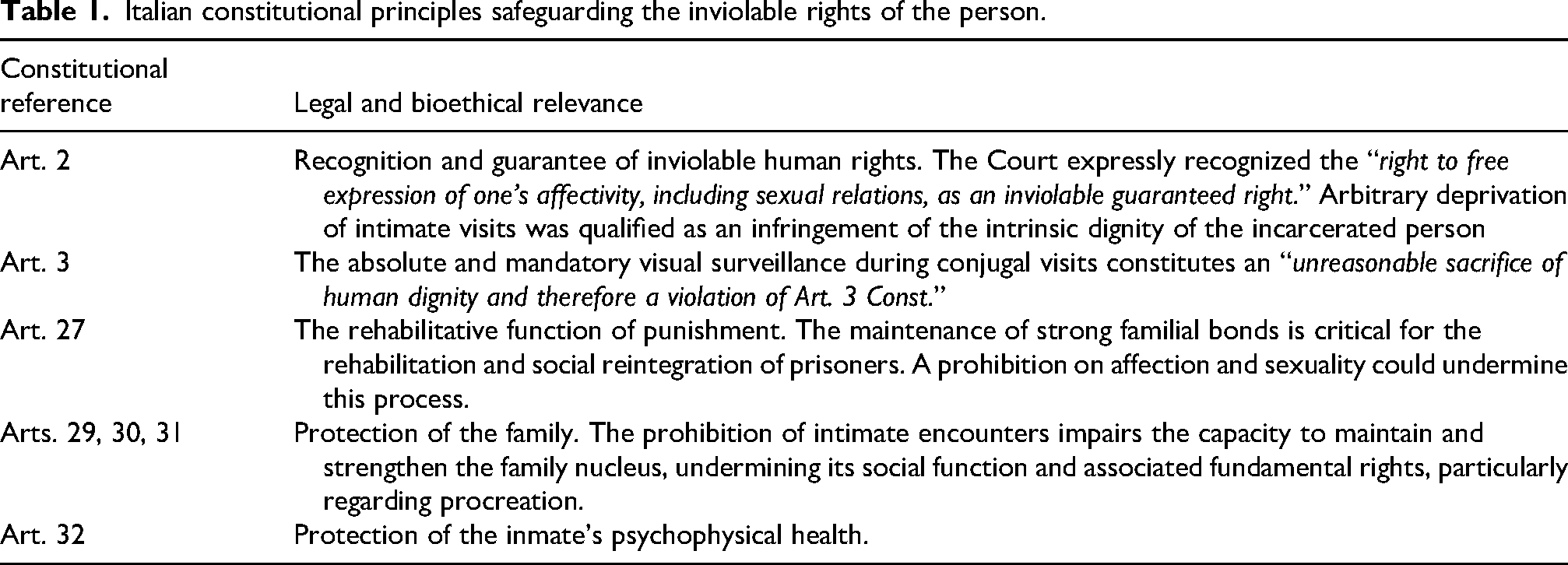
Following this ruling, the Department of Prison Administration (DAP) issued operational guidelines 3 outlining the facilities designated for conjugal visits, the eligible individuals (spouses, civil union partners, stable cohabitants), and access priority criteria, with particular attention to those not benefiting from external leave or serving longer sentences. These guidelines also provide for informed consent, exclusion of individuals in special regimes or with irregular conduct, and specific security and organizational measures.
This legislation brings Italy into alignment with several European countries, such as Belgium, Denmark, France, Germany, the Netherlands, Spain, Sweden, Switzerland, and numerous Eastern European nations, which have long allowed “conjugal”, “intimate” or “private family visits” with varying degrees of regulation.
The European stance also aligns with that of the European Court of Human Rights (ECtHR), which—while refraining from imposing any obligation to permit sexual relations in detention—reiterates that persons deprived of liberty continue to enjoy their other fundamental rights, including respect for private and family life under Article 8 of the Convention. In other words, the deprivation of personal liberty does not extinguish other fundamental rights; it conditions the manner and extent of their exercise. Any restriction must be prescribed by law, pursue one or more legitimate aims (e.g., public order, national security, protection of health), and be necessary and proportionate in a democratic society. 4 Moreover, detention conditions that infringe prisoners’ rights cannot be justified by a lack of funds or resources, and prison life should, as far as possible, mirror the positive features of life in the community. 5 In the Court's case law, “family life” encompasses genuine, stable bonds between partners and between parents and children, irrespective of formal status; the State must avoid arbitrary interference and, where appropriate, adopt reasonable positive measures to sustain their continuity. In the prison context, this may include opportunities for private contact where compatible with security and public order (i.e., a proportionate balance). In this vein, a recent judgment reiterates that, although prisoners have no right to choose the place of detention, placement so distant as to render visits very difficult or impossible may constitute an interference with the right to respect for family life. 6 The same demands of case-by-case assessment and proportionality have also been affirmed in relation to reproductive choices in detention, eschewing rigid and undifferentiated approaches. 7 Ultimately, the Court has repeatedly underlined the need for a proportionate balance between prisoners’ rights to maintain family ties and the imperatives of security and public order, as well as the duty—so far as the penal context allows—to prevent the disintegration of emotional bonds. This requirement of a case-by-case, proportionate assessment applies both to conjugal visiting arrangements and to reproductive choices in detention, and argues against blanket, rigid or undifferentiated restrictions.8,9
Against this backdrop, recognition of the affective and family sphere in detention does not entail an absolute right to specific forms of relationship; it requires reasonable, proportionate measures that make family ties effective without sacrificing security. Precisely because such contacts may include a sexual dimension, an operational corollary follows: the foreseeable possibility of conception during intimate visits. Hence the need to address explicitly the related bioethical and medico-legal dimensions—State responsibility, protection of the unborn child, the exercise of parenthood in detention, and the design of adequate health-care protocols—which the debate, to date, focused on psychological and relational well-being, has only marginally explored.10,11
Conjugal visits: A right to conception in a restrictive context? A critical analysis
The primary purpose of intimate visits is to safeguard the detainee's family life and emotional ties with the partner. Consistent with Article 8 of the Convention, such visits seek to preserve relational continuity and the couple's intimate sphere notwithstanding the restriction of liberty, thereby supporting family stability and the rehabilitative function of punishment. In the same vein, the Italian Constitutional Court has recently made explicit that intimate visits—available to a spouse, a civil-union partner (including same-sex), or a stable cohabitant—serve a primarily relational function, aimed at preserving the couple's affective continuity despite incarceration. 12
That said, authorising conjugal visits may, foreseeably, extend beyond the mere effectiveness of family life, as it can also enable the partners’ reproductive autonomy—a broader and qualitatively distinct sphere of rights from the simple maintenance of ties. This shift in the rights framework calls for a more robust architecture of safeguards and obligations: additional interests and parties are engaged (the partner, the unborn child and, where applicable, the child), a more exacting proportionality review is required (with the best interests of the child as a guiding benchmark), and positive obligations arise on the administration—not only to allow contact, but to ensure free and informed reproductive decision-making and appropriate subsequent health and social care pathways.
On the one hand, it is undeniable that the Italian Constitution and international conventions recognize and protect the detainee's right to form a family; on the other hand, this right cannot be considered absolute or without limitations, especially considering the objective conditions under which conception occurs.
The right to parenthood must be distinguished from the actual ability to exercise parental duties. In prison, the capacity to care for and raise a child is severely limited, creating a discrepancy between the formal right and the real possibility of providing an adequate family environment.
Conception in prison presents several challenges that require careful bioethical and legal evaluation. The fundamental issue is the balance between the detainee's subjective right to parenthood and the paramount principle of the child's best interests, a cornerstone of international family law. As emphasized by the ECHR, “society as a whole has an interest in maintaining a coherent family law system that prioritizes the welfare of the child”. 13 This means that the protection of the child, particularly concerning their birth conditions and developmental environment, should guide any legal or practical intervention.
It is undeniable that the family of an incarcerated individual faces structural fragility: deprivation of liberty entails not only physical but also social, economic, and psychological limitations, which inevitably affect parental capacity. A child conceived in prison is born into a context of profound disadvantage, which reflects in a series of potential risks to their well-being and development. In these circumstances, the possibility that children may, from conception, face disadvantages linked to the prison context (social, economic, and institutional) and lack of a stable family environment or adequate parental support raises sensitive ethical and legal questions.
Studies have consistently highlighted the higher exposure of a child with one parent (most often the father) to psychological and physical disorders. Various evidence showed that the incarceration of parents can negatively impact the cognitive development and mental health of children,14–17 increasing the risk of substance abuse, 18 violent behaviour, 19 and the development of psychiatric disorders such as Post-Traumatic Stress Disorder (PTSD). 20
While it is difficult to draw definitive conclusions about the independent and universal impact of parental incarceration on these conditions, such evidence complicates the decision to permit conception in detention without an adequate support and protection system for the children involved. Therefore, the state's responsibility cannot be limited to merely authorizing intimate visits; it must extend to active protection of the psychological, physical, and social well-being of those involved. The lack of clear regulations and support systems for children born to incarcerated parents (of any gender) represents a dangerous legal gap, risking social harm by marginalizing these children.
Another challenge pertains to the informed consent required for conception in prison, which cannot be equated with consent given in a non-coercive environment. The coercive and isolating nature of detention limits the autonomy of individuals and their awareness of the implications of a pregnancy conceived under such conditions. The risk is that decisions may be made without full awareness of the consequences for the detainee, their partner, and the unborn child. Therefore, a rigorous ethical approach is necessary, involving appropriate counselling and information for both the detainee and their partner to ensure that the decision to procreate is free, informed, and considered, taking into account legal, social, economic, health, and psychological aspects.
In conclusion, the issue of conception in prison necessitates a critical review of existing policies and regulations to strike a balance between the right to parenthood and the superior interests of the child, avoiding the perpetuation of social disadvantages and injustices.
Children conceived in custody: Best-interests standard
The best interest of the child is a primary legal standard requiring that, in all decisions concerning the child, his or her interests be a primary consideration, directing outcomes towards physical and mental well-being and balanced, healthy development. Adults’ rights are calibrated and balanced insofar as they are compatible with the child's effective protection, assuming a functional role in family matters. Adults’ rights are calibrated and balanced only insofar as they are compatible with the child's effective protection, thereby assuming a functional role in family matters. According to the UN Committee on the Rights of the Child (General Comment No. 14/2013), the best-interests assessment is the analytical evaluation of all case-relevant elements; the best-interests determination is the final, reasoned decision that, on that basis, explains why the chosen solution best realises the child's interests. 21
If conception occurs during a parent's detention, the assessment should begin with the anticipated child's profile (foreseeable family setting, effective resources of the non-detained caregiver, realistic time horizon of the incarceration, and estimable health and social vulnerabilities) and with the expected impact on the continuity and quality of family bonds. It must also consider prenatal and perinatal healthcare that can be guaranteed in practice, the risk of reproductive coercion or decisions taken under conditions of vulnerability (by one or both partners), effective parenting capacity in the short/medium term, and longer-term implications for development (housing stability, community supports, family network). A specific and pivotal issue is the establishment and legal recognition of parentage: timeliness is not a mere administrative detail but a constituent of the child's legal and personal identity (name, parental responsibility, access to benefits and services, and protection of relational ties).
The assessment must culminate in a reasoned determination explaining why the proposed arrangement best achieves the child's interests; applying the criteria of necessity and proportionality, with transparent, auditable reasoning and provision for review should circumstances change.
In conclusion, authorising intimate visits should rest on a prospective evaluation of the non-negligible risk of conception and on necessary and proportionate safeguards (independent counselling, robust non-coercion guarantees, effective access to contraception, and perinatal care pathways). If conception occurs, a child-centred pathway must be activated without delay, with expedited and reliable procedures for the legal recognition of parenthood and the establishment of parentage, to immediately secure the newborn's legal identity, activate parental responsibility, and enable immediate access to health and social services.
Medico-legal and health implications of conception in prison
The possibility of conception within the prison system raises significant medico-legal, and health implications, requiring careful consideration and the adoption of concrete measures to adapt prison health services and strengthen the legal protections of the individuals involved.
In this regard, it is crucial to ensure equitable, non-discriminatory, and comprehensive access to reproductive health services for all inmates with the right to intimate visits. Such services should include, among other things, the availability of modern contraceptive methods, always respecting confidentiality and the principle of non-coercion.
In the prison context, relational dynamics and environmental factors can compromise non-coercion. Pressures within relationships often intensify and partner-control dynamics take specific forms: intimacy may be demanded as a supposed demonstration of loyalty or commitment or compelled through threats to withdraw visiting rights or to withhold financial or emotional support, thereby reducing consent to mere acquiescence. Within this frame, a partner may impose or attempt to impose unprotected intercourse, obstruct or sabotage contraception, and press for pregnancy by exploiting the absence of viable short-term alternatives (i.e., reproductive coercion). Case-specific vulnerabilities and misinformation about risks and consequences may compound these dynamics. Beyond internal pressures (peer dynamics, reputational pressure within the wing), external pressures from family members and socio-cultural networks may also incentivise sexual activity or conception (for example, as a demonstration of loyalty or stability, or in conformity with gendered role expectations). This necessitates effective, verifiable safeguards: separate counselling for partners; two-step, always-revocable consent; clear risk–benefit information and unobstructed access to contraception; and protected reporting channels without risk of retaliation.
The implementation of pre-visit counselling, aimed at both inmates and their partners, should become an operational standard to promote informed, deliberate, and thoughtful decision-making. This counselling should address not only the risks related to conception and health implications but also the psychological challenges and parental responsibilities in a restrictive context.
The prevention of sexually transmitted infections (STIs) is another critical aspect. It is essential for the prison administration to implement structured programs for periodic screening, sexual health education, and the distribution of protective devices, integrating these into public health protocols for incarceration.
Access to genetic counselling, prenatal care, and perinatal services must be carefully monitored, as the lack or inadequacy of such services may increase risks to both the health of the mother and the newborn, potentially giving rise to medical-legal responsibilities on the part of the prison administration.
In the case of pregnancy, complex bioethical and legal dynamics arise regarding the management of the pregnancy in a detention setting. The health of the incarcerated woman and the foetus must be safeguarded through timely access to specialized prenatal care, the possibility of conducting visits and tests outside the prison, and, most importantly, ensuring that delivery takes place in adequate healthcare facilities outside the prison, with full respect for the dignity of the birthing woman and the fundamental rights of the newborn. 22 Literature showed that pregnancies in prison are associated with a higher risk of inadequate prenatal care compared to the general population, with potential negative consequences for maternal and foetal outcomes. 23 Considering the increasing availability of conjugal visits, these risks should be mitigated through preventive and organizational measures aligned with the most recent European Prison Rules, 24 the so-called “UN Bangkok Rules”, 25 and with current Italian legislation,26,27 which guarantees that detainees receive healthcare equivalent to that available to free citizens.
Another particularly important issue is the legal recognition of paternity in cases where conception occurs during detention. In this context, filiation cannot be treated solely as a civil matter; it must also be addressed from a bioethical and medico-legal perspective. It is essential that the legal system establish clear and accessible protocols for the determination of paternity, including genetic testing in contested cases, always respecting the dignity and confidentiality of those involved. Certifying the parental bond is not only functional to the formal recognition of the child's rights - such as surname, inheritance, or maintenance - but also represents a fundamental premise for ensuring the integrated protection of the child's personal, emotional, and legal identity. From a bioethical standpoint, the principle of parental responsibility, even when exercised in a limited or mediated form due to detention, cannot be annulled or delegitimized. On the contrary, it should be protected and supported, in accordance with the principles of the UN Convention on the Rights of the Child 28 and, in Italy, with the recent Charter of Rights of Children of Incarcerated Parents, 29 which recognizes the right of minors to maintain an emotional bond with their incarcerated parents and seeks to protect the right to parenthood.
Conclusions and implementation proposals
The introduction of conjugal visits in prisons represents a significant step in recognizing the right to affective relationships for detainees, as well as a sign of progress toward a rehabilitative approach to punishment. However, this advancement cannot overlook the complex bioethical and medico-legal implications of conception within the detention setting, which, to date, suffers from a concerning regulatory gap. A clear legal framework, with shared operational protocols, is essential to balance the detainees’ procreative rights with the superior interests of the child, ensuring that the recognition of individual rights does not lead to long-term detrimental or inequitable effects.
In this context, the establishment of multidisciplinary technical panels involving prison staff, scientific societies, juvenile judges, and associations dedicated to the protection of the rights of detainees and minors is highly recommended. The goal would be to develop guidelines for managing potential conception within prison, addressing all stages of the reproductive process: from pre-conception counselling to pregnancy, childbirth, and post-birth care, following an approach centred on the “best interest of the child.”
Another important aspect is the specific and ongoing training of prison and healthcare staff, which must become an integral part of institutional management policies. Only through a structured investment in continuous training for prison and healthcare personnel can the gap between laws and practice be bridged, transforming the management of affective and parental relationships within the prison system from an area of improvisation to one of consolidated professional competence. In this sense, training should not be viewed as an optional add-on but as a strategic tool for ensuring the respect of fundamental rights, the protection of mental and physical health for all parties involved, and the effectiveness of the rehabilitative function of punishment.
Prison institutions should also establish accessible and non-stigmatizing reproductive and parental counselling services, available to both detainees and their partners. These services should ensure competent and confidential medical and psychological consultations on fertility, contraception, family planning, and the implications of parenthood within the prison context.
Simultaneously, there is a need to strengthen maternal and child healthcare within prisons, with adequately trained personnel and facilities capable of ensuring continuous pregnancy monitoring, facilitated access to external facilities for childbirth, and adequate paediatric support post-birth. The quality of care in these cases is directly linked to the physical and psychological well-being of both the newborn and the mother and should therefore be considered an integral part of protecting fundamental rights.
In conclusion, recognising detainees’ right to private and family life—including the maintenance of intimate relationships—marks a significant step towards a more humane and rehabilitative penal system. This, however, requires clear and enforceable State duties: a coherent legal framework; proportionate safeguards; access to reproductive and perinatal healthcare; independent counselling, enforceable non-coercion safeguards, and child-centred measures consistent with the best interests of the child.
Only a systemic approach turns law on the books into practice that respects dignity and protects the best interests of children conceived during parental incarceration.
Footnotes

Funding
The authors received no financial support for the research, authorship, and/or publication of this article.
Declaration of conflicting interests
The authors declared no potential conflicts of interest with respect to the research, authorship, and/or publication of this article.